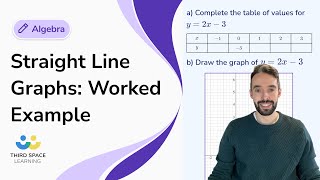
A short GCSE-level video lesson by Paul (Third Space Learning) explaining straight line graphs using the form y = mx + c. It shows how to calculate gradient (m) and y-intercept (c) from a graph (example: m=3, c=-5), completes a value table and plots the graph for y = 2x - 3, and notes how exam marks are awarded. The video also points viewers to further resources and tuition.
Chapters
Hi, this is Paul from Third Space Learning. Let's have a look at straight line graphs. As usual, I'll use our online classroom and our lesson slides to go through the topic and look at some questions. Check out the links at the end of the video for access to free resources and information on our one to one tuition. Let's have a look at the question. Work out the equation of the graph so we can see we have a straight line graph. Now we know that the general equation of any straight line is Y equals mx plus C, where M is the gradient and C is the Y intercept. So let's start with the gradient M. Well, M tells us how the graph changes over time. So all we have to do is pick any two points we want on the graph. So it's a good idea to pick points where the graph goes through a corner. So let's go for this one here and let's go for this one here. Now what we have to do is work out the difference in the Y values. So that's the difference between this point and this point. Well, what's that going to be? We can just count 1, 2, 3, 4, 5, 6. So the difference in the Y values is just 6. Now let's do the difference in the X values. Where we can see from here to here. And that's going to be 2. Taking great care of the scale. And 6 divided by 2 is 3. So we know that the gradient is 3. Next, let's look at the Y intercept. Well, C tells us where the graph crosses the Y axis. So the Y axis is the vertical axis and we can see it crosses at this point here, negative 5. So C is equal to negative 5. Let's put it all together and we get y equals 3x take away 5. Take great care to make sure that you include the X there. The gradient is 3, but the equation is y equals 3 x take away 5. Let's see where those marks come from. It's worth two marks and we're going to get one mark for a correct answer of 3 and negative 5. Let's see where those marks come from. So we're going to get one mark for a correct gradient of three and a final mark for the whole answer. This question is slightly different. It says complete the table of values for y equals 2x take away 3. Well, let's do that. We can do that by substituting in values of X into the equation. So let's pick one. Let's take a nice easy one. Let's take X equals 1. Well, when X equals 1, Y is equal to 2. Lots of 1. Take away 3. 2 times 1 is 2. Take away 3 is negative 1. So we can see when X is 1, Y is minus 1. Now we can keep on doing that, but it's even easier if we can just spot that the gradient here is 2, the coefficient of the X. So all we have to do is add on 2 to work out the values. So negative 1 add 2 is 1 and 1 add 2 is 3. Let's just check going the other way, negative 3 add on 2 is negative 1. So that's good. Now we still have a missing value here. So a number add on two is going to be negative three. Well that's going to be negative five. That's worth two marks. So let's see where they come from. We're going to get one mark for any two correct. And the final mark is for all four correct. Part B says draw the graph. So, so all we have to do now is plot our points. So we have negative 1, negative 5. Well that goes off the graph. We have 0, negative 3, so that's that one there. We have 1 negative 1, we have 2, 1 and we have 3. 3. Once we've plotted out our points, we just need to join them up using a lovely straight line. Now it's a good idea to use a ruler and make sure that your line goes through all of your points. So if I do that there, I can move it on here so it goes through all the points like that. And there we go. It's a really good idea to extend the graph above and below your points. And that's worth two marks. We're going to get one mark for correctly drawing a nice straight line that passes through negative three. And the second mark comes from a fully correct straight line. Now over to you. Check out the links in the description below for step by step examples, questions, worksheets and tons of free resources to help you practice. You'll also find information on our one to one personalized maths tuition. Don't forget to like and subscribe to stay up to date with all the latest thirds based learning videos.