The best free primary maths resources to reduce workload and raise attainment in 2023/24.
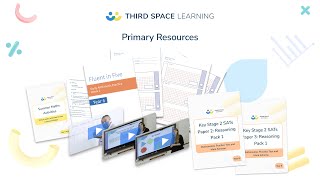
Webinar transcript (hosted by Emma with guest Hannah Searle) introducing Third Space Learning's Primary Resource Library and one-to-one tuition. They overview key free and premium resources—Fluent in Five, Rapid Reasoning, ready-to-go lessons and worksheets, sentence stems and vocabulary lists, times-tables packs, diagnostic pre/post assessments, SATs practice materials, games/engagement activities, and extension questions for greater-depth pupils—explain suggested classroom uses, access/pricing options, and alignment with schemes such as White Rose.
Questions this video answers
£390 per year for smaller schools; £780 per year for larger (two-form-entry or more) schools.
Weeks 1–6 are free; premium users get 36 weeks (five days of questions per week).
Years 3 to 6.
Ready-to-go lessons (daily teaching slides with worksheets and teacher notes); first place value block for Years 1–6 is free, other blocks are premium.
Yes — schools with pupils receiving Third Space Learning personalised tuition receive access to the premium resources.
Chapters
Brilliant. Well, since we're about a minute past four, we want to get going, we will get started and any sort of latecomers can join a little bit later on. So welcome everyone. Thanks for joining us today, where we're going to be looking at sort of the best picks really of the Third Space Learning Primary Resource Library. So we've got thousands of teachers who use this up and down the country to help how they teach maths, not only to save time for classroom preparation, but also to present maths concepts in different ways to make lessons more fun and engaging and ultimately boost that attainment. So we've got loads of resources that are freely available on there and we've also got our premium ones as well, which schools access through purchasing a premium subscription, but it's also free for those who have pupils receiving our personalised tuition. So I'm, I'm Emma, I'm part of the New Schools team and I focus on the one to one tuition side. So for those of you who aren't aware, there are two key strands to us. We've got our resource library, which we'll cover today, and also our one to one interventions where we help pupils with catch up and SATs prep with our individualized lessons each week with our specialist tutors. So I'm speaking with schools every day, hearing from you, how they're approaching maths and teaching it in school. So hopefully I can offer some of your perspective when looking at how we use our resources. So I am joined by Hannah Searle, who is our Primary Maths content manager and she's responsible for creating all the wonderful resources that we've. So. Hi Hannah, thanks very much for joining us today.
Hi, Emma, thank you very much for that introduction and thank you everyone for joining us. Thought I'd give a little bit more detail about my background just so that everyone knows. I was a primary school teacher for over seven years. During that time I was also an acting senco. And just to keep my tone, since I joined Third Space Learning, I'm also now a vice Chair of Governors at my local stage school.
Lovely. So there's also going to be a sort of Q and A chance and there's a chat box as well for anyone who wants to ask Hannah questions. We're going through the webinar, so just pop it into the. The chat box and I'll promise I'll try and keep an eye and catch as many questions as I can that you can, you can ask Hannah as we go through. And we'll also be sending the recording and all the information to all of you later on. So those that can make it today or if you have to drop off, not a problem, we'll sen through to you. So without further ado, let's, let's get cracking. So what have we got? First up, it is our Fluent in five.
Our first resource, yes, is Fluent in five. This is probably our most popular resource, the one that we are best known for. It's one of. I'm going to say this for all of them, but it's one of my favourite resources because it helps to develop fluency and arithmetic all the way from year one up to year six. So the point of it isn't just to have some repetitive arithmetic, it is to really understand those questions. So in key stage one, we encourage use of maths manipulatives or pictorial representations to help those people to really understand what it is that they are doing with that question. As we move into Key Stage 2, we then try to encourage the understanding of which method is actually best to use because we've all experienced it. When a child learns to use a formal written, written methods such as column addition, that's all they ever think to use anymore. And that's not always the best approach to take. So as we move into key stage two, we really try to make them think, which method should I be using to best answer this question?
It's interesting that you put this first because speaking to schools, this is the most popular one that comes up. It's the first thing that they say if they're aware of us already. It's through Fluent in five students. So obviously schools use resources in different ways. How would you suggest that schools perhaps use these on a daily basis?
There are lots of different ways that you could use it. The ways that I often suggest is either as a starter for your maths lesson or as a starter activity for the morning, getting those pupils settled as they come into the classroom, or in a similar vein, settling them as they come in from lunch. But if you've got other ideas, teachers, please feel free to share how you use them in your class. We'd love to know.
Oh yeah, absolutely. If anyone has used any of these resources who's tuned in and you've used them in a way that's been particularly successful and you've found to be really engaging for the pupils, please let us know because we'd love to hear about it and share it with everyone else.
Indeed. So very much linked to Fluent and five is the next resource that I wanted to talk about and that is Rapid Reasoning. We like to think of this as a partner resource to Fluent in five. It's for years three, all the way up to year six. And the idea of these is they focus on the problem solving element of maths. So we've looked at fluency and fluent 5. This is more about problem solving and reasoning, really trying to get pupils to understand what questions are asking of them. We really took influence from this, from our intervention because in our intervention we have one lesson at the end of the slides that encourages pupils to apply a similar, a familiar, familiar content in a different context. And these questions really do that. They take something that pupils understand, they put them in a slightly peculiar context, say peculiar, it's not the right word, a different context. And they really try to make pupils explain, understand how they've sold that, solved that question in the answers. What we also do is once a week we have detailed answers that are modelled and they explain common errors that pupils may have made when answering that question. And they also explain why we've put that question in so that teachers can understand what it is that we're trying to draw out of pupils with that specific question.
It's interesting talking about that application side and something that's really sort of foundational to our intervention. So it's not just that understanding of the concept that's important, but it's using that concept to problem solve and that runs through all of our intervention content. I mean it's really scaffolded, beginning by introducing that concept for that foundational knowledge, then working towards more application worded questions at the end to develop that skill, which is just, it's so fundamental, especially with primary maths, to then be more transferable for the basics when moving on to other things. And it's something we always hear about from schools that it's not just that they understand the concept, they can use it in a different context, which is, which is so special about it.
Yes, definitely. And also we understand just in general maths isn't just something for the classroom. So pupils really do need to be able to apply it to different contexts. And this is a really good resource to help them with that.
Yeah, absolutely. And this is for three to six, isn't it?
Yeah, it is for three to six less.
And we do have the Fluent in five and the Rapid reasoning. The. Yeah, the weeks one to six are free, as you've mentioned on there. So for those of you who are free users, you can go on and start making use of those.
Yes, definitely. And then for our premium users, we've got 36 weeks for both rapid reasoning and for fluent in five and they are accessible for everyone who are premium users. And there are five days of questions for every single week.
Brilliant. Lots of stuff to start making use of.
Yes, very much so. So then on to. I would definitely argue. And again, I know I've said this already, this is my favorite resource purely because I've spent an awful lot of time thinking about the ready to go lessons. So these are our daily teaching slides with worksheets that go alongside them. I've very much taken when I designed the actual layout of the slides. I've taken inspiration from our intervention because we really tried to scaffold the learning throughout the lesson and we have got teacher notes for each teaching slide that is there to just support teachers as they are going through the lessons. We've also got some support slides at the end. We've all had lessons where we sit down and we think it seems like I was speaking a different language to my class or to a certain set of pupils. So we could use the support slides either as pre teaching or post teaching. Or if you just have had that entire moment with a class and think they don't understand what it is that they needed to to get to this lesson. So those support sites can be used just to guide you as to where you need to be before so they can understand the lesson. Another thing that being an ex senco, something that was really important to me is making these semd friendly so they are all on an off white background. The font is dyslexia friendly and they don't have too many images on them that are unnecessary and could be distracting. We've really tried to think about that.
Brilliant. And it's about sort of, not just sort of time saving, but also being able to perhaps introduce a concept in a different way, which is what teachers might need help with. Or they can just use little snippets or you know, it's not a full scheme of work that they have to stick to rigidly. You can just pick and choose, find things that work for you, or just switch something around a different way, approach it differently, or just get a bit of inspiration for how you want to approach things entirely.
The PowerPoints themselves are fully editable. So if you decide that you want to take the full lesson and teach that, or if you want to do a ping pong style or if you want to split up the lesson, teachers know their classes best. We can't know every single class because even when I was teaching, I would teach similar lessons each year. No two classes were the same. So we understand that you need to be able to edit, you need to be able to move things around so that they are bespoke for your class.
Yeah, make it flexible to how it's working and how your class responding to things and effectively how you want to be teaching.
Exactly. And just on the free and premium side of this, the first place value block for years one to six, they're all free and then all of the others are premium. We do follow white rows for this in the sense we follow the same blocks as white rows in the same order and we follow the small steps. There are two versions of this just in case anyone is getting confused about that. That is because White Rose have got their scheme of learning version 2, school of large learning version 23 and we've matched those. So we do have two versions for whichever scheme if you are following Bite Rose.
So we have just had a quick question come in. How do I get access to the premium resources? You've got a couple of options. So schools pay for a subscription. So what you can do is just get in touch with us and we can set that up for the school. So all the staff members in the school will have access to the content that's on there. But it is also free if you have pupils on our one to one interventions. So who are sitting tuition sessions with our tutors, they run through a computer and headset and have these personalised learning plans. So then they can we include that for the school to more broadly support maths across the entire school. So pricing wise for it's based on the size of your school. So if you. For smaller schools it's £390 for the year and for larger to form entry schools or more it's £780 for the year. But as I say, it's included with the intervention. So it might be worth taking a look at that if it's something you wanted to look into. I hope that answers your question.
Okay then. So next on our list of our most popular, our favourite resources are our sentence tense and our vocabulary lists. Now these are absolutely linked to our ready to go lessons and that is because at the beginning of our ready to go lessons we have a list of sentence stems and vocabulary that is going to be important in that lesson. Sentence stems are so important because they give pupils and teachers a consistent language. We have sentence stems for different blocks and they are progressive. So start from year one and where possible start from year one. Some don't Always have year one content and go all the way through to year six. And, and the idea is to give a common language. I don't know how many people were taught maths at the same time. I was taught maths, but when I was in primary school I was told that a sum is any calculation in maths which we know isn't correct. So having that common language throughout the school that allows pupils to not get confused as they move further up the school into secondary school, it just really helps them to have a structure and to speak mathematically all the way from year one.
It's interesting that you mention how it aligns with what's been taught in school, because that is sometimes something that comes up when we're talking to schools about the interventions, not just about language, but around content. Is what's being taught going to align what we're teaching them and the processes and the language that we're using in class? And so along with the tuition and with the resources, your process of research to inform that information come from all sorts of different sources, hasn't it?
Very much so. So I work very closely with Adela, who works on our intervention, our primary intervention slides, and she is fantastic. We both love language and really think that it is really important to get language correct. So we have looked at the national curriculum, we've looked at the ready to Progress guidance, we've looked at the NCTN White rose, we've researched as many places as we can to get a common language, not only in the resour, but in the intervention. So a really good example is in our intervention and in our resources, we use regrouping for addition and for multiplication, but we use exchanging for subtraction and for division. That was a choice that we made. It was an informed choice and we have that consistent both in the intervention and in our resources.
Yeah. So, I mean, from the perspective of schools, we say it's a bit of pressure off. It's going to be something that is the most sort of commonality that comes across in maths language and sort of concepts. I mean, we follow a maths mastery approach in our interventions, that really scaffolded approach. And that's something that when we talk to schools, then I think, yeah, that's, that's the approach that we're taking as well. And following that white rose scheme, so tends to be aligning nicely, which is always really, really nice to hear.
Yes, yeah, we try. We try very hard. We love our resources and our intention. Is it too early to mention, oh.
The dreaded the dreaded stats. Is it too early?
It's always too early and it's never too early. So we know when's the right time. There's never the right time. We know that stats aren't the be all and end all of a primary child's education in primary curriculum, but we also know that it is important and that they need to feel prepared for this. And however that looks in your classroom is however it looks. But we've got lots of resources to support you in the way that you feel is best to be supported. So we have got six sets of practice papers, we have got some lesson packs. These are very. They go into quite granular detail. So a very good example is we've got a lesson pack that is three lessons and it is on decimals up to three decimal places. So if you have your whole class, a single pupil, a group of pupils who don't quite understand that they just need a bit of support, we've got a lesson pack that can help you to teach that concept. We've also got our stats parents presentation, which is absolutely free. It is updated every single year. It has already been updated. You can present this to parents. And it's not just about maths. While we love maths, we understand that maths isn't the only thing that is covered in the SATs. So it goes through all of the tests using the data from the previous year, questions from the previous year, and it just helps to reassure parents that they understand what the tests are going to be asking. But it also reminds them that like I said, this isn't the be all and end all. It is only a couple of days and it is only a snapshot of their child's education. It's not everything.
Absolutely. I mean, taking that pressure off as well. I mean, often, you know, I mean, preparation is really important, but sometimes it's that confidence, isn't it, which is the key factor, especially at that age as well. And so of building up that familiarity with what they're going to be presented with goes hand in hand with that confidence. So using these resources and looking at those satstyle questions that they're going to be presented with helps build up that familiarity to help them to perform their best. I mean, that's the approach we've taken with our SATS booster program that we have running in the spring term. It's showing them the, and letting them have a go and work through these SAT style questions with their tutors. So they've had as much practice as they can. They can Feel as confident as they can and it's as familiar so that they can perform their best and sort of take the pressure off from. From that side of things.
One thing that I love that we do in our intervention, that we know teachers do in their classes as well, so we do try to mirror what they do is really getting pupils to understand different things that they can do during the SATs, during any test, to help them understand what the question is asking. So it might be, look at the units. What are they in? Is it centimeters, is it millimeters? So what does your answer need to be? And what is that question actually asking you? And it really encourages pupils to discuss that with their tutor and understand what that question is asking. So they don't make those mistakes that you look at and think, oh, no, they know this, but they're not going to get it because they made that mistake.
The life skill, isn't it with anything, just being able to check your own work, which I imagine all of us wish that we were slightly better at.
Yeah. That's why we have people who QA our resources to help us out with that as well. Because I can look at it 10 times and still miss things or quality.
Checked again and again. Because, yeah, sometimes it's better to have a fresh pair of eyes. So teaching that skill is super important.
Definitely. So let's move away from that.
Yeah, we'll pull that out for the time being.
Yeah. Just know that we've got those resources. So the next area that we wanted to look at is times tables. And again, we understand that there is multiplication table to check, but that's. It's one. It's a test. That's it. So we understand that times tables are such an important part of mathematical understanding. If you're not confident with your times tables, it can be quite difficult to understand things like complicated fractions. So really understanding times tables is going to help pupils in so many other areas of their mathematical understanding. So we have got things like our ultimate times tables pack, which is a premium pack, but it has got loads of games in there. So all the way from year one to six, we've got individual activities that pupils can do. Games, whole class games. So you can really drill into those times tables in different ways to help your pupils really understand what it is, what time tables mean, rather than just learning them. Again, showing my age here, learning them by rote, which is what I had to do. So we really do try to encourage understanding, not just learning by. Right.
And it's great that we've got different options as well. So there's things that could be a five minute starter or things that could be for a whole lesson. And so you've got options there to just, you know, be just that quick, constant sort of practice of them or if you want to do more focused sessions on them.
Yes, definitely. We also do really try in all of our times tables resources to encourage pupils to use maths manipulatives or pictorial representations to really understand those as well. So it's not just do this worksheet, play this game, it is understanding using other things as well.
So we're all moving on to assessments, but, you know, it's got to be done, hasn't it?
The way that I always used to introduce assessments to my class was I always used to say to them, it's not about what you know right now, it's about what I need to know that I need to teach you next. So it's a way of trying to say to them, we're learning together, we'll all you needed to know next. So a really good resource that we have for that is our pre and post diagnostic assessments. These can be used at the start of the block of learning and then again at the end of the block of learning to help you understand what are the areas of need and then how have they done throughout that block. These are really great resources because they are multiple choice, which means that it's reducing that cognitive demand on the pupil because they don't have to come up with every single answer, the answers are there, they just need to work out what it is. But also in our answer scheme, we have got really detailed explanations of those disruptor answers so that you as a teacher can understand. What was that pupil thinking when they gave that answer? What error have they made? How can I support them best?
And that's something that we follow with our interventions as well. Being able to not only be able to assess what the pupil needs to be taught or needs to go over, but then being able to map progress as well, because we bookend it with a pre intervention assessment and a post intervention assessment. So that initial diagnostic, which again, multiple choice, so it reduces that cognitive pressure, allows us to find where the gaps are in that pupil's knowledge and then when we repeat it at the end of the intervention, you can see how they progressed and map it across that time and then you've got that to sort of see that progress as your whole class moves forward.
Yes, definitely. We do also have, for years 3, 4 and 5, some similar to SAT style questions again, as we said before with the SATs, it's just to get that familiarity with the layout and the style of question asked so that they can just see those a little bit before they get to year six.
Yeah, absolutely.
So then, if we are finished with the assessments and all of those things, I wanted to talk about games and activities.
Yes. Let's move on to something a little bit more fun and fun and engaging.
Very much so. So maths can sometimes be seen by some pupils, by some parents, as something that isn't fun, a little bit daunting, and we wanted to try and give our teachers something that can make maths fun. We've got loads of activities for doing this. I've just highlighted a few that I've said it too many times now are some of my favourites.
They can all be your favourite, Hannah. It's absolutely fine. They're all great.
I'm very biased. I took a long time to think of these and I'm very proud of them. So one of our most popular resources is our top topical maths packs. These are Key Stage 2 packs and they are for every term. But we've also then got a festive one for those festive celebrations. They are for different days in a term and it's trying to encourage a bit of maths into a day that maybe doesn't have a maths focus. So something like World Book Day. Not necessarily a Mathsy day, but we've got some questions to help you bring a bit of maths into those fun days that you have at school. One of the other resources that we have that I absolutely adore came from inspiration from when I was teaching is our tarsier puzzles. It is a bit of cutting and sticking, which some teachers, some pupils don't like doing, but it is a really great, really fun way to have a bit of retrieval practice at the end of a lesson. We've got slightly more broad categories. For example, in the image we've got mixed division, but then we do go a little bit more granular. So we've got one that is about multiplying by 10, 100 and 1000. And I like to use these when I was teaching for those lessons that maybe took a little bit longer than I thought were going to, and I wanted to go over a concept, but in just a little bit of a different way, a little bit of a fun way. These are really great for doing that because it's just a bit different and it is retrieval, but in a fun way. Then another one that I absolutely love and I Should probably apologize a little bit for this because you'll see my sense of humor coming out in this resource that it's the maths code crackers. So these are for the end of a block. So you've come to the end, you want to have a little bit of a practice of what they've done throughout the block and they are roughly linked to a day in a block. And the idea is that they have a joke that's rather a silly joke and the pupils need to answer all the questions which gives them the answer to the joke. So unfortunately you'll see my silly sense of humour coming out with those jokes. But we quite something for everyone.
We have just had a question come in. I just want to say to whoever's asked, if you mind clarifying, they've said, could you demonstrate your use of a PowerPoint as an example? Not. Not 100% sure what you're referring to. So if you might sort of rephrase it and then I can get an answer from Hannah. But sort of moving back to sort of the games and activities, it's. It's something that we really sort of champion at third space learning, that it's not just attainment in maths, but it's enjoying the subject as well, particularly for those who have that maths anxiety or, you know, have, you know, parents who perhaps don't enjoy maths and they carry that through. It's enjoying the subject and then that's sort of a springboard to being able to. To attain and be a better mathematician going forward. But it's about enjoying it, isn't it?
Very much so. It's definitely one of the things that I think everyone should really think about is that maths is in so many things. It's in the art around us and it's in everywhere in the world. So maths can be really fun as well as being something that is an essential part of our learning.
Absolutely. Another question in from someone. Thanks, Hannah and Emma. What would you recommend for greater depth pupils?
Oh, we have just got a new resource that I think that it's slightly difficult with greater depth because there isn't an official greater depth definition from the government. But we have just released a new resource that is called Extension Questions. We've got place value up at the moment and we are getting the others written as we speak. These are, again, from my experience teaching, we used the categories that I have, but these are designed to be cut out, given to pupils and for them to complete independently. The idea isn't that there is always one answer. It might be that there is no set answer to it. So it might be a question that for employees, picture this question where they have a calculation and they have to draw it out. How they decide to draw it out, that's up to them. It has to be mathematically correct. It might be a prove it question. So yes, they know the answer. The answer might be there. But prove to me using mathematical language, using mathematical model, why is it right or why is it wrong?
I hope that answers your question. So I mean that we have just sort of scratched the surface really of what we've got available. And I know we're running short of time, but I mean, we've also, we've got, you know, thousands of resources on there for you all to to make use of and the premium subscription as well. We'll send all of this information over to you and how you can access those and the recording later on. We've also got our third Space Learning blog where there's tons of quick resources and extensive pieces and sort of school guidance, SLT supporting guides and strategy. And we also do lots of regular premium giveaways as well on our maths hub. So for those of you who just access the free ones, we often, if you sign up to our mailing list, we'll release premium ones for you. And so that's certainly worth bearing in mind. If anyone has any other questions, then please do either let us know now or if you have to jump off, then you can send them to helloirdspacelearning.com or if you are interested in some more information on the tuition side and we just like to have a chat about it, find out a little bit more, then do the same or just respond to my email and we can send you over some more information. But thank you so much, Hannah. I hope that you've enjoyed sharing your insights and that everyone watching has found it useful.
I hope so too. And I hope it comes across how much we do love maths here at Third Space Learning.
We do. We live and breathe maths. We hope that it shows in the resources and if any of you've got pupils who are sitting in interventions that they're progressing as we hope they will be as a result. Have a lovely evening, everyone. Thank you very much for joining and take care.
Thanks.
More from Rob





The Top 20 SATs revision topics 2026: A focused revision approach for maximum impact in minimum time

GCSE maths marking 2026 decoded: using examiner insight to improve teaching and results


How To Embed AI Literacy In Your School: Practical Steps To Get You Started [Webinar Replay]


Reviewing And Planning Your School's AI Approach: A Strategic Framework [Webinar Replay]
