The best free secondary maths resources to reduce workload and raise attainment in 2023/24.
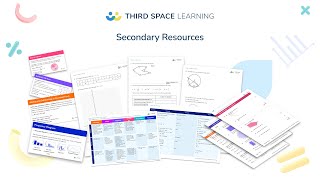
A Third Space Learning webinar (hosts: Emma from the new schools team, and Paul Coffey, lead of content) demonstrating the organisation and use of the free secondary and Key Stage 3 maths resource library. The library contains revision guides with videos and step-by-step worked examples, self-marking multiple-choice practice that expose misconceptions, worksheets split into fluency/application/exam-style with full mark schemes, revision maps for high-level topic checks (red/amber/green), over 60 diagnostic MCQ sets, Fluent in Five daily practice (secondary and KS3), downloadable GCSE papers for Edexcel/AQA/OCR (higher/foundation) with examiner-authored mark schemes, and additional materials (posters, templates, formula sheets, hyperlinked index). Resources are teacher-created, freely downloadable, and designed for flexible classroom or independent student use to save teacher workload and improve attainment.
Chapters
Great. Well, welcome everyone. Thanks for joining us. Today we're going to be taking you through our secondary resource library which is filled with GCSE revision tools and an increasing number of Key Stage 3 resources. So we want to show you what's available and how you can use it to support your teaching and your students. So at Third Space Learning, we provide one to one math tuition to primary and secondary schools up and down the country as an accredited NTP provider. But we also want to more broadly support maths attainment in school by providing you with resources to help save time and present concepts in different ways to ultimately boost your students progress. So our new resource library is released in January and all of those resources are freely downloadable directly from our website and are developed by our brilliant content team of ex teachers and examiners. So I'm Emma, part of the new schools team. So I actually focus on the one to one tuition side where we help students catch up on our year seven program and prepare for GCSEs with the revision program by pairing them with specialist tutors. But I'm speaking with schools every day, hearing how they're approaching teaching maths in school. So hopefully I can offer some of your perspective. When we're looking at how to use these resources, we're going to focus mainly on GCSE. We do have some key stage 3 ones that we'll cover later on. So leading the charge of our content team is Paul Coffey, who I'm joined by today. Hi Paul, thank you for joining us.
Oh, thank you so much for having me. I'm so excited to talk people through some of our resources.
Yeah, your pride and joy, isn't it the resource library, Paul?
Very, very much, darling.
So maybe just tell us a little bit about your background, Paul, and how you've come to be at Third Space Learning.
Absolutely. So I have worked in and around the northwest of the UK for just under a decade as a very proud MADS secondary school teacher, work with departments to develop curriculums and teacher training. And I've been with Third Space Learning now for the last couple of years as we have expanded into secondary and created a load of amazing resources for teachers to support each and every one of you. And thank you very much for taking the time to talk to us today. I know you're all very busy, so hopefully we're going to give you loads of great free stuff that you can take back with you and use with your classes.
Absolutely. And we do have the chat box open as well. So if anyone does have any questions that they want to ask Paul. Then just pop in there and then I will, I will pause it as we go through and ask Paul. So, without further ado, let's, let's get cracking. What have we got up first, Paul?
Fantastic. So a great place to start is our maths resource library. So if you go to thirds based learning.com and hover over the resources button, you can get quick access to all of our, all of our resources. Now, we have developed this over the past year and a half and we're really, really proud of it. If you scroll down, you can see we've got all these nice big buttons for our collections. And this will take you to each collection page where you can filter and search for the specific resource. We'll talk through a few more of these in a little bit of time. This search function is really nice if you just think, right, I'm looking for some stuff on fractions. You type in fractions like so it will give you absolutely everything we have on fractions. So all of our revision guides and all of our resources at the click of a button. Now, if you look at the top here, we've separated it out into Key Stage 3 and GCSE revision. So let's just have a look at GCSE revision. This page is another way of accessing our material. So you can see we've got tabs here for the different types of topics. Algebra, geometry, number, etc. And what we've done is we've grouped together similar topics into these pages. So you can see we've got different pages grouped together. And what's great about this is you can see on one line everything that we have on, let's say expanding brackets, and you can click on them and download them at the touch of a button. So it's just another way of accessing our materials. Now let's have a look then at one of the resources in more detail. Let's look at our revision guides. So if you go to Google and type in simultaneous equations, you will see this on the, on the first page, we've broken these down into various sections. And the idea behind these is to support you when you are developing your lessons, but also to support your pupils when you are giving them revision and intervention. So let's have a look at it. Quite a lot of the pages have videos on there now and we've also got a main section which gives the pupil an overview of what the topic is. Little flip card to help remember the key information. And then as we scroll down further, we get to see how to do this particular topic. So in this case, it's how to solve simultaneous equations. Now, these steps have been very, very carefully thought through. And then we create a load of examples which cover the majority of the different types of questions that you would expect to see on this topic, and breaks them down step by step by step. So this is a really, really great way of using it as part of a flip learning lesson, perhaps. Or you could give this to a pupil who's particularly struggling on this particular topic. If we keep on scrolling down, we have multiple examples and we will reach our practice question. Now, I love these because they're multiple choice and they mark themselves. So we've got four answers. One's correct and the other three have been designed to identify a particular misconception. And people can do these without any input. They will mark themselves really, really nice. Now, we keep on going.
I bet those watching. I bet those watching wish that all of their sort of homework and things could mark themselves.
I know that's what I would have absolutely loved that when I was in the classroom. So this is a way of just supporting each and every one of you. If we go to our last section on these pages, we have our GCSE questions. Now, I should mention we have an incredible team of maths teachers, secondary maths teachers, who are creating all of our wonderful content. And as Emma mentioned at the start, many of them are examiners. So whenever we have any exam content, it has been made by examiners for Excel, aqa, ocr. So they've been designed to be applicable across, across the boards, developing those questions in those styles. What's great about this is we can then accurately award marks as it would be in the exam. So it's a great way of giving pupils that independence, developing that independent revision on the preparation for their GCSEs.
It's interesting that you mentioned previously, Paul, about the misconceptions that are included with those that sort of mark themselves above, because that's something we hear a lot when we're speaking with schools, particularly at gcse, that misconceptions come up and what are really tricky to overcome once they've been developed. So it's not that their students necessarily don't have the ability or the understanding, it's that they've picked up these common misconceptions and they create a barrier in their process for answering questions. And so it's really important to identify those and try to overcome them as quickly as possible.
Absolutely, absolutely. And it's really great here because our team of teachers are very carefully identified common misconceptions which we can then use to highlight them and make sure that we don't do them in the actual GCSE exams.
Yeah.
Right, so each and every one of our revision guides comes with a worksheet, so let's have a look at them. I'll go back into the presentation. Now, we have got hundreds and hundreds of these. We want it to be as granular as possible so that you can get the resource that you need for the particular lesson that you are teaching. So we've split this up into three sections. So the first section is a skills section and in here we've got different subsections which you can chop up and give to various parts of your class. But the idea here is to intelligently practice the particular skill. So there's lots and lots of opportunities here to delve into different types, different types of questions around that particular skill to give your pupils lots and lots of practice to develop that all important fluency. Now, once we have that fluency, or we're feeling, or we're feeling that the pupils have got the basic skill, we move on to the second part of the worksheet. This is the applied section. So what we've done here is we've taken the skill we might have, then bring in a few, a few different other skills, apply it to a particular context or apply it to a particular diagram. So we're taking, taking them on to that next level and giving the opportunity to practice it in a particular context. And then once we practice the skill, once we've had a go at it in a context, it's time to prepare for those all important GCSE exams. So our team of examiners have then created exam style questions, which are then the third section. And these come with full answers and full mark schemes. And I should say every single one of our resources comes with answers, because that's so important when you're in the classroom, you want to be able to quickly see if it's right or it's wrong. Really, really proud of these. And they are all designed to be printed off in black and white if need be. They look great. So to save on those, on those printing costs.
Yeah, I guess sort of isolating those individual sections really allows you to be able to pinpoint where it is that student needs to practice and where the issue lies. I mean, it's building up that students learning in that scaffolded approach, you know, first beginning with the fluency, then the application, and then onto the exam style questions is super important in building up that understanding. And it's what we've found to be the most effective way of preparing students for GCSES through our revision program, which mimics that initial fluency questions, then application and then onto the exam style questions as well, so that pupils have that the best foundation for moving on to those trickier exam style questions later on.
Please, Lee and what's so great about these is they are made by teachers for teachers and they are free forever. So they're here to support you when you are planning your lessons and supporting your students.
That is something that's really special about our content team, isn't it, that everyone's been there, they know exactly what it is like. On the flip side, they've created things which they know are going to be useful. And we do listen to schools as well and staff members when they sometimes email in or we ashall shows at the end. Paul we do have a box where you can make suggestions and things that you think would be useful and we do try and listen and create things which are sort of topical and going to be of the most benefit at the end of the day.
Definitely. Teachers are the experts, you are the experts. We are here to support and partner with you and anything that you think actually this resource will be really, really useful. As Emma said, we have a box on our main page. Type it in there, it'll come straight through to us and we can use it as part of our planning for the future as we're deciding how we can best support each and every one of you.
Yeah, you're all super busy, but you can always be busy. I can always have more. So irons in the fire, so to speak. So what have we got up next, Paul?
So coming up next are our revision maps. Now, these were a request from teachers. So there we go. Seamless, seamless transition. So these have been created to support teachers with how. How do you decide what a pupil can and cannot do? If you've maybe picked up a class in year 11 or perhaps, perhaps the pupils missed quite a lot of. Quite a lot of school. And what you want to see is right on a topic, which bits can they do? Which bits can't they do? At quite a high level, what we've done is we've taken the main, the main six topic areas, algebra, number, etc. And we've broken them down into a series of revision maps. Let's take a look at one. This is one of the geometry maps, revision maps. We have then broken this particular topic down into smaller sections. So let's take printer and area in rectangles. What we're trying to do here is give a good representation of the sorts of questions that a pupil would need to be able to answer. So you can give this to pupils as part of an intervention. It could be a homework, it could be at the start of a. Start of a term. Pupil can then go through, try their best, and then we provide answers and then they can red, amber, green, it. So if they got it wrong, big, big, big red thing next to it. If it's. If you got it right, big green thing next to it. And you can see at a glance. And you can see at a glance what, which areas the pupils are struggling with. Now, let's say they were struggling with perimeter and area. Most of that was red. So then what we can do is then go straight over to our secondary resource library, type into perimeter, into the search bar, and you'll see everything that we have on perimeter, all our topic guides, all our worksheets, all our other resources which we've mentioned and are yet to mention. So it's a really, really nice, nice resource. And you'll notice that we've even put them in little boxes so that you can chop these up if you wanted to, so you can just give particular pupils particular topics. So it's really flexible to support your classes.
So I imagine this is really useful for those who perhaps don't know the best way to revise, so they can start with these sheets to isolate specific areas of a much broader topic that they're struggling with and then working through, they find those more isolated problem areas and then, as you say, go on to third place learning, go onto the worksheets, revision guides, work through that concept again and then come back to it, rather than it being like geometry, I'm struggling with, but I'm not sure where the issue is exactly.
That's exactly, exactly how and how they've been created and they're designed to fix up that particular problem.
Brilliant, Brilliant.
Let's have a look at the next one. So, coming up next, we've got our GCSE maths papers. Now, this is probably what we're best well known for and it's our most popular resource. Our team of examiners have created these. We have versions for edexcel, aqa, ocr, we've got higher versions, foundation versions, We've got three different sets of these that are live on the website now for you to download for free, complete with mark schemes. And we have a Brand new set which are currently in production and will be ready for the 2024 exam season.
I imagine they're going to be just as popular when it comes around to those final weeks of preparation.
Absolutely. Exam practice is really, really key. So this gives teachers another way of accessing exam style questions.
Yeah, and building up that confidence as well. Because when there's only so many past papers you can work through, then you. Creating more and being able to offer more to students as well allows them to sort of rest those nerves, build that confidence, that familiarity, which at the end of the day, you know, practice is so important on that basis. It's not to necessarily revise concepts again, but give them the confidence that they can answer those questions to the best of their ability.
Completely. Completely. Absolutely. Okay, let's have a look at the next one. So we've got here our GCSE diagnostic questions. So in a similar way to our revision guides where we have those practice questions, what we've done here is taken that concept and created over 60 sets of topic specific revision diagnostic questions. Now, these are a question and then four answers. One answer is correct and the other three identify a particular misconception. Those misconceptions are then clearly identified in the answers to give you the flexibility on how you might want to use this resource. So one option would be print off the worksheets, the PDFs, distribute them to your class, and then focus on which answers are the misconceptions and maybe ask the people as well. This is a misconception answer. Why is that a misconception? How would you change it? How do you change that in order to get the answer correct? Another great way to use these would be they come with a PowerPoint which has the same questions on, but is designed to be shared with the entire class. So we could put it at the front on the interactive board and then really bring in the whole class to use many whiteboards or with targeted questioning so that we can assess en masse how particular pupils are doing. As I say, we have 60 sets of these and they cover the main key topics, which also match nicely up with our revision guides and corresponding worksheets.
It's always easier from a revision point of view, isn't it, Paul, for students to focus on topics that they like or that they can do, rather than on those that they are avoiding because they need to improve on them. So it seems really helpful in being able to identify where those areas are both for students and for teachers, so they can work together to overcome those. I mean, we Sort of take that approach with a revision program, don't we? You know, we run a diagnostic assessment because it's so important to find out initially where that pupil needs to, need to focus on and work on. You know, there are diagnostics will identify if they're working behind, they're developing towards or they're on track and then we'll prioritise where the pupil is working behind or towards first in high mark topic areas. So it's hitting hard on where essentially they're going to make up, make up the most marks and going to make the biggest difference in achieving that Grade 5 or Grade 6 at the end of the day.
Absolutely, absolutely. Diagnostic assessments are so, so important so you can really identify what people can and cannot do. Whether that's through our one to one online interventions, whether that's through our free downloadable resources.
Yeah. So I suppose in lessons then you could bundle them into small groups and work through them, I mean and then ask a one to one. So pupils would work with their individual tutor each week to work through those themselves. So it just depends on the, the needs of the school and the, the, the students that and their working level.
Absolutely. Next up, let's have a look. Now Fluent in Five. I don't know whether we have any primary school teachers listening or people with experience of primary. Fluent in five for Primary is our most well known and popular primary resource.
Firm favorites.
Yeah, firm favorite, firm favorite. Everybody, everybody really likes these. So what we've done for secondary is created a secondary version of them. We have carefully taken the GCSE curriculum, just foundation for the time being, carefully sequenced it and then produced five questions to be done each, each day of the week for every single week of the school year. These are designed to have that constant practice and they very carefully sequenced so that we can start with relatively simple concepts and build them up, build them up, build them up. These are a really great form time activity. So for those 10 minutes in form, fluent in five is a perfect way of settling down your class, doing some great math skills and really practicing skills that they're going to need not just in the maths lessons but across, across the curriculum. Because as we all know, maths is wonderful and it is absolutely everywhere. So these skills will be really, really important for them.
It's great that they say bite size as well. Oh, sorry Paul.
I get carried away, Emma. I get carried away. I'm very, very excited about it.
It just sort of reflects the whole library really about it being bite size and it's dipping in and out and using it how you, how you want to use. Because it's not necessarily a scheme of work that we're sort of dictating a rigid framework for you to stick to. It's about you sort of dipping in and out flexibly and finding how you want to use things and how have you want to teach.
Absolutely. We want very much these to be used exactly as you want to use them. So say you wanted to find a particular question, say you wanted some questions on fractions. Each of these come with a resource which will there. It can clearly tell you that fractions will be on say week three, day one. So you can go straight to the resource that you really want or you can allow us to work through the content day by day, building up those skills, building up our practice.
And we have these as well for key stage three, don't we?
Absolutely. We also very excitingly now have a key stage three version, these which covers year seven, year eight and year nine, which brings us very nicely onto our key stage three resources. So we have a key stage three fluid in five PowerPoints and also worksheets. But we've also got our extremely popular Key stage three maths test. So we've made these now for year seven, Year eight and year nine and they've been designed as a helping hand to teachers. So the year 7 1, for example, has been designed to cover material that we might expect expect a pupil to be really confident with at the end of year seven. So you could use it at the end of year seven to see how a pupil's got on, but you could also use it at the beginning of year eight. Say you have now got a brand new class in year eight who you haven't taken from Year seven. These resources are a really great way of giving a quick, quick assessment to see where the pupils are at, what they can do, what they can't do, and really allow us to then put in place interventions to support them as they're going through key stage three.
I mean it's something that, particularly with large schools as well, when you've got classes of, you know, up to 30 people, being able to find where those individual pupils are out when you've already got so much going on is so sort of time consuming and difficult. Like anything that can is available to be able to minimise that time and identify where pupils are at is, is I imagine so, so beneficial. I mean we, you sort of found that from year six is moving up into year seven when you were working with key stage three that often the, the data just was so incomplete when they moved over that being able to find what which peoples had fallen behind was so tricky. And so, I mean that's. We offer our transition program for that specific purpose because it covers content from years five, six and year seven to bridge those gaps so that they're ready to learn year seven content. So if you've got people to have that more isolated need who are working far behind and then you are able to accommodate for that.
Absolutely, yes. I mean, we've all been there. We know what it's like when you've got a year seven class and they might have come from 30 different primary schools, all with different levels of knowledge. Resources like this can be a really great way of seeing what the pupils can and cannot, cannot do so that we can then plan to give them the best possible math support and level.
That playing field as well. So it makes your life easier. So you're able to, you know, you're teaching to the right level for the, for all of your class.
Absolutely. And let's have a look then at our additional resources. Now this is a really nice section on the website where we put loads of different types of things. So we have very specific question sets in here. So we have some same surface style questions in here, but we've also got maths posters, we've got templates, we've got formula sheets that your pupils may need for the exam. And in here is one of my favorite resources. What we've got is a PDF and on this PDF it very clearly breaks down all the topics, all the topics per main topic, say number, ratio, algebra. It'll list them all in there. And then there's the hyperlinked that will then take your pupils directly to the equivalent revision guide or worksheet or diagnostic question set so that your pupils can then, as part of their revision, tick off the questions that they're feeling more confident with or the questions that they approve to yourselves that they understand. And the ones that are feeling a bit more iffy on, they just click on it and it will take them straight to bespoke, step by step resources that are completely free for them to use.
Oh, there's, there's no excuses, are there really? It's all excuses at all. I wish they had this, all this sort of stuff when I was. Even though it wasn't, wasn't too far in the, in the past, but still it feels like a lifetime ago. Now, looking at all of this, these resources that are available.
So I think that brings us to the end of our whistle stop tour of our resources and there's loads more on the website. We've got loads of blogs and articles, we've got SLT guides, we've got a whole host of videos. And as mentioned before, we are really, really, really keen to get as much feedback from teachers as possible and hear any requests that you have. We're here to help, we're here to partner with you. So if you would like a particular resource on the main page of the website you can see a little box and you can vote for potential new resources or just type some text in the box and it'll come straight through to us where we can then see what's going to be popular to help us with our planning.
Great. Now, does anyone have any questions immediately that you want us to to go over or anything that you perhaps you might have used one of these resources and you've found it particularly useful and you wanted to share it with us? Please do. But you can also get in contact with us afterwards with by hello, Thirdspace Learning and we can discuss any of the resources or if you want any extra information on our one to one interventions where there's our Year seven transition program or the GCSE revision program, perhaps you've thought some groups of pupils that might need that additional one to one support, then more than happy to send over any information on those. And I also will be sending the recordings out to everyone. So if you haven't managed to watch all of it today or you want to share it with a colleague, then by all means do so and yeah, get in touch. We'd love to hear from you. Thanks so much for joining us, Paul, and sharing all of that with you and your wisdom. I hope everyone's found it useful and you've enjoyed sharing it with us.
It's been absolutely wonderful. Thank you so much, Emma and please do get in touch. We'd love to hear from you. We're here to help.
Oh, we do actually have a question. Oh, not necessarily a question. We've just got some praise people. We've got someone says fabulous, thank you and they're just going to spend some time exploring everywhere. Thank. And then another from Christopher saying thank you for all your efforts. These resources have been incredible and superb support for my revision and intervention within school. Keep up the incredible work. So that think that's a big thank you to all of the content team as well.
Absolutely massive content team. So that's wonderful, that's wonderful to hear.
Oh, thank you so much everyone for joining us and for your kind words as well. It's always great to hear that it's having the impact that we hope it will do. Just check if we haven't got any more questions. No, I think that's everything. Well, thank you so much for spending the time with us, Paul, and for everyone else for taking the time to join us. We hope it's been useful. As I say, we'll send out all the recordings to everyone and you've got our contact details. Get in touch and we'd love to hear from you. So thank you so much, Paul, everyone. Enjoy your evenings and take care.
Thanks, Emma.
More from Rob





The Top 20 SATs revision topics 2026: A focused revision approach for maximum impact in minimum time

GCSE maths marking 2026 decoded: using examiner insight to improve teaching and results


How To Embed AI Literacy In Your School: Practical Steps To Get You Started [Webinar Replay]


Reviewing And Planning Your School's AI Approach: A Strategic Framework [Webinar Replay]
