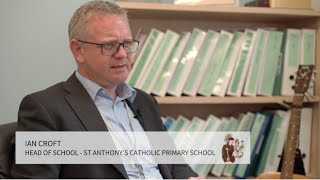
This is a short interview/testimonial (YouTube) with Ian Croft and a colleague from St Anthony's Catholic Primary School describing their experience using Third Space Learning online one-to-one maths tutoring. They explain how the service allows multiple pupils (around 10) to receive simultaneous one-to-one tuition in a single room without disturbing each other, how lessons are personalised (examples such as tutor-placed unicorns), and how the school used Pupil Premium funding for pupils assessed roughly two terms behind who then made good progress overall. The speakers describe monitoring practices (session-by-session reports, printed two-week and termly progress summaries), classroom technical checks during sessions, and cite the amount of tutor contact time and tailored teaching as reasons for choosing Third Space Learning.
Chapters
We've used one to one intervention with staff, but that's very time consuming, costly because we don't have enough staff to do it. So if we've got children who are on the special needs register or have an ehcp, then we can provide one to one. But it's not practical on a day to day level to be doing that. So what impressed me was that we've got maybe 10 children in a room and each getting one to one, not disturbing each other. That high level of input is why I think that works better. Because 10 children in one room would disturb each other.
They always have little things. For example, one of the girls loves unicorns. So every week there will be a unicorn at some point in her program. Even though she's not that into maths, it's creating an atmosphere which she wants to join into, which teachers don't have the time to do. They know that, that's their interest. But you're here to learn maths and this is what we've got to get done in an hour. Whereas the tutors, they're almost like their friends as well. So give them extra bit of time and give them something that they enjoy as well.
It's all to do with the impact because it costs money. What's been the impact? And there are two impacts really that we'd look for. One would be positive engagement with children and the other would be the children's outcomes. Has it made a difference to children's outcomes over time from where they were to where they are? We started with Pupil Premium. That was where we were going to use some of the Pupil Premium funding. They'd been assessed as being about two terms behind in their learning and on the whole they made good progress. There was only one child who didn't, who for one reason or another didn't take to third space learning. So by Christmas we took her off and we moved somebody else in.
We always say if someone gets something like, oh, there's a light bulb moment and you're like, you've just got it, the light's on, you've just got something. And that's great. And sometimes within third space, particularly one of our girls, she's like, oh, I really get it now. And then I'll go and talk to her. And she really has. She's not just saying that she's got it and that's just because she's allowed that much more time. She's one of our low ability children and we spend a lot of time with her, but it's just not the same as having an online one on one tutor that is really telling her exactly what it needs to be done. And sometimes if someone's saying it one way, it's not working and then the teacher says it another way and it's not working, but then you've got a tutor that might be trying a third way and it's just amazing, like what can happen with three different people all trying different ways and then eventually it'll click. So it's good for the low ability as well as the high ability. During the lesson, I have my own laptop up so I can check all the children that they're in, that they've got good audio. If there are any problems, it flashes up in like a little red screen and it means that it's quite smooth running for the whole hour. And also you can do progress reports, a report for each session, like the day after it pops up that there's a report and we try and print them out every two weeks and stick them in the back of the book, so we've got a good guideline of what's going on. And then every term the progress reports for a term we print, so then we can see actually what progress has happened that term and what they've actually learned within the maths curriculum for the classroom as well. So then we can tick off what they've actually got, what they've actually understood.
Yeah, we do. We get lots of emails coming through from maths and all sorts of other subject areas trying to persuade us to buy into their services. But the reason that we went with third space was because of the amount of contact time that children get with the tutor and the fact that it is directly tailored to their needs.
I just think it's amazing what it does for the children. And I've said that I would think it would really work for year fours as well, which is why we're now going to try and get six in for year four next year. I really like how it works, I think it's really clever, it's not that time consuming and I can really see the difference in the children. So for me, I think, why wouldn't our school keep using it?