Trigonometry | GCSE Maths | Third Space Learning
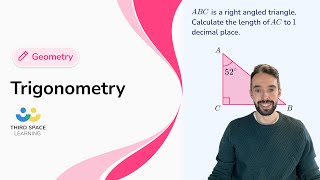
Instructional lesson on using trigonometry in right-angled triangles. The presenter explains how to label hypotenuse, opposite and adjacent, introduces the three trig ratios (sine, cosine, tangent) via SOHCAHTOA, and works through multiple exam-style examples solving for missing sides and angles using a calculator and rounding answers to one decimal place. The video also notes marking guidance for each example and points to further resources and tuition links.
Chapters
Foreign. From third space learning. Today we're going to look at trigonometry. Trigonometry is the relationship between the side lengths and angles in triangles. And today we're going to look at right angle triangles and how we can use trigonometry to do various different things. We'll look at how to name the sides of a right angle triangle. We'll look at Sohcahtoa and how to use it to work out the missing side lengths and missing angles in right angle triangles. As usual, I'll use our online classroom to go through the topic and answer some questions. Check out the links at the end of the video for access to loads of free resources, practice questions and information on our one to one personalised in school tuition. Let's look at trigonometry and how we can use it to find the side lengths and angles in right angled triangles. Grab a pen and let's dive straight in. In order to use trigonometry in right angled triangles, we first need to label the sides of the triangle. Each of the three sides has its own name. The longest side is called the hypotenuse. It's the side opposite the right angle. The opposite side is the side opposite the angle and the adjacent side is the side that is adjacent next to the angle. The angle itself and it doesn't matter the orientation of the triangle. We always label the sides in the same way. The hypotenuse is the longest side, it's the side opposite the right angle. The opposite side is the side opposite the angle itself. And the adjacent side is the side that is next to adjacent to the angle. Now we've labeled the triangle. We need to use one of three trig ratios in order to work out missing sides and angles. These are sine, cos and tan and they relate the angle in a right angled triangle to the ratio of two of its sides. So sine of the angle is equal to the opposite side divided by the hypotenuse cos of the angle is equal to the adjacent divided by the hypotenuse and tan of the angle is equal to the opposite divided by the adjacent. And we can put these into triangles to help us to use them. We can see that this spells so can toa and it can be a really nice way to remember it. Let's have a look now how we can use labeling triangles and the Sohcahtoa triangles to work out missing sides and angles in right angled triangles using trigonometry. The question says work out the length of X to one decimal place. Well, we can see we have a right angled triangle here. And, and we've got a length of x and 8 and an angle of 40 degrees. Now, because we've got an angle and it's a right angled triangle, we can use trigonometry here to work out X. So let's start by labeling the sides of the triangle. Well, the hypotenuse is always the longest side of the triangle. It's the side opposite the right angle. The opposite side is the side opposite the angle. So that is going to be this side here. And then the adjacent side is the side that's left. It's the side that is adjacent to next to the angle. Okay, let's now draw the sohcahtoa triangles to help us here. So we've got three triangles, let's write them in. So sine is equal to the opposite divided by the hypotenuse. Cos is equal to the adjacent divided by the hypotenuse. And tan is equal to the opposite divided by the adjacent soh Cah toa. Let's now decide which triangle we need to use. Well, going back to our original question, we can see we have information about the opposite side, that's X and the hypotenuse, that's eight. So let's label them. We know nothing at all about the adjacent, so let's just forget about it. So we're looking for a triangle that has O and H in it. So it's going to be this one because that has an O and an H. These two are no good to me. So we're going to cross them out and we're only going to look at soh. Okay, now let's think about what we're trying to find. We want to find the opposite. Well, the opposite we can see from the triangle here is equal to S multiplied by H by covering up O. So let's fill this in. O is actually X, S is actually sine and it's always sine of the angle. And the angle here is 40. So 40 in there. And we're going to multiply that by the Hypotenuse, which is 8. So let's put that straight into the calculator. So sine of 40 multiplied by 8 and I'll be really careful here to make sure that the 40 goes in a little bracket and we get 5.1423008. Always a good idea to write down a good number of decimal places. Okay, now the question says to One decimal place. So let's round it. Well, the one is in the first decimal place, so let's draw a line to the right of it. And that four on the right, well, that four is lower than five, so that means we're going to round down. So we get 5.1cm. Let's just double check to make sure our answer is sensible. Well, the hypotenuse here, the longest side is 8, so our answer should be less than 8 and it is. So that looks good to me. So let's pop that on the answer line as 5.1 cm. Let's see where those marks come from. Well, we're going to get one mark here for correctly identifying the trig ratio and subbing in the values. And then the second mark is for the answer. Let's go through a second exam question together. So it says ABC is a right angle triangle and we want to calculate the length AC to one decimal place. Well, AC is this one here. So let's call it X. So we can see it's a right angled triangle. We can see we have some information about the sides and we have an angle. So we can use trigonometry here to work out that missing side. So let's start by labeling the triangle. Well, the hypotenuse is the side opposite the right angle. It's always the longest side. The opposite side is the side opposite the angle, which is that one there. And then the adjacent is just the one that's left. It's the side adjacent to or next to the angle. Now on this one I'm just going to write adjust. So it's super clear that I mean adjacent here because we have a side length of X and an angle of A. So we don't want to get them mixed up. Right, let's write down the Sohcahtoa triangles. So I've got some triangles here. Let's write in sohcahtoa. So, so sine equals opposite divided by hypotenuse, cos equals adjacent divided by hypotenuse, and tan equals the opposite divided by the adjacent sohcahtoa. Right, let's see what we've got. Well, I can see we have the adjacent side, which is X, and we have Hypotenuse, which is 9. We don't know anything about the opposite, so let's forget about it. Which triangle will I pick? Well, I need one that's got the adjacent and the hypotenuse. Well, it's this one, isn't it? It's the middle one. You can see there we've got A and H. So we don't need this one and we don't need this one. Now I'm trying to work out A the adjacent. So if we cover up A, we can see that B adjacent is equal to C multiplied by H. Right. Well, A is X, C is cos of the angle which is 52 and H is 9. There we go. So let's put that straight into the calculator. Now we need to take great care to make sure that that 52 is in a little bracket. And we get X is equal to 5.54095. Good idea to write down a good number of decimal places. Now it says give your answer to one decimal place. So let's see where that is. Well, the first decimal place is that five. So let's draw a line to the right and the four on the right of that, well that's less than five. So that means we're going to round down. So X is equal to 5.5 meters this time. Okay, let's do a quick check. Well, 5.5 is less than 9 and 9 is the longest side. So 5.5 seems like a really sensible answer to me. So let's pop that on the answer line as our final answer. Let's get this marked. Well, we're going to get one mark here for correctly identifying the the trig ratio of cos and substituting in the values. And then the second mark is coming from the final answer. Okay, your turn. Pause the video and have a go. Take it step by step and we'll go through it together in a sec. Okay, let's go through it. So the question says work out the length of X to one decimal place. Now we can see that we've got some side lengths here, an angle, and the triangle is a right angled triangle. So we can use trigonometry here to work out that missing length X. So let's start then by labeling the sides of our triangle. Well, the hypotenuse is the side opposite that right angle. It's always the longest side. The opposite is the side opposite the angle. Well, that's that one there. And then the adjacent is just the one that's left over. It's the one that's next to the angle. Okay, let's write down the Sohcahtoa triangle. So I've got some triangles and let's fill them in. So I've got sine is equal to opposite divided by hypotenuse. Cos is equal to adjacent divided by hypotenuse. And tan is equal to opposite divided by adjacent sohcahtoa. Now, which triangle do we need? Well, let's have a look at the question. I can see I know information about the adjacent, that's X. And I also know information about the opposite, that's eight. I don't know anything about the hypotenuse, so let's forget about it. So I'm looking for a triangle with O and A, So it's going to be this one, isn't it? Because that's got O and A in it, which means I don't need this one and I don't need this one. Now, we wanted to work out X which was the adjacent. So if we cover up the A in my triangle here, we can see that A is equal to O divided by T. And let's substitute some values in. So A is X, O is the opposite, which is 8 and t is tan, but it's always tan of the angle. And the angle here is 29 degrees. Now, we can put this straight into our calculator. It's a good idea to use the fraction button here to say 8 over tan 29. And as always, take great care to make sure that the 29 is in a bracket. So when we do that, we're going to get 14.43238. Let's round it to one decimal place, because the question asked me to. So let's see where that first decimal place is. Well, it's here that four is. So let's draw a line to the right and look at the three on the right. Well, three is less than five. So we round down. So X is equal to 14.4 and the units this time are kilometers. Very big triangle. And let's pop that onto the answer line, 14.4km. Let's see where those marks come from. So we're going to get one mark for correctly identifying the correct trig ratio and substituting in the values. And the second mark comes from the answer. Let's try this exam style question. So it says, work out the angle X to one decimal place. Now we can see we have a right angle triangle. We know two of the sides and we want to work out that missing angle X, so we can use trigonometry. So let's start by labeling our triangle. Well, the side opposite the right angle. The longest side is always the hypotenuse. The side opposite the angle is the opposite. And the one left over is called the Adjacent, it's next to the angle. Next, let's write down our Sohcahtoa triangles. So I have three triangles here. Let's fill them in. So sine is equal to opposite over hypotenuse. Cos is equal to adjacent over hypotenuse. And tan is equal to opposite over hypotenuse. Now, we need to decide which triangle we're going to use. So let's go back to the question. We can see we have information about the adjacent. It's 8 cm. And we have information about the opposite side, it's 13 cm. We know nothing about the hypotenuse, so let's forget about it. So we're looking for a triangle that has O and A. Well, we can see it's this one over here. O and A. So we don't need that one and we don't need that one. Right. What were we trying to find? We wanted to work out angle X. So out of T, O and a tan opposite adjacent, it's tan. That involves the X. So let's cover up T and write down what that equals. T is equal to the opposite divided by the adjacent. Right. Well, T is tan of whatever the angle is. And in this case it's angle X. The opposite is 13 and the adjacent is. Is it? Right, now we need to work out X. So in order to get X, we need to take the inverse of this. So the inverse of tan is tan to the minus 1, 13 over 8. So we can do this on our calculator by pressing shift tam. And then make sure we open the bracket and then in the bracket, 13 divided by 8 and we get 58.39249. Now, the question says to one decimal place, so let's round it. The number in the first decimal place is now three. The number on the right of the three is nine, because nine is bigger than five. We're going to round up. So my answer is 58.4 degrees because it's an angle. So let's write that on the answer line. 58.4 degrees. And let's see where those marks come from. So one mark is for correctly identifying the trig ratio and substituting in the values. And the second mark is for the correct answer. Let's try another question. Together. XYZ is a right angle triangle. XZ is 4.5 meters, which we can see. And YZ is 11 meters, which we can see. And it says, calculate the size of angle XYZ to one decimal place. Well, X, Y, Z, Z that angle is this one here. So when we are naming angles, it's the letter in the middle that refers to the angle. So let's call this one angle X. Now, because we've got a right angled triangle and we've got two sides and we want to work out a missing angle, we can use trigonometry. So I start by labeling the sides of our triangle. So the longest side is the hypotenuse and that's the side opposite that right angle there. Let's label the opposite next. Well, the opposite side is the side opposite the angle, which is 4.5. And then the one that's left over is the adjacent, which is the side next to the angle. Next job, let's fill in Sohcahtoa triangles. So sine is equal to opposite over hypotenuse, cos is equal to adjacent over hypotenuse, and tan is equal to opposite over adjacent. So let's decide which of these triangles we need to use. Well, on the question we can see that we know information about the opposite. 4.5. And we know information about the hypotenuse. It's 11, so we don't know anything at all about the adjacent. So let's just forget about it. And we're looking for a triangle, one of the Sohcahtoa triangles that has O and H in it. Well, we can see it must be this one because that has O and H in it. We don't need that one. And we don't need that one. Right. What were we trying to find? Well, we wanted the angle X well out of sine, the opposite. And the hypotenuse sine is the one that refers to the angle. So let's cover up S and see what it equals. S is equal to O, the opposite over the hypotenuse, H. So S is actually sine of an angle. And the angle we want to find is X. And that equals the opposite, which is 4.5 divided by the hypotenuse, which is 11. Now, we want to work out X, So we need to take the inverse function here. And the inverse of sine is sine to the minus 1, which is 4.5 over 11 in the bracket. Let's put this into the calculator. So, so let's press shift and sine to get sine to the minus 1. And then in the bracket 4.5 divided by 11 and we get X is equal to 24.14773. Always a good idea to write Down a good number of decimal places. Now the question says to one decimal place, so let's do that. Well, the first decimal place is where the one is. So let's draw a line to the right of it. And we can see on the right we have the digit 4. 4 is lower than 5. So we're going to round down. So X is equal to 24.1 and this is degrees because it's an angle. So let's pop that on the answer line. 24 0.1 degrees. Okay, let's see where those marks come from. So we're going to get one mark. For correctly identifying that, we need sine here and substituting the values in. And the second mark is for the answer. Okay, your turn. Pause the video and have a go. Go through it step by step and we'll have a look at it together in a minute. Right, let's go through it. So it says work out the angle X to one decimal place. So we can see we have a right angled triangle. We know two sides and we want to work out the missing angle. We can use trigonometry. Let's start by labeling our triangle. Well, the longest side. Well, the longest side is the hypotenuse. And we can always spot it because it's the side opposite that right angle. The opposite side is the side opposite the angle. And that means that the last side is the adjacent. The adjacent side is next to the angle. Next job, let's write down our sohcahtoa triangles. So sine is equal to opposite over hypotenuse. Cos is equal to adjacent over hypotenuse and tan is equal to opposite over adjacent. Right. Now, which triangle are we going to use? Well, on the question we can see we know information about the hypotenuse, it's 23. And we know information about the adjacent, it's 10. We don't know anything about the opposite. So let's forget it. So we need a triangle that has A and H and we can see it must be this middle one here because that has A and H. So I don't need this one and I don't need this one. Right. What we tried to find, we wanted the angle X, didn't we? So X the angle is involved in cos here it's the C because A and H are sides. So let's cover up C and see what it equals. C is equal to the adjacent divided by the hypotenuse. Well, C is cos of the angle. The angle here is X equals the adjacent, which is 10 divided by the hypotenuse, which is 23. Now, to work out X, we need to take the inverse, so it's cos to the minus 1 of 10 divided by 23. So on our calculators we're going to press shift and and cos. And then in the bracket we're going to write 10 divided by 23. So X is equal to 64.22853. Always a good idea to write down a good number of decimal places. Now, the question says one decimal place, so let's round it. The number in the first decimal place here is at 2, so let's draw a line to the right of it and the number on the right, the two, is less than five. So that means we need to round down so X is equal to 64.2 degrees because it's an angle. So let's pop that straight on the answer line so it's really clear. And there we go. Let's see where those marks come from. So we're going to get one mark for correctly identifying the trig ratio, cos, substituting the values into it, and then the second mark comes from the answer. Thanks so much for watching the video. Check out the description below for loads more information on this topic and for access to our library of free online resources and loads of information on our one to one tuition. Don't forget to like and subscribe to stay up to date with all the latest third space learning videos.
More from Rob





The Top 20 SATs revision topics 2026: A focused revision approach for maximum impact in minimum time

GCSE maths marking 2026 decoded: using examiner insight to improve teaching and results


How To Embed AI Literacy In Your School: Practical Steps To Get You Started [Webinar Replay]


Reviewing And Planning Your School's AI Approach: A Strategic Framework [Webinar Replay]
