Using past SATs data to inform your maths SATs revision for 2024
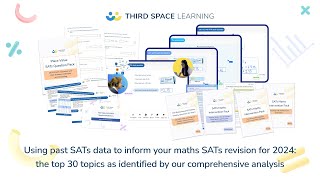
Recorded webinar (Third Space Learning, presenters Emma and Adela) reviewing seven years of KS2 SATs maths papers to identify 30 focussed revision topics and top priorities for Year 6 SATs preparation. The session explains the data‑collation method (mapping past SATs questions to National Curriculum references), shows distributions by year group and curriculum strand, and describes a diagnostic assessment → tailored intervention workflow and recommended lesson sequencing, plus free classroom resources.
Chapters
Hi there everyone. Thanks very much for joining us this afternoon where we're going to be taking you through the data from our analysis of the past six years of the SATs papers and the 30 topics to focus on so you can optimize your revision planning. At Third Space Learning, we specialise in maths tuition across primary and secondary and we've helped pupils over 4,000 schools with catch up and exam preparation for our one to one math interventions. We also have a library full of resources to help teachers which I'm sure many of you will have been making use of. But now that we're in December and many of you will be thinking about preparing year sixes for their SATs. And our booster tuition program is kicking off in January, we thought it would be a good time to give you an insight into what informs how we prepare pupils and to hopefully help with your own approach in school. So I'm a part of the New Schools team so I focus more on the one to one tuition side, but I'm speaking with schools every day, setting up their tuition and hearing how they support their pupils and what their needs are. So hopefully I can offer some of those perspectives. Now I'm joined by Adela, who's our primary curriculum and content specialist that will be taking you through the data. So hi Adela, thank you for joining us. Perhaps to begin with, it might be worth you just telling us how you came to be at TSL with your background. Yep.
So my current role at tsl, I'm the, as Emma said, I'm the primary curriculum and content specialist here. So my role is designing all the content and the material that is used in both our SATS revision program, but also our Key Stage 2 diagnostic program. I've been working with TSL. Now I think this is coming up to my third year, my career prior, prior to that very much worked in teacher professional development, so training teachers to teach maths really effectively in schools and I was a lecturer at the University of Brighton in initial teacher education. So all of our materials and resources based on really solid research about effective maths teaching. But you're probably wanting to know in terms of SATS and SATS revision, I have worked in test development since 2008, so quite a long time. I've been working with the Standards and Testing agency on and off as their external curriculum advisor. So get involved in reviewing different stages of their test development cycle. So I'm hoping that today I can share some of my that insight to support you in making the most of your SATS vision. With your year sixes. So we'll take you through our thinking and hopefully from there you'll be able to take some ideas forward to the classroom.
Yeah, absolutely. I mean, before we get started, I know Ruth is saying that she can't hear us. Is that a problem for anyone else, Ruth? It may be that you're not connected to the audio, but if we get going, hopefully it will sort itself out. But let me know if anyone else has any other problems. So to start off with then. Also, by the way, if anyone's got any questions for Adela throughout, then please do just drop them in the chat box. And so I think a couple of people might be struggling with. With the sound. Is anyone else having trouble hearing us? Oh, everyone else can hear. Okay. So I think it may be the case that it's just a couple of you on your end. You may not be connected to the audio, but I can always send you the recordings later on. So not to worry. But I think if we get started. So.
Emma, should we put a message in the chat to say that everyone else can hear? Yeah, because they're not going to be able to hear us say that.
Yeah. Adela, if you'd like to sort of get us started. And so what we've got here is the test format specification, isn't it? So more of a high level sort of overview which is publicly available, isn't it, of the mark rating?
Yeah. So this is the test framework that is actually written for test developers, but it's available freely and the link is there, which you'll get following this webinar for every year six teacher. I would definitely be using this framework. So it doesn't tell us anything you're probably not aware of. But as we know, a large proportion of the marks, 70 of the marks are focused on mathematical reasoning papers and then the arithmetic, 40 marks. Now the arithmetic becomes quite predictable year on year and I think that that's why from our point of view, we particularly focus on developing the mathematical reasoning side of things and then build the fluency and the arithmetic into that as well, so that we're covering all areas and then no surprises. Over on the right hand side, this is the specification in which every test year on year, so it never change that the standards and testing agency have to adhere to. So you'll see that number ratio and algebra, 80%, nearly 80% of the marks come from those strands and then just sort of 15 to 25% come from measured geometry and statistics. So that already gives us a good indication of where we should focus our attention in terms of our revision, but obviously this is still very broad. It's not particularly helpful at this stage, which is where we have as a team drilled down into more detail for each of those areas which we're going to share with you so that you could potentially use in your classrooms.
Yeah, absolutely. So then sort of moving on to our specific analysis. I mean, firstly, what is the sort of process of collating this data from across the years and what can teachers take away from this to implement into their revision?
Yeah, so every year, I mean, we've been building this up over, over time, but every time that the STATS papers are published, I go through every single question and in a big database that we've got and we use the National Curriculum references that the mark scheme, actually in the very front of the mark scheme is every single question listed and against that, the National Curriculum reference and the year group that that reference is related to. So I put that all into a database and to see really what trends are coming out or what we can learn year on year from those papers. So, for example, on the left hand side you'll see the year group allocation. As you remember, it's not just a test of year 6, it's a test of all content from key stage 2. And actually, if you look at the 2023 paper, so last year's paper, only 40% of the marks are coming from year 6 content. So the other 60% was coming from year 3, 4 and quite a lot from the year 5 content. So I suppose what that's telling us is. Yes, yes, we need to cover the content from year six, that's their entitlement. But when we are thinking about SAPS revision, to be thinking about content from year three and year four and year five, because those marks which are normally at the beginning of the paper, are really easy marks to pick up and quite predictable. You can predict usually, I would say in the top, at the first five questions of a reasoning paper, you are going to get a question on finding change, you're going to get the question on rounding. This is not for sure, but, but generally this seems to be what, what comes up year on year. You'll get a question with maybe missing digits, you'll get a question on what else might come up. I had written it down for the top five, five things.
Finding change.
Oh, something on the value of digits. You're always going to get something early on on the value of digits. So these are really easy marks to pick up. So to just make sure that children Being exposed to these earlier ideas and concepts so that they can.
They're just easy wins, aren't they? And Obviously the year 5 and 6 weighting is a lot larger, but it's still a significant proportion for the years 3 and 4 content. So easier marks that they can be picking up. So it's good idea to make sure that those are, those concepts are sort of solidified.
Yeah, absolutely. And what our intervention lessons do, and this could be mirrored in the classroom as well, is that we take a topic and then we choose two lessons, we come up with two questions that are more likely to come up in the beginning of the paper, two in the middle of the paper and then two at the end of the paper. So they're getting kind of exposure to different levels of questions on the same topic within. Within one. Within one particular revision lesson.
Yeah, so. Sorry, go ahead. Yeah, yeah, I was going to say sort of moving from this or further down into the data you've got from that distribution across the year groups, we've got a spread across the content domain, haven't we? So you're talking about that exposure. It's not just year group exposure, it's exposure to different types of questions and different content domains.
Yeah, that's right. So if you just go back a second, Emma. So if you see there on that pie chart, we've got the different strands broken down. So we've got where we've got that broader strands from the test framework. Obviously every lesson, every question is allocated a strand as well. So again you can see here that calculation, fraction, decimals, percentages, number and place value measure are the big areas that seem to come up time and time again and are worth the most marks. But this is still quite broad. So exactly what Emma was saying, what we wanted to do was drill down a little bit further and go, okay, so what calculation questions come up, what measure questions come up and that's where we've started to drill down a little bit deeper.
So we've got this here, haven't we? I mean, pretty conclusive in showing where the total marks are coming from in terms of those more drilled down content areas.
Yeah. So what we've done is we've broken down the strands into 30 sort of revision topics, I suppose that study topics that each question from the stats fits quite nicely into. So we've taken each question and said, right, well that is mainly, mainly focusing on applying all four operations. This one's mainly focusing on calculations of money. This one's mainly focusing on number sequences so that we can start to see popularity in terms of where most marks come from in, in the SATs year on year. So we've got, actually, we've got seven years of data because not only have I used the 2016 onwards papers, but I've also used the sample paper that, that was available before the new curriculum came out and the new SATs. So, yeah, we have lots of, lots.
Of data to draw up on and then we sort of move on from this, don't we, to then deciding, like for our revision lessons, where we should get started, what we should prioritize. I mean, because if you just based it solely on mark weighting, reasoning with solving problems using mixed operations would be top. But if we take a look at our list of lessons, it's not at the top. It's. It's here, isn't it? So there's other elements that come into play.
Yeah, absolutely. I mean, if we just went for the straight, crude order, it would be quite a. It wouldn't be a very cohesive journey for the pupil, I suppose. So we take that information, obviously. We also have watched lots and lots of lessons of pupils doing our maths intervention, our SATS revision program, and built intel into that as well. So, for example, this year we've actually brought up multiples, factors and primes. It's brought it higher up into our list of 10 because what we were finding was then we were watching pupils completing the solving multiplication division problems lesson. They were getting stuck because they just didn't know their multiples and factors. They didn't know their multiplication facts. Same when they were doing, comparing and ordering fractions. They weren't able to put them over a common denominator because they didn't know the multiples and factors at their fingertips. So what, what we try and do in, in thinking about our top 20 top 30 lessons is which is going to have the biggest impact on helping with other areas of the curriculum as well. So, so that's why you'll see we've ordered things in a slightly different way to perhaps the graph is showing because we want it to be a progressive journey. Also, if we're going to start, we're not going to start our first lesson with, right, everybody, we're going to do mixed operations, solving problems. There are two, three marker questions. They're the hardest questions in the paper. They're right at the end of the paper. Yes, we want them to be able to pick up the. Those marks, but there's loads more marks that they could pick up earlier on in the paper. So that's why we focus on really thinking about those ideas. That will help with other questions.
And one of the main things that we hear from schools when they're setting up tuition, why they need extra support is it's a time frame issue. It's trying to be able to, I say, prioritise the key words here really, but they just don't have enough time to go through everything. So it's picking those which are going to have the greatest impact. And you mentioned that sort of interleaving of knowledge throughout. So that just works by feeding into each topic. Again, so they're not just touching on something once. When it comes down to working through this order of lessons, they're going to keep on touching on things, but they've got the sort of core content sort of down and sort of mastered so that they can hopefully try and apply it to things later on.
Yeah, that's right. So, for example, there we've got data and averages as our ninth revision lesson. But in finding the mean, what do.
We need to do?
We need to calculate, we need to add, we need to add all the amounts, we need to divide those amounts. So again, we're giving them exposure to multiplication division, which we know is going to be a large part of the SATS tests that comes up. So yeah, we do try and sort of imagine we have a pupil that's doing all 30 lessons, which does happen. Then they're getting opportunities to revisit key ideas. So for example, reasoning with measures, you're going to be drawing on that calculation to. And decimal understanding to when you come onto the reasonable measures vision lesson. So it's all interlinked. But this is.
Yeah, it's. I was. You took the words out of my mouth just to say. It's important to say that this isn't a one size fits all approach. And by no means should you take this as gospel, this. I mean different peoples will be stronger in some topics over others and that will differ from people to people. And so where possible, try and I suppose assess and pinpoint those areas in order to tailor it and be be aware of that.
Yeah, absolutely. I mean, if I was still a year six teacher in the classroom and I have been there, done that, but I would, I'd be, I'd be saying, now this is great because actually what I can do is take those first 10 priority areas that we've identified and see whether these are areas that children in my class need through assessment, you know, a few questions on each area so that, so I could then prioritise what I need to do for my children in my class. And I suppose that's the beauty of our intervention is with 30 children, even those 30 children are going to have different needs. So whereas our, our program actually does that diagnosis for you as well and does that assessment for you.
So it's the time saving element coming into it again, isn't it? It's all been, well, saying tailor it as much as you can, but then having the manpower to be able to actually provide the support on an individual basis for 30 children is sometimes just, it's just not feasible in schools. I mean, so, I mean, that's why we run our own assessments in order to create that tailored approach and then they work through it individually with a tutor, so they've got their own plan, but then it's, it's adjusted. So I mean, if we take a look at the way that we kind of assess and that can hopefully help with some of the viewers as well and how they approach that in the classroom.
Yeah, so Here there's the 10 lessons that we've identified as our top revision lessons. And then what we do is we then ask two questions on each topic area. So the questions you see there on the right are taken from our money revision lesson. And we ask one question that is a question likely to appear quite early on in the paper, and then one question that is more likely to appear halfway through or towards the end of the paper so that we can gauge. Okay, have they, are they. Are they just understanding this or actually they haven't got a clue or. No, they're okay, they can do the earlier question but they can't do the second. And then our software then diagnoses the lessons based on this. So for example, here, this pupil here got both these questions incorrect, so it's recognised that they're therefore behind with that particular topic. And so therefore it will suggest that this is a lesson that we teach. If they get one right and one wrong, then it comes out as developing. And obviously if they're on track and they've got them both correct, then they, then it comes out as on track and we don't necessarily teach it. Although this is totally down to the teacher, they can say no, actually it's a revision program. I still would like the tutor to go through all of those areas, be it. They might go through it much quicker than perhaps the ones where they're behind because it will just be revision and exposure to SAT style questions.
Yeah, and it's all, it's all good practices in it Anyway, if you've got the time, certainly revisiting those concepts, even if they're on track, is obviously going to be useful and beneficial. But. So if those topics have been highlighted as being behind or developing, would you perhaps take us through how we like to structure our lessons in order to combat that?
Yeah, absolutely. And this is again, something that you could mirror in the classroom. So obviously this is the money lesson that's been diagnosed as a lesson, as an area struggling with. You'll see a similarity in a minute to the questions we ask and then the content inside the lesson. As I alluded to earlier, although we focus on the reasoning questions, every single one of our sessions starts with the fluency slide. So this will be a question we expect them to be able to solve in their heads. So for example, these two here, one's just counting up to ten pounds, the other one is adding amounts, but there's no real regrouping needed, so it's quite easy for them to hopefully do that in their heads. I know they don't get money questions per se in the arithmetic paper, but it's just trying to give them exposure to arithmetic style questions where the topic doesn't lend itself to arithmetic questions that would appear in the paper. So we always start with fluency and then if we move on to the next slide. Yep. So this example. So within our, within our lessons we have, like I said, two questions from early in the paper, two middle two ends and these, these mirror, they're not. They mirror SAT style questions. So they're, they're very similar to questions that have come before. Different, obviously, but different context, different scenarios, different sometimes testing the same concept, but in a different way. They have a go at the question, the SAT style question, on their own, and then if they get stuck, then the tutor goes through it with the pupil and they try and solve the problem together. And I've tried to put in their models and images that they should be used to using in the classroom. So part whole models, number lines, bar models, and the kind of thing would expect to see in most classrooms these days. So they work through that together and then you'll see that then the pupil gets another opportunity with a similar question to solve this one, having had that input from the teacher.
So it's one of those things that always comes up is it's that confidence. It's not necessarily just that they are, I mean, perhaps they've got the ability, but it's that confidence and so being able to expose them to as many types of questions as they can. And the different variations will build that confidence. So certainly something in classroom environment constantly try and expose them to as many different variations as they can, which is what we try to do.
Yeah. And every pupil will go through this lesson at a different rate. So you'll see the first question set down there in that first column. That's the one I just showed you. Now, it might be that actually the pupil gets this right, this first question. Right. Correctly and therefore doesn't go through the rest of it. So they move to the right, which would then be. Okay, well now try this question slightly harder, slightly more demanding. Okay, great, you can do that one. Brilliant. In which case they go on to question three, where they are probably going to get stuck. This is a question that's more likely to be at the end of the paper. And so different children will need support with different questions. So there's different journeys for every pupil to go through our lessons. And you'll notice the question from here was the assessment question they got asked or very similar. And this is the second one in is the question they were asked in their assessment question there. So building in the importance of that assessment again to diagnose what it is that they need to focus on.
Yeah. To make the most of the time as well.
Yeah, yeah, absolutely.
That gives everyone a good idea of how they perhaps structure the different questions and taking them forward. I mean, we can see as well on. It's slightly smaller here, but these sort of like keyword highlighted little bubbles that we've got. Even if not able to access these intervention lessons, it's got some good strategies that you've produced that can be used in the classroom as well.
Yeah. So we use these like stickers on all of our lessons. We actually got a poster on the link there that as well you could use in class. But these are the things that we hope that they would think about using in any question within the sets. You know, obviously highlighting keywords that helps them know what to do using a diagram. So many times you see them trying to answer the question, they don't finish it off because they haven't quite worked out what bit it is they need to find out. So using a bar model or making a drawing of an array can really help them in answering those questions. We always highlight the number of marks a question has because it gives the children a bit of a clue that they either need to show they're working because if it's a two mark question then they could pick up one mark. If they get it incorrect, they're Answering correct. So always encouraging that. Or it might be that they're expected to give two answers in two different answer boxes. So we always highlight the marks and get them to look at the marks. Silly things like remembering to write the units. Has it asked the time in minutes or has it asked the time in hours and minutes? So we try and flag these things continually to the pupils. And so this is something that certainly I would have up in my classroom to say to the children, you know, don't forget. Like, have you underlined it? Have you got the correct units? Have you actually answered the question that was being asked? So these are really useful reminders for them to succeed in the SATs test.
It's encouraging good habits, isn't it? Because it's such a shame when they've put the time, the effort, and then they've learned the concept. But it's just silly little mistakes because they've, you know, forgotten to check the units or something like that. So really sort of easier wins, which certainly teachers can, can use and try and really, really encourage pupils to get into, into good habits. Yeah, I was going to say it.
Fascinates me when, when you look at the, the scripts of children, when they, they come in and you can see how they've shown their working. Literally. I have seen not many, many times show your working. And, and, and a, a child has drawn a picture of them working and you're like, have you really had no exposure, have you had no exposure to actually understanding what that means? Show your working. So, yeah, we do need to prepare them for, for, for, for the way a paper looks, don't we, in the way it feels so that they can go about it without feeling heightened anxiety.
I'm sure a lot of people watching can sympathise with that and say, yeah, I see all the time when I'm marking things, it's a nightmare. So hopefully, I mean, I'll send this out to everyone as well and you've got the link there. If you want to download that poster and use that and put that up in your classrooms, then please do so. And hopefully it will help encourage some, some good habits. But I mean, that's kind of just a. I mean, we focus more on our stats booster, obviously looking towards that, but it's a real kind of drop in the ocean really, of what we do at Third Space Learning. So we've got our SATS booster program that's beginning in January and schools are booking their pace at the moment. So if you would like more information, let me know. But We've got so many other things that you can access. We've got our fantastic blog, so we've got CPD videos, SATS intervention packs there that you can use, and our maths hub with loads of free resources to hopefully help you prepare for sats and across key stage one and key stage two with general, more broader teaching of maths across the. Across the school. So by all means, please go and take a look and make use of those. But while we've got a few more, I mean, we've come to half four now. But if anyone's got any questions for Adela, please do pop them in the the chat box and more than happy to stick around to go through them.
I will just say that this SATS intervention pack link is amazing. What you've got on there is you've got six, so, you know, I've just showed you the lesson of the money lesson. You've got six other lessons there, the whole complete pack. So you've got two, I think, that are within our first top 10, two from our middle top 10 and two from our lower top 10. So really useful. I would be using those if I was still a teacher. So you can access those and they are free of charge, so certainly be useful resource for you all.
Perfect. Any more questions? I just had someone come in checking that I was going to send it out to everyone. Yeah, I will send out the link to the recording and the slides so you can all take a look through in your own time and share with anyone.
Any questions?
Don't think so. Everyone's keeping very quiet, but I'm sure if there's anything that comes up then you can just pop me an email and I'll pass it on to Adela and then we can, we can get an answer to you. But thank you so much. But firstly, Adela for joining us and taking us through that. I hope everyone found it useful.
More from Rob





The Top 20 SATs revision topics 2026: A focused revision approach for maximum impact in minimum time

GCSE maths marking 2026 decoded: using examiner insight to improve teaching and results


How To Embed AI Literacy In Your School: Practical Steps To Get You Started [Webinar Replay]


Reviewing And Planning Your School's AI Approach: A Strategic Framework [Webinar Replay]
