Volume of a Cylinder | GCSE Maths | Third Space Learning
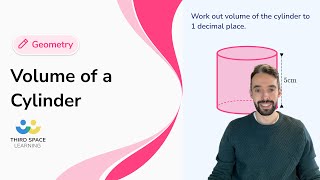
A GCSE-level YouTube tutorial (Third Space Learning, presented by Paul) explaining the volume of a cylinder. The video defines a cylinder and its cross-section, derives the formula V = πr²h (area of circular cross-section × height), and works through several example problems: substituting values to compute volumes, using a calculator, rounding to one decimal place, and rearranging the formula to find height or diameter from a given volume. Each worked example includes where exam marks are awarded and the final answers with units; the video closes with links to further resources and tuition.
Questions this video answers
V = πr²h
1539.4 cm³ (also given as 490π)
141.4 cm³ (also given as 45π)
223.4 cm³
6.3 cm
Chapters
Hi, this is Paul from Third Space Learning and today we're going to look at the volume of a cylinder. The volume of a cylinder is the amount of space inside a cylinder. And today we're going to look at how we can calculate it. As usual, I'll use our online classroom to go through the topic and look at a few questions. Check out the links at the end of the video for access to tons of free resources, more practice questions, and information on our one to one personalized mount's tuition. Okay, let's have a look at how we can work out the volume of a cylinder. Grab a pen and let's dive in. A cylinder is a three dimensional shape that has two flat faces, which are circles and one curved side. It also has a cross section as a circle going all the way through that shape. In order to work out the volume of a cylinder, we first have to work out the area of the cross section, which in this case is a circle. And the area of a circle can be worked out using PI r squared, where R is the radius of the.
Circle going from the center to the edge.
Next, to work out the volume, all we do is multiply the area of the cross section by the height and let's call that height H, which means that the formula for the volume of a cylinder is just PI r squared h. So for example, let's find the volume of this cylinder. Well, we can see that the radius is 7 and the height is 10, which means that r equals 7 and h equals 10. And let's substitute those values into our formula for the volume of a cylinder, which is PI r squared h. Well, when we do that in the calculator, we get 490 PI. Or as a decimal, we could write that as 15 39.4 centimeters cubed to one decimal place.
And there we go.
That is the volume of the cylinder. Let's try a few of these together.
So the question says work out the volume of the cylinder to one decimal place. Now we know to work out the volume of a cylinder, all we have to do is work out the area of the base, which is a circle. So that would be PI r squared. And then multiply that by the vertical height, which we'll call H. So PI r squared h. Well, if we have a look at our circle, R is the distance from the center of the circle to the edge, it's the radius. So in this case R is 3. And if we look at H, well, H is the vertical height. So from the top of the shape to the bottom and that's five centimeters. Okay, let's put them in our formula. So volume is equal to PI multiplied by r squared. So three squared in this case multiplied by h, which is five. Now if we work this out, we can do three squared, which is nine, and nine times five is 45. So that's going to be 45 PI. Now, because it wanted it to one decimal place, we to put that in our calculator. 45 times PI and we get 141.3716. Always a good idea to write down a good number of decimal places and then to one decimal place. Well, we can see that the three is in the first decimal place. So if I draw a line to the right of it and look at the number on the right, it's a seven. Well, seven is bigger than five. So we need to round up. So the answer becomes 141.4 and the units are centimeters cubed. So let's pop that on the answer line. 141.4 cm cubed to one decimal place. There we go, the fully correct volume. Now let's just see where those marks come from. So we're going to get one mark for correctly substituting the values into the formula for the volume of a cylinder. And then the second mark comes from the fully correct answer and that's worth two marks. Okay, your turn. Pause the video and have a go. Best of luck. Let's see how you got on. So it says, work out the volume of the cylinder to one decimal place. Well, we know that the formula for the volume of a cylinder is equal to PI R squared multiplied by H because we have the area of the circle at the bottom. And we're going to multiply that by the vertical height. So let's write down what R is. Well, R is the radius, which is the distance from the centre of the circle to the edge. Well, in this case we can see that the distance across the circle, the diameter is 6. So the radius must be 3. And let's look at the height. Well, the height is the distance from the top to the bottom. And we can see this is 7.9. So be super careful here to make sure we write down the radius, not the diameter. Okay, let's work this out. So volume is equal to PI multiplied by r squared. Well, three squared in this case multiplied by 7.9. So let's put this straight into the calculator. And if we do that, we get 223 0.367. Always a good idea to write down a good number of decimal places. Now the question says to one decimal place. So let's round it. We can see that the three is in the first decimal place. So I'll draw a line to the right of it. And we can see the number on the right there is a six, which is bigger than five. So that means we need to round up. So we get 223.4cm cubed. And we'll just pop that on the answer line to one decimal place. And there we go, full marks. Let's see where those marks come from. So we're going to get one mark for correctly substituting the values into the formula. And the second mark is going to come from your fully correct answer. Okay, let's go through this one together. Now, it says the volume of the cylinder is 1600. So we already know what the volume is this time, 1600 centimeters cubed. Now we know that the formula for the volume of a cylinder is PI r squared h. Because PI r squared is the area of the base of a cylinder, which is a circle. H is the height. So it's PI r squared H. And that means that 1600 must be the same as PI r squared H. Let's keep on reading. It says, work out the perpendicular height. Well, perpendicular means at right angles too. So the perpendicular height is just the vertical height and it's this one. So let's label that H, and that's what we want to work out. Now what else do we know from this diagram? Well, we can see that the diameter of the base of the cylinder, which is the distance from the edge to the edge passing through the middle, is 18, which means that the radius must be 9. Because the radius goes from the center of the circle to to the edge, it is half of the diameter. So let's make a Note. R equals 9. Okay, we've got all the information we can from the diagram. Let's substitute r equals 9 into our formula and try and work out h. So 1600 is equal to PI multiplied by r squared. So 9 squared multiplied by h. Right. Well, 9 squared means 9 times 9, which is 81. So let's rewrite this as 1600 is equal to 81 PI h. Now notice I've written the 81 at the front there. And that's because these are all multiply. So I can write them in any order I want to. PI multiplied by 9 squared multiplied by H is exactly the Same same as 81 multiplied by PI multiplied by h. And by writing the 81 at the front, it makes it a little Easier to read. Now we want to work out H. So the right hand side there means 81 PI multiplied by h. So the opposite of that is dividing by 81 PI. So let's divide the right hand side by 81 PI. And let's also divide the left hand side by 81 PI. If we do that on the right hand side, 81 PI divided by 81 PI is 1. So we're left with H on the left hand side. 1600 divided by 81 PI on the calculator is 6.287. Always a good idea to write down a good number of decimal places. So that's our height. Now let's round it to something sensible just so it sits on the answer line nice and neatly. So let's say one decimal place. So the number in the first decimal place here is that two. So if I draw a dotted line to the right of the two, we can see the number on the right is eight, which is bigger than five. So that means we have to round. So 6.2 becomes 6.3 centimeters and that's our height. And there we go. That is worth full marks. Let's have a quick look to see where those marks come from. So we're going to get one mark for correctly substituting in the values into the formula. And the second mark comes from the fully correct height. Okay, your turn. Pause the video and have a go. Take it step by step and we'll go through it in just a sec. Okay, let's have a look. So it says the volume of the cylinder is 1400. So let's write down what we know. The volume is 1400 centimeters cubed. And we know that the volume of a cylinder is can be calculated by doing PI R squared H. Because PI R squared is the area of the circle, the base or the cross section. And H is the height. So it's PI R squared H. That means that 1400 equals PI r squared H. And we want to work out the diameter to one decimal place. Well, what do we know? Well, we can see that the Height here is 15 and we want to know what the diameter is. So that's the distance across the circle passing through the center. So let's call the diameter D. Now in our formula we've got R. So I'm already thinking what's the relationship between R the radius and D the diameter? Well, the radius is the distance from the center of a circle to the edge. It's half of the diameter. So let's see how that will affect our calculations as we Go through. Let's start then by substituting what we know into the formula. So that means 1400 is equal to PI R squared multiplied by H. Well, H in this case is 15. Okay, now I'm going to write this like this. I'm going to put 15 at the front and then PI and then R squared, because it doesn't matter which way I write these, PI multiplied by R squared multiplied by 15 can be done as 15 multiplied by PI multiplied by R squared. We can multiply them in any order we want to. So let's try and get R by itself. So this means on the right hand side, you've got 15 PI multiplied by. So to undo that, we need to divide both sides by 15 PI. So 15 PI on the right and 15 PI on the left. Now, if we do that on the right, what are we left with? Well, 15 PI divided by 15 PI is one, because anything divided by itself is one. So we're just left with squared. And on the left hand side we've got 1400 divided by 15 PI, which is 29.7089. Now, we need to be super careful here. I'm not going to clear this off my calculator screen because I don't want to lose any marks at all. This long decimal equals R squared. So to do the opposite and get R by itself, we need to do the opposite of squaring, which is square rooting. So the square root of R squared is just R and the square root of 28.7089 can be worked out on our calculators. So leaving that long decimal on the screen, I'm going to press the square root button and then press answer and press equals. If I do that, we get 5.4505 and that equals R, which is the radius. Now, as we're going through the question, we're asking ourselves, have we answered it? So I've worked out R at the moment and I might be quite keen to go. Yep, brilliant. Really good. I've got R. But let's just double check what it asked us and it says work out the diameter, which is the distance across the circle. So it's two lots of R, it's double R. So again, leaving the long decimal on the screen, I'm just going to press multiply two and you'll see it come up answer times two. And if we press equals, we're going to get D, not R anymore, D, because that's the diameter is equal to 10.90117. Now we've got our final answer. That is the diameter. Now the only thing to do is to round it to one decimal place to finish the question off. So if we do that, let's look at the first decimal place. Well, that's a nine. So if we draw a little dotted line to the right on the right of that we've got a zero. Now zero is less than five, which means we round down so the diameter is equal to 10.9 cm. And there we go. That is our final answer. Now let's see where these marks come from. One mark is for correctly substituting all the values into the original formula. The second mark is for a method to work out the radius. And the final mark is for the diameter, the fully correct diameter. And there we go. That is worth 3 marks.
Thanks so much for watching the video. Check out the description below for loads more information on this topic and for access to our library of free online resources and loads of information on our one to one tuition. Don't forget to like and subscribe to stay up to date with all the latest third space learning videos.
More from Rob





The Top 20 SATs revision topics 2026: A focused revision approach for maximum impact in minimum time

GCSE maths marking 2026 decoded: using examiner insight to improve teaching and results


How To Embed AI Literacy In Your School: Practical Steps To Get You Started [Webinar Replay]


Reviewing And Planning Your School's AI Approach: A Strategic Framework [Webinar Replay]
