What Past GCSE Data Tells Us: Prioritising Your 2025 Maths Revision
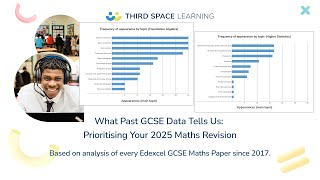
Webinar (Third Space Learning, presenters Tash & Paul) sharing a data-driven analysis of Edexcel GCSE past papers (2017–recent years) to prioritise Year 11 maths revision for summer 2025. The team split exam content into six topic areas (Number, Algebra, Ratio/Proportion, Geometry & Measure, Probability, Statistics) and reviewed frequency and style differences between Foundation and Higher tiers, highlighting high-frequency subtopics (e.g., fractions, standard form, quadratic graphs, compound measures, Pythagoras/trigonometry, cumulative frequency/box plots) and advising which procedural vs problem-solving skills to prioritise. The webinar also outlines Third Space Learning’s 20-lesson GCSE programmes, a three-slide lesson structure (exam question → scaffolded walkthrough → independent practice + marking), and points teachers to free downloadable resources: worksheets, topic lists (hyperlinked), exam blogs and yearly practice papers (Edexcel, AQA, OCR).
Chapters
So I think I'll start off by just giving you a brief overview of what it is that we do at Third Space Learning, just in case you're not familiar with us already. So there's two sides to what we do. We have our resource library. It's got a really extensive bank of resources and lots of GCSE resources to help with your revision, your teaching and your planning. And then the other side of what we DO is our one to one interventions. So we've been doing these since 2013. Now we pair up students with their own one to one maths specialist tutor via a headset and a shared interactive classroom. So we've got an image on the screen there to help you visualise that, if that's something that's new to you. And they have weekly sessions where they run through GCSE style questions, if they're on our GCSE program with their own tutor. And one of our most popular programmes is our GCSE programmes. And in the designing process of those programmes, we have gone through and analysed all the GCSE past papers from 2017 all the way through to last year's. So what we thought would be helpful, and that's what the purpose of today's webinar is, is to share all that data analysis with you and share all those insights to help you with your own GCSE revision planning, with your own year 11s. And then we'll briefly also just talk you through how we've structured our revision programmes and the lessons themselves. And that way, if there's some helpful bits there, you can steal them and replicate them with your own interventions, if you're running those in house or just with your own year 11 classes. And I'm joined today by Paul. So Paul is going to take us through all this brilliant data analysis of all the past papers today. So do you want to maybe just give a bit of background on yourself, Paul, and how you came to be at Third Space Learning?
Absolutely. Hello, everybody. So, my name is Paul. I am a maths teacher, or rather I was. I taught in the northwest of England for about 10 years as a classroom teacher, lead practitioner, and then did lots and lots of work as a specialist leader of education going around the northwest supporting departments. I've had the privilege of looking after secondary here at Third Space for the last four years. In that time, we have created thousands and thousands of thousands of free resources to help all of you and also created these incredible interventions which Tash was just talking about then. Now, how we have done that is what we're going to go through today. We have taken every single Edexcel exam paper from 2017 right through to last year. We've analyzed that data and all of that learning, plus the accumulated knowledge of our wonderful team of ex and current maths teachers has gone in to create these programs. So today what we're going to do is we are going to have a look at the major six topic areas which are algebra, stats, geometry, number ratio and probability. This is how we've split up all the data and this is how our resources are structured. So we're going to have a look at each one of these in turn, the higher and the foundation. And we're going to look at some of the key topics that have come up frequently over the last few years and then we can have a look at some ideas on where we might want to focus our revision in these final few months as we look towards the summer 2025 exam series.
Great. Thanks Paul. That sounds like a really helpful plan. If you do have any questions at any point throughout the webinar, just pop them in that Q and A box and then at the end we'll go over them and Paul will be able to answer them. So let's make a start. Can you just start by giving us an overview? What is it that we analyse each year?
So at the end of every single paper in the summer season, we go back into that paper and we have a look at it in detail. So we look at topics, we look at styles of question and we produce an exam blog. So that's what this is. We do that every year. We do that for papers one, two, and then we do a summary blog and then we do another one when the results come out. But because we've been doing this for multiple years now, we can take all that data and then apply it to our much larger blogs, which on the next slide we can see. We've got one for hire and one for foundation. Now this gives us so much useful data going right back to 2017 and it's this that's going to form the basis of our very quick overview of the topics and exam style questions that have come up frequently. So we're going to send out these slides really, really recommend that you have a look at these in detail because there's so much more information in here today. We're all very busy. We're going to have a whistle stop tour to try and give you some top tips that you can take away with you when use in your classrooms.
Great and the way that we've structured this is we're going to go through all the foundation first and then we're going to move on and look at all the topics in Higher. So that way, if you're watching this as a recording and you're mostly interested in higher, you can just skip across the foundation and watch the higher section. So let's make a start then. So, as I said, we're starting with foundation, and the first topic we're looking at is number. What can you tell us about number, Paul?
Right. So this is how this topic stack up over the last few years from 2017. This is how frequently they have come up in those exam papers. Now, what we're saying here is not that the most frequent topics are going to come up next year, and the least frequent topics are not. We obviously want to make sure that our students have access to a really rich and rounded curriculum. But what we are saying is this is what has happened over the last few years. So this is where we might want to focus our revision if we have limited time. So we can see the most popular one there, fractions, no big surprise there. And at the other end, we've got things like combinations and permutations. Now, when we look at this data in more detail, we see that there's lots and lots of questions on context. Rich topics like the four operations, calculation skills, basic arithmetic, all the standard foundation stuff. No real surprises there. But when we do see real life context at foundation, it seems to be more around bank accounts, utility bills, recipes, best buys. Now, what we saw coming up again and again is lots of procedural questions on things like standard form, interestingly, rounding and estimation, HCF and lcm, product of primes. So it's those ones you want to make sure that we're feeling really, really confident on from a procedural standpoint for foundation number.
Okay, sounds good. Thank you, Paul. And moving on to algebra.
Now, algebra. So solving linear equations proves to be extremely popular here. Now, we can see that in the middle we've got quite, quite a few topics that sort of come round in rotation. The key thing here at foundation is that algebra is mainly procedural. So we're talking things like expanding brackets with algebra in them. We're talking simplifying simple algebra. Algebra can often be challenging for our students, but there are some nice procedural marks available here. No surprise, the higher end topics like quadratic sequences, nonlinear graphs, they tend to not come up at this level. We push those too higher. So if we were picking a couple of things to really, really focus on with Our foundation children, it would be things like basic algebra skills, prioritizing things like sequences, simple functions. And it might be an idea to spend a bit of time linking simple equations to graphs.
Great. And students can often find algebra quite tricky. It's not necessarily a case of picking up easy marks here, is it? So do you have any insights on why do students find this particularly intimidating and how can that be mitigated?
Algebra is one of those topics where it's extremely abstract. Now that is a beautiful, wonderful thing. And we're a big proponent of maths is wonderful. And not everything has to have a real life context. So there's some really, really fun things that we can do with that abstract nature. But our students can find it a little challenging. So it's about going back to basics and focusing on those procedural. Procedural questions now. Seamless plug here. Tash. One of our thousands of free resources are our worksheets. And we've got. They've been very carefully broken down and developed by maths teachers. So the first part of our worksheets of every single worksheet has fluency style questions, intelligently varied fluency style questions. So it's that first part of those worksheets that you want to focus on, particularly for algebra, to get our students feeling really, really confident with those basic skills.
Great. So fluency as ever, really important in terms of accessing algebra. Okay. And moving on. Ratio and proportion. Got quite a few there that are sort of in the lead. How can teachers prioritise their revision in this topic?
What we see for ratio of proportionate foundation is two sort of distinct areas here. So we've got. There's a large number of problem solving areas. So with ratio proportion, no surprise, we see lots of direct proportion recipes, best buys. But in a problem solving context, we see ratio as well in there notation, splitting ratio, combining ratio. And we see a bit of compound measures as well. But there are some topics that are more likely to be assessed procedurally. So here we see things like unit conversions, we see things like proportion graphs, reverse percentages. Those are the topics where the students just have to answer a couple of marks here and there. They're great ones to pick up marks on this topic. So if we're going to pick a few things to prioritize, we want to look at speed, distance, time, really strengthening those compound measures if you're going for a higher end of foundation grade. And make sure that we're fixing those very basic, basic misconceptions around fractions within an hour. And all important calculator Use.
Yeah, great. Calculator use is always important across a lot of topics. So let's take a look at geometry. So we've got angles right out in front there and lots of real life sort of abstract contextual questions in this topic, isn't there, Paul?
Absolutely. So really interesting here. Look at this. We see transformations really, really high up here. So that is something that we can practice really, really well with our students. So it's about making sure we're going over our reflections and translations and enlargements, rotations. That comes up really, really, really frequently. Now as we start to go down, there's quite a steep drop off here. So these topics like vector notation and vector cal have come up, but they don't come up that frequently. So we might want to bear that in mind if we're prioritizing. Things like perimeter, area and volume are heavily problem solving based at this level. So it's often based in a real life context and it's often abstract. So it's not enough for our students to be good at finding the perimeter of something, we have to get them good at that. And then we have to move them on to a more applied style question and then Tash seamless plug number two. If we go down on those worksheets we were talking about before, the second part of them, we've got applied style questions. So you can break up these worksheets and use them however you want to. They're all free, they're all there to download. Please take them. Search for the topic. First part fluency Second part applied Typical context we see for these types of questions in the exam would be cost for fencing boundaries, covering areas with paint or grass seed, but that sort of thing.
Great, thanks. Really helpful, Paul. And moving on to probability. So we've got single event probability with quite a large proportion of questions there. And this is mainly procedural, unlike geometry, isn't it, Paul?
Very, very much so. So probability at foundation is mainly context free. So less time spent on probability, problem solving and rich, rich context. A lot more time spent on those fluency questions focus on procedural topics like Venn diagrams listing outcomes, frequency trees. These are coming up time and time again and they are lovely questions that we can pick up a few marks here and there. Where we do see a little bit of application is often around things like fractions, decimals and ratios. So we want to think about those questions or once we've got our students feeling really, really confident on the procedural style topics here.
Great. And moving on to our final topic within foundation statistics Once again we see.
That stats at foundation is highly procedural. So big focus on that rather than the problem solving and more context rich problems. Emphasis on presenting data is really really big here. So making sure our students are feeling really good about Dr. And completing different types of charts and graphs. Data collection interesting tends to appear less frequently. So those. And then when it does come up, we often see that students may be able to answer some of those questions more intuitively. So if we are being selective over where we're going to put the most of our time, things like key topics on pictograms and pie charts really really frequently come up. Scatter graphs, drawing and interpreting them really really frequently. Coming up estimating the mean. They like those questions too. So those are the ones we'd be focusing on the most.
Great. And we're going to move on to higher now. But I should mention once we finish sharing all of this data, we are also going to share the programme list that we've got for each target grade. So for example, if you've got students that are targeting a grade four, we've got a list of topics in order that is the most logical for them to revise in order to achieve the proficiency required for that specific, specific target grade. So we have done something really helpful with all of this data and we will share that. So if you are sort of scribbling, scribbling things away things down, we will be able to help with a sort of concise conclusion to what you can do with all this data in terms of planning out revision. So let's start with higher then. So going back to number, can you what are the key sort of findings here for?
And also Jas, just on that, just to say that we are going to send all the sound, all the slides are yours, we'll send out the recording, we'll send out all these links and do not worry about taking all this in now. There's a huge amount of information. We will send everything out for you. Okay, higher number, let's do it. So we can see that standard form stands out a mile here and we think about it. Well, standard form we can ask loads and loads of lovely things. We can add them, we can subtract them, we can times them, we can divide them. We include things like power powers in really, really rich topic. As we start to move down the list, there's a nice chunk of topics there that come up relatively frequently. And then it's only at the other end where we see things like place value and integer arithmetic not being assessed specifically. Very Much at all. And why is that? Well, at higher we start to see a move away, particularly at number, from the procedural to the applied. So a lot of those basic skills and foundation are just assumed at this point. So if your higher students are feel a little bit iffy with some of those topics, again, no problem at all. That's what our worksheets are for. That's what that practice is there for. But it's really important in order to access some of these marks. The fluency of those basic skills is really, really good. Where do we see our most interesting topics here? Well, we've got standard form, hcf, lcm, Surge manipulation. Lovely, lovely topic. It's coming up again and again and again and again. And there's lots of lovely procedural style marks in here, unusually for and things like error intervals. And as I mentioned earlier, using the calculator becomes more important than ever here. So making sure that our students are familiar and comfortable with the calculator they will use in their actual exam.
Thanks, Paul. And algebra. So we've got a quadratic graph, strong lead here for that. What are the key takeaways?
Look at that. Quadratic graphs is out there by a mile. They absolutely love it. It comes up so often and we can use it in so many different contexts, can't we? We can use it to solve equations, we can use it for transformations. So quadratic graphs, big, big tick on that one. Now the rest of them maybe that first, first, third or so pretty much for muchness. Lots and lots of lovely topics in there that come up time and time again. What doesn't come up as much would be things like gr, completing the square, not coming up very frequently and drawing and interpreting linear graphs on those papers. For algebra higher, a lot of topics are embedded and assumed embedded within other questions using assumed knowledge. We start to see a big crossover here with number. So it's really, really important that those skills are really, really strong. So when we're doing things like simplifying more complex algebra, expanding and factorizing more complex expressions, there are though some notable procedural topics here that are a little more accessible. So iteration tends to be more procedural, inverse and composite functions, nth term of a quadratic sequence or more procedural style marks. So if we're going to choose a few things to focus on, what would that be? Well, we might want to do a bit on forming and solving equations and inequalities, linear, quadratic, simultaneous. But we might want to have a look as well at some of the more challenging topics with our higher end of our Higher tier students, things like algebraic proof and quadratic equations in context. Really nice questions there that come up frequently and when they do come up, they're worth a good number of marks.
Okay. And ratio and proportion. Again, we've got a strong lead there with compound measures. Is that what you suggest focusing on then?
Well, yeah. So again, a bit like foundation here we see a nice little split between those that tend to be assessed through more reasoning style questions and those that tend to be assessed through more procedural style questions. So key topics for proportional reasoning would be things like direct proportion, but in more of a context, and those compound measures. So speed, distance, time, but again in more of a context. So a clear distinction there from foundation. The topics that are more likely to be assessed procedurally would be things like unit conversions, light foundation, interestingly and simple, and compound interest. So if we were going to pick a few things to focus on speed, distance, time again here and focus on those crossover topics at higher things like reverse percentages and percentage change, they're coming up again and again and again on that crossover section of the paper. So they are nice topics to get your students to practice here.
Great. And geometry and measure. What are the findings here, Paul?
So geometry and measure, large amount of problem solving here, huge amount of problem solving. And what we start to see is significant crossover with other topics. This is where algebra and number really start to come together wrapped up in a beautiful geometry bow. So we've got things like solving equations, Pythagoras, trigonometry, all wrapped up in different, different types of shapes and parallel lines. There's so much work that we can do here that relies on previous knowledge. So it's really important that the proceduralness of the, of number and algebra at the foundation level is really coming into its own at geometry higher. So things like knowledge of rectilinear shapes, area, perimeter of them assumed at this point, and we're going to use it and apply it to gain those higher level marks. And as I said before, Pythagoras and trigonometry, big, big marks available here, often associated with big multi step problem solving style questions.
And you've mentioned to me before, Paul, that with this topic it's really important that students are flexible with applying different methods rather than just applying one method to every type of question. So do you have any advice how to promote that flexibility?
Yeah, absolutely. So particularly with these styles of questions where it can be incredibly overwhelming for our students, they're given a question that's got three or four different things going on in it. From three or four different topics. And students can often just go, oh, I'm not sure what to do. So one way of giving our students lots and lots of confidence in order to tackle these problems is to just break it down and take it step by step by step. So a nice technique might be to take an exam question or take one of those applied style questions from our resource library. Print it off, put it on the whiteboard, start to read it together with your students, and then we can read the first line. And after the first line, it might say the word area. So rather than carrying on down the question, I can stop and I can see, well, look at the shape in the question. Can I find the area of it? If I can't find the area of it? Maybe it's a trapezium. Can I write down the equation of a trapezium? What can I do with the information in that first line? Then let's do the second line, do the same thing again, let's do the third line. And then by the time we've got to the end of our question, it's highly likely that we will have at least picked up a couple of marks. And even if we haven't picked up a couple of marks, because the mark scheme wants very specific things, we've got lots of different information on the page and the student can begin to see, oh, I've got this, I need to do this. It's a lovely way of breaking down those questions and making our students feel a little bit more confident. So I'd really recommend giving that a go, particularly with geometry, particularly with those Pythagoras style questions. All you have to do, go to thirdspacelearning.com, go to resources, type in Pythagoras, download one of the worksheets, download one of the exam questions.
Great. Yeah, really nice way as well to encourage some confidence with your students as well. Even if they don't immediately know what the answer is or what they need to do, there's still a good chance that they can pick up marks. And making them aware of that is really helpful because picking up a few marks here and there can really make a difference even if they're not getting the the end answer correct. Okay, so next topic is probability. We have independent and dependent combined events way out ahead there, don't we, Paul?
We absolutely do. So once again, probability at higher, like foundation is largely procedural, but where we start to see some differences, we see there that independent and dependent combined events is one way out ahead at foundation. The Questions tend to be more, more around just, just drawing, drawing things like frequency trees. Here we're reliant on lots of other skills that we've already picked up and developed in number in algebra. So we want to make sure we're really good with our fractions, decimals and percentages so that we can apply those to probability. Questions such as probability of multi, of multiple events happening. Venn diagrams and combinations are particularly important here and they appear frequently in similar style question formats year after year after year. If we were going to pick a couple of things to focus on that would be something like tree diagrams. They come up a lot more frequently than frequency trees and as well as, as I said, applying our fraction and ratio skills to a variety of unfamiliar contexts.
Great. So we've reached the last topic of higher, so stats.
Well done everybody. Okay, we've nearly made it, nearly got to the end. We've got stats and we've got higher. Okay, so here we want to emphasize charts and graphs. That is really, really, really, really important. Focusing on drawing and completing them and interpreting them and critiquing them. Topics like cumulative frequency, box plots, frequency polygons. Again, they are very frequently occurring topics. We can see there at the top, we've got equal. That's the equal joint, top one. Very, very, very, very nice questions there come up an awful lot. That being said, there are some processing marks available here, so things like estimating the mean from a frequency table, quite a common question, comes up time and time again worth spending a bit of time on, as well as classic questions like calculating the interquartile range from a box plot. Now we see that things like data collection, sampling doesn't appear in every series, but when it does appear, it's worth a good number of marks. It's worth spending a little bit of time on it, but if you're short of time, focus on those cumulative frequency graphs.
Brilliant. And that is the end of all our graphs. So thank you so much, Paul, for walking us through.
We did it.
We did it. Thanks for walking us through all of that. What we're going to show you now are the list of sessions in each of our GCSE revision programmes, which you are obviously more than welcome to steal. You could even cut these out and give them to different students, depending on what their target grade is. What we've done is we've used all that data that Paul's just walked us through and everyone on the team's experience teaching to build cohesive lists of topics that should be prioritised to help students achieve the proficiency that's required for each specific target grade. So, for example, when schools come to us to use the GCSE programme, we'll have a range of students, so we'll have some students working through that grade four list, other students working through that grade five or grade six or grade seven list. So it's really tailored to get the most out of their revision, depending on where they're working at. We also appreciate this obviously isn't a one size fits all and you might have students who are actually particularly confident with certain topics or really need more time spent on other topics. So you could always use this as a starting point and make your own edits and make any changes to fit your class. But we are hopefully catering to a lot of different students with these lists and saving you a bit of time going through all those graphs and trying to come up with sort of a final list. So do you have anything else to say about these books?
Just like absolutely everything we do, we are maths teachers, we are former teachers. Everything we do is to try and support all of you lovely people to deliver the best possible maths lessons, to give the best possible opportunities to all of our students. So these lists are the product of all that data, all the combined experience of a team. This is what we think would be a great list if you wanted to revise for a particular topic. So this is what our intervention programs follow, this is what all our tutors follow, but they're also there available for you to use. Take them, download them, chop them up, give them to your students, use them as the basis of an intervention, whatever you want. We think though that once we've. So we've got all of our topics there, we've got the topics from our data, but as I mentioned before, the blogs, which I really encourage you all to read, go into a lot more detail. So not just talking about topics, it also goes into detail around question styles, question types, where marks come from. So, so we've gone one step further with our interventions and we've created, if you go into the next slide, Tash, we've created this little structure which the intervention program follows this. But you might just want to use this in your, in your everyday interventions too. You can download, load some example slides from our resource library. Every single one of those topics is then broken down into a series of either maybe three or four different exam style questions which have been proven by the data to cover up quite frequently. So we take an exam style question, that's that one on the left There and we let our students have a go, go through it with them, see how they get on. Our tutors are there to support and provide guidance. Then if the student needs it, we go on to the second one. Now, this is a scaffolded slide, so this is the let's go through it together slide. We can go through it step by step by step using all of the learnings from the data from, from those exam questions over the past few years, we can see where the marks come from in exams and help our students to feel really, really confident breaking down those questions. Now, once they've done that, the most important thing is the student then has a go by themselves. So we move on to our third slide, the your turn, where we try a very similar exam style question independently with the tutor there ready to support and then crucially, mark and show the student exactly what they need to write down in order to get the maximum number of marks they can in the exam Using that data, we can see here, this question was worth three marks, so it might be that the student at the moment is only going to get one mark, but that's okay, we're going to get one mark and then we're going to show them exactly where to pick up two marks and then we're going to show them where to pick up three marks. So we're building that confidence, building that resilience so that when it comes to exam day, they are feeling really happy with this style of questions. Once the tutor is happy that the student is feeling happy with this style of question, we'll move on to the next style and we repeat this three or four times per lesson. And there's 20 lessons per programme.
Yeah, and also this approach means that we can really optimise their revision time and get them the grade that they need to be even in a limited amount of time. Because if they have shown that they're confident they understand this topic already, then they can go straight on and start tackling questions more independently and challenge themselves versus if they do need a bit more support support and a bit more time to unpack the question, then they've got their tutor there ready to take them through the support slides. So we're sort of not wasting any time and we're making sure that the students are working at the pace that is the most effective for their particular start point on that particular topic. So thanks for walking us through how we structure those lessons, Paul. And where can teachers find all our analysis? So from 2017 all the way through.
To 2025 it is on our wonderful database Learning blog. But do not worry, these slides will get sent out, this recording will get sent out and there's links on there, just click on the links. And there is the higher one for the last few years and there's the foundation one. And we go into so much more detail in that we've not had much time here. So we've given quite a high level overview in there. We're going to talk about exam style, different exam style questions, we're going to talk about crossover questions, we're going to talk about the most frequently use topics for the first five marks, for the first 10 marks, we're going to go into some teaching tips. It's really detailed and it's the accumulation of many, many years worth of past papers. Well worth a look. So it's all on there, all you have to do is click on the link.
Great. And we did just want to draw your attention as well to our topic list. So I know these are really popular amongst students partly because it really helps them with their organisation. They can tick off these topics as they've revised them and as they feel confident with them. But also within all of those columns, all of those topics are hyperlinked. So if you would send them a copy of this, they could click on the topic and it would take them to the revision guide and resources that they can use in their revision. Do you have anything to say extra about the topic list, Paul?
Only to say that these are lovely resources, all our resources are free. Take them, use them however you want to. You can print them off and give them to your students. They can tick off the topics. It might be that you've then identified a couple of topics, perhaps based on the data from this webinar from the blogs. You can email them this, they're all hyperlinked and then the students can go, okay, I need to focus on types of graphs, go onto the list, click on types of graphs, go straight to our resource library. You get thousands of free worksheets, questions that mark themselves videos, examples, loads of stuff on there. So it's a really versatile resource, really encourage you to share it with your students.
Definitely. And another resource that we've got which is based on all of that data you've walked us through is our practice exam papers. How can these be used and why are they so beneficial?
Paul, just like all of our GCSE programmes, in our interventions with our tutors, all the data from since 2017 up to now that we've shared today, it's in the blogs has gone into creating a our exam papers. We make a new set of these every single year. They are absolutely wonderful. They are most popular resource. We have a brand new set coming out for 2025 and this webinar has been about Edexcel. But we also make these for AQA and also for OCR hire and foundation. They are really, really nice and they are predictions of what we think is most likely to come up in the next year based on all of our experience, based on all of the data. Data.
Brilliant. And that's everything we wanted to take you through, but we obviously have had limited times. So we do have lots more available to help you in the run up to your GCSEs. So we've got SLT guides, we've got our intervention packs. So those are based on the interventions that we run, but you can download those and use those with your own small groups if you're running interventions in school. And we've got blogs and articles which Paul's talked already about how much information is on those blogs and insights and predictions. We have fluency programs and then this focus of today has obviously been GCSEs, but we do also have lots of key stage 3 resources. So if you've got teachers in your department who are just focusing on Key Stage 3 this year, then you can always point them in the direction of some more Key Stage 3 resources that we have on our website. And then finally we do also have our one to one interventions, but we've already spoken through our GCSE program and how that all works and how the lessons are structured. So if you do just want to find out a bit more, have a conversation about your cohort of year 10s and 11s and what works with them and what you've done with interventions and how we might be able to help in the run up to exams, then do feel free to pop me an email. We can have a call and just chat it through. And my email is in that yellow bubble on the screen there. So if you do just want to find out a bit more and have a chat, then you can just pop me an email whenever. And like we said, we will send out all these slides and lots of things are hyperlinked so you will be able to just find exactly what we're talking about by following that link. That is everything we wanted to cover today. So I think all that's left is to go through questions. Unless Paul, did you have anything else to add?
Note just to say that we are here to help so anything that we can do to support you and your students, let us know. And whether that's reaching out and seeing how we can support you with our one to one interventions, or whether it's how supporting you in the classroom with all of our free blogs and free resources, just let us know. We're here to help.
Great. Thanks so much, Paul. You've taken us through a lot there. So thank you very much for your time this afternoon. I'm just looking at the questions and this does apply to Edexcel. And then we've had another question about whether we're sending out the recording, which we will be. Will be sending out the recording and the slides. So everyone who's registered will receive that in their email inbox tomorrow morning. But that's all from me. So again, thank you so much Paul and I really hope that this was useful for everyone who joined in terms of thinking about planning your revision in the run up to exams. And if there is anything else that you would like more information on, then you can pop me an email. Email. And we can always set up a phone call if you want to discuss anything further. But thanks again everyone who joined and have a lovely evening.
Thanks everybody. Bye bye.
Bye.
More from Rob





The Top 20 SATs revision topics 2026: A focused revision approach for maximum impact in minimum time

GCSE maths marking 2026 decoded: using examiner insight to improve teaching and results


How To Embed AI Literacy In Your School: Practical Steps To Get You Started [Webinar Replay]


Reviewing And Planning Your School's AI Approach: A Strategic Framework [Webinar Replay]
