What Past SATs Data Tells Us: Prioritising Your 2025 Maths Revision
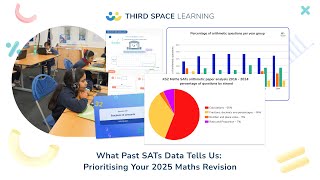
This content was created by Rob Langman. This content was uploaded by Rob Langman. This is a YouTube webinar titled "What Past SATs Data Tells Us: Prioritising Your 2025 Maths Revision" (created 2025-01-23) presented by Third Space Learning. The session is a structured webinar led by Tash (host — former teacher working on interventions at Third Space Learning) with Terry (content lead) as co-presenter. They review SATs question- and topic-level analysis from 2016–2024 to recommend priorities for 2025 revision: emphasising number, ratio and algebra (≈80% weighting), calculation/fluency, and Year 6 content trends. They describe how Third Space Learning sequenced a two-part 20-lesson SATs programme (a “golden list” of top-impact lessons then follow-on topics), introduced developing-fluency lessons, diagnostic baseline and end quizzes, lesson pathways (initial check, scaffolded support, reassess), mandatory “Ready for a challenge” slides, exam-strategy prompts (stickers), and practical resources (slides, recording, CPD, intervention packs, maths hub). The presenters also note how teachers can adapt the sequence based on diagnostic data and classroom context and confirm slides/recording and resource links will be shared.
Chapters
Good afternoon everyone. Thank you so much for joining. We'll just give it 30 seconds or so just to give people a chance to log on and then we will make a start quite promptly. Great. Can see quite a few more people joining. So hi everyone, thank you so much for joining. We'll just give it again a few more seconds and then we will make a start. Okay, I think we'll make a start now because quite a few people have already joined and then I will be sending out the recording and the slides after. So it's not a problem at all if we have some latecomers. But I'll start by giving you a bit of context on Third Space Learning, just in case you're not already familiar with what it is that we do. So there's two sides to what we do. We have our mass resource library. So this is a really extensive bank of resources at primary. It ranges all the way through from year one through to year six. And all the resources on there are designed by our team of curriculum specialists and former teachers. And then the other side of what we DO is our one to one maths interventions. So we've been delivering these since 2013. Now we've delivered them in over 4,000 schools. So we've really got lots of insights from doing those. And one of our most popular program is our SATS revision programme. And in order to design and develop that program, we have done lots of SATS data analysis. So we've analysed the SATs papers from 2016 all the way through to last year's paper, so the 2024 paper. So the purpose of today's webinar is to share that data analysis and share our insights to hopefully help you with your SATS revision planning, figuring out which topics you should prioritise and how to just plan the run up to sats. We'll also talk a bit about how we've structured our SATS programme, so hopefully you can replicate some bits and take things away from that in your own SATS revision. A bit about me then. So I'm Tash, I'm a former teacher and I now work on the intervention side of things at third Space Learning. So I'm speaking with teachers and SLT about their approach to interventions, how they're running it, what's working for them and how third Space learning can support in their intervention approach. And I'm joined by Terry, who's our content lead. So she's the brains behind all of our SATS programme and all our lessons. So she's going to be taking us through her analysis and how we've structured the programme. Do you want to maybe give a bit of background and how you ended up at tsl, Terry?
Yeah, sure. So, hi everyone, I'm Terry, I am the content lead at Third Space Learning. So what that basically means is that I sort of oversee and create any of the content that goes in front of our pupils on our one to one intervention programs. Before that also at Third Space Learning I was training and development coordinator where I worked quite closely with the actual tutors, making sure that they so training them to be able to deliver to UK methodology, making sure they were confident with bats. And then before that I was a primary school teacher for around 10 years and the majority of that was in year six. So I can remember still very clearly the kind of like frantic SAT season build up, trying to get the revision program sorted and making sure my bases were covered. So hopefully I'll be able to share kind of some of my own experiences of that and how that sort of relates to what we have analysed and done to our own program.
Great, thanks Terry. And if you do have any questions for Terry at any point during the webinar, do just pop them in the chat and at the end we will go through them and answer your questions. So let's make a start. So before we start looking at our analysis, we're just going to take a high sort of level overview of the stats paper itself by starting with the format and the specification. So probably not anything you haven't seen before, but I think a good place to start. Do you want to just walk us through this, Terry?
Yes. So what this is is it's the test developer framework. So basically the people that develop the tests, what they work to it is available publicly if you wanted to look at it in any more detail. But I think that these kind of areas are the ones that year six teachers might find the most interesting. As you said, Tash, it's not going to maybe say anything that's it is hugely surprising. But some of the numbers may be higher than perhaps what you would have thought. And I think it does offer a really good starting point when you're trying to think about which areas to cover first. So I'll just draw your attention first of all to the paper summary table there, which just breaks down the paper and the number of marks. So as I'm sure you are aware, there are kind of 110 marks in total across the maths papers. 70 of those are reasoning marks. So that is the more Heavily weighted part of the marks. Which is why, you know, in our revision our program is structured that way that it is more weighted towards reasoning. It's always the more kind of mysterious paper as well. We don't know what's going to come up year on year and then the arithmetic there. I will just draw your attention to the marks here as well because whilst that is 40 marks on its own, that is the most heavily weighted paper in terms of marks and it is still a significant portion of marks as well. And I guess one of the themes that we will talk about today is about making how to kind of structure the revision so that it balances that arithmetic and the reasoning so that you give your pupils the best chance. I mean a lot of ways you can think about the arithmetic as almost kind of like low hanging fruit in a lot of ways that they are kind of marks that you can almost guarantee that pupils can get if you can just kind of get it right with the revision. And then if you look over at the overall domain coverage, this is where I would be looking for my revision plan and what I was going to do. So this framework splits the kind of areas into two very broad strands. The first one is number ratio and algebra. And you can just see there the kind of strands that come under that. And I suppose what's really interesting here, and I think, you know, when I was teaching I probably would have, would have said, well I know I would have known to an extent that this was going to be the highest weighted area. But if you actually look at the percentage, it is actually 80% of the 110 marks that comes from that number ratio in algebra area. So I'm not sure I would have maybe said it was quite that high. But that is, you know, that's hugely significant in comparison the measurement, geometry and statistics strand is it only accounts for about 20% of the marks. So straight away there when I'd be setting up my plan, I'd be thinking I have to really make sure that that number ratio and algebra strand is like nailed down and my pupils ready for whatever questions are going to come up there. So that would 100% be coming towards the top of my list for what I absolutely had to have revised. I'm definitely, obviously not saying, you know, just don't bother with the second strand at all. It is still very important. But you know, if you've been in year six before, you'll know the kind of patterns is sometimes, you know, something will come up on a paper so you might get area One year, next year area might not be there, but perimeter will be. This year, for example, I don't think volume was there. So some, sometimes things will drop out of the papers and you can pretty much guarantee that it will be from that second strand, whereas you are never going to get something dropping out of that first strand because the weighting is so, so high with 80%. And then you just really quickly can look at this broken down by paper, which again won't be surprising that obviously all of the marks in the arithmetic are come from the first strand, whereas the two reasoning papers are more spread across the two, but still weighted towards the first strand. And so I said, I think this, this is a really good starting point. So, you know, you've got it right in terms of what the test is going to look like, but it's also too broad in its current state. So what we have done, and hopefully, you know that you, hopefully you'll be able to take some useful information from this, is we've drilled down into that and created kind of a very, a structured program that makes sure that all of those areas are covered in the most kind of in the order that will maximise marks for pupils.
Great. Really helpful. Thanks, Terry. Yes, it's a good starting point, a good basis, but we have got a lot more detail coming for you. So let's start by looking at some of our own analysis. So here we've got our question level analysis, so we've split up the questions by their year group. Can you talk us through the key takeaways here?
Yes. So this is kind of the first bit of analysis that we do. So we every year we take the paper, go through the questions and we just kind of look at, analyse which year group it has, each one has come from. So you'll see some of the trends there. Looking at the bars, obviously you can see straight away that each year the year group with the most content is year six, which I suppose you'd expect from an end of Key Stage 2 tests. But what I do also want to draw attention to is just that pattern of year six coverage that you can see, and you can see from the data where we started analyzing it in 2016, there's like a gradual increase in the amount of year six coverage that kind of creeps into the paper. And I. Those were in those years I was myself in class and I certainly had a feeling back then that the papers were just getting a little bit harder every year. The wording was just slightly more complicated, more layers of thinking involved and Then there is like a drop there in 2022 and 2023 in the year six coverage, which is likely because of the pandemic and the effects of that. And then what's interesting is that this year, that year six coverage has crept back up again to kind of pre pandemic levels. So again, the expectation is that pupils, they need to have access to this year six content. It's really important that they all see it and you know, are exposed to the year six concep. It's the most of the paper and it's also starting to creep back up in the amount that's in there. So that is super important. But I will caveat that by just saying that the year 3 and 4, your lower key stage 2 content, it is still there and it's still a significant portion of the papers that you can, you know, you can get marks on. And I think, you know, year six is so busy, you have a lot to cover and I think, you know, comes home, make the assumption that the year or you hope that the year three and four concepts are kind of in place. But it's just really important, I suppose, that there's still time allocated to that to just make sure that those concepts are secured because, you know, well, for them one of the main reasons is that those are the foundations for being able to access the Year 6 content anyway. So if they've got gaps lower down in these concepts, they're probably going to really struggle to access the this higher level year six stuff anyway. So. And what it's even more important for is those cuspy students which were the ones that I had a lot, a lot of experience of working with those ones like hovering around the 98, 99 standardized score and you want them to tip over into 100, but not quite there. They can pick up a lot of marks earlier in the paper because the way the paper, as you may know, progress is that the earlier half of the paper is made up of those year three and four concepts. And then it will progress in difficulty. Those cuspy students will pick up probably the majority of their marks from the year three and four parts of the paper, which is why, you know, it has its, its place in the revision kind of plan to make sure they are secured. And we're giving everyone the biggest chance they can. And our lessons do go some way to kind of take that into account as well, in that all of our intervention lessons have a question that will appear at the start of the paper, questions that will then appear in the middle and questions that will appear at the end to make sure that we've got kind of have all the bases covered and we are still pulling in those kind of easier year three and four content.
Yeah, thanks, Terry. It sounds similar to things I hear a lot on the phone when speaking with teachers and meeting with teachers is that it's really tricky when you. For any particular topic, any given topic, you've got pupils who still really need to be mastering and getting confident with the easier style of questions that appear earlier on in the paper. And then you've got other pupils who've mastered those sort of early in the paper questions and need to be spending their revision time getting more familiar and having more time practicing the trickier questions that you get towards the end of the paper. So that's sort of a key benefit of being able to do really small group or one to one interventions is that you can divide the work and have some pupils work through a slower pace if it's a topic they find particularly difficult. And then the pupils who need a bit more practice on the trickier questions are able to speed along to that. But we'll talk about in more detail about how our interventions cater to that a bit later on. But let's look at our next level of analysis. So here again we're looking at questions, but we're looking at them by topic rather than by year group. What are the key findings here, Terry?
Yes, so this is the analysis we do that just looks at basically the areas that have the most coverage. So it links to that test developer framework that we looked at on the first slide. But this is kind of broken down into more areas so you can see exactly which things that we need to hit. You're probably looking at that and thinking I would probably been able to guess that that would have been the kind of, you know, the general coverage. But what I really just want to draw attention to in this analysis is that calculations percentage, which is just absolutely massive and you'd expect it in the arithmetic. It's over half of the paper that comes from calculations, but it's also still the strand with the most coverage in the two reasoning papers as well. So I guess the kind of key takeaway there and something that we have built into our own revision program also is that we really just have to make sure that pupils are secure and confident with these kind of this fluency and these, this calculation ability. And it's one of these things that sort of, you have the pupils in year six and you kind of hope that they've come to year six with some kind of ability influency that they can calculate, they can add and subtract and multiply and divide. And there is an element of truth to that that pupils that are coming to year six probably do have. They are able to calculate. But I suppose a question mark comes over whether or not they can calculate efficiently, which is what kind of is often the drawback that people can calculate but they're not always choosing the most efficient strategy which does have knock on effects in that kind of when they're doing the paper. So we have tried to address that this year by where our program has always before been kind of pretty much all reasoning focused. As you know, that is the majority of the marks. But because they need this calculation ability to be able to access that reasoning, it's almost like a prerequisite for it. We have introduced this year our developing fluency lessons which are designed to mirror the arithmetic and not only just kind of, you know, go through arithmetic questions and as long as they get it right, move on. We really try to unpick methods that are being used and making sure that, you know, pupils aren't just always doing column methods when it's not the most effective thing to do, that they're being able to pick the most kind of time effective strategy to work through the question.
Yeah, I was just about to pick up on that point of time. It's also so important that they're fluent so that they can actually get to the end of the paper and do those higher mark questions because they haven't lost lots of time doing inefficient methods where they didn't need to be using those methods. And then also just allowing them to have more time to spend on the trickier questions rather than wasting time on questions that actually could be using far simpler methods to get to the answer. Okay, unless you've got any more points on here, let's move on to our next level of analysis. So this is looking at our SATS programme revision lessons and how the marks are allocated across each of those lessons.
Yes. So this is kind of the last bit of analysis we do, which we do this to basically make sure every year that our revision, our Satch revision programme is still fit for purpose. So we go through the papers, then we look through the questions and we allocate each question to one of our revision lessons and sort of where there are perhaps pockets of questions in the paper that don't quite have a lesson, a task attached to it in our program, we then kind of Create a new lesson or we readjust based on that. So it just helps us make sure that we have. We are covering the right things and that we're covering things in enough, you know, in enough detail. Like, you know, we may have, you know, not just necessarily having a fractions lesson, but have we got lessons that are covering equivalent fractions, also ordering and comparing fractions, also calculating with fractions. Like, are we covering all of the bases so that it matches all the kind of. Of ways that a question might come up? And what this graph is shown here is sort of what are top five areas in the. Of our program, what those top five areas are coming out as. So these are our kind of top five reasoning lessons that comes out with this analysis, which you can see. Again, you'll probably look at the areas and think, yeah, I see. I would have guessed, like, had a kind of good idea that those would have come out at the top in terms of the number of marks and coverage in the paper. Multiplication division problems is top. Then multiplication division facts, addition, subtraction, decimal calculations and calculating with fractions. So those are kind of your areas where you really want to nail down the concepts and to make sure that the pupils are going to be ready to get into the paper and be able to answer any questions that are going to come up in those areas, because they are very likely to have a high coverage and. Or mark weighting.
Yeah. And particularly helpful if you've got those cuspy peoples you referred to earlier, where you really want to prioritise the topics that are the most heavily weighted and will have the biggest impact on getting them over the line. And this analysis leads us nicely on to our sort of golden list. So the top 20 most impactful lessons where we've of course taken into consideration this data analysis. So which topics are the most heavily weighted in terms of marks, but then we've also made sure that it's sequenced logically and that it's sequential and is a cohesive learning journey for the pupils, rather than skipping ahead and missing prerequisite knowledge. So, Terry, could you talk us through how you came up with this final list and the thinking behind it?
Yeah, so a lot of work and thinking does go into this because whilst you have. Have to make sure that you know what you're covering. So this is. Our program is split into two programmes, each of 20 lessons. And this is what we're saying is our highest impact lessons. And there definitely has to be a trade off between making sure we have got those high mark, high coverage lessons in here, because those are the opportunities for pupils to pick up marks. But it has to be cohesive and sequential in its manner. So you can't just be putting, you know, all of the things that are worth the most marks at the top. You know, if you did that, you'd have something like mixed operations right up there at lesson one, because the mark rating would probably be. Would be very high for that. But they wouldn't be able to do the mixed operations like revision lesson until they had secured other concepts, until they've done addition, subtraction and multiplication, division and been exposed to other kind of word problems. So there has to be this element of, like, making it teachable and logical in the way that it moves on. And we. We have to take account our analysis, which shows us the coverage, but also from what we know about our lessons that our tutors deliver, you know, we have thousands of lessons that take place and we look through them and we see how these are kind of, you know, taking place and if we need to change anything, and we quite often do change the order based on that. So one of the main things that came out of some kind of, like, sessions was that we noticed that you might see reasoning with multiples factors and prime numbers there and think, I'm surprised that's, you know, number six, that's quite high. Its mark weighting is probably, you know, quite low. But the reason that is there is it was actually moved quite recently because we were finding when we were watching the lessons that, you know, the pupils couldn't access the reasoning with multiplication and division problems lesson because they didn't have multiples knowledge. So they had a gap and that was preventing them from being able to access this, you know, slightly more, I suppose, complex learning objectives. So we had to rejig our order based on that, which is why multiples, factors and prime numbers is first and then multiplication, division comes in a little bit problems, comes in a little bit later. And then within that, you'll see this year where our fluency lessons are kind of interweaved throughout the programme. And that is something that to consider when you're thinking about the revision for your class math. Sometimes it can be that, like the arithmetic revision is, you know, kept quite separate, so, you know, arithmetic and reasoning, revision. But I think that building it into the whole learning journey does have an advantage in that pupils are then accessing prerequisite, kind of like fluency practice that they need to then do the associated reasoning lesson. And you'll see in the order there that we we put the fluency, where possible, always before the associated reasoning lessons, so that we feel like we've built up that calculation and fluency, that they need to be able to do that more tricky kind of reasoning.
Yeah. Well, I hope this list is helpful for some of you. Obviously feel completely free to steal it and make use of it in whichever way you see fit. Obviously we appreciate it's not a one size fits all solution and you know, you're your classes and your pupils best. So you can always use this as a starting point. And if you want to prioritise other topics that aren't on there or manipulate the order a bit, then that's great, that hopefully it's a good starting point and could potentially use it to form the basis of a diagnostic assessment and go from there. We'll come on to that, we'll talk to you a bit about how we use diagnostic approaches to tailor this a bit. And if you do have time, then we have a follow on 20. So the next 20 most impactful topics. Is that right, Terry?
Yes. So these are, you know, they're still, you know, super important and obviously the ideal situation is that you can cover all of these in the, you know, the depth that is necessary. But obviously we've put these in the kind of like second program as kind of the next highest impact because you'll see that this list includes probably titles that would fall under that second strand. On that first slide, we looked at the measurement, geometry and statistics. So, you know, I, we, in our program, we, the pupils have to go onto the booster first and they have to, you know, secure those concepts and make sure that those are, that they're confident in those and then they can move on to the follow on. And, you know, still, you know, there's still really important objectives in this one as well, but they just. Obviously it might be that some of these, you know, they might not come up one year, as we talked about earlier, but. So this is why they're in like a second, a secondary list, as it were.
Yeah. Great. And taking a look at assessment data and how this can play a part in your SATS revision. So this is how we start off our SATS revision programme. Each pupil does this baseline assessment and part of the reason for that is so that when they finish the programme, they can do a programme end quiz and then we can send through a comparative report so you can see exactly where they started, everything they covered and where they ended at the end of the programme. In terms of Progress, this has 20 questions and is Just a great way to highlight which areas might need a bit more time and a bit more attention spent on them. Do you have anything to add about assessment and its part start, Terry?
Yes, there's always, you know, a place for any kind of assessment that you can do and obviously, you know, as teachers, you know your class the best and what they need. I suppose it's just like a similar kind of thing to think about, about, you know, the order of revision. There's just like a trade off between obviously if you can do any type of like, you know, pre assessment or diagnostic work or you are aware of where your class have gaps, it's about just trading off between that and then where that would place next to some of the more high impact kind of high coverage kind of areas. So you know, if you know that your class, for example, has got some gaps in sort of, you know, 2D shape knowledge, would you put that as your absolute, you know, top priority above, you know, addition and subtraction, multiplication, division? Maybe not, because you wouldn't want to sort of then lose time and not be able to cover these, these really high impact areas. But I do think that that pre assessment data is really useful in terms of deciding how much time you're going to allocate to different areas. So if you know that, you know, 2D shapes is potentially an area that's going to be problematic. Then you know, when you're kind of sorting out your revision and what you're going to cover and when maybe there's more time that can be allocated to that to make sure you've got time to build in sort of scaffolding or support if necessary. Whereas if you think, you know, my class are pretty much solid with addition and subtraction things, maybe there can be sort of slightly less time to allocate allocated to that. So just a way in which of sort of changing the pace of sort of how long it takes you to get through rather than, you know, putting things potentially in a different order. But it is, it is very dependent on your class basically and how you feel, where you feel they need the work.
Yeah. And moving away from the initial assessment and into the lessons themselves. We're going to talk through a bit how we've structured our lessons and then hopefully some of this can be replicated or you can just take some ideas into your own intervention lessons. So could you maybe start by giving us an overview of how we've structured the revision lessons, Terry?
Yes. So see some screenshots on the next couple of slides. Just that I've taken from actual lessons, so this is from one of the new fluency lessons that I mentioned. So hopefully you'll see that kind of the kind of, kind of similarity to the arithmetic paper and how we've tried to structure it. But both types of lesson, the reasoning and the fluency, they follow the same structure, which is, you know, hopefully something you can think about. If there's a way you can kind of take it back and use yourself in that. We always give the pupil a chance to practice kind of question first. So just as a type of, kind of like, you know, formative assessment, can they do this? How confident are they with this type of question that I'm doing? And then if they can do it, they will move very quickly through that learning objective and onto the next one. So there's not kind of lots of time spent on a lesson that they're very confident with. If they can't do it, though, then we do have support slides built in so that we're ready, the tutor's ready to be able to scaffold that with the pupil, go through the skills they need to answer that type of question and support the learning. And then if they've used that slide, we give some more questions as, like a form of post assessment to see if they are. Are now secure with that, with that kind of, that question topic. Obviously, if they are not, then that would identify an area that really does still need work. And if you look on the next slide, you'll see it in a bit more detail. These are some shots from our reasoning lessons. Again, you'll see how they mirror very closely the SATS questions and papers themselves and you'll see kind of the pathways that pupils can go on here in the lesson. So. So these slides are all from one lesson and again, the structure is the same. So if they are able to, if they're very confident, the tutor can quickly adapt to the pace of that lesson. And they'll just go from the question. First question. Yep, they can do it. Next question. Yep. Third question. Yep, finish. Whereas if there's, you know, more support that's needed and there's some gaps and they'll take a more, you know, a different pathway through the lesson. So they may have to do a couple of support slides and the reassess slides, which you can see kind of going down the support slide and the reassess side that's attached to each set. As I mentioned, all of the questions we use are very, very similar to past SATS questions. So we make sure that they align very closely. Where we can we change, like the context or the wording ever so slightly, but we make sure that we're building that kind of familiarity with wording and the ways that questions can come up. And we also allocate marks in the same way that they do in the stats papers. And we help our tutors make sure that they know how to go through the that and discuss that with the pupils. It's one of those things that make some pupils that always know whether to look at the marks. And one of the things that came out of this year's papers was that actually there was peoples were expected to do quite a lot for not very many marks. And there can be an assumption sometimes that because there's four things, surely this is going to be worth two marks, so I can still get one mark even if I made a mistake. But quite often those questions are only worth one mark. They have to get all of them correct to get the mark. So it's just about giving them that insight to think. And I'm just going to check what this is worth, whether it's two or one or, you know, sometimes three.
Yeah. I really like the idea of these three learning pathways that the pupils can take, depending on their confidence and understanding of the topic when assessed at the beginning of the session. Because we always say, it's great the more questions you can expose them to, the more SATS questions they do, the better. But what's even better is if they're doing SATS questions that are the right difficulty to optimise their revision time. So if they do understand the concept, it's best that they're spending their time practising those trickier questions a bit more independently, the ones that you'd see towards the back of a SATS paper. Whereas if with that particular topic they're maybe not very confident, they are still struggling, then using the structure that you've designed here, they can spend a bit more time going through at a slower pace and the tutor unpicking the question with them and providing some supports and scaffolds. And they might, might take a bit longer to progress through that learning objective, but they're really getting the most out of it by doing the questions that are appropriate to them for them to progress through their SATS revision. Okay, let's look at two specific types of slides then, that you'll see in our interventions and that can obviously be replicated. So we'll start with the fluency, fluency side. So can you just talk us through what these are There for Terry.
Yeah. So before we kind of brought in our fluency lessons this year, this kind of fluency slide is all the kind of arithmetic revision that we. That we focused on and we put them at the start of each of our reasoning lessons. So the questions here, there's like three or four and they link to whatever topic is about to be done. So if it's a multiplication division lesson, they'll do multiplication division questions. What we have done this year, because of the introduction of the developing fluency lessons, we have still kept them in the reasoning lessons, although they won't appear in the developing fluency lessons that seem kind of, you know, a bit much to have them in there as well, when the lesson itself was focused on fluency. But they just really help the people kind of warm up and kind of access that kind of prerequisite calculation knowledge that they are likely to need to apply to the questions in the kind of core reasoning lessons in.
Yeah, and then our Ready for a challenge slide. So these are relatively new and I know you were sort of inspired to add these in based on those types of questions that you get every year or especially recently that are just surprisingly difficult and you think that are. They come up more and more. And I know there was one particular question last year that really drove you to create these slides, which was the money question. I think it was question two or maybe question three, and it was surprisingly challenging for that early on in the paper. So now we've got these slides designed to address that issue. So maybe you can talk us through maybe that money question as an example and then what the slides are there for.
Yes. So the challenge questions are just new this year and it literally did come off the back of this question when I was analysing the papers. Although there was kind of an awareness over the past few years because of what we talked about earlier on, that analysis of the increasing kind of like, difficulty and the increasing year six coverage that we needed to kind of make sure that our lessons were matching that difficulty. But this year when I was doing the analysis and I got to question two and there was this money question and it was something like there was a table that showed some prices of fruit and then it said something like, Amir buys two pieces of fruit and pays the two pound coin. He gets £1 50 change. Which two items of fruit did he buy? And it came up at question two. And whilst the. The actual calculation needed to solve it was. Was quite simple for it to be so early in the paper. I mean, I was thinking some of the pupils I would have taught when I was, I would have found that they would have struggled with this because they had to do a couple of layers of thinking before they could get to the mark and be like, oh, so, okay, so it's 50p, they'll have to go in and I have to find two it of food that add up to food. Whereas usually when money comes up this early in the paper, it's sort of something relatively straightforward and predictable, like giving change. But this was just an extra level and I was kind of thinking, if it's coming in so early at question two, I just do need to make sure that, you know, all the pupils are seeing these kind of more unusual contexts, which is why we've, we've added this slide in this year and it's, it's a mandatory slide so all pupils do it. It's not just there for, you know, more able that need an extension. All the pupils have to do this one and they're across both lessons, the reasoning and there's also in the fluency just to kind of give that access and prepare them for slightly trickier wording or more obscure kind of like context that that might come up.
Yeah. It's quite easy for them to panic, isn't it? When they see a context that doesn't feel very familiar, it's a bit wordier than they're used to, there's an element of confusion and then they just panic with that question. So it's great that these are compulsory and they're all doing them and can hopefully be a bit more familiar with that feeling of reading a really wordy question and then hopefully tackle it with more confidence if something like that does come up. Because you don't want their confidence to be stumped early in the paper, especially because that's going to have a knock on impact on how they progress through the rest of the exam. Okay. Okay, moving on to our last few bits. So we've got the stickers that we use in our lessons which we think might be useful to share. So these are exam strategies. Can you maybe just whiz through the purpose of these, Terry?
Yeah, so these are strategies that you'll see in. We use them in our reasoning lessons so they always look the same and we put them, we use them in all of our questions so in the hope that sort of the kind of increased exposure to these kind of strategies will kind of embed and they'll be able to do it when they actually have got the paper in front of them. So it's just, you know, quite, you know, relatively simple strategies to help them through, you know, an exam basically. But stuff that sometimes gets, I suppose overlooked like, you know, exam technique things really so things like, you know, finding the keywords in a question, knowing when to use a diagram, like when a bar model might help you figure out what you're supposed to do, like, you know, checking the marks, for example, and figuring out what you are going to have to do to get those marks. And there is like the downloadable post there if you, you know, want a little bit more detail. But it's just that increased the constant exposure to it to build the habit of. I'm just going to actually think here, I remember this and I know I need to remember my units or really think that I could use a bar model here to help me figure out what I'm supposed to do. And we have something similar in our fluency, although they're just slightly different on the next slide. So yeah, the exam strategies in our fluency lessons didn't quite kind of work in the same way. So what we focus on in fluency, as I kind of alluded to earlier, is that we focus on promoting effective strategies. So even if a pupil kind of just gets a question right, if they have used kind of, you know, quite, you know, an ineffective method or you know, there's, there's, you know, a much more, a quicker, more effective way they could have got to the answer. These are the kind of methods we promote in our lessons. So these stickers are the ones that will appear in our fluency and you'll see things like in our addition and subtraction we try to promote, you know, rounding and adjusting numbers using counting on if the numbers are close together. And again, hopefully that will just. They keep seeing it, it will embed and be like, ah, I notice, I mean these two numbers, you know, 199 is close to 200. So I could round in this one and then adjust the answer. Great.
Yeah. If you do think this would be useful, whether it's to stick up in your classroom or to hand out, then like Terry said, there is a link here so you can follow that and print it off for your class. But that's all the insights and revision tips that we have for this webinar. We obviously couldn't go through everything or we'd keep you here for too long. So if there is, if there's any more support that you need, we do have plenty more things that you can make use of. So we've got lots of, of Blogs which share different experiences of teaching and learning, different insights, different data analysis. So these are all hyperlinked, so when I send out the links, you can click on any of these. We've got daily math challenges, we have CPD videos, so if you've got any teachers who are maybe quite new to year six or TAs living interventions that could use some more support or ECTs, then they're hyperlinked there as well. We have our SATS intervention packs, which are obviously based on our own intervention programs, but you're more than welcome to to utilise those in anything that you're already running with your Year Sixes. We have SLT guides, we have our one to one interventions, so we've obviously spoken lots about the SATS programme already. So I won't go into more detail about that, but it's not too late to sign up if you do have a group of pupils in mind or if you want to just have a chat about how it all works in a bit more detail. If you want to discuss your Year Sixes, what you're currently running with them and what's working and how we might be able to support on top of that, then do just pop me an email. My email's in the yellow box just in the corner there and we can talk through your sort of context and how we might be able to help. And then we also have our maths hub, so there's lots of free resources on there as well as the ones under our premium subscription. Lots of SATS worked examples, SATS pass papers you can make use of. But it's not just sats, it is Year one through Tier six, so do also. So feel free to sort of pass that on to any other teachers who might benefit from some more maths resources. But that's everything that we wanted to share today, so unless, Terry, you've got anything else you had in mind, we can just have a look if there are any questions.
Yeah, now it's all from me.
Okay, let me just have a quick look.
There are a couple.
I think I might need to just stop sharing my screen to have a look here. You can you access them? I can stop sharing my screen.
So the first one is a copy of the slides and so, yeah, you are going to share those anyway, aren't you, Tash? So you'll get the recording as well and the slides to go with it?
Yeah, so I'll send that to everyone who's registered. So just keep an eye out in your emails.
And yeah, the next question is also, will the slides be shared? So, yeah, they are going to be. Share the slides and the recording?
Yeah, I'll be sharing all the slides and the links are hyperlinked so you can follow them directly if there is a particular resource that you think will help. And I'll also send the recording, so if you missed anything, you can sort of catch up. Is that all there was, Terry? Is there nothing else in the box? Okay, brilliant. Well, thank you so much to everyone who joined and hope you all have a lovely evening and hopefully this has helped a bit as a starting point with planning your SATs revision and the best of luck when SATs do arrive. So thanks everyone. Have a lovely evening. Thank you.
More from Rob





The Top 20 SATs revision topics 2026: A focused revision approach for maximum impact in minimum time

GCSE maths marking 2026 decoded: using examiner insight to improve teaching and results


How To Embed AI Literacy In Your School: Practical Steps To Get You Started [Webinar Replay]


Reviewing And Planning Your School's AI Approach: A Strategic Framework [Webinar Replay]
