Hacking human brains -- Hackron Tenerife, Spain 17 Feb 2017
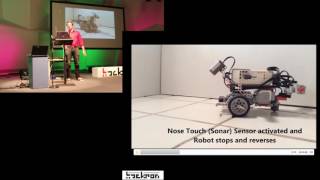
Russell Hanson, a neurosurgeon at Mount Sinai, describes mapping the human brain's complete connectome to create a "brain backup." His team has uploaded a worm's connectome onto a robot and demonstrated crude brain-to-brain telepathy. A human connectome would require hundreds of terabytes of storage, costing roughly the price of a small car.
Questions this video answers
Common brain regions (e.g., hippocampus) are consistent across people, but the detailed wiring (connectome) varies significantly between individuals.
The visual data is represented as a 3‑D voxel matrix (≈256³) and a statistical model maps this volume to visual frames; the exact algorithm is not disclosed.
Very far; it would require individualized imaging of learning processes, detailed models of each person's brain changes, and advanced simulation—still many years away.
Chapters
Hola a todos, bueno, pues aquí seguimos. Esta es la última charla de esta sesión tan montada de verano. Os animamos a que la veáis, queréis, porque vale mucho la pena. Os voy a contar por qué. Gracias a Amazon, este científico apasionado de la bibliografía mundial y Actualmente investiga el cerebro y las capacidades que podemos tener para transferirlo como si fuera una copia de seguridad.
Es decir, que podemos hacer un backup de todas las memorias que tenemos en el cerebro y con ello luego tener una base de datos de todas las memorias y poder verlas como si fuera un vídeo, poder acceder a ellas, poder modificarlas.
Podemos así transferirlas incluso a otros cerebros en el futuro e incluso, ¿por qué no?, a crear un cerebro humano, que es precisamente lo que nos va a contar Yeah, thanks for the introduction.
Thanks for being here with us. You will be talking about hacking human brains?
And mouse brains and just all types of brains.
Morals, kind of. Well, thank you very much and go ahead.
It's great to be here. Thanks to Igor and everybody for putting on the conference. My name is Russell Hanson, I live in New York City, I work at a hospital system called Mount Sinai, and I'm also the founder of a company called Brain Backups that endeavors to make the human brain accessible at the level of all the neural connections between them. Over the years I've talked at like the CCC conference in Berlin, Biohacker conference in Finland, and some other stuff. So I came from New York, and Igor was really insistent that I do a demo. But he quickly changed his mind once I told him I was going to bring some live mice and do experiments on them, live. So unfortunately, a lot of the machines that we use are really huge machines that cost millions of dollars, and unfortunately, I don't have one here either. So I'll play some videos. I hope you get the gist of the types of research we do and that in fact they do require some pretty significant equipment. Like I said, sometimes we hook up animals to machines. So in this case, you can actually hook up a mouse to like a virtual world, and instead of having a mouse navigate in a maze, you can have the mouse navigate a virtual reality maze. When you see these pictures like on the right here, Usually it's optogenetics, so you use light to control the neurons in the mouse. So it's a really exciting time for neuroscience, and, you know, I'm going to tell you some first-in-the-world types of things that have happened recently. So telepathy is communicating directly from brain to brain using other types of methods, and indeed, "Hello world," or Ola or ciao was sent between, over thousands and thousands of miles by these little devices that are on this guy's brain. So this guy here, he was controlling a computer to raise a ball up and down using his feet, and so he sent zeros and ones across thousands of miles to this guy, who was seeing little flashes of light in his brain. So, you know, even right now it's possible to have telepathic communication. Though it's very crude, and I don't really recommend doing it this way. So people are usually very curious, what is a brain backup, what does it entail? So a brain backup is like the connections of all the neurons in your brain. And one of the really great things that happened last year was one of the first uploads of an entire human brain occurred. And additionally, it's open access and open source, so anybody can go to atlas. Brainmap.org, and you can browse all the cells in a whole adult human brain. I'm on a little bit of time pressure here, because we are running late, but I will do my best to keep on schedule. So, Brain Backups is actually the name of a company. What it is, is it's our way of sort of describing what the connectome is. The connectome is this scientific term for all the connections in the brain, much like the genome is the the sequence of all your DNA base pairs, the connectome is the sequence or the network diagram of all the neurons in your brain. You know, I encounter a lot of skepticism when I tell people that, you know, we can simulate brains or that we can image brains at the neuron-by-neuron level. So, you know, one of the interesting things you can do is, a couple of years ago, a supercomputer simulated a second of human brain activity. But it wasn't in real time. It was about 2,000 times slower. So that means if computers were 2,000 times faster, it would actually be in real time. You can do a little bit of math to figure out, you know, how much, how long it'll take for computers to get 2,000 times faster, and one might estimate it's, you know, 10 to 15 years. Just to show what a connectome looks like in kind of a text file that might be familiar to Computer hackers, this is the connectome of a small worm called the C. elegans. So what you have is you have the origin neuron and the target neuron, and what type of connection that is. So on the left you have ADL, and on the right you have ADAR, and they're gap junctions, and the type of neurotransmitter that's transmitted is a glutamate receptor. And what would one do with that? Well, you can load it into a computer simulator, and you can simulate the neurons firing. Basically with all the information that you have in a text file like the one I just showed. And you can upload that to a robot. And so here is the C-Elegans Connectome running in real time on a robot. Yep, so people have uploaded brains to robots. Albeit one of the simplest brains. So, you know, every brain is designed to do a particular function for that organism. You know, humans do human things, worms do worm things, mice do mice things, and so forth. And so, you know, it goes forward and backward, it responds to very simple stimuli, and, you know, it looks for food and avoids obstacles. There's been a huge uptick in interest in neuroscience these days, whether it's from artificial intelligences who are going to take over the world to people who just want to cure Alzheimer's and Parkinson's and dementia. And venture capital has gotten interested in it. There's a company called Kernel that got $100 million to do basically a coprocessor on a human brain, so you could have like you're not very good at math, so you could have a computer do the math stuff for you, and you could do whatever it is that you like. Additionally, one of the common questions is how big is this so-called connectome? You know, there are about 100 billion neurons in the human brain, and on average about 10,000 connections between them. And so if you do some math, you might say it's, oh, about 909 terabytes. There are many problems with this calculation, but it's a rough, a very rough estimate. When I did this calculation, the price of a terabyte of storage was $28, and so if you multiply it out, you get about $25,000 for this whole storage, and that's about the price of a small car. You know, what would you rather have, a small car or a copy of your brain? I don't know. There are many ways to do this calculation that involve more detailed biology and math and everything. And so if you do it more detailed, you say that there are 500 inputs per neuron, that the adjacency list is on average 500, you know, but then you add compression and then it goes down. So instead of going up when you have more details, you just add compression, it goes to 200 to 300 terabytes. As I mentioned before, brains are really diverse. Up on the top row, you have mouse brains that only have about 71 million neurons. A rat brain goes up to 200 million neurons. Guinea pig, 240 million neurons. Monkeys, 3 billion. And then the human brain that we generally are more familiar with as humans, since we aren't neuroscientists studying mice or rats or monkeys. In addition to the— so now I'm going to start talking about ways to interface with these brains. And one of the simplest ways to interface with the brain is just putting some electrodes on the surface of the brain, and these electrodes allow you— allow, you know, basically two-way communication. So neurons respond to stimuli, and they also— you can read stimuli from the neurons. So this is not a science fiction Hollywood movie, this is an actual prototype that was made in France called the Wiimagine. And what it is, is it's an array of 64 electrodes that you can put on the surface of the brain on different areas of the cortex. So you can put it on the motor cortex, or the visual cortex, or the auditory cortex, and it doesn't have a battery, it responds to radio frequencies, and it gets data through the, Aether. But this is just the beginning. Something that's gotten more and more popular is these so-called EEG headsets. So an EEG headset you'd put on the surface of the skull, and it detects currents that are very crude, but they're— you don't have to have any kind of surgery. You just put this cap on your head. Has anybody heard of the Emotiv headsets before? Raise your hand. 1, 2. They're really fun to play with. I recommend it. You can play video games where you raise rocks by using your brainwaves, or meditate. You can sort of practice calming your brain or exciting your brain. And I put it on strangers and see what they can do with it. So this guy has has a wireless headset on, and he is controlling a synthesizer with his brain. There will be a close-up of the computer in a second, and you can see the signals on the different neurons there. Sorry, they aren't neurons, they're just electrodes. Is this audio live here? Yeah, so what you get is you get these little impulses coming out, and that's the synthesizer he's controlling with his brain. So what if you wanted to connect to the internet without using your cell phone or your laptop? Well, since we have these fabulous technologies for interfacing with the brain, why don't we just type ifconfig brain0 up? And then you have a direct connection to the internet. You could use a Broadcom BCM4329 chip that's used in the HTC EVO or the iPhone 4. And conveniently, there are all kinds of exploits for this chip. But that previous chip that I showed you that was only 64 electrodes is ancient news these days. So in the next couple of years, there will be brain-machine interfaces that read from a million neurons and stimulate 100,000 neurons. So that's obviously a huge improvement over this, the simple one that I mentioned. So this is a DARPA program solicitation. It was in January of 2016, and this program lasts about 3 years, so, you know, we're a little bit into it now. What would you do with one of these next-generation neuromodems? You could control an exoskeleton if you were in a car accident and you had spinal cord problems, or you were a soldier fighting for the military. But now we'll transition to what is the connectome and why should I, you know, what is the state of the art of imaging this network of neurons? The current state of the art is really taking a brain out of a dead organism and slicing it very thinly and imaging it on a microscope. That microscope could either be an electron microscope, an optical microscope, or, you know, a fluorescent microscope. In addition, there are some technologies that allow this to be done much more rapidly than slicing a piece of tissue and carrying it across the room and imaging on a microscope. And so on the right here is pictured an automatic microscope. So what it does is while it's slicing, it actually images. That makes it just that much faster to do the imaging. So people who work in this field just think about exciting ways to image the connectome all day long, and so this was a pretty exciting way that uses next-gen sequencing, which is genome sequencing, to actually sequence the connectome in essentially one step. So what you do is you infect the brain with a virus, and the virus has these little barcodes that— where you can follow the barcode how it was transmitted through different neurons. And then when you sequence the The cells in the brain, the barcodes show what the connectivity was. Unfortunately, in order to do this next-gen sequencing stuff, you still have to kill the organism and take its brain out. So what we do is we try to make this more non-invasive in vivo imaging. And we do that mostly by using contrast agents, which are essentially just ways of lighting up what it is that you want to image. The next two slides I'll show some of the current work on decoding what you get from the brain. So the visual cortex is processing vision. So in this experiment what happened is an individual was put into an MRI machine, which is just a big magnet that reads inhomogeneities in the magnetic in the magnetic field. And so someone was put into an MRI machine with a TV screen, and they're presented with this image. And then the question is, you know, can you figure out what they're looking at without knowing what they're looking at? And so in this study using an MRI machine, which is a currently available technology, you can actually get, you know, a really blurry picture of what the person is seeing. An MRI has a resolution of about a millimeter. In addition, you aren't limited to imaging the visual cortex. You can also image the auditory cortex. And if we can get audio on this, you'll hear— [Speaker:MAN] Admittedly, it's not the most clear reconstruction of what someone is hearing, but it's almost decipherable, and it's using one of these relatively simple 64-electrode arrays that's right on the surface of the brain. One of the interesting things you can do with this also is you can actually have a a piano player or a musician, you can hear what it is that they're hearing in their brain without having to play it. So people visualize, or, you know, visualize in an auditory fashion the things that they're hearing. When you zoom up on a brain, what does it look like? It can look a lot like this. So these little black dots are nanoparticles for the glycine receptor. And so what we do in neuroscience is we image things like glycine receptors and dopamine receptors and serotonin receptors, and we try to do it in as accurate a fashion as possible. And one of the ways to do that is by making these little black dots. So we know that the black dots are the location of these different receptors in the brain. And it gets a lot more complicated. So there are, you know, maybe 300 to 500 receptors that we really want to image. And so here's an Excel spreadsheet of our list of receptors that we want to image in the brain. And, you know, When we image these, they look kind of like this. So this is half a micron, and if we zoom it up a little bit, you can see individual neurons on an X-ray or CT machine, and thereby see what's going on with those neurons. The dream of a lot of people who work in this is to have basically what we would call a nanorobot, that you would inject it into a person, it would cruise around in their bloodstream, it would go through the blood-brain barrier, and it would find the neurons, and then it would label them, and then it would see what neurons are next to it. This is currently well beyond the state of the art in nanotechnology, but we can do simpler nanorobots. So we can take a gold nanoparticle and we can stick a ligand on it, and then we can see where that nanorobot or nanoparticle attached to. In addition— sorry, starting these movies doesn't work particularly well. So this is a volume of brain on an electron microscope, so this is about the highest resolution you can get. And what you want to do is you want to take these volumes and you want to reconstruct them piece by piece. And so you've probably heard of synapses. Synapses connect one neuron to the other. And in this volume, it's relatively hard to find the synapses. Without the help of a computer. And so what you'll see is these little red pancakes. Those red pancakes are the synapses that are automatically detected in this volume. Do you see the little red pancakes? Those are all the synapses in that little volume. Quite a lot. One of the questions that also comes up is, you know, why do you think you can simulate a brain anyway? Isn't there something intrinsic about humans that makes us so you can't simulate us, that we're human, that we're not computable or something like that? And there are many ways that you can address this criticism. One of the ones that I chose here is that, you know, is it computable? Can you compute what's happening in the brain? And so in computability, what we say is that it's a way of modeling certain systems and that brain functions cannot be effectively modeled. You know, there's no evidence that brain functions cannot be modeled. In fact, since there's a finite amount of data in the brain, you know, you can simulate a finite amount of data with a finite set of bits. So any finite set of bits can be modeled computationally. In addition, there's a lot of questions about, you know, would you really want to study the brain or figure out why it works? Interface with it in a new way and so forth. And I think that one of the really interesting analogies is that a lot of work in genome science these days has been on figuring out what's happening in cancers and making drugs that target specific things that are wrong in those cancers. And so the same thing can work in the brain. So if you have the brain and you can see what's wrong with the network of connections, you can make drugs that work better to address those problems. You know, if you're afraid of understanding the brain, it's like you're saying that you don't want to understand how to cure somebody or fix what's wrong with their brain. In addition, you know, very recently this year, there's been a lot of interest in artificial intelligences and, you know, are we fighting artificial intelligences. And I was trying to brainstorm stuff to put in this talk the other day, and I decided that, you know, if we had the connectome, we could actually surpass machine intelligences. And I call this the Russell point. So as you go through time and performance, we're right here in time versus performance, and computers are supposed to surpass us. But if we have an accurate image of the human brain, we can fight that, and we can, or at least try to fight it. So brain imaging can save us from the AIs if we try really hard. And so instead of having computers that are essentially not human take over the world and kill off the people, if we are able to maintain certain human aspects of humanity, we can stop that from happening. So what's next in this area? I think that doing machine learning on these image stacks is really important. The Neuromodem is going to happen pretty well. And Brain Backups has the goal of doing a $1,000 connectome and also save us from the AIs. That's my quick talk. I'd really like to thank everybody here for sticking around to the end, and it's been a great 2 days. And that's it. Are there any questions from the audience? Right there.
My question was, how unique is each brain, each person's brain? I mean, is it a fingerprint, or you can give a certain image of a brain get some characteristics that are very uncommon, and maybe in the future use that to apply to another brain. Or for example, I mean, when you have some part of your brain damaged, you can know that a healthy brain has some characteristics, and you can put some device and copy that or copy that behavior? I don't know if I'm explaining.
I heard a couple of questions.
The first part of my question is, two images of different brains, are they unique or they share some characteristics?
Yeah, basically brain anatomy studies the common characteristics between different brains, so when you do math problems there's a region of the brain that lights up for that. And you know, our hippocampus is very much the same between different people. So yeah, there are common brain regions between different people that allow us to perform different functions. We all have the same structure of nerves. But when you get to the wiring structure, it's very different between different people. So there are things that are very common, and then there are things that are very different, as you could probably expect. Does that answer your question? So, you know, in an MRI experiment, you have someone perform a task, and the area of the brain that is used to perform that task will light up. And then you do that on 10 or 20 people, and it's very consistent. So, you know, the regions are consistent. There's a question over here.
My question is, how did you, or your team, how did they translate the information from the visual cortex to a video? I mean, what kind of code did you use to try that?
What kind of what? Code. Oh, it's just a volume of MRI data, so it's It's 10 centimeters by 10 centimeters by 10 centimeters and about a millimeter. So it's like 256 voxels by 256 voxels. It's just a 3-dimensional matrix. And you just— you use that matrix of data. And then there is a statistical model that figures out how to map the volume of MRI data to the picture. Yeah. It's complicated exactly what that model is. Another of those things—
I forgot what it's called.
Did you have a question behind you?
How close do you think we are to downloading knowledge into the brain, such as a language?
It's hard to say. Very far, definitely. But I think that there— by having better imaging methods to see how the brain changes when you do learn a language. So you would image somebody before they knew French and after they knew French or through the process of learning something. And basically you would make many, many comparisons to see what the process is by which someone learns a language. It's likely very individual to that person. So you have to have, in addition, a model that's very individual for that person. So there are many pieces to doing something like that, definitely.
[Speaker:AUDIENCE] Hi, brother.
Suppose behavior is motivated by genes, by actual situation, and by past times. Where you have similar situations post-registered psychoanalysis. Do you think you can emulate that just with the brain? How you can add simulation to the real situations outside or nothing?
Do you mean to see something or?
No, no, just to see that you try to And with the way how she behaves, you are supposed to have the later information, the actual information, and the base data. You use the, say, face tracker, the brain scanner. This you can emulate using these two factors in 5, 10 years, can't you?
Yeah, I think to replicate or simulate the human experience or the way you experience things, you need to have a very accurate, a connectome and then data about the individual neurons, and then you also need a very accurate simulation system as well. And in order to make such an accurate simulation system, you need a very accurate way to measure existing neurons. So there are huge pieces of software that do this right now as well. So you have a database of neurons and then 1,000 neuron types and then you add those 1,000 neuron types into your simulator and it's just a huge amount of data really. If that's it, I guess we're free to go. Igor, do you have anything to say?
Bueno, pues hasta aquí esta exposición de cabrones, una exposición muy diversa, con mucho contenido, con grandes ponentes, como habéis podido ver. Gracias a todo el público que habéis venido, que habéis seguido hasta el final. Gracias a los presentadores, por supuesto. Y hay que darle las buenas a la organización, porque han hecho un trabajo magnífico. Y ya que están aquí, quiero que les den aplausos, por favor, porque
More from Russell





Black woman tried to ram her friend with her car at Eldridge & Delancey, NYC on May 24, 2021