Synthetic Biology and Data-Driven Synthetic Biology for Personalized Medicine and Clean Energy
Russell Hanson explores synthetic biology's convergence with data science for personalized medicine and clean energy. He covers how genome sequencing costs have plummeted, enabling cancer subtypes to be treated based on individual biomarkers, and describes the "Pink Army" model where patients co-own therapies derived from their own cells. The field increasingly uses open-source tools, machine learning on genetic data, and DNA origami for targeted drug delivery.
Chapters
Okay, I think I'll just get started. My name is Russell Hanson, and it's a pleasure to be here at OSCON Data. I'm going to be talking about synthetic biology and data-driven synthetic biology for personalized medicine and clean energy. And this talk is going to be a little bit broad because it's difficult for me to assume what the background of the audience is. Is everyone here to ask what synthetic biology is? Or has— OK. A lot of people have heard of it. Who wants to learn more about what synthetic biology is and doesn't know what it is already? OK. Also a lot of people. So synthetic biology is basically using different synthetic constructs in biology and assembling them into new things. So kind of like in electronics, you can take an AND gate or an OR gate or a transistor or an integrated circuit and make it into something new. In synthetic biology, you can take different little biobricks, as they're called, and make new bacteria or viruses that perform a particular function. So this, this is a very new field. In some sense, it may have started around 2003, 2004 with the iGEM competition, which is the competition for genetically engineered microorganisms. So my interest in this area is particularly in as it relates to potentially cures and treatments for diseases in a personalized medicine setting. So it's becoming cheaper and cheaper to sequence people's genomes and figure out what exactly is wrong with them. So for instance, in breast cancer, there are 4 different subtypes of breast cancer. And if you treat someone with the wrong medicine that has the wrong subtype, then you are essentially not treating their disease. And many other types of cancers have a lot of very particular subtypes. A gene has a mutation and that mutation causes something to break, and if you treat it for the wrong gene that's been mutated, you're not treating the right thing. So personalized medicine in this context is using data about an individual or data about an individual's specific subtype of disease in order to treat them better. So instead of a doctor just looking at them and using their experience In the context of genomic personalized medicine, the doctor would be able to use a biomarker test, whether it would be an assay in a laboratory or a SNP chip, or potentially at some stage using their— the sequence of their genes or the sequence of their cells. There are a number of IP issues related to personalized medicine. Electronic medical records are being increasingly used for personalized medicine so that the bulk of the data that doctors can collect from patients can be used to better develop a body of knowledge related to different diseases and types of diseases. So instead of having all of the patient medical records on paper and a doctor's office, they can be accessed potentially by an entire hospital system and so forth, or enable a new drug to find the right patient cohort for a particular study. I'm going to touch upon an idea called Pink Army, which is a biotech biopharma co-op. So So instead of having a for-profit company that is in the business of disease management, so if they actually develop a cure for a particular disease, then they lose a customer. In the co-op setting, an individual can buy into a biopharmaceutical company and actually have joint ownership for the product that's made to treat their disease based on their own cells and their own genotype. There's a lot of interest in nonprofit clinical research organizations, and the big data aspect of this is the electronic medical records, personal genomics, and other types of bioinformatics. So this talk is, I feel, a little bit out of place at OSCON Data given you know, that talks about Facebook and LinkedIn and HBase and Hadoop and PyPI and NoSQL and so on, but, you know, what would a social web app be without the people on that social graph? What is life? What is artificial life? And incidentally, what is consciousness? These are some interesting definitions of ways that one can quantify consciousness. There are many different ways to sort of typify what would one mean by consciousness. One scholar says that a brain is a state machine that contains an inner neuron partitioning conscious and unconscious states, perceptual learning and memory, prediction, self-awareness, representation, and meaning. Learning utterances, learning language, will, instinct, and emotion, and another has another set of concepts. So based on these ideas of what consciousness is, clearly a lot of synthetic biology is nowhere near conscious. It is, however, artificial life. So artificial life is— or A-life, as it's sometimes called— is is an area where computers mimic the processes of life. They mate or they exchange their genetic information or whatever. Or, you know, an existing organism is changed in such a way that it has been designed. And in a sense it's artificial because it's been changed by an outside entity which has control over that. In addition, I think that this topic has particular relevance to open source because, in a sense, life is open source. You can read the sequence for life, you can read the sequence for proteins, you can read the sequences for our genes, and we should have excellent tools to manage our source code, so to say. So, as this area has been maturing over a couple of years, a number of web tools and sort of consortia for managing new things have started. One is Open Wetware, which is a wiki whose goal is to promote the sharing of information, know-how, and wisdom amongst researchers and groups who are working in biology and bioengineering. And from the very beginning, this whole area and the people working on it were really deep in open source. Many of them were computer scientists who used Linux or open source tools, and the tools they used for their software is also open source. If anybody has any questions or wants to make any comments, feel free to speak up. Clarification, whatever. The BioBricks Foundation is related to Open Wetware and it relates to these individual components that are subsequently assembled into larger synthetic organisms. It provides a bunch of— it runs in part the iGEM competition, which is this yearly competition where tens of teams from universities around the world come and compete to engineer E. coli that smell like bananas or organisms that secrete a siRNA that is relevant for breast cancer or any of a variety of things. I'll talk about a couple iGEM projects. There are too many to go into great detail on, but I've got two that I'm interested in. So this is iGEM. iGEM is the International Genetically Engineered Gene Competition, and it's the premier undergraduate synthetic biology competition. It's a pretty cool thing that's been going on since 2004, and it just gets bigger and bigger every year. Originally it was a handful of teams, like 4 teams, and now it's I think 1,000 people, and they're trying to to break out and have an iGEM competition in Asia and an iGEM competition in Europe, and probably we'll still have the iGEM competition in Boston for the grand final. One of the most interesting things that's been coming out recently is so-called next-gen sequencing. So next-gen sequencing is using either solid-state or non-solid-state ACR-type tools to get sequences for people or for bacteria or viruses. And these— a number of different companies are in this field: Illumina, Applied Biosystems, Helicos, Roche 454 are a couple of them. And they all have different characteristics, the throughputs, the statistic varies widely. The data per run in gigabits varies widely. They're just different— different companies have developed different engineering paradigms for sequencing stuff. For a long time sequencing was much, much too expensive and SNP chips or single nucleotide polymorphism chips have been used extensively. While next-gen sequencing has just become more popular. So, for instance, a lot of the tumor data that I work with is all ChIP data. So basically what you get is you get 500,000 probes of genetic markers on an individual, and you can get a pretty accurate genotype of that individual or copy number profile of that individual. These chips. So instead of it being a million dollars to sequence someone, for $450 or for $250 you can actually get a pretty high profile or resolution of that individual. So 23andMe, which you may have heard of, is using SNP chips. It's using a different type of SNP chip. It's using an Illumina SNP chip that in the third version of 23andMe has, I think, 1.2 million probes, and the per-sample price is $250 to run them. Yeah, so these are some of the things that you can glean from a ChIP. You can get a copy number profile, which is the number of copies of different genes. You can get gene expression on gene expression arrays, so you can look at expression levels of particular genes. In some cases, overexpressed genes can be indicators of particular things. You can get the major copy proportion. Many people do machine learning on SNPs because basically it's just an array. So you could have 10 patients and you have an array of 250 SNPs, and you can— it's just a vector, so you can do machine learning on these vectors. You can do support vector machines, Bayesian networks, Markov chains. Biomarker identification is the process of finding a set of characteristics that characterize a particular disease. And for instance, someone who would be susceptible to a particular therapy, one would look for a biomarker for that sensitivity. There was a recent study, but it's a very broad term. Recently a study came out that said that a biomarker for autism is simply a lack of empathy. There is no genetic biomarker against lack of empathy. It's debatable, obviously. I mean, there's a wide spectrum of autism as well. So where are we? How much do we know about cellular processes, regulation, oncogenes, protein-protein interactions? Microbiome interactions, how much do you know about brain structure-function relationships, gene activation in neurons, memory, electrophysiology, neuronal cognition, or brain maps from worms to mice to humans? I would argue we know a lot but still nowhere near the entire set of information we would like to know in order to be able to design therapies or simply understand these different things. So if you are curious to download the human genome, it's actually quite easy. Just go to ftp.ncbi.nih.gov and you can download the complete sequence for a particular sequence of the human genome. Genome, and it's right there. So, as synthetic biology has been maturing from 2004, 2003 to— this paper was published in 2009— a lot of emphasis has gone from just building these little blocks like a transistor or an OR gate or something into building systems. Much like a circuit board, and figuring out ways to isolate these different systems from each other using insulators or other things, or just characterizing the functional characteristics of the gene interactions or regulatory system interactions. So this is a figure that's talking about modules based on transcriptional, translational, and post-translational control, and in particular feedback loops in these systems. So the top one is an RNA device that contains a ligand, a catalytic region, an aptamer, and a sensor. And this other one has a leucine zipper and another system. And so one of the things that's happening is people are starting to build like datasheets. So if you ever did any electrical engineering, what you do when you get a little integrated circuit and you want to figure out what the pins are, you get the datasheet for that thing and it will tell you that pins 5 through 6 are 5 volts or whatever. And so building datasheets for these modularized parts is growing rapidly. This one has a public license and it's from the registry of standard biological parts. And they tell you how to make it and what the static performance is, what the dynamic performance is, what the input compatibility is, what the reliability is, and the operating conditions. Question? Yep.
So I get the impression that the idea here is to, at a biological level, reinvent the usual modules of electrical engineering, you know, gates and flip-flops and things like that, you might build a computer. Is that true?
To a certain extent, yes, that's true. It turns out to be very difficult to do a lot of chained AND gates, for instance. Like having 3 or 4 chained AND gates is about the state of the art. So basically you end up having to do different things because the environment is so different.
Well, I know that Carver Mead, the integrated circuit guru, is actually kind of critical of digital logic and that you spend a lot of time and energy overcoming the natural capabilities of silicon and argues that we should design systems in an analog mode that exploit all the properties of gates instead of overpowering them to make them digital. And I wonder if there is a design style emerging that is more natural in that sense, in a place where digital might be harder.
Yes, definitely. There's definitely a design style that is a biological design style that is more akin to analog electronics with curves like these instead of— you can't get a rough— you can't get a spike, you can't get a— sorry about that. Yeah, I mean, you don't have a clock for one thing, so you have to— you It's just a— So partsregistry.org is a way— is a place that one can find these things. So along with the individual parts, a lot of tools are emerging in sort of the systems biology world that are based on things like the systems biology markup language. In particular, there's a tool called Cell Designer which allows one to design using a graphical environment what you would like to do in the wet lab using abstractions and simulating things a little bit to see what the right concentrations should be for the output you desire, just to sort of allow one to go one step further than what you can kind of design in your head to be able to do some experiments on a computer system. I'm sorry? This is open source software? Yes, this one is. So, in the system biology markup language, it interfaces with a number of databases. From the PubMed database to the KEGG database, and then you have software tools and you can design cells in this way and plot behaviors you've simulated, change the simulation paradigm, and so on. So in addition to these types of synthetic biology things. There's also a lot of work going on in structure of DNA molecules. So in this case, there's a nanorobot that's been made out of DNA molecules that can encapsulate a payload, and in this case, it's been designed to treat leukemia cells. So it recognizes a cell surface receptor, it has a gated function, and then it releases releases its payload. It has essentially a one-step logic. It recognizes something and does something. Unlike in the case of many small molecules, they're going to a ligand pocket and inhibit a protein or something like that. So, 23andMe and next-gen sequencing and SynBio getting together can do some really cool— things. So this is the 23andMe version 3. It uses the Illumina Human OmniExpress bead kit, which is $250 per sample, and it has 700,000 SNPs, and you need 200 nanograms per sample. So, just like Cell Designer, a lot of new computer-automated design and biological CAD tools are being developed. AutoCAD in particular has a new group in matter design and they're trying to work a little bit more in synthetic biology topics. So Thingiverse is a place where you can download open CAD models. There are increasingly many 3D printers, laser cutters. You can send designs off to be printed very cheaply and of high quality. There's more personal fab technology. The MakerBot, which is a cheap 3D printer, is another type that's becoming more widespread. I think this picture is actually from OSCON 2008 or something. So this is the RepRap Matter Compiler, which is a particular matter— so-called matter compiler, it's just an extruding printer, which can print all of its own parts except for a couple that are like metal dowels that you can buy at any hardware store. So the idea is that with this printer it's actually self-replicating, so you can it can get— so it behaves like bacteria sitting on food. It will just be able to replicate. It can make— it can run itself, basically. So there's no constraint of having to have a factory to build these things. It can run itself. Now we have a movie. So this movie is a description or an animation of apoptosis, and I just wanted to show it to you because it elucidates some of the systems that are going on. Apoptosis is the, the death of cells. So there's a diseased cell, these are healthy cells, and there's a killer T cell. So these are the cell surface receptors that the DNA nanobot that I was talking about latches onto.
Now is this from an actual simulation or is this just a representation?
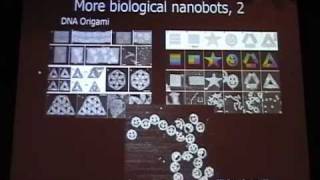
It's not a molecular dynamic simulation. Wasn't that nice? Okay, so like the gentleman asked, the way that these are simulated typically in a biophysics setting is you do what's called molecular dynamics. So you integrate the equations of motion, you have a force field that says how proteins should interact with other protein molecules, how water should interact with the, the solute, and so on. In addition, you can do mixed quantum mechanics molecular mechanics simulations, so you have a little box that's a quantum mechanical simulation that's joined to an electromechanic box via kind of a switching function. And in addition, there are a number of biological pathways, chemical reaction simulators, optimizers, and uncountably many products in gene network analysis and stochastic simulation. So in case it isn't clear, I think that the marriage of data and first principles and functional abstractions can do some really awesome things. So if you're able to build a sensor that can sense what's wrong with the system and you have enough data about the system to know that that is the unique characterization of that thing that's wrong, then you can do something about it. And so in this case, if you have SNP information or you have gene expression information or you have from the next-gen sequencing, you know, and the marriage of electronic medical records and a patient's sequence, you can potentially design whatever therapy you want, really. So instead of having to spend 10 years and a billion dollars to get a small molecule through FDA approval, I think that there are options. Very few small molecules Small molecule drugs have been approved in the last 10 years or so. So, how and where are these data used or made more usable? Randomized clinical trials. You can do biomarker development, genomic tests in certified labs. The licensing— these developed biomarkers can then be licensed to other companies for marketing and development. In the practice of doing these kinds of biomarker development, a lot of databases are used. There's a database called GEO, the Gene Expression Omnibus, which is an NIH-funded database of genomic information from papers that have been funded by the government, which allows reanalysis of countless datasets to be done. So, R is a common package that's used. Bioconductor provides a lot of tools tools to allow biological analysis of these gene expression sets or SNP sets or sequences and a variety of statistical methods. So, um, the FDA approval for a process, not a drug or biological device, is a way to make this kind of personalized medicine. More scalable. So there are a number of cellular therapies, particularly for melanoma and some other cancer therapies, where basically there's a process by which cells are taken out of the body, saved, chemotherapy is given to the patient, and then the healthy cells are introduced, among a number of other ways this is done. And so this is It's a process, it's not a drug, a biologic, or a specific device. So, back to Pink Army. So, in the Pink Army cooperative scenario, you know, you own your own cells. Why can't you control what's done based on your own cells? So you have— can develop therapies based off of your own cells, and they should be yours in the co-op, not owned by a for-profit company. And if a biopharma company cures your disease, they lose a customer who is cured. So it's relatively inexpensive to do a lot of laboratory work, and if the procedure is worked out satisfactorily and it's proven to be safe and efficacious and the other constraints were faced 1, 2, and 3, and more trials by the FDA, then a model like this one could potentially occur. This is some data on cancer 5-year survival rates. Pancreas and lung cancer have very, very low survival rates. On or much higher. So just as a— some data points on how much it costs to do certain CRO trials or medical research organization trials. For a melanoma trial with only 1,000 patients, it would cost about $60 million in CRO expenses. For a chronic obstructive pulmonary disease drug, it would cost between $240 and $250 million for 10,000 patients and just zero expenses. So oncolytic viruses are viruses that would cause cancer cells to lyse. It's very difficult to get lysing viruses approved for much of anything. But given the fact that you can make logical things, basically if it sees this it can do that, or it can do that, or if it doesn't find it, it can kill itself. Basically they're not computational devices, you're not trying to compile something, but it can perform logical functions very slowly. So for instance, in one model that we're working on right now, you can use data to engineer therapies or cures for genetic diseases. So if you have a nanoparticle and it sees a particular combination of RNAs at a particular time, then it can do something like release a protein initiating apoptosis in the tumor cell. And these, these logical ANDs can be or you can have many more of them or many fewer. It's not limited to 5, you could have 2, you could have 8. Do you want to see a movie of technical robots? I got a question. What about non-proteins or non-trans— like transfer RNA or anything else? Do you control those a little too? I'm sorry, I don't understand. I'm not understanding the question. What do you mean by control? Well, you think it's like RNA-RNA. What about non-proteins? Like, natural RNA responded by RNA? What about those parallel parts? In the particular sensor that I was referencing there, it's specifically a short RNA sensor that's not sensitive to single nucleotide mutations. So it can do matching between short RNAs, but if there's a single mutation, then it actually can detect a single or sometimes a double mutation. So there's some more biological nanobot technologies. This is DNA origami. So these are actual— DNA molecules that have been— where their sequence has been engineered such that they can make smiley faces or pyramids or squares. Obviously the biofuel community and ExxonMobil have been very interested in this for a while. There was a $600 million contract signed between Exxon and Craig Venter's company Synthetic Genomics to develop a synthetic biofuel technology. And these are just a couple of the iGEM things. So they realized that you can make E. coli glow. And they were like, well, why don't we make a light bulb out of E. coli? And they call it E. Glowi. It's a bioluminescent creature. And some students at the Chinese University of Hong Kong were very interested in a bio-hard disk. So you encode everything, all bits as A, T, C, and G to represent numbers. And in this model, insertion in a cell of the United States Declaration of Independence is 18 cells. And so they designed these parts and they put them back into the repository of parts as part of their project. And on the BioHard disk, 1 gram of E. coli is equal to 900 terabytes. Very big biological data. There's also a lot of interest in microbiome engineering. So basically the microbiome, or the set of microbes inside your body, could potentially be engineered so that they could actually provide you with a continuous source of drugs or elements that would cure a number of genetic diseases. So for instance, engineering a microbe that's introduced into the microbiome that produces interleukin-10 would essentially cure many of the symptoms of Crohn's disease. You could engineer a microbe that makes insulin for diabetics. It's a highly competitive environment and It's an active area of research to do this. In addition, in the chemicals industry, people are interested in cleaning, refinement, scalability, and more sensors. Conclusions. I hope I have explained some wide-ranging applications to existing problems in health, engineering, energy, and manufacturing, particularly human health care genomic research and data-aided design and testing, and also some new paradigms for manufacture processes and biological design concepts. I'm happy to take any questions. Yep.
It seems like a lot of the tools that you've talked about and a lot of the things you were describing were techniques or tools for looking for basically positive effects, so these things you've discussed. The question is, what kind of tools are available for negative negative effect testing? So like, what kind of testing is done for side effects, undesirable effects, before these things are actually used, before these things are actually, you know, implemented in the lab or something like that?
In a lot of cases, the side effects can be tested using existing laboratory equipment. We don't design something new to do that, but certainly you could have a micro— I mean, there are many Many of the iGEM competitors have made sensors that detect toxic levels of different things, and so just having an engineered microbe that detects the toxic level of something that was generated by something that was synthetic is very practical.
But no software tools that do that or anything like that?
You would just set the parameters. What was that? You just set the parameters. It's the same tools, you just set the parameters different to get your results.
Sure, but I mean, when you're talking about testing, you're saying 500,000 negatives and 2 positives.
You need something different. Software is going to do that, you're not going to have to go through 500,000 negatives, right? I would use the same software. Is that what you would do? It really depends on the situation.
I guess my question is more, do you know of any tools that exist that do something like that, or is that just, like she said, you just sort of code up new things to test?
I mean, it's very simple to make a sensor. I mean, if it sees something, it does something. And that's the same paradigm over at the College of Manhattan.
So that would be specific to that?
I don't think it's a specific scenario. I think I'm done, so I'm happy to take any questions offline as well.
More from Russell



Black woman tried to ram her friend with her car at Eldridge & Delancey, NYC on May 24, 2021