a daily checklist to get your business to $833k/mo
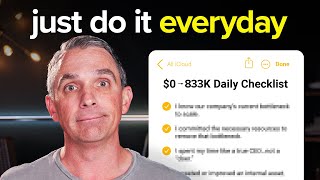
Ryan Deiss walks through a 10-point daily checklist for founders scaling toward $10M revenue. It covers identifying your bottleneck, protecting CEO time, building internal assets, reviewing metrics, and checking cash flow. Takes 5-10 minutes and works best as a phone note you check every morning.
Chapters
This is a daily checklist that will take your business from 1 million to 10 million in revenue and beyond. And best of all, it takes less than 10 minutes a day and it will instantly show you if you're acting like a real CEO or just a very busy employee. And in this video, I'm going to walk you through the 10 point daily checklist that I personally use to stay focused on the high leverage CEO level work. Now, if you don't know me, my name is Ryan Deiss. My partners and I manage 17 companies across our $200 million holding group. And so we know a thing or two about staying out of the weeds. So again, the idea is pretty simple. You have your checklist and at the end of every day, you just set aside five to ten minutes to run through each item. If it's a yes, you check the box. If it's a no, you leave it blank. The goal is obviously to check all 10 of the boxes, but really anything above 7 or 8 is pretty solid. So let's get started with checklist item number one. I know our company's current bottleneck to scale. Now, this is out of all of them, probably the most important question of all, because your job as a CEO is not to do the work, it's to remove the obstacles. And the truth is you cannot remove what you don't see. So every single day you need to ask, what is the single constraint that's preventing us from scaling right now? I want you to look at your scorecard. I want you to talk to your leaders. The bottleneck should be obvious and it should be visible. Now, if you're stuck, where I'd want you to start is just ask, am I demand or am I supply constrained? Now, demand constrained simply means you need more leads or sal. And supply constrained means please don't give us any more leads or sales. We can't fulfill the ones that we have because basically all constraints in business are gonna come down to one of those two areas. Now, if you're demand constrained, ask yourself, is it a marketing problem? We talking top of funnel? Is it more of a sales problem? If it's supply, is it an inventory issue? Is it a team capacity issue? We need more people. If you start with demand and supply and you keep narrowing down and down and down, you'll eventually find your bottleneck. But this is the most important role of any CEO. You must be able to identify, you must know what is the right next thing for your company to focus on. And to do that, you need to know the number One constraint checklist item number two. I committed the necessary resources to remove that bottleneck. Again, this one's pretty simple. Once you know the bottleneck, you need to commit to getting that bottleneck resolved. That means reallocating budget. Maybe it means investing in a new tool or getting everybody together for, you know, a sprint or a new major project or key initiative. Now, at the same time, I don't want you to change strategy just because things aren't happening fast enough. And all too often, a team is working on the right thing, and you just kind of have an impatient CEO throwing a wrench in everything in the form of just new ideas, right? They're just kind of bored. They feel like things aren't happening fast enough, and so they just say, let's try this and let's try that. If you are doing the right thing, even if it hasn't happened yet, you can sit there and be confident, Yep, I'm doing the right thing. I just need to be patient. We just gotta let the cake bake. Checklist item number three. I spent my time like a true CEO, not a doer. Now, this is where most of us fail. And the truth is, the calendar doesn't lie. So what I want you to do for this one is simply look at your calendar. Look at where your hours went. Were you solving only the problems that you can solve? Were you thinking ahead, or were you just firefighting? Specifically, were you putting out other people's fires? Or worse, doing other people's work? Even one hour of proactive CEO work per day beats 10 hours of reactive tasks. So you don't have to be perfect. But if you had to characterize your day, would you say you wore the CEO hat most of the day, or would you say you wore someone else's hat? Checklist item number four. I created or improved an internal asset. Now, this is the ultimate test of leverage. Did you document a process? Did you build a new tool? Did you create a resource that somebody else can use again and again and again? You might not check this box every single day, but you should definitely check it anytime you're asked to perform a task that could have or should have been done by somebody else on the team. And remember, a CEO's work should create compound interest. And asset building is the ultimate form of compound interest. Doing work today that continues to add value day after day after day is how companies scale without you having to be there every day to make the scale happen. It's how you get to not solve the same problems over and over and over. Again. So I like to ask this question every day because it's definitely a reminder the next day, can I create a new asset? Because every new asset, it's a new asset that's working for you. It's a new asset that's working for the company. It's a new asset that's creating. Scale checklist item number five. I reviewed our scorecard and key metrics today. Now, this one is super simple. And I actually got this idea from my personal trainer. Yes. I know I don't look like it right now, but there was a time when I was actually in pretty good shape. Now, his advice to me was super simple. He said, ryan, if all you do is weigh yourself every single morning, you will lose weight, you will get in better shape. He's like, I won't have to give you a special diet. I'm not going to have to come up with a whole bunch of exercise plans. If all you do, if I can just get you to do this one thing, I would have you just to weigh yourself every single morning. If you're not looking at your numbers, you can pretend like everything is fine. But if you weigh yourself, you're going to know that it is and you're going to take steps to make the change because you're being accountable to it. You can no longer pretend like everything's fine when the numbers are staring right back at you in the face. So every day, scan your scorecards. Are the red metrics trending up or down? You can look back a little bit. The metrics that are red today, how long have they been red? Were they green and now they're red? What are those trends looking like? Or are we on track for the quarterly goals? You don't have to take immediate action. I'm simply suggesting that by keeping an eye on your scorecards, you're keeping a pulse on your company. I know, yeah. If for some reason you don't have a company scorecard, I'll be sure to link to another video video that I made on how to create one that also includes the template that we use. So be sure to check that one out because obviously you can't check this checkbox if you don't have a scorecard. Checklist item number six, I led through clarity, vision and accountability. This one's really important because this kind of shows that you're doing the highest level version of your job. And sometimes it can be during a meeting, sometimes it's during a one on one. Sometimes it's just a quick slack message. The question that you're asking though, is, did I leave a team member more empowered or frankly, are they more accountable than they were yesterday? Maybe you just had a difficult conversation with one of your leaders because they just weren't living up to your standards or expectations. The point is, you're not just the owner, you are the North Star. Did you act like it today? Did you shine? Checklist item number seven. I said no to something that was urgent but non essential. Now this one's one of my favorites. I love the Michael Porter quote. He's the godfather of business strategy, if you've never heard of him. And he said, and I quote, the definition of strategy is choosing what not to do. The choices that you make about the direction of your business has more to do with what you choose not to do than what you choose to do. Because the reality is every day is going to bring noise. Your job is to hear that noise and to choose silence and to model that for the rest of your team. And it doesn't have to be something massive. It can just be saying no to a meeting that doesn't have to be there, or saying no to a shiny new idea that somebody is suggesting. Checklist item number 8. I checked in on cash flow and capital reserves. So do you know what money came in today? Do you know what went out? Do you know what still needs to be collected? How are accounts receivable, accounts payable? You're going to be able to make payroll in the next couple times. Now, this one takes about two minutes. Like literally, open up your dashboard, open up your bank accounts, look at your balance, and if you see a cash problem coming, deal with it before it's a crisis. At the end of the day, a business can survive just about anything if it has enough cash. And the only way to ensure that you never run out of cash is to always keep an eye on it. So I make a point still to this day, every day, of logging in and checking our cash position. I recommend you do the same checklist on number nine. My calendar tomorrow reflects my highest priorities. This is important. I like this one being towards the end because it's kind of that quick check, am I planning tomorrow, today? And this is critical because the work of a CEO requires space. Space doesn't just magically appear. In fact, the opposite is true. If you don't claim your time, if you don't put a stamp on it, your time will be claimed by others. So every afternoon, scan tomorrow's calendar and ask, did I block out time for strategic work for those high level Things that only I can do. Do I have buffers between meetings so I'm not just going from one to the next. I can actually think about and maybe take action on what was and is there anything eating up my time than shouldn't? You're far better off having blank space on your calendar than feeling the need to fill up every minute of every day. The reality is you can't win tomorrow if you lose the night before. If you check this box, you're giving yourself a really great shot at winning tomorrow. Checklist item number 10. I acted like an owner, not just an employee. I love this question. I want you to basically ask yourself, if I were employing me, would I be proud of the work that I did today? Was I reactive or intentional? Now this is the ultimate gut check and only you know the answer. Now, this one's last because if you look up the checklist and if you found that you checked most of these boxes, you can generally check this one as well. But this is kind of that last little check to see, how did I do? If you're not your own best employee, then make a commitment tomorrow to be a little bit better than you were today. If you make that commitment, then I can assure you your company will get a little bit better. It'll scale a little bit more each and every day. So that's it. 10 boxes, 10 minutes, and a daily practice that, when done consistently, will radically change how you show up as a CEO. Now that you have it, here's what I suggest doing. Take these 10 checklist items and add them as a daily note on your phone. Then set a reminder each day to check off each item. Maybe you want to do it at 5 or 5:30 before you leave the office. Maybe you want to do it in the evening when you go to bed. Time doesn't matter, just be consistent with it. If you do it, your business will scale and you're going to have a lot more time, I promise. If you want to work with me and my team to implement any of the systems and strategies that I've talked about in this video or any of the others, you can book a free strategy session using the link in the description. I hope you enjoyed it. Hope to talk soon and I'll see you in the next one.










