Everything You Should Unlearn From Business Books
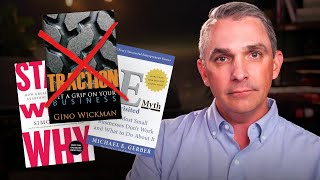
Ryan Deiss breaks down what business books get wrong: hiring cheap help, obsessing over productivity hacks, and letting one visionary run everything. He learned to hire functional leaders, document only what matters, and build systems that scale instead of chasing big hairy audacious goals.
Chapters
I've read just about every business book out there, and it nearly broke me. The four Hour Workweek. Traction the E Myth. Start with why all of them? And look, they've all got pretty smart ideas. But when you try to actually run a company, and specifically when you're looking to make the leap from 2 million to 20 million, this bookstore wisdom, most of it, it's just going to keep you stuck. It's just going to keep you overworked, it's just going to keep you overwhelmed, and it's just going to keep you wondering why, despite the fact that you're supposedly doing everything right and everything still feels really, really, really wrong. So in this video, I'm gonna show you what these bestsellers got right, what they got wrong, and what I had to unlearn to finally build a business that could run without me. And the best part is, if you stick around until the end, I'm gonna share a few underrated gems, some books that no one else talks about, but some books that absolutely every founder should be reading. Let's get into it. All right, let's start with getting things done. Look, I love David Allen's obsession with systems. I love the idea of. Of clarifying, of organizing, of reviewing, of executing. If you've read the book, you know exactly what I'm talking about. It's great if your goal is achieving inbox zero. But here's the problem. Most founders don't need a better task management system. What they actually need is fewer tasks. I'm gonna say it another way, because this was actually one of the hardest lessons for me to learn as I was growing my own business from seven to eight figures at scale. Your job is not to do more. Okay? It's not. It's not to be more productive. It's actually to do less. I love the quote from Andy Grove that he said in his really phenomenal book, High Output Management. He said, the output of the leader is the output of the team. In other words, your job is not to be more productive. Your job is to do less so your team can accomplish more at scale without you being the bottleneck. Because if your business depends on you to get more done, not only are you holding your business back, but. But you're not even really acting like a business owner. You're acting like an employee. An employee with a crappy job working in an unscalable business. And nobody wants that. So, look, this book is fine. Give it to your executive assistant, maybe give it to your project managers, but it is not a book. That you need to read when you're making the seven to eight figure leap. This is a book about productivity. And productivity is for employees. Productivity is not for owners. It is not for for leaders. Leverage is for leaders. And speaking of leverage, next up, we have the four hour work week. Gotta love this one. Tim Ferriss absolutely had me sold. Hire virtual assistants, outsource everything. Automate your life. I'll admit it, it sounded amazing. I mean, who doesn't want a four hour workweek? Come on, that's the dream, right? But here's what he didn't tell you. Hiring task doers, which is really what these virtual assistants are. What it's really doing is it's replacing a fairly simple to do with a to manage list. In other words, you're replacing simple tasks that you could probably do in your sleep with a brand new task called managing VAs. And that's not as simple of a task as people make it out to be. So look, freedom doesn't come from hiring helpers. It comes from hiring experts who can truly own the tasks and outcomes that you give them. So if you want leverage, and this is the thing that I had to unlearn, don't hire people to do things, Hire functional experts who can own those things. So I'm talking about head of marketing, I'm talking about head of sales, I'm talking about head of product. I'm talking about hiring someone who's actually better than you at a small aspect of your business. They're not only going to get the job done right, they're going to get it done without you having to follow up behind them and clean up all their little messes or heck, even tell them what to do, because again, they're better at it than you are. And this is where real freedom and this is where real scale is created. This is frankly when you're actually able to have a real four hour work week or heck, a no hour work week. So stop hiring armies of inexpensive helpers who only create management overhead. Start hiring functional leaders who own the outcomes. It's a bit harder, it's a bit more expensive on the front end, but the ROI in time saved and in money made on the back end is massive. Aha. Traction. All right, look, this book has some good things to say about meeting rhythms and has some decent things to say about goal setting. But the concept that founders are these precious little snowflakes who should hire an integrator to do all the dirty work so that they can be left to just visionate all over the place is one of the most destructive myths ever perpetrated on the entrepreneurial community. I really believe that. It's one of those things that sounds so good in theory, but it doesn't work at all in practice. It's sort of like I'm trying to remember, think back when my wife and I first had kids. If I would have said to her, if I would have gone to her and I would said, honey, look, here's the deal. There's something you need to know about me, okay? I'm what you call a visionary dad, which means I'm not going to be one of those dads that changes diapers. That's not really my thing. I don't do that dirty work. I'm the dad that plays with the kids. I'm a visionary parent. I'm the dad that plans the family trips. I just do the fun, visionary parenting stuff. My wife, appropriately would have slapped me. Oh, my darling. Oh, my darling. And yet this is the business equivalent that we're basically doing when we have this visionary integrator construct. And it just isn't how life works, and it just isn't how business works. Business is messy. And the reality is, is that when you're running a business, when it's your company, when you've birthed this thing, your role is going to change. The nice thing is, is you may even come to to enjoy a more formal CEO role if you actually give it a chance. But the solution to the craziness of scale is better systems. It's more skilled, functional leaders. It's not a unicorn like babysitter whose sole mission is to provide adult supervision so that business owners never have to grow up and they just get to kind of be business Peter Pan. That's just silly. Just to be clear, I'm not really against you necessarily having an operator on your team. There are plenty of teams and certainly plenty of founding teams where one is more visionary and another is more operational. That's fine. I'm just saying don't think that you can go and make one magical integrator hire so that you don't have to do any of the dirty work. That's just not how it works in reality. Once you have an operating system, then you can hire an operator to operate your operating system. But if you hire an operator or an integrator, as Traction likes to call them, before you have an operating system in place, what you actually wind up with is an overpaid executive assistant. Ask me how I know. I kind of screwed this thing up. Like two or three times. I've said it before. I'm gonna say it again. Good people don't fix broken systems. Broken systems break good people. And this applies to your operators, too. So we're gonna figure out the systems first, then we're gonna hire the operators to operate the operating systems. And speaking of systems, next up we're gonna talk about the book that told me to document everything and wound up almost causing a mutiny in the process. The E Myth. You gotta love the E Myth. The E Myth is an absolute classic. Love Michael gerber. He was 100% right when he told business owners that you can't scale if you're stuck. Absolutely true. I absolutely believe that this is the manual on systems documentation, and it's a pretty entertaining story. I think there's a lot of good things in this book. The only problem is kind of the big overarching message of this book is that you need to document everything in your business. You need to treat it like a franchise. Which, again, is one of those things that sounds good in principle, but does not work in practice. And again, it's one of those things that I should know because I tried. I remember reading the E Myth. I remember reading it for the first time. I was on vacation. Came back from vacation. I remember calling an all hands meeting. And I remember declaring to everybody in the company, effective immediately, we're not going to greenlight any new projects, we're not going to approve any new hires until everybody has documented absolutely every single thing that they do in this company. And I remember thinking that this was the greatest idea ever. And I remember looking out at my team and realizing that I had just made a horrible mistake. About half of the team were super duper pissed off at me because they thought I didn't trust them. And the other half was panicking because they all thought they were going to get fired. So don't do that, okay? No matter what, don't do that. Nevertheless, we push through. We powered through. I explained to it, it's like, no, we're not firing you. None. It's going to be great. These systems are going to create all this stuff. But I basically shut down my entire company for a month just so we could build these systems. And after a month, we had it. Everybody had pretty much documented everything. And I remember printing them out and putting in these beautiful color coded binders and buying a special bookshelf for them and having them in the middle of the office. And when we were done, there they were. And there they sat. And guess what? They Nobody looked at them. Not ever. Not once. I remember pulling them down when we moved offices and thinking to myself, this was one of the single biggest wastes of time ever. Why did nobody look at them? Because it's really simple. When you document everything, you actually wind up documenting nothing at all. You run into the problem of discovery. So here's the deal. You don't have to document everything. You just need to document the critical. 10 to 20 things that are, number one, high stakes, meaning they directly impact your ability to get more customers or serve the customers you have. Number two, they're highly repetitive. So this is something that comes up a lot. And number three, there's a high chance for human error, meaning they can't be automated using technology. So if this is something that is high stakes, highly repetitive, and a high chance for human error, boom, we're going to document that. And specifically we're going to have the person that does that thing regularly document it while they do it. Then we'll hand it off to somebody else to kind of field test it. Once it's been tested. Now we'll create some documentation around it. When you only document the critical, your team starts to take these documentations, these SOPs, these playbooks as we call them, seriously. And suddenly it becomes an honor rather than a burden to be asked to add something to the playbook library. We actually make it a big deal. We make it to where somebody said, hey, can I create a sop around this? Let's find out. Not just anything gets to get added to our company playbook library. So the E myth, great in concept, just over executed. But the only thing worse than throwing a bunch of documentation at your problems is throwing a bunch of people at your problems. Which is what our next book can lead you to do if you aren't careful. Next up, we have who, not How. This is the book that tells you that basically every single problem can be solved by by just hiring the right who. And look, this is another one of those concepts that is absolutely true in theory, but doesn't quite work in practice. Because here's the problem. The right people don't want to work for crappy companies that desperately need them to step in and fix everything. And guess what? The right people, you know what? They have options. They've got options because everybody wants to hire them. So telling a business owner to just hire the right who, that's kind of a bit like telling the sad, lonely guy in your friend group, hey, look buddy, if you just want to be happy, just marry a beautiful Successful, funny person who's amazing in bed and laughs at all your stupid jokes. It's true, but it's not that helpful. Well, it turns out that the way that you attract the right people to your team is the same way that you attract the right romantic partner to join you. In life, you simply become someone who's worthy of the person that you want to attract. Now in life, we don't just get to declare I only date tens and then poof, that magically happens. It's not easy, but it is that simple. And the same is true in business. When it comes to recruiting talent. That means building a company that's so systemized that it doesn't require a players to succeed. Because guess what? That's exactly the kind of company that a players want to work for. Because again, said it once, I'm going to say it again over and over and over again because it's so important. Good people don't fix broken systems. Broken systems break good people. And you know who else knows that? A players. Look, at the end of the day, hire great people. It's good advice, but it's not a strategy. It's an excuse to avoid the hard work of designing a business that doesn't require superheroes and a players to succeed. So it's not a who thing, it's not a how thing. It's a systems first thing and then a people thing. Up next, we have the biggest myth of them all. That purpose alone is going to save your business. Start with why by Simon Sinek. This is the one that gets you kind of in that purpose trap. And I love Simon Sinek. He is inspiring. No doubt. His TED talk, it is an absolute classic. If you haven't seen it, you should see it. Leaders hold a position of power or authority, but those who lead inspire us. But the big idea behind the book, that people don't buy what you do, they buy why you do it. It's beautiful. Okay, it is. I love it. It's beautiful. And it's true to a point. But it also kind of ignores the fact that there's still that pesky profit thing that funds that purpose. In other words, it doesn't matter how noble your why is if you can't figure out how to make your business model work. If you can't do that, then none of that matters. Because last I checked, an inspiring purpose has never once covered payroll. More importantly, and this is the most critical of all, no one cares what your why is if your product sucks. It really is that simple. And I Can't tell you how many entrepreneurs I've ran across who could wax philosophic about their company's purpose and how they're going to disrupt entire industries. But at the end of the day, their product, their service, it just wasn't that great. So, look, an inspiring mission matters. But businesses exist if and only if they provide surplus value. Period. It's as simple as that. In other words, you either create more value than you take, you deliver more value than you ask for in return, or you don't. And while an inspiring why might distinguish you from the competition, step one is to matter to the customer by first making a tiny little impact in their corner of the universe. And that's just the piece of this book that's missing. That's the part that I had to unlearn. It's not about your why, it's about their why. Great brands are built when those two whys align. But make sure you're working backwards from your customers. Why not yours? That is the lesson that I had to unlearn. And finally, the one book that pushed founders to dream way too big, way too soon. Built to Last, which gave us the Bhag delusion. Now, all in all, it's a pretty good book, right? It really is. But the big idea that I had to unlearn was this idea of the Bhag, or the big, hairy, audacious goal. Big, hairy, audacious goal. This is a goal that is so big, it is so grand, it is so inspiring that your team springs into action like a herd of happy little golden retrievers who just lapped up an entire case of Red Bull. All right, that's the idea behind a bhag. It's like, oh, look, it's. I'm so inspired because the gold is so big. Here's the deal. Bhags are probably fine if you're Microsoft or Apple or insert random Fortune 500 company here, but most of the time, Bhags just turn into buzzword salads. And you've seen them. I mean, when you see nonsense like to be a global leader in innovative customer centric solutions that empower tomorrow's world today, or we're on a mission to end inefficiency forever or to save the planet through digital transformation. I think maybe my favorite of all time, to unlock human potential at scale. Here's the deal. Nobody knows what any of that means. Nobody wakes up excited to chase any of that. All they result in is big, giant eye rolls from your customers and from everybody on your team, which is why? Nobody really needs a bhag. What they need is a three year revenue and profitability target that tells them where they're going. Because three years is long enough to be meaningful, but short enough to still be somewhat predictable. If you pair that three year target with a company purpose statement that encapsulates who you serve and the impact that you make in your life, congratulations. You've got something that is way more powerful than a B hat. And by the way, I created an entire video about how we create what we call a clarity compass that encapsulates that three year target and that company purpose on a single sheet. So be sure to check out the link in the description for that because it's just a lot more useful than a B hack. Here's the truth, everyone of these books, they have value. They do okay. And writing a book is really, really, really hard. I should know. But they're also loaded with logical lies that sound good in principle, but they fail in practice. Largely because most of them are written by people who either are done running businesses and they're talking about what they did, or frankly, they never ran a business at all. Sorry, just kind of got a call. Spade. A spade here. Now. If you want to read books that actually teach you how to scale your business the right way, here are a few underrated gems that changed how I think about building companies. That I really do think that you should add your reading list. So first up, we have the goal. The goal is the book that taught the world about the theory of constraints, which in my opinion is probably the single most important concept in all of business. The idea that all business strategy can be summed up by first discovering what is the constraint, what's the bottleneck in the business, and just figuring out how do we solve it, and then just moving from constraint to constraint, bottleneck to bottleneck. It's a great book. It's a book primarily about manufacturing, but really it's just a book about business. It's written in a narrative form. I think it's great. Listen to it if you don't want to read it, because it's kind of a big book, but is absolutely a book that has been forgotten by most business owners. It's a book that every entrepreneur should read. The second underrated gem is a book called the Art of Profitability. This is another kind of weird little book that a lot of people haven't heard of and haven't read. But I love this book because it breaks down the 23 ways that businesses actually make money. Again, this one is kind of told in a narrative fable form, but I just love how practical and simple it is. Just the different business models that it breaks down. It's worth taking some time just to say, okay, of these 23 models, what are the ones that I'm currently doing? What are the ones that I could apply? This is one that I have people, all the managers in my company go through and read and we discuss and we talk about what are the different profitability models that we're applying? What are the ones that we could be applying? Again, it's a must read. Next up, two from Peter Drucker, who is just the absolute goat when it comes to business, in my opinion. The Effective executive teaches you how to effectively manage others. Managing Self teaches you how to manage yourself. And one of the things that Peter Drucker says is you cannot effectively manage others until you can first manage yourself. So the very first book that I give to any new manager at my company is Managing Oneself. The second book that I give them is the Effective Executive. So I would tell you right now, Managing Oneself, it's a thin little book, is absolutely an essential read. It helps you discover, how do you learn? How do you process ideas? It's the playbook for clarity and decision making. And it was talking about all this stuff before it was cool. So read Effective Executive. Read Managing Oneself. All right, lastly, this one is clearly just totally a shameless plug, but read my book too. It's a book where I talk about how we go about building operating systems. Compared to all the other ones, it's, you know, a distant, like fourth or fifth compared to the other ones that I sent. But I would still definitely go ahead and read it. I think you're going to get a lot of value from it. And it is a must read for anybody in our organization as well. So I'm going to say it's a must read for you too, if you watch this far. At the end of the day, not enough founders read books. There's so much wisdom out there in books. Of the ones that do read, they're primarily reading just to get inspired. For me, I read to get free. So if you're ready to stop chasing hacks, if you're ready to stop chasing fortune cookie wisdom if you want to just start building systems that actually set you free. I've dropped some resources and links in the description on how we build operating systems. I definitely talk about it in this book, but if you want to skip reading the book and just kind of watch some of the videos I've dropped some of those down in the description. If you enjoyed this, drop a comment if you think that there's another book that I should maybe review. I'd love to hear that. If nothing else, I'll see in the next one I.










