I Use Notion to Run a $10M Business (Copy My Template)
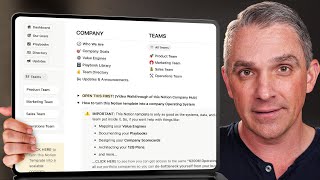
Ryan Deiss walks through the Notion system he uses to run his business, which manages 17 companies across a $200M holding group. The template includes scorecards, quarterly planning, project tracking, process maps, and a playbook library. He offers it free to copy.
Questions this video answers
17 companies
$200 million per year
Yes — he says he will give a link so you can duplicate the exact template for free.
Chapters
I use notion to run 17 companies that generate $200 million per year. Not Plan, not Brainstorm. Run. And in this video, I'll walk you through the actual dashboards, systems, and processes that we use so that you can build your own company hub that finally gives your team the clarity that they need to execute without you. I'll even give you a link so that you can duplicate this exact same template for free. If you don't know who I am, my name is Ryan Deiss. My partners and I manage 17 companies across our $200 million holding group. Now, we are not Notion experts, but we do know a thing or two about building systems at scale. And since Notion is our tool of choice, I figured I'd just give you ours and show you how it works. So let's get into it. What you're looking at is the Notion template that houses the operating system all my companies use to stay organized and systemized so that they can grow and scale without me going insane. But before we dive in, you should know that this template is only as good as the systems and assets that you put into it. So if you want our help turning this template into a fully customized and scalable operating system, that's literally what we do at the scalable company. And we'd love to work with you to do just that. Once you download this template, you can click on any of the yellow boxes in the sidebars to get more information about our services, or you can check out the link in my description. Okay, let's get into it. This Notion template is broken up into two main parts. There is the company section that really kind of serves as the main hub for your company operating system, and the team section that really is that holding area for any special projects and meeting notes that each of your individual teams might have. I'll come back to the team section. Really try to make it something pretty simple that anybody can use. There's also this company calendar down here. It's a calendar, right? I'm sure you can figure out how to use that. But this is where you might want to put important company dates, meetings, and things like that. All right, going into the main company section, you can see right up here, we've got this who are we? Section. And this is really pure to answer that question, who are we? So anybody at your company knows, okay, this is what we do. This is our three year target, our company purpose, our core values, what we refer to as strategic anchors. If you have any questions about how to fill this out, I did do another video and there's a link to that here. But this is really important because it tells anybody and everybody at your company, whether it's the first day at the company, the 50th day at the company, or the 500th day at the company, it's just a good reminder, one stop that they can look at to know who are you and what do you do? So that's pretty simple. This next one though, the company goal section. This really is the biggie and there's a lot going on here. So I'm going to spend a bit of time because it's really important. This first section is your scorecards and dashboards. So we've got a link here to the company scorecard and another link down here to your 12Q planning canvas. This is that three year planning canvas. I've actually done separate videos on both of those as well. So if you want to see how you go about building your company scorecard, there's a link to that as well as a link on how to build out your 12Q planning canvas. Now, we build these tools in Google Sheets. We love Google Sheets. We found that Google Sheets are really effective way to build scorecards. And so as you can see here, we're just simply linking to those. So that's really, really simple. Basic links, you would, you know, take out these links, put in your own after you build these, and they would be here. Now, as we go over here to the quarterly Sprint plan, what we believe at the scalable company is that annual planning is really kind of worthless. It's a spork. We like to set three year targets. That's the 12Q. And then we like to break these into quarterly sprints. And so what you see here is this is an area that can house all of your different quarterly Sprint plans. And if we open this up, you can see we've got a really cool template here for doing just that. So you could put in your different revenue goals, Your goals, goals based on unit of the different products and services that you sell. You can break your revenue goals up into months. And then down here we get what's the theme for the quarter? What are the different, what are the different pillars that you would have? What are the North Star metrics? And then this is the biggie. What are your key initiatives? What are the projects that you're going to greenlight that will help you achieve these metrics, that will help you achieve all of these different goals? And in case you're wondering, we do have templates for these as well. So if you go over here and look, you can see that we do in fact have a key initiative template. So that this gets really everybody on the same page about what's the project that we're doing, who's responsible for it, what are we expecting to happen from a results perspective? So as you create this, you're going to see that it interlinks with different areas. So there's a project lead that links back to individuals on your company team directory. We'll talk about that. There's a status due, dates, pillars, and this is the biggie. What team is uniquely responsible for that? When we get to the team section, you'll see why this matters. But everything, again, interlinks to something else. And so as you build out your different quarterly Sprint plan, quarter over quarter, and as you create these key initiatives, you'll find that they show up in different places. So all of the key initiatives for all the teams are going to show up here on the company goals page. So you can see there's a lot going on on this company goals page. We got our scorecards, our quarterly Sprint plans and, and all of those key initiatives, those big projects that we're greenlighting for the quarter. Going back to our dashboard, we'll move down to value engines. Now, Value engines are kind of a proprietary concept for us here at the scalable company. This resource really is kind of like a training within a training, a tool within a tool. I mean, kind of embedded within this particular resource is just a lot of other cool resources that are just going to make you a lot more effective as a, as a business owner. But what these value engines are, quite simply is they're business process maps that visualize how does your business work. So how do you go about getting customers and clients? So we've got some examples here for you. Obviously you would delete these and replace them with your own. We use Whimsical because it has a direct embed with notion, but you can use really just about any flowcharting tool. So this is a directory where we would place those. Then we would come down to our Playbook library. Now this Playbook library, this is your classic standard operating procedure checklist, sop. You can see these here and we do in fact have a template for them as well. So if you go over here and you look, anytime you create one, there is a basic template here that you can fill in. We try to give you as many templates as possible. Again, we never want you to have a blank page. But here's the best thing about These particular about this particular template, you can see every one of these playbooks has an owner and that's important because if nobody owns these Playbooks, then nobody's responsible for keeping them up to date. So in this case, Claire owns this particular one. And this again, interlinks back over to the listing on the directory. We'll come back to that in just a second. Also, it is associated with a team and it's associated with a particular value engine. So if I see this member login creation, troubleshooting, but I don't quite understand where does it fit, what does it have to do? I know that it is associated with this particular fulfillment engine and I should be able to find where it is just by going and looking at that. So pretty cool the way that everything is interlinked in the way that it's set up for you in that way. Back to the dashboard. We'll now look at the team directory. And I love this team directory. Really, really simple. Just a quick snapshot, all your people based on teams. And also like to look at it here based on the high output team canvas, because you can also look at everybody's, what we call their critical accountability bullets. These are the very specific things that they are uniquely responsible and accountable to. If they're managers, you can see who their direct reports are, you can see the teams that they're on. Just a really simple place for all of your people to be. And you know, when you go in here, obviously what we're showing here is just a picture. But down below you could put in things like, you know, what's their favorite candy, you know, what's their favorite sports team, things like that. The type of information that would be fun for other people to know. And then lastly, we've got updates and announcements. And even here again, we've got lots of different templates for you. So here's a company newsletter template, if you want to post those. Here's a memo. If you want to write a memo to your team, we've got a template for that as well. If you want to do a CEO update, kind of a variation, a simpler, more streamlined newsletter. And then we've got another thing that we call the vision memo. So if you're kind of putting out there, I've got this new vision, this new idea, this new concept, we have a case study and a template and an example for that as well. So all the different updates and announcements, we've got templates here for you there. So this is the main company section. And again, this really does function as the core operating system within your business. So if you're looking at this and you're saying, this is cool, I like all these things, I don't know exactly how to necessarily fill these things in. That's exactly what we help our clients do. Click on one of these links. Happy to share more with you on how to do that. All right, now let's go to the team section. So the great thing about the team section is that at any time you can create an additional team. So you can just create new page, you can create the plus, you can do it over here. We've preloaded product team, marketing team, sales team, operations team. You can add additional teams, you can change the names of these teams. They're just filler. But as you can see, each section, each team page has a projects page, and the projects page has its own template. So if you're working on a particular project, maybe it's associated with a key initiative, maybe not. You can house those here also, at a certain point in time, you know, if you want to, and a project's out of date, you can archive it that way. This just doesn't get big and out of control. Same with the resources area. And so some of the resources that I can give you. As an example, this is where you might put your team scorecards. So you might link or embed to your team scorecard here a marketing team. You might have your ideal client profile. And so we put an example template of our ideal client profile. You might put in clients who are not a fit. For example, you might put your marketing calendar. You get the idea. So this is just a place for those general evergreen resources, the kind of things that people are always asking, hey, where's this thing? This is where you would go to put them. And then as you look down here, you can see that the key initiatives that we had all the way back here on the goals page. Remember when we were setting our doing our quarterly sprint planning, we were creating the key initiatives and we were associating each of these key initiatives with a team. Well, by associating it with the team. Now, the team specific key initiatives can show up down here so that each team at a glance can tell, okay, these are the main projects that we're working on that are most important. And the way that you would go about editing this, it's simply a filter. You'd simply drop this down, click on teams, and you would just select the team page so that if you go to create a new team, you would just need to go and make that simple edit. And now it will display the key initiatives that are associated with that particular team. Now, there's obviously a lot more that I could go into and share. I think you get the general idea of how it works, how it's structured. The idea again is just to give you that one place, that single source of truth, where everything that's truly important about your business, your company operating system, your communications, everything, can find a home. And what this means is that people don't always have to ask you for every little thing. They don't have to ask their manager, they're able to find it themselves. They're able to cross train one another. This is how companies scale without always needing to be reliant upon the founder or that core founding team. So I hope that you use it. I really do. That's why we're making it available for free. I hope that you make it your own. And obviously if you want our help customizing it, if you want our help turning it from a customer hub into a true company operating system, that's what we do. That's what we love to do with clients at the scalable company, and that's what we would love to do with you as well. But if nothing else, again, this is a template that we use. It works great for us. I hope it works great for you. If you have any questions, if you have any comments, we're not notion experts, so we can't necessarily get into technical support and things like that. Unless you're a client. We're. But drop it in the comments. I'm happy to do the best that I can. With that said, thanks for watching and if you got any feedback on the tool, we're always looking to improve, so thanks.










