If You Suck at Delegating Tasks, Watch This
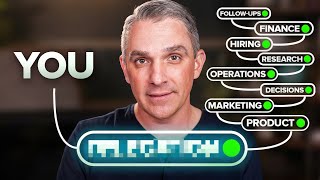
Ryan Deiss, who runs a $200M portfolio, breaks down a five-step delegation system: dump your tasks, sort them into a matrix of flow, drudgery, menial, and captive work, run a 30-day stop test, delegate the menial stuff, and use impact-based delegation for high-impact work. The goal is keeping yourself in your genius zone.
Chapters
Let's face it, normally when you delegate, one of three things usually happens. Number one, it either doesn't get done right and you wind up having to just accept crappy work. Number two, it winds up taking a lot longer to teach someone to do the thing than if you just did the thing yourself. Or worse. Let's say you do delegate it, but it's done so badly that you have to waste all your time cleaning up someone else's mess, only to find that the work is right back on your plate and the very next day. Does that sound familiar? I do everything around here. Yeah, I've been there, too. And I'll tell you, I used to dread delegating. I hated it. So today I'm going to show you how to create a system of delegation where the work gets done as well or even better than if you did it yourself. And most importantly, it never boomerangs back to your plate. And just to be clear, this stuff isn't theory. My partners and I run a $200 million portfolio of companies using this exact same system. And I still make it over dinner most nights. All right, I've got five steps and a super simple framework for you. So let's get into it. All right, so the first step of my delegation process is what I call the task list brain dump. What I want you to do is I want you to grab a notepad or an open document and I just want you to write down absolutely everything that you touch. In a typical week, try to capture everything. Start with your to do list, start with your calendar, open up Slack, open up your text messages, open up your recurring meetings, all of it. You cannot delegate your work until you first clarify the work that you are doing. So that's what we're doing. We're getting the work that we do out of our head and we're getting it onto a sheet of paper. So what you can do is you can go into your ChatGPT account, you can connect it to your Google Calendar, you can connect it to your Gmail, and you can have it actually look at your calendar, you can have it actually look at your inbox, and you can ask it, hey, based on what you're seeing here on an average week, what are the tasks that you think that I am doing? And believe it or not, it'll do a pretty great job of coming up with your task list. So when you're done, you should have a list that looks something like this. And I can say that because what you're seeing right here was literally my list. Once you've done the task list brained up, you got everything on one page, you can now move on to step two, which is to organize and prioritize all of those tasks that we just brain dumped. And to do that, we're going to use a framework that we call the critical task matrix. So the way the critical task matrix works, it's really simple. What we're doing is we're going to be plotting our tasks in terms of high impact and low impact and low ability, slash, low desire and high ability or desire. So you can kind of draw this out. Now, the reason that this works is if we have something that's low ability and low impact, this is what we refer to as the drudgery zone. Okay, Drudgery. Because this is no fun at all. Now if we have something that is high impact and it's high ability, this is our flow zone. So this is. These are all the things that we're going to keep doing. Like this makes us happy. We like things that are in the flow zone. We like going to keep doing those. Then you kind of got the areas right outside of that. So if it's high ability, high desire, like you're pretty good at it because maybe it's not that hard, but it's also low impact. This is what we refer to as the menial zone. So these are all kind of those menial tasks, right? All the menial tasks are basically going to fall here. And then when we get into the low ability, high impact, these are the things that they're important, but maybe you're not that good at it. This is what is known as the captive zone. And obviously the reason we call it the captive zone is because that's exactly what it does here. It holds you captive. So what I want you to do right now is I want you to go back to your list and as you think about the different items of your list, I want you to plot them. Where do they fall? Think about it in terms of, is this a high impact? Is it a high ability? So for me, when it came to creating content and being the brand ambassador, well, that's pretty high up in terms of impact, but it's also pretty high up in terms of ability. Pretty good at it. And it's also really, really important. Then the financial reviews, look, let's be honest, it's important, obviously making sure that the business has all the money is big. But I'm not a finance person. It's not where I'm necessarily living my best life. So I'm gonna kind of put it over there in the captive zone. You know, as we go and overlay these in, you can see we definitely have a number of flow zone tasks. That's really good. Got a couple of drudgery zone. That's nice. Not so great. We got some menial. That's to be expected. And then we've got some captive zone tasks. So now that we've plotted everything, what do we do next? Step three is to run a stop test. Now, this step is pretty simple, but it can also be a little bit scary because what we're going to be doing is I want you to pick one task from the drudgery zone, and I want you just to stop doing it for 30 days. Now. Now, you may be thinking it's so important, I can't stop doing it. Well, if it's so important, then I submit to you that it should move from the drudgery zone to the captive zone. Right. It's a higher impact task than you're admitting. But if it's a true drudgery zone task, why not try just not doing it? In my experience, 90% of the time, when I just stop doing these drudgery tasks, nobody notices. And then I can just delete it forever. And if they do notice it, then maybe at that point, we need to add it back in. But maybe the person who is really bothered by the fact that it wasn't getting done needs to be the person who starts doing it moving forward. Just saying, when I did this the first time, I was able to eliminate about 20% of what I was doing every single week. It just vanished. One of the things that I did is almost immediately, I ended all brainstorming meeting just gone. And the way that I did that is I said, if there's no scorecard associated with this meeting and if there's no agenda associated with this meeting, I will not attend that meeting. The next thing that I did is I just started letting customer care handle the customer complaints. And then lastly, and this one was my favorite, I just stopped doing the expense reports. Like, it's fine. If it's a big enough expense, I'll send it to you. But the little, like, measly tiny little expenses that were taking hours of my time, whatever we were saving in taxes, we were more than losing just in the amount of misery it was creating for me. All right, once you have run your stop test, it's now time for step four, which is to delegate the menial tasks to your existing team members. And this is the key for the menial zone, I only want you to delegate to existing team members. I don't want you to go out there and hire a bunch of helpers to take over menial work. And I see business owners do this all the time. They say, oh, I, my email is overwhelming. Oh, my calendar is overwhelming. I know I'm going to hire a bunch of VAs to do this for me. Now they got a half a dozen VAs to manage. It just doesn't make sense. I'm not saying you should never have a va. I'm just saying make sure that if the task is truly meaningful, that it wouldn't be easier just to keep on doing it yourself. And while my executive assistant is in my inbox and definitely helps me with my email, I don't mind managing it myself. I log in a couple of times a day. I respond to the emails that I need to respond to. Because the reality is if you're getting so many emails as a business owner that you can't personally deal with them, you don't actually have an email management problem. You have a role problem. You just have too much inbound. You just shouldn't be getting that many stinking emails. They should be going to other people, not you. All right, now we come to the biggie. Now it is time to document and delegate those high impact captive zone tasks that are still stuck to you. We call this impact based delegation because that's exactly what we're doing. Simply put, if you invest in only delegating the truly high impact tasks, you can be confident that you're going to see a positive return on that investment. And if you need to hire somebody or if you need to invest in training that person, because number one, it's high impact. So when you get it over to somebody else and they're doing a better job than you are, that's going to deliver an roi. And you can also be confident that the work will stay delegated because you can actually afford to hire a true professional since it's a high impact task. And this is the reason that when we delegate, so many of this stuff comes back to us. If it's high impact and somebody better than you is doing it, it's going to have a positive return on that investment. When it came to the financial reports, I do still review the financials and things like that, but I had the team build AI assistants that could do the initial review for me so that I wasn't starting from scratch. The goal of any business owner, any founder, any CEO, should be to Eliminate all captive zone and drudgery zone tasks first. So this is what my task list looks like today. I get to stay in my flow zone 90% of the time. And while I definitely do have the occasional menial task, I'm certainly logging into my inbox, you know, a couple times a day and things like that. It's nothing I can't handle. And if I ever wanted to, I know that I could easily, easily delegate it to someone else. You've got to stay out of the captive zone. All right? Make sure that if a new task, and this is why you should repeat what I just showed you quarterly, if a new task shows up in the captive zone, you got to get rid of it. And this does happen at scale. So at scale, what's going to happen is what was formerly kind of a flow zone task is before long going to be seen as a captive zone task. What was this thing that you did and you kind of enjoyed for a while? As your company scales and as your role scales, you're going to find that the things that you used to do are now the things that are holding you captive. And so what scale looks like is transforming flow zone tasks into captive zone tasks. So avoid the captive zone. There's one other region I really want you to avoid, and that's this area right here in the middle. This is the trap zone. And this area in the middle, it encompasses every single quadrant, including the flow zone. Believe it or not, this lower left hand corner of the flow zone is almost as dangerous as down here in the drudgery zone. Because those are the parts where it's really hard to tell, it's really hard to differentiate. And so this entire middle area where it's like, ah, it's kind of low impact, it's kind of high impact. I'm kind of good at it. It's kind of like just everything's just sort of bleh. If everything's sort of blah, then this is the ultimate trap zone. We got to avoid this completely. When it comes to the flow zone, we want to be up here. We want to be up here in this upper right hand corner. And this, this is our genius zone. And this is where I want to get you spending 90% of your time. But if you can spend 90% of your time not just in the flow zone, but in that upper right hand corner in that genius zone, this is when you're going to be having a whole heck of a lot of fun. And it's when your company's going to be scaling bigger and faster than ever. By the way, if you want help installing the systems that make captive zone delegation possible, that make flow zone maintaining possible, that's what we do at the scalable company. I'll drop a link in the description where you can learn more about us, what we do and our services. And until then, I'll see you in the next one.










