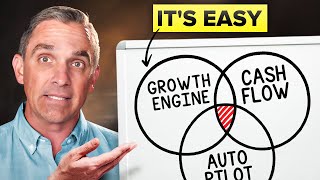
Ryan Deiss explains why companies stall between $2M and $10M in revenue and what founders need to fix it: leveraged sales, bankable profit, and transferable value. The key is building systems that work without you, moving the business out of what he calls a UoS, or you are the operating system.
Questions this video answers
17 companies
$200 million (holding group)
Somewhere between $2 million and $6 million in revenue (he also references up to ~$10 million)
Around $250,000 a year each, minimum
Each may want to hire between 3 to 5 to 7 people, each paid ~$100,000+
Chapters
All companies, even really good companies, stall out somewhere between 2 million and 6 million in revenue. And this video, I'm going to show you why it happens and how to escape it or avoid it completely and what not to do if you're currently in it. Now, if you don't know who I am, my name is Ryan Deiss. My partners and I manage 17 companies across our $200 million holding group. So we know a thing or two about navigating the no man's land. Between 2 million and 10 million in revenue when you're finally kind of out of it. So why do companies stall out and specifically why do they stall out? Start at around 2 million in revenue, kind of 3, 4 million. Well, to understand that, you first need to understand the three things that all companies need if they're going to scale. Number one, leverage sales. Number two, bankable profit, and number three, transferable value leverage sales. Pretty simple. Obviously you need to have revenue coming in, you need to have it coming in often and it can't be dependent on any one thing. Bankable profit. Again, that one's fairly self explanatory. You can't just have paper profit, P and L profit. You need to have actual real life profit that can be put back into the business and then transferable value. What that is is that's all the systems, the documentation that make it possible to transfer the value creation from the owner, from the leadership to other people within the company and then ultimately outside of the company. And the reason these three things are so critical is because if you have leveraged sales and you have bankable profit, that's when you have momentum, right? If you've got sales and you have profit, the profit can keep going in, it can keep funding the business. That's what creates the momentum. And if you have leveraged sales and you have transferable value, this is when you're actually scale able. You're actually able to scale because you're no longer confined by just a couple of people in the organization. I've seen a lot of businesses that stall out not because of a lack of profit or anything like that. They stall out because the only person in the business who knows how to run the business is the business owner. Now, if you have transferable value and you have bankable profit, this is when you have options. By options I mean you could raise money or not raise money. You could get a loan or not get a loan. You could sell the business or not sell the business. Again, you got options because you have transferable value, meaning somebody would buy it, but you're also profitable, meaning you can kind of do whatever the heck you want to do. And when you combine momentum with scalability and optionality, this is when the business can scale and this is when the founder can exit. So this is the goal. These are the three things that we want. We want leverage sales, we want bankable profit, and we want transferable value. Now, what does this have to do with no Man's Land and why businesses get stuck? Well, it's really simple. There are three people in business that you would want on your team if you want to make sure these three things happen. And those three people are a CMO or a CRO that, that's the person that's going to be in charge of leverage sales. And then you're going to want to have a cfo, a chief financial officer, that's the person in charge of bankable profit. And then ultimately you're going to want a CEO, maybe a president, that's the person who's going to be in charge of that transferable value. And these are roles that we know, roles that we understand that need to exist. Problem is, the really good ones, the ones that are going to take you to, to 10 million and beyond, cost around $250,000 a year each, minimum. And here's the other big kind of problem. Each one of these people are probably going to want to hire between 3 to 5 to 7, 100,000 plus people all on their own. And you can afford exactly none of this. This is why good companies stall out. So what do you do? Well, you've got three options. Option one is you can just double down and you can work like crazy. You can assume these roles yourself. You can ask your team to double down. Likely this is what you're already doing. This is what I see most founders do. They say, well, I'm the CEO, so I'm also going to be the coo, and I'm going to figure out this pesky marketing stuff and this sales stuff. And you know, I'm going to do my best to understand the books. I'm going to kind of do everything. I'm going to ask the people on my team to step up too. This is something again, that we all try. The problem is, is that our team, and very often us, we burn out before we achieve the level of scale that we need to achieve to afford the replacement. Now, what do a lot of companies do? What do startups do? Some of the startups that you hear about in Silicon Valley? Well, it's really simple. They raise capital. So that's option two, is to raise capital. The problem with this scenario is that not every business can raise capital. Maybe you're not VC worthy, maybe you're not at a point where a bank is going to lend you money. Maybe you don't have a rich uncle. Even if you could, not every business wants to. If you raise capital, you give up a degree of control, you give up a degree of ownership. All right, so if none of those other options are great, then what is the third option? The third option is really simple. You need to upgrade your operating system. You see, currently you're operating on what we refer to as a UoS, where you are the operating system and the operating system is you. And so the only real option that you have is to duplicate yourself. And the only real way to do that is to get your business out of your brain and into a state where other people can actually help you do this, where it's not limited by just you and by just the 24 hours in your day. Now again, this is something that I think we all inherently understand and we can try a little bit. We'll create a couple of checklists and SOPs and things like that. We'll dabble. If you want to double down on systems, which that is the key. If you want to bridge the gap from where you are right now, if you want to be able to make it through the swamp of scale, if you want to get through no Man's Land, systems are going to be how you do it. What that means you're going to have to pause growth momentarily so that you can focus on systems building. And this is something that no founder wants to do, but it's something that you absolutely must do. Here's the cool part. When you're on the other side of system building, when you increase the capacity of your business, the growth actually comes back faster than it ever would have come if you just kept focusing on growth during that time. So how do you get out of no Man's Land? You systemize your way out of it. You're not going to be able to hire your way out of it. There's no magical unicorn that's going to take you through. You can't just bring on some kind of integrator that's not going to work. You can't just throw a bunch of low level people at it. They don't know how to get there either. Now if you want to know how we do that, I've created another video. I'll link to it down in the description. The commitment that you need to make is to really change the way that you think about being productive in business, because it can't just be about you doing everything. It actually needs to be about you thinking. Well, I'm going to take a pause for a little bit. I'm going to choose to not pursue growth today, because I'm going to choose to systemize. That's not something that every founder necessarily wants to do. But if you're there, if you're stuck, if you're near burnout, if you're in no man's land, this is your best option. And if it's something that you want to that you want to try, just know that that's exactly we do at the scalable company. We are here to support you. So go ahead, scroll down, check the link in the description, and I'll see you over in the next video.