Sachin's Biohacker Presentation - Beyond Breathing
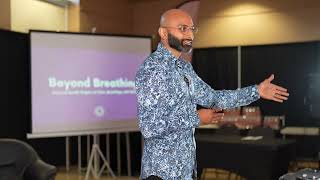
Sachin Patel leads breathwork and mindset practices focused on healing. He emphasizes that belief in the possibility of recovery is central to health, and uses breath-based techniques to center and expand consciousness.
Chapters
Fellow biohackers, esteemed guests and seekers of wisdom and wellness, it is a profound honor to welcome you to today's event. An exploration into the cutting edge world of biohacking and neurohacking, where we journey together towards unlocking the highest potentials of our bodies and our minds. Today we gather not just to learn, but but to experience transformation. To begin this journey, it is only fitting that we are led by someone who exemplifies the principles of deep knowledge, conscious living and purposeful healing. Our opening speaker is not just a man of great insight, but a sage of wisdom whose words carry to power and inspire, to heal and to guide. Sachin is more than just a speaker. He is a visionary, a father, a husband, a philanthropist, and a guide to those seeking true health and fulfillment. Sachin has dedicated his life to empowering individuals to raise their consciousness, activate their inner doctor and embark on their deepest healing journeys. His influence extends far and wide as he coaches hundreds of practitioners around the globe, helping them to deliver affordable and inspired care to their communities. Through his perfect practice mentorship program, Satchin will not only lay the foundation for our day together, he will also guide us through breath, allowing us to center ourselves, expand our consciousness and fully immerse in the experiences to come.
This is Sachin. I trust you're doing amazing. In this video, I wanted to talk about the importance of getting our mind right when it comes to our health. It may come as no surprise to you how powerful our mind is in helping us run our business, in helping us look at the world through a positive light. And the same thing holds true for our health. The first thing that we need to do is believe what is possible for us. We need to believe what with every ounce of our being, with every thought in our mind, that healing is possible for us.
Without any further ado, please join me in welcoming to the stage a man whose meticulous choice of words and deep well of wisdom will undoubtedly set the tone for a day of transformation. My fellow biohackers, please welcome to the stage Sachin Patel.
For the first time, I think I'm at a loss of words. Thank you, Brandon. That was very beautiful and very unexpected. I appreciate that. Let's give him a round of applause, please. This is no small feat, so thank you for putting this together. Thank you for your leadership and I know it takes a team, so there's lots of volunteers. Be sure to be kind and thank them as well as we enjoy this beautiful day together. I know there's a lot of love that's been put into this room to make this happen. And we're going to start off by talking about what I think is quite likely the most important technology that you possess that you've never heard of. So there are lots of great things that you can do, there's lots of great things you can buy. But when I work with clients, I want to know things that are timeless, that are timely, and things that are going to make an immediate, measurable difference in their health. And so I've been seeking what that zenith of both sophistication and simplicity is my entire career. And this November, it'll be 20 years since I graduated. I think I'm on my fourth different personal PhD. How many of you have a PhD in something where you just spend all your time going down the rabbit hole, reading all the books, going to all the summits? Many of us have many PhDs inside of us because we've learned so many new things. My current personal PhD is all about breathing. And breath. It's opened up some amazing doors that not only swing outwards, but. But I think it's opened up the most important door in my life, which is the door that opens inwards. And so anything that takes us inside opens up a whole new university and a whole new universe of possibility. Most of us are looking outside of us for all the answers. And that's exactly how our medical system and our current establishment is set up, right? We're meant to think that our body is broken. We're meant to think that there's something wrong with us. And we're meant to think that there's nothing that we can do but take a medication that would make a healthy person sick. That's how we have this whole system rigged against us. And people say the healthcare system is broken. I'm here to tell you it's not broken. It's fixed. Every system does exactly what it's designed to do. It's fixed this way so that you are powerless. It's fixed this way so that you are forever a client and forever a patient. And it's fixed this way to create maximum dependency, because that's what drives our economy. Every day, one in five people wake up waiting and anticipating and existing because other people are sick. There are more people that profit off of cancer than actually have cancer. If tomorrow everyone woke up healthy, our entire economy would crumble. So our economy depends on you being sick. But I said a long time ago, screw that. And we're going to do things very different, okay? Not better. We're going to do Things different. Thank you. Thank you. So my mentor and friend, Sally Hogshead taught me that different is better than better. So many of us are looking for better solutions. We're looking for a better doctor, we're looking for a better mentor, whatever that case may be. But if you want more of the same, then you just keep doing more of the same. But if you want something different, then you have to take a different approach. So our approach is different because we position our clients as their own doctors. If you write nothing down today that I say, you're probably going to write a lot of things down. But if you write nothing down, then write down, the doctor of the future is the patient. That's the direction that we're heading in. So you can decide if you want to be your own best doctor. Because I don't believe that there is a better doctor than you. You literally built yourself from two cells, right? You just started off as one cell from your mom, one cell from your dad, and they came together and it turned into a human being. And you're literally a hologram of a human being that's dying and being reborn in every single minute. Billions of cells this morning have died and billions of cells have replaced themselves. Why do people stay sick? Just the same way that buying you a new car doesn't make you a better driver, giving you a new body doesn't necessarily ensure that you're going to be healthy. If I give you a brand new body and you have the same behaviors in the same environment, in a short period of time, you're going to be right back where you were. If I give somebody a brand new knee but I don't change their mechanics, what happens? That knee is going to break and wear down, too. So what we actually need to change is the signal that our cells receive. If we change the signal, that's like changing the way you drive. So what we do in our practice is more like driving school for our patients instead of going to the mechanic or going to the body shop. Yes, you need those things. I'm not competing against the hospitals. I don't want to do surgeries. But you are a surgeon. You are a pharmacy. You are your own doctor. You're all of those things in one. There's nothing more powerful than you, than you. Nothing can fix you better than you can fix yourself. But nobody's giving you that power. Nobody's given you that permission. And so today, with everything that you're going to learn, you have that permission to heal. Say I. If you want to heal forever, so the last thing I want is the last thing anyone wants in this room, which is none of us want our children to get sick and then end up in a holistic practitioner's office, right? Who here wants to see the world's best oncologist? Probably nobody, right? You don't want to have to see the oncologist in the first place. So really what we have to do as parents is we have to model health. Your children don't pay attention to what you tell them to. They don't listen to what you tell them to do. They model what you do. So the best person to change isn't your children. The best person to change is yourself. Create the right environment, model the right behaviors so that your children can be healthy for life. You can decide in this lifetime if you want to be a leaf or if you want to be a branch. So you could be a leaf, which is transient. It's one season, it's dead and turns into fertilizer. And of course, it fuels a tree for future generations. Or we could decide to be a branch, and a branch changes everything on that tree. Okay, so do you want to be a leaf or do you want to be a branch? So then you have to make branch like decisions. Every decision you make has to not only account for your present moment, but it has to account for all the future generations to come. When I make a decision, I ask myself, would my future generations be proud of this decision? And would my ancestors be proud of what I'm doing right now? It makes decision making so much easier. You know the best way to honor your mom? How many of you want to honor your mom? Take care of the fricking body she built for you. Right? That's how we honor our parents. So when you start thinking in these frameworks, life becomes so much easier, decision making becomes so much easier, and health becomes so much easier. Here's what I'm here to tell you. The more complicated your health solution is, the further it is away from the truth. Okay? The more complicated your health solution is, the further it is away from the truth. The more embarrassingly simple your solution is, the closer it is to the truth. So what I share with my clients is embarrassingly simple things that they can do that instantaneously, measurably improves their health. So we get results within days. When people say, oh, it's going to take me years to get better, well, you can be directionally correct today, right? If you're lost, you may not get to your destination. If you're 10 hours off course. But the moment you start driving in the right direction, you're on your way. And you get to choose the pace and the speed and who you get to go with. So the fact that you're here, you've made a choice, right? You could have been anywhere else. Some of you could have slept in. Maybe some people did, maybe some people changed their mind, right? But you chose to be here. So my encouragement is for you to be here as best as you can. And so in the words of Ram Dass, he says, be here now. That's the only thing that exists, right? The past, even this morning, doesn't exist anymore except in our heads, and only in your head. And the future doesn't exist anywhere except in your head. The only thing that we collectively share is this present moment, right? So if we can all be here now and raise our collective consciousness, then we're going to have an amazing day together. Okay? How's that sound? Awesome. All right, so we're go beyond breathing. What I focus on, you may have heard of Wim Hof, you may have heard of other breathing experts. What I focus on is how you breathe when you're not doing breath work. When a child is born. I know there's a young child here, Bear if we want to give Jordan a shout out. There he is trying to sneak out of the room. Poopy diaper. Yeah. See how he shit his pants, right? All this stuff I'm saying, he's like, I gotta be my own doctor. My God. He got overwhelmed. So. Here's the thing. The first thing we pay attention to is what? When a child is born, are they breathing? Right? And when somebody passes away, what's the last thing we say? We don't say I was there for their last heartbeat. We say I was there for their last breath. But nobody talks about it in between. And they certainly don't teach it to us in school. They don't teach us to us in medical school. Presentation I'm going to share with you today. Pulmonologists come running up to me after, afterwards and saying, where the hell were you when I was learning about breathing and lungs? Right? They don't know this either. So you're going to be light years ahead of where I was five years ago and light years ahead of where everyone else is. Just by listening to today. I'm going to go fast because I've taken up, you know, probably 10 minutes of my time just kind of preaching to the choir. But we're going to go and we're going to have Some fun. Okay, While they're fixing that, I'm going to show you a breathing technique. This is called the physiologic sigh. This is a technique that you can use at any given moment when you want to shift from being in fight or flight to being in a parasympathetic state. This is a good time for us to be in a parasympathetic state, because when you're in a parasympathetic state, you actually remember more, you absorb more. You're more present in the moment when you're in fight or flight, which is probably where most of us were trying to get here. Am I going to find parking? Where am I going to sit? Right. Am I on time? Right. That's fight or flight. But now that you're here, let's kind of shift into the right gear. So this is something that you can do in the car, not when you're driving, but this is something you can do at a red light if you wanted to. You could do this before you walk into the house, if you had a tough day at work, before you walk into the office, if you had a tough day at home. Right. And it's a technique that you can do with your clients, if you're working with people, and you can also do this with your children. So physiologic sigh has actually been shown to be more effective than meditation. So Andrew Huberman and his team, he's part of the study, released a study just recently showing that this technique was more effective than meditation. So if you have a hard time meditating, that's okay, because I'm going to show you how to do something that you're already doing, but I'm going to show you how to do it better. So we're going to do something called the physiologic size. So sit up nice and straight. Why weren't you sitting up straight the whole time? And we're going to place our tongue at the roof of our mouth. I'm going to walk you through it. Then we'll do three of them together. So you're going to place your tongue at the roof of your mouth, and your tongue is going to sit gently there. You're not going to push it there. You're going to rest it there. Next, what you're going to do is you're going to breathe into a soft belly in through your nose. Take a nice deep breath in through your nose, and you're going to fill up your belly. And then you're going to breathe a little Bit more into your lungs. And at the very top, you're going to take a few more sips with your mouth. And then you're going to squeeze your pelvic floor like you're stopping yourself from peeing. And then on the count of three, we'll release with an audible sigh so it'll sound and look like this. You're going to. You'll drop your shoulders, drop your tongue, drop your pelvic floor, and then just relax and say, perfect. Tongue at the roof of the mouth. Deep breath into the belly, into the lungs. Few more sips at the top. Hold it. Squeeze your pelvic floor. Keep holding. On the count of three, we're going to release with an audible sigh. One, two, three. All the way out, all the way out. Okay, one more in. And through the nose, tummy at the roof of the mouth, into the belly, into the lungs. Few more sips at the top, few more. And hold. Squeeze your pelvic floor, belly soft. And on the count of three, we're going to release with an audible sigh. One, two, three. All the way out. Okay? Perfectly. Now, what you're going to do is you're going to breathe the rest of this presentation with your tongue at the roof of your mouth. Unless you're gasping from something. I say keep your tongue at the roof of your mouth because that's going to activate your parasympathetic nervous system. The moment you know somebody is stressed is if they start breathing through their mouth. Okay? So you can tell a lot about an individual based on how they're breathing. It's an actual signature that they have. I can tell if somebody's had been traumatized. I can tell if somebody's fearful. I can tell if somebody's scared. I can tell if somebody's calm. I can tell what state their nervous system is in based on how they're breathing, because your breath is the steering wheel of your nervous system. So if I was up here breathing like this, what would you think? That I'm stressed out? Right. Mouth open, fast, short, shallow breaths. But if I was sitting here breathing six seconds in, six seconds out, my nervous system would have a different vibrational frequency, wouldn't it? Blood would be going to different parts of my body, different parts of my brain, and I can actually control that. Once you learn about this, you start to realize that, oh, my God, I have gas pedals and I have a steering wheel that nobody's ever taught me about. And now you can directly choose how you want to feel in any given moment. Who wants that type of power. Right. Imagine that. All right, so we've all probably heard the word pranayama. Prana is life force. Yama is control. So whenever you hear the word pranayama, break it down. It's just control of your breath. We all have control over our breath. It's the one thing that we do unconsciously that we have conscious control over. You don't have conscious control over your heart rate. You have. You have indirect conscious control over your heart rate based on your breathing. I could raise your heart rate. I could lower your heart rate based on how you breathe. So you have control over this life force. That's what pranayama means. Breath is the most powerful health technology that we've likely never heard of. And breath is both art and science, which means that there's variations, but there's also a process. So you can use a process to create a predictable outcome for somebody. I can choose exactly how I want someone to feel. One of the most effective ways to lower somebody's blood pressure is by changing the way they breathe. Works within minutes. It actually works instantaneously. And your body actually uses it. Your body uses your breath without you even knowing you're using your breath. Think about sighing. When we feel a sense of relief, what do we do? We sigh. What did we do just a few minutes ago? We exaggerated that act that we already do to induce a response. The greatest sign of sophistication and simplicity. The greatest sign of sophistication is simplicity. This is from Leonardo da Vinci and Steve Jobs echoed this as well. Because there's nothing simpler and nothing more sophisticated than your body and your breath. The breath is the zenith of sophistication and simplicity. Between the stimulus and a response, there is a gap. So Viktor Frankl talks about this. And this space is our power to choose our response. In our response lies our growth and our freedom. So some of you may have read Man's Search for Meaning by Viktor Frankl. I just adopted that quote. And I said, there is in between a stimulus and a response, there is a breath. And so we can choose. Your breath is a fork in the road. In any given moment, how you want to feel next. So each think of each breath as a step in the direction you want to go in. So if I want to feel calm and relaxed, I slow down my breathing. Tongue at the roof of the mouth, breathing into my belly. If I'm going for a run, I wouldn't want to breathe that way. I would want to breathe a different way to get more blood flowing to My arms and legs to increase my blood pressure so I can get blood to my arms and legs, to increase my heart rate so I can pump that blood. So there's no wrong or right way to breathe. There's no one way to breathe. That's why it's an art and a science. There's ways to breathe for what the moment requires. So you get to choose. That's our breath. We take 23,000 breaths a day, most of which are unconscious. And thankfully, we don't have to think about breathing, because if we did, most of us would be dead. Right. Because we don't think about it, we consume 30 pounds of air a day. So you actually consume more air into your lungs and obviously goes out of your lungs, too, than food you would eat in a week. So which one do you think is more important? There are more molecules of oxygen in each breath than grains of sand on the entire planet. So there is literally a universe that you're inhaling and exhaling with every breath. Each red blood cell carries a billion molecules of oxygen through 60,000 miles of blood vessels. And we only use oxygen in our mitochondria. So you'll be hearing people talk about mitochondria later today, which is a little battery inside of each of our cells in our body. Some of our cells have thousands of little mitochondria inside of them. And the only place you use oxygen in the entire body is in the mitochondria. We need it to actually make energy. The slower we breathe, the more oxygen we absorb. So it sounds kind of counterintuitive because we think, oh, if I breathe more, then I'm going to actually absorb more oxygen. With each breath you take, you only absorb about 20 to 25% of the oxygen. So if you breathe slower, you actually have four to five additional breaths in each breath that you take. What's really fascinating is the slower you breathe, the more oxygen you utilize. It's called the Bohr effect. I won't bore you with this, but you can look it up. No pun intended. You can look it up and learn more about how PH with our breath affects how much oxygen gets delivered. This is why somebody. When somebody stops breathing, how long does it take for their heart to stop? About three to five minutes. Because with each breath, even with that last breath, there's so much more oxygen. And as our CO2 concentration goes higher and higher in the blood, more oxygen is actually being dumped at the tissue level. Your mitochondria die after 5 seconds of not having oxygen. 5 seconds. So thank God. We have the Bohr effect because with each breath we take, it takes more than five seconds to kill us. The slower we breathe, the slower we age. So if you study animals, animals don't have this overdeveloped prefrontal cortex that makes us do smart and dumb things. The way they breathe, which is mostly unconscious, the slower an animal breathes, the longer it lives. A Turtle takes about three breaths a minute. It lives to 200 years. A dog takes about 35 breaths a minute and ages seven times faster. A mouse and an elephant take the same number of breaths in their lifetime. A mouse lives just a few weeks because it takes so many breaths. In many cultures, we are born with a certain number of breaths, not a certain number of heartbeats. The greatest predictor of lifespan is actually lung capacity. So how much air you can inhale and exhale is the greatest predictor of how long you're going to live. We burn about 1200 calories a day breathing. And just like most people overeat, most people over breathe. So you could actually spare yourself one meal a day by slowing down your breath. If you were to breathe a third less, you would need a third less calories to stay in an anabolic state. So when people fast, if they don't change the way they breathe, they feel hungry all the time. But if they slow down their breath and they restrict their calories, now they're slowing down the aging process and they're lowering their caloric intake, which has also been shown to extend lifespan. So when you hear about these yogis that eat very little, it's because they breathe very little, they take one breath a minute instead of the average person who takes 15 breaths a minute for every 10 pounds we lose. Some of you might have weight to gain or lose, but people don't know this. When they asked experts, they asked experts, where does the fat go when you burn fat? Almost none of them knew the answer. For every 10 pounds you lose, 8.4 of those pounds is through your lungs. Because the byproduct of cellular respiration, which is energy production, is CO2, carbon dioxide, and water. So the other 1.6 pounds, you pee it out, or you sweat it out, or it goes out in the fluids in your stool. So think about this. All these people are trying to lose weight, right? We have an obesity problem. So to me, that means we actually have a breathing problem. Breath is the most potent and fastest acting adaptogen, right? So we hear about reishi as a powerful adaptogen. Ashwagandha, rhodiola. We hear about all these supplements and herbs that you can take that are powerful adaptogens. And yes, they are. But nothing works faster than your breath because I can instantly change how you feel. How many of you, after we did that physiologic side, felt a little bit more centered, more relaxed, more present? Just raise your hands. And we only did two. So if you imagine you did that for like two to three minutes, think about how your life could change. The key contributor to oral health is how we breathe. And that's actually where part of my story starts with my son. Mouth breathing is the number one cause of cavities. How many of your dentists told you that? Okay, some of you might need to upgrade your dentists, right? And that's not a shot at dentist, but we just don't know what we know. You want to find an airway centric dentist. So if you go to askthedentist.com, you can find a dentist that is actually focused on the airway, not just on having white teeth. How long if you Want to live? 20 years longer. How much longer do your teeth have to last? 20 years longer. People's health degenerates and degrades when they lose their teeth because they can't chew their food, which means they can't break open the cell walls of plants and they can't extract nutrition from their food. So we have to have, if we want to think longevity, we have to think we want all of our parts living for that long. So you see people in their 40s, 50s, and 60s, and they're losing their teeth. Well, good luck with longevity. The mouth is a window into the rest of the body, just like the eyes are a window to the soul. The one thing I'll say is that this is very commonly overlooked and what happens when we breathe through our mouth is there's a whole cascade of negative things that happen. But when I took my son to the dentist for the first time, they said, Mr. Patel, we have good news and bad news. I'm like, okay, give me the good news. The good news is all your son's teeth are going to fall out. I was like, okay. Because he was still young at the time he had baby teeth. And I'm like, what's the bad news? He says his teeth are full of cavities. And we're like, what the hell? Because we eat healthy. He doesn't eat all the stuff. I'm sure he does now, but can't control teenagers, right? Just never know what they do. So I don't Want to say he's perfect. And then you find out he's not too much pressure on them, but he's a great kid, okay? So we're like, what the hell? We don't feed him all this stuff. Like, what are we doing wrong? And it turns out he was a mouth breather, and most kids are. And that resulted in not only him having cavities. He doesn't have any anymore because we know what to do. And it resulted in him having a small upper airway because his palate was underdeveloped, because his tongue was not sitting in the right position. Our tongue actually changes the shape of our face. How you breathe changes the shape of your face. And I'll show you how the shape of my face changes. It won't make your hair grow back, but it will change the shape of your face. Mouth breathers require more sugar than non mouth breathers because how we breathe affects our taste buds. So are you a sugar junkie, right? Or do you have a sweet tooth? Or do you not know how to breathe correctly? Chances are you may not be breathing correctly. The number three cause of divorce is dysfunctional nighttime breathing. Look it up. It's snoring. So this affects. How many of your lawyers told you that? Right. Snoring and apnea are common contributors to elevated morning cortisol and blood sugar. Some people come to us and they're like, I can't get my blood sugar dialed in. I'm not eating, I'm exercising, doing all the things, which they're probably not anyways, but let's assume they are. And their blood sugar comes elevated. Guess what? It's probably because they were fight or flight breathing while they were sleeping. And when you change the way you breathe, it changes the hormones you produce. If I want to increase your cortisol production, I would just get you to start breathing through your mouth, and you would increase cortisol production because it's a button. Every time I press it, it works. A third of ADHD and ADD diagnoses can be attributed directly to the way children breathe. The way we breathe kind of informs our entire nervous system. One of the things that I learned doing this work is that a lot of our trauma is stored in our diaphragm. We store trauma in our diaphragm, both physical and emotional trauma. And you'll understand why if I get through all my slides. And the other thing that you do is you store grief in your lungs. So grief in the lungs, trauma in the diaphragm. And so if we've had trauma. So Jordan was saying, this kid, he just breathes through his belly all the time without any effort. I'm like, yeah, because he hasn't been traumatized. When we take physical blows, our diaphragm stabilizes what's called our entire myofascial matrix, which I don't know if anyone's going to talk about that, but you have a web like structure that connects the nucleus of every cell in your body simultaneously in a hydrostatic system, which basically means that you have this force distribution system in your body which is maintained through your diaphragm. So when we take a physical blow, our entire body myofascial system stabilizes to take that blow. When we experience something traumatic, what do we often do? We cry. Right? And then what are we often told not to do when we're crying? Stop crying. So what do we have to do to stop crying? We have to stop breathing. Right. So where does that trauma goes? Right into the diaphragm, which then forever changes our breathing signature. And if we change our breathing signature, those little kinks in our breathing signature change the default state of our nervous system. Is this blowing your mind yet? Okay, awesome. Our breathing signature creates safety for those around us, right? So this is. I mean, I don't do this. I guess I may do it intentionally, but it's unconscious to me now. But people will tell me, I feel safe in your presence. How many of you feel more calm hearing me speak? Right? And that's because I know how to control my voice, how to control my breath, how to speak at a pace that aligns with the way that you're breathing. If I start speaking faster than you're breathing, my nervous system and your nervous system is out of sync. So the way you hold space for other people is by shifting the way you breathe. And guess what, everyone, their nervous systems will follow. The way we breathe determines our facial structure and attractiveness. So here's me on the left. That picture is from about five years ago now. And what you might see is the way this part of my face is structured. And now you can see how it's structured now. And it's subtle, right? So it's not going to be like significant, but if you have a discerning eye, you can very quickly see the difference. And my face is just a little bit wider. And I did that simply by being hyper conscious of where I placed my tongue. This can happen for your children as well. Like no human being needs braces. Just so you know, we're the only species on the planet that gets braces. Like, when's the last time people had braces on their dogs or their cats? Right? Dolphins, they don't need braces, right? Every animal has perfect teeth because every animal has perfect tongue positioning. What happens when you put your tongue in the roof of the mouth? Not only does it calm your nervous system down, but it pushes your face outwards, otherwise your face collapses inwards. And what ends up happening is you end up with a very small airway and you end up with a small arch, which means that your dentist wants to pull your teeth or your children's teeth. That's what my son's dentist wanted to do. So we went through four different dentists until we found one that was airway focused and didn't have to pull any of his teeth. And now he's got a beautiful smile, so it's never too late. But I would highly encourage you to run away from people who want to pull stuff out of your body. There's no such thing as too much of you, right? God, don't make no junk. So breath work and plant medicine, sometimes they can be used together or they can use independently of one another. The way I equate plant medicine is that plant medicine is like taking the elevator to the mountaintop. And breath work is like taking the stairs. So you can get there, you can get to extreme levels of ecstasy and you can have out of body experiences. You can do all kinds of amazing things with your breath. Just might take a little bit more effort to get there. Okay, so Ram Dass, some of you might know him, we have a company called Neurodose here. I would highly encourage you check him out. And one of the things that Ram Dass used to do, him and Timothy Leary, they used to work at Harvard and they would give their students lsd. And then the school found out and kicked him out. So Ram Dass went to India and he met his guru, Neem Karoli. And Neem Karolyi taught him the power of breath. So when he came back from India, he brought back these yogic breathing techniques with him. So he actually gave up his plant medicines and focused strictly on his breath. So you can get there. And I'm not saying one's better than the other. I would probably encourage people to consider both, but it's possible. Breathing can lead to profound spiritual experiences. This is me leading a group of healthcare practitioners through a guided breathwork experience. And this opened up so many doors for me because it allowed me to take others through these type of experiences. So Breath is life. And this is my grandfather on the left. I missed his last breath by a traffic light, so it was really, like. It was really disheartening. But that's my grandmother on the right. And even during COVID they said, well, you can only have so many people. And we're like, okay, what are you going to do? Right? So we were there for her, for her last breath. So if you ever have the opportunity to be there for somebody's first breath, that's really special. But I would say their last breath is even more special. So do whatever you can to be there for the people you love. And why is breathing important to you, your family, and your clients? Because what's more important, you can't go more than a few minutes without breathing. So I have a special gift for you, and it's basically what I refer to as the ultimate breathwork bundle. And so what you can do is you can scan this QR code. I hope you can see it, take a picture of it, and just enter your name and email. And I'm going to send you some keynotes. I'm going to send you these slides from today. I'm going to send you some bonus materials. I'm going to teach you how to stop snoring. I'm going to teach you how to breathe when you travel so you never get sick. It's really simple. I'm going to teach you all kinds of ways to breathe in different scenarios and situations. Okay? So there's a free guide for you there. And for those of you that sign up, you'll have a chance to win an OURA Ring. So we're going to give out an OURA Ring probably the end of today. So make sure you get registered there and get access to that. How much time do I have? What time am I going till? Okay, so I actually haven't even started my presentation, and that's why I put this slide in there, because I knew I probably wouldn't. So just get that. Okay. And enter your information, and then you'll get a chance to win, but then you'll get some additional resources. So let me go through this. Can I have 10 minutes? Okay. You know what that means, right? All right, so why do we breathe? We breathe to remove CO2. We breathe to make energy in the mitochondria. We breathe to regulate our ph. So many of you have heard, I'm going to change my diet, and my PH is going to change. Guess what? Your lungs are already doing that for you. I could change your blood ph. Just by changing the way you breathe. So speeding it up, slowing it down, we can regulate pH. Try smelling without breathing. What's your first cranial nerve? Your olfactory nerve. Right. So we sense our environment through smell. It's very important. Try speaking without breathing. Right. We need to move that air detoxification. 70% of our detoxification is actually happening through our lungs. It assists the heart in pumping blood. So every time we breathe in and out, guess what? The diaphragm's moving up and down. The lungs are expanding and contracting. It's squeezing your heart. If your breathing is dysfunctional, your heart has to work harder. You see how God is so brilliant? God put all this apparatus together to work synergistically together. And all God said was, if you simply breathe, then the rest of the stuff takes care of itself. It all falls into place. We move lymph. Some of the biggest lymph nodes in our body are underneath our diaphragm. And that makes sense because my diaphragms, if I was God, and I said, where should I put these big lymph nodes? Why wouldn't I put them underneath the thing that's moving up and down 23,000 times a day, which is your diaphragm? So dysfunctional breathing leads to poor lymph circulation. Most diseases, like cancer, start in the lymph. We regulate our emotions with our breath. When you laugh, that's a breathing signature. When you have an orgasm, that's a breathing signature. When you're crying, that's a breathing signature. When you feel a sense of relief, that's a breathing signature. So you can get a sense of what that person's nervous system is going through just by paying attention to the way they're breathing. You can tell if your kids are lying just by paying attention to their breathing. It also increases circulation. So when we breathe correctly, we also increase something called nitric oxide. Nitric oxide helps us dilate our blood vessels. Nitric oxide helps increase circulation. But nitric oxide is also anti pathogenic, it's antibacterial, it's antiviral. When cold vid was a thing, what did we do? We basically said, nobody talks about breathing. We said, cover up your face, but you all have a mask inside of your face. It's called your nose. And your nose actually produces mucus, which contains something called nitric oxide, which kills viruses and pathogens on contact. Why wasn't anyone talking about that? Why wasn't anyone teaching you how to breathe when you're around sick people? Do you know how to breathe. When you're around sick people, you want a million dollar solution, Just breathe out, right? If somebody's coughing around you, don't breathe in. Just breathe out and nothing comes in, right? It's like stupidly that simple. Embarrassingly like, oh my God, why didn't I think I could be up on stage? I could have said that, right? Of course, right? It's embarrassingly simple, right? When I go into a bathroom, I'm not breathing that air in. I don't want to breathe in the last person's poop particles. I take a deep breath in, I take a few cleansing breaths, I hold my breath and I breathe out as slowly as I possibly can. And if I have to take a breath, I breathe in super slow so my nose has a chance to filter and kill anything that wants to get into my lungs. Your nose cleans and purifies the air. Your mouth is the dirtiest part of your body. So by simply breathing through your mouth throughout the day, which about 50% of people do unconsciously, your lungs are just like, what the hell, dude? Why don't you breathe through your nose? That's why I gave you one. When you breathe through your nose, it pressurizes the air. It cleanses the air. Moisture, regulates the air temperature, regulates the air. It perfects the air when it's coming into your lungs. When you breathe through your mouth, it actually makes whatever air you're breathing, it makes it dirtier. Okay. We can also have spiritual experiences. So how should I breathe? Of course, it depends, right? So mouth closed, jaw relaxed, tongue placed gently at the roof of the mouth. Six seconds in, six seconds out. Is coherence breathing. It's referred to as breathing should be slow, steady, and breathing should be inaudible, right? I shouldn't hear the person next to me breathing. I should be like, is this person even alive? Right? When you watch your children breathing, a lot of times we're like, shit, are they breathing? I can't tell because it's such a calm, gentle process. Three gears of breathing in and out through your nose. That's how you want to be breathing 99% of the time. Second gear is in through your nose, out through your mouth, right? It's okay to breathe out through your mouth because we want to get rid of the CO2, right? As quickly as possible. And that's with mild exertion. With intense exertion. If I was running away from a lion or something that was chasing me, right? Or I was doing an all out sprint, I would want to be Breathing in and out through my mouth, because that's going to be very short lived, right? Just a few seconds, maybe a minute or two. And the faster I can breathe in and out, the more my lungs and my diaphragm will pump my heart. You see, if I was trying to run as fast as I could and trying to breathe as slow as I could, I would be fighting my biology. Biohacking is understanding your biology and doing what your body needs in that moment, right? That's what it means to me. So where does the immune system start? Trick question. Where does your immune system start? Does it start in your gut? Does it start where? In your nose. That's your primary defense system. Watch how people breathe when they wear a mask. The mask is like going in and out like this, right? Because they're breathing through their mouth, destroying their immune system. So why do we breathe through our nose? I gave you all the reasons. I think I got all of them. Oh, here's another one. So when you breathe through your nose, it actually recaptures moisture, so you're having to drink less water. And when you breathe through your nose, it acts as an anti diuretic, which means that if you breathe through your nose while you're sleeping, because you're mouth taping at night, you don't have to wake up to use the bathroom as much. And that one tip is like, is like gold for a lot of people. Because sometimes you can disrupt your partner, sometimes it disrupts your sleep, and it has to do with the way you're breathing. That's one of the first things that people notice. How long does it take for that to happen tonight? Right, These are buttons, right? We just push them. All right. Nasal breathing. Nitric oxide. You can measure your nitric oxide. Humming, embarrassingly simple increases nitric oxide. Hum your favorite songs, you'll increase nitric oxide 15 fold. All right, the diaphragm, releasing the diaphragm. Here's. Hold on. Diaphragm controls blood pressure and controls lymph. It maintains the fascia. Here's a really embarrassingly simple exercise you can do to strengthen your diaphragm. Lay on your stomach for two minutes and breathe into your belly. And you'll strengthen your diaphragm. Your diaphragm is the only muscle in your body that works 24 hours a day. And you have conscious control over all the other muscles in your body shut off, except your heart and your diaphragm. But your heart, you can't consciously control your diaphragm. You can so it's probably one of the most important muscles. It's referred to as the second heart. Your tongue is connected through the fascia all the way to the tip of your toes. So tongue placement should be right behind the front teeth. Changes our facial structure. Check your kids and yourself for tongue ties. Changes the way we feed. It also changes the way we soothe ourselves. The tongue is connected to your shoulders. This is my wife's before and after X ray. You can see that the curvature of her neck completely changed when she had her tongue tie snipped. Okay. So our tongue plays a crucial role in how we breathe. Learning disorders are associated to how we breathe. Chewing and all those things are associated to proper breathing. So I've got all these slides for you. Okay. And I don't want to rush through this because I know I can do that, but I don't want to because I think this requires time for you to digest. So I've got this presentation or similar one that I'm going to share with you and you can tap into that. I know we have a tight schedule today and I want to honor everyone's time. So I'm just going to go to the last slide here. And you can go ahead and scan this QR code. Holy smokes. How did I ever think I was going to get through this? Okay, so scan this QR code and I'll be sure to make sure you get a copy of today's session. Was that helpful? Okay, awesome. I would love to know what's one? Like maybe we can get two or three people sharing. What's one new thing that you learned that you're going to apply? Go ahead, Mohammed. Wow. Thank you for sharing. Thank you. One more. Anyone else? Go ahead. Yeah. Yeah. Amazing. My pleasure. Thank you. Thank you. Yeah. He said, do you want to repeat it? Yeah. So most people over breathe, which leads to overeating because they burn all these excess calories without getting the efficiencies. If you slow down your breathing, your breathing actually becomes more efficient and you're wasting less energy to get the oxygen that you need. Breath by James Nestor. That gentleman in that second picture that I shared with my face, that was James Nestor. Come see me afterwards if you have any questions. Thank you. I love you all. Have a great day.
More from Sachin








Your Doctor Won't Prescribe This… But It's the Most Powerful Medicine on Earth

