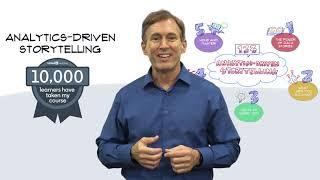
A short YouTube preview featuring Mark Dinolo and SalesGlobe Sage announcing that their LinkedIn Learning course "Analytics-Driven Storytelling" has reached 10,000 learners and sharing a clip titled "Comfort in Numbers." The clip argues that while data provides comfort and certainty, analytics should support a clear, complete story — including a recommended resolution — rather than forcing listeners (even capable CEOs) to draw conclusions themselves. The video emphasizes storytelling's primal power and role in business communication.
Questions this video answers
10,000 learners.
Hey, it's Mark Dinolo at Sales Globe. And today is free to Friday, and.
I want to let you know we.
Now have 10,000 learners on our LinkedIn learning course, analytics Driven Storytelling. And I want to share a segment with you all, Comfort and Numbers, to help you get into the mode of.
Storytelling with your analytics.
So check it out. The link is right here, and we'll see you there. There's comfort in numbers, especially in business.
There's a degree of certainty that we have in number. In fact, the more information, the more data that we have, and even some in the appendix, we feel a lot more secure. But what we can do is we can end up showing all of our hard work. It becomes about me. I. I did all this work. I burned the minute of oil, and I'm going to show you everything that I did. And what I end up doing is I end up confusing the audience. I end up over taxing their brains. I'm asking them to do too much. I'm forcing them to do the thinking and the deciding. So I was working with a person the other day, and he did a wonderful job of telling this analytics story. And in fact, it had a whole architectural theme about what the company could do to improve itself and all the different improvements and changes it could make to increase its value. And we got to the end of it, and I said, well, where's the finish? And he said, well, the CEO is a smart guy. In fact, he's a former strategy consultant. I think he's going to be able to draw his own conclusions. And I said, well, that's exactly the wrong thing to do. And you don't want to force him to do the thinking. What you want to do is you want to give him the thinking and give him the entire story and the resolution. So the analytics, they don't tell a story alone. They're part of the story. In fact, they're not even the main character. They're the supporting cast. So you have a whole storyline, and the analytics come along to support that story. So why are stories so powerful? Well, they engage our primal wiring. It's what we've been doing for 50,000 years. It's how we communicated. A long time before we had writing, we had stories. In fact, even before analytics, we had stories. It's how we learned when we were kids. It's how we learned when we were in school. In fact, you might have learned your job or your profession through stories. You know, Bill had a meeting with the CEO, and he said some things the CEO didn't really like, oh, really?
Well, where's Bill?
Oh, he doesn't work here anymore. So we remember these things because they have a visceral impact on us. So stories have power. And in fact, you should be leveraging that power in your stories to get more impact from your analytics, because you want to get to your ultimate goal, which is motivating action. So here's what I'd like you to do. I'd like you to jot down three examples of recent presentations that you've done that had a lot of analytics or a lot of data in them, and and overlay onto them a story, what a story might have looked like, and which of those would have had more impact if, rather than just giving the information across, you were able to tell a really clear data analytics story.