2022 Survey Readout - Hybrid, Omnichannel and Trusted Advisor
This YouTube readout (SalesGlobe Sage, Nov 15, 2022) summarizes a 2022 sales-survey focusing on hiring and role shifts: companies are increasing hiring for hybrid (54%), inside (43%) and field (36%) sales, with a strong emphasis on new-account (hunter) sellers (61% hybrid, 50% inside, ~48% field). The conversation covers geographic pay and remote-hiring issues, the historical shift from field to inside/hybrid enabled by technology and COVID, the rise of omnichannel buying and the "trusted advisor" expectation, and the downstream implications for sales process design and incentive/compensation (channel crediting, channel neutrality, revenue roadmap).
Questions this video answers
54%
43%
36%
61%
50%
Chapters
On the hybrid roles, hybrid and inside are leading the way. 54% of companies increasing hybrid. 43% of companies increasing inside sales. We'd not mentioned the third point yet, but 36% of companies increasing field sales. So you can see in all three of those sales categories, the numbers are up. And what's really interesting, and I love these kind of things because you can start to see what's happening in the market overall. The big push in all this hiring is toward new account sellers.
Yeah.
So your Dobermans. Right. Or you know, your, your hunters. So new account selling is a priority. 61 of companies are increasing new account sellers in hybrid. 50% of companies are increasing new account sellers in inside sales. And in those new account sellers are primarily the outbound sellers on the inside sales. And in 40%, 48% of companies increasing new account sellers for field sales. So what does that say? It's saying companies are looking at how do we go out and how do we get new customers, not just hold on to what we have. So companies are getting much more aggressive about hiring in those areas. So that is a key point. And we have this broken out by industry. If you want to get the report from us about, well, what's happening in my industry in terms of new account selling hiring, we can tell you that as well.
Right. And we believe that one of the reasons behind that is because we've already talked about the hybrid is the fastest selling or fastest growing role. And people are having to. Your salespeople are having to learn how to connect in new ways. So going out there and getting new customers, new clients, new buyers, it's just a whole new game. And you know, companies are seeing that there's greater opportunity to go out there and, and get market share. So that's what the game is today, getting new.
Yep, yep. And good point just came up. Again, thank you. For Regina, the companies hiring people in other geographies for salaries that are in their home geography. So use the example of California companies paying California pay to people in Texas and then it makes it harder for companies in Texas to compete. Right. So I'm a big free market guy, so I'm like, okay, that's interesting. What does that mean in terms of, you know, competition for labor? And, and do California companies really need to pay California rates for Texas labor? Are they being efficient that way? Or, you know, I'm sure their HR policies will say something, but could they actually pay less and still get what they need? But that's a really good point. So we now break down the geographic barriers. Then you've got the other situation, Regina, which is California companies saying, well, okay, if you're moving out of the Bay Area and you're moving to Idaho, we're not going to pay you California rates or wages anymore because, you know, we're seeing that happen too.
Yeah. So interesting. Mark. I've got some colleagues out there and, you know, running a couple of people that are running global companies and have found out that a lot of the employees, as in thousands, you know, multiple. A lot of people moved out of state and they didn't even know. Now, that's a whole nother question, not only about pay, but around tax liability and everything else. Like what?
It's like we want you to come in the office next week. Well, no, I live in. I live in Minnesota now.
That's just a whole other side note. But we'd love to hear more your thoughts about that and what you might be facing. Oh, so now we're going to talk about Omni and trusted advisors. So what we have said is that we've got this omnichannel growth and it's been, you know, it looks like it's here to stay and trusted advisor status, which we know is no longer, you know, it's not just a phrase. It's the way it is. And let's talk a little bit about why we thought it would be good to talk to people about that. So we know that, you know, back at the beginning of time, people didn't go very far. Everything was pretty local. And when we talk about primarily field, everything from the door to door salesperson to, you know, oh, gosh, back in the day. Well, back in the day, in those old movies, they've got the people driving the carts and the merchant would be going into the cities. Right. But it was field. Right. And they'd be going around field.
They were actually out in the field.
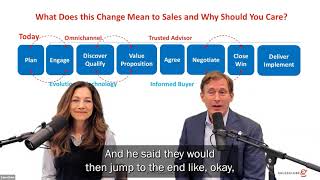
Out in the field. So then what we saw was that, is that. I'm sorry, with globalization, we started to see some pressures for efficiency. So globalization, I mean, we were able to. With planes, trains, automobiles, right. Everything getting a little closer, hiring people from different areas. We started to see catalog, phone orders. Gosh, those, those continue today. But then we started to see a real growth of inside sales in B2B and that center of excellence where people work together in teams. And many of you on the, on our meeting chair, on our round table will probably be familiar with that, right? There's bells and whistles, there's balloons there. You know, it's. It's a real team environment. But then what we saw is that we had some technology innovation, hello Internet, right, so that came about and the informed buyer, right? So the informed buyer, that's the one that has talks to you and they've already talked and they've already researched five or six other competitors. They already know what pricing looks like and et cetera. So you've got this evolution of trust advisor. It's no longer about features anymore, it's no longer about, you know, my product but it's what am I solving for for you. And you know, let me explain why we're different. What's our value proposition? And then we've got more evolution of technology and we've got new sales roles that started to evolve. We talked about the hybrid role which really has been enabled by what we're on today, like video, video conferencing and the ability to be what almost real, right? Like almost face to face. This virtual face to face like we're on today and tele web. And then finally you'll see how that curve just goes straight up. Because we had the COVID acceleration which created a lot of behavior, behavioral changes which really were habits, right? We had to shop online, we started going to the curb, more calls were made for from in the B2B space for orders. And then even companies started to adopt and put online a self serve ordering. So then those habits, you know, really became behaviors well ingrained. And so we know Omnichannel trusted advisor here to stay. So why is that important to you?
What does that mean for the sales process?
What does that mean? Right, so the legacy sales process in yours may not be just like this. So this isn't about, you know, this is the right sales process. But basically there was a couple of things going on. Prospecting, where you go to the buyer, demand creation, where the buyer comes to you. The whole role was to engage, educate and inform about your product, your features, your pricing, negotiate what that was. Mainly it was around the pricing and then you'd win it, you know, or maybe lose it, but then deliver it, right? But that's how it was. Now what's happened? Who two drivers, evolution of technology and informed buyer. So now what we see is there's all of this planning how we're going to go to market and how are we going to engage people in this very crowded space of competition. The whole discovery and qualification and value proposition, it like cycles around and around as sellers are being asked to really think about what problem are we solving for, right? And then as we get through. And we're negotiating, looking at close win. It's not just about how much is it going to cost, but negotiation is really around what does our relationship look like? How do I continue to engage with you? How will you help me solve my problems in the future? I mean, it's a whole different ball game.
Yeah. And what I think is really interesting how these, these points, key back to that, that evolution that you talked about, Michelle.
Yeah.
With the evolution of technology and the informed buyer. So as you mentioned up front, the buyer knows a lot more, so we don't have to do that same level of informing. And as we've been talking about or alluding to along the way, Omnichannel is playing a bigger role. So they expect to be able to get information from multiple sources. They expect to be able to make the purchase, you know, jump from one channel to the other to make the purchase. They might not even want to deal with a human. Right. So I keep seeing where we're heading in the future here, which is the, the salesperson who's going to have the advantage that the seller is going to have the advantage. The leader is going to have the advantage is the one that's able to move not just into the trusted advisor role. But you were talking about the ability to solve problems. Right. So that's the one thing that's not going to be AI'd or, or automated or offshored is the ability to solve the customer problem. So where the customer can get all this information up front. Now it's that problem solving capability that I think is going to be the new competency that differentiates organizations.
So, Mark, we were just having a dinner and then I want to get to how this impacts people that are in payments that are dealing with incentive comp. But I want to add, we had a dinner the other night with a global client. Right. They do, they offer global services and their sales leader was talking to us and said, I need, you know, still. Right. I need my people to be able to understand what problem is it that our clients are solving for or we're not going to win.
Yeah.
And what we say is often the first thing that someone says you like. I'll make up a couple common one that we hear all the time, which is our people are just not out there getting new. They just keep selling more of the same because it's easy. But that might not be the real root cause problem. That might not be what they're really solving for. And they think that they just need to put in, you know, A higher threshold, a stricter plan, you know, something that causes them to push beyond. But that may not be the root cause issue at all. You may have some coverage model or even some mismatch on your, on your product, on the product mix that you're offering.
Yeah. And at the company you mentioned, Michelle, I think is they're huge, they're global. I think they're a good indicator of some of what's happening is they, they were saying, if you take this sales process as an example, they're saying our people are so used to getting the opportunity up front and basically filling the order.
Right.
And you said our. And he talked about certain levels of tenure. He said our people at that certain level of tenure have never been in an economy where they've had to go out and find business and fight for business. It's always just come in. Right. So they've started at that beginning of that process that you see there. And he said they would then jump to the end, like, okay, we need to sell a big deal. I'm going to scope out something really big. And they weren't, as you said, getting to solving the problems. They were jumping way ahead. And he's saying that that new skill is, look, we can, yeah, you know, we've got a lot of marketing, we've got a lot of, a lot of tentacles out in the market. When we find those opportunities, we need people that can really dig deeper and find out what is it that we're trying to solve for that, that client, for that customer. So guys, this, you know, mark our words, we'll talk about this in a year. That's going to be a differentiator. It's going to continue to evolve as a differentiator for companies.
That's right. Solving ability and for our incentive compensation professionals on the line. When we think about Omnichannel, you need to be, you will be talking to your sales leader. There's a lot of questions, some of which I'm sure you're already facing. But one of the big ones is what do we pay for and what do we not pay for? So I've had questions around. We've got the self service portal. Do we pay them? What if they go in a store and then they buy online? Do we, do we pay them? You know, what should we do? So these are big questions that need to be answered and lead to.
Yeah, I mean it's a great point. Omni Channel.
So. Yep.
Okay, so you've got the Omni Channel question. From a compensation standpoint, you've got to really work back up, you know, what we think of as the revenue roadmap. So you've got to work further upstream and answer some of these bigger questions, which is how do you want the customer experience to operate? And so the customer, you know, we might want them to engage, how they want to engage, when they want to engage, where they want to engage. And so we've got to look at the natural process, right? So we were working with a retailer right now. So they sell retail through the store and you can buy online, right. Or you can also call over the phone. Well, there's some gaps in between there. So somebody goes out to buy something at their retail store and. And they go, great, I think I want to buy this. Can I go online and just purchase it? Well, then the salesperson puts pressure on the customer to purchase it in the retail store because there's not a clean transition to omnichannel for that customer to be able to move to the right situation. Or can I call online? Right. Same kind of gap. So how do we smooth out the customer experience? And when we talk about channel neutrality with in Omni Channel, we're talking about it both from the customer standpoint and the seller standpoint. So big, you know, first big question, what does the customer experience need to look like? Second big question, how do. What does the salesperson experience need to look like? So I want that salesperson to feel, or probably want that salesperson to feel channel neutral. So, sure, I helped you out in the store. Just go online@xyz.com and you can make that purchase. Right? Okay. So some companies are doing a little wonky stuff, right? They're saying, well, sure, you can go online here, just enter this code and I'll get credit for it. Right? So enter this code so it tags my, my involvement in the sale, right? So then we have to figure out how do we actually do that, Crediting how to do the compensation. Your simplest way obviously would be to credit everybody for everything. But then you're going to get a lot of inefficiency. Which brings up the third question. How do we not multiply our, our cost of sales? So three big questions around omnichannel sales. But there are a lot of complexities. But again, starting with the customer experience and working through the salesperson experience and then the motivators and the cost of sales. So, so big, big consideration. We're not going to try to solve it obviously right here because it's, it's unique for every company.
But considerations, I actually, I think that this is a great piece of information for you to take back to your organization as you're facing the same challenge. Right? So you're gonna have your cf, you probably finance and sales and who knows, maybe marketing in the room. But basically, you know, going through that and answering those questions will help drive the solution, don't you think?
Yeah, yeah, yeah, I think, I think the, you know, the consistent factor in, in those kind of questions is with sales compensation, almost everything starts further back up the revenue roadmap. It starts further back upstream in terms of what is our strategy, what are our C level goals, how do we want that to flow into our coverage model, how do we want that to flow into our sales process and our customer experience? And then how does that look when it comes out with compensation in the end? So everything does connect together. That's why compensation, I find, is one of the great, you know, geeky connection points for everything it is in, in the sales management model, everybody pays attention.
To it, that's for sure, no matter what they do. So if anyone's not familiar with the revenue roadmap, I think many of you are. It's, it's one of our, our foundational pieces. You can find them@salesglobe.com and Mark has it right there.
It's one of our laminators.
So you can pretend it's, it's in back of us. We can pretend you just, just pulled it out of the wall or something. Anyway. Okay, so good.
More from SalesGlobe







Sales Compensation for Results - Course 1: A Strategic View on Sales Compensation - Trailer


Freative Friday - Episode 98 - Insight in Your Hunt for The Revenue Roadmap Pt 4


Freative Friday - Episode 97 - Insight in Your Hunt for The Revenue Roadmap Pt 3