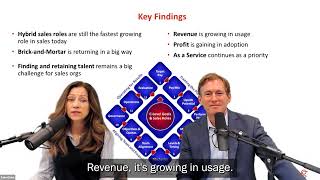
This YouTube video (SalesGlobe Sage, recorded Nov 15, 2022) presents key findings from a 2022 sales survey. Primary findings: hybrid sales roles are the fastest-growing sales role and are defined as spending roughly half of customer-facing time in-person and half virtually; brick-and-mortar retail showed notable growth (speaker cites ~18.7% increase) while e-commerce also grew (~14.5%); incentive compensation is shifting with revenue and profit increasingly used alongside bookings; SaaS/as-a-service vendors face economic pressure due to variable usage and seat reductions; consumer return policies (including return fees) are changing and may drive more in-store shopping (speakers cite examples of $3.50 and $10 return fees).
Questions this video answers
Spending roughly half of customer-facing time face-to-face and half working/connecting virtually.
About 18.7% (speaker-cited figure).
About 14.5% (speaker-cited figure).
$10 (speaker anecdote).
Chapters
So Mark, we, it was tough for us to pick out the big findings here and we distilled it down to six hybrid sales roles. They continue to be the fastest growing role in sales today. We started to see that during the pandemic. Pandemic. And it's very important to say how we define the hybrid sales role. So this isn't I'm working hybrid, right. So this isn't a hybrid workforce question. Like I'm working in an office and working from home. But this is how am I interfacing with my clients, my buyers, my customers. So it means that they're spending roughly half of their time face to face and half of their time working, connecting with their customers in a virtual or remote fashion, regardless of where that takes place. So that's how we define hybrid. And it was really a ship from field sales role, brick and mortar. And there was just something that I saw online today by one of our clients, actually a big advertising company around brick and mortar returning in a huge way. And they were posing the question on what do you prefer? Do you prefer the in store shopping experience or E commerce? Because they talked about Mark, the growth in brick and mortar and, and brick and mortar sales were up, I think it was like 18.7%.
Yeah, people are back out in the stores.
Yeah, they're in the stores. And they talked about E commerce too. Right? It was like up 14 and a half percent, something like that. So we're going to talk about that. We're going to talk about omnichannel finding and retaining talent. It remains a big challenge for sales organizations. And then three other things that we found true to all of you in incentive compensation. One, revenue. It's growing in usage. So it was bookings was always the strongest one for that new acquisition. And we're going to talk to you about the role that revenue has been playing and then profit, how that's been gaining adoption in pay plans and as a service continues as a priority. Although we know that it has been fraught with some maybe economically driven, we're not sure, issues in, in getting there.
Yeah, I think as a service, I mean that's been the, the trend. Right. That's where everything's going in terms of moving off of selling the one time license or the on premise thing to the as a service. Interestingly. And we'll kind of color some of these comments today about what's happening recently the as a service. The SaaS companies, particularly in software, are feeling the brunt of some of the recent economic pressure because of the Variable nature of what they're buying. Right. So in a couple of ways you can, you can use less if you need to. So you haven't committed to that huge license or depending on your contract terms. And then if, if you're laying people off and you don't have as many people, which. Well, you're not going to have as many as a service seats. Right. And we haven't heard as much about sales organization layoffs as much as general layoffs, but certainly that can have an impact on the, as a service segment.
Yeah, you're exactly right. And what we've been hearing, some companies are even questioning should we be pushing it as much. And you know, and salespeople are saying, would I just be making more if I sold that one time upfront, you know, cash. Right, that, that one with that upfront deal.
Yeah. So, you know, I see this point from Regina on, on the, the note here. Now there's going to be a fee for returning clothes. They'll drive people to go back to brick and mortar shopping. You know, that's a really good point. I've heard some of that as well. Like was it stitch fix or somebody 3.50 fee or maybe that was the wrong company. But it's like $3.50 to return something. So it kind of, you know, diminishes that a little bit in terms of certain people I know that buy massive amounts and they plan to return, you know, two thirds of it. Well, there's going to be a little bit of a penalty for that. So. So that's been used, that whole free return thing's been used for a while to really try to drive online. And you know, people have really picked up during the pandemic. But there's going to be a cost to that with some companies at least.
Well, let me tell you something. I'll let you in on a secret. So I actually put this on my post this morning on LinkedIn. Mark and I talked about that I bought a pair of jeans in, in a store, a little boutique independently owned store in Nashville. But I found out about this new brand of clothing that's Made in America. I happen to like Made in America clothing. I seek out Made in America stuff. Anyway, so I bought a pair of jeans from them online and I'm like, are you kidding me? They didn't fit. But you know, same size, whatever. 10 bucks to return them.
No way.
10? Yeah. So now I'm like debating, okay, is it going to be what's the cost differential if I have them? You know, if I have them taken in a little bit, I just have them altered versus return them. So I'm going to find that out make and I got 10 days. If I don't return within 10 days, got to keep them. So, yeah, things are changing.
Yep. I had the same thing happen with some boots I just bought and they were. They were huge. And I. Luckily I was able to return and the place got it back to me. They. They sent them back even before they got the return back. So then the smaller size I got, they were too tight and I'm like, I can't return these now. So I'm wearing the smaller size. So I'll get used to it. I will get used to this in.