A 2022 survey on sales compensation shows companies removing pandemic-era caps to let reps earn faster, then reintroducing them in 2022. For SaaS deals, the key is defining metrics like TCV and ACV, timing payouts carefully, and avoiding annuities that kill new sales momentum. M&A integration stumbles most on role clarity and incentive alignment.
Chapters
Tom, let's go on to the next point. Story and plan governors. I'm not supposed to talk about the election or governors, so we're not going to talk about that. We're going to talk about governors for the plan. So there is a general trend here that we're seeing in terms of during the pandemic, things like caps and thresholds came off plans. So companies are saying, we want you to be able to earn earlier. We're going to take the thresholds away. We, we want you to be able to earn the upside if you can get it. We're going to take the caps away. So things opened up, those governors were removed from, from the plans. And then what we're seeing now is a shift from 2021 to 2022 in the following areas. So caps are reducing to some degree. Now. We're not big fans of caps here at Sales Globe. We think about caps kind of like free range chickens, right? So you got this chicken sitting in a very small cage and that very small cage is the pay cap, right. And that, that little, very small cage is kind of depressing because it kind of influences how I perform as a chicken, right? So, so that's our pay cap. But you want a free range chicken. You want somebody who's positive. I mean, when you talk to people about a compensation plan and they, they talk about the cap on the plant, we don't like the cap on the plane. You ask them the question, well, have you ever hit the cap? No, I never hit the cap, but I know a guy that hit the cap. It was a couple years ago. Right. So, so nobody, so the cap is more psychological. So back to the free range chicken thing. So I'd rather have a free range chicken that has aspiration, right. I want somebody who wants to go out there and blow out the plan because like the free range chicken, we know there's a fence out there somewhere, right? There's a natural limitation to how far we can go. So the cap is hugely psychological. So, so those are starting to pair off a little bit. But other things are coming along. Bloomberg and megadeal policies increasing a little bit. You'll see. So that's, that's those unforeseen deals or huge deals where we take them outside of the plan. Remaining even is thresholds for hunters and you can see that's holding even from year to year and also your thresholds from far for farmers holding even year to year. And we could talk separately about why you use thresholds, but those are holding pretty consistent and Then regressive payouts are increasing as well. Swing by there. So you can see that. Okay, so progressive payouts are increasing as well. Regressive payouts are basically, when you get to that X excellence level, they start the. The effective commission rate starts to slow down on the plan. So. So it's slowing down the payout. So that's kind of like a soft cap in a way.
Yep.
Right. So that's a little bit what, what's happening on plan governors.
All right, so let's get into the plan measures. This is where that this came from. So we went across industry and this is also for your field and hybrid sales roles. It was. And actually the inside sales is in here too. So whether I'm doing account acquisition, account management, or I'm doing both, that we grouped in all the different jobs together. So what we found is top performance measure across all three areas. So whether I'm a hunter, a Doberman, or I'm out there doing account management, penetrating accounts, or I'm doing both. Revenue appears to be the number one measure. It's number one. 52. Call it, you know, 62 on acquisition and management. So call it. More than half of companies are using that as the top measure in their plan. Secondly is coming in bookings. Right. So that's when I booked that order. And then gross Profit as the third measure with 39, and, you know, about 35% of companies using that as well. So that's just a little bit of a breakdown. And again, as Mark said, we've got this broken out by industry and by job role as well. But we wanted to aggregate this to show you what it looks like.
So a question came in from one of the viewers on are we seeing compensation on price increase at all? Price increase. And that would be kind of inherent.
In revenue, but so it hits in revenue but also on gross profit. And that was the question that came back to us, which was if I can, if I'm understanding the question. Right, because you're looking up and I never know what he's thinking when he's looking up. But anyway, what one of the questions that have come back to us is if I can give them control across the price that they offer. So they've got, you know, a starting and then a higher price. Obviously that higher price brings in greater margin for the company. And the thought was, you know, should we could pay them for that spread. Right. So the answer is yes, we are seeing some of that. However, your rep has to be in control of that and it has to be Realistic, right?
Yeah, yeah. And probably the most common measure that I think I'm seeing on price increases is price realization. So it's a target price and how close can you get to that target price if you don't, like you said, Michelle, if the rep does have control over price and margin, or even if they don't, one of our clients said recently that our reps are our best, our customers, best negotiators. I mean, they'll come back and tell us why we need to lower the price for the customer. Right. So. So that would say the rep's not highly impacted or, or compensated for price in that situation. But. Yep, good question.
So the other thing is we just wanted to bring up a consideration point because we're being asked this a lot as well. Whether you're paying on bookings or revenue, that's where it starts. But then it's like, okay, how do we measure what, what the value looks like? And it starts with contracts. And then you've got. Though we mentioned that TCB and ACV are being used most frequently for bookings by companies in this study. But then you've got MRR monthly recurring revenue. And how long should that be paid out volume in units? It could be whether it's new business versus renewals. Do we pay for renewals and how much and then one time sales. Right. So there's all these different things that you need to be thinking about in bookings and revenue and get very specific on how that's defined and make sure that's communicated very well in your plan and very well defined for the sales reps. So they know what they're going after.
Yeah, yeah. And I think one of the biggest challenges that I see in this area is that we're trying to align the SAS payment with what used to be the, the perpetual license or the premise payment. And the other one is the concern about annuity. So I don't want to create something that's going to be a long term annuity, that we're just going to continue to earn that money over and over and over as long as we have the account. Because what it starts to do is it starts to offset the, the new customer selling. So you've got questions about what are the right roles. I'm going to just sleep. Swing over here for a second. What's the timing of your payout? So when you, when you're doing your TCV or your acv, how much of that are you paying at the time of the deal? How much of that are you paying A year in or at certain, certain points, who's eligible, eligibility, RPN responsibility, like I mentioned, retention, penetration and new customer acquisition responsibility. And then finally, rules of engagement. So how does the team work together? So again, going back up the revenue roadmap, the answer to a lot of the SaaS questions is going to be how do we want that sales process, those rules of engagement, the sales strategy to work.
That's exactly right. So as you're thinking about, you know, you're being asked to solve for a plan, you're being asked to create a plan around everything as a service or as a service. There are these other questions that need to be answered. And this is again, I think a good tool mark to get the conversation going with sales and finance and those that you need to get their buy in from.
Let me bring up another question here. Any thoughts on how to attach value to bookings for hunters in a consumption based SAS model? Yes, the, the challenge with a consumption based SAS model for a hunter is that we have some kind of soft commitment from the customer that we're going to use your product or use your service to a certain level, but we don't really know what that level is going to be until we get some time further out. If you have a true hunter or true Doberman, you don't necessarily want them hanging around and babysitting the account for a year to see what that consumption level comes in at. One good solution, and there are a number, but one good solution that I liked was a company we worked with that had two different sales organizations. One was a software based organization where they sold an actual license. The other was a service based organization that was SaaS in nature. And what they found was the software based license organization, people would get paid on billings, they'd work all the way to the end of the year. They work through the holidays because they knew bookings. I'm sorry, if I booked something I would get credit for it, right? The other organization, the consumption based organization, was paid on revenue or actual billings. While the consumption based organization, they were enjoying the holidays in a different way. They were going home because they're like, well, if I sell something in December, it doesn't matter because I'm not going to see any, any revenue or billings come through from it anyway. So what they did, being good analytical people, is they figured out what is the typical percentage of committed consumption from the customer that will come in because they had such a history of that and what level can we actually commit to the salesperson paying them. So it Actually turns it into a pseudo bookings measure. And it changed, totally changed the behavior of the organization. And because it was financially modeled, well, they didn't lose money off of it. It was highly predictable.
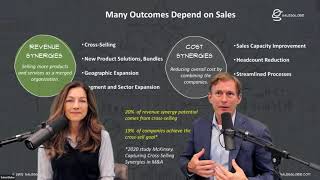
Yep. So like you said earlier, that might not be the answer for your company. Whoever asked this question, it was a great solution for that business. So we can, you know, we'd be happy to talk further about that, but there's a lot of answers out there and they're out there. It's just a matter of, you know, figuring out the one, the right one for your business. So a little bit about M and A because we said that over half of the companies that were involved in the study were part of M and A over the past 12 months. And so, you know, we've got 1, 2, 3, 4, 5, 6 top challenges. The top three role definition alignment across the organizations. And we hear this time and time again. So we had, you know, about 80% of companies saying that that was the top challenge. And I focused in Mark on enterprise companies here because for M and A it's more prevalent on the larger companies how big those challenges really are with a smaller company that might five people buying, you know, in and there might be two more joining the challenge may be a little bit less. So we wanted to get some good solid representation, incentive compensation alignment. That's everything from the pay philosophy to what the measures are used that people are paid on to the timing. You know, that is a big challenge as well. And then a big one we see that we're solving for all the time is total target compensation and pay levels across the organization. So gosh, I remember, I still recall a global client that, you know, it was, they offered on prem bought a software company and their inside sales team with the, the premise product was fairly entry level. And the acquired company, their inside sales organization was extremely sophisticated. In fact, their pay rivaled that of the field sales of the other company that was acquiring them. And that was a highly compensated role. Well, they immediately started to see fallout where people were leaving the company and they couldn't figure out why the company that they had acquired and they found out, you know, rumor mill, right. Chatter at the chatter at the cooler and beyond. They thought that their roles were going to be diminished so they started going to the competitor. So you know, there are other issues around integrating the sales organization, cultural differences, aligning the performance expectations. Again, that gets around to the culture of the company and what they expect. But you know, I think the, the big one here is get your role definition Alignment across the organization set and everyone bought into that before you even tackle the other things. That's what would be one of our lessons learned on that. And when we talk about and think about what the expectations are from an acquisition, so there's three, three big ones usually that we see and a couple of them fall into the sales organization. So cost synergy, when we think about sales, that's reducing the overall cost. By combining the companies, a lot of times they're thinking they can leverage best practices, they can leverage what's best across the companies. Maybe their, their structure and model that they have. Revenue synergies would be things around cross sell. The ability to put products together, bring new products to the market and grow your market share by having both companies take advantage of what the other company has to offer. And then of course, capital synergies. Right. So what kind of buildings and things that they have in place. And then you know, when we think about the outcomes that depend on sales revenue, big challenges. We know that you've got cross selling new product solutions, bundles, geographic expansion and segment and sector expansion. And then the cost synergies we see around sales capacity improvement. Again, I talked about leveraging best practices, the belief that there can be a headcount reduction at some point and streamline processes. So the big warning here is that or the big thing to be thinking about is 20% of that revenue center synergy potential. It's typically put on cross selling but yet less than 20% of companies actually achieve that cross sell goal. So there's a lot to be thinking about. And as we delve into the root causes, why it goes back to that role alignment and the setting expectations and people understanding what it is that they need to do.
You know, it's funny Michelle, the, the biggest barrier that we hear on cross selling is risk.
Yeah.
It's not like we're going to throw more spiffs or more incentives as somebody to cross sell products of a company that's been acquired. It's, it's the person says, hey, I don't know how, how good those products are that I'm selling, how reliable those services are. I've got a really strong relationship and I'm in my best accounts. I don't want to put that at risk. And you know, if I'm going to introduce somebody new as a person into the account to sell with me, well, that's a risk as well. So risk is the big single biggest factor in, in the single biggest thing that companies look for for synergies in an acquisition. Which is cross selling.
Yep. So, you know, got any questions on that, or you need some help around that? We're here to help.
More from SalesGlobe







Sales Compensation for Results - Course 1: A Strategic View on Sales Compensation - Trailer


Freative Friday - Episode 98 - Insight in Your Hunt for The Revenue Roadmap Pt 4


Freative Friday - Episode 97 - Insight in Your Hunt for The Revenue Roadmap Pt 3