2022 Survey Readout -Talent and Performance Measures
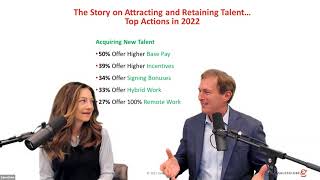
SalesGlobe Sage breaks down 2022 survey findings on how companies are competing for talent. About 50% are raising base pay and 39-42% are boosting incentives, but base pay increases lock in long-term costs while performance pay offers more flexibility. Most firms now use 2-3 performance measures instead of one, with a shift back toward individual goals over team-based ones.
Chapters
All right, so let's dig a little bit further into the thing that we referred to earlier in that storyline, which is attracting and retaining talent. So the question comes up, what are companies doing to retain talent? What are companies doing to attract talent? Right. And the answers are not all that surprising, but the answers are somewhat concerning as well. So stopping turnover, these are the top actions that companies are taking. This is across industries. And again, we've got this cut by industry as well. So if you say, well, you're what's happening in tech or healthcare or whatever, we can answer those questions for you. 52% of companies are increasing base pay to hold on to people. Okay, well that's kind of obvious. No brainer, right? 42% of companies are increasing incentives. And I think it's 24% of companies that are doing both increase on base and an increase in incentives. And you've got 29% of companies already offering greater than 200% of target incentive upside in in their incentive plan. So 200 in addition to their target comp. Their target incentive. And I'll come back to this in a second. 37% offering hybrid work. Okay, so you can. Now this is really funny when you talk about sales organizations because sales organizations have been hybrid for years.
I know.
I mean how many salespeople actually come and sit in the office? There's some companies where they do, but that's not an unusual thing. About a quarter offering remote work and about a offering enhanced reward and recognition. Okay. And I'll come back to some of these comments, but that's for stopping turnover. And then I want to go to the next one here, which is what are they doing to acquire new talent? Okay. Similar types of numbers. 50% offering higher base pay, 39% offering higher incentives. Then you see signing bonuses, about a third offering signing bonuses, about a third offering hybrid work. And then about a little over a quarter offering remote work. Okay, so quiz question for everybody. And you don't have to answer, but kind of think of this. I know we always like quiz questions. So we all like the Cosmo quiz. It's like what's your question is and.
What if I get it right?
You get a sense of pride and accomplishment.
Okay.
It's all about the ego. Okay. What's wrong with hiring and offering higher base pal base salaries, higher base pay. What's offering. What's wrong with offering higher base pay? You don't have to answer that. Okay, didn't I mention earlier econ 101, this is a short run problem. This disequilibrium in supply and demand in the labor market is a short run problem due to what's happening with the number of people in the workforce. The people that are, you know, the, the, the departures or the quitters, what do we call them now? The lifestylers. This is a short, what you're doing is you're committing a long term or you're committing to a long term or long run solution for a short run problem. Once you offer those higher base salaries, that higher base pay, you're stuck with that for some period of time. Right. And so then there are only three things you can do as a result of that.
Right?
So you can either increase quotas or you can decrease costs somewhere else or you can increase the price of your product. And inherent, an increasing quotas is increasing productivity. Right. So if you don't do one of those three things and somebody else will probably find a fourth one, that's fine as well, which would be great. But if you don't do one of those three things, you're going to be losing margin. Right. So you're committing in that base pay decision to a long term solution for a short run problem. Why not put what you can into performance pay or into incentives? And I realize you have to do some increase in base pay to be competitive in the market. And in fact, okay, we can see our short run problems starting to show up now, right? So was it Twitter the other day, laid off half the organization. Facebook today or Meta, maybe they'll go back to Facebook is now going to be doing significant layoffs. So we're already starting to see a problem, see that happening, right. So the short run is already starting to show itself and now we're going to be sitting with a lot of companies that are over paying and over committing.
What's interesting is for the first time I'm hearing, because it's being CEOs are actually coming out and saying get rid of the dead weight. People didn't really say that before, but now, you know, they're, they're looking at that. And then the other unintended consequence, Mark, has been pay compression. So you know the difference between people that are highly experienced and those that are not, that pay is getting, you know, compressed and that's created an unintended consequence that companies are having to face as well.
Oh yeah, we're seeing that company by company. We do a lot of, we do a lot of competitive benchmarking. And as we go and talk to different companies, many, many of them are saying that they're saying our people that have been here for a couple or three years or four years, they're being surpassed by new hires that are less experienced and that's causing a problem. And we're having to make adjustments again. More long term commitment to a short run problem.
Yep.
So I see somebody commented here. Already happened. Yeah. Bingo. So, okay, so there you go. So, so that's what's happening right now in terms of attracting, retaining. So think back on that last storyboard that we talked about Just, just as a final comment on this in that you've got to look at your employee value proposition. So when we talk about doing the competitive benchmarking, one thing we're hearing from companies is, hey, we're not going to just pay more because we have something different in terms of culture or we have something different in terms of the work life balance or the lifestyle or what we do as the affiliation with our brand, whatever it might be. So companies are looking at what's our total value proposition. So, so don't just go for the, go for the base pay.
Yep. Okay, so let's move on to incentive compensation and what the big story was coming out of the survey. So the first one is that plans, they are very specific and focused. And what that means is that we're looking at two to three measures in a plan, which is what we consider a best practice. When you've got too many measures in there, people tend to lose focus. Right. And then because you weight those measures, more than likely it just, you know, creates, it dilutes the importance of your most important priorities. So 71% of companies, three quarters, are using two to three measures in their plan. And that was what, 56% in 2020. But that's simply because during the pandemic we saw people going down to maybe one measure. It was just a strange time and people weren't sure what they could measure. They didn't want to hold their teams accountable for profit, for example. They were just out there to get what they could get. The other thing that we're seeing is when we look at the sales roles, we're starting to see revenue being used more frequently as one of the key measures in the plan. So when we think about people selling, if I'm a new acquisition hunter, a lot of times they're being asked to focus on bookings. So go out there and just close that deal. But now companies are becoming a little cost sensitive and for other reasons as well. They're starting to get more focused on the revenue that's coming in and so we're seeing that and we're also seeing profit, gross profit showing up in the plans. And we're being asked about that pretty frequently. I would say this year, Mark, the question has come should we add profit in even if it's just like a 20% weighting in the plan to provide a little bit of focus? And then I guess all we'll say about that, because you're going to spend more time on this is when we look at the bookings measure, we're seeing that tcv, total contract value and annual contract value. Those are the most likely used methods to determine what the pay, what the value of the deal looks like. So the other big news is, which might not be big news for any of you, but maybe you would like to know that your colleagues and peers out there, everyone is still struggling with how do we set quotas in the next coming year. So there's still continued supply chain. Now there's economic uncertainty, there are layoffs, there are people being hired, there is are people going to work in the office or remote. And there's changes in what the needs are from in the B2B space. So again, we're looking at a lot of factors that are impacting quotas as well.
Yeah. And I want to mention if we go back for one sec, Claudius, there's this one point here on individual versus team measures. That's another big dynamic we're seeing shifting as well.
I skipped right over that.
Didn't I do that or I'm repeating myself, which I do all the time.
So you're right. And what's very interesting is during the pandemic we had a lot of our clients even coming back to us. But they showed up in the survey and they went to more of a regional country team level goal setting because it was easier and they thought it kind of, you know, the bigger the number, the easier it is to achieve to it over a greater mass as opposed to being so small specific. But there was pushback even at the individual seller level. So companies are working to get back to that individual measure. The individual seller wants it and the company does as well.
Yeah, yeah, yeah. So that, that is an interesting shift that we're seeing going back toward individual just for all the reasons you outlined. But I, that's one of those things. I'm like, wow, isn't that cool that people really do want more individual accountability as well.
Y.
More from SalesGlobe







Sales Compensation for Results - Course 1: A Strategic View on Sales Compensation - Trailer


Freative Friday - Episode 98 - Insight in Your Hunt for The Revenue Roadmap Pt 4


Freative Friday - Episode 97 - Insight in Your Hunt for The Revenue Roadmap Pt 3