25 for '21: Sales Effectiveness Predictions & Priorities for 2021
A SalesGlobe Sage webinar (Dec 14, 2020) discussing 25 predictions for sales effectiveness in 2021. Hosts examine pandemic-driven drivers (fear of infection, vaccine uptake), financial impacts (office vacancy, permanent work-from-home rates), and resulting shifts: hybrid selling models, geographic boundaries loosening, sector-specific buying patterns (Corterra), weakened collaboration, and the need to recalibrate sales capacity, quotas, and compensation. Recommendations emphasize data-driven strategic account planning, simpler compensation measures with upside for top performers, and building data-support capabilities to enable sellers as creative problem solvers.
Questions this video answers
39%
At least 75% of the population
42% working from home (vs ~7% pre-pandemic)
About 9% pre-pandemic rising to about 15% (cited)
68%
Chapters
So welcome everyone. The last roundtable of 2020 and we are going to talk about our predictions around sales effectiveness and things that you should know as you look at getting into 2021. And just a little bit about us. We are a problem solving firm for sales and what we do every day is solve the biggest challenges that organizations are facing with their sales. And you see that we've written a few books here on essentially account planning, what your CEO needs to do, know about sales, compensation and a book on quotas. And all those things are changing in 2021, the approach that companies are taking. So today we're going to talk about a lot of the indicators and we're going to be looking at our predictions that we have for 2021. Now, Mark, you see we got a lot of predictions back there, don't we?
Yeah, we, we tried to just come up with 21, but we came up with 25. So. And we're not going to go through one of these. We're going to pick a few and if you'd like the infographic or any of the materials that we're cover today, just let us know, be happy to get it to you. But these are all, as you said, Michelle, indicators, things that we're seeing that may be indicating what's ahead for us in 2021. And we're trying to understand the potential future of sales so that we can be better problem solvers, be better data driven, creative problem solvers. So if we know these things, then we can say, well, you know, is it going to continue on in this way? Are things going to change? So we want to give you some of our favorites here.
Yes, we could only pick a few. But again, just like, you know, Mark said when we, if you would like to get the materials, we're going to show today, we believe there's a lot of value for your organization and for others that you know, your peers. So please be sure to spread the word. So Mark, why don't we get right into our first observation and prediction?
Right. So we've been telling everybody fear and financials are going to be the big drivers of behavior for companies, sales and customers. I want to break that into a couple of pieces. So the first one is really fear and liability. So you know, fear about is it going to continue? Is it going to come back? How long are we going to keep going on like this? We pulled a few stats here and we're making some conclusions or some therefores about what you might want to do about it. So we've seen A couple different surveys recently. One of them right up here from Pew Research Center, 39% of people say they definitely or probably won't take the vaccine. And we've seen a few other sources that are very similar.
Right, 40%.
Yeah. So you've got a lot of people that are still skeptical even as the vaccine is coming out. And I think months ago, we were saying, well, when the vaccine comes out, everything's gonna back to normal, but we know there's gonna be considerable cycle time in that. And then we've got Dr. Fauci here saying, you gotta have at least 75% of the population vaccinated to build herd immunity. So there's kind of a big delta there. Right, right. Even if you get a lot more people that say they're gonna. They're gonna take it, it's gonna take some cycle time. So the big conclusion here is the vaccine is not the panacea for the sales environment, at least not in the near term. So caution is going to continue far into 2021. So, you know, at the beginning of 20, mid 20, we're going, okay, well, we'll be getting back to normal during 2021, probably not. So it's going to continue to limit the ability of us to connect salespeople, to connect with teams, their teams, and with customers. And we're probably going to be operating in this mode for some time. So this will be the new normal. We'll get into the details of what this means in terms of sales organizations.
Yeah. And Mark, on one of our previous roundtables, we had talked about just one other stat I want people to think about is there was that Fortune magazine, they did a survey, and it had 98% of the Fortune 500 CEOs participated, and 60, 68%, and this would have been back in October, said that even if a vaccine came out, they were still planning on not reopening their offices. So that's, you know, just like what you said. People are continuing to be cautious.
Right. So as we're looking at the hybrid models we've been using, as we're looking at how we're looking differently at total addressable market territories, even compensation, a lot of those assumptions are probably going to continue. Continue further along. So we want to plan for that. Here's another one. This one's from Gall. Kind of a similar finding here as well. And you can see the dark line represents the percentage of people that say they will not take the vaccine. And the green line represents the percentage of people that say yes, they will take the vaccine. You can see that was about 50, 50 in September and then it moved back over to about 42% which is where it is right now. So kind of some similar results from a few different sources here. So, so that's, I think that's a big indicator of continuing on what's ahead.
So the vaccine, it's not a panacea.
All right, so then let's look at the other side of it. So we said fear and financials number two, financial savings. We'll take the financial piece. Financial savings from less commercial real estate and T and E travel entertainment will be tempting for now.
Right.
So a lot of companies are saying, gosh, you know, we have people working at home. We can continue on with this model for some period of time because it's a lot more efficient and we don't have to have people traveling the office, we don't have the commute time. But we think things are going to probably start to swing back. A few interesting stats here, Michelle. So we had the commercial office vacancy rate in the US pre pandemic at the end of 2019 that was about 9% and you can see that's up to about 15% right now. Now that doesn't even include all the unoccupied real estate that's sitting out there, just not being used.
Yep, that's right.
So we got a lot of empty space sitting out there. We have 42% of workers. Now. It's just not just salespeople but workers across the board who are working from home. And you go, well yeah, that makes sense. But we compare to where it was, it was 7%.
I know, you know, massive increase perception that a lot of people actually did work from home. But really nationally it was 7%.
Right.
And now it's 42 that are permanently working from home as far as they know. So I don't believe that this includes all the temporary workers. Right, yeah.
So, so you got, you got a situation here where there's a lot of empty space, a lot of empty real estate. Some companies, a lot of companies under long term leases that are going to continue to, to hold that space, but it may not be occupied. And then you got 18% of sales workers nationally in the US that were, have been laid off. Now we're just talking about layoffs here. We'll talk later about our anticipation of turnover for those people as well. So some conclusion points or some therefore is based on this. So we think that having this separation is going to impact productivity. We'll talk about that. A little bit further in a few minutes here, but it's going to diminish the level of collaboration, diminish the level of productivity. When you think about people in call centers, as an example, and we say, well, you know, people can work at home because they're working on the phone anyway, because they're doing customer service work, or they're working on the phone anyway in a call center. Well, you know, you have people sitting by themselves. A call center, by definition, is a center of excellence. So people work together. So you're even losing collaboration in call centers. We're going to see decreasing collaboration, decreasing productivity. Companies are going to start to swing back, we believe, and they're going to do it in two ways. One is they're going to look at collaborative workspaces. And we can already see some of that coming up here in Atlanta, which is places where people can go and get out of the house and go meet with other people or get peaceful work environments away from. Away from the kids and every other distraction. Right. So we think we're going to see a swing toward more collaborative workspaces, socially distanced. And then the one I find really interesting is I think we're going to see a swing back to commercial real estate with people coming back, but it's going to be socially distanced. I think we all know that. But the irony in this is it was all the rage, Michelle, to do the open office space and collaborative office space. And I know as we were setting up our office here at Sales Globe in the studio, we were doing a lot of that. It's like, well, people want to be close together, want to be working together. And we're like, you can't even make a phone call. Right. So now I kind of feel good about this one. We're going to start distancing a little bit. And so what does that mean? Well, that's going to probably offset some of the commercial real estate vacancy. Right. So we're going to see some absorption in commercial real estate. It's going to start to come back, and we're going to start to have more square foot per person in the commercial real estate than we had before.
Does that mean you might move out of my office?
I was thinking the other way around.
Yep, I believe that that's right.
Okay, so fear and financials, a couple of big trends. So we'll start to get a little bit deeper into the sales piece here now.
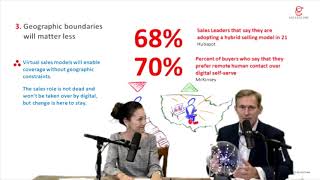
Yeah. So geographic boundaries will matter less. And I believe that people have heard us, some have heard us say that Right. That prediction's been around. But what do we know that 68% of sales leaders say that they're adopting a hybrid selling model in 2021. Hybrid selling model. You're going to hear this word. Now, as we're researching, we're finding that it's becoming very commonplace to use that. And it means that I'm, I've got a combo job, right. Some of it is remote, some of it is an office, some of it may be on site. We actually are hearing about some people that are starting to travel again, although not to the extent that they were. And we'll see that validated, Mark, as we look at what is happening with the airline industry and shortly. And then we've got 70% of buyers say that they prefer remote human contact over digital self serve. So what does that mean? That means that. Good news everyone. We've been saying it all along. The sales role isn't dead. There is a place for human interaction. And it just may be that a lot more of it is not face to face. Now, where that's going to play out, we're not exactly sure yet how much will be in person, how much will be remote. But what we do know is that your role of your salesperson will not be taken over by digital. It will not be taken over by bots. What we are finding is that those that are looking at shifting their selling models already are doing things like virtual selling. So, Mark, we are currently consulting with a very large retailer in Europe. They're like Best Buy. And I realized through this that Best Buy is doing the same thing. They actually have a virtual shopping experience where you can have a zoom call and you're talking to an associate who's physically in the store and they're walking around and showing you the product. So, you know, that's, that's not like digital bot, that's a real person that's taking you around that store.
I went to deposit a check the other day at the bank and they made me go up not to the person in the bank, but up to the atm. Yeah, I don't say ATM machine because that's redundant, but the atm, and then there's a person's face on the ATM and they're sitting at a call center and they greet me and it's interactive and they're talking back and forth and I'm like. And I said, well, why can't I just do, you know, deposit check here? Oh, well, this is our lounge area. We don't, we don't do that.
Here anymore.
So that's moved digital as well.
Wow. So the virtual sales model, it's going to enable coverage without geographic constraints. We just gave you a couple simple examples that are in retail, but we are seeing that it's in B2B sales across the country, actually across the world.
So that means, Michelle, that geographic territories. Yes, but we're probably going to be starting to look at sectors across those territories and not be bound by those geographic limitations anymore. So as we're setting up territories, we might be saying, well, things are going to be different geography by geography. But maybe what we realize is there are certain sectors that are coming back stronger than others and then we can start to focus on the ones that are stronger.
Good lead in Mark, to the sectors. Did you know, Were you predicting that? We were.
I was predicting that slide was going to come up.
I think he was predicting that. So you're, you're exactly right. And let's talk a little bit about this. So the information that you're looking at right now is from our partner Corterra, and what they have is a very Large percentage of B2B. What, what companies serving B2B are buying. So it's their buying behaviors. And, and basically what they buy shows the health of that, of that business. So what we're finding is that this is the, let's see, this is data through November. And we compared this to the end of Q2. Q3, right? Yeah, we compared to the end of Q3. So we have found on the professional computer equipment, the wholesalers, that's about flat. But let's talk about a couple that are up right. When we talk about this. So we'll talk about the data and then the impact. Electronics and appliance stores, they're up, I think about 20% or so from where they were at the end of Q2. And that's because what we're finding is that people are continuing to work from home and they're starting to have to buy some appliances. I mean, gosh, I'm hearing people that are even buying new washers because they're doing more laundry.
Yeah. And so that's, that's definitely coming up from where it, where it was. So the numbers you see here are year over year. So electronic and appliance stores up 66% year over year. And like you said, Michelle, they were. It was about 49% as of the last reading at the end of last quarter. So still moving really strong in terms of an increase. Yeah.
Right. So that's a good point, Mark. I Didn't, I didn't state that. This is. These numbers are looking at same period from 2019 to 2020. So we see that construction of buildings is up, which, that was really interesting because when we looked at it last quarter, it was actually down. So construction appears to be coming back.
Right. And that's probably a lagging one too, because it was down 18% last time we looked at it. Now it's up 24%. So there's, there's been a big swing there. And you know, we know that there's. The real estate market is hot, especially residential real estate. And there's a lot more building happening now. So that's probably reflecting that as well.
That's right. And look at clothing stores. They're up.
Yeah, that wasn't even on the list last time we talked about this. So in there are a couple indicators here you can see patterns. Right. So clothing stores are coming back, people are starting to purchase clothing more. Because last time we looked, it wasn't, wasn't even there. So that's appearing. Right?
No, I'm hearing from people, a lot of sales out there, Mark. But I also think that people are, you know, they're dressing up a little bit for some of these meetings. I am, I am starting to hear that a little bit from others.
I talked to a guy yesterday on a call and he was wearing a button down shirt. And he said, yeah, I got to a point where I just had to put a button down shirt on again because I just had to feel normal because I was starting to feel just kind of like all I'm doing is wearing T shirts and stuff, you know.
Oh, back to the best Covid story. I mean, I know we're in the middle of something, but what about the NBA saying that the coaches don't have to wear suits anymore?
Right, you don't have to wear suits anymore during a game as an NBA coach because the COVID gets on the suit. Maybe.
Yes, I figured, I figured the logic behind it was if you're in your sweats, you can just walk into the locker room, take them off and throw them in a washer. But your suit has to be dry cleaned.
So what's that going to do to the dry cleaning industry, Michelle?
Yeah, that's already been sold.
Not going to be dry cleaning anymore.
Nope, they aren't. So what do we know? That territories, we believe, will begin to focus on rebounding sectors that have the highest potential. So let's see what else is going on. What's maybe not doing so well, Mark?
Right. Okay, so take a look at the ones in the. We just kind of put a box around the ones that are down 20% or more. And I'll call it a couple. Now, these are real interesting, right?
Yes.
Air Transportation is down 25%. And you go, wow, that's really bad. It was down 45%. So that would indicate that we're starting to see some more traveling. Some of that's probably due to Thanksgiving and maybe the anticipation of the holidays. And again, this is purchasing from air transportation companies, so they may be buying in anticipation of these things as well. And the other one that caught my eye was accommodation. So that's down 55%. So it was down 35%. So accommodation has gotten worse. You see Airbnb going public yesterday.
Yes.
So non hotel accommodations may be staying at homes, may be actually preferable to the hotels at this point.
Yes. I read something actually in the Wall Street Journal this week, and they said that people are choosing to stay in place like an Airbnb or a home where they can just be with their family. They feel they have a better control over, you know, who they're in contact with.
These places like Airbnb, Home Away, they actually short on inventory right now because people still don't want to rent their homes out. So they're trying to get the owners to actually free up inventory so that they can. They can rent out more. So, yes, the travels up, accommodations are down, so people are traveling, but they're staying somewhere else other than hotels, right?
Yeah, it's kind of cool.
So we'll see how that one plays out actually, you know, after the holidays, and see how much of that was really just related to staying with family or actually going somewhere else.
Yep. Okay, well, let's talk about teams and collaboration. So what do we know? We know that 33% of employees who say employers are providing effective ways to collaborate. Just 33%. That's kind of a low number, don't you think, Mark?
Yeah. And I think you got to think about the employers, too. They have to find new ways to help people collaborate. So, you know, we've been deferring off onto video conferencing and things like that. And, gosh, a couple months ago, Michelle, we asked the question about video conferencing. We said, okay, it's great. This is accelerating technologies like this, but there has to be a paradigm shift where things really change in terms of how we collaborate. So, you know, again, we were talking about this idea of how do we get beyond just the camera and the Screen and the microphone. Is there some way that we can better connect? So perhaps some new technologies do that?
We don't know, but, well, there's some whiteboarding technologies out there. There's like a lot of technology. I just thought that was a low number. 33% said that they're providing effective. That means that 70 are saying they're just not. You know, and actually 75%, if we look at that, the rest of the story, 75% of employees say collaboration is suffering the most due to work from home. But what I find really interesting about that is that a vast majority, and another study said that the vast majority of people who are working from home would like to continue working from home. So it's just a lot of stuff going on out there. And then you've got the C suite who's saying, well, oh my God, productivity, it is suffering. Now we have been talking to people and we had actually been, and we hear that productivity is suffering. A lot of the things that you read out there, though, I don't know, Mark. A lot of the things that are being reported in the press, they're saying productivity is fine, but that's not what the C suite is saying.
Right. So 86% of the C suites say that's their top concern concern. So if you think about the puts and the takes, and this is on our big list of 25, Michelle, when you guys have a chance to take a look at that, which is efficiency is going up, efficiency of contact. We talked about this before. Some people aren't on planes and trains anymore. So it's easier to get a hold of people, easier to have meetings. So that would be a, that would be a increase in productivity. But then you're having less collaboration, like we said at the outset, that would be a decrease in productivity. You're going to have probably some lower price points on products because we're coming out or companies are coming out with new products that are perhaps easier to buy. So that could take average revenue down or productivity down. So you've got some puts and takes on productivity aside from just people, you know, feeling like they're, they're being more productive. Now, one of the other, one of the other positives, and we talked about this a couple of months ago as well, is people actually have more efficient or more time during the day to work if they are really working the entire day, because they're not commuting.
Right.
You know, an hour each way or 30 minutes each way. So that's, that's adding time back in as well. So. And we'll talk about this relative to sales capacity in a few minutes. But. But that's gonna. That's gonna shift things around a bit.
So the big conclusion is that there's going to be pressure to find better ways to work with teams and customers. And the other point we want to make is that work from home is here to stay, but jobs are going to evolve into hybrid remote office model moving forward. Now, remember that term because I said this a little bit earlier. You want to remember the words. It's hybrid remote office model. And that means that that is a role that is working part of the time remotely and from home and part of the time in an office. Now, Mark, I would like to bring up one collaboration story that I did bring up last week, but I think it's just another. It's another thing that supports all these things that are being said. So I've told people that I'm part of the Downtown Development Authority, and we're making decisions that are going to impact the city of Roswell, where we live and where we happen to work. And we were elected and put in our place just before COVID hit. And we have not seen each other all year. And all year we've really been focused on a couple of things that we've been just trying to get through. And we met together, it's a team of seven as a team in a socially distanced, safe environment at City hall this month for the first time, it's the first time we have been together face to face since we've been elected officials and started actually working in our capacity. We got more done in that two and a half hour meeting than we got done all year. And it had nothing to do with the fact that we didn't have our act together or, you know, but it had everything to do with the fact that when you're collaborating and making big decisions, there's something to be said about being able to communicate face to face. And it just comes across a little bit more clear. All right, so, Mark, I think it's time for us to move on and talk about some things that are near and dear to your heart.
Right? So you take all these pieces and what that means with all the puts and takes we talked about, is sales capacity models are going to need to recalibrate. So again, you think about lack of collaboration, you think higher efficiency, you think about differences in price points, you think about all the different factors that maybe impacting productivity. And you need to recalibrate the sales capacity model, and you can see the quota success model here from the book quotas that we borrowed for this visual here. But sales capacity is going to borrow.
It from the author.
We borrowed it from the author's permission. Yes, I threw on a slide here. But your sales capacity is going to be a counterbalancing factor with your market opportunity. So we talked a little bit about market opportunity, Michelle and you can see way over there you got market opportunity on the right hand side. And so that has to do with things like we were talking about with the territories, like which industries are we going to be focusing on and who's buying and who's not and what geographies are going to be focusing on. So it's enough, it's fine to have enough market opportunity but you have to have the sales capacity to go after it. So as you move to or continue with hybrid models, do not assume your sales capacity is the same, you need to recalibrate that. So the old assumptions need to change and you're going to have to look at new data sources for market opportunity. We talked about one already from Corterra and there are many others out there as well. But you can't be just looking at how many employees does a customer have and multiplying that by some factor to come up with some estimate of your total addressable market because that is obsolete and that's actually a changing number. So if you can find data sources like we're talking about that are up to date, say of the last month about what they're actually doing that will give you a big benefit.
And Mark, we had a guest on our roundtable last week and that was talking about how you should be thinking about parallels even to your industry to look for untapped sources of data that maybe you hadn't considered before. Right. Because what you are saying, what we're saying is that history is history and the traditional data sources of that we will have used maybe for 2021. They're just not going to work, right?
Yeah and we'll talk about that relative to market opportunity but also in a few minutes relative to compensation. So the old data looking at history is just not going to apply anymore. So look at your sales capacity. We do this a lot for companies and it's a real eye opener because they can find out what they actually have to have in terms of a model to achieve their sales goals. So when you look at your goals for 2021, you're going to have to know what you're going to need to get there. So let's talk about those goals now, those quotas, Michelle, because this has been a big question since the beginning of the year, which is what do we do with quotas?
Yeah, it has come up since March, actually the end of March.
And the answer was in the beginning, nothing. And then the answer became, okay, we're going to go to more discrete quarterly quotas during 2020 so we can get more visibility on what's going on. And then during all of this companies were reforecasting, so they're trying to figure out what's going on. And then some companies or a lot of companies have adjusted full year quotas as well. So then you get to the question of, okay, we're right at the precipice of 2021, what are we going to do? Well, quotas may become shorter term to account for that uncertainty. And we know that we're going to have to move from history to market opportunity or account opportunity driven quotas. History is history. So we know that about 40% of companies use history in their quota setting to some degree as some part of their quota setting. And if you're doing that for 29, 2020 history, obviously that's not going to work for 2021, or maybe it will, you know, hopefully it doesn't. 2019 history is not going to work for 2021. So we have to find an alternative to that. So what we are seeing is that some companies are looking at doing semiannual quotas for 2021, so sending two six month quotas. Some other companies are looking at doing a full year quota with an acknowledged mid year adjustment to see where they are. And some companies are going for it and doing the full year quota for 2021, which is placing a big bet on a lot of uncertainty. So, so three different camps we're seeing, but we haven't seen as many of the in the past we haven't seen as many companies doing these half year quotas as we are now. So that's becoming a lot more common. And Michelle, this has to be balanced with the longer sales cycles.
Right?
So things are taking longer to close.
We sure are hearing that. That's been a common theme, that sales are taking longer to close. Right.
So sales capacity and then how do you set a quota for 2021 and how do you account for the longer sales cycles and then what we believe we're going to see a lot more as well, which is in the 25 predictions. And one of our therefores right here is strategic account planning. Okay, so strategic account planning is going to become more intentional because the best way to be able to help customers is to understand customers. So we're not going to be able to perhaps sell at the same level or surface level that we have before. So we're working with a lot of clients now on reinvigorating how they're doing their strategic account planning and understanding what's going on and in particular for those big accounts in the industries that we know are going to be strong industries.
Right, right.
So moving from the opportunistic to the strategic. And we talk about strategic account planning. You know, there's one big thing we hear, Michelle, do you know what that is? That's moans. That's exactly moans. We hear a lot of moans. Right. We hear moans and groans. And then the next thing you hear is people recite the table of contents of a strategic account plan because they all know what a strategic complaint is. It's almost like they've been beaten with the strategic account plan and it's left its mark on their brains. Right. So they know what the table of contents is.
That's right.
But what we discover about strategic account planning with companies with sales teams, that becomes this rote exercise where they spend the most time filling out the information, filling out the history, filling out the blanks, and then saying in some kind of labored fashion, okay, well, so this is what we're going to do for next year, and this is what we're going to do for the next two years, next three years. And it's uninspired. Right. Okay. So I want to share a couple of ideas with you on strategic account plan, and we'll come back to this in another time. We go deeper. You can talk to us. One is you're going to have to have an aspiration for your account plan. Aspiration means you're going to have to have a big, audacious goal for that. And then it's for a couple of reasons. One is to reset how the team thinks about the account, and the other is to reset how the customer thinks about the account. The other thing you're going to need is to get beyond the boxes and filling out the blanks. So you're going to need to get to how do we solve the customer's problem? So you need to get to a pipeline build that's going to be two and a half to three times your goal for that account for the year. And you're going to have to look at opportunities or come up with opportunities that the team has not initially thought about by getting closer to the client. And it's by the combination of what can we sell to them? The traditional what can we partner with somebody else to sell to them? And then what can we sell with them? How can we partner with them? So there are a few different dimensions. So you've got to get into. We talk about creative problem solving. You got to get into the creative problem solving on the strategic account planning. So. So that's a really important bullet point.
Yeah, there's a lot in there. And we will be talking more about that in January, Mark, because we do believe strategic account planning is definitely going to be a differentiator. That is one of our predictions. Yes.
All right. And then getting into compensation a little bit here. So payments. 60% of organizations have plans with at least 200% upside potential for the 90th percentile performers. So we're seeing a move toward more upside potential in plans. And what we believe we're going to see in 2021 is a shift to pay mix, becoming more aggressive to emphasize performance and lower fixed investment. So with the uncertainty, we think we're going to probably see a shift toward moving some of that to the sales organization in return for additional increased upside opportunity. Okay, so you can see by the diagram here that a lot of people have seen, you know, the basic idea here, your target incentive and then your ratio of target incentive above your target total compensation, that's going to go up. So there's going to be greater rewards for the performers. Okay.
Mark, I've heard some companies say, and we've talked to some people and they're, they're asking themselves, gosh, maybe I should fix, you know, have a greater salary base pay and then less incentive. And we're saying, not so fast. If you, if you and those companies tend to not own the concept of really upside, and upside is what that your high performance can actually achieve. So really pay attention to that because you can tie performance to what the pay really looks like, and you should continue to do that. So don't let what you believe the fear and financials are going to drive. Don't let them force you into thinking you need to increase your fixed pay. Take a look at the upside in the plan.
And so let's look a little bit further on this. So the benchmarks. Michelle, I think this is an important one to mention here. So everybody that's used to getting your annual surveys, participating in your annual pay surveys, and getting your annual surveys from the big survey houses, I'm sorry, big survey houses, but this is going to become obsolete. Very quickly because it's going to be old information. So if you're getting your annual information, by the time you get it, it's going to be old. So there's going to be a shift toward doing more rapid insight or rapid pay benchmarking on a faster cycle, probably closer in on the competitors that you're most concerned about, because the information is going to be timely and it's going to be current and it's not going to be aged.
We have seen a huge increase in requests for rapid pay benchmarks, Mark. We have seen that as we've gone through the pandemic this year.
Yep. So that'll be a change. And then let's talk about inside sales and field sales.
Yeah. So what we know is that there is a pay difference of a. It runs 20 to 50, so an average of 35% between what was pre pandemic considered an inside selling role. And it's similar field sales role. And what we believe is that the gap between inside sales and traditional field sales, it's going to narrow. There are other predictions we have around that. We've talked about the hybrid selling role and we've even talked about teaming of what those roles do. So even though they both may be working from the inside, if you will, this is all about roles and responsibilities and who's responsible for what part of the revenue. So expect that the gap between inside sales and those traditional field sales, that it will narrow. So take a look at that as well as you're looking at your overall pay.
And we've heard that story about companies looking at their field salespeople now working virtually. Okay, do I reclassify them as inside salespeople? They don't fit the pay bands. You're going to have to get that out of your head in terms of these structural constraints, because inside or virtual is really just going to be a mode.
You know, it never really was about, I'm just in the field and I'm just inside four walls. It was about the roles and responsibilities. And those haven't changed so much. It's just how you go about your job has changed. All right, now let's talk about measures. What we know is that revenue will continue to remain the key compensation metric with an increase in use of bookings. And that's our prediction is bookings are going up. Now, what we know from a survey we did earlier this year with World at Work, it had over 400 companies in that 78% of those companies said that they use total revenue for account managers with 60% of it using it for new account sellers. So we know that revenue remains king. And we believe that when we talked about this elongated selling cycle, that there will be a portion that will be paid on bookings and the rest paid on actual realized revenue.
Yep. So plans themselves, and we'll talk about this here as well, are going to become simpler, too.
That's right. So we know that they'll become simpler. 25%. In that survey that we did again with World at Work, they said they use only one performance Measure. Now, in 2016, they did a similar survey and 71% of it was. It's up 71% from the number that it is now. So companies are getting more simplified and we are being asked to simplify. And, you know, part of that is now people are working remote. You need a simpler way to measure their results. They need an easier way to understand. And it's not going to happen as easy when you're communicating through zoom or across some of the platforms, even Salesforce. So we are being asked to look at simplicity, and companies are even focusing on the technology that will help them manage those plans as well.
And so that's providing more latitude as well as 2021 comes up where instead of saying, well, we need you to sell these certain product groups or sell to certain types of customers or whatever the stipulations might be in a plan typically gives more flexibility. As 2021 happens in strategy shift, what it also does is it does transfer more of that responsibility onto the sales manager. So we've got sales managers are going to have to do a better job of leading and directing the front line instead of allowing the plan to do all of that. So it's almost like taking some of the governors or regulators off the plan and shifting that to management.
Well, that's true. So, Mark, we know that the majority of people that are promoted into management happen to be the best sellers. And we also know that the role that they played was actually sitting beside their sales rep and actually help closing deals. And in fact, many times we would hear that they were. They would be the main front seller in many cases. And so that's got to change. It needed to change. But now with people working remote, these managers, these sales managers are really going to have to learn how to coach their team and not close the deal.
All right, so let's dig a bit more into the heading ahead here in terms of what the organization looks like and how we're going to work with the organization. So we think that organizations are going to have better data support capability. And what that means is that we've talked about the idea that you can't just rely on the relationship anymore with customers to make the sale. We think one of the big differentiators is going to be better problem solving, like we said before, but that's gotta be data driven, analytical problem solving. So salespeople are gonna have to arrive at the sales call, whether it's virtual or in person, with better information and better recommendations and better ability to have problem solving conversations. How do you do that? Well, you have better data about the customer, about their industry, about their situation. How do you do that? Well, salespeople don't have time, right?
That's right.
So we think what we're going to see in sales organizations is probably more data support capability in terms of teams or organizations to develop that information for the sales organization. And the salesperson of the future is going to be the data driven, creative problem solver. So they're going to have to. We're going to have to change the playbook and we're going to have to equip sellers to be able to do that better.
Yeah, the playbook changed, hasn't it, Mark?
Yep. Yep. So. So no longer the relationship playbook. So, so that'll be a big change. And this is probably one of the biggest changes that we're going to talk about here and we'll see in 2021. So mark our words, it's going to be the problem solvers that are going to usurp the, the, the glad. The glad handers and the relationship builders.
We're already hearing it and what we're finding is that customers are actually looking. What are they looking for? They're looking for information. So those that can go to them with problems that they can solve for them and they've got data to back it up. Right. And they're bringing them information. We believe that those ones are going to be the winners, don't we, Mark?
Yep.
Yeah. So as we sum up our predictions for 2021, there were 25 of them that we have gone through. So again, be sure to ask us any questions that you may have or if you would like this deck, we're happy to send it. And it looks like we may have a question that came through the Q and A. We'll go ahead and take that one. All right, what do we have here, Mark? Is your recommendation to adjust quota and not pay mix?
Well, I think they're two separate components. The pay mix is going to have to do with the definition of the job. When you look at a sales role, you're going to have about probably six or so different factors that are going to be dimensions of that role and drivers of that payments. And in the book, what your CEO needs to know about sales compensation, we go into those in the payments estimator. So it's going to have to do with things like your sales strategy. So new customer selling versus current customer selling and complexity of the sales process, et cetera, that's going to be a driver of payments. So that's why you're going to see more aggressive payments for a Doberman than for a retriever.
Right.
Your quotas are going to reflect what a stretch level of achievement is for any particular job. So whether you know you're a Doberman or you're a retriever, there's going to be a stretch level of achievement. So the quota should be reflecting the opportunity in the market for that particular person, if it's an individual quota for that particular type of job. And as we said before, the sales capacity, so the ability for that job to be able to hit that goal, which is going to incorporate things like how long does it take for them to manage an account or sell a new deal, how much sales time do they have available versus contaminated time doing other things. So those are two actually separate variables. So I think you have to look at both of those.
Yep. Okay. Well, here's an interesting one about brainstorming and problem solving. So the question is, is brainstorming really as effective online as it is in person? In your experience, has Covid affected brainstorm session and problem solving? And the answer is yes, I believe that it has. When people are remotely meeting to problem solve problems, it's not quite the same. And actually, I don't know if we brought that stat in, but it's an interesting question because we couldn't include all the research that you and I did as we were preparing for today. But one of the big issues that CEOs are facing is they said that there's not enough creative problem solving going on in brainstorm sessions, that they're not as effective, and that they've actually put a lot of major initiatives on hold, not because they don't have the money to finance and fund them, but because they don't have the right solutions for them yet.
Right, right. And I would agree with what you're saying, Michelle. I think again, this goes back to ways to collaborate, but I think there's just a spatial thing that happens with brainstorming. Yeah, we can sit here and talk about ideas. And we can, you know, we can write things down virtually on the screen, but it's very different than, you know, when you're in a room with a couple of whiteboards. I mean, we know that. So I think it's a question if and when technology can start to enable that better or, you know, when we could start getting back together to do that.
Yeah. So what are things that are helpful? Well, one of the things that we do, right. We ask everybody, keep your screen on and engage. Right. So just talk. There's nothing worse than being on a brainstorm session. Then everybody says hi, and then they all turn their cameras off. Has that happened to you? Probably hasn't happened to him because he's famous and everybody wants to be on screen with him. But it's happened to me.
Do you know what I find so different now, too, is that if somebody actually does join by audio only.
Yeah.
It's almost like, weird what's happening. Where it used to be, you know, you'd hear the prompt when you would dial in for a conference call and you would hit pound to join the conference call. And it was just normal for it to be audio only. And now the expectation is it's going to be video. And if it's audio only, you're thinking, okay, well, they must have gotten out of the shower, you know, this morning, just recently. They're still getting dressed or something, having breakfast. You know, you're thinking something's going on. Right. You're walking the dog. But. But it. Yeah, it's very. It's very different just in terms of our expectations.
Yeah, it sure is.
So. So these are our 25. We can share these with you, as we said. So just drop us a note. Happy to do that. Happy to talk through any of them. And we wish you could have covered all of them in this session. But what we want you guys to do is take a look at these 25, and then let's talk in six months. Don't wait six months to talk to us, but in six months we'll have another conversation about this. So let's see how many of these we actually. We actually came close to.
That's right. And speaking of which, we will be back in January, so we are going to start having roundtables every two weeks is what we're going to. Our new schedule will be. We are so very excited because we've decided to space these out just a little bit because we are going to be bringing insights and research that we expect you will get nowhere else. So any and everything that you need to know about sales, we're going to be curating that and then of course, providing our own point of view. So please be sure to register for the roundtable as they come in January. Call us about your toughest sales challenge. We are here for you at info at salesglobe. Com. And our next one will be on January eigth.
That's right.
We are looking forward to seeing you there and thank you and happy holidays to you all.
Happy holidays, everybody. Be well.
Bye Bye.
More from SalesGlobe







Sales Compensation for Results - Course 1: A Strategic View on Sales Compensation - Trailer


Freative Friday - Episode 98 - Insight in Your Hunt for The Revenue Roadmap Pt 4


Freative Friday - Episode 97 - Insight in Your Hunt for The Revenue Roadmap Pt 3