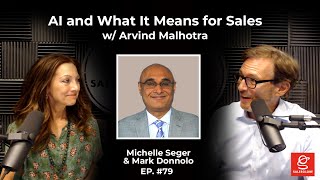
Transcript of a Rethink Sales podcast episode (SalesGlobe Sage hosts Mark Danolo and Michelle Seeger) interviewing Arv Mahatra (Kenan-Flagler, UNC) about AI and its implications for work and sales. Mahatra argues that AI will mainly automate routine, information‑intensive tasks while humans retain advantage in emotional processing, exception handling, and high-level decision-making; sales is positioned as a hybrid activity well-suited for AI augmentation (lead gen, pipeline scoring, content/education) while humans keep the final emotive/closing role. Tactical advice includes learning prompt engineering, ‘‘use and verify’’ outputs, playing with AI tools to automate low-value tasks, and focusing on uniquely human strengths (EQ, storytelling, judgement).
Chapters
Being early in that Prompt engineering, I always tell everybody, learn to be a prompt engineer. And prompt engineering is about asking the right question. How long have you talked about that? In the sales is to ask your client the right questions.
Right.
And that builds trust that you can sell it easier. Same way, it's AI. AI. Ask AI the questions the right way to get your answers. It's the perfect time to learn how to use AI.
Welcome to the Rethink Sales podcast. I'm Mark Danolo.
And I'm Michelle Seeger.
And Michelle, we've got a really exciting topic today, an informative topic on something that we're all interested in, which is AI and what it means for sales.
Completely relevant. I mean, we are reading so much. It's all over the news. Whether you're on. Well, wait, it's not called Twitter anymore, is it? What is it called?
I think it's X.
Whether you're on X or you're on the. Reading the Wall Street Journal. I mean, it seems like AI and tools like ChatGPT are just everywhere and it's really all over the place, isn't it?
Yep. Yep. But, you know, the question comes up for everybody, like, what does it mean for my job?
That's right. Yep.
And we don't have all the answers, but we're going to be talking to somebody today, today that has some really great answers. So I had the privilege a few months ago of going to a class at UNC Chapel Hill. It was an alumni class and it was with ARV Mahatra. And it was fantastic. So ARV is the H. Allen Andrew Distinguished professor of Strategy Entrepreneurship at Kenan Flagler Business School at UNC Chapel Hill. And being a Tar Heel myself, I'm really excited to have ARV. And ARV's going to talk to us about AI and what it means for work and what it means for sale. So welcome arv. Glad to have you here.
It's a pleasure being here. Mark and Michelle.
Yeah, we're super excited about today. Mark had sent over some of your notes and some of the information from that class that he went to. And I was wishing that I was a Tar Heel.
Doesn't everybody?
You know, everybody does.
So. So, arv, I had the opportunity. I was at a reunion and they have these great classes at the business school where we go back and. And the nice thing about the classes that they're not hard on us. So we get to and enjoy class. Like, I didn't really enjoy class that much, I guess as much 30 years ago, but you did a class on, on AI and the future of work, which I thought was fantastic. And you shared a lot of great ideas. And one of the big ideas I wanted to start with is looking at history to understand maybe what happens in the future. And I always talk about being a student of history and how that helps with innovation. But I thought your historic perspective was really helpful just to understand major innovations throughout time and what impact they had on, on people and work. And maybe that's a place we can start is just tell us a little bit about the past and, and a basis for understanding what might be ahead.
Yeah, there's two schools of Thai history has nothing to show us about AI. And when I was young I probably say something like that, that it's all transformative and disruptive words we love to use. But then there's history of great major technological shifts, especially computer technology. Of course there's a lot more shifts in farming and automation and farming textile industry. But closer to home, more digital quasi technology. You know, one of the earlier ones one can look on is the mechanical switching and telephone exchanges which have completely been taken over. And so that's one one can look at more recent and it's not so recent anymore but 90s and 80s with the advent of spreadsheets. And then one could also look at manufacturing and you know, CNC machining and all of computer control. Machining, computer control jobs in automation and manufacturing industry. What happened? So these, these are great historical precedences and economists have for us the great news is economists have looked very deeply. So if you looked at telephone switches and phone operators, that was one place where a, it was a work where women were predominantly employed. And once the automated switching controls came in there was a shift. But it also meant that women either upskilled themselves into more advanced kind of jobs or downskilled themselves into less skill requiring, but still jobs that were very important and formed a large part of the society. So that's one. Then along came, if you fast forward a tad bit and you know, I'll date myself but having used it, VisiCalc, Excel, you know, the first spreadsheets as we now call them and we've now just tend to call them Excel. But Excel had precedence. You know, more routine jobs like accountants, bookkeeping, those went away, but financial analysis, investment strategy creators, those jobs came roaring in numbers. And then it's kind of funny in between, if you really think of I forgot agm, which you know, if you look at the earliest pictures of ATM being the first day ATM came into operation, lines outside the door waiting to use the atm. And economists have done studies where the number of bank branches actually increased post adoption of atm. So that was interesting. And then, you know, if you really looked at again, economists studying Census Bureau numbers and going as far as back as 1950, the only true job that has been eliminated. I'm not sure if you've seen one of those recently, but that's how economists look at that and say only elevator operators is a true job that's been eliminated. In any form or shape. Transformations occur. People have to move up and down the chain. So there are implications, but there, there are implications because we tend to, you know, react to displacement, disruption, those kind of things. But there's also partial automation and there's augmentation. Those, those tend to be there as well as what we would call job displacement or complete annihilation of jobs that existed.
So people are, people are moving up into different roles, but. Or into maybe adjacent roles like you talked about the ATMs, but the jobs are maybe becoming a little bit different, but it's not eliminating the need for those jobs. Except like you said, the elevator operator, which I, by the way, I did that as a work study job in college. I was the elevator operator. Talk about a great way to meet people. Yeah, that was a good job. But anyway, that was the one job that went away.
Yeah.
Wow.
And I wonder if, you know, I haven't been to New York recently, but I even doubt, you know, the doorman still may be pushing the buttons for the elevator, as I see in the movies. So I have an experience. Yeah. But it's definitely impacts, there's transformation. The nature of jobs always evolve. Even if the job per se continued to exist, its processes change and new jobs emerge. And when automation takes place, new skills are required and those skills require new training, then over time that occurs. But in the meantime, there's also investment in more automation, which increases, you know, the revenue for producers because it reduces costs. And then that creates new jobs. And that, that happened in textile too. So there's precedents going as far back as textile and looking at innovations coming in that change one job, but then created a job requirement for three or other types of jobs.
So I know that we're going to get into today, we're going to talk about how AI can be leveraged to actually make you more efficient, more productive, maybe augment a particular role. But I want to start with the big question that people are asking, which is, and it's just your opinion in jobs that you think like that like that elevator operator. Are there particular jobs that are out there that we think could be completely displaced or eliminated because of generative AI or AI enablement?
Yeah. And Mark had heard me say this. If it's super routine work with lots of information processing, that looks like a domain of automation, whether robotics or software, AI that looks like a domain where it's, it's the same thing repeated over time and also a lot of information processing occurring at the same time. And, and those definitely are strengths of automation and software based, you know, repetitious jobs are the domain for robotics, information processing, extensive amount of information processing. You know, humans have cognitive boundaries. So if the information is increasing at the rate it is and it requires a lot of processing, that again looks to be a domain of automation.
So I heard something really interesting today. I was talking to our director of marketing here at Sales Globe and he plays a lot within AI. He was part of that beta group for ChatGPT, for example. But he was talking about how AI and ChatGPT and, and intelligence like that, that it basically when you, when you really put it in context, it ate, it eats, if you will. Information is how he kind of described it to me. So it's already eaten and it's hungry. So it's already eaten every piece of information that was ever created on the Internet. I mean, going all the way back in time, right to the early 90s we say. And then it needed more. So it started to eat, if you will, video, right? They started to engage in video and other things like that. And I just go, whoa, wow, right? Because I, I can't even imagine synthesizing that type of information. So I think that people can become a little fearful of that, you know, but, but what's your take on all of that?
Arv A healthy dose of fear is always good because it prompts you to. I wonder every day with the advent of AI. Howard teaching change So a healthy dose of respect for technology makes you consider what is it that you do that is truly a value added, skillful activity. That's the way I look at it. Rather than waking up every morning and thinking AI is going to be teaching. So I might as well retire right now. I know that there are certain roles and, you know, repetitive and routine and packaged knowledge can always be taught. But knowledge also is emotive and decision making, which is still privy of humans for now. And I think one can consider what's the emotional slash decision making role or part of my process of my job and how can I get better at that? Is. Is the way I look at it from thinking of, you know, I know that AI can help me quite a lot, and I, I'm already starting to use it every day. I'm wowed by it. But I also know that the information it's eating, as you say, is not unbiased. I mean, it comes at a cost. So there's that cost of teaching people how to filter information or, or verify filtered information. Right. So I always tell my students, you know, because I heard Wikipedia is going to change the educational industry completely. And then that came and went.
Yeah.
People said, oh, should we let them use them? Why should you not let people use any source of information? But trust and verify to court all that is our job. And then ultimately decision making is our job, our value added and emotional, you know, So I always look at what are these components of any job that humans can get better at, because that's our core strength.
So that leads us to. Right. The something that we talk to companies about and salespeople all the time, which would be, what is it, right. That the one thing or those two, three things that I will never be able to do that humans can. And how do we really think about and leverage who and what we are as we look at, you know, our job today and the jobs tomorrow. And even the advice that you're probably giving to recent and upcoming graduates.
Yeah. As I get older, there's a time I would. And I forgot to give you my own historical context, which is I immigrated to United States as a research assistant for AI.
Oh, interesting.
Three decades ago. So I look at AI as a race between humans and AI When I came, humans were winning garbage and garbage out. So you're like, humans are not going to train you. Because people. Because the humans I was working with were very knowledgeable and they knew that they had the advantage. So using that context, Michelle, my pendulum standing to get a little more centered because at that time we were winning. And I was like, it's going to do a lot of repetitious information processing jobs and it's doing a lot of emotional information processing. So I just wanted to use my historic context and say, my pendulum may be swinging and saying, Michelle, it's a race. So we, we've got to win a race for our own value. Right. And we also got to win a race, according to some, to beat AI or, or to control AI into not doing wrong things. But where do we have advantages where we win the race? And. And I think that's what you're asking me. And I Think we win the race in emotional processing, right? We definitely win the race in informational processing right now. Computers don't have enough data, intuitive data to make this or not intuitive data points to say well that would be the optimal decision for something like this. Humans are still needed for that decision making step. And I think those are the two. But I always human ingenuity is our advantage and will that be replicated? I have heard convincing arguments on the other end. I think I've also heard convincing arguments that human ingenuity is always going to be there. So without the existential answer, I think there's the answer of how do we keep leveraging what we have that is so beautiful yet we need to trust and verify. So it's been eating all this food information but we are the also the information providers who've been providing lots of great information and lots of bad information. So that part's still there. You got to make the decision as to well does this make sense intuitively what would be the emotional reaction of the person who's consuming our service or slash and impact of this decision. So I think that way Michelle, that's where we can win the race. Will it replace. I have, I've been astounded at the ability of AI or as most people think it's chat GPD but most regenerative AI and doing things that 30 years ago I would have said well that's not going to be possible because that's creative work, right? So I think the creative work I'm starting to see come out of AI pretty well. Generative AI. But I still think there's an emotive work which is I was just talking to somebody in the hospital, right? So I'd gone for a checkup and I was talking to my doctor about nursing situation and he's like what are you talking about? AI I can't get enough nurses, you know. And I was reading an article about global war for talent for nursing, right? So you can also look at why Because a it's a super exception handling emotive work and I always hold that as a standard of people still want humans. They could have designed robots to for bedside manners and doing all of this. But you know, if I am in the hospital what do I feel if a robot moves along or a system's put in place to ask me questions in a very robotic voice. And even if I made it human nurses are required and nurses the shortfall of nurses is incredible. The other place which I was reading, you know, we get carried away by AI and knowledge work and we should because we do a lot of that work. But the shortfall of pilots in United States, both in air Civil airlines as well as United States Air Force is astounding. Then the shortage. So there's all of that stuff that we forget. You know, coding. Yes. I mean AI is already showing, generating logos, great sales globe logo could be made better. Carolina, I love my wealth, so I hope it never changes. But I think yes, the creative part's still happening. But there's enough examples of emotive exception handling work. Right. So airplanes can fly themselves, but why do we have pilot shortfall? Because they're required for that exception handling and making passengers feel safe. So there's a transition of AI do stuff that humans will accept. Yeah, maybe over long term, but that transition has to be managed.
You know, the, the healthcare example I think is a good one with, with the nursing and the doctors. And I was reading something the other day about the, the more human emotive work of the doctor being the more important thing. But then AI being able to take over a lot of the things that you see doctors doing during an appointment, like they're on their computer. You notice when you're with a doctor now, they're on their computer taking notes as you're talking and you're wondering, are they listening to me? Well, they are. So they're using recordings and AI to transcribe the recordings and then what they call PAJ now where the doctor goes home at night and they end up writing up all their notes, that's being done by AI. So you take a lot of those data intensive routine processes away. Right. Or make those more efficient. But yeah, I mean, are we gonna ever want to get into a Star Trek situation where we've got like machines, I guess we do have machines operating on us, but, but machines actually talking to us. Right. To understand us. Maybe not, but, but your point on this whole, and this has been kind of my bios for quite a while, that the ability to creatively solve problems is still innately human. That's one of the few assets that we have that can't be AI'd or outsourced. And so that's something to build upon. And our view, talk about this model where you get to things like more complex problem solving and higher level decision making, that, that's kind of the realm or the domain of humans, which I think as far as we can see right now, that's, that's the place. Right? That's the place that we can build upon.
Yeah. And I heard him mention also discuss like human judgment. Right. So trust and verify. I don't know if you guys saw an article, this is a related. But the article this week in San Francisco, they've got the self driving cars and I don't know if you read about that, but they said they're, they're being really rejected by the community and they've had a couple of dogs that were hit apparently. And it's not using quite the judgment to be able to differentiate necessarily all the time. So self driving cars a little tricky. So I, I think, I thought that was just kind of a little visceral and very tangible example. Right. When you think about the human is there, the human's not and what can go right and what can go wrong. Yeah.
If you ask somebody who loves. Not me but like loves to drive Alfa Romeo, would he want a self driving car or not? So there's that value creation act. Yeah. You know, experiential activities are experiential activities.
Yep.
Right. Just because you can throw a frozen dinner in the microwave doesn't mean you just still don't want to cook. Right. You know?
Well, that's true.
Yeah. Yeah.
I don't use the microwave for frozen dinners.
But.
And if you look at TikTok. Yeah. If you look at social media and TikTok, there's more videos on how to cook and more amateur cooks. Right, Right. We are still democratization of being a chef. Right. So that's not an accurate.
Yeah, that's important. Right. We're still human until further notice, which hopefully we never get.
But I'm beginning to feel like I'm the only person who has not been on TikTok anyway.
I'll be the other one. Except for what my daughters send me. So if we swing this around to the world of sales, Arvin, we look at kind of the evolution of sales and, and I think back, I think back on like some of those old black and white movies. I think back on It's a Wonderful Life. And you know, people would get on a train, the traveling salesperson or salesman in those days and they would go somewhere. So it was face to face. And then we learned that we could actually sell through over the phone. So we had inside sales telesales for a while, phone sales. And then it became tele web. Well they actually can be on the phone and be on the, on the chat or on the web at the same time. And then with COVID we moved more into online certainly. And especially with COVID we moved into Omni. Channel. Right. So I can go to the store, but I can also go home and I can make the purchase on the phone or I can make it on the Internet. And so there have been these evolutionary points in sales. What I'm wondering about is what does all this mean for sales? So if we apply this thinking, we say simpler, data intensive decision making, analysis, that kind of thing, where does that apply in sales? And what do you see happening, I guess overall in sales in terms of maybe AI augmenting what people are doing?
Yeah. And you know, sales is still very emotive. So I think it's a very unusual activity because I'm biased towards sales because I still, you know, I found my mother still watching qvc and I was in the hammer like, wow, QVC is still gold. And it's actually, I read some statistics, QVC has grown even more over the past decade. So each of these disruptive waves only makes qvc, you know, and I don't see a robotic element selling stuff in on qvc. So back to your question, Levity aside, I think it's a unique job because it has such emotive decision making component to it, yet it has such information and processing component to it. Right. So it looks a perfect place for augmentation. And to me, maybe I have biased glasses. Almost all these high knowledge skill activities have both components. And I always think, wow, if we could completely leverage lead generation or lead evaluation or pricing optimization, these sound to be very, these activities where there's lots of upfront informational processing, but in the end it's always about emotive decision making. Right. So that's where humans in that process, you know, why, why not let, you know, upselling, cross selling. I always look at those as, wow, they got me that last element. And I'll give you an example. I went to this restaurant and I'm a poor professor. Somebody else was paying for it and they said, you want to eat this pasta and it's expensive, but why don't you take the tasting menu? And then this person went on to give us five reasons why we should have the tasting menu. And I ended up eating the tasting menu. It was about four times more expensive for the person who's paying. And yet we were like, wow, we're, we're, we're in this profession, you know, one was a consultant, one me being educator. And we're like, we fell for sales. So isn't that amazing that you know, when we let our guard down and we don't trust distrust is this activity. It's still amazing how QVC is successful and how upsell and cross sell. So again, going back to upsell and cross sell, rationally all of this would say don't get upsold or cross sold, right? You know, it's your consumer surplus, but yet how many times we do that, right? So that human, whether B2B, right? So people go B2B sales is a little different. I'm like, no, humans are still human. Still human. So educate your. Let your consumers get as educated by AI or online tools or whatever they want to get educated. But that last impact of turning them into a revenue potential is a human privy to me. Right? So that's such an emotive. Even in the age of full informational transparency and purely true information, you still have that last step of a emotive experiential process that is, requires a lot of decision making. Consumers love health and decision making. And so that's, that's again a sales person's privy. And, and you both are experts. So I only read Mark's book, but I, and having watched so many movies on, you know, always be closing and, and you know, that always be closing also means, you know, that is where you are helping somebody make a very emotive decision and making them trust that they made the right decision.
Now you may, you just pulled up a really interesting, I guess, mental model there. You said something like in the earlier stages of the sales process, I'm kind of, you know, paraphrasing so like lead generation or maybe even backing further out to understanding who we should even be focusing on in the market to lead generation, et cetera, et cetera, that those things are more data intensive and maybe more suited for AI. Then you get further along in the sales process, closer to the close, that becomes more emotive, more human. So maybe there's some kind of rough correlation there.
Yeah, Mark, very well put. That's exactly how I would state it. That's very well put.
I can think of one spot, arv, where somewhere as we get closer to the human, where I could be really helpful. Which would be when you're looking at, you're sitting in the classic sales meeting and everybody's going through their, their CRM pipeline and they're like, oh yeah, this is going to close, you know, and I could probably tell you, well, based on all of our data, this only has a 27% chance of closing in the next 30 days, whatever it is. And you know, forget all the fluff and pomp and circumstance, it's not going to Close, Jerry. You know, I could see AI being very helpful there to kind of flesh out pipelines. So we get cleaner, leaner pipelines as well.
Yeah, absolutely. And you know, this resource reallocation of, you know, I see AI being biased and I see humans being biased. I see this power of us crossing out each other's biases. Right. AI could be super biased in processing all this information in the most rationalistic decision making form. But humans are very emotive, non rational decision makers. Right. So that final checkpoint of, you know, while all the data might say this is an account you should pursue or should not pursue, my intuitive appeal, which I have not been able to yet codify into data says that that's an account, maybe in long run we should continue pursuing even if it's not profitable at this point or that probability is low right now. But I think that probability can turn in our favor. And this is again your profession, but you know, the complementary effects are immense. Right. So it frees up humans to do what we're really good, at least sales, which is that decision making, intuitive thinking, you know, creative thinking, all of those forms can then be layered on top of a rational decision model. Right.
So when we think about, and we were just working with a client over the past couple of months on a, on a question like this about lead generation and they said, you know, the people on, they get on the phones and we watch them, they get on the phones, they make calls, they're, they're reaching out to prospects and their, their hit rate is really low, it's laborious, they don't like to do it. In fact, those are the, those are the first people to schedule sales interviews with us because they would rather be doing anything than being on the phone making those cold calls. But, but the leaders of this sales organization, they're kind of old school. They couldn't understand why the cold calling wasn't working and why they shouldn't just be doing more of it. And we're saying, well, really what's happening now is it's more about putting knowledge into the market and creating preference and becoming an authority in your particular space and supplementing those people calling out if they're going to still call out with, with better information. But you know, if your point is right, which I think it is, a lot of that cold calling could go by the wayside because it's just not going to be effective anymore. Customers are going to have information sooner. And it could be something where we say, well, actually what we're going to do is we're going to use AI to come up with better thought leadership on our particular space. If we're a logistics company as an example. Okay. How do we get the best thought leadership and logistics and what's going to resonate with our customers in the beverage industry or whatever industry. Right. And that might be a use of that, that replaces largely cold calling.
Yeah, and I've thought of my own profession that way too. Maybe it applies to sale, you know, rather than a cold push, a warm pull for content service. So cold push is like what you were talking about versus one pull is let the consumer demand but then deliver the want along with it. The emotive part which makes them trust that they, they pull the right service from you. That's, I think that's how I think about my own profession quite a bit.
So, so we got the, the lead gen, the data intensive stuff up there and then we have this whole laborious thing in the middle of nurturing customers, nurturing prospects. So they, they responded to us, but it's dragging out. And how do we keep that going and how do we figure out versus having salespeople periodically call and just check in or whatever it might be, or send emails? Well, what's the best nurturing process for the types of customers or the segments and the buyers that we're talking to? What kind of information? What should, what should we be saying? Not leaving that up to chance. And maybe as we're seeing even with LinkedIn right now, maybe AI is actually taking the place of the salesperson and actually becoming the, the personality of that salesperson to do that nurturing. That becomes very labor intensive and data intensive.
Wow, that's interesting.
Yeah.
What do you think about that arv?
I like that. I think, and that goes back to Michelle, that refrain from thinking that the emotive part cannot be done by AI. Right. There is, there's also base level emotive part, but then there's higher level emotive part. There's this level creative work and then there's a higher level creative work. And I think that's where, you know, that's the next phase for us to take each profession and distinguish the base and higher level in each one of our professions and then focusing on honing.
The higher level, you know, particularly in an uncertain sales environment with our arguably, at least from our clients perspective, I can say that we are, we are in an uncertainty sales environment. And what we're seeing are much longer sales cycles to just current, current state. Like Mark was discussing as companies are trying to Figure out like what to do next. And I see a lot of fatigue across sales organizations too, you know, because it's like, oh, so if you could think through, right, if you could leverage AI even for what's the right information and how can they help with the nurturing of that sale and then your effort and energy is really focused on helping them make that final decision when they're ready to make that decision. I'm just hearing about a lot of burnout across different industries. So I'll bring up one example. I'm speaking at a conference that's aimed at senior living industry, which is a huge growing industry. Right. When you think about baby boomers, which will be the largest segment of society that will need some type of everything from independent to full service care living, they are talking about how the sales cycle is really being drawn out because costs are higher right now. There's still continued concerns about inflation, recession. And lingering in the background a little bit is still about what happened during the pandemic within the senior living, within segments of senior living and people not really having access to their family, their loved ones. So if, if we could leverage, I would think some technology to help on the upfront qualification, let's say responding back. My understanding is people stay on wait lists for a couple of years and that means they're not ready to go in yet, but they're waiting until they are ready to go in. So someone needs to nurture those.
Should we be getting on one of those wait lists now?
I'm not getting on because I'm going to. No. So I live and I'm planning on being one of those centenarians that, you know, is going to be a high performer. I don't know, living at home that is perfect anyway.
I don't know, I love your analogy. But yeah, you know, not losing focus of long, you know, cycles, all this come and go and then when, yeah, when this cycle ends, there is going to be all of this pent up demand. It always is out of pandemic, out of recessions, economies always go stronger. So you know, but nurturing as your, your correct word is nurturing. Right. Many times we have to nurture our students too because employment cycles also change pretty badly. But we got to nurture them by giving them skills, telling them if they're waiting for a job, they've been asked to wait for their jobs, what to do in the meantime, what skills to develop, you know, so those are, I love your nurturing. So same way maybe, you know, buyers have to be nurtured they can't be dropped. And how do you nurture them is a big aspect of it. Why they should, you know, giving them alerts as to, hey, maybe this is the time you start to think of that thing. You have held off on purchasing for a while.
Yeah. So I want to ask just a practical, tactical question for sales leaders to the individual, you know, salesperson, frontline salesperson. How can I begin to rethink, you know, we talked about rethinking the future of sales, how I can leverage whether it's, you know, part of a company initiative or not. So a lot of companies, they haven't figured out how to leverage AI, Right. But yet it's all out there. How could I begin to leverage it to help me do my job, to be more efficient, more effective and have a better relationship, start to build better relationships with my clients? I'd love to hear your take on that. Both of you. I'd like to hear your take on that.
Yeah. I think one of those is just like I do. And I won't tell you my age, but how could I use my. All these tools? Now there are gazillion tools, right. So which tools could I use to automate the most boring parts of my job or the least value added part? And playing with that, right? So instead of being fearful of what's coming sometimes when you play with technology. Yesterday I was trying to generate a logo and with my son and I told him to teach me, we looked at four or five different AI tools to generate logos or graphics for my PowerPoint. And I was like, oh, this is good. This is terrible. You know, just learning how to work with AI, this is the right period to, instead of being fearful, to learn how to work with AI, to do things that would make your life, whether personal or professional, easier. Right. So being early in that, you know, prompt engineering, I always tell everybody, learn to be a prompt engineer. It's, it's. And prompt engineering is about asking the right question. How. How long have you talked about that in the sales is to ask your CL the right questions.
Right.
And that builds trust that you can sell it easier. Same way it's AI. AI. Ask AI the questions, the right way to get your answers. It's a perfect time to learn how to use AI. Just asking right questions. I think also in eq, right. Your. Your emotional quotient, right. How do you increase your emotional quotient? How do you get better at. We all have severe weaknesses. And if we think AI is coming for us, what are the things we can distinguish ourselves. There's enough research. You know, people say, oh, I'm an extrovert, so I'll be a good salesperson and I'm an introvert, I'll never be good sales, but those have been falsified. Right. So especially our kids and their generations, you know, they all have unique skills. That's one of those most promising things. And so each one of them tries to not hide their uniqueness, they try to highlight their uniqueness. And I think that's something I'm learning. I mean, when my students ask me what can they learn, I'm like, increase your emotional quotient of how you interact with people using what you're really good at. I mean, this introvert, extrovert, type A, type B, these are very old school boxes. And the next generation doesn't have these boxes at all. They're just, they impress their uniqueness and then they sell their uniqueness and they leverage their uniqueness. And I think I'm learning that myself at this age as to what's, what makes me unique in a classroom. Right. What, what can I embrace our phone and what can I do with AI to take away all the stuff I don't like?
Yeah, yeah. I mean that's a great point on the uniqueness. Arv. I'm thinking back to business school and how we all thought we had to develop all these specific skill sets to be ready for the job market, which we did in a lot of ways. But the reality was I came from art school undergrad into business school. I wasn't going to be nearly as good at some of those things as the engineers were. Right. I mean, just wasn't my strong point. But. And, and I think we've evolved a lot over the past, I'll say three decades since I graduated, where recognizing our uniqueness is actually a strength.
Right.
And, and so I love that idea of, of play that up and understand what it is and that becomes something that's really, really important. We're not, we're not all trying to be, you know, drones and fit a certain mold. Yeah, yeah.
And then next generation is really, you know, my students have taught me that they embrace their uniqueness. Right. They're not embarrassed by it. It's not that something, you know how introverts always, we felt had to hide that they're introverts.
Right?
Yeah, I am an introvert, but I have, I have analytical skills. You will never have decision making power. So, you know, I love that part, is to take a step back and you know, always look at what's unique about me. That would be the perfect fit for this job. And if there's nothing, then I need a new job.
Yep. Yep. I want to ask you a question or based on something you said earlier about AI having bias, like humans have bias. And then an observation Michelle and I made the other day with one of our teammates that had AI write an article and then he was testing the information in that article and AI then said, well, a lot of this was not true. And it basically filled in a lot of blanks to create this article.
It did. It said, I made this up.
Some of this, some of this I made up. But it didn't. It's like a bad kid.
Right.
It didn't tell. It didn't tell him until he had. He actually forced the question. So. So my question for you, arv, is how is AI becoming smarter? Or how is it going to become smarter? Because, you know, now it can pass an exam for some colleges, but, you know, just barely some it fails, but it's got to be coming. Becoming smarter. When does it. How does happen over time?
Yeah. And we talk about. This is so fun, Mark, because we, you know, when we talk about chatbots, we talk to chats as if they're humans. And then we're talking about AI being biased and humans being biased, and we forget that AI is biased because it was made by humans. And so inherently, it's our own bias that is replicating and amplifying itself. Right. So I think the answer is in there, that verification of information to me is super important. Right. Like, to get carried away on wrong information can really, really wreck a lot of good stuff. So this verification of information is going to be very super critical. Right. And I think that's where, again, one of our strengths is to use AI to verify our information. Right. To fill our holes and to ask for sources or to make it look at sources. I just saw how to write prompts, which is you make it look at the things you think are trustable rather than, you know, you can constrict its brain, AI's brain, by telling it to look at reputable and. And restrictive sources for that information and writing a prompt to get. Do your job by looking at trusted and verified information. Right. Is a good way of removing our own biases.
It's almost like a just a person. It's basically saying, well, if you, if you look at this verified information, you're going to have a certain point of view versus, you know, you're. What you're seeing or watching. Other things that maybe are on the fringe or whatever. And so, yeah, your point of view is going to be based on the information that you're, you're taking in.
Yeah, its greatest strength is human weakness and its greatest, or its greatest weakness is human weakness and its greatest strength is human strengths. At the end of the day, I think the way I look at AI is reflecting us. So hopefully societies will transform into better societies just by being reflective.
So if you look at this from a sale, we talked about salespeople. If you look at this from a sales leadership standpoint and say, I'm a chief sales officer, chief revenue officer and hearing all about AI, what should I be thinking about? Unless I'm planning on retiring in a year or two, what should I be thinking about for my organization ahead rather than kind of shying away from AI or just kind of pushing it on to somebody else? What should I be thinking about strategically about how to take my sales process or how we work with customers or how our coverage model works and thinking, you know, where, where might AI play in there? Not, not necessarily knowing the answers, but like you said, what questions should they be asking to improve their go to market models in their sales organization?
Yeah, I, I, I'm gonna try, Mark. I think it goes back to the same framework I use all the time, is what's repeatable in my job and what requires a lot of information processing. And now my job are those who I manage, right. And how can I leverage AI for those things? And then how do I tell who I manage or myself as to what distinguishes me or what distinguishes the process by me being part of the process? Right. And if it doesn't distinguish itself by being me being part of the process, then it is where I have to leverage it the most. I also think, you know, this is very stupid, but it's simple and effectively stupid is take some time to play with it. Some of these are very overhyped tools. The reality of the tools is very distinct, different from the, the hype of the tool. So, you know, sometimes you just have to look at the tool because if somebody tells you that I'm going to be able to use this tool to do this and this and this, having that ability to say, nah, I don't really think so, but if it's price optimization, I'd look at a tool, I mean, you know, just to be more concrete in your world, just what can help me make decisions better for my clients and play with those tools? I mean that it's always such a great idea. Any Tool, for that matter, you have to create a new logo because it tests, it shows you how AI is thinking in different fields. Right, right.
You know, take your logo example. I'll just take my whole art school background. When I look at AI creating logos, what scares me about that is it's kind of like back in the days, I'll date myself back in the 80s when we've had our first Mac pluses, the little boxes that sat on the, on the desk, the little black and white screen, everybody's like, well, desktop automation. You know, everybody's going to be able to do newsletters and everybody's going to be able to do their own advertisements and all this stuff now. So the need for design firms is going to go away.
Right.
And it's, it's sort of like that saying, well, AI can develop logos, but what we found with all that is just because you give somebody, you know, a hammer or give somebody a loaded gun in terms of desktop automation, doesn't mean they know what to do with it.
Right.
So what happened was a whole generation of the most horrendous design that you'd ever seen because people just started, people now had the ability to do their own design work.
Right.
It was, it was horrific.
Right.
And so I see, I see AI generated logos now and I'm like, okay, what's the concept behind that logo? Yeah, I can mix and match and throw stuff into a blender and come up with different images, but what problem is it trying to solve in terms of what we're communicating, the corporate voice, whatever those things might be. So I think that's just an observation on logos itself, but it also talks to your point about the emotional intelligence. Yeah, and, and, and, and the humanity of understanding what's really going to communicate or what's going to really get across to people. So I think to play on top of your answer too, are what I would do if I were a sales leader as well. I would take your criteria and I'd probably break apart the different components of our go to market strategy. So I'd probably take the sales process all the way from segmentation and targeting and what customers are looking at to lead generation to, you know, nurturing, to closing the sale, to implementation, whatever it might be. And I would ask those questions about what's data intensive, what could AI actually supplement in an unbiased way. Where do we still need to have the human element? And I'd probably look at that across the coverage model as well, in terms of the roles that we're using because some of those roles it might be, and companies are already doing this, right? Maybe certain customer care roles to face to face roles to, to certainly online, you know, Internet purchasing, Internet information acquisition, a lot of that can be automated, some of it can't. But I'd start to break apart kind of those different components and ask those questions, go through your questions and ask those. And then I certainly wouldn't know the answers, but I would know the answers I was trying to find. Right. And then put the right people on that. But, but I think your point about playing with the tools is a big one because I think just the, the fear of it and, and shunning away from it is, is worse than actually understanding what it really is at this point in its development.
Yeah, it is, it is. You know, because the tools also help you map what you said, right? So if you find the reality is not where you think it is, then you certainly find we as humans are really good at this. And so you start to separate that in the map, which is this is the. It still is part of emotional intelligence and it's not. And over time things will shift to, as I said, to Michelle's response to Michelle, whether they'll take over or not. That's. We perhaps won't be here. But not to answer existential questions, but to say, well, there's a way to analyze what's the privy of humans and our strengths and what's good with AI and, and how do you figure it out unless you play with it? Because again, going back to your logo thing, I, I played with the logo six different. All I wanted them to do was to make a graphic image which shows business disruption. And I couldn't get it to do it right. So I got my son to come help me. I was like, he's like, why don't you put fire? I'm like, no, son, you can't put fire for disruption. What about explosion? I was like, no, that's not disruption. And so at the end of the day, I gave up. I was like, I'll just put the word disruption and resonate better with people than trying to find a graphic for a PowerPoint slide. Right?
Because what you brought up there was a complex kind of emotional problem. And when you say business disruption, well, yeah, you have kind of the immediate things of what things are disruption or destructive. But then you have the, you have metaphors like what is destruction, what is disruption, and what are metaphors for that that are positive metaphors. And so, yeah, I suppose AI could do that at some Point. But those, those are very human questions.
Yeah. When I think about how salespeople can start to play in the space, a couple things come to mind. Right. When I think about, oh gosh, I'm going out there looking at new customers. Right. I'm out there looking at what the opportunities are and I've got this lead list. But having it help you do that research and gathering the information for you across, you know, because if you think about what that AI ate.
Right.
We talked about everything that it ate. Anything from, you know, who knows, a CEO's YouTube video channel that you may not know exists to their LinkedIn profiles and any other articles that are out there about the company, recent M and A, whatever that might look like. But to be able to synthesize that and help you understand the story of the company can help you understand what your buyer may be solving for. Again. So you're not asking AI to solve the problem, but what you're doing is leveraging it to gather you information, save you some time. I can see that being really helpful.
Yeah. And what you're talking about within that, you said the story.
Yeah.
Story is something that's human too. It's like within all this information, how do I find the story of if we're going to meet with the CEO? The story of the CEO, not just in terms of her resume or his resume, but what have been the challenges, the drivers, the things that are going to be meaningful as that person looks ahead.
Right.
So we can do a better job helping them. So that's, that's a human thing.
Yeah. You nailed it. I mean, I asked somebody.
Oh, go ahead.
Sorry, Michelle. Go for it. Michelle. Sorry.
I was just going to say, I think what I'm hearing is that sales or people aren't dead. We're not out of the equation yet anyway. We're not out of the fight.
Not dead yet.
Well, you know what I mean. I think that's sales. I was recently talking to a sales leader of a global manufacturing technology firm and they were one of the first companies that made a decision to get out and see their clients as the pandemic as some of those restrictions were lifting. And they came back and said, boy, what we're hearing is the person who shows up, the one that looks them in the eye, that they're building the trust with and can tell them why their product and service is going to help them solve their problem are the ones that are winning the deal.
Yeah, yeah.
So I still think the human element.
Is very important in the showing up piece. Yes. It's important to build the human connection. I'm also thinking, Michelle, based on what you're saying about this idea of understanding what's going on within the customer, if we're talking about kind of a two dimensional flat world and we're in and we're, we're doing this right, we're on zoom calls and we're, we're connecting on email and that type of thing, that's one way of gathering data that I assume AI could handle. But if you picture ARV as an example, you go in and you're a consultant and you're walking into the client's office and you're observing what's going on in the hallways and you're seeing how people are working and you're going on a customer call and you're watching how the customer interacts with the salesperson. Unless you have like some kind of AI on your shoulder, I don't know how it gathers that kind of information, that kind of knowledge, at least in this generation that we're talking about, that would be very hard to do in a three dimensional world.
Yeah. And that's, isn't that what everybody's realizing? Because I had students who took me virtually and then they took me in class and they said, you're so much better in classes. Like, I don't find myself different. And I think that was the part of being part of their emotional decision making about. Yeah, I am part of their emotional requirement from education. I am not critical part that I realized, but I am part of their emotional journey. And, and, and so is, and this is interesting. I didn't want to let this go because I asked somebody, he's my mentor and he, he's, he says things that are so brilliantly simple. I said, what's our job? He said, selling our, selling knowledge through storytelling. Sounds like, wow, it's storytelling and selling. That's everybody's job.
That's right.
That's. I mean, he's such a good storyteller. I'll always be terrible. But then I was like, maybe I'll, I'm a stand up, so I'll tell jokes.
I, I think you're a great storyteller and I think that's one of the reasons we're talking today because I sat in your class, arv, and I'm like, man, this is, this is great. This is a fantastic story. Plus, plus you're funny, so that's even better.
Thanks, Mike. You could tell that to my kids.
So, so, arv, as we're finishing up here. What one piece of advice would you give to a sales leader on AI and what they should be thinking about?
Verify. One word. Use and verify. And get comfortable. I think get comfortable. Change is very uncomfortable. Winners or losers are governed by who gets comfortable with change. Right, Right.
Excellent. Well, thank you. This has been a great conversation. How can people get in touch with you? Arv, you're at Kenan Flagler Business School at UNC Chapel Hill. Is there a way they can connect with what you're doing or ask you questions?
Absolutely. I think being an educator at public university, I'm the most accessible person. You just have to type my name in the Google Bar. You'll get my phone, my email, and also access to my research articles and research thoughts. So it's all there in the Google Bar.
Okay, that's great. ARV Mahatra, thanks for joining us and we really appreciate you being on the Rethink Sales podcast and look forward to talking to you some more.
Absolutely. Thank you. Marc and Michelle, thank you.
Thank you.
More from SalesGlobe







Sales Compensation for Results - Course 1: A Strategic View on Sales Compensation - Trailer


Freative Friday - Episode 98 - Insight in Your Hunt for The Revenue Roadmap Pt 4


Freative Friday - Episode 97 - Insight in Your Hunt for The Revenue Roadmap Pt 3