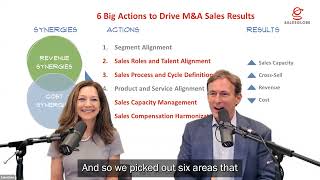
This short video/transcript outlines six practical areas to prioritize for realizing sales synergies after mergers & acquisitions: segment alignment; sales role and talent alignment; sales process and cycle definition (especially for cross-sell); product/service alignment; sales capacity planning; and sales compensation harmonization. The speakers present a "Revenue Roadmap" framework—four competency layers (market understanding, sales strategy, coverage/deployment, enablement)—to show how these six actions connect and where to prioritize effort depending on the company.
Chapters
All right, so let's turn the ship a little bit here and we'll take a look at some of the things you can do. So we got this idea of synergies that we talked about right on the left hand side and then you got these results over here. So we say we're going to get all this stuff, we're going to have more sales capacity, we're going to have better cross sell, we're going to have more revenue, more cost and it's like okay, well go ahead and do it now. Okay, well what do we actually do? And so we picked out six areas that we work on most commonly in an M and A situation. And we also see working really well in organizations that do it as well. And these big six, if you do these things well, you'll be able to get those kind of results on the right hand side. So number one, alignment of segments. So making sure that we're actually working with the same definitions and alignment of who we're going to be going after in terms of our customers, sales role and talent alignment. So as you mentioned before Michelle, making sure the roles are actually reconciled and they're the same roles and bringing those together, mapping those and bringing those together and the talent that goes within them. Right. So in a account manager, may not be an account manager, we have to understand the differences between those sales process and cycle definition, particularly as it pertains to cross sell. So if we have a different sales process, we have a longer short sales cycle that's going to be harder for us to do the cross sell correctly. Product and service alignment. So you know what, what does the portfolio look like and what do people have to offer and being very specific about that sales capacity, of course one of the results. So how do we planfully make sure we're going to get what we're looking for in the M and A situation and how do we identify what the levers are to pull to actually get us there? And then finally sales compensation harmonization. So today we're going to hit on these, the red ones here because those are some you can dig into right away and we can certainly talk with you further about the other ones as well and get into the details on those.
Yeah, what I would love to know is if after today's session if we should do a follow up and hit on some of those other areas as Mark and I were talking about segment, for example, we can do an entire session just on that one alone. So the big point, right, you've got synergies, you've got these results and there's an assumption you're going to get those results. So what we are really focused on are the things that we work with companies on really good key actions that they can take so they can actually realize the results of those synergy expectations.
Okay, so here's the toolbox. Let's, let's get into a framework for how to look at this. A lot of people have heard about revenue roadmap. This works really well in these kind of situations because we need a place to understand how things fit together. And so what you'll see is as an organization operates well as it performs well from a growth and sales standpoint, it tends to do well in four major competency areas that you see these levels here. So insider understanding what's going on in the business and the market. The sales strategy, which is basically the action plan to get to the goal, the big go to market plan that includes what we're selling, who we're selling to in terms of our customers, what our value proposition is, our coverage model. So what kind of channels and roles we're using, our sales process, our deployment or territory, feet on the street question. And then finally the enablement layer which supports these other areas. So incentive compensation, people, programs, technology. So if you take a look at a little bit more detail on this in terms of these different areas, what you'll see is the big six that we talked about here, they sort of hit some of these areas here. So your products and services, the segmentation, your sales structure, your sales process, incentive compensation, talent. So the point is, as you're working on these, you have to make sure that these alignments are all connecting together. So if I'm working on something like incentive compensation or talent, I have to make sure it's responding to the upstream disciplines, the ones that you see at the higher levels here. So having to make sure, make sure all these pieces connect together.
Yeah, it's just a really good tool. It helps frame your thinking and it can also help you prioritize because there's a lot in here. Right. So you can begin to understand where do I need to start? And for every company that's going to be different. So one company may have less challenge with products and services, let's say, than their sales process or the talent that they have.