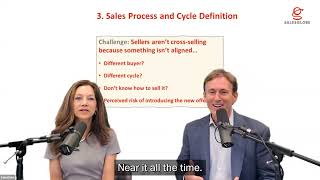
Michelle outlines six checkpoints for cross-selling after acquisitions: buyer alignment, offer differences, sales cycle timing, role mapping, sales talent, and relationship risk. A shipping company's failed attempt to sell financial services to its customers shows what happens when the buyer profile doesn't match.
Chapters
So sales process and cycle definition. So if you're going to do cross sell, you have to know how the sales process is going to work. You have to know how the roles are going to work. And we might hear a challenge like this, Michelle. Our sellers aren't cross selling because something.
Isn'T aligned right here at all the time.
And then we look and we see stuff like, well, is it. And we ask questions. Is it a different buyer? Is the cycle different? You know, do they know how to sell it? Is there risk? So let's take a look at some key questions you can ask in this, in this particular area here, around what you can look at around the sales cycle. So we have six different areas here to take a look at. The buyer and for your sales process asks these, these questions for each of the situations is the same buyer for the cross sell. So I can think of a situation, Michelle, where we were working with a shipping company, this is a while back, and they were moving into the financial services business. They said, well, we can offer, you know, receivables, factoring, and we can offer all sorts of other financial services around our shipping products. And our people that sell shipping are going to go in and they're just going to offer that to our customers. Right. And so they acquired a financial services company to do that. Well, lo and behold, the shipping people need to get to a different buyer because it's not the same buyer that buys shipping, that buys financial services. Big, you know, underestimation of the difference between those buyers.
You know what we see, we see all these assumptions that because I have a great relationship, you may be your, one of your top 10 strategic customers. Right? Because I have a great relationship. We got a great customer there. They're going to. The buying is not really going to be a challenge, but you may be starting from around somebody completely different.
Right?
Yeah.
The offer. So do you have different offers? Is one offer a commodity? The other specialized? Is one more of a capital purchase. The other is maybe more of a service this cycle. So you may say we're going to cross sell, but we have different timing. One is a long, more complex sales cycle. The other one maybe is a faster, more transactional sales cycle. The role, you just mentioned the role. So the roles mapped, are they, are they integrated well? Talent. Okay. This is a great one too. Kind of like what I just mentioned before. Do the salespeople have the talent to recognize the opportunity for the cross sell, to ask the right questions, to communicate the value proposition, to bring in somebody from the other organization? Perhaps at the right point to help with that cross sell or are they going to try to take it down themselves and end up losing it? Right, which we see that happen as well.
We do see that happening.
And then finally this one comes up a lot risk. Right. So I've had these accounts for a long time. I'm an account manager and the last thing I want to do is introduce something new that's going to introduce risk or I'm going to bring some guy or some gal in from this other organization that I don't know into my customer and they're going to mess things up. So I don't want to create risk. So the benefit to me is not as big as the risk of messing something up. So six big checkpoints you can look at here. And again we can go deeper into this as a follow up if you'd like. But just some things you would look at around the sales process and the cycle definition.
Just being aware of these things we tend to, so we just talked about earlier on that the decisions around these synergies are made right up here, right at the deal maker level. And they're not really thinking about the salespeople may not, may not really want someone else in their account, for example. So you know, these are just really big good considerations for you to have that you can address. And again, pretty practical approach that we know works.