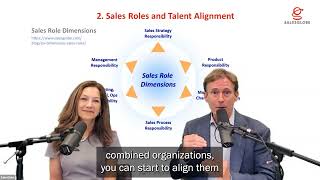
Speakers (Michelle and SalesGlobe Sage) describe a method to align sales roles and talent during integrations or organizational reviews. The core is identifying six sales role dimensions (sales responsibility/strategy, product scope, market/segment/channel, sales process scope, technical/marketing responsibilities, management duties) and using them to build a role matrix. Teams should inventory all job titles across organizations (example: ~98 titles) and, through interviews with leaders and frontline managers, map attributes like revenue focus, skills/certifications, and objectives to group titles into harmonized roles (example: reduced to six categories). The approach helps reveal misalignments (e.g., 'account manager' roles with very different revenue responsibilities) and informs deployment decisions.
Chapters
Let's get into that second one, Mark, that you mentioned on sales roles and talent alignment. And this challenge or this sentence is basically what we hear from clients all the time. It's either the organization, the roles, the talent, they're just misaligned. Even those with similar titles, there's always a scratch in the head on that one. And we're not leveraging any of the combined strengths of the organization. So we get this big question and we're like, okay, we can help you solve for that. Right, so what's the approach? There's a lot here, but we're going to break it down. And again, materials will be available after the session. But the first thing is you're going to understand the sales role dimensions. And a sales role dimension, as Mark will discuss shortly, is simply nothing more than, or simply everything that a sales role could be responsible for doing. So understand those sales role dimension that apply to each role. And then you're going to create this role matrix, and we'll. We'll get into that. And then you're aligning titles, so titles that seemingly are the same. You're going to align them across these different companies, and you're going to group them together by that role matrix that you created. So it'll be the attributes of the role, that's the role dimensions, and then revenue, responsibility. And finally, you can extend that to the deployment of the sales organization and what we call draft day. And that's putting basically seats or putting people in the right seat.
Yep, yep, yep. So, and I think one of the important areas on this too, Michelle, is that this is not just making a list of the jobs, but it's actually doing the detailed mapping here. And we'll take a look at this first piece, which is the sales role dimensions, which I think this is one of the keys here.
Yeah.
So a sales role is defined by six different dimensions. And some of them are present in a role, some of them are not present, some of them vary in terms of the level of intensity. So if you look at each of the sales roles in the organization, you can ask these six questions here. So what is its sales strategy? Responsibility? So does it sell to new customers? Does it sell to current customers? Is it doing retention or service responsibilities, or does it do all those things?
Right.
Product responsibility, especially if we're talking about cross sell. So does it sell a specific product? Does it sell a whole portfolio? Does it sell a certain category? And the more you answer yes to any one of these questions, the more that particular job has to do and the more the bandwidth gets, wider on that job, broader in that job, and gets tougher for that, for that job to accomplish. Market, marketing and channel responsibility. So does it have any responsibility in terms of how it's going to be going out to pre market what it does and what kind of segments is it working with? So is it working with major accounts, middle market accounts, small accounts, certain sectors, you know, financial services, health care, that type of thing? Again, the more sectors a job is covering, the harder it gets for that job. Sales process, is it end to end? So do they generate a lead and take it all the way to close or do they pick it up after the lead's been generated? Do they hand it off after it's been closed? And does somebody else implement that? The marketing responsibilities, technical responsibilities, does it have technical expertise around a product? So you know, imagine you're working in a high tech company. You say, well, this particular job has to understand the products to a certain level of depth versus they have an SE to help them, a systems engineer to help them. And then finally management responsibilities. You have some jobs that are selling sales managers. So they don't just sell, they also manage people. Right. So you can imagine if you said, yeah, they do that, yeah, they do that. And you said yes on every one of these, you get a pretty expansive job and then you get a job that's really hard to execute. Right. Number one. Number two, if you ask these questions about all of these jobs in your combined organizations, you can start to align them and find the points where they're misaligned and start to bring those together and do some consolidation.
That's right. So this is a great starting point, or we would say it's the starting point by looking at sales role dimensions and asking some key questions. Now where do you get this from? You get this from not just the job description and getting whatever documentation from hr, but you need to talk to people. So talk to sales leaders, talk to managers and understand what people are really doing and where they're spending their time. So I'm going to take a quick segue before we go to the next one and give an example of marketing responsibilities. We were talking to a company very recently about marketing responsibilities of the team and, and they had a brand new hire, a really talented individual who said, I got to tell you something, I don't feel like a salesperson, I feel like an event planner. Real words out of that person's mouth. So we had to look at some alignment on that. So don't make assumptions, just know that you got to ask some questions of the people that are doing the work. So now let's get into this role matrix that you're going to create. Once you know what the sales role dimensions are, you're going to take all the different job titles across the different companies. You're going to put them down in a, in a workbook, right? So you got to document them. And I got to tell you, it can be a weighty experience. I remember a recent, another recent acquisition that took place and we had over 98 different titles that we were reconciling. Now we ultimately got those into six different job categories, which will be part of, part of this whole mapping. But know that you can have a lot of titles there. And what you want to understand are a few key things, sales role dimensions we've already covered. And you're going to build on that and say, well, what's their revenue focus? It's going to be very important to know if someone is responsible for new business versus contract renewals, for example. It impacts things, everything from what they're doing to how they're being paid. You're going to look at the attributes of that role. So Mark just brought up different talent and skill requirements. If you're in a technical sales role, you might have certain certifications that are required or years of experience and then what the key objectives are and then really importantly how they do it. And why do you want to know all this? Because that's really going to help inform if titles, are they really doing the same thing, those job roles that you're hearing about? And the next step is you take and you're going to group them into this, this harmonized roles. Now I just mentioned to you that we had, this is an example of that company. I was just discussing the global company. They had over almost 100 different unique job titles, or so we thought they were unique. We got them down to about six different job role categories. We're showing four right now. And we looked at, you know, things like, you'll see that one of the companies that's there in green, they do new customer wins. That's the focus of the job, all the way down to one that might be responsible for technical sales or just contract renewals. So you're going to create a mapping and let's see what that tells us across those different job titles. What's going to pop out? Well, what popped out of this one is account managers have very different revenue responsibilities. So, so an account manager at one company, they're out there winning new Logo business. Only an account manager at another company is responsible for growing the account base. So what we're selling within an existing account, growing more of that year over year. And in another case, that account manager was actually the technical sales role and lived, if you will, lived on site at their clients where, you know, the. When we talk to them, they actually said, well, our client really doesn't know the difference between us and themselves because we basically live on site. So account manager, which has a lot of assumptions, can actually have very different revenue responsibilities, which translates into very different responsibilities.
You know. You know, one of the things I find to Michelle, when you do an exercise like this, which you can see it's pretty rigorous and it's pretty logic based, is that a lot of times the managers, the leaders that are involved in the process have different understandings of what their jobs do.
Yes, they do.
And so particularly, like, if you're working with managers from different parts of the country, you'll find out that even in the same company, they're using those jobs differently. So it's a really great exercise just to get alignment overall, even beyond the M and A situation.
You know, Mark, you make a really great point because often, you know, the question becomes from clients. So you want to talk to the sales leadership. Well, you want to get down to the front line. And I'm not saying that in an organization of 2,000 people, you need to talk to all 2,000 people, but you can get good representation from frontline management that typically understands what's going on.
Yeah, I mean, I'm thinking of a situation where we were working with a company. They said, we need you to go out to the field and understand what our people actually do because they had all the titles, but they really didn't know what they did. And what was happening in California was different than what was happening in Maryland as an example, in terms of those jobs. Yep.
And again, what happens is all of that is underestimated.