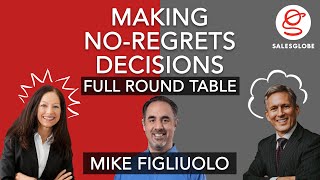
Mike Figliuolo discusses how to make decisions you won't regret during uncertainty. He walks through scenario thinking and trend analysis to spot opportunities, and shares his own no-regrets move: building an e-learning platform during the pandemic. The session covers how to tell leaders what they actually need to know, not everything you know.
Questions this video answers
December 7, 2020.
Mike Figliuolo, author of The Elegant Pitch; CEO of ThoughtLeaders LLC.
21 predictions ("our 21 big predictions on what's going to happen in 2021").
Building an e-learning platform/capability to deliver virtual training (pivot from in‑person training).
His business is projected to be down ~5% for the year versus a prior record year (attributed largely to the e-learning pivot).
Chapters
Well, welcome everybody to this week's Rethink Sales Roundtable with Sales Globe. And we are glad to have you here, Michelle. We're going to be talking about some fun stuff today, but we should probably tell them a little bit about us first. I'm Mark Danolo, managing partner, and with me is Michelle Seeger.
Hi. Welcome everyone, to the roundtable this week. So, a little bit about Sales Globe. We are a problem solving firm for sales organizations, and that means that we consult with organizations to help them solve their biggest sales challenges. And, boy, what a year it has been. We know there have been a lot of challenges for sales organizations and sales operations, and we've been bringing every week to you on our roundtable guests and new thinking around that. So you'll see that we've written a few books, the Innovative Sale, about design thinking, sales design thinking and problem solving, which is also covered in the course of Quotas book that came out last year. We've also written about account planning and what your CEO needs to know about sales compensation. All topical areas that we know are being rethought as we rethink sales in 2021.
Yep.
And so while we're talking about all this, this rethinking, one thing that's really important to remember is that we don't know the answers yet. We see a lot of indicators, we see a lot of things that are happening and evolving. In fact, we've got our 21 big predictions on what's going to happen in 2021. You can check that out online or ask us and we'll get you a copy of that. But Michelle, a lot of this is about problem solving. A lot of it is understanding what the indicators are. We know fear and financials are two big drivers.
Right.
So everybody's wondering, is this going to continue on and are we going to keep doing things the same way? And financially, you know what's going to happen. I mean, there's tough times financially, but then companies are saving a lot of money on commercial real estate and they're going, wow, you know, it's kind of good to have people not in the field and all that T and E money that we're saving. So these things are all going to have their implications. So today we're going to be talking about understanding how to solve the problem. And Michelle, some of the topics we're going to be talking about today are pretty cool.
Yeah. So we're going to discuss trends that we're seeing in culturally, socially, from a business perspective and with sales. So what has happened this past year. And what of those might stick? We're going to discuss a little bit about scenario planning. So on some of those trends, building different scenarios and what outcomes might look like for your business. And of course, we would be remiss not to discuss with our guest two topical areas, which is around problem solving and getting your message across. Our guest today wrote a book called the Elegant Pitch, and it's an excellent read and it really takes you through. I've read it myself and picked up great ideas for our own team here at Sales Globe. And it really talks you through. And how do you talk to the executive? How do you talk to the board? How do you get your point across in a way that is very clear and tells a story and is the right build? So, Mark, want to talk about our guest today?
Right, so we have Mike Figliolo. And Mike is, as you mentioned, author of the Elegant Pitch, CEO of Thought Leaders. And so Mike does a lot of work on strategy and training sales teams and training leaders. And Mike's also a West Point graduate and former McKinsey consultant. So we're going to learn a lot from Mike today. And Mike, real excited to have you. Welcome.
Yeah, I'm thrilled to be here. Thanks for making the time and giving me an opportunity to talk about topics that are fun and interesting and challenging and always a new way to apply these concepts.
Yeah. So we did some initial research, Mike, just the other day, and we found out that there are only about 1200 people in the world that share your same surname, Figliolo.
I know that's pretty rare. I was just as surprised to find out that there's what, like 143 denolos in the world.
That's right, yeah. Yeah. The rest are in hiding, but yeah, there's 143 that we know about.
Yeah.
It's really kind of crazy, isn't it? So we have on air with us today two uniquely named Italians.
Yeah. So be careful.
Yes, be very careful. And you know, given his West Point, Point and military background, you're just going to have to be on your best. So anyway, to get us started, what I would love to do, I like to start when we talk about connecting virtually. Mike, we'd like to ask you to share with everyone listening today just something about yourself that isn't about thought leaders or what you do, but something that people may not know about you that is of interest.
Yeah, I mean, folks always want me to go to the military background and talk about cool stuff there. But like that's Old hat. Like the thing that nobody knows. I make an awesome turkey pot pie. Oh, I make a phenomenal turkey pot pie. This is after I cook a wonderful Thanksgiving dinner and then nobody eats everything because, you know, they ate before they came over, which I want to kill my children when they do that. And then I have all this turkey leftover and all these fixings. And this year I ended up with 17 of them, I believe.
Oh, my gosh.
Yeah, they're fantastic. So I love to cook. It's just. It's a good flow place for me. Whether it's, you know, chili or pot pies or steak or Italian food. It's. It's just the thing that gets me away from all the stressors.
Now, are you. Are you one of those cooks, Mike, that follows the recipes to the T, or is it more of an artistic interpretation?
Oh, recipes are for amateurs.
I get into that argument all the time.
The spirits of my ancestors tell me when I put enough garlic.
Exactly, exactly. Yeah, yeah, yeah. I learned that years ago from my grandmother because I don't like to follow directions. But she's Swedish and she was a big baker, so she baked a lot. What I realized about baking is you can't just wing baking.
You can wing baking. You cannot wing. No, no.
This girl bakes pies, and I'm the baker in my home. Except for bread, but that would be. My husband's a bread baker. But you can't deviate on those. But everything else. Yeah, you can have the creative license.
Yeah.
Cooking, Absolutely.
So I want to talk a little bit about. Talking about baking and strategy. I don't know why those two really don't go along, do they, Mark baking and strategy? I don't know. Okay, let's talk about strategic planning. And as a lead into that, let's just talk a little bit about trends. Right. So when we talk about strategic planning, we're looking at long term trends, Right. We're looking at predictions, we're looking at things that we believe are. Are going to impact a strategy. That's what we build it around. So what are some of the trends, Mike, that you would see today that we believe will be holdovers or that you believe will be carryovers as we look into 2021?
Yeah, you know, I think there's the short term obvious ones of people are a lot more comfortable with remote work and remote collaboration. That's not going away, especially given the cost savings you can get from doing it as well as the efficiencies that come along with it. So I Think that's one, I think, another one that I'm increasingly seeing. It's really fascinating working in the learning and development space. Right. We do a lot of training is. You know, I hesitate to say it, but, like, the university is dead and it just doesn't know it yet. So when you look at the cost of getting an education, right, Higher ed, whether it's your undergrad or graduate degrees, the cost costs have just been skyrocketing. Then you look at the increasing availability of additional learning materials and how ubiquitous that stuff is becoming. Look at LinkedIn learning and e learning platforms and being able to do distance learning. And now you've got learners who are getting more comfortable doing distance learning. Plus you've got another trend of people continuing to look for career growth. But I think this whole, all the unemployment that we've experienced and all the shocks to the system, I think it's going to be an awakening for a lot of people saying, yeah, my company always said they would be there for me until they weren't. And I think a lot of people bought into that loyalty pitch that a lot of companies throw their way. And I'm not saying that companies aren't loyal. Right. But when it's like, all right, we got to stay in business and lay people off, or we can just keep everybody and then go out of business, we. Well, the choice becomes clear, but that fractures the loyalty. So you have all these people who are now saying, wow, I'm not as secure as I thought I was going to be, therefore, how do I increase my marketability? How do I do it in a more remote manner? Right. And there's just a lot of interesting workforce dislocation trends that I think are absolutely going to continue. And that can have huge implications for your salesforce. Right. I mean, you think about your salespeople, and we know they stay around for compensation and for lifestyle. Some of them stay around for the travel. That's not happening anymore. And you really got to rethink how you approach them. Yeah.
And one thing we're looking at, Mike, so you're talking about the relationship being broken between the company and the employee. And I'm assuming that's involuntary turnover. Right. So we need to save the business people. You know, we need to lay off some companies. Some clients we know are in second, third, fourth round of layoffs. But you bring up another point, which is the change in the employee value proposition. So as a salesperson, you know, I'm getting money slipper fatigue working in my living room all the time, and I really want to be out with people, and this is not really what I signed up for. And I mean, it's our view that companies need to do something to be able to strengthen that value proposition to keep the right people.
Absolutely. You know, and it's got to go necessarily beyond just the day to day blocking and tackling, because in 21, that's not going to change. Yeah, travel will hopefully pick up a little bit, but it's not gonna change that much. So what are the other areas that you can provide value to those employees? And it may be learning. It may be comp. It may be. Ben. It may be special projects that they're working on with all that new free time from not being on planes. Right. Are there other projects that they can get involved in that are gonna be development opportunities for them? You know, I think the other thing to realize is people are now gonna be a lot more comfortable taking roles outside of their geography. And this is going to work either to a company's advantage or against it. Right. So now I can touch salespeople. I can have salespeople working remotely. It used to be, oh, I need to see my salespeople physically, like, at least once a week when they get in off the road. And we'll have our sales huddles. And it's like now, all right, everybody, hop on Zoom. Let's have the sales huddle. And people are not tied to the office anymore. So you're going to have these high performers. Right. So when you have the layoffs, the low performers go for the most part, but you're going to have the high performers saying, wait a minute. Yeah, I'm not secure either. So they were first, but I may be next. And that employee value proposition and that trust has been fractured. And now you got people who want to learn, they want to grow, they have more geographic flexibility, and they're seeking other sources of value.
You know, you brought up this thing about, and it's one of our predictions, people taking roles outside of their geography. We're saying in sales, geographies will matter less. Right. Because you can service customers remotely. And I want to dig into that for a minute because this is a trend, and it's something that happened to me this week. I was sharing with you that I'm part of the Downtown Development Authority for Roswell, and we're making very key strategic decisions for the development of our city. And since the pandemic, I mean, we haven't met in person at all in 2020. We met this week for the first Time and it was in person and we were socially distanced. We were in a room, a big U shape. It was a huge room for seven people. But anyway, we got more done in that meeting though, and were able to connect on some very key decisions that before on Zoom, we weren't quite able to come to consensus. And I would love to hear a little bit about from your perspective. You're a great communicator, your perspective on how you can bridge that gap. Because we are believing that face to face is still something magical happens, something different happens that doesn't happen over Zoom. What do you think about that, Mike?
Yeah, I think some of the face to face you're never going to be able to replicate in Zoom because the micro expressions, the gestures, some of the sounds when people are on mute, you don't hear them sigh with that exasperated sign like, hey, hang on a minute, Michelle, it sounds like you got a point. If you're on mute, I don't know that you just went, right? So by default, just not having that physical proximity, it's going to be hard to pick up on those cues. That said, I think as people get more comfortable with the medium and being on camera and knowing, hey, the camera's up here, it's not down on the bottom of your screen and you should not be muted when you try and talk. And people are finding it a little bit more normal. I think the other thing you're finding is people are allowing themselves to be themselves now. So a lot of times when people see themselves on camera, the reaction in the past was, I hate the way I look. And they start obsessing about it and then all of a sudden the mask goes on, right? And I have to look a certain way and I have to behave a certain way. And what we've taken out is the authenticity and the ability to connect. Now people are just, you know what I think they're so freaking tired of being on Zoom, they're just like, hey, this is me today. What do you got? And guess what? Those barriers are starting to fall. So I think it's getting a lot easier to make those personal connections. You'll never bridge that entire gap. But I think slowly, over time, we are bridging it. And, you know, myself included, the first few times that I taught class, normally when I teach, I'm in a classroom in front of 20, 30 people for a full day, and you have that vibe, you have that energy going on. The first times I taught virtually, it was like, if I was a participant, I would have been like, you know, this guy's like a little bit stiff and, you know, what's going on here. And as we've gotten more comfortable with the platform, myself and my other instructors, it's just like, all right, let's have fun, let's joke. And it's just so much more personable. So I think that trend is going in the right direction. People are getting more comfortable. But you're right, we're never going to get entirely there beyond the face to face.
So what you're saying then is the trend is going to continue? And what I mean by trend, the trend of online communications trend may be doing things virtually, as you said, Michelle, geographic boundaries are dropping. So even with. And I'll just bring in a news item here. Even with a vaccine, which I saw in the Wall street journal yesterday, 42% of people say they're not going to take the vaccine when it comes out. So that kind of leads you to believe things are not going to go back to normal anyt soon, Right. So we can project way into 2021 probably that, you know, we're going to continue on this trend line in terms of how we're working, right?
Absolutely, absolutely. And some people, you know, they hate travel and they're going to see it as well, this great opportunity to save a day and not get, you know, banged around on plane and expose myself to possible, you know, health issues. Other folks love to travel. For me, I'm going out of my mind. Right. Like last year I did 250,000 miles, something like that.
And.
And now the furthest I go is the kitchen, you know, and it's just like, oh, my God, get me out of here. I've thought about flying o' Hare in the morning, sitting in the United Club all day, and fly home that night just so I can feel normal.
Right?
There are. I think the trend is going to continue. So people have to figure out how can we connect and be more authentic, let the guard down to be able to have those more compelling conversations.
So if you take some trends like that and other trends that we might talk about as well. We talked the other day about this idea of trend lines and convergences. And what I found fascinating about it, Mike, was, you know, we were thinking about it like a strategy consultant. So if you think, you know, you're a former McKinsey person as well, if you think like, you know, a strategic thinker, what kind of things do you do with the information that you're picking up right now? How do you identify, you know, where these Trend lines are going and what you should do so that you can start to find opportunities, you know, make some of those big bets or those no regret decisions versus just kind of watching things unfold.
Yeah. You know what's fun about trends is, and it's not like I'm some analytical wonk that's like building these models and looking at macro trends. It's like I'm reading the news, I'm listening to people, I'm talking to people. And what I like to do is it's really easy to take a set of trends in a narrow field and sort of straight line them. If you took like sales compensation trends, sales tenure trend, average pipeline length, and you took a bunch of sales metrics and you trended it out, it's like, okay, you can reasonably see what the future holds for that area, but there's no real innovation and major insights there. When I talk about trends, it's like, take a bunch of different trends that have nothing to do with one another and see what happens when they intersect. Right? So things like the rising cost of undergraduate education plus increased remote workforces, plus decreasing trust in long term careers at corporations, plus increasing global climate change and global warming risks and what sits at the intersection of any of those things, and it's like, wow, they're all really disparate things. Now what will happen? Nine times out of 10 you're going to draw one of those intersections and go, yep, nothing there, nothing interesting, nothing interesting. But then all of a sudden say, hang on, hang on. So climate change and pandemic and work from home and working remote and all of a sudden increased pressure on airline industry and also people being shamed into traveling and carbon offsets and wait a minute, how is this going to impact the travel industry? And what alternatives are there going to be to travel? And, and how is that going to impact how I think about the people that I hire? Right. Because there's undergraduate degrees, do they really need a degree anymore? And all of a sudden you're ending up with a very different conversation. And I'm still not convinced that there's something there. But you can see how some of these intersections can create threats and opportunities. You just got to pick weird ones. And by weird I mean things that are unrelated and then be prepared for nothing there.
Yeah, so that's pretty cool in that you're taking some randomness, right? You're taking things that maybe aren't related. And you could say, well, you know, it's kind of like Mad Libs or whatever. We're Just trying to, you know, create combinations and see what we come out with here. How do you do that in a, in a. In a logical way, Mike, versus just kind of picking random things? Are you trying to find things that you assume would be related to, or is it better to find things that are just obviously not related?
I like the things that are obviously not related because it's in those non obvious intersections where the ideas reside that nobody else has thought of because nobody said like, well, what if I take this ingredient and this ingredient. Okay, now we're back to cooking, right? So what if I took this ingredient and this ingredient, what would that taste like? If I combine them and all of a sudden it's like, nobody's ever done that before. It's like, all right, well, anybody willing to try? And sometimes it's horrible. Sometimes. Like, my kids will tell you I've had a couple of nightmare meals that I've cooked, right? But every once in a while, one of the best meals I ever made was called random crap in a taco shell, okay? And I went to the fridge and it was like, we had some chicken cordon bleu and some baked beans and some other. Like, there were like seven or eight ingredients that you look at and you go, these things have no earthly business whatsoever being on the same plate. And put them all on a burrito shell and baked it and threw some enchilada sauce on it. And everybody took a bite and we all just stopped and looked at each other and we were like, oh my gosh, this is genius. Right? And it was just. And it was the, it was the intersections that you'd never deliberately think of where an insight pops out and something interesting happens.
So from a sales organization perspective. So we bring this down to kind of a. A level of the sales realm. And this is kind of on the fly, admittedly, Mike, but, you know, kind of work with us a little bit. How do you. How would we do something like that within. Within sales? So, you know, with our predictions, we're thinking about geographic boundaries dropping. You know, it's all the things we've been talking about in those 21 predictions. The employee value proposition getting weaker, more goal risk happening in 2021. So we don't know what's happening. But how do you do that within a sales realm?
So then I start thinking about adjacent.
Trends that you can lay across those major trend lines, right? So I think about those trend lines as sort of working from you straightforward.
And what I'm looking for are the.
Diagonals and the Horizontals and the obliques to it. So things like, okay, what about product development life cycles? How are those changing? And how are compensation plans changing in organizations as you have increasing income inequality? And are there any implications of that on bonus structures and compensation?
And then what about climate change?
And how could that impact these? Right. So those are sort of the diagonals that I start layering across this. And you may end up with a place where you say, wait a minute, so we've got increasing pressure for income inequality, plus you've got faster product development life cycles, plus you've got, you know, social norms around, like the whole eat the rich and tax the rich movement. And like, what does that mean for home sourcing talent? And it may lead to different sales compensation structures. It may lead to different sales organization structures around product development life cycles.
It may mean different selling competencies.
So being able to sell the sustainability of your product, not just the basic features and benefits and prices, but how is this a more sustainable product? And does that create a competitive advantage? And then does that do anything for your talent acquisition? Right. And say, going out with a value prop to future employees saying, look, you can go sell the widget down the street and try and compete on price, or you can come and work with us where we're sensitive to income inequality and making sure that people get paid more fairly as well as selling a product that actually has sustainability benefits. And that's how we compete and that's how you win talent.
It's like, oh, my gosh, my sales.
Strategy and sourcing talent, sourcing strategy may have just shifted.
So that's big brain stuff.
Right?
So a lot of people watching this are probably like, you know, Mike, that's cool, but I don't have the time for this. And I don't know that people are going to tolerate that. But how do you do that within a company? Is it done in strategic planning sessions or. You know, a lot of times I always talk about the idea that you come up with these great ideas in the shower, right. Or you're, you know, mowing the lawn or whatever, and you're doing these combinations, these random combinations, and all of a sudden, bam, things hit. Right. But how do you do this within an organization where people have their day jobs and how do you. How do you get them to pull out to do that kind of thinking?
Yeah.
I mean, every time I hear the, oh, we don't have time to do that, immediate response for me is, you don't have time to not do that. And I know that's A double negative, but you know what I mean. So we could sit here and say, oh, we don't have time to think about the future. We're too busy with this quarter's quota or this week's quota and this week's reports. And it's like, okay, but if you don't take that time and you constantly are just pushing things off and procrastinating, you're going to come to that point of the comeuppance where the world changed. You didn't realize it was changing and now you're way behind the curve. So for me, I'm always encouraging. I do a bunch of exec coaching and one of the first things I do is try get, try to get the execs to clear their calendar. And by that I mean get all the junk off there. The recurring meetings, the meetings they shouldn't be in. And once they clear some of that stuff off, then putting in blocks of what I call think time. And think time is two hours at least once a week. And it's got to be a two hour block, not like four 30 minute blocks. I'm talking like a chunk of two hours. And it's called think time. And you do it away from, well, when we were in offices, you do it away from the office so you can't be interrupted. And that time is just to think about these types of things. There is no deliverable coming out of think time. So there's no expectation that you come out with a deck or an idea or recommendation. And the reason it's got to be two hours is it's going to take you 15 minutes to decompress from whatever you were doing the last 15 minutes. You're going to consolidate your thoughts and get ready for whatever you're going to next. And it takes you a good 30 minutes to really get into some deep thinking. So that gives you at least 45 minutes to really think about an issue and bang it around. And if you're doing that every week around different sets of issues, all of a sudden you're finding those opportunities and you're realizing, gee, I'm really not missing that much by doing the sales report and looking at, you know, a trend line that's up by 1%, who cares? Like that? That's not what's really important.
Yeah. So in creative thinking we talk about getting that time but also defending that time. Mike. Because what can happen? And we do schedule think time ourselves.
I know I was going to ask you to high five and you end.
Up, you end up sacrificing that we're actually not in the same room. That was virtual, that was spliced together with video wizardry. But we end up sacrificing to think time. Right. We go, well, you know, we got to get that proposal done. So we got two hours of think time here. Let's just use that.
But you got. I know we have done that, and that's not a good thing. So here's what I would like you to do if you could do this for me. We talked about this, about making no regret decisions. Right. And so I want you to share with people. So we're saying, you know, there's a risk to just not doing this, but I want you to share with people, Mike, a real no regret decision that you made. And then how can people just get started on their own path? We spend time talking about the implication of inaction versus action. So just share with everyone a no regrets decision that you made. And then how people can get started in really thinking about that path for themselves.
Yeah, it can get paralyzing to make a decision because there's risk. There's risk of being wrong. There could be a cost. I work in the leadership development and training industry. My business model is get a bun fly somewhere, get a bunch of people in a room for eight hours and talk. That whole business model blew up in March, and I watched our entire training calendar go blank. All our clients called us and they said, we're not doing in person training and we just need to postpone. So that's it. And all of a sudden my calendar is literally blank for months. Like, nobody was saying, oh, let's reschedule now for October, November. They just said, we're not doing it. We don't know when. So my whole calendar for the rest of year was blank. So, okay, I hope it doesn't last long, but I got a bet, like, it will. So what do we do? And our business model had always been deliver training in person. I said, well, elearning is out there. It's a trend. People are doing it. I'm on LinkedIn learning. I've got 30 courses on the platform. You know, I know how to record this stuff and people are using it, so that's a trend. And our clients, they're going to start working from home and zoom is starting to pick up, so that's a trend. And if we build an E learning platform, well, eventually I could sell it when I sell the business. So there is some residual value to anything that I build. And if we don't really use it. It's a capability that I can tell people, hey, we got this thing and if you want to use it, you can. And by the way, it won't cost me that much money, you know, doing a little bit of research. It's not going to be that expensive. It's mostly in the form of time to film courses and build courses. But guess what, I got plenty of now. And it was like, all right, well. And I went literally from one of my instructors told me, he's like, I don't know how you shifted that fast because he talked to me on a Monday, said, there is no way we're not delivering virtually. It'll, you know, it'll reduce the value of our offering. It'll commoditize things. We're not doing it. And the next day I called him back, I was like, all right, when are we going to start filming? He's like, filming what? I was like, oh, we're building the elearning platform. He's like, you said no. Yesterday I said, well, now I'm saying yes. And it was. It's just there is zero risk to doing this. Yeah, I could use lose a few grand in sunk costs of building the platform, but there is no downside to having this thing and having it built. And the opportunities it's created have blown my mind. This year our business is only going to be down 5%. 5% and last year was a record year and all of that. The only reason that's happened is because we built this platform and it was a no regrets move. At the time I didn't know how it would pay off and it's paid off pretty nicely. So in terms of how do you get started, right? It's a question of understanding the concept of sunk cost and what really is sunk. It's understanding option value and saying, what can I do with this asset or capability after I build it? Is there any follow on value? Does it create new potential opportunities for me? So let's take one with the salesforce, right? Let's say you have a salesforce that says, you know what, our products are actually pretty good from a sustainability standpoint. And, you know, climate change and, you know, we, there's an angle there in terms of how we pitch this stuff. We could go out and figure out some marketing and sales collateral around sustainability for our products and we could also train our salespeople on how to talk about sustainability with customers. And yeah, that'd take us a few weeks to build that type of training and deliver the training but is there anything bad that's going to happen from that? Well, no, we'll lose a little bit of time. Okay. But if that's the worst, then this is no regrets, there's only upside there. So just go do it and accept that you may get to a point, go, well, that was interesting. It didn't really pay off, but didn't really cost us that much. You can't put business case logic on every action that you take. That's part of the problem. We sit there, you know, the finance people would get involved and they go, well, what's the IRR and the ROI on doing that training? And you're just like, oh my gosh, shut up. Right. And you have to be willing to do that and say, I don't know, I don't know if there is one and it may cost us money and I don't know what the upside could be. But do you logically believe that climate change is going away?
No.
Do you believe that sustainability is going away?
No.
Do you believe that improving our salespeople skills is an inherently good thing to do? Yeah. Okay, then we're doing it.
That was a great example. So what I, what I heard him do was he identified trends, you mentioned trends. And then you actually, when you talked about the sunk cost or you, you built your worst case scenario. So look at your worst case scenario. What's the highest risk as well as what the best could be? And then launch. Right. I'm hearing you say launch, which can be challenging for some organizations. You mentioned, you mentioned things like the finance group will stand the way. What's the ROI of that business case? We do a lot of consulting with companies and we are helping them develop the business case for change in incentive compensation, in changing maybe pay structures, whatever it may be. So I think that probably leads into when we're building and telling the story, how do you get people on board?
Right, right. And I do want to bring up one other thing that Mike talked about, which is the idea of, and you didn't really say these words, the concept of risk taking and the concept of play, right?
Yes.
So you're playing, you're trying things. Right. And we hear about this with all these tech companies in Silicon Valley, that a certain amount of your time should be testing and trying new ideas that may or may not work. So we can't be afraid of failing. Mike, over here in the studio, we've got a scrap heap of ideas that we developed and we're still trying to figure out what to do with them. But they had byproducts. Right. Other great things came out of them. So there's nothing wrong with that. Right. Nothing wrong with that heap over there. So the concept of play is a great one. But yeah, let's go into that. Which is telling the story. Because, Mike, your book, the Elegant Pitch, gets into that a lot. And I remember this story in the book in the beginning about an executive who's doing a presentation to the board and he's got all this information, all this data and this huge report and he's going through and then he runs out of time, I think, and the board doesn't quite get it and they're kind of flipping pages back and forth. And then the next person gets up to present to the board and she's got like, I don't know, maybe it was a 10 page presentation, something like that. And he's like, you know, she didn't do her homework. She didn't really put a lot of work into this, only 10 pages. And somehow the board gets it and they approve her recommendations. And there was something in that story that's very powerful about how do you take all this information, all this thinking that you do in any of these areas that we're talking about here, and how do you bring it down to a level where you're telling a really clear story and getting the message across? And we fall victims to this all the time in developing reports where they're like a phone book. If anybody remembers what a phone book is, they're like a phone book. They're heavy, but you just can't get through them and you don't get the point.
Yeah, you know, it's. Some of it is the learned behaviors from when we were in school, remember, like geometry class and trigonometry. And your teacher, you get your test back and be like, minus 10, show your work, show your work, show your work. And they always wanted to show your work. Guess what? They don't show your work anymore. You don't need work. Right. And I sat in with, I worked for the chief of staff at a large consumer packaged goods company. And we used to pitch to the CEO all the time. And I remember one team went in and they handed him the deck. And there were two teams presenting. We were presenting second, always present second. So you can see what happens. The team won and don't do that. So they hand him their deck. He literally holds it out and like he's weighing it, he's feeling it for heft then. And it was about 25 or 30 pages. He throws it across the room and says, talk to me. What do you want? I'm busy. We knew better. We had three slides, right? And the difference between team one and our team was they were telling him everything they knew. We were telling him everything he needed to know. There is a huge difference there, right? They trust that you're doing your homework. They trust that you've been rigorous. They're going to verify. They'll ask you two or three questions. And when you can answer those questions off the top of your head, they go, okay, for him to be able to answer that, I know he had to do all this analysis. Now, if you can't answer it, expect to go deep, right? But if you can answer them very quickly, they know, all right? They've been rigorous. It's. Tell me what I need to know, what's important here. They trust that you've been rigorous, and that's a mistake. We want to show everybody how hard we've been working and how rigorous we've been. And it's like they don't care. What they care about is, what are you asking me to do and why is it good for me? And me being either as an individual executive or why is it good for the business? And if you can push that button and understand, look, you know, Michelle is trying to drive top line revenue. And if I walk in and start talking to Michelle about top line revenue, I have her attention. And if I say, Michelle, what I want you to do is invest in a training program where we train our sales reps on sustainability and how to pitch our products more effectively. And I believe that's going to help us win more sales. And here are three examples of sales that we lost that I think we could have won. Michelle's going to go, oh, my gosh, when can we start the training? Now, if I walk in there with the history lesson on Michelle, there's this thing called climate change. And climate change started when there's. And I start droning on and showing her all the climate change data. It's like she's like, oh, my gosh. I know, I know there's climate change. Why are we talking about this? Right? And we got to understand, they don't want to see all that background. They just want the answer.
Yeah, I'm getting ready for something to pitch to a CEO. And I met with someone on the prep for that, and basically what they said was exactly what you did, which is one slide. Tell him what he needs to know. Don't even worry about anything else.
So I want to dig a little deeper into that because I think both you guys obviously are making some great points that. Okay, so you're saying, Mike, don't show me all your thinking.
Right.
I had this old boss that used to say to me, the problem with your report writing is you're showing the client everything you're thinking. You're doing your thinking while you're writing the report, and then you're giving all that to the client. Right. So this idea of how do you create something simple? And the idea and this applies to anything in sales effectiveness, really. We do all this work, think about a compensation plan. We do all this work, but with the best compensation plan is the simplest version of all that work, yet it doesn't show everything that we did. So when you think about report structures, Mike, you go in a little bit into this. In the book, you got pyramid structures, you got different structures for how report should look. What's a good way to think about? How do you get the story across? Because you just don't want to throw the information on that one page. There's some kind of setup, there's some kind of structure. What do you find works really well to get that message across.
Yeah.
So you've got to have the narrative. And I always, I have all these little triggers that tell me if somebody's doing something wrong. And one of them that I hear a lot is, well, we've got all the information and all the thinking. Now we need to boil it down to the story. Okay, I don't know about you, but when I go to boil things down on the stove, I usually get distracted and I forget about it and I come back and it's like this black, burnt, sticky message. Because you don't boil stuff down right. There's no structure there. All you've done is said, well, these pages seem too detailed. Let's throw them out and you're left with the residual junk. And that's not a story. So what you gotta do is do all that great thinking, like the thinking you're talking about, then set it aside and say, okay, who am I pitching to? I'm pitching to Michelle. What does Michelle care about? She cares about top line revenue. Okay, now, is Michelle grounded or not grounded on this topic? Well, no, she's not really grounded on sustainability and the way we train. So I probably got to give her some background. Okay, so once I give her, what background would be relevant? Well, these two or three points she would probably need to know. Okay, then is she going to be excited to do this. Or do I need to, like, create a case for action? Well, no, you got to create a case for action. She's not going to be bought in. All right, so what are the one or two trends that I could show her that would create a case for action? Or two or three case studies that say, Michelle, these are three sales that we lost last year that would get her leaning forward and saying, oh, my gosh, we got to fix that. And then what's my recommendation? I want money to be able to train people on this topic, and the result will be increased revenue, which is. Michelle, what you tell me you want. So, you know, that's doing the audience assessment, saying what's important to them, then looking at their level of knowledge and understanding of the topic, as well as their support or resistance to the idea that you're going to pitch and structuring a narrative. And once you have that narrative, then you can go out and say, all right, now, of all the analysis we did, what analysis do we have on sustainability? What analysis do we have on the sales we lost? What analysis do we have on this topic? And that's where you pull that data into the narrative after you've constructed it.
Good.
Yeah, that's very clear. Now, we have some questions for you that have come in and I would like to take a second because you're going to ask more questions and nobody else will have a chance. Come on over here, Caitlin. Okay, it looks like we've got a couple here. And Caitlin, I lost them. You got to come over here and show me what I did. Oh, no. Yeah, you need to come over here. I'm sorry, I'm not used to her iPad, so we're going to have to take a second for the question. Okay, thank you. Somehow I shut off Zoom. All right, the first question is. Okay, it's someone from Jersey. Maybe you should read this, Mark, because you got to say it with an accent.
No, go ahead, Michelle, you go ahead.
It says Joyce here. How you doing? Somebody from Jersey is calling you. If the university is dead but doesn't know it yet, what credentials will employers be looking for in two, five and 10 years? Certificates? Two year degrees. I want to learn and grow. But without a four year degree, how can my resume show value to a prospective employer? What venues are best?
It's a great question. And, you know, I've been through this, so I don't have an advanced degree. I have my undergrad from West Point and that's it. And I was being recruited at one point by a software firm and sent the headhunter my resume. And he said, hey, you sent me the wrong resume. I said, what do you mean? He's like, your MBA was missing. I was like, I don't have one. He's like, what? I said, I don't have one. I don't have an mba. He's like, oh, well, let me take it to the client and see what they think. And he came back a week later. He said, man, you caused a big debate there. He said, like, half the people love your background and what you've done, and the other half were like, really hung up that you didn't have an mba. And ultimately they decided they don't want to move forward. I said, you know what? I'm totally good with that. Because if they're not willing to look at my accomplishments and the results that I've delivered and it's more important that I have a piece of paper on the wall, then that is not a culture I'm going to fit into. But where I'm going with this is, yes, degrees and learning are amazingly important. I run a training firm, right, like, this learning is so important, but it's really about, what do you do with it, right? So what I'd much rather so I could have a candidate. Let's look at two candidates. I got one that did 50 online eLearning courses, and they have all these certificates and like, that's it. And that's what they've been spending all their time on is doing all this E learning and taking, you know, some courses at the local university, you know, not getting a degree, but taking some additional courses. I got another candidate that took two E learning courses, and then they on their resume, show me. I took this course on lead generation, and over the next six months, my leads were up 47%. And I took this course on how to be a better closer. And after that course, the next six months, my close rate was up 33%. Guess who Mike's going to hire. And what I'm looking for is the person who doesn't just, look, I want somebody who's always learning, right? So if you just tell me, well, I was just nugging away and making my sales and I didn't do any self development. Okay, you're out. I need people who want to learn and they want to grow. But you don't have to do 50 courses to demonstrate that. What you got to show me is you know what courses to take because you know your skill gaps and you know yourself well enough to know those are gaps. And then you got to show me that you can translate learning into impact. And when you can show the credentials of here's the impact, here's the lift, here's the revenue, here's the sales, you know, here's the. Whatever the metric is, that is what employers are going to want, at least the ones that I've worked for and the ones I've consulted to.
Yeah, I have to say I agree with you on that one. That's a good point. What mag. Oh, this is a good one. I want to know this. What magazines, newspapers, blogs, et cetera, do you read to track social and other trends?
That's a good question.
I know, right? I read the Wall Street.
Yeah. It's kind of funny because people ask me all the time, like, what leadership books do you read and what leadership blogs? And it's like, I'm kind of tapped out on the leadership thing because I live it, breathe it, and teach it every single day. So I try to get away from that stuff. It's not to say that I don't read it, but what I actually do is like, this is going to sound really bad, but my daily newsfeed, the starting point is my Yahoo Newsfeed and my Google Newsfeed, and I go through it top to bottom. I don't read every article, but I will scan it top to bottom. And what's great about YouTube is like, it's everything from the election to climate change to Cardi B and her latest controversy and TikTok and privacy concerns there. And it's just like all this random junk. Like, I don't have a curated feed in Yahoo, and it's deliberate. And my Google feed is not curated either. And it's deliberate because that's where that random stuff starts popping in. And it's like, wait a minute. Like, what is this, you know about Cardi B and what's this controversy? And who is she and why does anybody care? And there may be nothing there, okay? And usually with Cardi B, there's not, but every once in a while you may run across something and you go like, holy cow, wait. Snoop Dogg, like, comment was the commentator for the fight the other night for the Tyson fight, and now he's getting into the boxing industry in a meaningful way, and there's investments there. And I wonder, are there opportunities for entertainers to enter other fields? And like, how can personalities. And it's like, I'm reading about Snoop Dogg and the Tyson fight, right? But it's like random thoughts get sparked there. So I like Going really far afield with my learning. You know, I heard one exec back in the day, back in the. In the before times. That's what I'm going to start calling it. Before COVID It's like before times when people traveled. I heard of one exec who used to, before he got on a plane, would stop at the newsstand and buy a magazine about something he knew nothing about. And I'm talking, like, one time it was about pottery. The next time it was knitting. Next time it was motorcycles. Next time it was heavy metal music. And he would just buy a magazine about something totally far afield from him. And he would read it cover to cover. And 99 times out of 100, it was just a good, you know, get your brain away from work exercise. But every once in a while was like, oh, wow. I didn't realize, like, how much this, you know, the motorcycle industry has grown in the last few years, and we've never pursued that as a. As a customer segment. They may actually be interesting and exciting. So what I'm saying is, get out of whatever box you're in. Get out of it. Get out of the curated feed. Like, you get enough of this stuff every single day. Go look elsewhere in weird places. Right.
So in terms of creative problem solving principles, Mike, one of them we talk about is combining parallels, looking for parallel examples in other places, and also being a student of history.
Right.
And the whole idea behind both of those is that you're doing exactly what you're saying, which is you're referencing many different diverse areas of information that a lot of times will hit in combinations. And when you're trying to solve a problem, you go, oh. And something is sparked because you saw something that was totally unrelated that can be applied to that problem solving. So I think it's a brilliant idea that you're talking about.
Yeah.
You know, bringing those different perspectives. Again, it's, you know, same issue, different industry, or same problem, different function. And one of the funniest times I had as a consultant was we were serving a grocery chain, and we were looking at their inventory turns in the center of the store, crackers and cookies and stuff. And as we're walking down aisle seven, and the store manager is explaining how they're doing inventory and stocking and everything, I was like, oh, my gosh, this the emergency room. And they're like, are you okay? I'm like, no, it's the emergency room. They're like, no, you're in the grocery store. I'm like, no, this is the Emergency room. And they said, what are you talking about? I said, I had a client like three clients ago. We were looking at their emergency room and how they were stocking the fast turning stuff in there and they were having problems and they were having stock outs and they were doing this, and that is exactly what you guys are doing. And he's like, oh my gosh, this is the emergency room. I was like, I know, right? But being able to take that prior experience from healthcare into a grocery store, but see something, to see something. And the only way you can do that is if you're exposed to a breadth of different things. You know, I mean, you see my bookshelf back here, you can't tell what these books are, but man, it is the most eclectic collection of stuff like everything from Marcus Aurelius and the Meditations to Calvin and Hobbes and everything in between. And it's just, most of it's garbage in terms of being able to look at intersections. But every once in a while a really cool intersection pops up and there's some great creative problem solving there.
Love it.
Yeah, that's really interesting. We have time for one more. Do you have any creative thinking exercises? I don't think he means jumping jacks. He or she means jumping jacks. To help identify and analyze trends. He took my stuff, he took my finger strengthener and analyzed trends. It seems like synthesizing different elements is part of your process. How do you do it? How do you do it, Mike?
So you know, I'm a simple guy. My better half always cracks up when I say that. But honestly, I'm a fan of simplicity. Literally take a piece of paper and across the top write five to seven different trends and then down the other side write the same five to seven trends and make sure they're totally unrelated, right? From climate change to Covid to sales incentives and how those are changing. And then the nice thing is you only got to do half that grid, right? And just go to every box and say, what happens when I combine this with this? Is there anything there? Are there any new problems? Are there any new insights, any new opportunities that come up? And most of them you're going to put an X through and go, nope, nothing there, nothing there, nothing there. But there's going to be that one where you go, that's really interesting. And then step back and say, now let me take my current business and my current business model and fast forward it through that lens of that intersection and see how do I need to change today to be ready when Those two trends converge. If they converge or what threats do I face if I don't do anything about it? And that does come to pass. And how can I protect myself from that?
Awesome.
Yeah, very approachable approach, actually something you could try.
I think we're going to have to wind up here, guys. And Mike, this has been a great conversation. Tell us about.
Thank you so much.
How can people find out more about what you do, Mike?
Yeah, absolutely. Best place to find us is on our website, which is ThoughtLeaders LLC.com and it's got information about me. It's got our blog on there with like 1500 articles by some great. We get amazing guest authors and and our e learning stuff is there. So thoughtleadersllc.com is the best place to find out more.
Great. Well, thanks very much for joining us. I got a mini education here, so.
This was really great. And thank you, Mike. I think it would be interesting to have Mike come back in 2021 and talk about negotiations if he's willing to do that.
Yeah, very happy to have to negotiate that deal, huh?
We'll have to negotiate that deal. Well, our next session will be December 11th. Next week will be the last one of the year and we are going to talk. It's going to be really cool. We're going to discuss predictions and things that people need to know as they look at 2021. So looking at our predictions, looking at trends, just like Mike talked about and just some things for you to know as we move ahead to 2021. So thank you so much for joining us today at our roundtable. Be sure to tell other people about the roundtable if you have found this interesting and always call us about your toughest sales challenges at info at salesglobe. Com. And we thank you all for joining us and have a great weekend.
Thanks everybody.
More from SalesGlobe







Sales Compensation for Results - Course 1: A Strategic View on Sales Compensation - Trailer


Freative Friday - Episode 98 - Insight in Your Hunt for The Revenue Roadmap Pt 4


Freative Friday - Episode 97 - Insight in Your Hunt for The Revenue Roadmap Pt 3