Part 2: Quotas in COVID19 - Planning Beyond the Curve [Webinar]
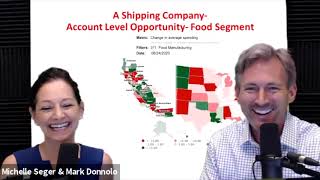
A July 1, 2020 SalesGlobe Sage webinar (Mark Danolo and Michelle Seger) about resetting sales quotas during COVID‑19 and planning for 2021. The hosts emphasize two main levers for quota setting under uncertainty — Market Opportunity (use fresh, purchase-level signals such as the Cortera COVID-19 economic impact tracker) and Sales Capacity (time-budget math, role 'decontamination', and forecasting discipline). The session includes live poll results (largest concern: decreases in demand), a demo of account-level spending/trend data, a forecasting scorecard offer, and capacity examples showing how modest time-reallocation can yield large revenue upside.
Chapters
Well, hi, everybody.
Hello.
We're just waiting a couple minutes here before we get started on our roundtable on quotas.
Yeah, we're pretty excited with some of the content we have. And yet again, just like last week, Mark, you've actually pulled yourself some market insights, haven't you?
I did. I know. It's great information. I think everybody's going to be going to be pretty jazzed about it.
Yeah. Thanks for being here with us today. It's lunchtime, isn't it?
Lunchtime in the East, Cocktail time in.
The UK I want to be in Europe. Yes. I'd like to be in Europe right now. What about you?
I know there were a couple of folks that I talked to this morning, said they might be on from Europe, and they said, but I may have a gin and tonic in my hand, so we can't see it. So that's okay.
So I don't know, do we want to be in Europe or do we just want a gin and tonic in our hand? I guess that's the big question. Today.
We'Re going to explore those questions and many more.
So you have plans for the weekend?
Plans for the weekend? Oh, it's July 4th.
That's right, it is.
That's a holiday.
You know, this is this whole Groundhog Day thing.
Right.
I'm just saying every day feels a little bit like the same. So I was meeting with my doctor yesterday, and he told me so he gave me a challenge. So we're going to watch Groundhog Day this weekend again. He said, when I see you next week, Michelle, what I want to know is how long do you think Bill Murray was in each period of Groundhog Day? He estimated it between five to seven years. Because he said, how else could he learn how to speak French fluently? Good point. And then the piano piece, I mean, he basically was almost like Bach by the time he got through.
That sounds like you watched that movie one too many times.
I haven't, but my doctor did. Do you remember any of those scenes?
Yeah, I do.
Okay. Anyway, I have watched it maybe a couple times, but I'm going to watch it this weekend and see if we can come up with that. So that'll be your challenge. I think one of the challenges is we would love to hear from you to know how long do you think Bill Murray was caught in Groundhog Day? And I won't ask the elephant in the room question, which is, how long are we going to be caught in Groundhog Day?
You know, it was kind of like that. It's like it was back March, March 13th. When I came back to the office, it was Friday the 13th and my calendar was still open on the side of my desk. And it's almost like we just woke up and now it's July. July 1st. Yeah, that happened fast.
Crazy. Okay, so for everyone that's joining on, we want to remind you that this is not live zoom feature like we've had before. We had cameras before, but we do have the Q and A function open. So we would love to hear from you. If you have any questions, we'll answer those live that we can. Those that we can't answer live. We will be sure to get back to you, but please be sure to communicate with us through this, through our talk today, our conversation by entering things in the Q and A.
All right, so why don't we get started?
Sounds good, Mark.
Welcome, everybody. I'm Mark Danolo with Sales Globe and with me is my partner, Michelle Seger.
Hi.
Hi, Michelle. How you doing?
Hello, Mark. I'm doing great. We hope you guys are all doing great as well.
So we're going to talk about quotas today. What you need to know about quotas and COVID 19 solving your real problem. Part duh.
Part duh.
We're going to get into some cool stuff today. We're going to get into some tools and some specifics. Michelle. So we're going to get down to some things that you can use in terms of your planning for 2021.
That's right. So let's get right to it, Mark. We are a problem solving firm for those of us that. Those of you that are new with us. So what do we do? That means we solve problems for sales organizations we like to use. We call ourselves creative problem solvers. So we take a data driven approach to creative problem solving. And you see, we've got a few books today and the one that we're talking about today is quotas.
Oh, you brought a copy?
I did bring a copy. It's not signed though. It never got signed by the author. But I know who he is. You heard me talk about that last week. And maybe he'll sign my book. I'm not sure.
Yeah, it's going to lower its resale value though.
Yeah, but sometimes they like them on ebay. It's fine. So anyway, thank you for joining us here today. And we are going to focus on some of the big drivers of quota change and tools you can use as you plan for 2021. What do we know that the future of sales, it's Exciting, extremely uncertain. And everybody knows, you know, we're talking to our clients every day about not only the next six months, the next three months, next year. I mean, it's every day seems to be changing and evolving. So we're going to be addressing that. And we do believe that one of the key things for companies that are going to make through, make it through this very successfully is to use creative problem solving. And we are going to put a couple of those principles place for you today and talk to you about that because we actually have used creative problem solving to bring to you some solutions for you to consider today.
Right. You know, it's that whole point, Michelle, that we can give you all sorts of benchmarks, we can give you information, we can give you ideas, but you really have to solve the problem and it's going to evolve and we can help you solve the problem as well, but it's going to evolve. So we don't know what it's going to look like in three months from now, six months from now. So if you have the tools to solve the problems, that's going to. That's going to give you the biggest benefit.
Yeah. So Mark, you want to talk to.
Them a bit about what we're working on. Snapshot of our, one of our rolling whiteboards. If you walk around the sales globe studio here in Atlanta, what you'll see is whiteboards everywhere. Glass whiteboards, traditional whiteboards, whiteboards that are rolling. And we've got mind maps all over the place. We're working on these different ideas and we took a little zoom in shot here of the future of sales whiteboard and this one is around how we're going to set quotas. You'll see there's but the two big factors that we want to dive into today. And we mentioned these last week. We mentioned actually a couple of big drivers of change last week that you can listen back on the session if you haven't, if you weren't on it. But those big drivers around fear and financials or the costs. Well, we're getting down to the more details here. We're going to talk about the market opportunity. So what is going to be out there in 2021? We don't know. But how do we look at that? What methods can we use? And then how will we structure sales capacity? And some of the things that are going to change about sales capacity is that our sales models might change. We might have more hybrid models at the very least with people working virtually and in person. So that changes your sales capacity. So you put those two pieces together and that's going to give you some good tools to use in trying to figure this out.
That's right.
All right, so let's take a deeper dive into this. Michelle.
Yeah, so you may have seen this before, but this is one of our models around quota success model. And we know right there's people at the top when we set the quotas that are working on what the corporate goal is. And then there's a process of coming up with the quotas. But two big ideas here is that you need to understand your market opportunity as well as your sales capacity. We talk about market opportunity. That's not saying we rely on history alone. We're going to take a fresh approach and discuss with you how you can look at market opportunity in a changing world a little bit differently. Because again, we said this is about creative problem solving and we don't believe that the way you solve for quotas before is the way that you maybe need to be looking at them moving ahead.
Yeah, so you've got these big factors here. And in the book quotas, you'll see this, we go in a lot of detail on it. The people that are driving the process, market opportunities you mentioned, of course, sales capacity. And these are really good left brain tools for solving the quota problem. And when we wrote the book, these were great tools for solving the problem in whatever environment you had at that time. But now as we look ahead and we know that things are going to change, goals are going to change, how do we solve the goal or how do we solve the quota problem? These again provide really good foundational tools to be able to solve that problem.
That's right. So first let's just step back and talk about what's changing with the market opportunity and what we know in talking to our clients. And I'm sure that some of you will be impacted with some of these is there's been a decrease in demand for some offers. We've seen some businesses like hospitality, a lot of food services that are having extreme problems in that area with the demand then shifts in demand to different sectors. And that just means that where you were selling into may not be where you're selling into today. And then when we talk about new offers from your company responding to the environment, we have everything from some of our clients. Gosh, we've got an upholstery company that went into making non surgical masks and you know, there's other creative uses. And if you are a company like Clorox, you've seen a Big change in your demand as well. The unknown changes ahead is what we've already discussed, which is, okay, so we've gotten through June. Now what. What does the next quarter hold and how do we plan for that? And as we know, a lot of the states that have reopened in the United States are starting to close again. So we're trying to understand what, how we prepare for that and what that looks like, because it probably doesn't look exactly the same as it did in Q1 and Q2 simply because we've gone through this once. And then, of course, the ability to forecast because of that uncertainty, the ways that we forecasted may not be the way that we will moving ahead. So I think it would be a great time for us to ask to take a poll, and we would love to know from you what's changing, what the biggest factor is changing with your market opportunity. So Mark is going to put up a poll question for us, and we would love to hear from you. Which is the most impact to your opportunity today.
So these are basically the areas that.
We just talked about. Big areas. Yep.
And you know, if you think back on our session last week, Michelle, we talked about those three different company examples, and one of those companies said, we think there's still a lot of opportunity out there, and a bad half year doesn't make a bad year. Right?
That's right.
Quarters doesn't make a bad year. So they would fall in that camp of, okay, the opportunity is just shifting around to different places, so we need to find it. You know, if you think about it, you know, kind of in sports terms, we don't have much sports anymore. But if you think about it in sports terms, we set a certain formation to go after the market during 2019 and early 2020. We have to change that formation. So the market has moved. How are we going to change our formation to. To go after where that market is moved?
That's right. Okay, so, Mark, it looks like we've got all the results in.
All right, so let's take a look at it here.
All right. What do they look like? What do our results look like, Mark?
Decreases in demand for some offers, leading the pack here at 38%. Okay, so what's affecting our market opportunity? So some of our offers, we have decreased demand. Uncertainty is the next big one. So we just don't know what's going to happen in terms of market opportunity and then shifts in demand. About 25% of people that answered here said shifts in demand. So it's going to move to different sectors and then ability to forecast are just about 6%.
Yep.
So not many there.
So not much on new offers. But again, the uncertainty is coming in about 30. So basically decrease in demand and the uncertainty.
Yep, yep, yep.
Okay, well.
And so that's saying that we're going to start to see demand in different places. We're going to have to go find that. So we should talk about what that's going to look like and where you would find that, Michelle.
That's right. Okay.
How do we do it?
So let's move ahead. That's right. We are going to. Oh, I'm so sorry. This was my part. So how should we think about solving the market opportunity problem now? It's getting a predictive view of the market and strengthening your forecasting capability. This is really something interesting that we're going to be showing you, which is getting this predictive view of the market interesting because we expect it to be something new. And again, we've really been working hard on trying to help you solve the problem of setting your quotas. And that is part of looking at the market opportunity. So we've been focused on how do we think outside the box. And we have partners out there that, that have data that they look at and business intelligence that we leverage here. And so we just want to show you, and we're going to be sharing with you how you can leverage different information to get this more predictive view of your market available to anyone who is on this call. And it's not very difficult and there's no cost. And then strengthening your forecasting capability, we're going to bring you through that as well. So Mark, with that, why don't you talk about this predictive view of the market?
Right. So when we did our research for the book Quotas, what we found was one of the big issues with quota setting was lack of market information. And that's becoming less and less of an issue. So over the years we've asked those same questions and that one's still up there, but it's actually decreasing. Used to be that you and a lot of companies still do just look at broad market information, broad forecasts, and that's hard to use if you're going to be doing specific quota setting and you're looking at what sectors are things moving to and what accounts are things moving to. So I wanted to share with you a couple of. Pretty fascinating, right? So this is from a shipping company that we work with and it is looking at account level opportunity. So how would we normally approach this well, we normally approach this is we might pull some general market information, like I said, broad strokes, or we might have some market information that gets down to the account level. But it just says, okay, they have this much revenue or they have this many employees. And then we try to interpret from that in this case, what's the opportunity for shipping, which is not going to tell us a lot. So we. I want to do a drill down here, Michelle, and take a couple minutes, just kind of explain this, something you can, you can do yourself. This is from one of our partners, Corterra, and this is their COVID 19 economic impact tracker, which is available right.
On their website for anyone. You can get the link through sales.
Yeah, you can, you can go on right now. Don't do it right now because you're listening, listening to us. But you can go on right now conceptually and you could actually look at it. All right, so I did this and we ran it for the food segment, food manufacturing segment, and we ran the stat, the change in average spending, and this is average spending month to month. And there are a number of different stats you can run. What is really powerful about this information source is that it's based on purchases that these companies are making. So if I am this shipping company and I'm looking at food service or food manufacturing companies, I can tell what they're purchasing, not just the number of employees, which is not really telling me a lot. And I don't have to make those big leaps. So I started this point here at the very top. So we looked at the US and we asked the question, what are the changes in spending? You could see the key down below here. You can see the reds and the pinks represent decreases in spending month to month. And as you start to get into the very pale green and dark green, that represents increases in spending. The dark green represents greater than 15% change in average spending month over month. And you'll see there are some areas of the U.S. some states in the U.S. that have a lot of greens, some have a lot of reds. Within those states though, you will see that there are a lot of greens and reds as well. So a state in itself doesn't mean just an increase or decrease with everything in that state. So we drilled in on California here and you can see by counties, food manufacturing, where the hot spots are in terms of increases in spending. Okay, well that's kind of cool.
That's interesting.
It's telling us they're buying more stuff and we want to know what are they buying and what we Care about here is food manufacturing and shipping services. What are they buying for shipping or transportation services?
You all don't have to try to read this. Mark will read this for you.
I will read it for you. Right. Okay, here we go. And we're just going to the couple of red points is what I really want to focus in on. So we picked two company examples here of food manufacturers. So you have Link Snacks and you have Schreiber Foods. And when you pull this kind of information, you don't just get a line item of data. You get actually a report that tells you a lot about the company, even to the level of how well or how timely do they pay, which is really important. So do they, do they pay timely or do they hang you out and they become part of your AR problem eventually?
So kind of the health of the.
Company, the health of their business. Right.
Also looking at the businesses that are beginning to open up and start to do business. Okay, right.
And so within food manufacturing, you're going to see differences by subsectors of food manufacturing. So all of a sudden right there we've got more specific information for market opportunity, deployment and quota setting. So let's take Shriver, let's take Link Snacks. So Shriver, what you'll see, and I just picked out this spot here, you'll see shipping. And you'll see shipping is up 1.4%. And you can see they spend about 56 million on shipping per year. Wow, that's a key number. That tells us a lot. So depending on what kind of shipping services we sell, that's telling us what the opportunity looks like. So that in itself would be valuable information. If you look over here at Link Snacks as an example, you will see they're down, they spend about 11.9 million a year on shipping services, but they're down about 9.6% but still a pretty decent spend. So right there, a lot more information than we might normally have to be able to set quotas. But we can look even further, Michelle. It depends on what kind of shipper we are. So let's take a look a little bit further.
Okay.
All right, so here is Schreiber on the left and Link on the right hand side. And what you'll see is again their growth. And you can see this breaks it down to the type of shipping that they're buying. So you can see truckload and then what we call ltl, the next line down less than truckload. And, and you can see what they're buying at the location that we Pulled there and you can see what they're buying for the entire corporate family. And you can see the trend on that. Then we can also look below that. We can see rail, we can see air, we can see fuel purchases. So if we're a fuel company, that can help us as well. You got transportation, leasing and services. So if we're a fleet leasing company, which we work with one of those, that would tell us information about what the opportunity is there. And so this is going to vary company by company. So being able to take this and being able to roll it together and to then use that for our redeployment, or I should say re segmentation of the market, then redeployment and then the quota setting is very, very powerful. So what's also great about taking a look like this, Michelle, is that we can look at trends and be a little bit more predictive. Okay. So it's not just saying here's what they did last year, but this is looking at it month by month.
Okay. So this is not looking at any of the traditional information or data that you may be looking at today to understand what the opportunity is in the market. And again, as we're looking at COVID 19 and the impact on businesses, one of the things that we have found out is that looking at how companies are choosing to or not choosing to begin buying indicates the health of that company and the business that they're starting to do again. So this is just a different way for you to understand across your segments and your territories where business may be for you, where you may not be looking today. So just looking a different way.
Right. And yeah, and let's take this a little bit further, Michelle. So this is one great data source. There are a lot of sources out there. I think the point here is not to just rely on the outside information, but to build your competency and your capability to have this market intelligence at your fingertips. So what other things might I do with this if I were this shipping company? Well, what I could do is I could understand this information correlated to things like perhaps number of employees or square footage of real estate or whatever it might be, and then I can start to build my own predictive models. So if I'm competing with another shipping company who also has access to this information, I can bring it down to the next level of specificity and usability for my company. So we're not. So we're trying to build competitive advantage here by making our data sources really work for us.
Yes. And bring them just one more Level. So you're not saying, and I didn't hear you suggest that the methods we may be using today or that people may be using today, they're not to be thrown out the window. But what you're saying is you can augment them with a bit more intelligence based on what's going in the market today. A bit more dynamic than just number of employees, which can be a rough telltale right now because with current status of furloughs and layoffs as well.
Oh, right, right.
So looking at these other factors help you with that predictability.
Great point. So then go back to that employee. So you could also, if you go back to that economic impact tracker, you can look at change in employees as well. So you could actually see what's happening in terms of layoffs within companies and sectors as well. So very powerful. So let's talk about the second piece here, which is forecasting.
Yeah, forecasting. So when you strengthen your forecasting, what is it? There are basically six dimensions you want to consider. The first is what's the process that you use that's in place? And that could be the cadence of meeting with your teams, what discipline they have around it, what reporting exists, the methods that you have for forecasting. Some rely on CRM. They look at pipeline people are using. Companies are using different methods today. The sources where you're getting that forecast information from. Are you relying directly on the reps? Are you using any particular modeling, any AI? There's lots of AI out there today, tools that you're connecting in with your CRM. When we talk about application and then what's the validation process look like? And then finally your CRM and enablement. So the tools that ultimately you report out on, there's like a lot of different considerations here. And so really, as you're looking at your. Go ahead. We believe you should just take a, a step back and say, okay, where do we as a company, where do we need to focus? So for every company, it's not going to be the same. And so in talking to a lot of different organizations, we created for you a tool. It's a forecasting scorecard that you can take on your own and it gives you immediate results. I believe that Tricia is actually someone on our team posting it on the Q and A right now so you can connect to it through there. And then after this call, we'll send you a link over there. But this is just something to directionally help you get started. Mark, anything else you want to mention here on Forecast?
Yeah, yeah, forecasting is something that most people hate.
Yeah, they do. I know. I really like it myself.
Finance, sales, operations, they're driving it. Nobody wants to do it. We've got to expose all information in CRM and, you know, frankly, it's a pain in the neck to do. But as we're in this kind of environment, it's even more critical to do that well now. And it's not good enough to just say we have to do a better job of pipeline management or we're not showing our forecast the right way. In CRM, you really have to look at these different dimensions of how you do it, your methodology or comparables, that type of thing. So that's why this report card is so useful. So check that out.
And again, it's in your chat feature. I think I said Q and A. I keep getting those two mixed up.
Yep. Anyway, all right, so check that out, and I think you'll find that useful. If anybody gets an A on it, let us know. Becca will know.
Yeah. And I guess, you know, one thing I had. I met with a global sales leader once. We were sitting there and we're figuring this whole thing out for them, right? And we put in this great cadence of meetings, by the way, if you would like. We did a benchmark study on forecasting last year with several Fortune 500 companies that were part of that. If you would like that, just let us know. But anyway, this head of sales was sponsoring this, and he looked at me and he said, you know, the one thing I wish that I could get people to understand is that a forecast is still at the end of the day, just that it's a forecast and, you know, just like the weather, right. It's. It may say that we had the next 10 days of rain here in Atlanta, and it only rained five out of ten. It didn't rain all ten. It was ten days straight.
Oh, man.
It was ten days straight. But we managed to, you know, get around that. The point being that your forecast, we work on things like getting some predictive modeling in there that helps us get a little closer. We have people entering in information. But again, due to the uncertainty, and you want to be careful on how much you actually put into the forecast, particularly in these uncertain times. Right. It's not going to be 100%.
All right, so that's market opportunity. Let's take a look at sales capacity.
Right? So on sales capacity, what are the things that we consider in that? It's workload, right? So how much work are people doing? It's the Time that they spend on those things. We look at things like, like your talent and the time. Right. So we're going to take a little bit deeper dive on sales capacity.
Right. So what's driving it here and what's changing, you know, if you knew your sales capacity to this point, the news is that you probably don't moving ahead. So we're moving to a de facto inside sales model or, or even a hybrid model. And so that's gonna change capacity. So if you think about some of the factors there, you have less travel and less travel time and less non sales time which could increase your sales capacity. So on some previous sessions we talked about territories and the fact that we don't have the geographic boundaries anymore. And so that's going to mean that we're gonna have greater reach and we have increased access to buyers that are not traveling. So if you think about what the life of your sales organization has been like over the past several months, I would bet based on what we've seen, that they've probably had more frequent conversations with customers and with prospective customers because they're more accessible. Everybody's not, you know, running around in planes and trains and you know, sorry, I'm on a flight at that time. We don't even hear that anymore.
No, can't make that call.
I'm on a flight at that time. I don't think anybody. A couple people have flown anyway, so they're not traveling. Unknown ability to sell and acceptance of new offers. So if you're thinking about like we talked about in market opportunity, you have new offers coming out. Well, we don't know how accepted those are going to be or how easy it is going to be to sell those new offers that can affect capacity. And then think about the whole mix of your sales resources. So you've got field, we've got inside. Then you're going to have hybrid, which could replace field or be, you know, a combination. Of course you've got your E Commerce channel, then you've got Omni channel. So we want it all to work together and we want customers to not, you know, want it to be all seamless. And then we've got partners. Right. So you have this whole mix. So you have to look at that whole mix as you start to plan out your sales capacity. And that that whole deck has been reshuffled.
Yes, it has. And we don't see that really going back. Even as we move through the current crisis. What we're hearing from the C level and sales leaders, even though people may Be getting back to the road and things a little bit back to the same way that it was. We are hearing nothing is going to be exactly the same it was. And Mark, I believe we talked about in a previous session that we are about three to four years ahead technology than we expect, the use of technology in sales than we expected to be. So this is forced that. And where companies were thinking about what does remote selling look like in addition to a face to face sale that also has been pushed ahead a few years because of that. So companies have got a lot to consider. And we are going to ask you now what's changing with your sales capacity? So if you could pay. The one thing that has had the most impact, Mark, is now sharing that you've got the moving to inside selling, the decrease in travel, increased access to buyers, challenges with selling in the new environment, and impact on your sales channels.
All right, so what do you think is going to have the greatest impact on your sales capacity? And you know, what are you already seeing right now? And the results are coming in, Michelle.
They're coming in, Mark. Yes, we're almost there. So, Mark, when we're talking to our clients, what are you hearing? We're hearing all of these points, which is why we're bringing them up. Is one thing coming out to a little bit more than another?
Yeah. I think the one I'm hearing is the hybrid selling. So how to get people to be successful selling in a new mode and how to take. The salesperson has been used to going out and being able to talk with the customer directly, how to convert them over to working remotely and. And when you're having conversations, you're having these kind of online video conversations, how to make that most impactful, how to get off of showing slides and showing yourself and still building that personal connection. Those are a lot of things that I'm hearing about as well.
Yep. Okay. So I. On that note, one of the things that I guess I would like to add to that is one of the big challenges is how do you take salespeople that are used to being on the road and that very excited and energized by that. And now they're selling from the inside and seemingly don't have an end to that. Gosh, we've seen things on Facebook, we've seen things in different formats and forums on Twitter where some salespeople are saying, I never thought I'd say that. I love Delta, but I miss you, Delta. You know, things like that. And gosh, I kind of miss Delta myself, especially that, that this year I'm a diamond flyer. But anyway, we'll see.
Not this year.
Anyway. Okay, so we got our results in and it looks like mark, about 30%. It's the move to the inside sales. About 10% decrease in travel. Interesting. I would have expected that to be higher, but I think it's because most people are selling from the inside and then half challenges with selling in the new environment. Ah, now that would be challenges with selling in the new environment. That doesn't necessarily increase capacity, does it? They're talking about a potential decrease.
These are puts and takes here.
Capacity. That's right. Okay.
You know what I think is kind of telling in this result here is nobody said increased access to buyers and I am shocked by that.
I know because.
I know with the clients we've worked with, their call frequency is going up and their contact frequency is going up. And I'm assuming a lot of it has to do with the fact that the buyers are more available. Now in a lot of businesses the buyers are not working or they're not working in the same mode. So that can affect that as well.
Could be. And just one other note on that, just a tip. As we're talking to clients and we're talking to our clients about they're in the B2B space and what they're saying is that their clients are really appreciating people checking in just to see how they're doing the health of their business. And anytime you can provide them some information, that's always helpful. So. Oh gosh, we just talked about the forecasting scorecard. We talked about Cortera's data. It's things like that that you can even pass on to your own clients. But we are finding that information, as everyone is nesting a bit, is really valued.
All right, so then I want to take a look here at some of the sales capacity components and how to solve this problem.
Right. So what are the key points here? Knowing how to plan your sales capacity.
Right.
And then we'll talk a little bit about decontaminating your sales roles.
Yeah. So big picture. Let's talk about big picture sales capacity. And we're going to do a little bit of math here. So it's about. It's lunchtime, so people haven't gone into the digestion mode yet. So you guys are still wide awake. All right. Except the people in the uk.
Right. But they're under the table, Mark.
All right, so we're going to show you a little bit of math here. But this is real important. So Listen up. When you're building a sales capacity model, it's going to have the components of the entire organization, all your channels, etc. This is a very basic kind of simplest terms. Look at sales capacity and sales capacity. In its simplest terms, we're talking about what the organization can do with the market opportunity. You would take your sales time either in total or you could take it at the rep or the unit level divided by the workload per whatever you want them to do. So if you want them to win a new account or you want them to manage current accounts, you would take the workload required on an annual basis to manage those accounts or win those new accounts. That would tell you the number of new deals you could close, the number of accounts you could manage, you take that times the average revenue per account and that's giving you your annual sales capacity. Now notice a couple things. One is this is based on averages, right? So you're going to want to break that out by the types of roles. So your strategic account managers are going to have different types of numbers than your maybe mid market field sellers. And the other is I mentioned, you have to actually put all these components together for your organization. It's not just one simple equation like this. All right, so let's look at some scarier math. That wasn't scary enough. All right, so take the top line. I'm having reflections. Back to high school, high school algebra class.
When you actually like math, I'm the one that goes, ugh.
Back then I made the mistake that you could do algebra by feel and I learned very quickly that you couldn't.
I was really good at algebra. But get back to your.
So let's put some numbers too, so you can see our top line. Our top line we just went through. So put some scary numbers to this. So Michelle, right behind you. If I take sales time, take a thousand hours per year. We're going to do it at the rep level. A thousand hours per year? Well, don't they work more than a thousand hours? Well yeah, on average. Say they work 2000 hours.
So that would be an average 40 hour.
40 hours a week times 50 weeks a year. If you're listening from France, you can cut that down to what, about 40 weeks a year?
No, just kidding.
So you've got 2,000 hours a year, but reps on average spend about 50% of their time selling. Yes, they don't spend all their time selling. Newsflash. Okay, so right there's a sales capacity improvement opportunity divided by the workload per account One, in this case, we're talking about a Hunter or Doberman. So say it's 63 hours. It's not 63 hours to win one new account. This is more of a transactional account. It's 63 hours to win that account through all the pipeline steps in the workload, plus all the other accounts that you carried through the pipeline. So if you're one of those bulky pipeline fillers and you have all sorts of stuff you're working on, if you do a better job of pipeline management and calling out the opportunities earlier, actually less work workload, which can increase your sales capacity.
That makes sense, Mark.
So by that math, 16 accounts closed by per year, $250,000 per average sale. That's about $4 million of capacity per rep. Okay, well that's a very useful number to know. And you'll see that for every resource type. And then you put that together for your organization, you're going to see what your capacity looks like. So the drivers or the levers or if you're listening to the uk, that means the levers of capacity, you can see some of them below. So time you can, we'll talk about this one next. You can decontaminate your roles to increase the available sales time workload, as I mentioned, you can decrease the workload and talent. You can increase taking inventory on the talent you have and increase the level of talent that you have. And the other thing is, as we mentioned, all this is going to change as you, as we look ahead into 2021, because we're going to have different models.
Right. And there shouldn't be the big assumption. Right. And I think this came out clear in the poll question that we asked that just because we've got less travel, that definitely does save time. That's not all going to be a one for one and increasing capacity, especially as you need to learn how to, your sellers need to learn how to sell a different way in this new environment.
Yeah. And so question came up, Michelle, as we're talking about this. How does prospecting fit in this model when there are some number of prospects which never get to the point of being forecasted and remain leads, not accounts. Right. And that's true. So in your, in your funnel, you think about the size of the funnel at the top of that funnel, you're going to have a lot of those prospects that are, that are never going to become actual customers. They're not going to be wins. Some may never be forecasted, some might not even be seen. But we're doing this Through a sampling methodology. So it's not like we're having, having to do a census of the entire organization. We're doing sampling to understand what this is going to look like normally. So if we miss some, that's okay because the sampling is going to shake that out.
Well. And then we always get the question around, you know, but how the heck do I even understand where people are spending their time? How do I decontaminate the role? That's the next piece of that.
Right. So let's take a look at that. Yeah, Decontamination. Where's the time go?
Yeah. So this is actually something that we do at Sales Globe. It's our tool, but you can certainly do something on your own as well. We've got something called Sales Time Optimizer. And basically it's again, as Mark said, you do a sampling of your organization. In our case, our method is we look at going throughout an organization. They'll spend one week only of time and they are entering into a mobile app where they're spending their time. Now, most people, some sales leaders. Well, gosh, okay, me, years ago when we, when we talked about this tool, this was something that you had thought we should bring out to the market. Mark and I said, but are salespeople even going to want to tell you where they spend their time? Is this like Big Brother? And the answer was, wow, was I wrong. They all want you to know where they spend their time, because what do they want to do? They want to sell. What do they not want to do? Administration. And so this actually helps you understand where they're selling their time. And then we ask you to think about three things. Once you know where the time goes, think about things that you want the reps to continue to do, those things that maybe they stop doing, and then those things that continue on, but someone else is doing that job. So they either keep it and it's stays the same. A lot of companies that we've met with, we found there were legacy processes in place. And when we really challenged them to think about why they were doing it, there was no reason.
Right.
So having a good, a good method and being able to time sample is really helpful for you and will help you understand when you want to decontaminate a role, where to start.
So if you think about some of the key pieces here, you can see right behind you, Michelle meeting with the customers. This is your sales versus non sales time. That's one of the key things to understand. And then you can understand it by step of the sales process. Type of account, type of product, et cetera. So a quick example or two, Michelle, I think would be helpful here.
Oh yeah, I think so.
One is a company we work with where the reps were spending a lot of time doing service related activities. In fact, this was a shipping company, different shipping company, but. And we watched this, the reps would go in and they would go into the warehouse of the customer and they would start measuring boxes and measuring packages. And we're like, what are you doing? Well, we're doing the cube weight measurement. Well, we have to do that. Why do you have to do that? Well, because we have to know, you know, what the projected volume is going to be. Is that really a sales activity? What we figured out is they got measured on sales time, but to them, sales time was all the time I could spend at the customer. In fact, we sat in Philadelphia filling out a call report in a parking lot and that counted as sales time too. So once we were able to find that, we could decontaminate that and move it over to a service consultant. So, and then one, one more quick example company worked with recently, they, they did this and they found out that they were spending about half a day a week. The reps are spending about half a day a week actually in front of the customer. And they prided themselves on having a collaborative culture. And what we found out was a collaborative culture translated into we have a lot of meetings, a lot of meetings internally. So the CEO of the company said, okay, that's it. Internal meetings only on Fridays. Monday through Thursday, you're going to be out in the field. Dramatically the capacity went up. So some of these big realizations.
So having a method and a way to understand where people are spending their time today and then having the ability to go back when you make some changes and take another look at that to see if you're getting the results you expect is extremely helpful in understanding how you can create the most effective role that your salespeople embrace and they buy into and works for you and the organization.
Yep. All right, so another question here. If the average REP is spending 50% of their time on non sales activities, what's a reasonable percentage to reduce it to? And does it always involve hiring other non sales or support resources? So let's take a look at that.
Oh boy. And does more math.
So you don't always have to hire more resource like you said, Michelle, you could just eliminate activities. That's right, you could. One client we have actually improve their pricing and quoting system because reps are spending a Lot of time on that. So yeah, that was an investment. They didn't have to hire but they actually bought a system to help with that. So let's take a quick look at here at roi. Okay. The last of the scary math and then we'll stop after this. So just hang on here. But I think you'll like this. So let's take an example. And this is an organization, say a couple billion dollar organization. I think they had about 500 reps and they were spending about half their time on selling here. So you can see this number way up here behind Michelle. The organization increases its sales time so they're spending 50% of their time selling. If they can bring that to 55%. So they're 5% increase in productivity increase 5 percentage points. Right. Or 10% over the base.
Right.
Then if you look at number two, the incremental revenue they can get from the organization if they say, well with that extra time we're just going to assume we get 30% of the productivity that we get right now.
So not doing a one to one ratio as we discussed.
So we're not expecting the same 30% of the productivity. Then what I can get out of this in terms of a return to the organization would be productivity of about an increased $15 million overall incremental.
Okay, nice.
And they didn't have to spend anything to do that in this case. All they had to do is start to shift activities out and eliminate things they shouldn't be doing. Doing.
Right.
So not a bad ROI for just making some changes in terms of what you do. And I'm a self improvement person. I don't know about you Michelle, but I love to know how I can get better at stuff. And there's a lot of opportunity there.
There is a lot of opportunity.
One of those opportunities we all find is like how do you spend your time? And so if you can do this for yourself, imagine doing it for the entire organization and the impact you're going to get out of that. So I just get all excited about this.
Yeah, it's actually really powerful. And again the math on here is not that scary and not that hard. We have models that you can get from us. If you want to know how that math works, we're happy to send that to you. Again, we're just here to help. And you can go to salesglobe.com so we hope that today has been very helpful to you. We're taking you through some concepts. We're taking through a lot in a little bit of time. So we're trying not to give you too much at once. Next week we want to talk about what's changing in the new environment. We're going to talk a little bit more about what we believe the changing behaviors are of buyers, how sellers need to respond, and then again how that translates into your quota setting. So that'll be next Friday at 1pm Right.
We want to get into some methodology there. So we got down to the level of sales capacity and market opportunity here and we want to get into. Okay, here's some methods that you can use to improve your quotas next week.
That's right. And if you enjoyed this session, please feel free when you get the email from us to pass it along to your friends. Don't forget to like us on LinkedIn. I think you can like people on LinkedIn. You can share on LinkedIn and please be sure to, oh, subscribe to our YouTube channel. So this is exciting. Last week we launched a YouTube channel, Mark. And these are going to be on there. And so I'm kind of excited about that. So, so right.
If you've missed one, you can go back and check out the other ones as well.
Yep. Oh, and then remember that sales forecasting scorecard. Gosh, there's like so many things we're doing today that will be sent to you. The link is here, but it'll be sent to you in the follow up email. So fill out the forecasting scorecard. You'll love it. Refer us to your friends and please take advantage of the resources we have because we're just here to help. So again, have a wonderful fourth of July weekend. For those of you that celebrate fourth of July, everyone else have a fantastic weekend and thank you for being with us here today.
Thanks everybody for joining.
Take care.
More from SalesGlobe







Sales Compensation for Results - Course 1: A Strategic View on Sales Compensation - Trailer


Freative Friday - Episode 98 - Insight in Your Hunt for The Revenue Roadmap Pt 4


Freative Friday - Episode 97 - Insight in Your Hunt for The Revenue Roadmap Pt 3