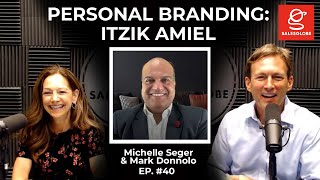
A SalesGlobe Sage podcast interview (hosts Mark Dinolo and Michelle Seeger) with Itzik Amiel about personal branding, relationship-building, and converting connections into business results. Itzik emphasizes intentional attention-giving (his book: The Attention Switch), prioritizing and following up on relationships (A/B/C and deferred-yes techniques), networking from the edges (not center), and discovering/defining/designing a distinct personal point-of-view for an authentic personal brand.
Chapters
Welcome to the Sales Globe Rethink Sales podcast. I'm Mark Dinolo.
And I'm Michelle Seeger.
And today, Michelle, we're going to be talking with a special guest, Itzika Meal, about personal branding, which is something I think we all want to learn about.
Oh, yeah, I'm very excited that we can call it Mill, who is an award winning international speaker, bestselling author. We can also call him a colleague and friend. So today we're going to talk about turning relationships into revenue and results and personal branding. It's going to be a great podcast today. Okay, so today we're talking to Itzika Meel. He is an award winning speaker, motivational trainer, attorney, I mean, you name it, he's like got it all going on, right? He's attorney at law, a mentor, business mentor, professional services mentor. Itzik, welcome. We are really excited to have you here with us today.
Thanks a lot, Michelle and Mark. Actually, I love it because, you know, you got confused in the titles. That's why, you know, my boss doesn't know, what are you doing? I said, you shut up. You give me one salary and I'm seven thing at the same time. So.
You have got like, yeah, so many things going on. It's almost like you must have a great ability to multitask.
Yeah, no, actually, I'm regretting about it. If you ask me now, biggest regret, I'm overqualified. This is the biggest regret.
That's really fun.
You know, it's like saying my wife said, you are you're fatigue. I said, no, I'm just born in the wrong heights. The same thing.
So. So, Itzaq, you've had an amazing journey through your career, through your life, and I think that we'd love to start there and just learn about you and how you've gotten to where you are. Because one thing we talk about all the time is, you know, you've got goals when you're younger and you want to accomplish certain things and you set these goals and you work on the milestones, et cetera. But then somewhere along the way, we develop a path, right? And we don't know what that path is until we actually get there. We go, wow, look what I did and where I came from. And so tell us a little bit about your background and, and how you got to where you are now.
Great, thanks for that. I mean, I would say I'm still on my journey. So it's not here the college year. I'm not dying yet, and my journey. So welcome to My journey. But you know, Mike, you said such a wonderful thing. I think I never planned and I would never plan. I don't have mission and vision. I knew what I love. I found out what I really love during the years. I think I feel comfortable now, think I'm very good at. And I also know very well what I hate very much. And that took me a long time to define, you know, to define because I realized I don't need them in my life. Because you know, when I was young and I used to have a, sorry to use bad word, asshole boss, I had to give my money. But now I know I can get rid of them and I can find another job. It took time to understand that and I even promised the last one. I stand on the biggest stage of the world. And I thank him for being such an idiot. Cause otherwise I'll be a good employee standing, working for a company and never standing out. But I think what I really enjoy and I think a lot of people will identify themselves with is the path. Because I think if there was an exit in my end of my path, I probably want to start again from the beginning. A lot of people in the startup world feeling the same. It's not about making money and exit because there's emptiness there. You want to start again. It's the challenge. You take something from nothing, make it amazing, and when it become a routine, it's so easy. Then you better go back to the uncomfortable to be successful again. Because otherwise you'd be comfortable. I think the path that every time meeting new people, you don't know what happened. Like this morning I talked with somebody within an hour because that's my mission. An hour ahead conversation to make him lifetime connection best friend so much that if people met us, they think we know each other for 20 years, although we know each other for one hour. Oh, that's the end of the conversation. One hour of fame and that's it. And that's the time I need to. And most time it takes me about five minutes because I'm so alert in my brain of other people. I was working for years on my library, in my brain and all of us doing it, by the way, unintentionally. When you cross the street, when you see people, when you're on the bus or a train or a plane, you always your brain said, I like it, don't like, I like, I don't like the brain. Do it constantly, consistently. Now if you know how to tap into it in these principles, you'll smell people from kilometers you know, authentic people. You see people on booty, so you give them five minutes of fame and say, go, bye, I have to go. I never say no to people. That's another thing, because I'm a giver, so it's hard to say no. But I say deferred yes. What do I mean is like if somebody asks something and I'm really not sure I want to help them and it's very hard to say no. I'll say, you know what? I'm so busy right now, let's talk at the end of August. Why? Because I teach follow up. And I know 98% of people failing in the follow up and also one follow up. So I give them a deferred yes, they turn it into a no. There you go. So two tips just in the beginning of our conversation.
I love that deferred follow up though, because what you're doing is you're kind of testing them and their drive and their interest and their tenacity to be.
Able to follow up.
Right. That's a filter right there.
Absolutely. I mean, I agree. I mean, because it's always reciprocity. I mean, relationship is reciprocity. You cannot decide you want to be a friend, somebody and they don't like you. I mean, you know, not going to go nowhere with it. But sometimes, I mean, I'm driving almost like I'm literally saying, like I'm crashing my car into a wall. Because sometimes I'm really driving fast. Because I always believed and I heard it many years ago. Somebody told me, what if it's tomorrow is your last day of your life? What will you do today? And most people ask this question, what do you do today? And they give me different answers. I said, what are you doing now? Go do it now. What are you waiting for? I mean, that's how I live my life. And if you know me, and I think you know my story, I survived Israel from terrorist attack. So that's always the motto for me, for loving people, loving life. I'm smiling because I'm happy in the moment. I'm so full of that. Most times, people that I met, they are the people who could change my mood. There's nobody else. I mean, there's not my mindset, which is very strong by now. It's not no money in the bank account. It's the people. And it could be one person that really can destroy the whole day, one incident, you know, because I never met the person in my lifetime. They wake up in the morning, going to the mirror, look at Themselves and say, today, today will be my peace day. I'll be so peace. Nobody's doing it. Everybody's waking up.
I don't know. I think Mark does that sometimes.
Sometimes.
And I. I think he might have been looking in the mirror saying, today I. I'm going to be pissed.
I don't do that. But I imagine if you did, it could only get better, right?
That's right.
So as I want to ask you a question, just, you know, you're talking about how you, how you walk around or how you connect with people or see people. Okay? So in this maybe could be some personal counseling for me because I'm one of those people, I walk through an airport, I'm not like looking at everybody. I'm not connecting with everybody. I'm kind of doing my thing or, you know, I'm walking through town or whatever. I'm doing my thing. But you seem to me to be a person who's a magnet, right? You probably attract attention and you attract people probably because of how you are and how you carry yourself. Is that something that, is something that you've worked on or is that just your natural personality or what would you give, what advice would you give to people maybe like me that, you know, I get focused on getting things done and I'm not, I'm not connecting with people as much or thinking about that connection point.
It's a beautiful and difficult question because nobody ever asked me this question. I'll be honest with you, Mark, and I don't think, by the way, it's a skill. I don't think you need to learn from this. I believe everybody was born with a skill. I think the only thing I'm more intentional, my behavior and the intention came from frustration, from feeling lonely for feeling in the side. Now, I was not a person in the middle of conversation, a networker, but I call it nowadays network jerks. I was the guy on the side and I thought, I'm doing it all wrong. And the older I grew, and I used to be the chairman of tax lawyers, I realized that the people in the middle are not network. They don't give a shit. They're just collecting business card. And I call them. That's why. Network jerk. I found out that the important people are always in the side of the room. Because if a CEO of a company come to a business meeting, they don't want to be in the middle of everything. They don't want to be seen. They want to grab the information and they go, they don't need connection or money, they have it already. So if you stand inside, you meet them, you see so. And I start separating. Because I was born in a very welcoming family. So much as my grandmother was accused when she died 104 that I remember there was books about my grandmother, but there was if somebody knows in the Bible there was Abraham, one of the three fathers used to be a hospitality. So they said if there was no this guy in the Bible, they think that he was jealous of my grandmother because he was so hospitality. There would be strangers coming to the house, eating. We didn't know the door was always open. Now we're not talking in a place that there's no thieves. I mean, who's leaving the door open? Let people stranger come. And I think that's came in all our family. The giving. So my struggle was how to be a taker. How to be able to take as a give, give, give and get frustrated. Because people take. Of course, they love to take as much as they want. And you think, okay, if I give again the golden rule and you don't get. So how do you get out of it and how do you make stuff for it? And I realized one thing, that if you're a giver but you don't know how to take, why should other people take from you when you give? So it's the balance of those things during the year and also selecting the people or prioritizing the people in your life. Also important because at the end of the day, we all know we're not going to have time for all the people you know. So who are the people you want to give? And make sure they know about it so much that even I'm a person. If somebody booked for me one hour mentoring and I think the conversation is so awesome, I'm not going to stop it after 60 minutes, I'll let it flow another few minutes and I will delay the next one because I think it's not fair for the sake of building relationships and people. I don't care if they feel it or not. I feel it. It's from my own soul. So everything was maybe selfish behavior, but more I always believe if my mindset will be strong, everything will be so easy. And nobody teaching me that. So I remember I work for law firms, they used to tell you what not good to do, but nobody tell you. Hey, did a good job and I worked so hard on it. So I said, you know what? Don't tell nobody. I'll share it with you. I used to go to the toilet, close the door look at myself in the mirror and said good job, man, good job. Yeah. And so nowadays when I'm a speaker, do you think I care if the audience like what I say on stage or not? Yes, I do. But I'm not based my success or what if the audience clap, they understand innovation first for me, how much should I prepare? And I did everything to do. And guess what? When you're doing that for sure they would love it. And they have self envision, but it's not based on other people's opinion. When you do that, you'll be miserable. You never know yourself value. You never will be able to ask $1 million per hour. Although you know you are the only person in the world and you're unique. So why don't you ask $1 million for the hour? Because the fears comes, all these things come to your brain. So mindsets for me, without reading about it and without going to any seminars, I was just probably from frustration, I knew that I have to work on it very hard. So I think that's where it starts. So then you have to be intentional. Mark the question for you. You are doing what I'm doing exactly the same. Because we are human beings, so is human behavior. You just not very aware of it. Your brain watching all the people that you cross in the airport and say, I like, I don't like, I like it. But nobody taught you how. Can you go open this peg, what we call peg in the brain or this drawer in the brain that you store the information. If I go there and I show you, you realize, oh, you're right, it's like I actually like only ladies with blue eyes and red shoes, you know, but you never did it. Nobody ever take the time to do it. When you see the pattern of behavior and it's easier. You see, here's another thing for you, go to conference, thousands of people in the room. Will you see thousands of people. Most people not probably see 10, 15 faces. Now what happened? Now this is scientifically proved, actually. And so if I could stop the time and ask you, Mark or Michelle, can you show me 1, 10, 15 people? Most people cannot do that. Why? Because they push the delete button and I start talking to everybody and wasting their time and hoping they meet good people. But here's the reality. Reality. The brain is your biggest, biggest slave. If you want, because you enter the room, there are thousands of people in the room. The brain see all the thousands of people, compare them to all the people you have in your library in your brain and show you on the silver tray. Here are the 10, 15 people you should talk right now because most probably should have something happen. Friendship relationship based on all the people you like in your life. Now if you do that and if you don't have good memory, put a pen and paper, say okay, this lady with a red scarf, this man with a blue tie, whatever, and go to them, you'll see magic happen. Oh my God, you know them for 20 years, you just met them. So we ignoring a lot of powers we have within us. We all born with the same skills. I don't think I teach anything unique. I just practice it a lot and I think I'm aware of it. And it sounds like magic, like people think I'm reading people. I don't read anybody. It's just that again I just pulling the right role and it's amazing.
So you said set a very important word as you were saying all that, which is intentional, right. You're being very intentional about what you're doing. Because we have the predisposition to just classify quickly to try to cut down on the work our brain needs to do, right?
Yeah.
And so being intentional about. I want to connect with people.
And there's people, you see that people you know, you want to connect.
Yeah.
That people you don't want to connect. Negative outlet. And there's always example. I like to scare myself sometimes. Take somebody who looks horrible, I think not and see what happened. And if it's in horrible, great. My system works. If it doesn't, that's correct. And by the way, everything I'm speaking about today, I stole from somebody else. This is my example. This is how you go to Israel. And you'd be screened if you go to Israel ever. That's the way you screen. There'll be good people welcome, there'll be bad people will never come to the airport, be isolated in the highway with a helicopter. And it will be the example that take people and perform them everything like the terrorists to show that the system works. So that's, that's the way I just did the same thing with relationship works perfectly good. And then you know what? The system works.
So I want to ask you about something. You mentioned that most and people are so many people are comfortable with giving and they're not as comfortable with taking or I'll even say another way asking. So I know many people that have so much goodwill that they've built up and they don't know how to or really make that shift over to asking. I've sat next to people where A CEO has asked another CEO, what can I do for you? You've done so much for me. And the answer is nothing. Just keep being my friend or whatever the case may be. How do you get people to shift their mindset into being comfortable with asking.
Again, a wonderful question? Because it's exactly the problem that I think we as society destroy our own brains. I invited once in conference, actually conference of lawyers. They're all going to get referrals. So you know what? I'll come there one day with few clients and ask who wants clients? Who do you think look weird or them or me every time I'm a weirdo, what client? But they all come in to get clients. But when you come to clients, it looks weird to them. Why? Because nobody gives them. They all come to get, not to give. Somebody comes to give. That's exactly, exactly. By the way, this is my book. That's exactly where you stand up. If you will be the giver. And everybody come to take. Yeah, maybe people thinking you're weirdo, but if you do it again and again and again, now you're authentic. Now it's you. And you stand up very quickly. Because everybody nowadays, not only everybody, everything coming out is to grab something from us. I own marketing based on getting attention. Oh, my teacher. How do I grab attention of the audience? I said no, no, no, no, no. Build relationship by giving attention. If you give attention, everybody wants from that. If you get attention, everybody's scared of that. You know, we don't want. You know where all this commercial, all the things, all the, all this stuff is exercise for your audience. If they ignore my voice or your. Our voice.
Yeah.
And listen to other sounds in the room they have around. Maybe they have a car passing by. Maybe the children are playing. Maybe the fridge, they're making some noises. Maybe the erco, right. All those things are there all the time. So it was a tricky question, right? Because I shifted their attention from my voice. All these sounds. So you see why in English you say you pay attention. It's a monetary verb. It's stronger than anything else you could do. We are in a tangent economy. If you know how to pay with it, you do magic. Because you give people the biggest gift. You give them your time, your biggest commodity. So you better choose who you want to give it to. And if you don't choose, you're going to waste it on the wrong people. And there's no way to get it back. That's how important it is.
This kind of leads into the heart of your bestselling book, the attention switch. So let's talk about why. What joy of you to wrote that, write that book. And what would you say would be like, you know, the biggest takeaway from that book for anyone reading it. And by the way, I did read it. You gifted me that book, by the way. I took it because you gave it to me. And, and it has really wonderful principles.
Thank you for that. I mean, so again, this kind of frustration, frustration in my own house and traveling. The idea that I saw people, husband and wife sitting in breakfast, in hotel. They don't talk to each other. They're both in the phone on the iPad at home. We're sitting in dinner and I see my daughters in the iPad. I'm on the iPhone. Nobody talked to each other. I thought it was crazy. And I started out of a joke, I thought, you know, imagine our grand grandchildren when you ask them to go outside to talk to the neighbor. They don't know what to do, how to do that. What do you mean to talk? What is that thing? You know, And I thought it was crazy before Corona, of course. And before that to be disconnected to people. And that was my biggest fear because I thought this is. It's not a skill, it's a must for human behavior, with social behavior. It's for survival. It's nothing to do with business. And I realize that everybody else teaching, networking, building relationship in the wrong way. They tell you go network when you need clients. No, you don't go to network when you're desperate. Nobody wants to talk to desperate people. You network when you're busy. We have so much work, go network.
Wow.
So everything the opposite teaches as all the people teaching doesn't even know how to network. You know, they tell you be in the center. I said, absolutely not. You know, so all things against. And I said, you know, my industry is industry professional says, you know, all based on that mouth and ear, all these advertising referrals, they're not allowed to put commercial, you know, all marketing based on. So it was frustrating. I said, okay, I need to find the principle. And then what I found interesting, there's so much material about that attention is actually a muscle muscle of the brain. And there's a lot of science, psychology, I mean they talk about a lot about it. When you talk about adad, you know, the patient deficit, the children were sick. They never looked at attention as a positive attitude as a negative. Yet you're demanding too much attention so much that they compare attention to a bucket of water. That is a limitation. I said, it's not limitation attention. You have enough attention you can give. The problem is the time. But if you have unlimited time, you have unlimited attention you can give. You decide what you want to go you want to give it to. So I start building my own thinking around it and I discovered that and I start practicing it. And I know that's what I'm good at as a as more in I'm not introvert, I'm beaver like most of us. But I more introverted part of my personality. It fits very well because I didn't have to talk, I didn't have to say anything about me. I hated elevated pitch. I just asked questions and people tell the stories and then what? And then tell the story and then after that then tell the story and only I capture it. And they would thank me and I said I didn't say a word and they thank me. So it was so easy for me to start building relationship based on that. And that's why I started creating my own world of attention giving. Funded Microsoft research from 2015. We showed that in 2000 the average attention span of human being was only 12 seconds. And in 2013 to 8 seconds, which is now in 2022. I don't know what happened now. But the scary thing it was one second less as you know, like goldfish. I don't know how goldfish can give nine second attentions.
How do they know that?
Yeah, so that's the news. Here you go. So that's all those things build it up and I build my own methodology and I teach it and people loving it because it's easier than start to learning or memorizing thing and talking about yourself which is always hard for all of us because then you don't need to sell yourself. I think Mark is the one, we talked about it a while ago but it's nobody likes to buy, nobody like to be sold, but everybody loves to buy. They don't need to convince nobody to sell nobody. But they are, they want to buy from you just because you're going to give them attention again. All excuses in the world to see you again, to be around you again, to be part to buy the product from you and not nobody else just because of that.
So I'm picking up a great pattern here which you've called out already, which is opposites, right? So to build relationships, you give attention. You don't seek attention, you network when you're busy, not when you need work. You ask questions, you don't say, you don't talk, you ask questions. And then you go to the outside of the room at the conference, not the middle of the room.
Yeah, I mean, and if you look at it, it's the opposite of normal behavior, of human being. Because people who go to conferences, what do they buy? If you have money, you buy VIP. 20% of every audience buy VIP. 20% of VIP buy even diamond or platinum, whatever it's called. But you think from a perspective of business, it's idiotic thing. What do you think? If you sit there in the front, what will happen? Gold will fall from the sky. I mean, you are a speaker, you know, as a speaker. Right. If we are going to listen to another speaker on stage, when we are an event speaker, well, we're going to come from the front or from the back of the room. We're going to stick from the back of the room. So if you want to meet the most important people, they're not going to be in the front, they'll be in the back of the room. It's so many things. So I'm talking about it for years. And that's the way I did it, you know, that's why I built relationship. And sometimes I was shocked. I couldn't believe. I remember meeting a lady, she was CEO of oil and gas company from Ukraine by coincidence side of the meeting room and everybody said it cannot be. I remember even talking to myself, it cannot be. I met her and everybody looking to meet these people and I meet them like I went to a toilet in India in the conference and. And I saw TV in front of me. So I said it loudly. I wish I knew that then I can drink a bit more. At least I can watch the news. So the guy next to me started laughing hysterically. And the end is the CEO of InfoSystem, one of the biggest IT company. I mean, I never looked for those things. But again, exactly what I said, I was intentional. So my brain was alert. I mean, moment I went outside Infosystem, of course I built relationship. But I never went after him because he was his. That's why people don't understand. Successful people are very approachable people. The mistake people make, they're running after people, they think they are successful. But those people are small people who guard themselves with guard that you think they are big successful people are very approachable people. But they don't want your money, they don't need your connection. The only thing they want is where they gave you advice. They see that you implement it, you put it in your business and you report to them back how was it successful? Not successful. What can you do more? So I called it, by the way, the golden circle in relationship. If you want to meet somebody very known, very known, go somewhere. When they speak on stage, listen. Listen to one of the advice they give, something that fits with your business and commit to improvement and run before they leave the stage and say, I want to talk to you. Yes. Can I ask you, lady, where can I reach you? Because I saw you saying that on stage. I would love to implement in my business, but I want to report to you back if it's successful or not. And they will tell you, give you an email or a phone or the assistant. They give you a way to report back. And the only thing you have to do is do it and report back. And the moment you did it, you'll be the only one in the world. And here's the spark of relationship. And you can meet the most important people.
Well, but it's different. That's unique because what I want to do is I want to. It's an interesting segue over to sales. I want to tie this back to people in sales, which I would argue that is in the legal profession, everyone that you serve, business people, those that own business, we're all selling right at the end of the day. So how do you effectively. And you've already done some of this. But I want to discuss, you know, there's attention and some people will associate that with dinner and golf and events. And then there's actually, though, taking a relationship and turning it into true referrals, results, revenue for the business. You talk about that very specifically in your book and in your global speaking. And I'd like to make that connection for people because I'll give you an example. It's like I'm consulting with a national financial services company right now, and as part of their incentive plan, they have in there the number of dinners and the number of conferences and events that they're attending. And that would include like golf, but they actually have a targeted number and not results. And I thought. And I said, why is that in there? Like, why is the dinner important? What is it that we expect to have happen there? You know, I think that we get a little confused, but I'd like to hear your perspective and how we tie all that together.
I love that because, you know, first I will say that I have expression. I would say people bond when they're having fun.
Yeah.
So if you're asking me where do I start, networking is not when I sit in the seminar next to Somebody because all looks nice people. And they go in the evening and they start behaving like they will be able. Friends drink, they talk about everything. I work. So here you get the secret for me. I work because I hardly drink, I call zero. I was alert and I know exactly who they are. So I always laugh at people. If I want to make a lot of money, I publish some pictures, I become a billionaire. But I always. So people bond when they're having fun, because that's where the things comes out. But what he said is true. But it's not true because by the way, I don't know how to play golf. That's when I invited golf, I was avoiding it. So it's very good for networking maybe, but I never needed it. It's just that there are opportunities that people are letting the guard off. And that's a great opportunity to have to score authentic conversation. So you cannot come as a wolf and pay attention to your alarm. But if you're alarmed, that's a great place to be. But you know why they never get results? Because 98% of people not failing on building this initial relationship and dinner and blah blah blah. They follow up. 98% of people failing and follow up. And the reason for it is, I'll tell you very simple. It is how the human brain works. If you ever did the David Allen quadrato of productivity, all those things including losing weight, by the way, falling on a cube called important but not urgent. You know, you have urgent, not urgent, important, not important. All those things are important but not urgent. And important, not urgent. It's always long term. And the brain love to be fair. That's it. So we have to be intentional about it now different way of doing solutions. For example, I'm teaching two ways. One is associating it. So there are habits we already have in our life. Like, you know, we drink coffee every morning, we're opening the computer, you, I don't know what, brushing your teeth. So whatever you do. So if you associate the building relationship next to something you already done, in very short term it will turn into a habit as well. So that's one way. The other way just scheduling. You put in an agenda and nobody ever can delete it. There are application that even your assistant yourself, nobody can delete it in your agenda, which means you are consistently obliged to do it. But so follow up is one of the things. But follow up. The reason is not this. The solution is and again I discovered years ago is a lot of people have the wrong mindset. And I give you example and you get it very fast. I mean imagine you have a pill and this pill can cure 100% guarantee another person is very sick and you're a good person. How many times will you call the other person to take your pill? How many times?
How many times?
If you're a good person, you call them all the time, every time. You're never gonna feel nudgy, pushy, salsy, right. I want to help this person to still alive. Right. And the only thing could happen, maybe the other person said no, stop calling me, I want to die, I don't want to pill. I mean some people even continue calling after that as well. So here you go. A lot of people don't believe that their services is like this bill and that's why they feel nudgy and salesy and uncomfortable. Maybe I wait a week. It's not two weeks or one. You call every day but if you call every day, hey, what about the proposal? Well that's nudgey, that's pushy. If you call every day and every single moment you give value to the person you're talking to, they'll open it every day. They're never going to stop. And that's the problem. The follow up is the value creation and valuation is a hard, hard work. It doesn't cost money, but it's a hard work. Could be zero money but it's a hard work and most people not willing to put the time on it. And that's why it's easy to stand out of the crowd. I'm standing every Friday for the last 25 years. Every single Friday. Five postcard and written postcards. Yeah, every single Friday. And you know me, I'm traveling before going on the world. I don't care where I am, how late it is, how lazy I am, I will send them and I know what will happen because people get oh, it's send me postcards from Japan. Wow, he thought about me. Wow, it's a seed in the ground and again. And that's keep you top of mind. I don't know what will happen with it but I'm old enough to understand something will come out of it. Friendship, business opportunities, referral, whatever I want old spinoff but I do it for one sec only. I think that that's actually the motto you build relationship for the sake. You know what's the reason to build why we build relationship for? You know the one reason you build relationship for.
Why do you build relationships, Mark?
Well, I think it's for it's for connection. It's for to be able to, you know, give that person something or receive something for myself. But it's. But I don't build relationship necessarily to sell something. I build relationship, I think for connection.
Exactly.
We build relationship for building relationship. Everything else is you're gonna get sales and friendship and people will buy because they want to buy from them. Because you need to sell from it. Yep, you know it for all the companies that's. Everybody knows that. Surprise. You go to Starbucks, right? Imagine you buy coffee there. Most people buy $5 coffee. That's the end of it. Now in the store of Starbucks, there's nobody salesperson coming there or voice, oh, you need to buy more. Let's spend your money. Some of you falling in love with the Starbucks and you said, you know what? I'll buy souvenir or I'll buy a coffee bean to take home. So you decided to buy. Nobody convinced you. And some of you even fall in love even more and buy a coffee machine for $6,000. This is what value letter go another come Disney, you're watching a movie with your children. Oh, they love it now they make a headache for you. They want to go to Disneyland. So you spend much more money, a few thousand dollars and go to Disneyland, come and spend more money there. And even some of you fall in love even more and buy condominium Disneyland resorts or go to Disneyland cruises. None of this company ever came to convince us. Now, a lot of the businesses that I know, again back to my industry professionals, what did they offer the client? They offer the client the highest level consultancy, right? But that's crazy. It's like dating a lady and ask her to do the marriage after the first date cinema. Let's have a coffee. Where's the value letter? See, and a lot of business missing that. And that's why when you offer a lady to get married, you should feel guilty. You should feel nudgey and pushy and salesy.
It's stupid, right?
Why should somebody say yes to you if somebody yes to you is crazy? They're probably not the right person. And you end up many times with the wrong clients. But if you take them out, do it slowly. Guess what? They're falling in love with you. And then in that stage, nobody can take them away from you. Can you take your clients and introduce to all your competitors? See, you're thinking, yeah, yeah, because there's a difference.
Yeah, there's a difference. Yeah.
So I believe you don't have relationship or not deeper enough to be so Confident to take them like with first and think about it a second because that's the power relationship. If you have relationship, I have no problem to lose all my clients, all my competitors. And you know what? I can tell you more than that. If competitors pick up the phone and try on my client, what do you think will call me clients that, you know, this idiot calling me, trying to pitch on me, they will tell me I don't have to look for that.
So.
So I want to, I want to just bring up. I don't know, I want to, I don't want to break your train of thought. I was just going to make an example here and I paused for a moment because I'm thinking about a couple of different relationships. So I've got a relationship with a president of a global staffing firm. It's one of the largest across the world. And I've got a great relationship with this woman. And I would not be concerned at all about putting her in front of my competitors. But to your point, we have this mutually beneficial relationship that if consulting comes out of it and they need our services, that's great. But I'm looking at them for, you know, I'm always trying to provide to them value to provide to their clients. Like we're, we're doing podcasts, in fact, this one. And we'll give it to their salespeople to provide to their clients. Just getting the word out on something that's very relevant today on turning relationships into revenue and results. Right. And referrals. And so we refer each other and I'll get collateral from them that they've created, created and promote that as well. Including, you know, gosh, even meeting her for coffee and having a conversation about just what's going on. And I've got another client like that. And yet others that I think about, I haven't touched or continue to build that relationship with. There's the ones that I'm going and kind of have an open mouth saying, wow. So I hear what you're saying and.
Exactly. If you had everybody like this lady, your life will be much more easier.
Yeah.
You made a beautiful bridge, which is danger bridge from building relationship and the sales. I mean, I always say in public as well, lost clients are not lost relationships.
Yeah.
Many people forgetting it, but you invest so much to pitching on this client together. At the end, they decided not to hire services. Will you keep in touch or not? Most people don't. That's a mistake. Because, you know, some people have difficulties because their boss doesn't want to hire you and they like you, but they are somebody else. And then they move three months later to another company and then they pick up the phone because you kept in relationship in touch. They said I couldn't hire you there because this guy couldn't. But now I'm in a position to hire you and I would like to have your services. But if you didn't keep in touch, he lost an opportunity. All those things show the difference between sales or hard sales or core cells. Then building relationship. If you build relationship, your pipeline will never be empty. Never ever, ever. Why? Because everybody has a different point of time and they need your services. They're not going to come at the same time. So if you build the relationship consistently, you're going to get it. And I don't want people to feel like I'm talking about investing a lot of time. No, sometimes it's split of a second. I mean, I used to send people a little what we call pinging in our network. You just send a little message, I would say hug because you know, I survived because you know my story. And people I know, they know it's me. I know they had a smile on their face when they saw it. And that's it. I put myself again, top of mind. That's as simple as it sounds. How long does it take? And people is putting the efforts and I think a lot of people who know that know I'm talking. Right. And how do I know again? Go to Corona time. Everybody listening to us have thousands of thousands of connections. Right?
Right.
How many people called you in Corona time and ask you how are you doing? Are you okay? You guys are healthy, safe? How many people? Thousands. No, most of you probably can count.
On the two hands, right?
Yeah. We were talking to them though. We were talking to them, which is kind of interesting. You know, our theme during COVID 19 was Stop Selling and start helping. And you know, we basically reached out and said, what can we do to help you? You don't have to pay us anything. Even though being paid was a really important thing. But we knew it was a time where, you know, we needed to connect.
So I want to change your zone, Mark, because I warned a lot of people who are start building relationship during Corona because they're at home. Whatever I said, I love it. I love you to do that. But remember one thing, when we go back after the Corona period to kind of the new normal and you're not consistently continue doing will be even worse than even before because the client said, aha. This is the Interest driven person. So before you never kept in touch, you never built relationship. Then, oh, that's what you are. But now you start building that, okay, let's give him a chance, let's give our chance. But when you're not consistently continue doing it, you're in a worse scenario because now you did it just because you needed it. Now you don't need it because you're busy again.
So a few minutes ago you asked, why do you have a relationship or why do you build relationship? Right? And we said, you know, we build relationship because we want to have connection, we want to have relationship. But when you're trying to develop business, you're not necessarily building relationship because you want to build relationship, building relationship because you want to be able to grow your business or you basically want to be able to sell more. So how do you, how do you bridge that in terms of, you know, I want to build relationship with somebody, but really the objective is so I can grow my business there. And then I can't really find any commonality upon which to build that relationship. So it seems like I'm kind of doing it maybe not for the reasons that we talked about before.
So allow me to disagree. But I think you're right in the sense that if you allow me to go from the end, the end is the problem is the industry. The industry give you tools and solution that promote a different behavior. Because you measured how many clients you close, not how many relationship you build. You get paid by how many clients you close. All the systems that CRM system build on sales, not the end. There's an end for it, there's a process beginning, whatever you call it, prospect, whatever suspect, prospect, then client, another client or lost client. And that's the end. But as you heard me saying, lost client and not lost relationship, where you keep them. So I would suggest warming to every salesperson to have beside this mechanism of converting sales, have another little system for their own personal CRM. When you keep in touch with all your relationship because that's supposed to be differently. I mean, sales is not a hard, I mean cell. People told me I used to as a lawyer said, oh, I hate sales, I hate sales. But actually one sales person said it'sik, you are the best salesperson, your relationship is the highest level. You don't need to sell, they're buying you because you have relationship. And he was right. He also told me, the same person told me, hey, did you ever ask your wife that you want something for dinner? And you convinced. I said, yeah, sure. So you just sold her, you're a salesperson. So he was right. But I just. And that's why I did by the way last year the global sales summit to give to my industry, to teach everybody selling. But how do you sell? Out of authenticity, out of helping. It's totally different scenario pushing thing on people that don't need, you know, and I, I mean all people. By the way, if you build relationship mark, it's so easy because if you have now a law firm, tomorrow you're opening a tomato shop, the next week a pizza shop and then you sell computer, who do you think the first people willing to pay full price will the first be in line to sell? Are your relationship.
Your relationship.
And that's the power of it. You build once and serve you forever. While if you in sell, it's a hard work. Here's example for you. If anybody listening to us, and let's assume I knew all the clients they need, I bring them for a football stadium and I fill it with all those potential clients and I give them a microphone to the salesperson, tell them what can you do? Great. But here's the reality. Only 60 to 70% of the people in this ostadium need your services. Not now, in the coming three to five years. Out of them, only 20 to 30% aware of that need. The rest, not even aware they will need your services coming three to five years. And out of them only 2 to 5% need your services now. So if you're the greatest salesperson on earth, your maximum result you get is this 5%. And that's why it's hard work. Every year you have to come in front of all those people again, 5%. But if you're a relation driven person, I want you to talk to the 60, 70% of the people. And when you do that, and you do it well, and you plant the seed well, you'll be top of mind and then your pipeline will be full for the coming three to five years. It's much easier work, much more joyful.
One of the things that I'm hearing you say is as you look at building a relationship, it doesn't, you know, let's say you make a connection. Okay, so 1,000 people came to hear you speak, speak. And you reached out to them with very, very little response back. But what I'm hearing you say is keep reaching out, just keep some sort of soft connection. Don't really give that up. You're not selling, but you're connecting. And by the way, like I didn't get A postcard from Japan. Nor did I get a hug. So I'm expecting these from you as we move ahead with our relationship in the future.
Now you're diving into the art of follow up, which is, you know, it's yes. And this one I stole from Jake Walsh, you know, the CEO of ge. But we spoke one on stage and he taught me the methodology of being candid. Very brutal. And he used to use A, B and C. And that's the way I use it in follow up. A, B and C. A where people most probably, by the way the group of 10, 15 people most probably are the most important people now in my life. I need to really put all the tailor made efforts of, of building relationship with them. I do everything to scan to see what they need to help. Then you have the C. These are the mass destruction people, you know, whatever you got a newsletter, Christmas card or whatever. So these are automated, easy to do, keep them there. And then there's the B. And the B are the people who should be A or C. You need to decide very fast A or C. And those people need to invest a smaller group as well. It's about 30, maybe 50 people, no more than that. This is not thousands of people. So when I speak on stage, for example, even if there are a thousand people in the audience, I made a selection already. Then I could see who they are. I could see who was resonant. They will come after probably to talk to me. I could see them smiling. I could see, I could see the one who doubted me. If you see me ever on stage, I always jump to the audience. The cameraman always hates me because they have to follow me and they never expected that this speaker go out on stage. But I always go to the audience because I looking for these eyes of people who are thinking in the mind. Ah, bullshit. Ah, doesn't work. I will go close to them and I will hold them because I want them to feel authenticity. Yes. I want them to be convinced by my word. I want to see that I'm real. I'm talking out of experience. I'm not the guy who just talking from the mountain. I'm like you, exactly like you. And it's very easy to convert people to see. And then in that moment I make the decision. Now years ago when I had a law firm, I used to go and make people giving them a number. So if my mother was a 10 for me, I love that she's the best relationship. I want everybody to be like that. What number I give this person? Because you know this emotion you feel when you meet people, your little voice talking to you. And they are not capturing any CRM system and any sales system. It's things you add in the moment. You have to capture those moments. I used to capture the number with 7, 8 and 9 and 10. What is it? And I beginning, I used to follow with everybody. But later on I just follow only with the 9 and 10 and ignore the rest of the. So yes, I will make some mistake for sure, but most probably not the rest of them. So I don't want to make my life miserable. The prioritization of the relationship. The first part of building relationship is the most important part. It's not organizing your relationship. Most people organize the relationship. It's a waste of time. Nobody client, prospect, relation, family. That's a waste of time.
Right?
Prioritizing who are the hot clients, who are the cold clients, who are the prospect, who are. That's what you're focusing on. When you prioritize, then you know you need to follow up. Then you do the follow up and then the rest is performance, checking balances, see what you're doing good and what we call ROR return on relationships. And when you know your return relationship, you'll be standing up clear in front of your CEO and say, okay, yes, I brought 200 relationships that will bring you in the coming year, maybe three clients. When it came 10 years, you're going to get 300 clients. Will you pay me a commission even if I leave the company? Because I brought you a relationship today that worth 100 millions in two years from now. And I think that's the name of the game, unfortunately, as a lawyer and accountant, relationship capital does not count in the balance sheet of the company.
Yeah, yeah, like many, many companies, most companies are like that, unfortunately. So I wanted to shift to our final area, Itzik, which is something that I think everybody wants to learn about, which is creating personal, personal brand. Right. And we talk about, you know, how do you. How do you tell your brand story? You know, we spend a lot of time with people about, you know, it's not about introducing your resume or your list of experiences, but it's about who you are and why you do what you do and what drives you in your path. But how do you think about creating personal brand and then how does that play into building relationship and you know, communicating who you are.
Awesome. I mean, you know that I love the subject, teaching it, but maybe few clarification first. To those listening. Personal brand is not saved only to celebrity that's why I teach how to build the authority. Because, you know, there's a. If I say the name Anton Corbine, I'm not sure if any of our audience listeners know who is this person. If I say Madonna, you probably know, but she's a celebrity. Anton Corban is example for an authority. He said once, I'm not famous. I'm just known for the right people. Anton Corbin is number one photographer in the world for rock and roll band, for Nirvana, Red hot chili peppers, YouTube, they'll pay millions of dollars that this photographer will take the photos. Now why you don't know them? Why are the audience don't know? Because you're not in the rock and roll band. You should. That's authority. Authority is a person or brand is based on who, which field and which audience knows about you. That's it. The rest should not know about you. And there's of course very simple three steps to take them. But let me go back and say that if I ask the audience on you, by the way, do you have now a personal brand? Michelle? Mark, do you have now, do you have now, Mark personal brand?
Do I have a personal brand? I mean, I probably to myself, yeah.
The answer is yes, but we're actually building on our personal brand. Yeah, I do. But.
Let'S, let's, let me give you an answer.
Let's just say it's through, you know what? I believe it is today. But you give me the answer. Go ahead.
Yes. One of the biggest things I always ask why personal brand is overlooked and underestimated for so long. And there's two reasons for it. One, because think about people that you know when you meet them, let's say they move from another big company inside their own company, NASA, where you work now, what they're going to say, oh, I was 20 years the CEO of that company. What did they just did? They just branded the other company again. Instead of focusing on your own brand, you're always branding somebody else. So that's one thing. The second thing is 70% of adults don't know what their personal brand. So listen carefully to all of you listening to me now. You want it or you don't want it. You have now a personal brand. Steve Job once said, personal brand is what people say behind you when you leave the room.
Right?
People say behind the thing when even if you want it or not. Now, if there's anything you want them to say, awesome, great celebrity. But if they're not, you have to go correct it because it's like cement, it's going to dry. And if it sticks, people mind it's very hard to change. So personal. But if you want it or not, you need to work on it right now. And the difference at three level is character. Character is things you know, you got from home, education, religion, culture is harder to change. Around them is the personal brand that people see of you. They don't tell nobody because they watch your LinkedIn profile. They say, oh idiot, I don't want to hire them. They're not going to call you say that you're idiot. That's why I don't hire you. You'll not even know that. And then you have the personal reputation around that. Personal reputation is things that they may think and say to you. And that's why you have personal reputation company that you know managing reputation company will bury your bad reputation to show the that's why I said to people, if you want to know people's reputation, don't check page number one in Google, check page number 26. But they don't want you to find. Right. But personal branding is something so unique because it is in your own hand to shape. And so if you agree about it, there's three steps. Step number one, I call it discover. Step number two is define. And third number phase design. And the hardest from all of them is the first one, discover. And discover what? Discover your distinct point of view. If I give an example, maybe people will understand what it is. So for example, I love cheesecake. So let's assume you also love cheesecake. So let's go to the same supermarket, we'll buy the same ingredients. We go to my house, we put the cake in the same oven. Do you agree that the cake will change, it will taste differently.
And if I make it.
Yeah, yeah, of course.
Yeah, exactly. Because I'm a better baker.
I'm not sure about that. But my grandmother used to say it's the test of the hand. You see, that's the distant point of view that makes you unique. And there's nobody like you. So what is it that distant point of view and the problem lies down there that too many people linked it to the business? Not necessarily. Maybe you are the best opera singer, maybe you're the best salsa dancer, maybe you're the best cheesecake maker, whatever it is. But if that will be part of a personal brand and you, I don't know what sell computers. So guess what, people who love cheesecake, one computer will come to you and not gonna come to the other person who can sell the Same computer, but hate cheesecake. Love chocolate cake.
Yeah.
So you don't have to stand up with your business. You stand up with your distant point of view. And that's very hard to a lot of people. God said to a lawyer, yeah, you have to talk about salsa all day long. I mean, you're craz. I'm a lawyer, you know.
Yeah. And I see that happen a lot where people, you have to. You have to become vulnerable to get your personal brand out. So it's not about just listing, like you said, the company or what you do as a job, but it's who you are as a person. And I think you have to get to a certain point where you're comfortable with being exposed and you can do that and you feel like you're not going to be rejected. I mean, so. So for me, just real quick, I think of myself as the art school MBA because I could never get a job coming out of business school because I was the art guy. I was a designer for years in New York, then went to business school and couldn't get a job. Right. So back then I couldn't talk about it because that was a vulnerability area because I couldn't get a job. But then years later, it became a strength because it was the way I thought and the way I solve problems that was different than other people. That really became a strength. But it took a long time for that to happen. I couldn't do it in the early days, so that that cheesecake had to bake for a while in order for it to be actually good.
But let me ask you that question. Maybe I'll interview now. What do you think took you so long because you knew that. What took you so long?
Well, let's go back to your steps. I had to discover it because I didn't know I was the guy just trying to get a job in the business world. I wanted to get a marketing job and then I went into consulting. And so I had to discover along the way and I had to be the consultant and be the kind of the analytical business person. And then I learned it later on I could look back in retrospect and see that.
I could tell you one thing that is very interesting to see for your experience, that a lot of time our distant point of view is what we're going to call your gift, the thing that's so easy for you to do because you don't even think about it twice. And that's what we take it for granted because it's from our nose and that's why it's so hard to find it, you know. But I believe everybody knows that we were born with that. But we take time to discover that's what it is. And sometimes it's so. By the way, if you want I could share also the audience a free gift, a book workbook who could find a distant point of view because it's a lot of hard questions with yourself. So they can use it and download and answer themselves the questions. But we need to and our isolates have an answer. This is very hard because it's really giving time for yourself. But I wanted to think from a different perspective. I believe it's not up to you. I believe that if you have a gift and you don't shine and share it with the world, you're a selfish human being. So it's not about you. It's about the fact that if you're born with something that this thing can help other people if you don't shine. So that's what personal bodies not being snobbish and celebrities about shining out with your skills. And I don't understand why people are shying off with it. And I was laughing. You know great that you're an amazing human being but you are the best kept secret of Georgia. Nobody knows about you. So what do I care? You know everybody should know about you. And it's not being a snow beach and celebrity and not calling yourself influence and all that bullshit words is really shining with your goodness and authenticity. And I think it's very hard. But you said it's so true for all of us. For me as well. 20 something it took me to be me and still I don't think I'm 100% me. Because there's a lot of things that come in our mind from society and behavior and people reflection that closing us it's. But we've looked at a child child doesn't care. They know what they are, they tell what they are. They screw who they are. And you know and that's exactly the problem we have So I mean and defining your genius zone when you're so good at that's the place we have joy. And when you have it you're only gonna attract people who loving it as well and the rest will go away from you by themselves. So you don't have to select you don't have to do all kind of every person you attract yourself bad relationship will be the right relationships you know because they resonate with you. There is no secret agenda. You'll feel joy. It's almost you. Everybody has this experience. You know this experience. You met somebody, you met for an hour and you felt like you know this person for 20 years.
Right.
Everybody had these feelings. How come he was so authentic? You're not pitching. You're not salesy trust appear in the second. You don't need 20 years for that.
Yep.
It's all distinct human skills. We all have. We're not using enough.
So I love the point you made about if you have a special gift and you're not sharing with others, then you're a selfish person. So this, this has been like a lesson in opposites, which I think is just really revealing.
Yeah, that is interesting. Okay, so we start with this. No. So we start with a discovery process. And you mentioned two other points. So discovery, I do believe is the most difficult for me. It's a lifelong thing because I go back and revisit it, I become very introspective about it. And I've talked to our team here about that, that it's not about what company or industry you served or how long you worked at a particular company, but it's getting a bit more introspective. And what are your gifts? What is it that you offer to the world? Take us, if you don't mind, quickly through define and the design phase.
Sure. Maybe one thing. You mentioned a very important point. Personal branding is not equal experience.
Yes.
I can take a student from university and make him number one in the world. So those are people who think, oh, I'm experienced, people come to me. Experience doesn't count for personal branding. If you have it, it's great. If you don't have it, you don't need it. So that's something because if I get the students to connect to all the most important people who know everything about oil and gas. So who's the authority? The students who know all the people who know everything about oil and gas, or one person know one part about oil and gas. So if people want to know anything about oil and gas, it's easier to talk to the students because you know all these people than to try to find themselves each one of them separately. So you don't need to have the experience and knowledge yourself as long as you are the curator of those experiences and you put on it your own little touch, whatever it is. So. But the other one, defined design is what I said, because in order to have a personal brand, you need to know who and what field. So the defined process is finding the right. Who are the right people, right audience for Your distant point of view, but the fact that you found that you're a great lifeguard but you built a company in Sahara Des that didn't help nobody, Right?
Exactly.
The right audience. So if you know the right audience, then the last part is design is just going out and shouting it to the world. So that's the time when. Until that time is all internal process with you. You find, you define you look. And when you did that, then the design part is going and sharing it with the world in different ways. I mean by standing on stages, by writing book, whatever you want, blog, visit, audio, video. There's so many free tools in nowadays to share. On your business card, on your signature of your email, everywhere should be seen your personal brand because that's where you start putting it in front. And when people see it on consistent basis, then you are your personal brand.
Yep.
So you're almost brainwashing people mind. But that's. That's more than.
That laugh's gonna really come out on the podcast. So it's so brainwash. I got it. No, I'm just kidding. So I wish we had more time and we're going to ask you back but it's a. How can people get a hold of you?
So best way is probably via LinkedIn and. Or my website is itzy camille.com okay.
And we will.
So then I will also probably put it in the note. But it's also the website of the Switch hub that you find more new things are coming out. A lot of interesting new discoveries that I'm putting in. So it's brand new website. It's hub theSweet CH hub the switch and there's a dot between the T and the ch.
Okay so we're going to make sure. Yes, we will make sure that that is on the podcast itself because I'm encouraging people to buy there's a limited edition of your book right now attention switch that I also think is helpful not on Amazon intentionally on your site because you are giving the proceeds. Talk about giving back to the Kidney Foundation. We really, really appreciate you being on here with us today and everyone listening today. Please share and subscribe to our podcast if you enjoyed what you heard today, we will create a link to the discovery of your personal brand and we look forward to hearing or to sharing this and you sharing this out with your colleagues and friends. Connect with us on LinkedIn and we will see you the next time.
Thanks Isaac. Thank for. Thanks for joining us.
Thank you very much.
Thanks everybody for joining us.
More from SalesGlobe







Sales Compensation for Results - Course 1: A Strategic View on Sales Compensation - Trailer


Freative Friday - Episode 98 - Insight in Your Hunt for The Revenue Roadmap Pt 4


Freative Friday - Episode 97 - Insight in Your Hunt for The Revenue Roadmap Pt 3