Rethink Sales Podcast Episode 57: 2023 Predictions
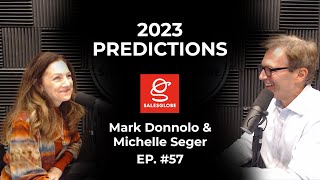
A conversational podcast (Dec 15, 2022) where Michelle and SalesGlobe Sage present predictions for 2023 focused on sales and talent. Major claims: the "war for talent" will ease as labor supply/demand re-equilibrates (driven by layoffs and lower consumer spending); hybrid sales roles and omnichannel selling are here to stay and require new skills and teaming; consumer savings have plunged and consumer debt is high, implying a slow-down/recession risk; salespeople must become creative problem-solvers to remain valuable amid automation.
Chapters
Hey, welcome everyone. Hi Mark.
Hey Michelle.
That exciting time of year where we talk about the things that we believe are ahead for the next year. So we're talking about 2023, our predictions.
Or otherwise known as what's going to happen unless the world gets this act in order.
Ouch. Yeah. It's been a couple of years, hasn't it? Well, I can say this much. I would say that we do a pretty good job on our prediction. I know, I hate to say it.
But you know, last year we did the recap of the prior year's predict with all the kind of look back harp music and which ones we got. Right. But there was so much of that we're not going to do it again. We'll just assume that we got the majority of them right.
All right, so let's get to it. Mark. One of the first things that we wanted to talk about was the war for talent because we're still hearing that there's shortage for those really good hot rolls out there. There still is some positions that aren't being filled. So let's, let's discuss what we think is happening with that and what it looks like ahead.
Yeah, so we think the war for talent is actually going to be a bunch of skirmishes and battles. Right. So the war for talent is actually going to be a short run type of situation. And that's one thing that's amazing is how we look at things. Kind of like, well, this is the way it's going to be. It's kind of like remote work and hybrid work. We'll talk about that later. But it' oh, this is the new world. This is the way it's going to be. The war for talent, this new world, the way it's going to be. Well actually what we have, Econ 101, we have a short run disequilibrium between supply and demand. So what does that mean? So we've got too much demand from companies related to the supply of labor. Right. So that drives price up. When you shift those curves, that drives price up. But then it falls back to an equilibrium as other things happen.
Right.
So as you have like new entrants into the workforce that can drive price down or if you have less demand from companies from say recession or layoffs, that can drive demand down and it'll drive price down. So we're going to start seeing that shift happening and companies are going to realize that they're actually overpaying and they're over committing in a long term way to a short term problem. So that whole, you know, increase in salaries and you know, one of, of our recent surveys, we saw that to acquire new talent, 50% of companies are offering higher base salaries, 39% of companies are increasing incentive opportunities, 22% doing both. This is for sales organizations. Well, the ones that are increasing salary, that's a long term commitment. And so they're going to find themselves sitting there with increased costs as things start to settle down.
Well, and what we also believe is that we do believe that things are going to start settling down a little bit. And we're starting to hear that already. And well, gosh, it's in the paper, the layoffs that are happening and more are on the way. And so what we also believe is that it's not necessarily going to be last in, first out, but we believe that they're going to be really looking at the talent that they have and the skill of that talent and make the determination on the layoff around that.
Right, right.
So they may have hired some people in, let's say, Mark, that might be a little over market, but they're highly skilled. And I don't believe that those are the ones that are going to drop out. But if you remember when we looked at the pandemic when the layoffs were vast, the logic that so many companies were using was last in, first out.
Right. Lifo now it's going to be ltfo, low talent, first out.
Talent, first out. Yes.
Yeah, because. Yeah, because when you get this, this increase or this inflation in the price of labor, inflation in salaries, I think you're getting a lot of people in there that when the tide starts to pull back, they're going to have to be able to prove their value or else they're going to be out. So all that job switching is actually going to produce people that are going to be standing there probably back out on the market and maybe the demand's not going to be where it used to be.
Yep. So can we talk for a second about the employee employer relationship? One of the things that we saw through the pandemic was, oh, that whole battle around being back in the office and it really has become an us, them mentality between, you know, the big company that's forcing me to do something that I don't believe I need to do. Like, it really made a lot of headlines too and really concerned me because I see this amazing opportunity for people, particularly look at where we live in Atlanta, to avoid having really big commutes five days a week. Right. But then this whole clash on let's not even sit down and talk. I believe that that's gonna go away and that companies are gonna, that's gonna settle down and that companies are really figuring out what jobs make sense. That they can be partial, hybrid, remote or in the office. And that people that are well suited for those jobs will probably also be the best suited for how that job works. So whether it's virtual or remote or, sorry, virtual hybrid or in office full time.
Yeah, I mean, I think it did go from that big us versus them situation. Remember that one survey we did where I think it was something like 60 something percent of employers. Employers thought that 60 something percent of people were going to be back in the office full time, but the employees thought that only like a third of them thought they were going to be back in the office full time. So there's a big difference in expectations. And we heard all these phrases like, you know, well, once you give people something, you can't take it back. You know, like, you know, companies gave people the ability to work remote and it was like, well, no, I think that was a pandemic. But now it's kind of rationalizing. Right. People are getting a lot more rational. And I think it's like you said, people are understanding that there are a lot of benefits to remote work or hybrid work.
Something else that I believe is that smaller companies could have an advantage in this whole thing about hybrid work. Because think about these big cities that are still a lot of office space is not fully occupied and it feels empty when you go work. I mean, I think the value proposition going to work for a company where people are not in an office, it's kind of a poor environment to be in. And I've heard that a lot from clients and others and leaders that are working to get their people in the office just a few days a week. But when it's empty, it just feels, you know, it just doesn't feel so good.
Yeah. So you've talked about this idea before of intentional collaboration. So come into the office when you need to come to the office. Don't come to the office to put your headphones on and kind of, you know, focus in on the spreadsheet, but be there to work with everybody. And you want to create that environment. Right. So some clients we see, they'll be like, oh, it's an in office day and you know, the place is bustling or they're going in and it's not an office day and the place is like a ghost town. So I think we're going to start to. Yeah, I think we're going to start to see, you know, an equilibrium there. I think we're going to start to see that settle down and hybrid work is going to become the norm. And as we know, and you were talking before, hybrid work is that's the fastest or hybrid sales roles or the fastest growing sales roles beyond inside sales, which used to be the fastest and of course field. So that's going to become, I think, the new majority type of sales role.
Yeah. So let's explain what hybrid sales role means to everyone here. So when we think about it, we're thinking about a Salesperson that's spending 50% on average, about half their time or so in front of clients and the other half of their time virtually connecting with them. It doesn't mean that they're hybrid in an office. We're referring to really their interaction with their buyer or their client.
Yeah, they're matching the customer. Right. So the customer is not in the office. They're not going to show up at a, in an empty office park.
And yes.
So by definition they're hybrids because they're trying to that match the needs of the customer.
So now that, that is basically here to stay, we've been saying all along. But there is going to be new skills and different skills required for that hybrid sales role. Okay, so let's talk about Mark, something you and I have been discussing a lot about consumer spending slowdowns. All right.
Yeah, there's. Okay, so I think the big trend we're going to see here is slower consumer spending. And consumer spending is what drives the economy. Right. And, and that's going to be slowing down. It's going to be challenged by lower savings and shifting more onto credit cards and more onto debt, which is going to in turn slow down company purchases, which in turn kind of a domino effect will slow down company hiring, which will settle back the war for talent. And if that leads to decreased GDP growth and that's going to continue us into recession. So here's some interesting stats to consider behind that. Right. So what we know is that consumer spending has been funded over the past few years by personal savings and pay increases from the war for talent. So check this out. Peak savings during the pandemic in 2020, in total United States, $6.4 trillion. Right. That was the peak. It is now at the end of 2022, down to 581 billion. Billion. It's down about 90% if my math is right. So that's the lowest savings level since 2009. That's kind of scary. So consumers have been eating through their savings, right? And how do you, what do you do when you start running out of savings and you have, you know, the same spending habits? Because they always say, don't bet against the American consumer? Well, you start putting on credit cards. Well, the thing is, our habit is we buy everything on credit cards anyway. So what we start to do is we just start to pay off less of our balances and that increases. So the consumer debt now in the US is at almost $1 trillion. That's the highest level ever. And then you take the increase in interest rates with what's going on in the economy, and then it gets more expensive to service that debt. So things have to slow down at a certain point here pretty soon because there's limited roadbed for consumers to continue that spending. And the only way out of it is if they continue to take on debt, which is not sustainable, or there's some other source of demand outside of consumers, which I don't know what that will be that could replace that. So I don't know how you can avoid this slowdown given those numbers.
If you're a global company, what do you think you're doing? Do you think that there could be, what, a concerted effort looking at economies that are not impacted, or are they going to be doubling down in a country like the U.S. i'm sure you're referring to the U.S. right now.
Yeah, I don't know. Now, that's a broad number. Right? So that's representing. Well, we know there are certain segments that are spending more than others. Right?
That's true.
So higher income segments are continuing to spend and they will continue to spend. So maybe they're shifting targeting there. So I think it's just showing us a general slowdown. So that's going to, again, lead into recession. Interestingly, recession is defined as well. Roughly, the accepted definition is two consecutive quarters of declining GDP growth. And so we had two quarters in Q1 and Q2. In Q3, we had a GDP increase at an annual rate of 2.9%. So that actually came up. So we did have a little of a recession dip. But I was doing a little research on this recently and I thought this was interesting. So that is kind of the commonly accepted definition of a recession. But really a recession is designated by this committee at the National Bureau of Economic Research, and they look at a number of things to say whether we're in a recession or not. So, you know, maybe we're not in a Recession. Maybe it's just a flesh wound, right?
Oh, stop.
So a recession can basically be whatever we want it to be, you know?
Well, at the end of the day, the recession is what the buyer and the consumer feel.
Yeah, it's what we feel. And it's like when things start to slow down, it's like, hello. Anyway, so we see that coming, and I think everybody kind of commonly agrees with that in the financial sector as well. But that will cool off the war for talent.
So let's shift a little bit. And can we talk about Omnichannel? Because one of the things that we talked about was given everything that happened through the pandemic, there was so much chat pre Pandemic about omnichannel and omnichannel becoming. You know, companies were exploring bringing that experience in B2B sales. Omnichannel just means that me as a buyer, I can buy any way that I want to, whenever I want to, and however I want to engage. And then the big question became like, well, who gets paid for the sale? You know, which we have good answers for that. But one of the things that we believe and that we're seeing is that Omnichannel, I mean, it's here to stay in B2B and B2C. And it's not a trend. It's. It's just the way it is. Right.
We could say Omnichannel is omnipotent.
Yes, we can. You were dying to say that, too. Yeah. So little pre podcast, you know, inside.
I didn't say omnipotent. So, like, at least I got that right.
No, no, you didn't. So that's good. That's good. Your enunciation works.
So. So, yes, Omnichannel, it's gonna. It's gonna be the norm. Right. And so companies have to figure out how are they gonna serve the customer, however, that custom, because their competitors are going to do that. So if I want to find information online, if I want to buy online, if I want to go to the store and then actually go home and buy online, or if I want to go talk to a salesperson. So however I want to get information, however I want to make that decision, and I'd say most companies have not figured that out yet. They haven't figured out that seamless sequence, and they haven't figured out how to get the sales organization, whether it's virtual or hybrid or remote or in person, how to get them to all work together smoothly and without any kind of preference one way or the other. So if you're in the store and you say, hey, I love this, whatever this item is, can I just go home and buy it online? That salesperson needs to be able to say, oh, of course. Right. Right now.
And not here's my coupon, here's my.
Coupon, here's my coupon and my code. Right. So I can get credit.
Do that because. But the other thing is, so in B2B though, when we think about that, what we believe that means is inside sales, it's not dead. And we built a model. So we've got. This is available at salesglobe.com, but we have a model that we built and it talks about how the sales organization can work together, the sales structure and what the selling motion looks like. And one of them, we talk about the highest end on this teaming concept where you've got hybrid teaming with inside sales. Right. Or field teaming, but it's a team. That could be customer success inside sales field, hybrid, whatever that looks like. But that can contribute to that omnichannel experience. Those rules of engagement and how they work together, including how they ultimately get paid.
Yeah. Compensation critical. Right. Because that's what creates or drives a lot of those behaviors.
Right.
So yeah. If companies are not. If they don't have omnichannel figured out, they're going to have to do that relatively soon.
So what I'm going to predict is that there's going to be a growth in teaming sales roles together.
Yeah, absolutely. Absolutely.
Okay, so let's move on to this. Job switchers settling in.
Yeah, well, that's another thing that's going to settle back. Yeah, it's going to settle back. The, the war for talent again is another one of those factors that. How has the war for talent driven up prices of labor? It's because people are jumping jobs to get higher paying jobs in other places, right?
Yeah.
Then you start getting these layoffs happening and people are like, oh, okay, maybe I need to hold back a little bit and kind of see what's going on. So there actually is less job switching. The pay increases for job switchers over the past 12 months is. According to the Atlanta Fed, job switchers saw average Pay increases of 7.3% versus 5.3% for non switchers. It doesn't sound like a big number, but job switching has paid off. But job switching actually is down. So it's come down from 3% to 2.6% now. Again, that doesn't sound like big numbers, but those are, that's movement in a direction. So the Less job switching, you have again settling back the competition and the war for talent.
You know, I just wonder if. Let's talk about something. You made me think about this when you were talking about the pay increases. So a lot of times, pre pandemic, let's talk about people would leave a job at a big company because they are, you know, they get a little stuck. Right. You've got this band of increases every year. So maybe 1.5% or 1.2.63%. However, it's so granular when they figure that out because they budgeted how much they can give in increases and that causes people to leave a company and then they even hear. They may hear from their leader or manager. Well, but the band in this job, this is the way that it is. And we can't even go beyond this particular amount or whatever. So I'd love to understand how you think that could be impacting sales roles. I have an idea for what I think where you want people to stay, you don't want them to leave, but that if pay really does settle down and if we really are in an inflationary environment for any particular length of time, it could take years to get out of the recession. Inflation, whatever you want to call this thing, how do you get people to stay without giving them increases that may not even coincide with how prices are increasing and that reward them for their efforts?
I think sales has one big tool to play with most other organizations don't, which is the incentive pay.
Yes.
So when we talk to clients, when they're increasing base pay for salespeople, we know salespeople value base pay at about double the rate that they value incentive pay. So that carries a lot of weight, obviously. But if you're constrained on base pay, being able to do something with the incentives can help. What can that be? That can be how you're setting up your payout curves. Particularly if you want to keep the good people, you can tip up your payout curve. So you can perhaps do something in more of a cost neutral fashion of that reverse Robin Hood principle, which is taking from the underperformers and paying the over performers or the high performers. So there's that tool that's available. Certainly how you're setting quotas can make a difference. So you don't really want to soften quotas just to be able to deliver more pay to people. So there's that lever and then I think there's the big one that a lot of companies overlook. And we're seeing this with clients right now. Michelle. Which is the employee value proposition. So when they're playing right now on the idea of we can increase base pay or we can increase incentives, they're missing a lot of other opportunities. So those other opportunities are about job content. So what somebody does. Companies are playing into that a bit in terms of offering up more remote work, that type of thing. So you got job content, you've got career path. Where can you go with us as an organization? You've got affiliation with a great company, a great brand, you've got culture, you certainly have benefits. So we're seeing this all over that everybody gets caught in the game of the pay increases, and it's like, wait, you have a lot of things that people value and why they want to stay here. Market that.
That's right.
To the market. Yeah.
I'm also going to predict that we're going to see more aggressive payments. And what that means is I believe that we're going to see more pay at risk across roles. We already were starting to see that when we were looking at the hybrid role. So we did that survey this year, and we understood what pay mix was for field sales roles and hybrid roles. And hybrid roles were more aggressive, meaning that there was more pay at risk. And we believe that that's because those roles did not exist before, and you could easily do that. But I'm going to predict that as companies are looking at managing their cost of sales, instead of increasing base pay, they will add more on top of the incentive opportunity to at least get some value back. Right. To at least offset the additional expense in pay. Instead of it being something fixed where they're gambling a little bit, they're going to put it in incentive. And so to your point, I think we're going to see more of that reverse Robinhood happening. You know how many companies Mark that we go to, and they're now coming to us and saying 80% of our people are at or above quota or 90%, and they know that that's just was too high.
Right? Right.
Yeah.
And in this whole conversation, I know we talked about this in other podcasts, we have to remember those big three things that if you're increasing your costs, especially fixed costs like base salary, you got to do one of three things, which is you either have to increase productivity to go along with those costs, meaning bigger quotas or people producing more, you've got to lower cost in some other area, or you've got to raise prices, otherwise your margins are going to go down. Right?
Yep.
And I know there are others beyond those three. But you kind of get yourself in a spot there that you have to do something if you're going to be raising your costs.
So I'm looking at your predictions and. All right, we'll talk about this one. The New Achievers will nudge out the great resigners.
Yeah, this is my, this is my flashback to the 80s, guys. And you know what? I'm passionate about this one because I'm passionate about the great resigners and the silent quitters, right. I'm passionate, not in a positive way about them, right? So it's like exit stage left because make room for somebody else. Okay? Well, you don't have to because somebody else is going to make room for themselves in this situation. So what I mean by that is the New Achievers are going to look at what's going on in terms of the people that are the silent quitters or the resigners, the people that aren't coming to the office or not engaged with the organization that I'm just going to work remote and it's like, okay, well, I see opportunities for my career path as a new achiever, because I want a career path. I'm going to show up, I'm going to be there working with the team, I'm going to be there working with the boss. I'm going to be working with the customer directly. I think that's going to open up opportunities for a group of people. We don't know how large they are, but we know they're out there because we see them, right? We have them. Those people are going to see opportunities and, and they're going to step in. Now, it may not be enough to tip the scales in terms of the overall labor market, but what it's going to do is it's going to start to nudge out a lot of people that think they can just coast, right? So, so watch for that. And you know, that's not, you know, may, may not be popular with the, the status quo or whatever, but I think it's happening. Well.
I just think it's really exciting for people that might be new to the workforce and others even more mature in their careers, but they haven't really been able to stand out even if they've done super, really good work. I think there's an opportunity, I think that the employer is looking at people a little bit differently and they're looking at, you know, people's results and work effort and, you know, I don't know. I think that you're right. I think there could be a really good opportunity today.
And the reason I say it's a flashback to the 80s is I, you know, I came up in the, in the 80s and 90s early in my career. And we were all new achievers back then. When you got out of college, you went to, went to work, it was all about what can I do to advance? And there was just a drive. Maybe some of it was because I, I started my career in New York, but it was all about that. Right. It wasn't about leisure. It was about, I'm gonna bust it so I can get ahead. So I see a lot of people doing that now.
Balance, but a little balance is good.
Yeah, of course, of course.
You know, because you're, yeah. You were high driving like the Wall street movie. Right.
Well, you know, it's like.
And, you know, not everybody wants that frenetic pace.
Balance is for later in life, though. You gotta make your bones and then you can have balance. Right. But that's the 80s flashback.
Oh, boy. Okay, so I believe what's going to happen is that people that really want to advance their career, younger people, they're going to figure it out. They're going to figure out how to have a good balance that it's not about.
I agree.
Oh, I can't have a great job. You know, I'm either going to live in my van and travel the country or, you know, I don't know, take out jobs. I think they're going to figure it out.
Yeah.
And I know young people have a better life.
Oh, yeah, you're right. Yeah. I mean, there's young people now that are going into sales and they go, they come through the junior sales rep program and they're ready to go out to the, to the market and they see how the company treats the reps that are out on the market, they just burn through the new reps. Right. They're transferring them to different, different territories or different geographies and they basically burn them out. And a lot of those people, I've, I've seen them, they're like, you know, I don't think I want to do this or I don't want to do this for this company. So that balance is going to play.
Yep. Okay, so what about this generation of less developed sales professionals that you're talking about? Do you really think that's going to happen?
It's already happening.
Yeah.
This is the great irony in the whole thing is. Okay, again, flashback to how we all grew up. How did we learn? We learned by being there and working with the team and working with the customer and working with our bosses. And we learn from the bumps and bruises that come with like, you know, an in person meeting that fails. And you were the, and you were the cause of it or something. And so you learn from a lot of those hard knocks because you're on the field of play. Right. And you sharpen your skills, you sharpen your talents. And so it's not easy. It takes, takes a lot of work. You're getting on planes, you're going places. There's a lot of that machismo in there, but we don't have that anymore. But that's how people learn, right?
Right.
And now you're getting this next generation of people who are the younger ones that are really comfortable with technology. Right. And that's great. And you've got some of the older generations that are just not as comfortable with technology, but the newer generations are younger generations more comfortable with technology. And you're like, hey, I'm totally fine working remote. I don't know why I have to come to work. Why do I have to go to the customer location? I can just do it all on zoom or teams or whatever your platform of choice is. And so their development is kind of limited. It's like playing a video game versus really being out on the field. Right. So they're playing Madden video games in their careers versus they're out there on the field getting hammered. Right. And, and they're not going to develop to the same degree. So they're going to miss those people that are the younger people that say they're totally fine with technology. They're the ones that are hurting themselves because they don't realize they're going to miss something. And so you're going to have this generation of people that just hasn't developed to the level of people that have been out there in the field.
And to be clear, you're not saying every single young person is like that.
No, because you got your new achievers. Right. You've got your new people coming along. They're going, no, I'm getting out there.
Yeah. And they're still comfortable with technology. And those that, you know that that's the hybrid seller that I believe will have the advantage moving ahead and could have a really wonderful career for themselves.
Yeah. So if you want to, you want to shift your career development over to, you know, being a video game, well, you got other people out there that are playing, you know, full contact.
Yes. And last but not least, we're going to talk about technology for a moment because there's always been this big thought process around oh my God, my job as a salesperson, I'm going to be made obsolete. I'm going to be obsolete because of all this technology and self service. But what we're seeing is that people really do want that connection. And what we're seeing and what we know, and I'll let you give the big news, but what we're seeing and what we know is that buyers want that contact with, you know, with their salesperson. But what they talk about and what they do is a little bit different. What are they doing?
Well, we know with technology and with automation, customers can get information earlier themselves. Right. So just being a sales representative and representing the company and providing information is no longer enough because customers have already.
Seen features and that doesn't matter anymore.
I mean, they've already gone through all those steps in their process by the time they see a salesperson. And I know you've had stats behind this, but by the time they see a salesperson, they've been through a certain number of cycles and they've already made a lot of decisions, right?
Yes, they have.
So when they ask the salesperson for something, the salesperson has to take on a different role. So the AI, the automation, the offshoring, that can replace a lot of what salespeople do now. So what's the last frontier or the next frontier? It's the ability to solve the problem for the customer.
Yes.
Okay, so we haven't AI'd that yet. You could say, well, we can AI how to solve a problem. Well, you can't AI how to. How do you creatively solve a problem? How do you creatively solve a problem?
Right. A linear problem.
Right?
Yeah, yeah.
So I think that's going to be the next frontier for salespeople, the ones that are successful in their careers and that's the best way to protect their careers, is become a better creative problem solver. And that's going to differentiate you. And that can't be offshored or AIed.
No. And we are hearing more and more of that. We're hearing that, that from sales leaders. We're hearing it out of the mouths of the C level. That is saying we need people and we want people that can solve problems, not that can sell a product.
Yeah, yeah. So there's a whole host of things that goes, go behind that in terms of how to, how to go through the problem solving process. And if you're not a creative person, that's fine because there are methods that, that you can use. And we go into that in other podcasts and free to Friday. Yeah, that's right. So that's I mean if I were a salesperson at any stage of my career, that's the thing I would invest in is how do I become a better problem solver. And the relationship is important as well. But that has to go along with the problem solving.
Yep. That's how you become really that trusted advisor. You know, we talk about trusted advisor almost like cliche, but the more that you talk to sales leaders and the C level, like, you know, there's really something to that. It means something. And solving problems is really a good path to get there.
Yep.
Yeah. So the problem solver wins out. So those are just a few of the things that we see ahead in 2023. Thank you you everyone for joining us today.
Yep.
And Mark, I think you and I are going to have a lot more to say on these topics and more as we get into 2023.
Awesome. Thanks for joining.
More from SalesGlobe







Sales Compensation for Results - Course 1: A Strategic View on Sales Compensation - Trailer


Freative Friday - Episode 98 - Insight in Your Hunt for The Revenue Roadmap Pt 4


Freative Friday - Episode 97 - Insight in Your Hunt for The Revenue Roadmap Pt 3