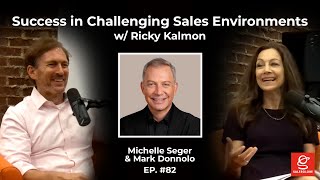
This content was created by SalesGlobe Sage. This content was uploaded by SalesGlobe Sage. This is a YouTube video titled "Success in Challenging Sales Environments" created on October 11, 2023. It features a conversation on the Rethink Sales podcast with Mark Danolo (SalesGlobe Sage), Michelle Seeger, and guest Ricky Kamen, a mindset expert. They discuss strategies for sales success in challenging economic conditions, focusing on mindset, personal growth, and adapting to change.
Chapters
Strap in, everybody, because if you're listening to this and you're in sales here, this is very important that you really just step back and absorb this. You might get this, you might not. But here's what I'm saying.
Welcome to the Rethink Sales podcast. I'm Mark Danolo.
And I'm Michelle Seeger.
And, Michelle, we got an exciting topic today because we're going to be talking about this challenging sales environment, this economy, and how you can be successful as a salesperson and a sales leader within everything that's going on.
I know it. And we're not going to be talking about sales process or your coverage model or your sales strategy. We're going to be talking about your most valuable asset.
Right. Which is you and how you think. And, you know, we talk about aspirational account planning and strategy, and everybody's always asking, like, what's the tool? What do I fill out? And it's not about the tool. It's not about what you fill out, but it's how you think. And we're going to dive deep into that today.
That's right. So I am very excited and privileged to announce our special guest today. Ricky Kamen is a mindset expert. I have so many questions for you today, Ricky. He is a motivational speaker and celebrity hypnotist, which I am not afraid to say. I'm afraid of the hypnotism piece on that. But we are really happy to have him here today. He is author of the book Leverage youe Mindset, Overcome limiting Beliefs and amplify your life. I started reading the book and what we'll find out is it's really a path and a way to help you change the way that you think. He is creator of the growth mindset and meditation app titled Ricky Kammen. And I did start the app today, too. And by the way, even though you claim you don't hypnotize people in that app, I'm beginning to question it because it seems to work. Ricky delivers programs that will change the way you live, work, and think, think. He reveals how our mindset can be the greatest tool in achieving new heights of reducing stress, adapting to change, and creating success with a growth mindset. And, you know, over the past few years, Mark, there's been a lot of stress and a lot of change in this environment, hasn't there?
Oh, yeah. And I think it's almost like we just keep soldiering on and going on and getting through it. And I think this is a great topic because I think so much of it is about being resilient and tenacity and getting connected with being positive around what you're doing.
That's right. So, Ricky, he also works with Fortune 500 and 100 companies, sales teams, leaders, executives, and sports teams. And he's here with us today, teaching them how to turn their best of intentions into their greatest accomplishments. His clients range from Pepsi, Disney, Dell, Johnson and Johnson at&t LexisNexis, and even the New York Yankees, which I'm a New Yorker, so we can talk about that. He is a visionary architect in personal growth. And today he's going to reveal some of the secrets and things that we can learn. Simple techniques for how we can change our mindset, potential, and prosperity. I am really excited to have you here today, Ricky. Thank you for being with us.
Thank you. I appreciate you.
Thanks for joining us.
That intro was awesome. Thank you so much. I feel awesome today. I just got my own cheerleader. That's great.
Yeah, I know. I'm really excited.
Well, we've been both reading the book, and I'm several days into to it and into the app, and so I think we're getting totally into it right now and becoming total converts.
All right, so let's get right to it. We're talking about salespeople. We're talking about this challenging environment that we've had. I mean, everything has changed since COVID Pre pandemic, we knew about things like inside sales center of Excellence. You know, post pandemic, people are working remotely, they're working from home. Your buyers are not able to connect with the same way. Everything, it seems, had changed. And now we've got things like AI that seemingly threaten the way that salespeople can connect with their clients today. So I would like to talk to you. Let's start talking about some of the challenges that you see across sales organizations, the patterns that you see and how people are thinking today and what they're believing. I mean, I know you're working with salespeople and sales leaders and what's top of their mind and what are the challenges that they're seeking to. To overcome?
Great question. And, you know, you really set it up because mindset have to. Has to do with everything we do. Everything we do every single day. Your mindset probably predetermined your outcome before you even started. Whether you start your day, whether you talk to a client, how you talk to other team members, how you lead your organization, your mindset plays out that conversation unconsciously. I think most people are more unaware of how unaware they are of their internal programming. So with all that being said, this is nothing new. In my 34 plus years of my career, the questions that I get asked the most now be like, well, this is something new. No, it's not really new. We're all in the for profit business, right? We're there to grow and we're going to have challenges. But it's how you think about challenges. What are the challenges? Are challenges frustrating? Are they a roadblock? Are they a wall that you don't think you can get over or get around? Or do you look at challenges as opportunities to grow? So when we talk about mindset, we talk about growth, we talk about sales, we talk about customer service and leadership, we talk about becoming a better version of ourself. Most people know what to do. What gets in the way is usually ourselves. So whether you're diving into this idea of mindfulness or whether you're listening to my program or anything, when it comes to self care and you already set it up, it's an investment in you. Let's get out of our comfort zone and embrace the uncomfortable. Yeah, let's embrace where we're most uncomfortable and figure out how to become better at things. So when it comes to challenging ourselves, let's challenge ourselves to be more accountable.
Why do you think that people are uncomfortable salespeople? Let's talk about with this idea of, you know, changing your mindset and getting themselves around. Like I know a lot of people that are even saying, well, if it sounds too good to be true, that you can change your mindset, you'll change your life. Right? You've, you've said that it is too good to be true. That's what they'll say. But, but what do you have to say to them and the challenge you give them back?
It's a great question. And I think that you have to step outside. I think we're human, right? We're human. We like comfort, we like nice things. We also are programmed to, well, if it feels good, why fix it if it's not broken, right? We like the warm fuzzy blanket. It makes us feel comfortable. But let's dive into that. The people that we admire in life, the leaders, the sales individuals, the big corporations, whether you're a small entrepreneur leading a group of 50 people or 5,000. I think these great leaders all have a common trait. They realize that self discovery never ends and they want to figure out how they can be a better version of themselves every single day. I think what we lead within ourselves, we lead other people better. And then people follow. So going back to it, when you look at people you admire, what's the one trait that we admire the most? Is that their resilience? You mentioned their tenacity, their perseverance. Maybe, maybe it's that one thing that gets them to push themselves harder. Because we're going to fail sometimes we just don't want to fail twice. Figure out how to use that information and capitalize on it. You guys do this every day. You come up with these great plans, strategies. You're taking information about the corporation, things that they are giving you, and then you're compiling new. And I'll call this software, software of the brain, your own internal operating system. So when people say to me, well, change is hard, change is overwhelming, change is frustrating, you know, I don't think I can really embrace that. I'm really comfortable with the old way of doing things. Well, then my answer is, you're absolutely right. You said it, you believe it. You, you already want to fail, so let's challenge ourselves to be better.
I mean, you said something I'll paraphrase a little bit, but you said it's an absolute necessity to invest in mind. And basically if you don't, you're going to repeat the same old patterns and you're going to have the same results that you've always had. Or he said maybe worse. Right. And I think we do that. We go through these patterns of how we think, self talk, just, just how we approach life. But can you talk a little bit about just what some of those maybe typical patterns are and how we could just recognize them? And, and I just love that idea that, and it was just so truthful when I read it that if you don't change that pattern, it's just going to pretty much continue the way it's always been. It's not like something magical is going to change unless there's some huge external factor that you didn't anticipate, which is unlikely. But that pattern is just going to continue. The results are going to continue.
Yeah, you couldn't have said it any better. We live life in our programming, our daily activities, the way we get up in the morning, the way we drive to work, or whether we are making our calls that become patterns in our life all too often. Many of those patterns or programming might have served us at some point and worked really well. But are they working as efficiently as they should be? And if we don't change, nothing changes. So if you're comfortable with the status quo, if you're comfortable with, well, you know, listen, this is as good as it's going to get, and this is the best year I've ever had, and I don't think I'm going to get any better than this. Then I'm just going to stay where I am and just stay in my comfort zone then. You're absolutely right. But I think we all have a driving need. We like that feeling of success. We like. We all like to. To feel recognized and appreciated. And you get that recognition of whether it's not only the paycheck itself, but it's the satisfaction of really making a difference. So when you become more conscious of the patterns and habits that you have, because we basically live on the last message we send our brain.
Right, right.
And. And if you. You're okay with that, that's. That's absolutely fine. I want you to think differently a little bit here today as you listen to this podcast and your listeners really just embrace this. First of all, you're investing in yourself. I don't want to give you a lot of fluff here. I want to give you, you know, practical applicational tools. You guys are feeding me information. I want this to be valuable. I want people to. After they're done going, you know what? That was a good 45 minutes of my time. You know, I don't want to say to my. I don't want somebody to say, jesus, how am I going to get that 45 minutes back? So I want you to think about different elements of this podcast of, okay, we're talking about investment. We're talking about investing in ourself. Because, listen, you guys got a great studio here, a great office. If something breaks, what do you do? You fix it. You attend to it right away. You will spend whatever it takes to make sure it's working. Do we do that for ourselves? Sometimes we put ourselves off. We put ourselves second. Do we give our families, which all too important. Our personal assets? All too important. I get it. But if we don't serve ourselves first, we falter. So first thing on this podcast, I want people to really walk away with going, okay, and you guys have set it up perfectly. Invest in yourself. What does that mean? You're doing it right now. Pause. We're going to talk about pausing a little bit. I know we're going to. You're going to set me up for that. It really is becoming more present of what we do every single day. As you sit here and we have this conversation, you become present in this moment.
So you said the subconscious, the natural purpose of the subconscious is to protect us, right? And so we may have automatically kind of negative or cautious patterns. You know, watch out for this, watch out for that. We're thinking about the negative. And how do you break some of those patterns? Because, you know, I've read a lot about motivation, and one thing I read that really hit me on motivation was that the biggest motivator is not aspiration or being able to do something great, but it's avoidance of pain, right? And so the subconscious is trying to avoid pain. How do we switch that pattern around, like, in a practical sense, day to day, as we're doing, as we're thinking, to kind of switch from the negative, Like, I can't do this. I'll never be that successful to the positive. Like, I am that successful. You know, how do we make that shift?
It's a gradual shift. It's a gradual understanding that the. Everything that we put in our brain, that feeling, that response is, is engraved because we've experienced it. And that information is then stored in the bank of our, you know, our head, our. Our internal hard drive, our operating system. And immediately when something happens, that information is pulled up, right? So if you say, what? You know, do I want to do this? And all of a sudden the pain or the fear of failure comes into play, then it's already telling you, well, I don't want to fail. I don't want to feel pain. Nobody gets in line for pain, right? People get in line for success, right? They want whatever they get in line for, they're getting in line because they want it really bad. Nobody gets in line to fail or feel that pain. So if you change the way you think about things, if you change the way you speak to yourself, the words that you say, I cannot, well, then you're right. You're giving yourself two rows of destination. Actually, when you say cannot, you're just going right towards failure. How do you do that? How do you change it? Well, it becomes a repetitive action of daily awareness, of concentration, of guided imagery, guided thought. Maybe it's just being present with ourselves, being mindful and what mindful means. To me, it might be different for you, but think about the patterns and habits you have created in your life as a sales individual, as a leader, as a. As a. As a significant other. Those were created because you repeated the same thing over and over. So is it hard to change? Well, you. You tell me. Do you think it's hard to change? Or are you becoming, you know, creatures of this idea that if I say it's Hard to change. It's going to be hard to change. Or do you embrace the change going, well, if that changes, yeah, I change. Could I be a better version of me today than I was yesterday?
Yeah. I mean, you guys are both saying it before. It's. It's comfortable to be in your own stuff, right? It's more uncomfortable very often to go into something that's unknown. So you kind of have to, like, break out of that and say, yeah, I want to take that chance.
Well, again, this is something I hear all the time from sales individuals. We've always done this way. Why. Why are they throwing us new procedures?
Right.
You know, I know how to sell. I've been selling my whole life. Right now they're telling me I gotta follow this new structure. Well, you have to step back and realize, well, maybe if you look at this with a different perspective, sit in the audience of yourself, listen to what you're saying, and maybe envision what this new procedure, this new accountability factor, this new plan of action, you know, what can this provide me Versus the first reaction that we just had was, wow, I've been doing this my whole life. Why are they telling me how to do it? You're probably right. You're going to stay exactly right there. But if you're really good at what you do, and I know that you're probably really, really good at what you do, what if this helps you grow personally and professionally, what would that feel like?
So as I talk to sales leaders and salespeople, one of the biggest challenges that we see out there is that they are being asked to change a lot of times the products and services that they're selling, and they need to engage with their client a different way. And sometimes the buyer is even a different buyer. So I'll bring up a real practical one that we hear almost every day. I am used to sell. I'm a salesperson now. I'm on the top of my game. And I sell printers, big printers to multinational companies. And maybe I sell print services. Now we've got this hybrid salesforce, and I'm being asked to sell to the. To enable the hybrid salesforce, I'm being asked to sell more managed services, print services, even from the home, for example. We have so many examples of. I was used to selling this particular product to now a suite of services. And all too often you've got salespeople that are saying, but I. This is what I know and this is what I do, and this is what I'm going to keep doing. And at the same time you have sales leaders that come into a new. A lot of times they're brought in to lead a transformation. And what I continuously hear is they don't have the talent. They don't have the skills. They don't have the will to. They can't even make the shift. I probably need a whole new team, and I want to think about how can we change the mindset? How is there a way that we, as consultants even can help them understand and change their mindset to open it up a little bit? Because I feel like all too often, you know, the verdict is out before the jury gets to really weigh in on those types of changes.
Right.
Like people having that opportunity. What would you say about that and what do you observe?
Well, you cover two different things.
You've got. I did.
That says. Doesn't have confidence in their team.
Yes.
Because great leadership makes great leaders. And then you've got a team that doesn't believe that this change.
Right.
You know, is a positive change because they've all been so comfortable in their. I don't want to say bubble, but with what they know and with what they know. They know it because they repeated it. They got really good at it over time. And so when you get really good at something, sometimes we as individuals will repeat it because we assume that's the best way of doing it. Now, let me give you a quick example. Whether you're a sports fanatic or not, it's. It's no different from, let's say, a pitcher or the battery. You know, if they're having trouble with the mechanics of their. What they're doing, it's because they're repeating the same thing over and over again, and they haven't changed their thought process. So a great athlete has two coaches, a physical coach on the mechanics of what they're doing and a mental coach, because what usually gets in the way on both those things you just said is themselves. The biggest obstacle in what you just gave me, the example was the leader has a huge obstacle themselves, and the team has the obstacle. It's themselves. How do you get out of your own way? Because what you just told me is the leaders already assumed that they're not qualified. They're not qualified, so I should just get a new team. Well, if they're already successful, then they are qualified. Let's just retrain them. But they have to have confidence within themselves that they can train them. That's my mindset. Now, again, you. You know, it's just the way I'm looking At this, because I'm hearing different things. I'm hearing the obstacles, I'm hearing the problem, but what I don't hear is the solution.
Right?
Yep.
So a person has to be. That leader you're talking about has to be receptive.
Right.
To making change. Right. So you said, you know, they need.
To hold their hand sometimes. They're already good, really good at what they do. Sometimes it's a guiding, holding hand of. Of understanding how your actions, words are magic to the receptive listener is what I say all the time. So what are you saying to yourself as a leader and what are you saying to other people? But I think it starts with the leaders.
So, so if you had, say you had a chief sales officer, chief revenue officer in a company, and that person had multiple leaders reporting to him or reporting to her, and they wanted to help those leaders to make the kind of change you're talking about, is there a way to get those people to come across to be receptive, or does it have to be really internally driven? So if you've got resistors in the organization, what do you do about that?
You're going to always have resistors. Not everybody's perfect. Sometimes you're, you know, are you going to get everybody in the room? You know, maybe, maybe not. You know, I'd like to buy a lottery ticket if you can, but you just continually hone that information. We talk about great, great companies that provide incredible customer service. What do we think of. What's the first names to come into mind?
Oh, maybe like an Amazon. Could be good. Although I can never get them on the phone.
Okay. Nordstrom.
Nordstrom.
There's no other client service that's a good one. Who else would you think of great client service?
Maybe Apple? Apple Care. Yeah.
Okay. So what they're offering is a human interaction.
Well, that's true. Yeah.
So, yeah, you know, there's. There's a lot of different choices. When people go to restaurants, they go on vacation, they purchase things from places maybe they can find it cheaper. But usually people buy because of the human factor. And that human factor is the training and the culture within. So when you talk about the apples, the Disney's, the Ritz Carltons, the. The Nordstrom's customer service where you, you just met this person in the store and all of a sudden they asked for your address and they're writing you a handwritten note. If I could be any more service to you in the future. My name is Ricky. Please, here's my information. Reach out to me. So, yeah, when you think about that. That's, that's a human interaction that makes a difference. AI doesn't scare me. It excites me. It's going to give us as humans ways to become better at what we do. So when somebody says it's too scary, it's going to be overwhelming. Change is going to be difficult. I'm saying, okay, step back. Give your mind what it really wants. It wants new tools. We're, we are creatures to grow. We are creatures to learn. I don't care who you are, how successful you are in life. I truly believe that everything we do can be a stepping stone to being a better version of you. And then when you become a better version of you, the people around you want to know what you're doing. They want to train, they want to be my mentor, you know, show me how to do this. How did you get so successful? So again, it goes back to, I think it makes great leaders that are accountable to themselves. Self accountability, understanding how the brain absorbs that information. When you work on that, I, I think your team starts to build that culture too. I don't mean to put the blame on the, I'm not putting blame on, on leaders. I'm saying leaders are the, you know, the backbone of a corporation in a culture. So when you go to these places that Disney and the Nordstrom's and the Apple, how are they doing things? What are they working on? What are they working on? The culture, how are they becoming better? And where you, the customer becomes the walking billboard.
So you talk a lot about words and language and you say basically, you know, words are kind of like objects. When we put them together, they're very powerful.
Yeah.
And you have at least two ways that that happens. One is the words that you use that you say as you're working with people, talking with people. And the other is your self talk. What you say to yourself. Could you, could you talk about that a little bit and just kind of the importance and maybe some practical tips on how do you change that.
All right, You're a sales individual, you're a leader. You're in the car. You're in your car either going to work or going on a call or thinking about something.
Okay.
Are you talking to yourself?
Oh, yeah, all the time.
Are you your biggest cheerleader or your worst enemy at times? Could be both.
Could be both.
And who wins sometimes? And really setting the tone. Who really sets the tone for how you act and react? Who is, who is the winner of those conversations?
I guess sometimes for me, it depends on the kind of mind frame I'm in that day. Because sometimes you could approach a situation with fear. So take public speaking as an example, right?
If you're.
And you do a lot of this, right, you're getting up on the stage and your self talk is super important before you're getting up on stage. So you could be saying, oh, wow, okay, don't mess this up. I've got to do this, I got to do that. Or you could say, I am. I just love to be here. I'm so excited to be able to connect with people. And so it depends, right? It depends what kind of mind frame you get yourself in before you're doing that thing or even walking into a sales call or a big meeting.
Okay, now let's go the negative part of this. You ever had. Have ever have negative self talk that sets your mood? You walk in the office, you talk to a friend, you talk to somebody, and already they're already saying to you, what's wrong? What's. What's going on with you? You seem off, you seem tense, right?
Yes.
So. And really strapping, everybody, because if you're listening to this and you're in sales here, this is very important that you really just step back and absorb this. You might get this, you might not. But here's what I'm saying. If we have two voices in our head, the negative and the positive, who owns both of those voices?
You do.
Exactly. So why is it at times that we let the negative rule our world and control our present reality and we talk about it like it's somebody else. Oh, my mind just got the best of me. Whose mind are we talking about? You talk about it like it's somebody else in the room and literally was on your back holding you back from being more successful or setting the tone for everybody else. So we're going to have bad days. We're going to have that self talk, that voice inside of our head that can be negative.
But is it because our subconscious is automatically doing that? If we're not consciously taking control, it's automatically defaulting to protection and negativity?
Yes. But let's go one step farther with that. We can own it and say, okay, I know that negative voice is there.
Right.
So when it does happen, what do we usually do? Most people will let that negativity rule their world. Okay, Plain simple. It sets the tone. Or if you want to really master your mindset. Whoa, step back. Pause. Hit the pause button for a second. Know that one word, pause. And if you have the Negativity, or somebody acknowledges the negativity, step back and realize you have the remote control to overcome whatever is ruling your world. It doesn't make a difference whether you're in sales leadership, you're in customer service, you are a truck driver, or in the food industry or in the service industry. It doesn't make a difference when negativity comes into play. You do have the remote control to change the channel.
So, so, but, but okay, everything's raining down on you. You're having a really tough time. You know, you haven't closed anything this month, right? And you're going, okay, I'm going to this next sales call. You know, I'm going to hear the same thing again. It's the same problems, whatever, but, but then you talk about this idea of gratitude and turn it around and say, you know, maybe something like, I'm grateful to be able to have the opportunities to be able to learn how to operate in this tough market and maybe how to adjust and be more rigorous at what I'm doing, or what kind of method can you use to shift that self? Talk around when everything's raining down on you. Negative.
Again, it's embracing this idea of self discovery. We will spend so much time learning our products and services, knowing the procedures, looking at the new strategies, looking at the new environment and the culture that we're doing. But when it comes down to it, it really does means reset and redirect on a daily basis. So when we talk about mindfulness and being more conscious of your unconscious thoughts, is that something you do once a week? No. If you were constantly having to look at spreadsheets to understand the environment, the pricing changes, whatever it may be, the inventory changes and lack of whatever it may be, well, then set time to understand yourself even more. Mindfulness goes beyond just meditation or relaxation or your breath like you picked up on. It's about what we do every single day between our ears. What words are we saying? What are you, what are you thinking? Yeah. All right, so you've had a, you've had a bad month. But you know your biggest problem, Your biggest problem could be somebody else's gift. Because somebody else might go, my problems are bigger. I'd rather have his problems or her problem.
Right?
Let's just reset, redirect. You have an opportunity, you have a product, you have a service. I'm there to help people. I'm here to provide solutions. And by the way, if they don't buy today, maybe they'll buy later. Because I know I'm the Go to person person.
I'm the expert.
I'm the person that provides more than what they ever think about. They're not just buying from me. We built a relationship.
I'm helping them.
Yeah, I'm. I'm talking to them.
Right.
I'm not going through a procedure of sales tech. No, I'm, I'm really there to helping. I'm. I'm there to help you. So when you have a question, come to me.
So one more point or one more question on the self talk. Because I'm, I'm just really into this whole self talk thing. You're trying to get to a meeting and you're potentially running late.
Right.
And the self talk in your head as you're getting ready, as you're going down the road, you're saying, I don't want to be late. I can't be late. I don't want to be late. Right. What's wrong with that language?
Well, you've repeated the problem over and over when we talked about just a few moments ago. Again, we're human. We're creatures of habit. We have a society that does repeat the problem a lot. I mean, how many times you ever seen somebody at the grocery store and they just verbally vomit all the negativity of what's going on?
Right.
How often do you see somebody that's motivating, that just says, okay, no, this is going on, but boy, here's a great solution. Let's focus on solutions. And maybe the first solution is not going to be the all answer to everything you're doing. So going back to what you said about that's negative self talk. You have to realize, you have to recognize it. Again, I said this earlier, but sometimes you have to sit in the audience as though you're the passenger, seeing yourself driving and listening to yourself going, what is, what is that going to do?
Right. Right.
What is the constant reinforcement of the problem going to do? For me, I haven't come up with solutions. I haven't focused on my presentation. I haven't focused. I'm so excited to finally get a chance to have the opportunity to meet with this client because they're busy and, and I have the opportunity. Not the person, but next to me or around me, I have the opportunity.
Right, Right.
Again, it's just what our brain thinks. It creates.
The same thing about I don't want to be late could be said in just the opposite, which is, I plan to be on time. I'm going to be a few minutes early. Right. And so as I'm racing and I've tried that, if I'm thinking I'm going to be on time today, I'll be a few minutes early. It totally changes my mindset. About the same exact problem.
So you're walking in the door, let's say you're late. What do you say to your client, Sorry, I'm late.
Then I make up an excuse.
And so now we've just set the tone. Now the conversation go a little bit far.
Digging out of a hole.
I don't have a problem with somebody saying, sorry I'm late. But even if I'm late, I'm so glad to see you. I'm so excited. Thanks for the opportunity. I can't wait to talk to you. I've been looking forward to this meeting. Changes the whole perspective does. We are so sorry I'm late. Traffic. That accident, by the way, getting here today normally would have taken me about 25 minutes. It took me 50 minutes.
Wow.
Traffic, whatever it was, it was crazy. I was maneuvering, so I was laughing. As you're saying this to me. You know, what good is it for me to tell you about what I went through? I'm just excited about being here.
Right, right.
We're going to share an experience.
That's right.
Was I late? I would think I was about three or four minutes before time, but nobody knows. My plan was to be here even earlier, but I wasn't going to walk in and go, oh, I just sat through 50 minutes of track. Oh, that highway is. You know, but we do that. We think of. No, I want to. I want to. I'm going to express to you right now. And again, some people are listening to this going, is this guy just throwing a lot of affirmations out there? And that's going to change my.
Right. Right.
About this. This. You know, we are attracted to positivity. Right. We are attracted to fun. We are. Nobody walks into a room and says, oh, you guys look so sad. Please give me some of that. So this goes beyond just positive affirmations and thinking. And I'm going to tell you right now, positive affirmations is not going to make you a rich person. But I'm going to tell you also that positive affirmations. Positive. Well, being positive mindset will make it easier to become a rich person than the negativity that will hold you back from achieving more in life.
Now. Okay, I'm going to tell a little story first about being late. So first of all, I was sitting here sweating, wondering if Mark was talking about me. But anyway, in all seriousness, I remember I was heading out to a client, and I was a young consultant with Accenture at the time. And it was all the way down. It was Ocean Spray, Cranberries all the way down the coast of Cape Cod. I'm from upstate New York. I hadn't been back in the fall in a long time. So if you know what the fall looks like up there, the leaves and the colors are just unbelievable. And we get that color here in Atlanta. We're very lucky to be near the Blue Ridge Mountains and all the. But it's still different up there. So I drove all the way down the Cape. I missed the exit by 45 minutes as I'm admiring and looking at all these trees before I realized, right, that I went by the exit. So I turn around, I get in there, and I'm going, oh, God, it's my first day and I'm leading change management. I walked in the door and I just said, I had forgotten how beautiful the fall is in New York, in Cape Cod, in New England area. And I just got lost in it. I'm so sorry. And they all laughed and we just moved on. Where I could have and normally would have been like, I am so sorry I missed the exit or whatever it would have been. So I think mindset does make a big difference. What I want to ask you about, you mentioned earlier on, very earlier in our conversation about people are motivated. You know, what they're motivated for more and for success. And people always talk about the drive of salespeople. And it's not always that they're striving for and looking for a monetary reward, although that's part of it. But salespeople are really excited about just the game, the win. They're excited and motivated about recognition, whether it's, you know, hey, Mark got the big. The big deal of the month, or he was able to close that new offer that we put out there, you know, pat on the back kind of thing. And I'm thinking about, you know, salespeople, if they. How do they. In a challenging environment, and maybe they're not getting those closes, begin to just change their own mindset where they're not relying on that. But what is it that they, you know, can be. Be reliant on to get them through? That'd be my first question. Then I got a follow up.
No, quick answer. Yeah, but when somebody's maybe having issues and whatever they're doing, maybe they just aren't closing sales. Maybe their confidence is down. Maybe it's whatever external things that they can't control. It's how you perceive and react to those things that I think are important. And maybe it's giving, stepping back and okay, let me give myself a personal audit. What have I been doing? So maybe it's stepping back and saying, okay, I've been making these many calls and I've been doing these, these things. If that's working for you, or is it. Maybe it's not. Because if, if they're not closing deals, or maybe it's something they can't control, like supply chain or pricing or competitors, what can they control? And we can control how we react to the world around us. That is key. So I think it starts with a personal audit. And we show people on a daily basis that when you give yourself a personal audit, you start to realize what's working for you, what's not working for you. You. And then you change that habit. So in going back almost, you even talked about the book at the very beginning. It's, it's, it's a plan. So everything becomes a plan. You would never buy something to put together without really looking at the plan. You would never build a house without a plan. Software is run because it's a plan. And over time, the software might change, the structure of the building might change. So we're going to change the blueprint. Maybe whatever we're doing is going to change so that change can be a positive one. And so really it's going back to step. The basics of let's rewrite the software.
So you're answering, really my second question. I want to get a little deeper into that. I'm a salesperson. I know that we're going through a major sales transformation at my company. I'm hearing about it. Coverage model is going to change. Our products are going to change. We got a growth factor, boy, that we haven't had in a long time. Haven't seen anything like that. And this is a real thing. This is what we come across every day. I've decided the salesperson, okay, I'm going to do this. I want to be on board. I want to make this shift. How do I start? And you mentioned this personal audit, and that really resonated with me as like a starting point. And I'd love for you to talk a little bit more about that and how people can begin to understand how they themselves can be. Begin to change.
Well, I'm gonna pick up where you, where you left off there. And that is, you've got this new plan. It's a structure plan, it's a system in place. Really smart people put this together. It wasn't like this was thrown together. There's a system and if you, there's two types of people, I think there's people that go, why do I need to follow this? I know what I'm doing. Or there's that person you just said, well, they must know what they're doing. I mean, they must because they just developed this plan. So I, I think it's a matter of if you spend as much time understanding and learning the plan, you spend just as much time learning the plan of yourself. I think we have to not only memorize and learn the procedures and learn the supply chain and learn the cost and, but I think we have to learn more about ourself and how we're absorbing that information. Older we get in life, don't you feel like, wow, I wish I would have known that years ago. I wish I would have spent a little bit more time on that. Well, there's never too late. I wish your wish is going to keep. You're going to keep wishing. Why not? And it's a training, it's a constant training and a cultural way of thinking. And you start to get into that and you start to see the results. And it's funny, people will say, you know, Ricky, I, I stuck with this plan that's like the book is 14 days. It's a 14 day plan. Do you stop after 14 days? Well, here's the, I'm sorry, I'm going to tip the hat a little bit because I talk about the last chapter. No, you don't end in 14 days. Life doesn't stop in 14 days. You don't go, I'm done, forget it. No, you start to realize these small little changes that you've created now become huge results at the end of the week. Think about it. If you were going to do something, most of us in culture, in our culture look for the big change overnight, right? Sometimes we look for that quick, huge, we want the big result. We want to see that change doesn't happen all the time like that. If we would celebrate the small little changes, the small little fractional changes that we make to move forward. Boy, at the end of the week, you start tallying up all those little changes. You've got some big changes.
So when you're, you're changing the software and you're doing the personal audit, you talk about the practice of doing that daily, setting aside me time, having quiet time, and then also journaling around your goals. Can you talk about some of the practicalities on that? Like how do you do that? And obviously you do it with a book, Right? So you go through the process, but what are some of the things that a person has to do on that day to day basis?
If you're listening to this podcast and you haven't turned it off yet, here's something very valuable right now. I'm going to throw something at you. And you might think it's simple, but don't dismiss the simplicity of this. Set a calendar reminder every single day for five or 10 or 15 minutes. I don't care if it's in the morning, afternoon, whatever time it may be that you can, you can move your calendar reminder, I don't care. But set, we set reminders for everything else. We, our client, calls, whatever it may be, our dinners, our weekends, whatever me, our holidays. We set reminders and little notes, block it off my calendar, and we hold ourselves accountable to it. It's a contract. Right. How often do we do that for ourselves or do we put it off? Do we put off accountability and relaxation and audits, personal audits? How do we put off to reset and redirect our mind? Do we put off, you know, hey, I gotta reset because I'm really negative right now. No, I'll get to it on the weekend. I got a lot on my plate. I got too much going on. Yeah. How many calls? You've seen my calendar. It's huge. You know, all those things would work better if you. Or a little calmer, a little bit more relaxed. Research has shown it's not rocket science.
Right.
When the individual is relaxed and calmer, what does it do? It lowers stress. It calms your body. You become more clear, more efficient, more productive. It's not rocket science.
Yeah, it's hard for us to do. Like it's. No, no, no, hold on, hold on, hold on.
You just said it. You just said the magic word. It's hard for us to do.
Yeah.
So when somebody says that, please don't give that. Don't get me wrong, but I hear that too. It's hard to do that. Really? Is it, Is it really that hard or. We just say it's hard, folks, I'm telling you, if you set five or ten minutes every single day, put it on your calendar. Give yourself five or ten minutes just to pause, reset, redirect. Figure out what your destination is, figure out the direction, find the solution. Everything else works better. Your new procedures, your new sales training, your new customers will appreciate everything when you're a better version of yourself.
And you talked about, you know, being more positive can make you richer. And you said something in your book about most people think, when I'm successful, then I'm going to be happy. But then you said, well, what if it's actually the other way around? What if I'm actually happy and then it makes me successful? And how do you flip that around? How do you get your head around, I'm just going to be happy?
Now think about what you just said. We don't talk about those things because most people are programmed to say, well, once I get the deal, I can do what I want. Once I can get to that level, sometimes we don't have a choice on things. So appreciate the present moment. Be happy and grateful. Be present really who you are and understand that. I mean literally understand. This moment of sitting in this chair and, or talking to a client or whatever it may be is an opportunity to be grateful, to appreciate life, to embrace happiness. Because I said it earlier, your biggest problem, your biggest fear, your biggest frustration, somebody would probably trade places with you because theirs are bigger.
Yeah, that's a mind bender right there. Just that one thought and it's so true.
So I'm going to share with you, if you don't mind. And you probably already delve it, dived into it a little bit because it's in the book. I shared a story at the very beginning to set the tone for this conversation about visiting a friend in the hospital. And we've all, listen, we've all. The older we get, we're going to have. We're going to be connected to somebody that's been a hospital. We're going to relate to this story. The gentleman I'm referring to as his name is Mike, is a very good friend of mine, was dying of lung cancer. I came into the. To his room that day and I was young that I thought my world was ending. Like I had a problem, whatever it was. I just was in a miserable mood. I thought, you know, everything was against me. Here's Mike in bed, laughing, giggling, making jokes, cracking up. He knows he's gonna die, but he's living his best life ever. Every single moment. I walked out of that day as a young man and said to myself, Mike would trade places with me in a heartbeat. And I think my problems are problems.
Yep.
So in essence, sometimes when we step back and we really assess where we are, and yes, you could say that's hard, or you can say, nope, that's a challenge. That's not. That's not criticism. It's a challenge. It's a challenge to yourself. We train ourselves in school. We train ourselves to go to college. We train ourselves to learn, learn different things from mechanics to science to medicine, to whatever our skill set is. Don't stop in your formidable years of college and high school and training and the once a year certification. Certify yourself every single day. Certify yourself and realize you have an opportunity to grow. So.
So I'm positive going into my customer meeting, right? I had positive affirmations that I was going to be on time. And I was actually a couple minutes early, right. I went into the meeting. I've got great positive feelings going into the meeting. So now I'm sitting in front of the customer. How do I transfer that kind of mindset to my customer interactions? Because my customer is a real pain in the butt, right? They're difficult, they're negative, everything's going wrong, whatever it might be. How do I carry that in and actually, you know, help benefit the situation with a better mindset.
Why are you there? Why are you there? What opportunity? Why did they give you the opportunity to be sitting in front of your customer?
Well, to, to help them or maybe, you know what? Okay, I gave you 15 minutes on my calendar. I didn't really have time to see you, but I gave you 15 minutes. Talk to me. Okay. All of a sudden I'm in a. I'm in a hole, right?
But you said something so powerful and that, that's because that's who you are. If I asked 10 people that question, why are you there? I wonder how many would say, well, I'm there to sell them my product. That's not what you said, Mark. You said I'm there to help them.
Right.
You know, even a seasoned veteran in sales, whether you're in a financial advisor with insurance salesman, medical, whatever, who, whatever you do, I think we have to be very careful of what we say to ourselves. And in that present moment, and you were so conscious, or maybe you weren't. Maybe it just is an unconscious thought. I'm there to help them. So much different in your reaction, in your interaction.
Right.
With them than saying, well, I'm there to sell them my product.
Right? Because when I go in to help them, I'm not showing them something that I do. I'm listening to what they're saying because I want to understand what the problem is.
I need to help solve, find out what's going on.
Yeah, yeah.
What's your problem?
Right?
Because when you look at it this way, in your mindset, what are people? What are you there as a sales individual? Again, you can look at this different perspective. So just because it's a role play, role play thing, some people might not agree with this. Are you there to solve a problem? I don't have a problem. Well, okay, maybe the problem is a need. Well, what's the need to make things work better? Okay, is that a problem? Nope. It's just more becoming, more efficiency, more efficient. So I'm there to offer you as many solutions to satisfy a need. And when you start to. When the customer realize there I need them, I need them because they are the solution provider. Whether it's just the practical application of a good and service coming across the world to get you to the destination. I'm solving a problem. So I look at things differently. When I'm talking to clients, I'm there to offer a solution. What's the problem? Was a problem negative or just avoid? So I'm thinking about those things on a regular basis. Client calls me, says, ricky, we're having an event. Okay, we heard your mindset. Speaker, a friend of mine referred you. Okay, great. Let's talk about what your event is. What are you looking for? What are your needs? What's the outcome? What do you want at the end of the event? You want people to walk away just feeling good, or do you want them to be more equipped? What tools are you looking for? What are your biggest challenges? Now, what I usually hear is pretty much the same thing between all companies. Let's face it. Nobody's going to come to me and say, you know, something that I haven't heard before. Maybe a little bit of a pivot. Okay, let me tell you more about what I do. You tell me if this resonates with you. Does this and we'll go down that path. I provide a very unique comedy show that breaks the ice, that has a lot of fun with everybody. Yes, I'm a hypnotist, so I'm going to hypnotize people. We're gonna have an absolute blast and nobody's gonna be embarrassed. It's not your typical show where people are made to do things. People are gonna want to do it. And by the way, you're gonna have me back. It's gonna be standing ovations of the rule and not the exception. Okay, now I have their attention. Oh, by the way, I offer another program because now that you just saw my show, I'm gonna teach your entire team how to relax better reduce stress Feel better about themselves and overcome the challenges and doubts and fears that come into our house every day. A day. What if I can show them how to be a better version of themselves every single day? That's. Does that sound like this would be the right fit? Well, and then we start going to whole conversation. Don't know if we have the right fit for both programs. What if we did a hybrid? But you see where I went with it and I could be selling anything right now. I wanted to find out again, this is. You guys know this. It's common sales. But let's focus on what we're there for in our mind when we reset ourselves. Confidence, the self esteem, everything. Boy. Now, by the way, if they don't hire me that time, they're going to call me back. Love it.
Yeah. That's all about how they're thinking. So you're not going in there thinking, oh my God, here's my quota, I've got to close the sale today. Right? Your mindset is.
It dominates your mindset. If you're dominating of if I don't get this, this sale, I'm going to be looked at negatively or I can't pay my bills because I needed that extra commission. You don't. Again, I don't mean to overstate this, but hit the pause button.
Right.
What is going to be the best solution to your interaction right now? What does your mind need to hear? If you already know your product or service, you know what you're capable of doing, you know the compensation plan, you know the price structure, you know the supply chain and you know the issues that you might overcome. You are so versed and by the way, you have to know that information, but how are you going to react to the information that you're giving?
So as we finish up here, what one thing could a salesperson do either today or tomorrow morning that would start that change? Okay, they're already going to Amazon, they're buying your book. But what one thing could they do to actually start that change?
I think that there's, there's so many things that I've gone through my mind because I'm throwing you all these different ones. I've already told you, start five or ten minutes every single day, right? Give yourself. Literally give yourself that time. Set that on the calendar. I think that's really, really key. Or even if you just step back after that you've listened to this, Embrace the statement, release yourself from the familiar and embrace the unfamiliar. Just think about what does that mean for you and figure that out, analyze that. That statement. Analyze. What does that mean for you? Itself. And let's let nature take its course.
Great. Well, Ricky, fascinating conversation. Thank you. How can people learn more about you? How can they connect with you?
Give me a call. No, look me up online. Of course. It's rickykalman.com. that's R I C K Y K A L L M O n dot com. I'm on every social media. I am fanatical from every platform. It really is me that responds in the hundreds of emails every single day. They do get weeded down and I do respond and I, I love talking to clients and figure out how we can make better teams and, and more profitable organizations with just really tapping into leveraging your mindset.
Awesome. And for people that are listening, you got to check out Ricky's videos. They are convincing.
Oh, yeah. They're very good. Oh, yeah.
You'll. You'll love them and you'll learn a lot.
I have a blast. I. I love what I do and I'm blessed that I get to do this every single day.
Great. Well, Ricky, thanks for joining us. Great.
Thank you for being here.
Sa.
More from SalesGlobe







Sales Compensation for Results - Course 1: A Strategic View on Sales Compensation - Trailer


Freative Friday - Episode 98 - Insight in Your Hunt for The Revenue Roadmap Pt 4


Freative Friday - Episode 97 - Insight in Your Hunt for The Revenue Roadmap Pt 3