3 Easy Steps to Repurposing Existing Content
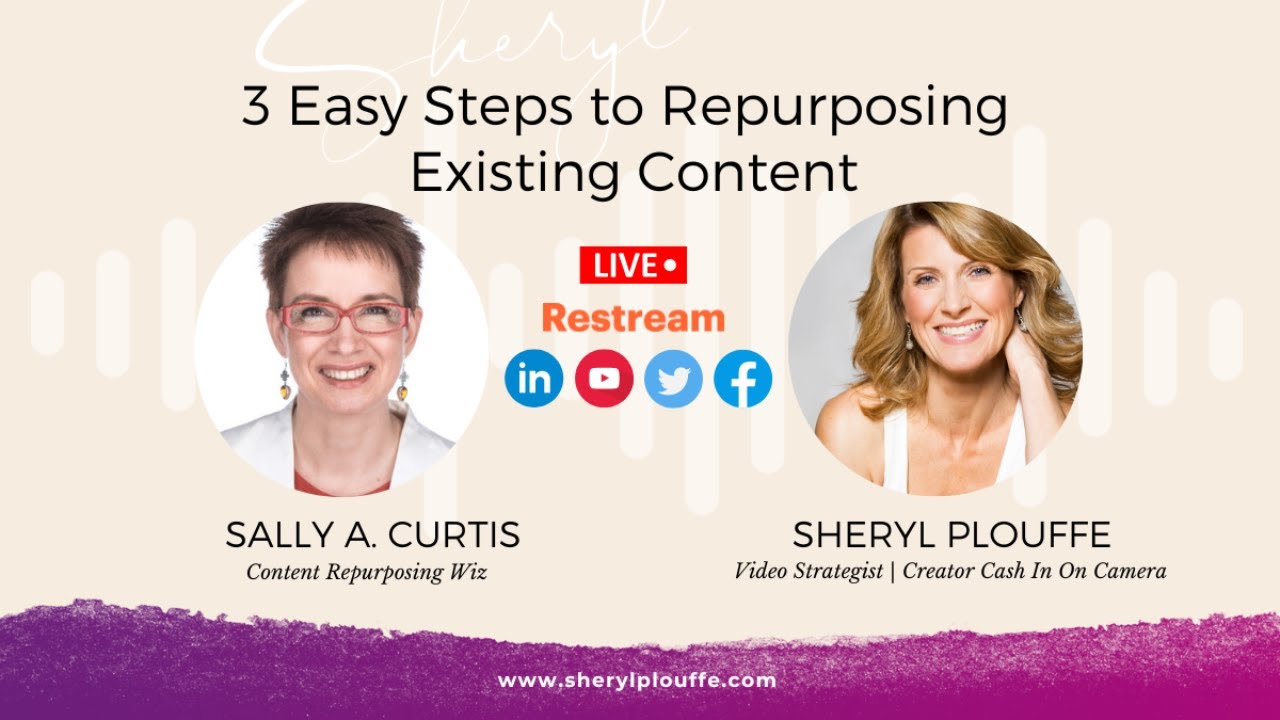
Sally Curtis, a content-repurposing strategist, breaks down how to turn books, articles, and transcripts into social media graphics. Scan for standout sentences, extract them into a spreadsheet, then design them as tiles in Canva Pro. Give away your best material free to build loyalty and sales.
Chapters
that work over and over and over again, which brings us to today's topic. Welcome to Cash In On Camera. We are going to dive into repurposing existing content today. Sally Curtis, all the way from Adelaide, Australia, is here with us to share her 3 easy tips to doing just that. Sally, so great to have you on the show today. You and I are both from the same, I think, world in terms of like really leveraging the work that you're already doing and then maximizing that. Leveraging that to the fullest extent that you can. What is your opinion about repurposing content in the world that we live in right now? Is it something that, you know, you're seeing not enough entrepreneurs doing, or can you give me a lay of the land of what you're experiencing on your side?
Yeah, absolutely. Well, first off, you've said my favorite word at least 3 times, which is leverage. So I'm super excited and getting goosebumps at the thought of that. So the big thing for me is I see so So many people get stuck, especially experts, especially those speakers, coaches, and consultants that are really starting to make a dent in their universe. They get stuck in this content creation hamster wheel, and we see a lot of people where they become fatigued, but we've also experienced that our own clients have become fatigued over the last few years with COVID and all the changes that are going on. So a real thing that's helping regain people's attention and get your community excited it is shifting from this very long-form content into these bite-sized chunks. And I think that's where repurposing written content like books and articles and blogs into bite-sized, easy-to-digest consumable chunks that your clients, audience, community can consume even on their worst day, that being the tip.
How much content is too much? Is there such a thing?
I think that can only really be answered by how much content does your audience consume and how are they consuming it. Obviously in an academic world they're used to reading white papers and all those sorts of things, so long-form content is very normal for them. For the rest of us that are entrepreneurial, that are fast-paced, it needs to be easy to consume content that's tends to be a little bit shorter because we don't know what's going on in our clients' world. So I think if you could have a variety of long-form, short-form, bite-sized, different types of content, then you keep that connection, you keep the inspiration and the entertainment, so you sort of capture everything. So I think all content is good content as long as it's driven from a purposeful place and it's what your audience is needing at the time to give them forward movement.
Yeah, and you're right, the strategy behind that content creation is something that needs to be there. And we're going to go along the assumption that that's already solved, right? That we already know the strategy, we know the audience, we know what kind of content. We're fast-forwarding this conversation out to the place where we've already created content, but now we want to repurpose that content. We want to take what's already been done. We want to maximize it. And we want to be able to create new pieces of content from within it. And you have some, some steps, 3 easy steps to help us understand better the repurposing of your existing content. So let's dive into that. What is your first step for entrepreneurs, coaches, consultants, online entrepreneurs who want to do this repurposing?
Okay, so first off, grab an article or a book. So I tend to So, start this process of learning this process with written content. I find that's the easiest place to start. I'm now going to add a layer of weird into that, and I'm going to preface by saying, do you remember in the '90s there was those stereogram images that you used to be able to buy that were the 3D versions and you used to stare at them and something different would jump off the page?
Oh, yeah.
Some of us might remember those. So, that process of where you sort of unfocused your eyes or sort of looked past what's is what I mean when I say the first process is scanning. So we're not reading the article, we're not reading the book, we're actually just going to scan the pages and by scanning it and not overly focusing on the words, you're actually wanting to see what jumps off the page. And the reason we want to see what jumps off the page is because then you're going to create from a more inspired space and you're going to be in an inspired state versus trying to do something methodically because the extraction process and content repurposing, if you try to do it too methodical too soon until you've learnt the practice of it, you'll get bored with it really quick and frustrated. So the tip is get your piece of content and scan it to see what jumps off the page. Often that starts by looking at the index page of a book and seeing which chapters jump off the page first and starting with those chapters first, not starting from chapter 1, chapter 2, chapter 3. Start with the chapters that jump off the page because instinctively and often intuitively, that's exactly what our audience is needing right now because that's why it's jumped off the page. Does that make sense?
Yeah. So in that written— in this context of the written content, let's say using the index or even going through chapters in and of themselves within a book, you're recommending just scanning through it as opposed to actually doing full-on curation of Quotes or pulling quotes, which is different than what I would have expected.
Exactly. So my favorite tool is either a highlighter or a pencil, and I literally go through it and just see what jumps off the page. And I do underline it, and usually in and around that key phrase or that keyword that's jumped off is the relevant sentence or story. So it's just helping you highlight things very quickly, and often you'll find when you've done it a few times that there's often a gold nugget of a sentence at the end of a paragraph. Or at the end of a chapter because you're recapping what you've actually shared. And it's those recapping moments and those little golden nuggets of, you know, teachable moments or tips that are often at the end of something or at the end of a paragraph in the thing. And by scanning it, that's actually what, what comes to the surface.
I love that. And so when it comes to the second step to repurposing content, where do we start?
Now, this is where it adds on perfectly to where you've said, because we've scanned through it, we've highlighted, we've seen keywords, we've seen phrases. Now we're going to look at the extraction process, which is, okay, what can we extract from what I just highlighted? Is there a sentence near or around it? Is that the sentence? So, now we actually go through and pull those elements off. I often, you know, work with PDF, etc. Sometimes as well or whatnot, and I pop it into an Excel spreadsheet so I'm seeing what I'm capturing. That gives you the volume of work that you've got, and then of course based on the strategy and the priority, we work out which of that content is actually going to go through to the creation stage. So, the extraction stage is again not prejudging what's there, it's just extracting everything that you found. The teachable moments, the stories, the quotes, the rants, the phrases that we say all the time that our audience know we say that we often don't know we say, those sorts of things, putting it all onto a document so you can actually see for the first time in a lot of cases the absolute gold that you have in your own intellectual property. You're re-seeing it with fresh eyes for the first time, and again, this gives you encouragement and puts you into that inspiration mode.
And in that extraction phase, that is not the time— my guess is it's not the time to start being critical of yourself.
Absolutely.
This is the time to just look at it for what it is and extract those golden nuggets that are already published.
Correct. And they are already published, so they're already significant. They're all ready to serve your audience. It's just about collating them so you can pull them all out. And for the first time, so many clients who've spent so much effort and time creating an article or writing a book or doing a blog or a video, whatever it is, they've put their lifeblood into it and they've moved on. They've got bored with it already. But when you see it in this manner, you actually see it with fresh eyes and you can actually appreciate it for what it really is. And that in itself is a gift because you're seeing it again, how your clients can consume it and how they'll see it. So I find that when clients have got into the practice It actually really helps them feel excited about what they're doing and how they're serving their audience.
Yeah, seeing it through fresh eyes is always a great perspective. And so that brings us to the 3rd step. What do we do here?
What we do here, this is the creation step. Now I do have a slightly bossy streak, so I do suggest a little teeny step just before that. And we use and suggest Canva Pro. Most people that I work with these days have all experienced Canva, which is where we create the graphics. And we turn these little snippets of written context into visually stunning graphic tiles, and we use Canva for that. So what I suggest here again, just to keep this inspired state so you don't end up down a rabbit warren again, is to actually create some templates based on your brand, based on your essence, create some templates that are ready for you to drop in this content that you've extracted. And also another tip would be to find a emotive images in advance before you start trying to create. So set yourself up for success in this creation phase as well by setting up some templates for your tiles, as well as finding some emotive images that you can use on these tiles, because they help to position the viewer, and then start going into the creating by adding these phrases over the top, etc.
Sally, when you refer to tiles, are you meaning graphics? Is that, is that your expression for— okay, yeah, in North America we probably— I don't know that we talk about them in terms of tiles, but maybe for those who are listening from other parts, we're talking about graphics that you would create within the Canva tool itself. So the actual artwork, the artwork or the content would be built there.
Absolutely. So if you think in very old-fashioned terms, if you think of it's a postcard in the easiest, or a meme some people call them as well. We're creating those graphic tiles, and I use the term tile because depending on the platform, it depends on the size and the shape and all those sorts of things that people may repurpose it into. But a graphic tile is literally the— a beautiful postcard or image that you've created with your content on it.
Yeah, I've been using Canva Pro for longer than I know, and it's essential. I mean, that's just the long and short of it. It is essential to, I think, an entrepreneur to have Canva and especially the pro level. I mean, it's so affordable. You can create so much with it. It's fantastic. I love the idea of creating those templates. I've done that myself. I continue to do that. And, and the great thing about it is that they're repurposing from the sizing perspective. So if you have, let's say, a graphic tile, it's in square format. You know, you can expand that to different sizes and reshape it, resize it. And yeah, I mean, I can't say enough about Canva Pro. I'm a big fan myself. So number one is looking at your scanning and highlighting your written content. Number 2 is extracting that, you know, different phrases or different turns of phrase and things along that line. And then the third is using Canva Pro to start creating those graphic tiles within the tool.
Yeah, very, very much so. And it really is as simple as that. It absolutely is as simple as that. But as humans, we overcomplicate it. So my next tip would be not to overcomplicate it. It is literally just scan, extract without judgment, and then create, but set yourself up for success by creating those templates and having some imagery already sorted. Otherwise you get distracted with images and you don't actually create the tiles that you're looking to create. So it's all about speed and efficiency with some of those tips as well.
And you also mentioned about imagery and making sure that you have emotive imagery in advance. Do you like the photography and the images that we can get and access within Canva Pro, or do you recommend going to an outside source and maybe even paying for some emotive photography that you could then import into the tool?
I'm going to suggest a bit of both. So I think if you're— if there's images that you've often used on your website, we've often paid for those, or images that you have actually paid for, if they really are solid to your brand essence, then I would absolutely be utilizing those or parts of those in your Canva designs. But if you don't have many of those and when you get into the production of producing, repurposing your content, you actually do want a really relatively large library of these images. There are so many on Canva and up in the little URL, you can actually search for. So if I want, you know, 50-year-old couples arguing, I actually type that into Canva and I'll find 50-year-old couples arguing. So you can use the URL search function— or sorry, not the URL, but you can use the search function within Canva and you can find exactly what you want. That's where when you're trying to create tiles in a hurry, if you've done that in advance, you won't get excited by all of the possibilities of the images that are there, and there are so many. So huge, huge fan of Canva. I don't know where we would have been without it.
Yeah, I agree with you. I think it's a phenomenal tool. What I'm really— I love what you're doing and the idea of starting with, again, the written word. Obviously, this is fantastic. If you're an author, leverage your book. You've already put your life's work into that, into that tome, into that work, into that book. So why not You know, take that and let that be a starting point, which is really aligned to what you've shared with us today. Sally, tell us a little bit more about where people can learn about the work that you do, and it actually is fantastic for authors.
Yeah, very much so. So what I have created is this ebook you can just see up on the screen, The 3 Easy Steps to Turning Your Book into 2 Years' Worth of Content. And I say that quickly, but the reality of it is we do turn the average book into 200 and 300 tiles for our clients, and e-newsers and, and, and. So, there really is massive opportunities sitting in your books, again, when you see it with fresh eyes. So, what I've done here is created a more extensive version of the 3 steps, so outlining all of the weirdness of how you go about scanning, what the steps are, and I've got some demonstrations of how you, how you go about creating tiles, what templates look like, the extraction process, and all of those little tips in there and how you get yourself out of your own way when you get stuck along the way, if that's the case. And that ebook will also go into a little mini training scenario as to how to store and sort and store your content prior to doing the different extraction processes. So that'll keep people well and truly out of mischief for a while and give them the opportunity to really create some repurposed content that is the lifeblood of their business, that demonstrates their inner genius and how they serve their audiences very, very well.
Is the URL for that easy to verbalize, or should we put the link below this video?
We could put the link below the video, that would be good. Do you have it handy? Otherwise I can pull it up.
You know what, I'll put it in the— I'll put it in the comment section below this video after. I can do that because I think that the URL— I can grab it here, but Let me just copy this and I'll show it to you, um, maybe in the chat. And while I'm asking you the next question, you can tell me whether or not I should put this on the screen. Okay. Um, I would love to also know, Sally, what is something that you find that is really, um, working for you in terms of marketing yourself and the work that you do? What is something that's really— you find working for you right now and part of our Stop marketing like it's $19.99 feature.
Yeah, absolutely. The big tip that I would have here that was shared, and this was shared with me by a coach about 8 years ago, and at the time I was sitting in a place of fear and I didn't get it, but I absolutely get it now. And that is, do not, do not be frightened to give your greatest stuff away. If you can serve your audience and help them have forward movement without you, You will be rewarded with their loyalty, their referrals, and then their business, often in that order. So give your greatest stuff away. People will love you for it and they'll talk about you.
I love it. And I agree 100%. So many people hold their cards close to the vest. And if you were just willing and wanting to be more of service and kind of give before you ask for anything in return, which is one of the tenets of what we do with Profitable Podcasting, it works because it's just reciprocity in action and I think it works really well. So, this is the URL. So, I mean, we'll obviously, we can even type this into the comments below the video on different platforms too. But we'd love to be able to direct people over to get your free ebook, you know, the 3 Steps to Turn Your Book into 2 Years' Worth of Content, which is fascinating and I think very useful, especially for those who are authors or aspiring authors to even have knowledge that something like that exists. It's fantastic.
The process works exactly the same with articles and transcriptions from videos. So as long as you've got it in that sort of written context, however the content originated, that book will actually help them have forward movement with those steps to repurpose whatever their content is.
Fantastic. Oh, Sally, this is great. I really love these tips. Thank you for coming on the show today and sharing them with our audience. And we really appreciate you taking the time all the way from Adelaide, Australia today.
Thank you very much. It's been an absolute pleasure. Thank you.
More from Sally






The Coaches Results Express: How to Build a Thriving Coaching Business That Actually Works


