Career to Legacy: Designing a Path that Influences the Future
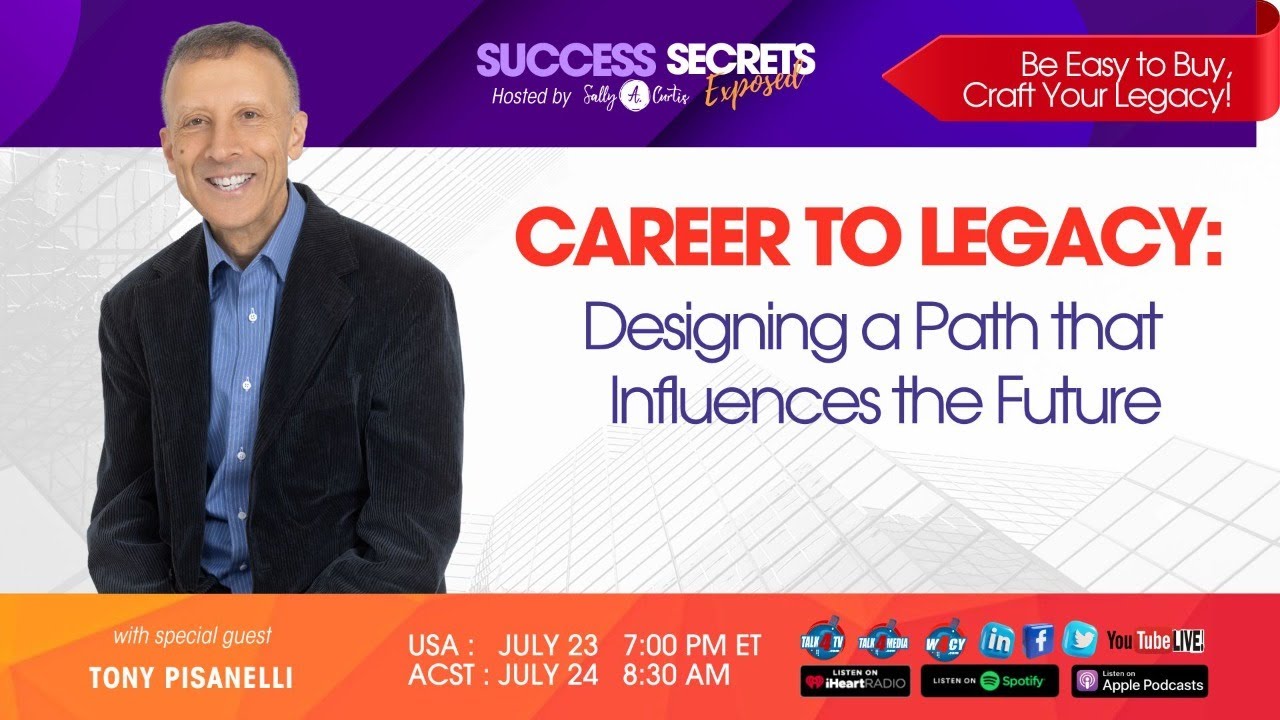
In this episode of the Success Secrets Exposed / W4CY Radio series, host Sally Curtis interviews career coach and two‑time international bestselling author Tony Pisanelli about moving from a conventional job or career to a legacy‑oriented calling. Pisanelli shares his personal corporate background, the moment he realized the fragility of a job‑centric identity, and how that spurred his transition into career coaching. He introduces a three‑dimensional career model—job (income), career (growth and status), and calling (purpose beyond self). Drawing on Maslow’s hierarchy, he describes two internal forces: a safety‑preserving drive versus a growth‑seeking drive, and how the “why‑not” voice can block progress. He outlines his five‑step “Career by Design” methodology, illustrating it with client stories that turn solved corporate problems into new consulting or entrepreneurial opportunities (e.g., product‑development mother‑food idea, landscape‑gardening business, food‑waste to supplement conversion). Pisanelli identifies three core characteristics of people who leave a legacy: willingness to embrace growth challenges, building a personal brand that reflects one’s essence, and an entrepreneurial mindset that creates higher‑value outcomes from low‑value resources. He reinforces these points with historical and contemporary examples—Jeff Bezos, Michelangelo, Steve Jobs, Taylor Swift, Howard Schultz, and others—showing how taking risks, owning one’s narrative, and serving large audiences generate lasting impact. The conversation concludes with practical advice on overcoming fear, the importance of purpose, and promotion of Pisanelli’s book Career by Design: Playing a Bigger Game and his LinkedIn/website for further coaching.
Chapters
The topics and opinions expressed in the following show are solely those of the hosts and their guests and not those of W4CY Radio, its employees, or affiliates. We make no recommendations or endorsements for radio show programs, services, or products mentioned on air or on our web. No liability explicit or implied shall be extended to W4CY Radio, its employees, or affiliates. Any questions or comments should be directed to those show hosts. Thank you for choosing W4CY Radio.
Welcome to the Legacy Leavers series on Success Secrets Exposed. Tune in live every Tuesday at 7 PM Eastern time or Wednesday morning on W4CY Radio and Talk4TV. The series showcases experts, changemakers,
Good morning, good evening, and good day to you all, and welcome to another episode of Success Secrets Exposed. Our topic today, Career to Legacy: Designing a Path That Influences the Future. And our guest today, Tony Pisnelli, is a 2-time international bestselling author. speaker. And business professionals are burnt out by unrelenting demands or are anxious that the axe will fall on their jobs. They turn to Tony to discover how they can overcome their current dynamics or find their next career path. And Tony is on a mission to help individuals expand their careers beyond the confines of a job for an income and status to one that leaves A lasting impact. So please help me welcome to the show Tony.
Hi, Sally. I'm delighted to be here. Thank you.
You're very, very welcome. I'm thrilled. I know it's been a little while that we've been planning and plotting to have you on, on the show. So I'm thrilled that you're here with us today to share your insights and wisdom. Thank you very, very much. Pleasure. Now, I'd love to start because I know there's always a story behind the story. Can I ask you to just share a little bit of your backstory? of how you've sort of come to the point where you are in your own career?
I guess in becoming a career mentor, coach, advisor, consultant, whatever you want to call it, really stems back from my own career journey where I spent a lot of time in corporate Australia, which presented a lot of challenges. And some of the earlier challenges I experienced, I went through career dissatisfaction. where I just simply didn't like the work I did. So I had to work through that. And then I went through another stage where I was selected to lead a major project in the company. And when that project was successfully completed, there was sort of a limbo time where there was no role for me in the company. Called into my manager's office. And was offered a redundancy payout, which I declined. But it was interesting. It was a wake-up call for me to realize, Sally, that you could be the man of the moment one day and tossed out like a pen that's run out of ink the next. Hmm. And it sort of became a bit of a clue for me to realize up until now I've been simply doing my job. as a sort of solid, solid corporate citizen and thinking that would be enough to get by. I need to actually now start proactively managing my career because these individuals don't really care about me beyond what I can actually deliver and do for them. And then later on, there was another incident I experienced which again reinforced the importance of proactive career management. It was at a time when I was working for the company's deputy CFO, and he was a very ambitious individual, hell-bent on becoming the CFO. At 6:30 one evening, I've packed up my briefcase and was walking out this narrow little corridor to go to the lifts when a voice over my shoulder said, where do you think you're going? I haven't finished with you yet.
Oh no.
And I stalled in my tracks and turned back and it was the deputy CFO and I had to turn back and put in another hour's work. And it was a very long hour and it was during that hour I realized companies want your life. They want, you know, they really want to encroach on your own personal time. And it was at that point I pretty much decided that the day would come when I would walk out of corporate life and reclaim my freedom. And that sort of became the reason why I chose career coaching because I subsequently beyond that became a keen observer of how people went about managing their careers. And I saw the devastation that male executives in particular went through when they lost their jobs. And the best the company could offer them was, well, we'll help you polish your resume and update your interview skills. But these people were devastated emotionally. They'd been punched in the heart and kicked in the guts in one hit, and they needed more than that resume upgrade. And that's where I recognized there was a bit of a niche in the marketplace and I was keen to fill it. So that's how it led me to do what I do today, if you like.
Yeah, beautiful. And I love that you shared that, the story of when somebody has a career that has ended and they're given some very, very basic support. I remember that actually happening to my husband at the time. And it was very emotional from a family perspective. And just having your resume updated and being given interview skills, it was sort of like, yeah, well, you know, but what you're still asking the questions, what's next? What, what, what, what's going to happen to me? Um, so I love that you've been able to fill that gap to, to really, really support, um, people, uh, in, in that circumstance because it is, it's such a, it's life-changing in so many ways. It's life-changing because the career and the income's finished, but it's life-changing as to what happens next can, can really set, um, the the person up with trajectories in both directions, I would imagine, too, depending on what they choose. So we've talked a little bit about the career, being proactive around the career management, which I love that phrase. So I just wrote that down while we were talking. But why should people aspire to leave that legacy? So I'm imagining when we say that you're it relates to the legacy that they're leaving for themselves, but potentially for their organization that they're slowly working themselves out of as well. So talk us through your version of that.
Okay. So back in terms of our career context, I speak to a lot of executives and they reach the top of the ladder. Okay. And they've got all the embellishments that go with that. They've got the luxury house, multiple cars in the garage, a holiday boat, a holiday house overseas, international holidays and all that. But they start, they reach a point in their life where they ask themselves a question, is this all there is or is this it? So even with all the material elements, in their life, they still believe they're missing something, but can't quite put their finger on what that is. So I come along and say, what are you contributing to humanity? Mm-hmm. What's the bigger picture of your life? You know, what's your, what's the reason for your being here beyond, you know, uh, your own survival and status and looking after your family? What's the greater good that you are contributing to? And a lot of times they can't answer that question. And that's where we start building that out. So that's where I see, I've got a 3-dimensional career review process that I work with people. I'm saying there's 3 levels to a career. The first level is purely a job for an income, and that's usually the starting point for all of us. So as you would know, then it's sort of as we mature a little bit, It becomes about career for growth, advancements, more income, greater status, and developing our leadership. And then there's the third level, which is called the calling level, where it's about serving a purpose beyond our own life, beyond our own family, and for the contribution to humanity, if you like. That's what I'm saying to these people. There is What else is there? This is what is the what else. It's your contribution that you'll be remembered by, that will register your existence on the planet.
And what I'm going to ask this question, what in that moment when you're having that conversation, and it might have been, you know, it might not be the first conversation, it might be the second conversation down. I imagine that when they suddenly hear that calling, so you know that they've got something niggling at them, but you're sort of working with them and they suddenly hear their calling, what happens to their face? I can imagine that, you know, a penny drops and you see a light bulb go off or something. Talk us through one of the experiences of what happens in that moment.
Well, typically they'll tell me, well, I don't know what that is.
Yeah.
Okay. I have no idea what that would be. A lot of men, for example, retire or delay their retirement because they don't know what to do with themselves beyond that. And retirement years can actually be a great opportunity to do something around leaving a legacy, such as passing on your wisdom. So I would say to that person, well, you don't know what it is. Tell me about some of your professional and life experiences and how you could combine that, repackage that to actually help the next generation. And then that opens up their ideas and the conversation about what that legacy could look like.
Beautiful. Thank you for that. I'm glad you shared that because one of those elements is— I do hear it— is that people are delaying retirement. They lose their identity when they retire because they don't know what's next and they've got a calling because I think COVID sort of opened up that conversation, that awareness with us. What more is there for me? Is this all there is? What's next? So giving people the methodology and the pathway and the conversation to open up that contribution conversation must just light people up when they finally realize that they've got so much inside of them and it's so, so valuable and they have a way in which to share it. So that's amazing. So let's ask now, what stops people from moving from a career or from a job or a career to leaving that legacy? What, I know we just sort of touched on it, so let's dig it a little bit deeper. What generally stops them and how do you help them overcome those things?
Yes. What stops them becomes the career, the coaching opportunity, obviously, because you're trying to overcome the stopping factors. So let me present it this way. So one of the people I've learned quite heavily from is a gentleman called Abraham Maslow, who is most famous for Maslow's hierarchy of needs. And he talked about there are 2 forces, Sally, inside every human being, all of us. And we're all dealing with these 2 forces. The first force has managed to secure its, a certain level of survival level And security level and status level, and therefore is seeking to protect that. Okay.
Then
there's a counterforce within each of us that wants to grow to the next level. Can you relate to those 2 forces, Sally?
Absolutely.
Okay. We all have those, but those 2 forces are constantly battling With one another.
Yeah.
Okay. So the conversation is, okay, Sally wants to do, host a podcast. That's the growth element of what she wants to do. And then there's another voice inside that says, Sally, what happens if you fail? What happens if you make a fool of yourself? What happens if you forget the questions? What happens if the technology doesn't work for you? And if you listen to that voice, Yeah, but if you listen to that voice, you're not gonna grow.
You stop. Yeah.
Okay. And the contribution you are making through hosting these series doesn't happen. My message doesn't get out in the world. The next person's message doesn't get out, certainly not through your interviewing medium. So it's— Maslow went on to say, at each point when you are faced with a decision between whether you listen to the voice that keeps saying, why not? Versus the voice that says why, always choose the voice that says why.
Yeah,
go for growth each time.
Yeah, beautiful. And, um, that from a human being perspective, it is that being of continually growing, isn't it? Because you're continually being and moving and transitioning into something else. Um, so can I ask you to sort of explain, um, the key principles of your Career by Design coaching method and how helps people in that transition, transitional stage?
All right, so people in transition. So I've got the 5-step methodology and I share to people. So for example, let's take the transition situation where a person is not sure what they want to do next, and the conversation will harbor around, okay, what problem, if you're in the corporate, for example, what problem have you solved that in some way will allow you to consult, coach, train on going forward? A gentleman I was speaking to recently had walked into a job where he was leading a team, but the team was dysfunctional. People didn't walk, communicate with one another. They were doing their own thing. There was hostility within the team and he had to bring them together and have tough conversations with certain people. Okay. And brought the team into line. And he had to work all this out himself because he went to books, but they didn't give him the answer to it. He went to HR and they couldn't tell him. They said, well, just have a conversation. With these people. He said, well, what do I say to them? How do I say it? And what order do I say it to them? So he worked all this out, came up with the solution. And then when he came to retire, had a conversation with me. Well, I go, well, I don't know what to do. I said, well, you've just gone through this. How about you go back into a consultancy capacity with corporations and teach them how to do it?
So valuable.
Because typically the problem that you have solved for yourself becomes the problem you can help solve for others.
Yes. So very, very, very true. Yeah. So coming back to that, I'm gonna go back to the 2 forces. How do you ensure that the— so mine's called the Grotty Goddess, the one that sort of does the, you know, The negative, negative talk. So how do you ensure that the greater force wins, the good, the good guy on the other shoulder?
Okay, the why force. Okay, so why? All right, so it's important to understand human beings are motivated by seeking pleasure and avoiding pain. So if We, if people believe that there's more pain associated with stepping into the growth element, they're not gonna go there. But if they see there's some rewards and pleasure for going to the growth side, then they will go there. So let's take an example of Jeff Bezos who headed Amazon or created Amazon. So He was faced with a choice of staying in his secure Wall Street financial job. But deep down, when he was a child, he used to invent things in his garage and wanted to do something inventive. And he had this idea of doing something on the internet. And he spoke to his boss about it at the time and said, look, That sort of stuff is for people who don't have a job. Why do you wanna even do that? But he said something was really important. He said, if I don't do this, I'm gonna look back at my life when I'm in my final days and I'm gonna be haunted.
Mm-hmm.
That I never went out and did that. So that's what I connect people to.
Mm-hmm.
You say to overcome your why nots, how will you feel at the end of your life? When you look back and you face the vision that you never did what you knew you were capable of. I remember another story, Sally, just briefly. Yeah, please. There was a gentleman in a hospital and he was in the final days of his life and he called his palliative care nurse over and he said, I'm experiencing double pain. 2 levels of pain. And she said, well, what do you mean? Well, my, my body is raking in agony from physical pain. She said, well, what's your other pain?
Mm-hmm.
He goes, it's my— it's this emotional pain. I'm beginning to look back on my life and just feel the guilt and anger at myself for not having taken the step to overcome the why-nots and grow into the person I could have become. That's what I share. I share those sort of stories with my clients to say, which one of those persons do you want to become? The person who plays it safe now or takes a step and faces the risk and grows? And that way, when you reach the end of your life, you're not going to live with the regret.
Yeah. Yeah. And it is, um, thank you so much for sharing those stories because it is as simple as just taking that, that single step, isn't it? It is that step. into the future that helps to unlock all of the ideas and the potential so you can take another step, so you can actually continue moving and having that continuous growth. I'm just going to ask you another question that's just popped in because I think these examples of where you've worked with clients to help them see the problems that they're solving in their career that they can then turn into the new possibilities outside of or outside a corporate career. Can you give us a few more examples of some of those epiphanies you've helped people have around what value they have and what they can contribute from the career, the corporate scenario, to when they're transitioning out?
All right. Well, the story of another lady who worked in an organization and she was in a strategic role. And she was in a product development role. So they were looking at what products they could develop in the future because as current products become obsolete, the companies always need to because every product has a life cycle. So eventually this woman who goes on maternity leave, Sally, one day is in the supermarket to buy some groceries and some baby food for her child, for a 1-year-old child. And she observed something interesting whereby the mothers were quickly taking the food off the shelf. It was some quickly packaged baby food because of their guilt. They weren't actually preparing proper meals for their, their babies, and they just didn't want to be seen. And they just quickly took those products and quickly rushed down the aisle. And she observed that and she thought, that's really interesting. And we came up during the coaching sessions, how about, given she had product development skills, one day she could work towards creating a unique, healthy product range for babies whereby mothers don't need to feel guilty about what they were feeding their young ones. So she was taking, even though she wasn't working in an organization that was about baby food, she was taking her product management knowledge, connecting that to a need in the marketplace where mothers were feeling guilty about what they were feeding their children to create a business idea for herself.
Yeah.
I'm a big believer that, Sally, that life is always— if we are observant, life is always speaking to us and giving us clues.
Yes. Yeah, very much so. And can I just, while we're talking about life speaking to us and the clues, I remember you telling me, and if I've got the name wrong, please correct me. Is it Dave or Gardner? I know, a completely different angle here. But I, I love that Dave story of, you know, his— I'm going to call it his inner genius and how he's been able to expand and contribute. And I think that's potentially a good story for those that are perhaps not in the corporate career transitioning out, but a different version of another story of how someone's found their their calling.
Well, yeah, Dave worked for municipal councils maintaining the uptake of parks, municipal parks. And what he found was when he was working for these councils that they were operating with a standard policy. Each park had this, this, this, and this. And he goes, well, I actually wanna express some creativity and design something unique. And said, no, no, his manager would always say, no, we've got to follow the policy, right? That's this plant here and that plant's there. Don't worry about color. Don't worry about this central feature business that you keep talking about. And he sort of said, well, if I'm gonna be working for someone and my creativity is gonna be denied, what's the point? I can't express who I am. So he then— that became the catalyst for him working for other landscape gardeners and sort of learning the business side of stuff before he then transitioned to running his own business as a landscape gardener.
Yeah, beautiful. And he was obviously in that role, as you've expressed to me, he was able to showcase his significant feature and look at the bigger picture and create elements of beauty both for his own satisfaction satisfaction, but also obviously for the clients that just love the work that he's doing, as you've shared with me as well. So yeah, that's— I love that story as well. So thank you for sharing that. Um, can I ask you to share the 3 characteristics that separate people who leave a legacy from those that don't? The big question.
3 characteristics. Okay, let's talk about the first one. Let's connect it back to that Abraham Maslow, the growth element, choosing the safety versus the growth. So if you wanna leave a legacy, expect to grow, you need to face the decision where you leave your status quo behind and step into the unknown. So I briefly touched on Jeff Bezos previously, Sally. So he's in a secure financial role and he needs to grow beyond that and leave. And so he lets go of his regular salary. That's one. So he grows beyond that. He needs to borrow $300,000 from his parents to start this business. So that's a growth decision, isn't it?
Yeah, absolutely. Big decision.
He'd only been married about a year at the time. So he had to approach his partner to say, look, I'm thinking of doing this. Are you gonna be supportive or not supportive? Right? So that's another growth step. They needed to relocate their home. That's another growth step.
Wow.
And then he came up with the concept of, I wanna start an online bookstore. Not many people knew what an online bookstore was at the time.
Yes.
So that's another growth step. So if you want to leave a legacy, you need to grow. Now, that's the story of Jeff, and I'll share another story around the growth element. It was about taking on a bigger challenge, a challenge that most people aren't prepared to take. The people who I see prosper today in organizational life are the ones who are taking on big challenges.
Yes. Yeah.
Back in the 15th century, some officials at the Florence Cathedral in Italy wanted to build a statue. Now this, so they bought this marble, big marble stone. It was 19 foot tall and weighed 6 tons. So they approached the leading sculptor of the time whose name was Agostino and they said, look, Can you build us this statue? And he said, okay. So he worked on it, chipped away at it, and discovered there was some flaws in the marble. The vein was interfering with what he was trying to do. So he gave it away.
Discreet.
After 2 years. So the— after a passage of time, the officials hired another gentleman whose name was Antonio Rossellini. He worked on it for about 2 years and So look, this is too big. It's just okay. I'm, I'm not gonna be able to, to do this. So he let it go as well, right? He couldn't grow beyond the challenge of the imperfections in the stone and the vein and the size of it. So some 25 years passed, and the officials identified that another sculptor had come along on the scene by the name of Michelangelo. So they approached Michelangelo and they said, look, can you work this statue for us, the Statue of David? So he worked on it, and because he had an understanding of the human anatomy, he redesigned the form of the Statue of David to work around the imperfections. To produce the statue. So here's an example. If you want to leave a legacy, take on challenges and grow beyond, you know, the excuses that this is imperfect and this is an error, this won't work, or this is too big. And then he has left a legacy. So the other 2 gentlemen are not known today. They never left their legacy because they gave up.
Yeah.
Okay. So the growth element is number one, if you like. The second element, if you want to leave a legacy, I believe is You've gotta be prepared to put your name out in the world and create some sort of personal branding. I see you nodding your head given you're in that space. So I follow the story of Steve Jobs. He's a classic example. Apple became synonymous with the name of Steve Jobs. Steve didn't hide behind a title of CEO or this or director or vice president or president or whatever. Steve Jobs was Steve Jobs and he presented himself in the world as he was. So he'd had his turtleneck, skivvies, his jeans. He loved sharing stories and presenting. Steve Jobs was Steve Jobs. More of us probably need to do that where we've become comfortable presenting ourselves out in the world as ourselves. And that's where you shared, just going back and that was a, A message that was reinforced by Dave the landscaper. When he first visited my home, I remember the Saturday morning when he arrived. He stepped onto the front of my property, sort of did a few circuits around, just looked where everything was placed and positioned. Then he stepped off the property onto the nature strip and took in the whole garden. I said to Dave, Dave, what are you doing? I don't understand. This is the garden in here. Yes. What I'm doing, Tony, is I'm taking in the character of the home. Because before I design a garden, it needs to align and enhance the home. Because I see too many gardens where the garden is a European-style garden they build, but the house might be an Asian-looking house, and it's just a complete mismatch, and it devalues the house. So he identified a garden a bit like your career needs to be an extension of you. Yeah. And Peter Drucker said the same thing. Your career needs to be an extension of your personality. Steve Jobs was an exemplification of that. So if you wanna leave your legacy, be prepared To put your name out in the world. And by the way, there's a growth element to do that. A lot of people can't do that. They want to hide behind the title because you will be criticized. Listen, no matter what you do in life, there will be people out there who will throw peanuts. That is just the way it is.
Very true. And I love that we've— the examples that you've shared there, because one of my phrases is, you know, the When you're creating a personal brand, you don't want a cardboard cutout of the guru that you learned from. It's about bringing that extension of yes, you want to be able to understand what you've learned from that guru, but it's the it's the understanding bringing forth your own essence. And I find when people are trying to play the cardboard cutout game, they are uncomfortable because it's not quite right. There's a bit of that kinky feeling there. But if you can allow yourself to grow into who you're meant to be and be the best version and extension of you, your essence comes out. And then there's that relaxed state, more relaxed state around bringing, bringing your persona and, and your wisdom to the world. So yeah, from that element.
Yes, there's a beautiful quote I share with my clients around, um, bringing yourself to the world. There's a lady, I can't remember the lady's name, that said, we don't change as we grow older. We become more ourselves.
Beautiful.
Can I get you one of the first? Yeah. One of my frustrations when I was in my career, um, the dissatisfaction I had was I'm just being this invisible cog in this large machine. Tony's not being Tony.
Yeah.
And a lot of corporate people hiding behind a title are dealing with that. So now let's talk about the 3rd principle in terms of leaving a legacy. So Sally, I'm a big believer that to thrive in today's world, we all need to think like an entrepreneur.
Yeah.
Okay. So which begs the question, well, what is an entrepreneur? Okay. Because it's typically associated with Well, it's a business person. I'm saying, I think there's more to it than just being that. The entrepreneur is someone who typically is inspired about what they do and is asking themselves the question, how can I serve a large number of people? Like, it's not about how can I make $1 million per se, it's how can I serve 100 million people? So you looked at Bill Gates, for example, putting a computer on everyone's desk. He served a lot of people. And if we look at Jeff Bezos, he's done the same thing with Amazon. How, how much have our lives been improved by the fact you can buy something in front of your computer? You don't need to drive to a shopping center. You don't need to find a car spot. You don't need to stand in a queue. You can do your shopping at any time. So he's made our lives far more convenient, hasn't he? By doing that. Absolutely.
We get to sit in front of the heater and not go out in the cold.
That's the other one. So I also look at someone like Taylor Swift. Now, I can't profess to own any of her music, but I follow her from an entrepreneurial perspective. So Taylor has built a large following of people. She has some 500 million+ followers through social media, but she also tells stories through her music that relate to her past hardships in life and what she's overcome. Stories that her audience can relate to because they're facing similar challenges. So she's prepared to open up, make herself vulnerable. Yeah. And share that. Okay. And then she does concert tours. So she puts herself out in the world. And also what she's done is she's, she found herself in a situation, Sally, where the recording studio companies owned her initial albums. And she wasn't comfortable about that. So she's gone about re-recording those so that she's got the ownership rights. And she's saying to the world, hey, I control my environment, not someone else. Yeah. So what she's saying to her audience in that situation is step into your power, express your individuality, okay? And don't let others sort of trample all over you. That's I see as her legacy more so than, you know, how many followers she has and how much money she's earned. It's the message that she's conveying to the young people who are, who've got a lot of challenges. And by the way, Taylor, if you study her early childhood story, was bullied at high school for having an interest in country music. So she had to overcome her why-nots.
Oh yes, yes, perfect. Yes.
To do what she does today.
Yeah.
So that's an example where I say to people, okay, in your work, what's the greater good behind, beyond just earning an income? What's the message you are directly or indirectly sharing with your audience or the people you serve? I suspect at some point, 5 or 10 years down the track, someone is going to make an impact in the world and they'll be interviewed one day, Sally, maybe on your show and you'll ask them who's been the key influencer in your life and they'll probably say Taylor Swift inspired me to overcome this, that and whatever so that I can make an impact. Okay. The next aspect in terms of having this entrepreneurial mind element to it. So Peter Drucker shared the definition of entrepreneurialism as a situation where you're someone who takes resources from lower value and lower productivity and takes it to a higher value, if that makes sense. And that's what I say to my career clients. What in your corporation company can you take that is of low value and elevate its worth? For example, if you look at the story of Howard Schultz, who was the creator of Starbucks, You had this $5 cup of coffee, but what he said was, I can increase the value of that by creating a place between home and work where people have a meeting or connect.
Yeah.
That becomes a greater value proposition, doesn't it? And all of a sudden in local communities, you see cafes spring up because the idea is born. Well, the value isn't in the cup of coffee per se, it's in the people coming together.
Yeah, absolutely.
So Howard Schultz understood the concept of entrepreneurialism in a career dynamic, take something of a low value into a high value. Another story to reinforce that message from a career perspective, I was recently speaking to a gentleman who I met via LinkedIn who approached me because he was in between.
Careers. Yeah,
he was a chief executive officer, okay? And he worked for a food company. And this food company was approached by a conglomerate of farmers who represented farmers, and they said to him, we have a problem. Okay, so that's another thing in terms of leaving a legacy. What is the problem? You could ask yourself, what is the problem you could solve? And so these farm— this farmer conglomerate approached this gentleman and said, we have a problem with our farmers producing 100% yield, taking it to the retail outlets, and the retail outlets coming back and saying, well, we'll take 70% of your yield, but 30% is imperfect. There's blemishes and bruises and it's the wrong shape. You'll need to take that back. So 30% of what they've worked hard to produce didn't make it to the marketplace and they virtually had to throw away or sell it on the cheap for pig feed or something of that nature.
Yeah.
So this gentleman said, I think we've got a solution for you. So he was aware of through his extensive network of a particular machine that existed where he said, what we can do is we can take your carrots and your beetroot and your apples, and we can put it into this machine, and we can produce some supplement powders, if you like, that's sold in chemists and health shops, you know, that you put in smoothies— beetroot powder, orange powder, and whatever.
Yeah.
Okay, so we can take this food and we can convert it into that. And he had some equipment Where the produce is taken and it's put in through a wine press initially, and they extract the juice.
Mm-hmm.
Then it goes into a, a dehydration chamber where it's dried.
Mm-hmm.
Then it goes into a milling process where a powder is formed.
Yes.
And therefore, the— they were able to sell it to supplement companies At a higher price than they were selling it to the other. So instead of this food being wasted and sent back into landfill, the farmers were making an additional income stream at a higher level.
Yeah.
By producing these supplement powders, if you like. So isn't this gentleman a genius in terms of lower value into higher value? Okay.
Yeah.
Now I said to this gentleman and I wanna go back because I wanna reinforce this point about the whys and the why not. So just to close the loop, if you like. Perfect. I said to him, you know, as a CEO, it's a very challenging job. You work long hours, you probably have to sacrifice time with your family. And I go, I know from my own research as a career advisor that in America alone, Last year, 23 CEOs died on the job. Okay.
Yeah,
that's a tough struggle. And he said to me, he goes, yes, this will be the final CEO job he does. He'll probably move into something else beyond that. And we'll— and him and I are gonna have a conversation around it, what that looks like. And I said, so what's the why that allows you to take on the level of stress that you take on?
And
he said, Tony, well, I have worked in many organizations around the world. And I said, okay, well, what's, where's the why? He goes, at one point he worked for a company in England, Sally, and they produced picnic party packs. I'm not sure if you ever walk around the parks on a Sunday afternoon, we've got the families having picnics. So this company produced these picnic party packs And what they did was they created an elaborate design, one for boys, one for girls, and the actual work was outsourced to lower-priced labor countries. Okay. And one day the CEO of this company was approached by customers who were complaining and saying, look, these patterns are all over the place. You know, there's a small truck here and this and that, and it's just And it's smudged and the printing quality is poor, we're not gonna continue to buy the product. So the CEO approached this gentleman who I've been speaking to and said, look, I want you to travel to these countries and sort out our suppliers, find out what is going on here, right? Because, and obviously the quality standards aren't what they're supposed to be.
Yeah.
So this gentleman travels to Sri Lanka where all these factories are and he does a quality audit to see who's got all the standards in place to make sure what they were producing was up to the level that was required. And then he approached a house which was also one of the suppliers. So it wasn't a factory. There was a family producing these tablecloths and napkins from their own house. So he walked into the house and he could see there was a light bulb and water was dripping from the ceiling and they were doing the work on a kitchen table and obviously a very poor family. And he noticed as he looked around, he realized he wasn't gonna be able to continue with this arrangement because they weren't gonna produce it. But he saw Out from behind a curtain was a five-six-year-old girl who was undernourished, underclothed. Her hair was disheveled, with a sad look on the face. There was no toys in her arms. There was no doll in her arms. And the image of the five-six-year-old girl stayed with him. And he goes, "Here I am." visiting Sri Lanka, staying in an expensive $500 a night hotel, having these expensive meals, traveling business class, and here's his family can't feed themselves. And therefore, he at that point realized how important food was in the world and the planet. And therefore, the prospect of seeing food go to waste Because a retailer was saying it's not up to standard. Totally didn't make sense to him. So his why, in terms of the image of this 5 or 6-year-old girl, became the factor that overcame his why-nots in terms of working long days as a CEO.
Yeah.
So I hope that story, and he is now leaving a legacy Because he's making sure food doesn't go to waste.
Waste, yeah. Yeah, high impact through problem solving in an area that you have your own inner genius in that we just need to discover and act on and have those incremental steps forward. Thank you, Tony, for sharing all of those really great stories and the, you know, the impact that you're actually having. So it's very important I think it's important now that we actually get to tell the audience how they can actually get in contact with you and share a few minutes about the ebook that we've got because we've got the ticker going across the screen as well as we start to close out.
All right. Okay. So I recently published my second book called Career by Design: Playing a Bigger Game. Okay. And that bigger game interestingly enough, is about leaving a contribution. So using your career as a bit of an apprenticeship, if you like, Sally, to develop the knowledge, the capabilities, the experiences, the networks that will eventually ultimately help you step into that bigger game, the legacy, if you like. So I'm trying to rewrite through my coaching and my books, rewrite the rules around a career as being something far beyond something that gives you a source of income and status and power in the world, but it allows you to leverage what you've learned along the way through your experiences and your knowledge to actually make a contribution on the planet. So that's really the intent or the big idea behind the book. So it's available on Amazon. It's called Career by Design: Playing a Bigger Game. And, um, that's a good starting point if people want to learn more about my work. And then there's some resources within the book that allow people to contact me thereafter if they want to have a conversation about their career and how they can leverage that to do something greater in the world.
Yeah, very much so. And the best place to connect with you online is LinkedIn?
LinkedIn at Tony, yeah, Tony Pisanelli. Yep. And I also have a website by the same name as well.
So, um, brilliant. Thank you. Sorry, continue.
Yes, happy to have conversations with people around their career. I'm really fascinated about seeing the purpose that can be spun out of someone's career journey that often, very often, they can't see for themselves. It takes someone with an external perspective to say, oh, what happened if you connect this dot with that dot, as Steve Jobs would say, and you can create a bigger dot, which is that impact that you can make in the world.
Yeah, brilliant. Thank you so much, Tony, for sharing so much with us. As Tony's just alluded to, he's your person to reach out to if you are trying to work out what's next for you and if you're ready to leave and create that contribution and create and craft your legacy and join some of those dots that we all have lying around us and sitting around us that we often don't see when we're looking at it. But somebody with fresh eyes will actually help join the dots and give you your fire in the belly inspiration to, to, to create your what's next. So thank you very, very much, Tony. Thank you, listeners, and we look forward to seeing you next week on another episode of Success
Remember, if you want to be sought after and sold out, as well as being known as the obvious expert in your industry, you need to speak with Sally, our host of Success Secrets Exposed. Sally is the founder of Monetize Your Content, a done-for-you content marketing agency that helps you be easy to buy. See you next week on another episode of Success Secrets Exposed. Bye for now. Success Secrets Exposed. Tune in live every Tuesday at 7 PM Eastern Time or Wednesday mornings in Australia on W4CY Radio and Talk 4 TV.
More from Sally






The Coaches Results Express: How to Build a Thriving Coaching Business That Actually Works


