Christine Handy The Cancer Disruptor
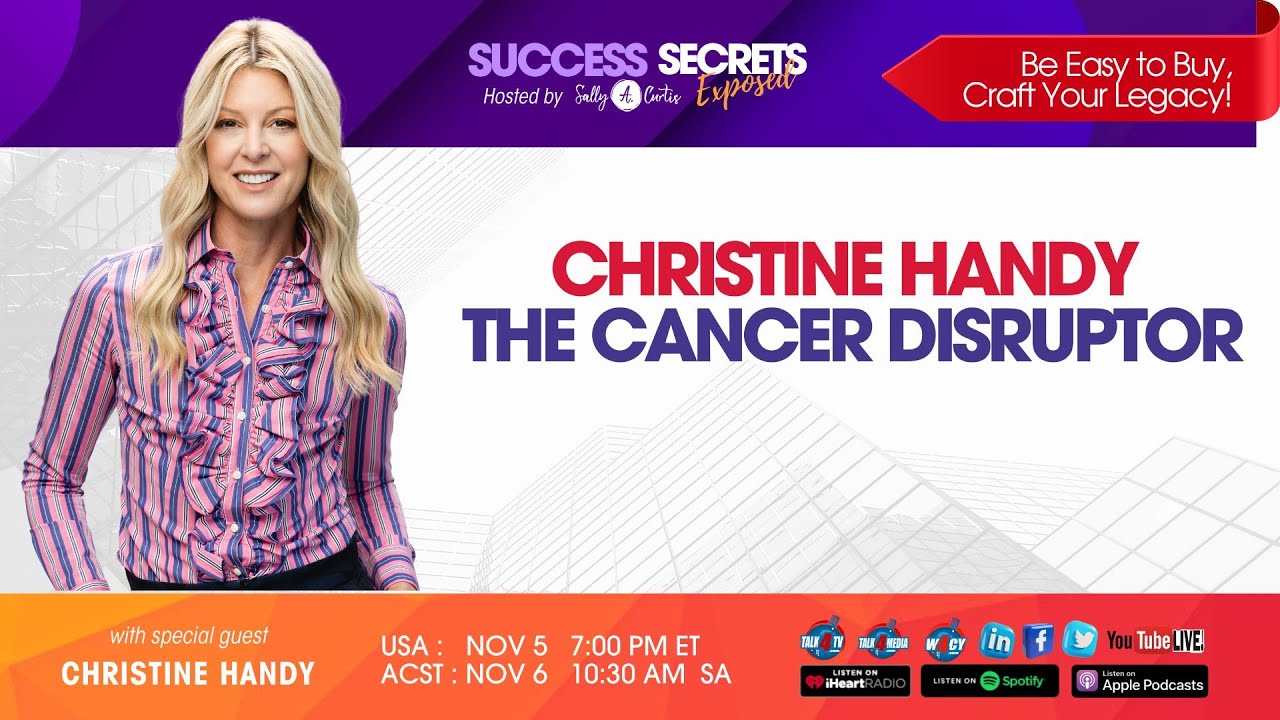
In this episode of the Success Secrets Exposed podcast, host Sally Curtis interviews Christine Handy, an international model, breast‑cancer survivor, bestselling author, and humanitarian. Christine recounts how early modeling taught her that her worth was tied to external appearance, a realization that shattered during her cancer diagnosis and led her to discover an internal source of value and purpose. She describes her transformation into a "hope facilitator," explaining how focusing on internal strengths, self‑talk, and service replaced fear‑based thinking. The conversation covers the creation of her memoir Walk Beside Me, the empowerment she found in finding her voice, and how vulnerability and community support helped her heal. Christine shares practical strategies for cultivating self‑esteem, managing self‑talk, building supportive networks, and asking for help without ego. She introduces the metaphor of moving from a "victim" mindset to a "vine" that grows and spreads courage. The interview also details the upcoming film adaptation Hello Beautiful, its aim to shift cancer narratives away from death‑focused stories toward hope and resilience, and how the film will amplify her message. Throughout, Christine emphasizes balance, grace, and the importance of authentic social‑media consumption, urging listeners to focus on service, borrow courage from community, and persist in personal growth.
Chapters
The topics and opinions expressed in the following show are solely those of the hosts and their guests and not those of W4CY Radio, its employees, or affiliates. We make no recommendations or endorsements for radio show programs, services, or products mentioned on air or on our web. No liability explicit or implied shall be extended to W4CY Radio, its employees, or affiliates. Any questions or comments should be directed to those show hosts. Thank you for choosing W4CY Radio.
Welcome to Success Secrets Exposed. Tune in live every Tuesday at 7 PM Eastern time or Wednesday mornings in Australia on W4CY Radio and Talk4TV. Every week, Sally leads intimate conversations with today's thought leaders, changemakers, disruptors, and masters of their inner genius to bring you tips, strategies, and insightful perspectives on various topics shaping our world. Welcome to Success Secrets Exposed. Our lives and business growth, revealing the human element of success and challenge.
Good morning, good evening, and good day to you all, and welcome to another episode of Success Secrets Exposed. Today we're going to be talking with the Cancer Disruptor. Now today's guest is Christine Handy, an international print and runway model. Bestselling author and inspiring keynote speaker. Christine's book Walk Beside Me is a fictionalized portrayal of her life, and it launched her into the spotlight as an advocate and as a speaker after its release in 2016. Beyond her writing and speaking, Christine is a breast cancer survivor, a social media influencer, and a nationally recognized humanitarian. She serves on the board of People of Purpose, the Break Free Foundation, and the Wonder Woman Initiative, supporting impactful causes. And her first novel is now being adapted into the upcoming film Hello Beautiful, set to release in the fall of 2024. So not long. So please help me welcome to the show Christine Handy. Hi, good morning, good morning and good evening to you. Welcome, thank you for joining us.
Oh, thank you for having me. It's always a good day to inspire people.
Absolutely. And I'd love you to start that inspiration, if you, if you would, by telling us a little bit of the backstory. You know, what brought you from the, that world of high fashion and modeling to become the hope facilitator and the advocate that you now are?
Well, I would say that I— it started as a very young girl, um, in the modeling world at age of 11. Now I still am in the modeling world, and I'll get to that. But you know, when you feel like— well, first of all, when you're an industry that is superficial— again, I'm in the industry, so I love my job, um— but when you're an industry that focuses on superficiality, right, the external portion of you Then for me, that's what I felt like I was. My worth came from. So it was my it was my value in the world was what I look like. And you know when that is stripped away from you in illness, you quickly realize man that never was my identity. That was never my value. And of course, that's one focus. I could have stayed within that focus and said okay well my value is now. gone and I have no value. That would be one focus. Fortunately for me, I figured out my focus was finding who I was inside. And when I nurtured that part of me, instead of focusing so much on the beauty external but on the, the beautiful Christine Handy inside, then I really figured out what my purpose was. And so I went from being a model, you know, worldwide model, to becoming a voice for women, a very big voice in the breast cancer community, but also a voice about nurturing your self-esteem so that people didn't go through what I went through. And what I went through was a very difficult shift because when you focus on external stuff— and that could be— it doesn't have to be external beauty, it could be money, it could be things, it could be relationally, you know, anything that can be stripped away, all of those can be stripped away. Then that's a roller coaster. And I wanted my foundation coming out of breast cancer. I wanted my foundation to be more stable. So when I focused on my self-esteem and when I focused on nurturing that and I focused on faith instead of fear, if we focus on fear, we become more fearful. If we focus on hope, we become more hopeful. So I would say that that shift ignited this pursuit inside of me to help other people with that, hoping that, you know, if they were going through something similar, that they might get that courage that I was showing under that sort of paradigm shift.
Yeah, thank you. And I think you've framed that up so well. There is so many different external variations that we have across humanity and our individualness and our communities. It's really great that you've actually helped share the fact that it's about, regardless of what the element is out there that's our rollercoaster ride at the time, it all does come back to what's inside of us and who we really, really are. So thank you for just sharing that. So being part of the Legacy Leavers series, as we are talking today, I'd love to talk a little bit more about that power of hope and overcoming obstacles. Because you actually describe yourself, and I can feel that hope facilitator In talking with you, can you share how the, the mission developed and why spreading hope, as that word of hope and courage, is so important to you?
Well, if you look at the world right now, you know that hope is important. But I, I, from a, from a personal perspective, when I was going through breast cancer and I realized that my worth was internal and it had nothing to do with anybody externally, Um, then I had this innate power. It was almost like my— it was my superpower. It's everybody's superpower. Well, when you figure out your superpower, which is ultimately always inside of us, then you have the courage to do things that we wouldn't normally have if we're based— if we base our life on external. Because like I said, my hair was taken away, my external beauty was taken away, and so then I felt powerless. So if my power is within, nobody can take that. Nobody can shake that. And so when I realized that I wanted to be— I wanted to show that light to other people, it became a very big mission because most of the people I had worked with for my whole life were also models. Ironically, most of the models that I had worked with have a very low self-esteem because most people don't think that. And so I thought, well, if I can write the book, if I write a book about the good, the bad, and the ugly about breast cancer, but also this transformation, then I can be honest and vulnerable. And wouldn't that be interesting to people to have a true story, right, of very great pain but also great survival? Mm-hmm. And wouldn't that be a way to give people hope? And wouldn't that be a way to be vulnerable and show this dependency on external to this shift in paradigm shift. And maybe that vulnerability would touch people's lives. So if I wrote the book, and maybe if the book got out there, maybe it would ultimately become a film. And if it became a film, that's a bigger audience to show hope. And once I wrote the book and it became popular, I did— I became a motivational speaker.
Mm-hmm.
Then I went back to modeling. with a concave chest, which is a whole nother audience that I was able to touch, which made it— which made a big splash. Because, you know, it's one thing to come out as a model when I'm 11 years old and young and beautiful, and, and then to come out at 50 when I'm scarred up and I have no chest because I lost it to breast cancer, it— those are very different stories. I'd use my history in the modeling space and come back as a disruptor in the fashion world, as a disruptor in the modeling space, as a disruptor as of in the cancer disruptive cancer space, then maybe I can touch people's lives and show them courage. And if I show them courage, maybe they can borrow my courage until they have their own.
Yeah, I love that, borrowing the courage. So when I talk, I obviously work with lots of people that have written, uh, books as part of what I do for our business, and they often talk about how the, uh, that they grow through writing the book because they're birthing the book and they're going through that. With the book being so deep, so personal, and so vulnerable— and I know it's sort of going back— what was the greatest lesson that you've discovered for yourself in writing the book? Because you've just shared lots of the lessons that you've learned and what you're bringing out to the world now. But what was that one lesson for you when you were going through the writing process?
I have a voice.
Yeah, nice.
You know, it's funny, I, for so many years, I thought I didn't have a voice. And you hear, and you hear people saying all the time, oh, you have a— everybody has a voice, you know, go vote, everybody has a voice. And for me, I thought, yeah, I don't really have a voice, I'm just a model. Because, you know, we put— people put us in a box and we stay there.
Yeah.
And so most of my life, when people would refer to me as, oh, Christine Handy, she's just a model, I felt that, and that's dismissive. And so I emerged from this cocoon into this butterfly of being free of all of those boxes that people put me in.
Mm-hmm.
Then I emerged as somebody that, you know, I— you can't— one, you can't label me, you can't put me in a box. But then I also became a person that said, you know what, I do have a voice, because I had the confidence to believe that. And so by writing the book and people accepting it and people commenting on it and people buying it, I was like, I have a voice. And that mattered to me. It— I didn't have the cathartic— I didn't go through this whole healing process by writing the book. It was not self-serving. Yeah. It was meant to be a tool to help other people. It's always been meant to help other people. And if people were touched by that, then that's all I cared about.
Yeah.
And so I never felt like this, you know, cathartic healing process during the writing. It didn't make me— also, I didn't feel like I was reliving the trauma either. I kind of detached myself from, from all of my pain that I went through. I think that was the coping mechanism, which I'm fine with. In fact, I was— once I started to really speak on a more global stage, one of my— one of the people that was helping me to kind of teach me the tenets of being a better speaker said to me, you know, you might want to shed a tear every once in a while on stage. You know, people might be able to relate to you more. And I said, that's not going to be me because I've detached from those feelings, which, by the way, makes me a better speaker because I can get up on that stage and I can be almost like a— have a marginalized perspective of my own story. Like a, you know, like a bird watching. And I can talk about it more freely without the pain, without the stops and the halts. Yeah, I think I've done a good job of kind of distancing myself enough in order to share the story.
Yeah, beautiful. And I love the 2 words that you've actually used there, that freeing nature of the ability to be able to speak in that way. which is very evident with the interviews and the information that people can find online and talking to you and having you coming in as a speaker. But there was also another word that you said about that dismissive nature. And I think, and especially as it relates to the boxes that people may put us in, but also the boxes that we stay in or the dismissive boxes we put ourselves in. So I just thought I'd touch on that because we that dismissive nature that we have, if I look at my own experience in conversations with women, when we are doing that, we actually are dismissing the courage that is internally in us. So I just wanted to sort of touch on that because through all of the courage that you're sharing with so many people, it's, you know, it's our opportunity as the listening audience to recognize that and bring forth that courage in us. So thank you for that.
You know, like, let me say a couple things about that. I think it's so critical to take inventory of our thoughts and what we tell ourselves. And that's so cliché, right? Take your thoughts captive and listen to your voice because you're the one that's inside of your head.
Yeah.
But it's so critical, even the littlest things. So as an example, I play tennis. And sometimes I'll hit a ball and I'll be like, oh, you suck. Well, My I'm telling myself that that is self-talk that isn't that is toxic. Yeah, I'm not a I tried right? We try, we hit the ball, we try if it's a bad ball who cares? It's like don't you know beat yourself up or even the simplest things. But those are the those are the thoughts that can be they're like a wave effect right? If we can call ourselves names, if we can tell ourselves that we are negativity. Then we're— that toxic nature is inside of us. We can have outside of ourselves people talk negatively about us, and we can slowly get rid of those people gracefully out of our lives. But if it's coming from within, we have to really spend a lot of time stopping that. Journal about it, take inventory of it, notice those thoughts, and change them, even if you don't believe them at first. You know what I mean? And that's— and I think that's where the change comes in, because Even when I was shifting and going to better self-talk, at first I was like, this is not important. And honestly, it was critical in my transformation.
Yeah. And it's all those— I love that you've expressed that. It's all those little teeny tiny incremental things that can compound. But by capturing them and reframing them and being aware of them and working on them, you sort of— you are creating your own opportunities. So I'd love, love that we've talked around that, you know, finding the courage in your voice, noticing the little voices to bring the big voices out. And we've also talked about that self-talk that dictates your life. So as it relates to the self-talk and the experience that you've had coming back as a model now, what's some of the messages or conversations you've had with the audience that you're helping them overcome? What's some of the common themes that you're hearing from women, and that we can now, you know, shine the light on those and help them move through some of those.
Well, I have a great story. Um, so when I— about a year and a half ago, maybe it was a little longer, um, the exact same week that I was hired by the largest lingerie brand in the world to model for them was the exact same week that somebody on social media said, uh, made a comment and said, were you born a man or a woman? Because I lost my chest. My— so I have a concave chest. And I said on social media, what would you focus on? Would you focus on the modeling contract, or would you focus on the comment like, were you born a man or a woman? Because that can consume you. You can be— you can say to yourself, gosh, I wonder if other people think that. I wonder if I'm telling myself something and but other people are looking at me thinking something else. And, and you can go down that rabbit hole, right? Or you can focus on the fact that the largest lingerie brand in the world hired you to be their model. And some— so I said on social media, I said I focused on neither, because the lowest of the low or the highest of the high, you gotta get rid of that. Yeah. If you want to be on stable ground, if you want to have a stable self-esteem, then you can't be reaching for the highest highs. I'm not going to be hired by the largest lingerie brand every week. I'm not going to be getting comments by haters every week. I want to be stable. I want to have a great solid self-esteem. And those things I don't want to rattle me, whether high or low. I want to be even-keeled, and I want to just walk through life inspiring people and not get tripped up along the way. I don't want an ego, and I don't want people to tear me down. So neither— I'm not focusing on either. And I think that was a great message for people Because women would say— women in particular on that message were like, I would have never even thought of that. Yeah. Because of course intuitively we think, oh, I'm going to focus on the, the, the, the job, right? I don't do that. Yeah, like, I mean, I'll get an award, like I'll get a humanitarian award, and I think to myself, there are so many people in the world doing incredible things that never get noticed. I accept my award humbly. I put it in my house and I move on. There's no ego involved. I'm not doing this out of, out of some sort of inflated ego. I'm not doing anything different than we should all be doing. Everything that I wake up and do every day is what we should be doing, period. It's what we are called to do. We are called to help other people. It's not extraordinary. It's not different. It is what we are called to do. We are called to serve. And so if somebody wants to give me an award, I'm like, well, that's super sweet, but it's not inflating my ego, nothing.
And that, that, that— I'll call it balance for want of a word that makes it easy for me to bring into my world— is that balance of, of self, um, is such an extraordinary, uh, message and is a really great anchor for that self-talk, which is what you've sort of expressed, expressed there as well. So can you talk us through, um, that, that balance and that message that you've actually just shared there from that place of service where we can actually help people shift, uh, towards that positively— that positive change for themselves and bringing some of those principles into their lives like you've been able to bring into yours?
Well, I think it starts with focus, right? I mean, if you focus on accolades and you focus on praise and you focus on getting something, if you focus on transaction, right? If I do this for you, then I want you to do something for me. That's a focus. But if you focus, you wake up every day like I do and say, okay, how many— how can I serve today? Who can I serve? What community can I serve? Who can I reach out to? That becomes my focus and all the other noise, all the other whatever it is, whether it's an accolade or hater, it's just noise. It really— and I'm not saying it's bad noise. Sometimes it's good noise. Sometimes it's bad noise. But that's, again, it's all what you focus on. Mm-hmm. And if you focus on the service and you don't focus on getting something back for it, then your life will be so much simpler. You'll have less of a roller coaster. It'll be just, I don't know, it's, it's a peaceful place to live.
Yeah. Yeah. And, and that, and focus is, is often the first step to creating that change. You know, we're all here again, you know, what you focus on is what you get. But when you're on that roller coaster ride and you're in that, uh, I'm going to call that wobbly awareness and you're working on yourself and you've got all the you've got all the outside stuff still coming in that you're sort of sifting through and sorting. What do you think, in your experience, have been the steps to move from that place? And I know there's a fear element in there, from that place of balance, finding the courage to be able to sort of stabilise those things. You would have stories of your own and stories of women that you've spoken with. Is there anything there that you can share? Yeah. Yeah,
well, I mean, I was— I had great pain in my life. I had— my, my wings were clipped many, many times. And so would I have gotten to this place without that? I doubt it. And I would hate for other people to have to go through that kind of refinement that I went through because it was so dark and so treacherous. The physical pain, the emotional pain, the 28 rounds of chemo, the 20-plus surgeries, the— I mean, I could go on and on and on. Then breast implant illness and that excavation of my chest, and to wake up in hospitals alone and go through a divorce. And I mean, they're— the, the list is long. And I'm not a victim, I'm, I'm a vine. But when you go through that refinement, that's not— you didn't choose it, right? I mean, this is not a choice to go through all those things. Then it really clips your wings. Of course, you have no ego when somebody says to you, "You are at 41. You are. This is your chance of survival with a breast cancer diagnosis or whatever kind of diagnosis," and you have young kids at home. Your ego goes right out the door because you think to yourself, "Okay, at the end of my life, what do I? What am I gonna say to myself?" And it's not gonna be, "Oh my gosh! I had all these pretty bags. Oh, I lived on this street, or I had this." car, or I had, you know, I— my beautiful blonde hair, and I got this great contract with Guess Jeans, and blah blah blah blah blah. Those things aren't going to come into my mind. And so I really want to focus on what am I going to say, what am I going to feel on my last days. And when you strip away everything, you realize the meaning of life is love, is serving, is what you focus on, you become. When I was focused on materialism, I became a great materialist person.
Yes.
When I was focused on serving, I became a great server. And so it is what you intend to do. It is what you focus on, and that is the way your life is dictated. And by the way, when I was a materialistic person and I was very focused on external, I was very empty inside and I couldn't figure it out. And I kept buying more stuff because I was like, I got to fill this void up. And it just never got filled. And so I had this hole inside of me, and this is before all the treacherous pain. And when I was going through chemo and people were showing up for me and I was realizing that my worth was internal, I had this peace about me. And I was essentially dying.
Mm.
About me because I became more focused and more intentional on showing courage, showing up for other people because people were showing up for me. Yeah, it looks very different.
Now you've just said something and I, I, I have never heard it before, and I'm just going to ask you to elaborate on that. You used the— you said the phrase, I'm not a victim, I'm a vine. Please explain the vine to us because I'm absolutely sure there's some gold within that.
Well, when I was diagnosed with breast cancer, I was like, why me? This is not fair. I just had this other illness. I just— my arm was fused. I lost a third of my colon for a different issue. And I was like, why is all this happening to me? Well, that's a victim mentality. It doesn't matter. It doesn't matter why it's happening to you. It's, it's literally happening. Now, in those same moments, I could have been like, okay, you know what, I have the courage to do this. And whatever the outcome is, is out of my control. That's being a vine. So now you're showing that being a vine to other people, and that has a wave effect, right? But if you're like— even for my kids, like when I was first diagnosed with cancer, I was showing them fear. Well, shortly thereafter, I was like, okay, no, this doesn't look good. This doesn't feel good. This fear-based— I was emotionally paralyzed.
Yeah.
And when you get into that victim mode, you cannot move away from that. You get stuck in it, and then everybody around you—there's all this negativity. And I was like, "I don't really want to do that anymore." And so when I started to feel like the courage that I borrowed from my friends at first, and when I started to actually get some courage, then I felt this kind of inner prowess, right? And then I then I realized I was becoming a vine because I saw people reacting to me, and a vine like grows out like great and. Well, if I could be a vine to show other people courage, then— and people were borrowing my courage, the outcome was the same whether I was going to live or die. The outcome was the same whether I was a victim or a vine. But how I chose to live every day was my choice.
Which, yeah, and to me, that's— there's the focus and then there's that choice. So thank you for sharing on that. Now, you've also said something in there around you borrowed other people's courage and then found your own. That comes back to having the right sort of people around you and building the right sort of community. Can you talk us through some of those elements? Because on speaking to people, the community around them actually helps to— I'm going to say, louden the voice or make the voice bigger. Talk us through your experience of the right people around you and that borrowed courage and building the communities.
Really, everything you listen to impacts your life.
Yeah.
So whether it's news, what news channel, the people who you pick to have in your life, your significant other, even the music you listen to. And when you take all of that inventory and you think to yourself, okay, why am I anxious? Why am I— why do I feel fear-based? Why do I feel scared? Why do— whatever feeling, or take the opposite. Why do I feel hope? Why do I feel uplifted? Why do I feel these feelings? You're— a lot of it is based on who you're talking to and who you surround yourself with. So when you figure out like which category each person is in, if they're in the category of like not uplifting you and bringing you down and taking you back to places you don't want to go, you really need to gracefully get rid of them in your life because they will impact your life in a negative way. That's a choice that you have. So community is critical. And building a community is critical, and participating in community is critical because we want to give to others. We don't want to just be taking. And so when people were showing up for me every single day during my cancer diagnosis, I, I thought to myself, well, I'm not contributing to their life because I was so sick. They didn't care. It wasn't about the transaction. That wasn't what they were there for. They were there to show up for me. And when I was able to show up for other people, that was my job. But it wasn't the season for me to show up for other people. I wasn't healthy.
Mm-hmm.
But
if
I was healthy, then it was my job to show other people— show up for other people. And so there's seasons of our lives that we aren't going to be able to show up for other people, and we have to borrow other people's courage. But man, I'm telling you, if you don't have people on your team That will be there for you in those seasons of your life where you need to borrow their courage, you need to pick different people. Right now, when you're healthy and things are going well, think about what they're saying to you.
I'm going to touch on something else, uh, in amongst all of that, if I may. We've talked about vulnerability and ourselves, um, being vulnerable. And one of the things that, uh, when I'm speaking to different people, we've all had the the scenario where we've had a fear around asking for help. Yeah, that one. And I'd love to hear your thoughts on, as it relates to this community and the ability to be there for others and have others there for us, and that conversation around asking for help. Please share some wisdom on that for us.
So when I was first diagnosed with cancer and all the— and the couple other illnesses I had, I was very ashamed to to ask for help. And this is where the vulnerability comes in. And I think why people like my story, because I talk about, you know, the things I did wrong.
Yeah.
And that shame comes from a place of ego. Like, you know, we— the world teaches us that women, we can do anything by ourselves. I think it's a flat-out lie.
Yeah.
I'm not saying that you can't do anything that you set your mind to. I'm not saying that I can't. But why do it alone? We elevate each other by doing it together. Our stories elevate each other by doing it together. So that, like, going back to the ego, that place of pride that kept me stuck from asking other people for help hurt me because I needed them. And so when I figured out that they weren't showing up for me for something, they were just showing up for me because they cared about me. That's when my ego and my pride just kind of softened, and I kind of let go of the ego and pride, and I said, okay, I need help. I need a lot of help right now. And they said to me, we, we're not here for one specific season, we're here forever.
Yeah.
And, but I had to be there forever for me too. And when we let our ego and we let our pride drive the train, we're not there for ourselves because we're dismissing our need for other people. We are here on this planet to be community-driven. We are not here to be alone. We all saw that during COVID It doesn't work. Asking for help takes courage. Courageous thing to do. And by the way, people want to help.
They do. They do. Yeah.
It's a privilege to help. And if you take that privilege from people, you're doing a disservice to them.
Yeah, I couldn't agree more. I find it interesting, um, around that conversation, and as you've expressed with women, you know, we are, we are so, um, brilliant when we are together. But we do— and I know from my own experience, when you, you're in stuff and that the pride kicks in, and for me, I describe it as a sort of a little prickling, you know, the hairs all sort of stand up a little bit prickly and I feel a little bit prickly. Uh, and with the right softening, you know, the bristles soften off. And the tone and the feeling and the self-acceptance changes, and then therefore the acceptance of the help and the other people being around us for all of the right reasons, not our perceived prickly reasons, if that be the case. So thank you for sharing on that. From the aspects of that conversation, that asking for help, that overcoming fear and finding your hope, your courage, your community. How, as community leaders and as an audience, do we help to facilitate the contagious nature of that courage, wisdom, and hope?
We show it, right? I mean, I model in Miami Swim Week in a bathing suit and I have no chest and I'm 54 years old. Well, you show it, that's one. You talk about it. Like, we're having this conversation and I talk a lot about it on social media. Listen, we're so tired of the highlight reels.
Yeah.
I, I just— I, I— it's, it's destroying the younger generations, right? It's, it's an— it's, it's torture for self-esteem. And so if we all put ourselves out there as a highlight reel, like in our best moments with filters, we're hurting other people. And so being vulnerable and showing courage and asking for help and all those things—you show it, you talk about it, you storytell about it—and then you you try to ignite that same kind of contagiousness around it to other people. If we don't talk about it, it's like there's so many things that we don't want to talk about, especially the vulnerable parts of our life. But if we don't about those and people feel so alone, and we don't want to live in a world of alone and loneliness, right? That's a terrible feeling.
Mm-hmm, very much so. And we've covered so much so fast, it's been very exciting. Is there any areas that we haven't touched on that you would like to share on while I collect some more of my questions for you?
So I think that we so far freely give people grace whether they deserve it or not. I mean, think about that. Like, let's go back to the guy that asked me if I was a man or a woman at birth. I, I responded a few days later because I had to take a moment, and I responded out of grace. And I said to him, what prompted you to ask me that question? So I responded out of grace. Like, instead of like something angry or retorting in a malicious way. But that grace we deserve to give ourselves. And so often we don't. We're so hard on ourselves and we're so— we treat ourselves differently than total strangers. I gave a total stranger that was not kind to me grace. If I don't give myself that grace, then I'm negating my self-esteem. I think grace is an action, and I think people need to pay attention to that grace.
Yeah, I love that. Thank you. Wonderful. I want to move on now to what you can share— I'm assuming you can— what you can share about the upcoming movie and the experience of the vulnerability and your hope for what that's going to bring to the world. As part of your legacy.
The movie is very exciting, and again, it's not ego-based, but I, I really felt like if I could get the book made into a film, then it would negate a lot of the previous films about cancer that end in a funeral and the impact that has on the world. And because my, my, the movie, my story doesn't end in a funeral. And that is— and both exist, right? I mean, some are sadder stories than others, but both should be shown in the world. Mm-hmm. And we— and I think in the movie world and in the TV world, there's a— there has been a bias to show stories that end in death in the cancer space. And I have righteous anger over that. And I think that That narrative needs to change, and so because it's my story and because it's a very honest portrayal of my story, I think it's also important to show the duress of cancer, the difficulty of cancer in the family unit. But also things come in the end, and there's healing, and there's shifting, and there's change, and it's all within the whole community and also in the family, and that is shown in the. And what an important message right now. More and more women are getting breast cancer now than ever. Younger women are getting it, which I have no idea why. And so what a great hopeful story that will be. And because the film, and because that's a bigger platform than necessarily getting on an interview or a podcast or an interview, whatever, then I think it has can has the opportunity. to be a bigger impact. And that's my goal, is to have a global impact, obviously, and to give people hope. And that's a good way to do it. And so I'm very excited about Hello Beautiful coming out. It's going to be really now like January 2025.
Yep.
Getting a movie out, getting a movie made, getting a movie funded is nothing short of a miracle. And I think that we are is so lucky that this is where it is. And now post-production's over, and, you know, we're really in the fun stages of the movie where it's going to be shown and seen by people. But it's a really accurate portrayal of my life, and I'm, I'm very excited to show that.
And how do you think, um, moving from having such, um, an uplift in the, the greater community back in 2016 when the book came out, and obviously the impact that's enabled you to serve, and now coming into the movie side of things with new information, new communities, and new exposure. What's your, I suppose, vision as it relates to not just your message, but the impact and the influence that's going to have? And I know you've just touched on that slightly, but I can— I can feel the difference between the two, and I'd love you to explore or explain some of that for us too.
Well, I'm on a crusade, right?
Yeah.
I'm on a crusade to— again, I feel like I am the HOPE facilitator.
Yeah.
And I think that that crusade matters. And I think that 2016, I had a voice. I think my voice has been amplified because people have reacted to my voice. And so I feel like I have a whole community of people behind me. that are rooting for me because they need to have the movie out. They need the story. They need the vulnerability. So it's not my story. It's out. It's so many people's stories and they need to be represented. And that's, that's a bigger vision and more than, you know, the movie has taken 6 years and I'm so glad in a way that it's taken 6 years because although I feel like in 2012 my wings were completely clipped, I think they needed to be clipped a bit more. And so I, I think that the movie is— it's going to be a powerful representation of hope, but also not negating what people actually go through. I don't want to dismiss the pain and the, the duress that women actually go through.
And it sounds as though you've now collected— I'm going to say a collective of, of wings, with people with their wings to share their story and their messages of hope too. Would that be a fair assessment?
I hope so.
Yeah, yeah, no, that's extraordinary. Thank you. So let's just circle back as part of the recapping of what's been an incredible conversation. We've talked about the, you know, you focus on what— sorry, you become what you focus on and your self-talk dictates your life. And the true power is both those that surround you, but also finding that true power and vulnerability, etc., within yourself. With all of that and knowing that so many women are experiencing all sorts of different fears and uncertainties around all sorts of different things or people in general, what would you share and say to them almost from that perspective of, you know, you're on the stage and they're all listening to you? What would be— what would you share with them to move them forward and help give them that borrowed courage today?
Well, I think the world, right? I mean, just look at the billboards around you. That's— they want to show you what you should buy, what you should collect, what you should bring home. And I think if you start introspective work and start to really understand who you are and figure out your purpose and understand What makes you tick, what keeps you up at night, what kind of projects, you know, inspire you. That takes a long time. And I think people quit because in this world of fast pace, everything is quick and there's only like these small segments and we don't have the bandwidth that we used to have. Then I think people get frustrated and go, it's just not for me. I'm gonna go back to filling up that void with this. Purse purchase or whatever. And I think what I would say, it's, it's a long process, and don't give up on yourself because that work is more important than being anything for anybody else. Be that for you, right? I mean, there's a big difference in doing the work for other people than doing it for yourself. And like I say, If you look in the mirror and you are able to tell yourself you love— you, you love yourself, that's, that's courage, right? And if you can't do it, get to the place you can. It's going to be a lot of work, but you will get there. Don't quit. People quit in the middle all the time. It's the people that don't quit in the middle that actually succeed at it, that have a better self-esteem and have a bigger voice because they Believe in themselves, do the introspective work, and just know it's going to take a long time.
Yeah, well said. Thank you. And anything worth doing is worth doing well, and sometimes does take that long time. And it— and I think that's a beautiful, beautiful expression of how the vulnerability journey is just that. It is that journey of discovery, of self-discovery, that's always— it's always continuing. and cycling through. So thank you for sharing that.
Well, the other thing I'll say about that is oftentimes when I think that we feel like we fail, you can reframe that and say you're failing forward.
Yeah.
You know, you don't— failure— and every time I have failed, it has elevated me. It has moved me in a different direction that I needed to go. Failure, I welcome.
Yeah. Well said. Thank you. Brilliant. Yep. Thank you. As part of winding things up and giving people the ability to know what they can do next as it relates to sharing your story, sharing the journey with you, how is it best for people to get in contact with you as it relates to potentially keynote speaking and obviously purchasing the book and following the rest of the journey? What's the best way people Can connect with you?
Um, well, my website is a good place to start, christinehanny.com. There's, uh, my representation is on there. I also am on all socials. I try very hard to respond to all the messages, and I love hearing feedback, so reach out to me. Um, and then look for the movie. The movie is going to be impactful and I hope very important for this world.
Yeah. Do you know who's— who it's coming out through as yet or not? Oh,
it'll come out in a film festival first and then into theaters.
Beautiful. Thank you. Um, oh, and there's obviously potential there with when it's coming out in theaters to be able to do more and bring more communities together and showcase it as a movie. So yeah, that's perfect. Thank you for sharing that. Um, is there anything else just as we come to the last few minutes so to speak, that you would like to continue to share with the audience, recap, um, and bring to the fore?
I, you know, going back to social media, I would discern who you are following because I think that's so critical. If you're following people that are only putting out highlight reels, it's gonna like shred your self-esteem. Follow people that are positive, follow people that are hopeful, follow people that are not fear-based are shocking you or just posting all of their beautiful vacations. You know, be— follow people that are real, follow people that are vulnerable. And, and I, I promise you that will be more touching, and that will also help you on a— to also nurture your self-esteem. Because if we feel alone, that negates our self-esteem.
Yeah, thank you. I think, um, Everyone will be in agreeance that we've covered a lot and shared a lot of wisdom with Christine today. There's a lot that we can do. I've got lots of little scribble notes down as it relates to, you know, finding the unfiltered versions of real people online, finding our own grace and vulnerability within the conversations that we have with ourselves and others. Definitely giving ourselves the ability to ask for help and accept help when it's there for us. And certainly the focus, what we're focusing on becomes paramount, and then the choices that we make within that focus. And I really loved the expression of the victim or the vine versus the victim. I can really— being a visual person doing the work that we do visually, that that expression of the vine, how that just sort of continues to grow and continues to grow and spread and flower and become more in the essence is definitely a beautiful story of courage and very, very hopeful for the rest of the community. So in closing, you have a book that people can find and the book is called Walk Beside Me, and it's that that's being turned into the film that's going to be called Hello Beautiful.
Yes, Walk Beside Me is on Amazon and, and most places— Barnes& Noble, Target. Um, so it's, it's accessible.
Yeah.
You know, it's funny, I never promote my book. I think it's because it came out like 8 years ago and I should promote it. It's not that I'm— I don't want to promote it. It's just I feel like, you know, I was on this book tour back then and it was— it's just kind of— I moved on from it. I even read it myself.
Yeah. And I do want to touch on that because working with so many authors like we do, it is a case of I've done the book, I've done the marketing, I've done the promotion, and then it gets forgotten about, which is why I always sneakily bring it back in because that's my Sally nag.
Sure.
There is so much wisdom in a book. But yes, I appreciate that you've grown from it. But for those that are just starting their journey and those sorts of things, it's a really, really great way for them to, to discover more about you, but more importantly, as well as discovering more about the courage and the hope that actually sits deep within, inside themselves. So the book's accessible right now. So that's creating the opportunity for people right now. And then they can relive the book in a different light and see a new form of grace when it becomes the Hello Beautiful movie as well.
Yeah, good. Very well said.
Thank you. You're very, very welcome. Any closing quotes, thoughts, or remarks from you as we You
know, even a person like me, which— who gets in the public all the time, there are days when I need to borrow courage from other people. So don't feel let down if you need to borrow courage, because it's— there's no pride and ego in this thing called life. You know, we're all trying to get through, and borrowing courage and asking for help really is the only way to get through. only way to navigate it in a healthy manner.
Thank
you.
And with that, thank you very much, Christine, for sharing so much wisdom with us, really highlighting the hope and the possibilities and the opportunities for us all. It's been an absolute pleasure sharing with, with you. I look forward to people grabbing your book, and I look forward to sharing the movie when it comes out and then getting that out into more communities Again, Christine, thank you very, very much. It's been an absolute pleasure.
Thank you.
Thank you everybody, and we will look forward to seeing you again on another episode of Success Secrets Exposed. Till then, we'll see you next time. Take care.
Remember, if you want to be sought after and sold out, as well as being known as the obvious expert in your industry, you need to speak with Sally, our host of Success Secrets Exposed. Sally is the founder of Monetize Your Content, a done-for-you content marketing agency that helps you be easy to buy. See you next week on another episode of Success Secrets Exposed. Tune in live every Tuesday at 7 PM Eastern Time or Wednesday mornings in Australia on W4CY Radio and Talk4TV.
More from Sally






The Coaches Results Express: How to Build a Thriving Coaching Business That Actually Works


