Conscious Sales
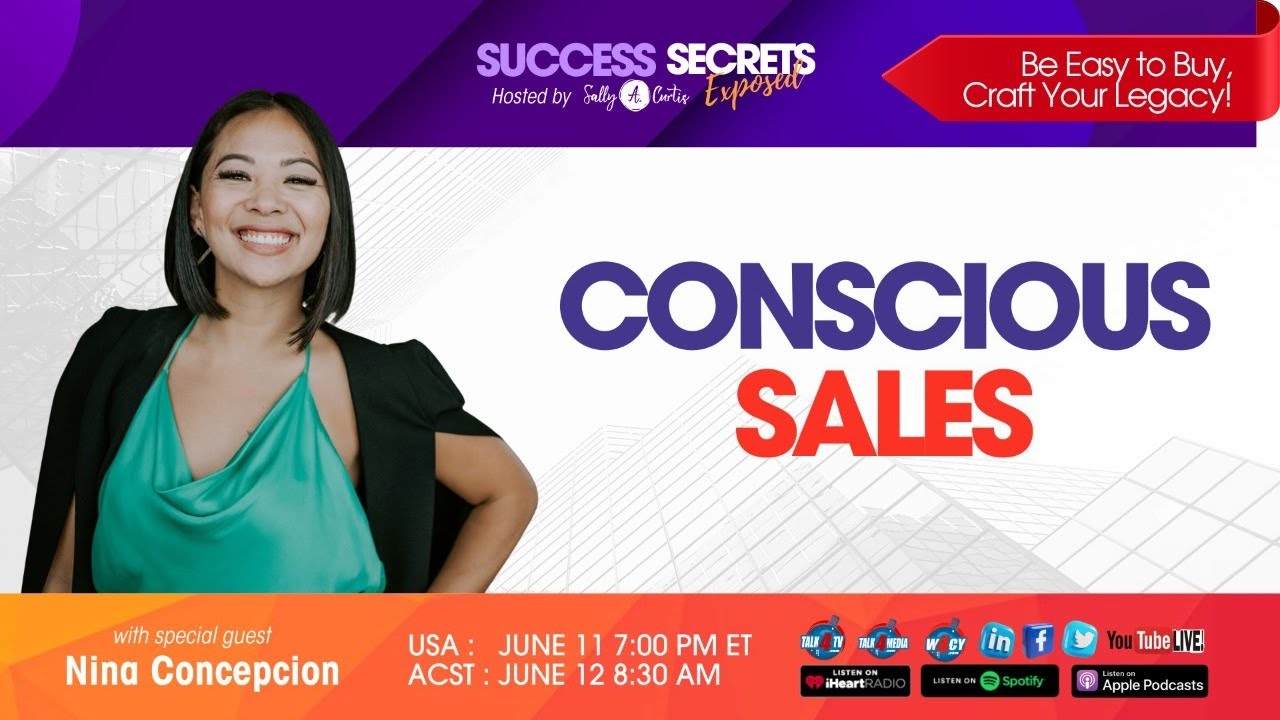
Nina Concepcion, founder of the Institute of Conscious Sales, describes an ethical approach to selling built on energy, mindset, and skillset instead of pushy tactics. She emphasizes one-to-one conversations, vulnerability, and a 7-minute soul-client attraction meditation over mass pitching.
Chapters
The topics and opinions expressed in the following show are solely those of the hosts and their guests and not those of W4CY Radio, its employees, or affiliates. We make no recommendations or endorsements for radio show programs, services, or products mentioned on air or on our web. No liability explicit or implied shall be extended to W4CY Radio, its employees, or affiliates. Any questions or comments should be directed to those show hosts. Thank you for choosing W4CY Radio. The following is a production of W4CY Radio. Welcome
to the Legacy Leavers series on Success Secrets Exposed. Tune in live every Tuesday at 7 PM Eastern time or Wednesday mornings in Australia on W4CY Radio and Talk4TV. The series showcases experts, changemakers, and disruptors leaving a lasting legacy with those sharing their wisdom,
Good morning, good afternoon, and good day to you all, and welcome to another episode of Success Secrets Exposed. Today's topic is conscious sales, and today we have an extraordinary guest, Nina Concepcion, a multi-six-figure conscious sales coach, speaker, mentor, best-selling author, and the CEO at the Institute of Conscious Sales. Now Nina has inspired tens of thousands of people globally. She's been featured in Entrepreneur and Yahoo Finance and spoken at TEDx UK and has been part of Sydney's Mind Body Spirit Festival and even more. Now her institute supports entrepreneurs in 16 countries with transformative courses and programs. Now she's actually known as the Naked Coach, and Nina combines mindset, energy and skill sets in her best-selling book, The Naked You. So please help me welcome to the show Nina.
Hi, thank you for having me.
You're very, very welcome. Thank you so much for joining us today and sharing with our audience. I'm excited to have you as a guest. Thank you.
Yeah, me too.
Yeah, cool. I'd love to start, and I didn't want to do any spoiler alerts at the beginning, so I'd love you to share a little bit of your backstory story of how you have come to where you are in this conscious sales space?
Oh my goodness. I'm going to do my best to condense this story into a shorter version. But I guess I was always that strange kid in high school that was always asking existential questions at a very young age. So I grew up as a Catholic, being Filipino, that's my background. And Um, I remember being in religion class and asking, why did Jesus have to die for us to go to heaven? What's the purpose of life? What, what do we do after we get a job? Then what? Like, surely there's more to life than just studying, getting a degree, working, and dying. And people couldn't really answer my questions. And so when I finished school, um, I studied in university, which was just something that I thought made sense. It wasn't really anything I was passionate about. I remember going to the careers advisor and even asking them, you know, what do you think I should do? Like, can I have some ideas of what I could study? And I found that it didn't really help. So I ended up venturing down exercise physiology. That's the degree that I have. But halfway through my degree, I had a— oh, it was in between my double degree actually, because I realized I didn't want to do that. So I started to do a double degree in PE teaching. And in between my double degree, I've always been someone who's loved working. I've loved earning my own money. I've loved being of service. I've loved getting out of the house and just keeping busy. And so in between my 3-month uni break after my first degree, I remember thinking, I've got 3 months. Why don't I just go and get a part-time job or a full-time job for those 3 months? And I thought, what am I interested in? What's something that I would want to learn? I've always been fascinated by property. I always, every time I go to someone's house, I always want to say like, can I have a tour of your house? Can you show me what your house looks like? And, um, I remember I applied, uh, in Australia we have something called Seek. I'm not sure if this is an international broadcast or not, but in Australia we have something called Seek, which is an online platform for looking for jobs. And I remember I applied for every single receptionist role on Seek. There were so many pages, hundreds of applications, um, because I thought I'm a people person, I'm happy to answer phones, and then I can learn about real estate. And one place called me back. I had no experience whatsoever, um, but they called me in. And long story short, I applied for a 3-month receptionist role. But they offered me a 12-month sales role.
Yeah. So
completely not what I asked for. But it was the first time in my life where I was posed with making a decision between choosing something that I knew I was unhappy in, but I was comfortable in, and something that had the potential for more, but was way outside my comfort zone and was not exactly nothing that I was looking for. Right. And at the time it felt like a really difficult decision. And I talk about this a little bit on my talk. But really, I'm the sort of person where I would rather try something and fail than wonder what if. I don't want to get to the end of my life and wonder what if I could have done better, what if I did this and what if I did that if I wasn't scared. And so I thought, you know what, I'm not enjoying what I'm doing at university, I may as well give this a go. So I deferred my double degree and I worked in real estate for a year and that's really when I got trained in sales. My boss at the time was incredibly integrity-driven and he was the best mentor that I could have had at that time. Yeah. And it was my second year in real estate. I had bought my own home, moved out of home. I was like 21. I became the 4th highest salesperson in the company. I was training the new staff coming in. I was in the process of opening up up my own office. And then I went to a personal development event and met the amazing Brendon Burchard. And so this is back in 2012, right? There was like 100 people in the room. No one knew who he was. And I could go up to him and get a photo. Like, this is how long ago it was. Like, no one knew who Brendon was.
Yeah.
But I remember sitting there being so inspired. And there's, um, a great quote. I forget whose quote it is, um, but he said that the best 2 days of your life is the day you were born and the day you knew why.
Yeah, goosebumps.
I remember sitting there in that, in, in that, uh, room crazily writing notes down, crying, feeling like— and as dramatic as I know this sounds, It was this feeling of I was dead up until this point. I feel so alive in my body. This is what I'm here to do. I'm here to be an author, a speaker, and a coach. And I knew nothing about this prior to seeing Brendon. And so that was my 5-year plan. I was like, I'm opening up my own office. I'm buying my second property. I'm on my way to becoming financially free. I think I had a 5-year plan to become financially free. Um, and then I was going to pursue this new dream of being a coach, a speaker, and an author.
Yeah.
But I went back to real estate and my heart just wasn't in it anymore. I, I loved it at the time, but it's kind of like when you catch up with an old best friend and it's been years and you just realize that there's not really much in common with them anymore. Um, it's not that they've changed, it's the fact that you've changed. And just something had shifted within me, and mentally I just I was already looking forward to that next chapter of my life. And so that 5-year plan became 2 weeks. I ended up leaving real estate. And I'm not saying that that's necessarily the wisest decision, but it was my journey. But it took 7 years for me to build my business to its first 6 figures. Right. And so that was Yeah, I've been coaching now for coming up to 11 or 12 years. And I remember feeling like, because I started off as a life coach, when I was posting about my life and traveling and moving out of home, I had people just started messaging me on social media, asking me for advice, asking me to be their coach. Yeah. And so I was their life coach. And then I started doing life and business coaching and I just found that there was something still missing for me. And I remember it was 2020, just before COVID And I remember thinking to myself, there's some really great books by T. Harv Eker. And one of the things that I got obsessed with looking for an answer for was where do I provide value in the marketplace? Where is something that the marketplace values and where is the value that I can uniquely and specifically provide to that marketplace? And I remember after asking myself every single day, multiple times a day for months, one night it just landed for me.
Weird.
Because people kept asking me, would you go back to sales? Would you go back to sales? Sorry, there's something in my eye. And I was like, no, I wouldn't go back to sales. I love the conscious community. I love working with entrepreneurs. I love working with people who have a vision for themselves. And it was funny because it was actually a combination of both. It was a combination of the sales and combination of working with people who I wanted to work with. And that's where really Conscious Sales, um, for me was born. Um, yeah, and that was back in 2020.
Yeah, thank you. And do you think that mentor that came out of real estate, the pinnacle, is it related to the, um, the— you mentioned integrity, and a lot of people when we think of sales will automatically go used car salesperson, sometimes real estate person, and go they're just trying to sell me stuff, even the, even as speakers at the front of the room. Do you think because you had a good, a good mentor in the beginning as it related to sales, that gave you the heart, the real truth that sales is, which is that service element? Was that—
Absolutely. Yeah. Again, it's something that I talked about on my TED Talk, but it's one of those things where I'm already someone who's quite strong in my own values anyway, but to have a mentor who has an alignment of values and who can pave a bit of a path for me of, you don't actually have to be anything other than yourself. And it's not necessarily that he said those words, but he never put any pressure on me to be pushy, to be manipulative, to lie. And I remember one of the things he said to me was, if a customer is treating you with disrespect, you don't have to work with them. Like, just tell them, I won't be spoken to like that, which is definitely very different to, I guess, most sales culture. It's like, no, you've got to do whatever you need to do to get the sale. The customer's always right, even if they're treating you like crap. Yeah. And, you know, when I started out in real estate and I was posting on social media, I had a lot of people ask me, should I get into real estate? Or, I've started real estate and this is what's happening. What do you think? And I said, yeah. And I'd always tend to attract people who have the same values as me. So I'd say to them, what's your mentor like? What's your boss like? What are they inspiring or encouraging you to do? Because if there's a clash in values already, it's very difficult to learn the ropes, especially in a role in an industry that you're new to if you don't have an empowering role model.
Yeah.
And it's also one of the reasons why sales does have such a high turnover of staff. Like, not only do you need thick skin, but it also does test your own values and your own morals. Because there were people in the office that I worked in that were manipulative, that did lie, that did say anything to make a sale. But my boss never put any pressure on me to have to be like
that. Yeah, you're empowered to be yourself and find your true service and path in that industry, which is awesome. So coming back now to the legacy element, with, you know, with such a beautiful backstory, with some great mentors and, and strong values, as you've said, what's, uh, the quest that you want to share with the audience? What's your quest now that you want to bring to the, uh, bring to the world as it relates to leaving a legacy behind?
Yeah, it's really interesting because I think when we get into this personal development world Um, for, for sighters, we realize that there's so much stuff we need to work on constantly. It's like, what is wrong with me? Why are there so many things I didn't realize? Right. And it's a bit of a rude awakening.
Yeah.
Um, and I think that just as you get older, you know, I've, I've found personal development, I have, I don't know what, 2012, like 14 years ago. Um, And I think as I've, you know, weaved in and out of that world from being incredibly obsessed to being a seminar junkie and thinking I'd rather be broke and spiritual than financially abundant and not happy, you know, it's finding that middle ground. Yeah. And one of the things I've really had to check myself on and something that tends to always happen whenever there's birth about to happen, um, is, is a bit of an ego death, a bit of a, okay, so why do I actually really want this? Why does this actually really matter to me? Like, what am I really fighting for? Um, and, you know, now that we have, um, I'm a mum, I've got a 6-year-old, we have another one on the way. Um, it's just really making me assess, you know, what do I really want in my life and what's important to me? And I think there's always been a part of me Like most of us ambitious entrepreneurs in the spiritual space, we're very much like, I want to change the world. I want to, I want to speak to millions of people. But I've definitely come into a place of, as long as I'm doing what I love and I'm being of service and I get to enjoy my time with my family, for me, that is the most important thing that I keep in mind now on a day-to-day basis. When, when it comes to, I guess, the, the legacy piece and something I talk about in my book, and I'm also very open, um, in talking about with a lot of podcasts and a lot of speaking that I do is, you know, having, um, a history, I guess, of being sexually abused and, and healing from that. Um, I do want to do quite a lot of philanthropy work in that area. Um, but I think that sometimes the pressure of like, what does that mean? Like, how much impact can I actually make when it's such a big, a big problem in the world. It's like, I just need to do my part. Like, how can I just keep shining my light, keep being me, and keep just making those little ripples? Um, like Maya Angelou said, like, you're never really going to understand the impact or grasp the impact that you can have in one life. Like, I, I completely changed the trajectory of my life because of Brendon Burchard, and he doesn't know. Like, I've tried to reach out to him. I've been to his other events, but now there's thousands of people at his events, and now you can't get anywhere near him. Um, even with VIP, it's like it's still a room of 50 people, right? So it's, um, yeah, it's— he doesn't know the impact that he made on my life. And I know that, you know, Brendon Burchard's one of the biggest influencers of our time. Um, however, even when I talk to people in this space, like Sally, a lot of my other friends who are entrepreneurs, and, you know, we're entrepreneurs who are relatively small fish compared to someone like Tony Robbins and Brendon Burchard, but we all have stories of people saying to us, oh, that one thing you said to me 5 years ago, or the one thing you said to me a decade ago, did you know that I've gone and done this now? And it's like, what? Like, that's amazing. I didn't know that that's what you've done. And so we really just don't I don't think we can truly grasp the impact that we make. And I think for me, rather than focusing on like, what's my legacy, I'm focusing on how can I just show up as the best version of me for me, my family, and then my wider community.
Yeah. And then as a result of that, the ripple effects, as you say, that just those— and isn't it those little tiny incremental ripple effects that make— that actually do make the legacy up? So I think that's such, such incredibly wise Wise words. Beautiful. Also talk in your book and obviously around conscious sales and communications. Can you explain what that is as it relates to a methodology? So for those that don't know, that, that would be a great explanation for the next step.
Yeah, so my definition of conscious sales is the definition that I've come up with. It is very wordy, I am aware of that, but But there's a lot of descriptive words that are really important in the definition of what conscious sales is. And so conscious sales is a heart-centered, ethical, and integrity-driven approach to sales that empowers the individual to invest into themselves when it's in alignment with their own values.
Hmm.
So the reason why it's such a wordy definition is because it's literally the opposite of what most people think to be as sales. It's not sleazy, it's not manipulative, it's not pushy. I'm not here to convince anyone. I don't even like to use the word convince. If someone says, oh, convince me, I'm like, well, I'm not here to convince you. That's not what I'm here for. Yeah. So it's also empowering someone to make their own decision, right? It's not about trying to force someone to make a decision. And it's heart-centered, ethical, and integrity-driven. I am very clear, especially when it comes to when I'm speaking to a lead in my own business and I'm speaking to somebody who potentially wants to work with me. If I do not feel like I can help them, if I do not feel like they're going to get value from me, if I do not feel like we are a good match, even personality-wise, I am going to tell them because that is the best thing I can do to be of service for that person. And so, you know, a lot of my clients, particularly those who I guess are starting out in the coaching industry. They say, oh, but I feel weird reaching out to people and, and, you know, with the intention of pitching them. I said, that's never the intention. The intention is never to just reach out to people on social media just to pitch them. And if you have that mindset, which comes into the methodology, then that's the energy that you're going to portray. And so, you know, Conscious Sales is a combination of 3 things, the energy, the mindset, and the skillset of sales because traditional sales typically focuses on just the one. It focuses on the skillset. Yeah. But I like to focus on the energy and the mindset as the foundation and then the skillset as the thing that ties everything together because you can have the right energy and the right mindset. And if you're speaking to people and you're speaking to enough people, you're going to make sales. You don't even need a high level or even a certain level of skillset in sales because eventually you're going to learn, even if it's going to be a little bit I see even though you're going to stumble, even though you're going to probably continue to make some mistakes, you're going to, you're bound to make sales, right? In sales, it's a very famous saying. It's a numbers game. If you speak to enough people, you're going to make sales. So the skill set then allows you to be more effective and efficient at refining how you communicate so that you can then speak to less people and make more sales and also attracting the right sort of people, your ideal clients. But a lot of people will focus on the skillset. Oh, I don't have this and I don't have that. It's like you need to just come back to your heart. You need to come back to what is your intention? What is your mindset? And so when a lot of people who are starting out, especially in the coaching industry, are saying to me, oh, but I feel bad reaching out to people and pitching to them, I always remind them the very, very, very first thing that we do is we build rapport with that person. Is there a genuine connection?
Right.
Because statistically, 1 in 3 people will like you, 1 in 3 people won't like you, and 1 in 3 people don't even know if they like you or not.
I love it.
So something that my boss told me in real estate and always stuck with me, because the sooner you can accept that 1 in 3 people just aren't for you, 1 in 3 people just don't even know if they like you, and you just got to find the 1 in 3 people that you do have a connection with, that's the starting point. And then we look at How can I provide value? However that looks, whether that's referring them to a friend, referring them to Sally, sending them to another coach, or this is actually something I feel like I can really help you with. Do you want to know more? It doesn't have to be me, and I'm not attached to it being me. It's just where can I provide value? And that's something that, um, you know, I did a post on Instagram about this, I think about a year or two ago. And I use the analogy of like a man on a date like flopping out his package. Like stop flopping it out, guys. If you're coming into social media and pitching right away, that's exactly what you're doing. People are like, what? I didn't want that. Why are you showing me that? I didn't ask for this, right? Right. And it feels intrusive just pitching something from the get-go, but we really have to I think it's really important for us to go into these conversations genuinely wanting to just find out who they are and if there's a connection with that person first and foremost.
Yeah, yeah, love that. I've got— we call that, uh, we've got a version of that in my community, the backpack guy. The guy that comes to a date with you, comes to have a coffee with you on the first date, and he's got your back. He's got his backpack there, and when you ask him what the backpack's for, he goes, oh, you never know where it's going to end up. Yeah, similar scenario. When you were talking about the number of resumes that you sent out, and I was sitting there going, oh yeah, law of large numbers. And of course, you've talked about that. That's sort of the term that everybody has heard. But ultimately, it's the law of the right connection that actually enables the efficiency and and the right people to land in your place, which is that conscious element, which you mentioned and expressed beautifully. Thank you. The other question that I've got, and this comes a little bit more starting to tie into the book, was you talked about imperfect action and finding the strengths through the opportunity. So I know they're two probably quite big topics, so I'll let you take that journey and wherever that needs to go, but I'd love to find out more for the audience around those two.
Yeah, it was really interesting, um, because I obviously, I had the Institute of Conscious Sales, which is my business, um, but I, I remember just having this insight and this download similar to when I saw Brendon Burchard, um, but I was at another event and I was like, oh my gosh, I'm gonna write a book and it's gonna be called The Naked You and I'm gonna be naked on the front cover. Um, and originally it was going to be a personal development book and it's It is pretty much a personal development book. But while I was in the process of finishing that book, I was also doing my TED Talk. So I literally felt like I had twins that year. They just got birthed at the same time.
That's so great.
And it was not planned. Like, I just felt like those are the 2 things I was working on for that year. And because with the TED Talk, it was the general population, I needed to strip it back to just communication because I always say sales is just heightened communication. And so I talk more about conscious sales as communication in the TED Talk. But in the book, I wanted to tie in the concepts of the personal development, but also the business. And so the book, I ended up changing the subtitle. So it's The Naked You and it's a guide to embracing your imperfections in life and business. And, and then I changed the, the name of the TED Talk to, um, Why Your Imperfections Are the Key to Conscious Cycles.
Oh, nice. Yes. Lovely.
So again, it's tying in the imperfections of the naked you, um, and Conscious Cycles, which is my business. Um, and Sally, what was your question again?
Um, I, I actually combined that because I had quite a few there. So there was— I love juicy words, and I know that they'll, they'll lead to a story. So It was around the imperfect action because to me, that's like failing forward faster in my world. So there was that quote that I love. And you also shared about the vulnerabilities and how they are— the vulnerabilities give clues to what you're truly looking for. So they were just juicy. So I just wanted you to expand on both of those, please.
Yeah. So when it comes to imperfect action, it's literally, excuse me, like the mantra in my coaching container. Done is better than perfect. Done is better than perfect. Done is better than perfect. Yeah. Because I know so many people in this industry or even in just the realm of wanting to do something in their life and not making any progress whatsoever because they're so focused on wanting to be perfect. They're so focused on the perfect time, the perfect situation, the perfect scenario, the perfect finances, when that's just not reality. And then when you can look 10 years down the track, there are some people that are exactly where they were 10 years ago simply because they just didn't make any progress.
Right.
And it's about the stacking and the compounding effect, right? Like even when I've When I've gone and looked back on some of my Facebook Lives from like 2012, 2013, 2014, I'm like, oh my gosh, it's like cringeworthy to watch.
Yeah.
Exactly. And one of the things that I think it was Charlene Johnson, she said, she's like, your audience wants to see you grow. They want to see you evolve. They want to see you transform. And that very much ties into the imperfection piece. Because I've had so many of my clients, again, especially the ones who are starting out in the coaching industry or who have not yet cracked the $10K or the $20K months, they're, they're quite insecure about, oh, but I don't have a big audience, or, but I don't have this, and, you know, I'm not making the money I want because of blah blah blah. Like, you know, there's always excuses that we can find, um, but you don't actually need a big audience in order to make a lot of money. You also a lot of a big audience also doesn't necessarily equate to making a lot of money. And it's such a big misconception, um, in on social media and being, you know, in this space that we're in. Um, and it's fascinating because when we— and I've said this to my clients again because they have a very similar, um, value to me, like our values are very aligned. So I had one client and she's so lovely. Her name's Erica and she was living in Singapore at the time. So she had quite a strong Singaporean accent and she was always really nervous about public speaking and going live. And she was a bit insecure about her accent. And, but I love her mindset around, I'm going to push myself. I'm going to get outside my comfort zone. I'm going to lead with service, um, as opposed to focusing on my own insecurities. And that's again one of my other quotes: we beat imposter syndrome when we shift our attention from self to service. I'm constantly—
You better just say that
again. We beat imposter syndrome when we shift our attention from self to service.
Beautiful, thank you.
And so she really embodied that. And I remember we were having a session and she said, I really want to challenge myself. And I said, okay, why don't we do 7 days of lives? Like the only intention is for you to get outside your comfort zone and for you to get more comfortable speaking and sharing about who you are and what it is that you do and the value that you provide people. And it was literally just her getting outside her comfort zone. It wasn't a lead gen. It wasn't to try and get clients. It was for her own growth. And she said, but what do I do on the first one? I'm so nervous. Like, what do I say on the first one? I said, say that. Say exactly that. Share the facts that this is nerve-wracking for you and you've never done this before, but you're doing it to get outside your comfort zone. I said, the more real you are with what's actually going on with you and you share that with your audience, they're going to feel like, again, what Chalene Johnson said, that they're coming along the journey with you. Anyway, so long story short, she ended up doing it. And then there was one person who watched her live every single day, um, but she didn't know about it. But then the— this person messaged her at the end of the 7 days and ended up becoming a client.
Yeah, yeah, how beautiful. Um, and that is the imperfection, uh, of success when you're outside of your comfort zone.
And there's also— so I remember, um, something that one of my— it was my first ever spiritual business mentors after I left real estate. Um, I found a mentor, and one of the things he said to me, and it also ties very much into the teachings of Dr. John Demartini, which is why I feel so blessed that I could interview him in my book. So the interview of that is in my book, and he wrote the foreword for my book as well. But one of the things that I learned from my mentor and from Demartini is the fact that the people can tend to automatically pedestal you if they see you as the authority, if you're the speaker, if you're the coach, if you're the person teaching something. So the sooner you can pull yourself off the pedestal, the sooner they can see you as like, it's achievable for me too. Yeah. Because what happens is when we pedestal people, we unconsciously want to pull that person down or be higher than them. It's just something that we do unconsciously. And so when it comes to sharing our imperfections, and in the book I do talk about how we can do this. effectively without airing out our dirty laundry and people losing respect for us.
Yeah.
Because there is a balance. When we can show up in a way where we can be vulnerable, we can show our imperfections, but we're still sharing what we've learned and the experience that we've had in a very effective and efficient way, then we also tend to attract clients that have a we don't attract clients that have an unrealistic expectation of our service. So I found that the more that I was myself, the more that I was upfront with I make mistakes, things happen, you know, it's just like I'm not trying to be perfect, the more that my clients were just so easygoing, the more that they were They just didn't have this, I guess sometimes I think we all have that experience of having a client that it's like, how come you didn't get back to me? It's been 5 minutes, right? That's incredibly demanding. I don't want to work with those sorts of clients. I call them, I call my ideal client soul-aligned clients, SACs. Yes. And so someone who's like that is not an ideal client of mine. But it starts with you. If you want to attract a certain type of client, how are you showing up? What are you portraying? And what are you giving out into the universe? Because that's what's going to come back.
Yeah, beautiful. So coming back to that story of the vulnerabilities and coming back to the energy and the often— I'm going to use the word fear— the fear that people that are starting out going like, like your client said, oh my God, what do I start? Where do I, where do I share, what— because I can actually hear a lot of my audience and a lot of the audience going, yeah, that sounds scary, but you know, I'm not really sure I want to do
that
yet. And I know you said, you know, just get out there and say that. If you were to give us sort of a list of some of the things that people could do to share more of themselves in that imperfect way, what would some of those suggestions be?
Yeah, since we're talking about conscious sales, the single biggest activity. You know, we've got in real estate, you know, my boss told me about highest paying activities, income generating activities, right?
Absolutely.
Guys, if you are just posting on social media constantly, that is not, it's not necessarily what's going to bring in money for you. Like it's just not. You need to be having conversations. You need to be having one-on-one conversations with your leads, with your audience, finding out what they're actually wanting, what they're needing, and building a relationship with them. Selling one-to-many is a different skill set to selling one-to-one, and if you're not having those one-on-one conversations, you don't know what to say when you are selling one-to-many. And so the single biggest thing that I share with people who are fearful of getting out there is how can you just increase the amount of conversations that you have on a daily or a weekly basis where you're getting to know people, you're building rapport, and you're finding out how you can be of value. Like, it literally just starts from there. That is the bread and butter of business, of, um, of building, you know, a brand, of finding clients, is just speaking to people. If you're not speaking to people, it's very, very hard to make sales. Right? There's definitely a bit of an entitlement in the personal development world of like, no, I want people to come to
me.
Like even my mentor who's made millions is like, I still reach out to people.
Yeah, absolutely. Yeah.
So, and I talk about this again on my TED Talk, we have this expectation of, oh, I just want people to come to me. I just want my leads to come to me. And it's like, that's like getting into a relationship saying you've got to put in all the effort.
Absolutely.
When every relationship is a two-way road. And to be fair, when you have the team, when you have the finances, when you have the ability to outsource it, you are still putting stuff out there. It's just not you personally doing it. It's your team. It's the ads. It's the funnel. But there's still value being put out there. You cannot expect something for nothing. And that's one of the things that talks about, you know, it's the law of reciprocity. It's a, it's universal law. For every giver, there is a receiver, and for every receiver, there is a giver. You need to be putting something out in order for something to come
back. Yeah. Beautiful. Thank you. Um, I love that. I've got, um, I had a question around, um, self-sabotage. Um, but I'm going to just change that up a little bit because I think one of the things from my own experience, and I see this with my own clients when they're getting the content out there and they're having those conversations and they're learning what their value is and having it reflected back because their people are having aha moments and all the rest of it.
Yeah.
I feel that actually reduces the potential of your own self-sabotage.
Absolutely.
I'll let you expand, expand on that from a conscious sales perspective.
Yeah. So it's one of those things where, again, we beat imposter syndrome when we shift our attention from self to service. If we are not getting outside of ourselves and having conversations and really listening, right? It's one of the biggest difference between like conscious sales and sleazy sales is you can tell when you're talking to someone and they're trying to sell you something and you can't even get a word in. It's like, oh my gosh, will this person just shut up so I can tell them I'm not interested, right? You're like looking, looking for a gap and just like, oh, stop talking because I can tell you I don't want to listen anymore. Okay. So if you're able to really listen to someone, it gives us perspective always, always, especially our leads. I don't know how many times, and this is a slightly different example, but it will make sense. I say to my clients when they get their first few coaching clients, make sure at the end of every coaching session you ask that client, what was your biggest takeaway?
Yeah.
80% of the time it's something that they didn't think. 80% of the time it's really, that's what you took from the session? That's not what I thought you'd like. And I'm not telling them to say that, but when they're talking to me and they're reflecting on what the biggest takeaway was, It often isn't what you think it's going to be. And especially if we're putting all this pressure on ourselves to have to be a million miles ahead of someone before we can teach them, which we don't. We need to be one step ahead of them.
Correct.
When we can get that perspective, we start to get our value reflected back to us. And that's the reason why I love that quote about imposter syndrome. Because when we're going into a conversation and we're listening to where that person is rather than being in our own head thinking about our own insecurities, and rather be in a place of like, how can I help you? How can I be of service? Like, I want to understand. Tell me what you're going through. Your mind will go to looking for a solution instead of focusing on the problem. And so if you're looking for the solution, There will be things about what they're saying that you just would not have picked up on if you were sitting there in a room by yourself, not talking to anyone.
So true. Yeah.
And so many times I said to my clients who are starting out, you will not really see the value that you have until you start getting in front of people and until you start working with clients. The moment you start working with clients and it starts getting reflected back at you, you'll be like, I'm pretty good at this. I actually know quite a lot. And honestly, it happens every single time. Like, every time.
Yeah.
Even going from, for me, life coaching to business coaching to sales coaching, it came from me just having conversations with people in my network, with people who I had, um, a connection with. And I can literally think of 5 to 10 people off the top of my head who, when they came to me, I said to them, so why are you coming to me? What do you think I can help you with? Because I didn't know. I'm like, why are they coming to me? I feel like they already know what I teach. And they'll say something like, I feel like you can help me with this. And I'll say, actually, yeah, yeah, I can. Yeah. And it's opened up a different realm for me that if I wasn't listening, If I wasn't in that mindset, if I didn't have that one-on-one conversation with them, if I wasn't open, I wouldn't have realized that there's another little element of value that I can provide for a certain type of person. I wouldn't have known that unless I had those conversations. Yeah. And so I say to a lot of people, like, you just need to get out there. You just need to have more conversations and you just need to be open to what it is that they're saying. And again, ask yourself, how can I provide value to you? Where can I be? And I literally will ask people, Sally and I know Jem, I wouldn't be surprised if he's been on here as well. And when Jem and I connected, I was like, how can I support you? What can I do to support you? And it can be as simple as that. And it could turn into a friendship. It can turn into a collaboration. It can turn into A client, it can turn into a different business opportunity. You just never know where it's going to turn into, and you're just not going to know until you start putting yourself out there.
That is the art of having conversations, is the opportunities unfold for you in, um, all sorts of manners and in all sorts of ways, um, which is a conversation, not a sales pitch.
Exactly. Yes.
Uh, one I've got, we've got getting towards the hour, so to speak. I've got one question I want to just interject in here just to shift things and then I'll come back. What's the one thing— and I know you started very, very early, so I'm very curious as to how you're going to answer this— what's the one thing you wish you— sorry, what's the thing that you know now that you wish you'd known earlier?
Yes, I've actually thought about this question a lot. I've asked I've been asked this question a lot as well. I wish that I got a high-level mentor sooner in business.
Nice. Okay.
Because similar to what we were talking about with my boss, having someone who understands the journey, who can foresee the roadblocks, who has been down that path, as much as we're like, oh, but I don't want to invest and it costs too much money, I've literally spent the first, most of the first 7 years of my business trying to do it by myself and being stubborn and like trying to bootstrap
it. Start with that brush or not? No, no. Start with that brush. Sorry, interrupting. Keep going.
And I remember sitting there calculating over the 7 years that I still wasn't making a full-time income in my coaching business. I had invested almost $300,000 over those 7 years in courses and programs and personal development and events. Yeah. When if I had just invested that 50 grand into that high-level mentor, that high-level coach from the get-go, from the start, it would've saved me so much time, so much energy, so much stress, And I would've gotten there so much faster. And even a lot of my clients, my high-level clients that invest quite a lot to work with me
to
help them get to $10K months, $20K months, $30K months, because they're not at that yet, they're still really hard on themselves. And I say to them, do you know how long it took me to get to where you are in your journey? You are 6 months into your journey. and you've done a $20K month, right? It took me 8 years to do that. 8 years, right? And I think it's really, really easy for us to doubt ourselves and to, to, um, always look at, oh, the grass is always greener on the other side, especially on social media. It's like, oh, but look, there's this millionaire and this millionaire and this millionaire. This person's doing well because people tend to always post about what's going well in their life and how How amazing things are going. You're not the other person. Yeah, how can you just focus on your lane, where you're going, what you're doing, and just remember that, are you, and ask yourself, do you feel like you're doing the best you can? And if you don't, then what support do you need to help you get to that next level? And are you willing to get that help? Because just because you know you need that help, There needs to be a decision of I'm willing to invest my time, my energy, my money, my commitment, because even though I'll never really know that the— I want to work effectively and I want to work efficiently, and I don't want to get to 10 years down the track and still be, quote unquote, failing. Yeah. Not actually failing, but quote unquote, I feel like I'm a failure. I'm failing. Simply because you just didn't get the help.
Yeah, and I think that's one of the greatest lessons I'm gonna say for entrepreneurs, but I'm gonna say especially for female entrepreneurs, is actually asking for help. Because when we actually ask for help, there's so many people that put their hand up and go yes, and we're like, oh wow, where did all those people come from? But we have to first ask for help and not be quite so bloody stubborn. And that's a little message to myself. Go from there, which is cool. I love it. Love that we shared, we shared that. Um, coming— we're very much coming towards the end. I know that you've got, um, a link that we've been sharing and is going across the ticker. Can you explain a little bit more about what, uh, that link is and what that offer is that you've got for people?
Yeah, so when I started working, um, with my high-level clients and helping them crack the $10K, $20K month As I mentioned, Conscious Health is very much the foundation is the energy and the mindset, and then the skill set really is like a bit of a cherry on top. And so if someone is doing the actions, but they're not coming from the right energy and the right mindset, it's almost a waste, almost doing all that action because you're taking action and nothing seems to be coming back. But it's because it's the place that you're coming from. It's actually better to just take a pause, recenter, reground. What are you doing this for? Then go and take action. You're going to be so much more effective and you're going to be a lot less frustrated with people and yourself if you just take that time to yourself. And so I remember, especially because obviously mindset can take a while to shift, right? I literally feel like a broken record sometimes and I'm happy to do it, but I feel like a broken record when I'm saying the same things over and over and over again every single week to my clients. But it takes sometimes a few months for something to land, even though I've said it a million times. Exactly. It's like watching a movie for the second time or watching a— reading a book. You're like, oh my gosh, how did I not see this the first time? It's exactly like— For sure. It's exactly like, oh my gosh, Nina, I get it. I'm like, hooray, amazing. And so when it comes to the energy and the mindset, there's some key things that I continually talk about. And so I remember there was a few sessions, this was like 3, 4 years ago, there were a few sessions where I would take my clients through a meditation around the energy and the mindset. And when I started to reflect onto my own processes, when I'm ready to onboard more clients and what I continually teach my clients, And the thing is, the more you do something, the more competent you become, right? So you start to see more of the patterns. And that's why I always tell people, don't create a course when you don't have any clients. Like, go and get clients and then the course will create itself. Yeah. But I was doing this meditation with them and then I got really clear on the fact that I got really clear on what those actual pieces. I think there's like 7 or 8 pieces that I make sure that I always do when I'm ready to onboard a bunch more clients. And so I would take my clients through this meditation and they just got so many amazing results from it. It would put them in the right mindset. They work less and get a lot more leads or they'll do the same amount of leads, but they'll get, or same amount of contacts, but they'll get more leads. They'll get more calls. They'll feel better on calls. They're attracting more of those soul-aligned clients. And so I decided to, when I was building up my funnel, I decided to convert and record that meditation. I didn't convert it, re-record that meditation professionally and really making sure that I literally had a checklist as I was, like, because I wasn't reading the meditation. It's a very intuitive meditation, but I had points to cover during that meditation. And it's a 7-minute meditation. I was very clear on not going for 20 to 30 minutes because I'm a mom and I'm like, oh, 20 minutes. Yeah. I don't have that time right now. I'm not going to do it. But 7 minutes, you guys can literally sit on the toilet and do your meditation. So it's, I call it a soul client attraction meditation and it's literally what I've given my my high-level clients who have invested tens of thousands of dollars, but I wanted to make it available for other people. And I've had so many people tell me, oh my gosh, Nina, I made my first $10,000 sale after listening to your meditation. And when a lot of my clients are not in the right mindset or their energy's a little bit off, I'll say to them, have you been listening to the meditation? And they'll be like, no. I'm like, go back and listen to the meditation. Make sure you listen to it at least once a day or twice a day. A lot of my clients will listen to it before they hop on a sales call. So it just puts you in the, I guess there's again, the 2 pieces of the foundational pieces of sales, conscious sales, which is the energy and the mindset. I will say that the offers, like once you register for the meditation, there's other things afterwards. They're not working right now. We're in the process of editing it. So if you have any issues, just reach out to me on social media. @ninathenakedcoach on Instagram and on Facebook, and then we'll sort that out for you. But you can definitely get the meditation.
And that was— and that's the key, because that sounds like a great opportunity to be able to experience more of you but also experience more of themselves, by the sound of it, as well. So that sounds very, very exciting. Nina, it's been an absolute pleasure. People are now able to get in contact with you. They can find you, as you said, on Facebook, Instagram, and LinkedIn as well. And as you can tell, an absolute gem and a powerhouse and full of wise wisdom. So Nina, thank you so much for sharing with us today. It's been an absolute pleasure. Thank you. And we will look forward to seeing you next week on another episode of Success Secrets Exposed. Bye for now.
Remember, if you want to be sought after and sold out, as well as being known as the obvious expert in your industry, you need to speak with Sally, our host of Success Secrets Exposed. Sally is the founder of Monetize Your Content, a done-for-you content marketing agency that helps you be easy to buy. See you next week on another episode of Success Secrets Exposed. Tune in live every Tuesday at 7 PM Eastern Time or Wednesday mornings in Australia on W4CY Radio and Talk 4 TV.
More from Sally






The Coaches Results Express: How to Build a Thriving Coaching Business That Actually Works


