I'm Not Sick, I'm Psychic! Healing The Body through Emotional & Creative
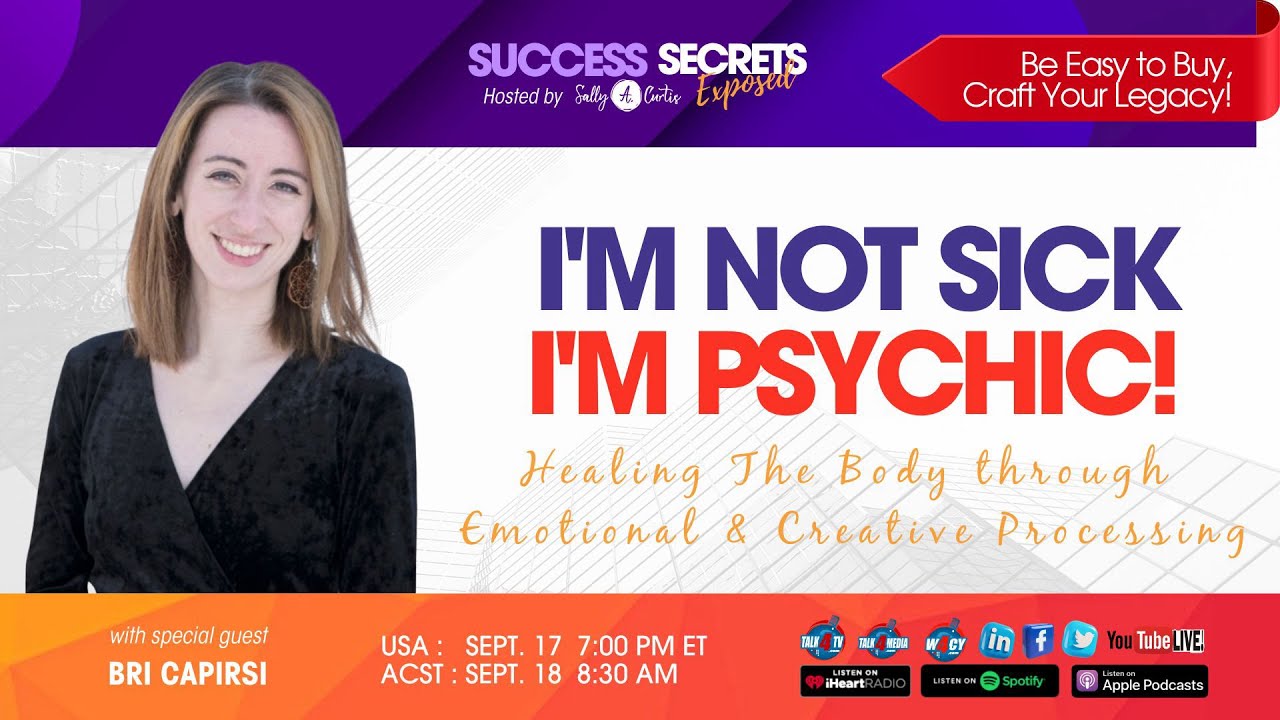
Bree Capricci spent years with unexplained convulsive episodes doctors called psychological. She found relief through visual meditation, shamanic practices, and creative release like painting and drumming. Now she guides sensitive clients using a three-body model of physical, mental, and energetic healing.
Chapters
through the power of bite-sized visual content. What we're best known for is turning books into 2 years' worth of dynamic social media posts. We provide a done-for-you service that amplifies your impact because you are sought after, sold out, and become the obvious choice in your industry. But today we have an exciting topic to share with you today, and the topic is I'm Not I'm Psychic, and we're going to be talking about healing the body through, through an emotional and creative process. Our guest today is Bree Capricci, and she is a highly intuitive creative from the enchanting forests of Pacific Northwest in the US. Now, her mysterious illness has led her to study Celtic shamanic practices, spiritual theory, mediumship, Western intuitive astrology, and light magic for the last 7 years. With the ability to process energy and integrate aspects of the mind, the body, and the soul experience, Bree has not only healed her own illnesses and insecurities, but it's absolutely sparked a flame in her to assist other highly sensitives to heal through their own experiences also. With an online business practice, she teaches others how to— how they can naturally process and integrate their emotions as part of their daily routine for overall wellness. So can you please help me welcome to the show, Bree?
Hello.
Hi, good morning or good evening to you and good morning to the rest of the world.
Good morning, Sally.
Thank you. Well, I'm excited to be able to share with, with our audience today your journey because I know when we spoke originally, it's been an incredible journey and you've got lots of really incredible insights to share with us today. So can you explain to the, to the audience a little bit of your backstory and this sort of mysterious illness?
Yes. So, um, starting from about the time I was probably 10, I started noticing that I had these like shakes that would happen whenever I was nervous. Um, and it didn't, it started out really small. I didn't think that anything was really wrong until like about, yeah, age 12 to 13 is when I started having symptoms where I would just drop to the floor and just start convulsing, but it wasn't necessarily a seizure. Mm-hmm. Or like my legs would just lose muscle tone for no reason and people would have to like push me around in a wheelchair, like at work and stuff. And it would happen like just out in public, like Like if I was at a funeral, if I was working at the store, if I was like pretty much anywhere in public, like my body would just freak out and it would take sometimes like multiple hours to get me back to like normal function. Um, so that is the basis of what I dealt with from age like 13 to age 27.
Wow. So we— and with that, I can only imagine, um, A, other people's experiences of it? Because if it's similar to a convulsion, obviously that frightens people because people don't know what to do. Were you able to communicate and sort of not only reassure yourself but reassure others? Because you, you would have not been used— not, I'm not going to say used to it, but you, you'd had experienced it for so long that you were aware of what was going on. Were there things that led up to it? Just curious how that all sort of rolled out.
I know I could sort of identify when it was about to come on. It felt like a weakness in my chest area that would— I would be like, oh, I think it's going to happen. And then, um, essentially, like, it wasn't like I was like completely unaware, like I would, but because I was so discombobulated with like the situation that was happening with my body, I was very much scared of my body actually.
Mm-hmm.
When I think about it, I was scared that it would happen and that I would get the negative attention. from other people of like, like, oh, are you doing this for attention? Or like, are you actually sick? Or like, um, and so eventually, or I think it was around age 23 that I made a zine, um, that I, I just handed to people when it happened because I'd had so many people call an ambulance for me and I'd have— and I'm just like, no, this happens all the time, please don't call an ambulance. So they'd read the book and they'd be like, well, what can I do?
Yeah. Yeah. And isn't that— yeah, I didn't even think about the ambulance side of things. Obviously, it's very fearful for you, but for others, it would be fearful as well. And then there would be the automatic go-to, which when people are caring, is going for that ambulance. But if it's not— I'm going to say, was it not not necessary? Was it— but I suppose you got so used to it, it wasn't necessary for you because you just knew it was a waiting game. Is that right?
Yeah, because it wasn't ever— it wasn't ever necessarily like so severe that like I needed that. It was just like I would— my body would just be like I couldn't do anything. It wasn't like I was having a medical problem. And so, um, yeah, I think, uh, a big part of my autonomy and like gaining control over the situation when I was in that emergency state of like just dropping to the floor and not having control of my body Um, it helps to have, uh, that, like, that zine to give other people to say, like, this is, like, this is okay, this happens. It's, it's not, like, a really intense ordeal, even though it feels like it.
Yeah.
I just, like, socially, it was very weird because it's like, oh, like, what is happening? And it's not so bad that you haven't needed an ambulance, but it's still this weird freakout thing that's happening. It's— yeah, it was, it was very strange to deal with.
And
it's not like I could give them a diagnosis either.
Yeah, God bless, we all love our labels, don't we?
Yes,
it just makes things easy, supposedly. So from a social perspective, at such a critical age, sort of going through your late teens into your early 20s, how did you cope with that and how did those around you cope with that?
Well, I think it was very weird. Um, I like— my family was very, um, concerned for me. That's why they took me to so many doctors to try to figure out what was wrong with my body. Um, at work, people just really responded. A lot of people were very helpful and wanted to help me.
Mm-hmm.
Um, I think that was like the main response is like, oh, how can I help you? Um, I'm scared for you. And I guess there was this part of me that always was a little bit shameful that like my body was making other people fearful. Um, and so that would happen a lot. Um, but in, in general, it wasn't a bad thing. It was just like my body initiating fear for other people. That was the problem.
Yeah. And, and, and did When you wrote the ezine about what it was, which almost became your handout, what inspired that and what sort of elements did you pop in it to help other people feel comfortable? Because clearly this was a service thing for you.
Well, I'm a very creative person. And that's the nature of why I decided a zine would be good. Because also at that time I lived with a lot of creative people. And they're like, you know what you could do is you could make a zine. And then other people would know what to do. And so in the zine, it was basically like, okay, if you're not aware that this is happening with me, turn to this page. But it— or like, I would just say, like, if you aren't aware or if you are aware of, like, that this happens with me. And then it would give a list of, like, don't call the ambulance. Like, put me in a room that's with the lights off. Turn on calming music. Like, I'm still aware, I just might not get back to you right away while I'm like, like managing all of this that's happening in my body. And that just that it wasn't a seizure and that I didn't need like immediate medical attention. And then I sort of went into like, you know, this has, in the past, this has helped me, in the past, this hasn't helped me, just so they kind of get an idea of how they could support me in that moment when it does happen.
And that would have been— I can only imagine, A, having been experiencing that alongside you, but how comforting that would have been for somebody when they're in that panicked, feared state for you, how that would have helped them normalize what was going on so they could actually support you in the best way possible.
Exactly. Because before that point, it really was just like chaos and Bree's not okay. And it's an emergency situation and me trying, like in a sick state, trying to calm everybody down, which is, that should never be the person that has the illnesses problem to deal with. But with some people, that's just the reality.
Yeah. And, you know, that would have minimized the highly stressful state for you, as you've just, just said with that. with that side of things. So talk us through, obviously there was a long period of time, it was unknown. You sort of sound as though you've instinctively worked out ways to manage it with having so many great creative people around you with lots of really good ideas. So you've been in an environment which has encouraged you and helped you work out, you know, the best way to manage it. But obviously there was a lot of it, there was a long a long journey of discovery as to what was really going on specifically for you. Um, talk us through some of that.
Yeah. So I think, you know, I grew up with, uh, in a Mormon family. And so they were sort of like, well, like, we're going to take you to the doctor to try to figure this out. Um, so I went to neurologists, physical therapists, um, physicians, all these different, just different doctors to get like different opinions on what was wrong with me. And, uh, I think at first the doctors like, they just did a bunch of tests and kind of ruled out everything that they thought it would be.
Yeah.
Um, and then, but then it got to the point when I was going to the doctor's offices where they said like, we can't find anything medically wrong with me, with you, so it's probably psychological. And I find this more often than not with, like, with women. Like, the more women that I talk to that have these illnesses that, like, doctors can't put in a box, like, we're always labeled like, you must be crazy.
Yeah.
Um, I'm like, oh, because I'm trying to figure out what's wrong with me? Like, and it's— yeah, so it's— so that was— I— then it was a mental health thing that— a journey that I was on to see, like, is it because I have anxiety? Um, is it because I'm depressed? And so, uh, I went through— or I met with a bunch of counselors. I went through this life training program that, like, um, definitely, like, I, like, felt like I was on top of the world and I was so happy. And even, like, at certain points there, I'm like, I think I have healed it. But, like, even at that point, after doing all this emotional work And living with a lot of like very emotionally aware creative people through my 20s. Um, and it still happened like a lot. It happened like more often, I would say like a few times a week.
Oh, wow, as much as that? Okay, wow.
So it wasn't— it wasn't— and you know, there were some windows where like I would be doing pretty well, and then it'd be like every couple months or so, but like there were time periods where it was as much as 3 times a week. So, um, yeah, I got to the point where I was like, well, this isn't a physical problem and it's not an emotional problem. And I was working with my naturopath to try to figure out like if it was something that was like more alternative.
Hmm.
And that's when I met a very fascinating person who was an intuitive counselor. Who kind of opened my eyes to the journey of how this could be an energetic problem. Yeah. And so—
It's giving me goosebumps just mentioning that. So there you go.
Yes.
Yeah. So you've met this person. You've had your eyes open to other and newer possibilities. What was your first— what was the first part that became exciting for you that sort of took you down this journey?
Well, I think because I had been so, uh, kind of cynical about my health because I'd been trying to search for an answer for like 13 years, um, I was, uh, when my, the, my intuitive counselor brought up, she's like, it's visual meditation, that's what it is. Um, I'm like, I don't know about that. Um, but then like when I started doing her meditations and then realized that I was having otherworldly experiences and that my sickness was going away, that's when I started to get excited because I had been so skeptical about it, um, of like, well, you can't just tell me that this could be the solution to my problems and that we're just built the same way and that I'm psychic like you. I don't— that's not going to be the solution to my problem. And, and so then when it was, I was like,
What? Yeah. Yeah. Yeah.
Yeah.
And what did that— I suppose what I'm thinking, the word tipping point came right up when I started to ask a question. So when you settled into the knowledge of, you know, there was a little bit more to it and there was— you've got the energetic and the psychic aspects there. What, what happened next? Because I mean, when, when you've gone from sort of that negative or that cynical space to the, the aha moment— so it's that aha moment where, where something absolutely lands for you and you move forward. Mm-hmm. Describe that for us, because you— a 13-year journey of, you know, not getting really an understanding And then having this aha moment. Walk us through some of that.
Well, I was just so— I remember there was a day that I was just sitting there and kind of contemplating, like, even like my spiritual journey, because I've always been a very spiritual person. And even through that life training program that I did, there's a lot of aspects of spirituality that were brought through. in that program. And, um, it, it was just this very joyful feeling, this like that I'm connected again, like from being so disconnected from the universe, like because of having this problem and feeling disconnected from others because they have to constantly worry about what it's, it's like, like with others. And then to meet this other person who's like, I understand your experience. Um, I know how to, like, how to heal this experience because I healed myself. Because she was also one of those people that was, like, dealing— that was just like me.
Yeah.
Um, and, like, as I started doing what she said, that, like, I felt like my body felt better for the first time in my entire life. Um, it was just this experience, like, I mean, I would say it was, like, one of the best moments of my life because I had been searching so long for it. And like thought that it would never happen. I really thought I was going to be sick my whole life.
Yeah.
Um, and, you know, had a lot of connections with other people that had illnesses, and I just wasn't expecting there to be an answer for it. And like, for me, it was this answer of energetics, of like when I started doing my visual meditations, and then I started like hearing people talking to me from the other side and experiencing this sensitivity, like, I can also say it was like also a very overwhelming experience as well as very exciting.
So you touched on a word there around the, I suppose, the energy and how it works. So what was the most shocking or exciting, depending on which way you want to spin it, realization around this energy for you and the curiosity that you would have started to have, you know, sort of bubbling up around what, what was going to happen next with it.
You mean just like with my psychic experiences that I started having, or
just in— I suppose I'm thinking in any more than the energy side of things, because there was one thing that you said, you suddenly felt connected. And yeah, when someone's disconnected— or sorry, I shouldn't say when someone— when I felt disconnected, I haven't felt energetic. It's almost like power plug's been unplugged. But when you feel connected and you find your people and you're connected to yourself and all those sorts of things, it's almost like plugging the energy, the power cord into the energy. You know, you've got the vibration, you feel the warmth and all those sorts of things. That's my experience of it. So I'm just curious as to when you suddenly felt connected, which to me is the energy aspect of it, what was that for you?
Oh, so it was this feeling of feeling alive for one thing. Like it was the first time I've ever felt healthy and alive. Um, but it was also— I started having like a lot of profound downloads about the world and how it works.
Yeah.
Um, that were— that kind of just opened up my perspective, and I was able to see everything from such a completely different perspective. And so I, I feel like it was overnight where— that I was— that I went from like being like sick and disempowered and like Um, just feeling like the worst possible, like just stuck. And then when I started experiencing the healing of it all, um, I couldn't stop talking about it. Like I was just, I felt alive. I felt free. I felt like, oh my gosh, like I, I'm seeing these little patterns in people. Like, and, and I don't know, it all just like came together from a larger perspective. Um, and I, and I definitely, I see that when people like, um, find what lights them up, like on, like inside and when they connect to their soul. Um, cause we all do it in very different ways. Um, that, that experience does happen where like they see everything from a larger perspective.
Yeah, very much so. Um, and it's interesting to me when you were talking about, uh, when you, when it all lands, it all sort of almost, it all comes in. So to speak, as you said, all the downloads happen, which is overwhelming, but it comes— it sounds as though it actually— and my experience is if it sort of all comes in in the right order, that you're able to capture it and choreograph it. It's almost like the big— you've got these big puzzle pieces, all the puzzle pieces all drop into the right spots at the right time for us. So
exactly.
Yeah, that's great. So let's have a talk about now about the emotions and how the work that you've done for yourself and how you help others, how that, how that, um, I suppose rolls out and how you help them in that manner. Because as you said, everybody's so different. Um, so I imagine it's a bit different for everybody as well, but with some key principles.
Yes. Well, so basically, um, what I see anyway, I'm only going to talk about what I see is that there's, you know, we have these physical, mental, and emotional or energy bodies. And, um, based on what we experience and kind of the energy that we come into this body with, we have um, certain things we're more drawn to experience than maybe other people. Um, and so, um, because I— with my abilities, I can see like in people's energy centers like where they kind of carry things and how that like, you know, relates or how that affects their journey as a human. Yeah. Um, but Really with the, with the emotional aspect, um, and how I started tapping into that was like these deep emotional release processes that kind of— it unravels and untangles those energy centers where we feel the most alive and feel most like us.
Mm-hmm.
And when we're having those deep release processes emotionally, or even— I see emotional and creative processing as very similar. Um, like, you can just— you can either, like, sob for 2 hours in your room, or you can collage, or, like, paint, or, or play music and scream it out. Like, you know, it's just these release processes that kind of, um, move energy through your body in a way where you can access, um, what real— what really matters to you.
Yeah. Um, I'm gonna ask you to expand on that a little bit more. And I'm just going to give an example. There was— I went— one of my girlfriends does the most amazing yoga retreats. And she got us to do— I'm going to call it— she had this incredible music. And it was a dance where we just literally shook for, I think it was 8 or 10 minutes. But we just shook all of our— every part of our body. And it was a great experience because it was a room full of women. So we were all being a bit crazy, which we all loved and all the rest of it. But that the level of energy that was generated in my own body by just movement, and it was sort of, it was that sort of that shaking movement for a first time, a person experiencing that was absolutely incredible and electrifying. So that's sort of what you're talking about. I know it wasn't, I suppose that may have been a release of some form, but that's the sort of thing that you're talking about is tapping into that level of energy in some form and letting it go. I love this. because, you know, many women have done the sobbing in the bedroom, and we've done the screaming in the pillow, and we've gone to the side of a cliff face like I do where I go hiking and have a big yell and all those sorts of things. So talk us through some of the creative elements of that, because here in Australia there's again another lovely girlfriend that does art therapy in corporate. There's lots of different things, so I'd love you to explore the sorts of things that you do so people know what the possibilities are, and then we can talk a little bit about the work that you do.
Well, so what I find interesting about people, so like you say the word creative and they just imagine like, well, I'm not an artist, or like, you know, I don't write music. And you're like, there are so many different ways that you can be creative. Like, like whatever you're creating with your body is moving energy like that. Whether it's body movement, whether it's chanting meditation, which I love, it's like you're creating these big sound waves inside your body. That's very creative. or like just playing music and singing. I've had a lot of profound downloads just from— so I met this intuitive astrologer who was also a sound healer, and she was able to connect the parts that, like, based on what we say in our tones, it aligns with our astrology chart, the tone that we're actually speaking. Mm-hmm. Um, and that, that tone can be healing if we're just focusing on that tone. And that's very creative. It's so just like when it comes back to frequencies, um, drumming. I go to a lot of drum circles here, uh, where I'm at. And just like, you know, it's anything that makes you feel like a big release and where you feel free. Um, I— so yeah, mainly a musician. Um, so singing for me, for me is, is where I feel alive. But everyone has their own unique gifts and talents, um, that are sort of looking to be lit up. And so you'll find like a lot of people who enjoy speaking, um, like their throat chakra, you can tell just talking to them of like, oh, this is what they're creating with their voice is healing them. And so, like, even at times when I feel like I— that what I've experienced with my trauma is too much to give to another person, I'll just speak it out on a voice memo, because that's very creative. At least it's getting that sound out of my body, and where I'm able to express.
Mm.
So, um, just these things like, you know, collage, painting, um, But what I've also found is that in more of the energy realm sort of things like creativity with Celtic shamanism and visual meditation, it's almost like what you're creating in another realm in your head and visually is helping you move through energy as well. Yeah. And that's what feels actually most naturally to me if I was to be honest. is qigong, and that sort of meditation is what kind of brings me back to myself. And also what I'll say really quickly is that I, I feel like also the most profound pieces of information that someone can learn about themselves is right after a big release process. It's like that's the piece that they need to integrate, um, whatever. So I always find that as like this— the most sacred moment is like right after you've released something creatively or physically, um, the realizations that come in right there are like, that's the juice. Like that's what you need to use to integrate like the next lessons or whatever you're looking to like balance out in your life.
Yeah. Brilliant. And from that perspective of receiving those gifts and those downloads and that, you know, that sacred moment, is there a, is there a way that you suggest capturing that? Um, I'm asking that because everyone talks about journaling and those sorts of things. or recording things, what's a great way to capture those so you can continue the, I suppose, the gift, keep the gift continuing of the learning process?
Yes. Well, I mean, I'm, I love to write and voice memos too are my thing. And also, um, conversing with another about it to, to kind of, um, bounce the idea off of them. Because I find that who people surround themselves with Are often the people that they're learning the most from, or that, that, that's the next lesson that's coming in. And I've been able to identify it down to astrology signs and energy bodies where I'm like, oh, all these people in my life are Capricorn. I wonder if I have a lot to learn about authority right now.
By the sound of that, yeah, yeah. I was just going to ask you too, there was one thing that I'm just quickly reading my notes that I wrote down. We're often, with everything that occurs to us, we're often guided. And if we're in that guiding process, I'm sort of half laughing at myself here, there's lessons that we need to keep relearning. that keep reappearing.
Yes.
Like a couple of times I've got, God, not this lesson again. I've already done this lesson. Not again. So talk us through some of this, I suppose, the way in which the emotional body heals itself through that repetition and through that. And it's not always the same lesson in the same way at the same stage. It's often the same. It's often a repeating lesson to expand on what what has already occurred. So I'd love to hear your philosophy around that. And I'd love you to share a little bit more about how you actually work with other people if people are going through different things and they're needing a hand with things.
Well, that's fascinating you say that because even just this morning I was like, like thinking about the trigger and the expansion that happens in the emotional body as we— so like Um, when you experience a trauma, um, it— and I say trauma and people get all like, uh, about that word, like, what is trauma? Um, it's like, trauma could be like, you know, your mom forgot to pick you up from school one day. Like, you know, it could be like the smallest thing that, you know, left an impact and that you remember it. Like, it's in your energy body because you have a feeling about it.
Yeah.
Um, that's what I identify as like impact moments or trauma. Even it doesn't have to be like the worst thing that ever happened to you. So in these, because there's so many layers, and I feel like that's the thing about emotionally unraveling something, is that you're gonna get a trigger at first, and most people try and suppress that. You're like, oh, I'm not feeling that.
Yeah.
Um, but then, but then you start realizing, the more that you notice it, you're like, oh, Okay, that's something I need to work on. That's something I need to work on. Well, what I find fascinating about the energy body is that because there are these pieces of energy that we have in our bodies, um, we all— we always think before we feel. We're like, what do I— what do I think I need to do about this?
Mm-hmm.
And it's, it's almost like you have to switch your brain. You have to feel it first because the feeling is what's going to send the message of what you need to change in your life. And so I always see that of like people get themselves more tangled in an energy problem because they'll think first before they feel, and they make it worse, and then it gets bigger. And so then unraveling it gets bigger.
Yeah.
Or this becomes a more lengthy process. And so Um, I find that we're not just here to be energy beings. We're not just here to be physical beings. We're here to integrate the two.
Right.
And mental, like, with all three. And so the trigger and the expansion, like, if we only lived as a physical being, um, and didn't— that's all we did, like, there wouldn't be any expansion, uh, like spiritually. And also, if we only lived as a spiritual being, we wouldn't feel very safe and we'd be like, what's the point of me even being here on the planet? Um, and so really what I do with my clients is I, I sort of help them. It's similar to like, you know how they talk about like the whole child, like meeting the child where they're at? Well, that's basically what I'm doing with like with energy is like meeting them at where they're at and then like kind of helping them unravel those belief systems and those problems in their energy body to see what truly matters to them.
Mm.
And I find that it's, it's mainly with people that are, um, mainly people that come to me are the ones that have like a lot of empathy, a lot of creative, um, like gifts, uh, that are being suppressed because of society and like the way that we live in this, in this world. And it's, um, they're the ones that are often sick as well because they're like suppressing um, this because they're being told to do that to be able to live.
Yeah.
Um, that, or people with disabilities that are very multi-dimensional. Um, and, um, that just, you know, those people operate more in other realms than they do in this realm. And so, um, those are a lot of people who I help to like say like, well, okay, so if you're always in another realm, then we need to integrate some of like, like you feeling safe physically. To help you kind of like, uh, tap into those gifts to like present them on earth. So it's kind of like a different thing with each person, um, based on where they're at in their energy. Yeah.
And that, um, with what I'm hearing with that, that integration process, that's the bit that's the difference. It depends on which bits integrating, but the importance of it is to have that integration, to have the sensory experience, to have the feeling safe experience. and then having the, you know, the thing that lights you up, which is ultimately what we're all wanting as beings, is to have that balance. But it's actually more than just the 2-dimensional. It's actually the 3-dimensional, as you've just explained it there, which is gorgeous. Do you have anything that you want to share? I know we talked earlier about your coffee shop and the beautiful people that you work there. Is there anything that you want to share through there, any stories or Or any examples that you want to share with us that may be relevant to the audience? You may not.
I'm trying to think
on the spot.
Yeah, I'm not good with thinking of things up on the spot. I'm very like, very drift. I drift off.
Well, let me give you some drift. Do you want me to give you some drift words instead?
Okay.
Yeah, I've written down and I'll always So I always take notes when I'm doing my interviews and I always find it really interesting because I see different patterns of what words I capture and how I actually order them. So I've written connection and light up. So connection and light up is the thing. And then empower, express, and then trigger the expansion. So to me, that it sort of is encapsulating everything that you're doing. You're helping people connect obviously connect in a bit broader sense, but with themselves to find their true expression of themselves, um, at that something that lights them up. And then there's that conversation around triggering, um, versus suppressing. Um, because we're all really good at pushing that stuff down. We're not going to do that. Um, versus triggering that expansion. So I'm laughing at myself through this conversation as well.
Yes.
My different experiences as well. So, um, yeah, I would happily let you share a little bit more there. Obviously you've got your YouTube channel that you can refer to and things as well. So
yeah, well, I think it's, um, I feel like also what that just made me think of is just like so many of the lovely people I work with at my coffee shop. Um, so I work at a coffee shop that employs people with disabilities and empowers them. It highlights ability over disability. and, uh, feels so aligned, and I love everyone there. And I often see when, um, when my coworkers are talking to me, uh, is, is, uh, they're always like saying sorry or talking about their weakness. Um, and, and like, the weakness is always like the most powerful part of you. Yeah. I think like that's the one thing that I wish that everybody Like, could realize is like, that's the trigger. Like, where you feel the most insecure, or where you feel like disempowered, or that you have a disability, um, that's often where your greatest strength is, and that's where your expansion is, and that's where your gifts are. Um, and so I guess that, that's one thing I'll say about that.
Yeah, I've just, I've just try to capture that. The, the, the— our perceived weakness is actually our greatest power of expect— for and of expansion.
Yes, yes. And that's why we have it. It's like, it's sort of our, like, it's our hint, it's our clue. It's like so many people, like, want to run away from the emotion, and then I tell them, like, well, that's why you're sad like that, or that's why you're disempowered, or that's why you're disconnected from— that you feel disconnected, or like You know, suicidal or, or not like plugged in is because you're running away from the thing that's trying to tell you what you care the most about.
Yeah. Yeah. That's the profound bit. It's the bit that we care about the most that we run away from, from the emotional side of things. So talk us through, um, we've got your website going along at long— sorry, your YouTube channel going across on the ticker, and you've got a special video that Is at the top of the list, so to speak. Can you share us a little— tell us a little bit about that, please?
Yes. So, um, I— because I've become so passionate about meditation and like what that can do, I have this video that's on my YouTube channel that kind of goes into the different types of meditation. Because I feel like when somebody says the word meditation, they immediately go to quiet the mind and sit there and like try to like feel peaceful.
Mm-hmm.
But, um, like there are so many more powerful ways to utilize meditation in your life that isn't just you trying to quiet the mind. Um, and so I have that video there to sort of teach others about it and, uh, hopefully bring more awareness to sort of the mindful aspect of and how you can use, um, visual meditation and chanting meditation and Celtic shamanic meditation and all these very powerful— even like, yeah, qigong, like slow movement meditation to move energy through your body in a way that can, yeah, help you be healthy.
Yeah, beautiful. And thank you for that. And on your website, you've also talked Sorry, as it relates, that's, that was talking about the different meditations for highly, for people that are highly sensitive. When somebody's experiencing disconnection and disempowerment and they have an opportunity to have a conversation with you, what's the first step that somebody in the audience can take with you?
Um, well, I have, I like, I do astrology charts for people. And so that's— I am a powerful believer in astrology, and that will— that taps me into intuitively your energy body and where to— and, you know, I always verify, uh, with the client of like, is this what you experience? Is this what you experience? Because I'm very— because of someone who's been to so many doctors and so many people that have sort of invalidated my experience, I want to always make sure that what I share and what I see of someone's energy body is something that also resonates with them.
Yeah.
But, um, but yeah, the intuitive astrology charts, um, is sort of like my map to like get you on the right track of like, oh, if you're a Cancer, then you're very like tapped into emotion, and you're very like, um, into nurturing other people and very into their like experience of their life stories. And, um, like I sort of, that's where I kind of like begin the story with a client, uh, to like kind of go deeper into the energy body to see like who they are. Um, and then where they might need some, some work to tap in a little deeper.
Yeah. Uh, thank you for sharing that. Cause I know we've, we've just had a conversation and what you've just highlighted there, cause I'm Cancerian, is very much, uh, where the things is. So, so what How that landed for me was that makes sense. You sort of start there, you get a reflective understanding of what's going on and why, and that's where that resonance of understanding of self comes from. So you can then dig into the next bits.
Yes, exactly.
Or expand into those next bits. Fantastic. So the best way to contact you, you're across the social media channels as Star Seer Mysteries, is that correct? That's the tag across all of them,
correct?
Excellent. And they can reach out to you through your website. Obviously, they've— you've got— they've got great resources on your YouTube channel, um, and the other social media platforms as well. Um, so is there any closing last words that you want to say, anything else you want to share before we wind up a great conversation?
Well, I was thinking of this amazing quote that— so one of my mentors says this all the time, and I love her so dearly. And I just think it fits perfectly with like what I talked about here is like, we're only as sick as our secrets. Stephen Hawking. And I just like, like, the more that you try to hide and suppress, and the more trauma you try to bury, or whatever you feel ashamed of, like, it's making your body sick. And that's what I experienced with me, with all the trauma that I went through and pushed down until it the point, you know, that I needed healing and, and I was able to unravel all of that and I am not sick anymore. And so I feel like that just really fits, uh, this topic is we're only as sick as our secrets. So, yeah.
And that is the, in itself is the opportunity for, um, connection, empowerment, expression, and expansion. So well done. Thank you very, very much. Um, a great conversation. I've thoroughly enjoyed it. Truly a gift to the world. And thank you very, very much, Bree, for sharing so much with us. People can reach out to you through all of the social media platforms. Check out the YouTube channels and take the opportunity to connect with Bree. She can certainly help you tap into a new and exciting journey of discovery. So thank you very, very much. Bree, thank you for joining us. It's been an absolute pleasure. One thing we haven't mentioned, which I just want to make sure that we do, you've got a book coming out as part of a cohort of authors coming out next month called Share Your Brilliance. Is that right? Yes. So keep an eye out for that. You'll see that across the social media channels, I'm sure, as well. Again, Bree, thank you very, very much. Audience, please reach out to Bree at any opportunity that you have. And thank you very much for joining us on another episode of Success Secrets Exposed. Thank you again, Bri. Take care.
Thank you, Sally.
See you later, everyone. Take care.
More from Sally






The Coaches Results Express: How to Build a Thriving Coaching Business That Actually Works


