Making Podcasting Human - Relationship Building and Community
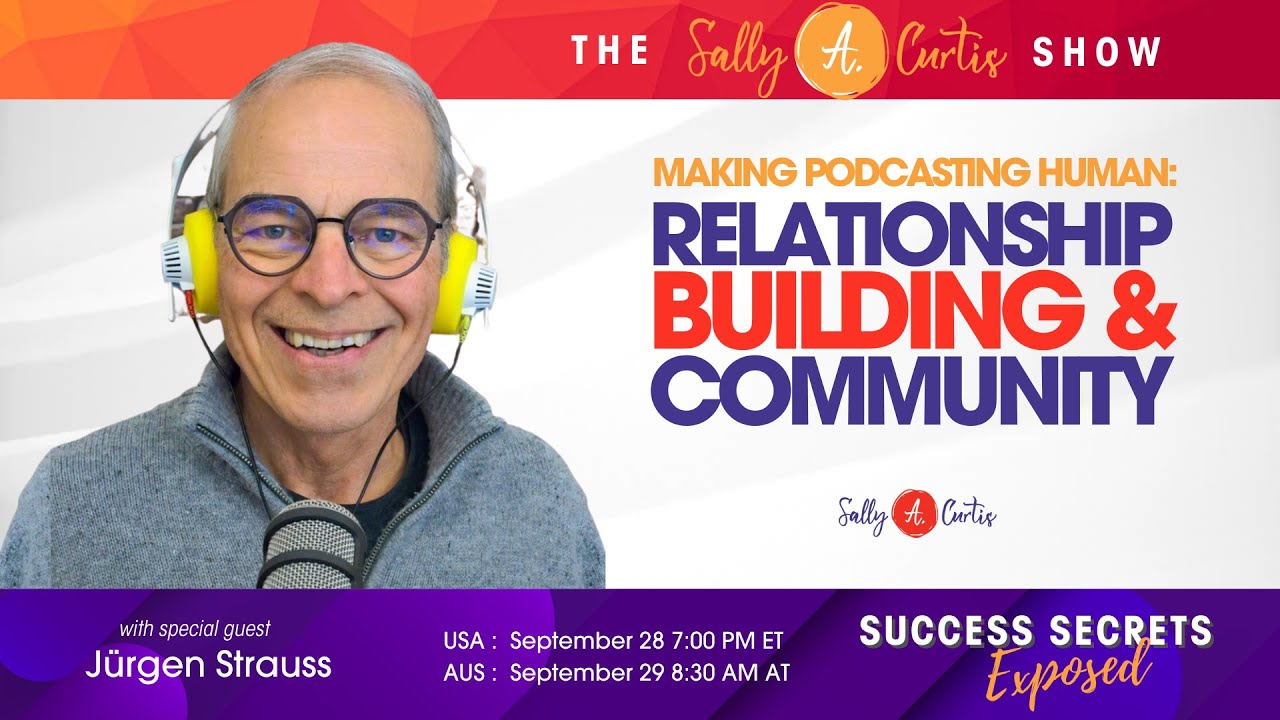
Jürgen Strauss built a podcasting business on curiosity-driven relationships instead of cold calls. He ditched rigid scripts for flexible outlines, created what he calls "scalable intimacy" through audio, and turned podcast guests into a paying community through the InnovaBiz Flywheel model.
Chapters
Exposed, where we have intimate conversations with today's thought leaders, changemakers, and disruptors, all to bring you tools, strategies, and insightful perspectives on both personal and business growth, really revealing the humanness of success and challenge. Now, for those that are new to the show, I'm Sally A. Curtis from Monetize Your Content. We work with, as an agency, with brilliant individuals to help them monetize their content. What we're best known for is turning books into 2 years' worth of dynamic social media posts. We help to save you time, maximize your assets so you're the obvious expert sought after and sold out within your industry. And I'm excited today about the topic that we have to share with you. We're going to be talking about making podcasting human. So how to build relationships and communities with Jürgen Strauss of Innovate InnovaBiz, and I will tell you a little bit about Jürgen as well. Now, he is a podcaster, a podcasting coach, and a podcasting strategist. He's also a speaker, a marketing strategist who also works with thought leaders to build sustainable visibility, credibility, and those meaningful connections so you can really attract your dream clients. Now he has held over 550 conversations on his InnovaBiz podcast with incredible outstanding entrepreneurs worldwide, and he's developed the InnovaBiz Flywheel System so you can use podcasting to grow any business. Now he has a philosophy to make marketing and podcasting human again and to nurture those relationships. He's an avid photographer, public speaker, and cyclist. So please help me welcome to the show Jurgen. Good morning.
Good morning, Sally. Thank you for that introduction, and it's a pleasure to be with you here on the Success Secrets Revealed show. That's almost as hard to say as in Overbiz.
Yeah, we were getting tongue-tied. It makes it interesting and keeps it humorous. Yes. Thank you. No, fantastic to have you here. And the importance of that, you know, that connection and that humanization, I think, is something that everybody's very much looking forward to and is intrigued again by and is much needed in the marketplace. So I'm excited, super excited to be able to share your wisdom today. So thank you for joining us. I did want to ask you if you could share a little bit about your backstory of what brought you to here, to podcasting and to this humanized connection aspect as well?
Yeah. Yeah. Well, it's a fascinating story and kind of reflecting back, it sounds as though it was very strategically planned, but of course it sort of went a very circuitous route. I had a corporate career of about 27 years. Of that, 23 years was in various jobs that involved a lot of international travel, working closely with clients. So we were in a B2B industry, working closely with our clients in different countries. And as a result of that, one of the things I always learned, even though I'm actually an introvert and probably in those days was even stronger introverted or even shy, I realized very quickly that I was quite skilled at building relationships with people very simply because I was curious. I was curious to find out what's— how do you do things in this country? What's the food like? What are some of the cultural things, habits, and so on that are involved And so beyond just the work, I was curious to learn about the people and their culture.
Yeah.
And as a result, I started getting invited to people's homes when I'd go there on business, and I realized that those relationships were actually really valuable. After the 27 years, when I was made redundant and I decided it was time to start doing something for myself. I realized that those building those relationships, because I didn't have relationships in, in the circles then that my business was operating in, which was the small business arena. So I had relationships with lots of people in big corporations. And so I went back to starting to build those relationships. On the foundation of what I'd learned in the past. And I knew that this, they were so critical to my success. And when I cold-called people, which in those days it was still a lot of cold calling, it was very difficult. And yet if I spoke to somebody that I'd met and I'd had a referral to, or there was a relationship of some sort, it all of a sudden became so much easier. So again, I was on this journey of focusing on those relationships. And a lot of it then came back to— so we were doing a lot of work around marketing and building websites and so on, and a lot of that again was focused on, it's nice to have a website, it's nice to have a brochure, it's nice to put information out there, but how are you going to connect with the people you want to connect to. First of all, who is it that you want to connect to and how are you going to connect with those? So that was the focus of the business. At some point, one of my mentors suggested I should start a podcast as a marketing exercise for myself and a positioning exercise to position myself as a thought leader in this space. And immediately it dawned on me that I have these relationships with these people internationally in large companies, in very senior positions, many of them owners of very large companies or CEOs of these very large companies. And they were doing some magical things. I knew that because I'd worked with them on some of that stuff. And so I thought, well, that's my first set of guests. And I reached out to many of them and, and the first 20 or 25 episodes of the podcast, it turned out, were, were those people. And of course, those conversations were magical. Uh, what I didn't realize and didn't understand until sort of about 50 episodes in, um, well, first, there was 2 things I learned very early on. The first one was that the people I'd spoken to who I knew, They said, oh, you should talk to so-and-so. Um, he or she would make a really great guest on your show. I'll introduce you. And then all of a sudden I had another, I met somebody else who was really awesome because they'd been referred by somebody I knew and had a relationship with.
Yeah.
And I had another brilliant guest to speak with on the podcast.
Mm-hmm.
And so I started asking that question, who else should I speak with?
Yeah.
And that grew my network really quickly. And I thought, this is a brilliant networking tool.
Yeah.
The second thing I learned, and this took me about the 50 episodes going in with those new people that I met, I would very carefully research them, learn about them because I didn't know them.
Yeah.
Very carefully script an outline of an episode and questions that I would ask. And put in a lot of effort up front. And then I found that many of those episodes early on were quite stilted because I was so focused on my script and, okay, what's, what's my next question, that I forgot to listen carefully and forgot to trust my own instincts and say, well, I'm just having a conversation. And if the person says something, I'll respond to that rather than looking at my script.
Yeah.
And as I say, sort of around about the 50 episodes, it dawned on me, hang on, these conversations I'm having with the people I have relationships with that I know are so much better than these other ones with the people that I haven't met before.
Yeah.
What's different?
Yeah.
And so I thought, okay, ditch the script. Just have a few— do the research, but have a few bullet points about what I'm going to talk about, and then let the conversation flow wherever it flows and just focus on listening and guiding the conversation. The second thing I also did was I won't bring people on cold to the podcast. I will have a quick chat with them beforehand, which is just a casual chat. Let's get to know one another. that gives both of us the opportunity to understand how do we operate, what's our style when we get on this conversation. And then of course we can co-create an outline for what should we talk about on our episode.
Oh, brilliant.
So that's, yeah. So that all came together and it just kept evolving there in terms of a networking tool and building the relationships. And then I thought, well, what if I, I've built the relationship. I really, it's no good sort of saying, well, goodbye, I don't want to talk to you ever again. Yeah. That's a new connection. So let's nurture that relationship because who knows where that will lead. And so I've recently built a whole community platform around those podcast guests where they can get together and I've run events where they can get together and connect with one another. And that's led to all kinds of opportunities. opportunities for people. And that's, that's where we're at today with the business.
Yeah, no, and I want to attest to that because there's something magical about receiving an email that says, hey Sally, meet such and such, I just think you guys should connect. And I've certainly had a number of those, and the conversations that have come from them have been, as you said, magical. And, you know, it's, it's, there's a certain amount of like-mindedness, there's a certain amount of camaraderie even before we get into the conversation because we've come from that similar and same community the same ethos. So yeah, thank you very, very much for that. Something that I just wanted to touch on, because there's always in sales and marketing, there's always that conversation of we need to have a script. And most people— and I agree to a sense we need to have a script, but I think it's actually not a script. I think you identified it's actually an outline that gives us comfort and is not designed to overcomplicate things, and then when we get stilted. So, and I think you've also addressed that, that you do still have that sort of that outline of dot points of when you've done the research with somebody. So would that be your secret sauce, I suppose, for creating the fluidity that you have with your podcast, is do really great research but allow things to go wherever they go?
Yeah, yeah. It's important to have prepared beforehand, to know enough about the person. And there's mixed views about this. Some people say, well, I don't want to know anything about them because I want to the podcast interview to be the discovery. And that's fine if that's the purpose. My purpose is, uh, I've banned the word interview because I, I say it's a conversation. It's not Sally question 1 and then I get an answer and then, okay, Sally question 2. That's, to me, that's an interview. Yeah. What I want to do in my podcast is have a conversation, and ideally I'd love to have a conversation, uh, where people say— the guest says to me at the end, well, gee, I've never been asked that in that way, or I've never been asked that question before, or I've, I've never thought of it in that way. When I get a response like that, I go, yes, because I want to kind of shed light on and bring out ideas or concepts or, you know, wisdom that maybe they take for granted or haven't shared before because it's something that they take for granted usually.
Yeah, I totally agree with that. I find that when you do speak to thought leaders and they're just doing their thing and they're in their own space, if they're in a genius They don't realize how highly valuable their insights and their wisdom is to somebody else that has no concept or can't possibly do the thing that they do so easily and effortlessly, which is why they don't value it in the same way that somebody else does. So
yeah, that's right.
Great insight in that. So I'd also like you to sort of talk a little bit as to why podcasting is so, so effective and why it's such— obviously you've covered some of that, but why I think we hear both sides of it. Oh, podcasting's, you know, it's done. People are already doing it. There's too many again. It's not the right time. But I know you've got some statistics and you've got some sort of some insights around why podcasting is still a great business building tool. So can you share some of that insight as well with us?
Sure. The I mean, there's a famous saying and I'm not sure who to attribute this to. I think it might be Confucius or it goes back to the Chinese that says the best time to plant a tree was 20 years ago and the next best time is today. So I think that applies to podcasting as well. The best time to have started a podcast would have been around about 2000, 2001, maybe a little before that, but that would have been a great time. If you didn't start then, the next best time, if you haven't already got one, is now. The reason podcasting is— or one of the reasons podcasting is still a great medium to get involved in— people— oh, my screen just went blank. People don't have any argument with blogging. Or posting on social media. And I'm not sure what the numbers are of posts on social media, but I know there's over 600 or 700 million blog posts on the internet. So that's a lot. To add one to and expect my blog post that I've just added to that 600 or 700 million to Kind of hit the mark in terms of getting attention and getting my message across. The number of active podcasts, and this is, I think this is 2 or 3 years old, this number was about 2 or 3 million. So it might be, let's say it's 3 to 4 million. That's still a lot less than the 600 or 700 million blog posts.
Yeah.
So there's still a lot of room for new podcasts. The key is to be really clear about who your audience is, who you're speaking to, and what your message is and how that's going to transform those people you're speaking to, and then provide value and be consistent with that. That's why I think there's still an opportunity there with podcasting. Blogging. Mixing the two. Obviously use a blog to promote the podcast. The other thing about podcasts, which is different to a lot of other media, even video, I mean, video is very powerful. Podcasting, people listen to podcasts while they're doing other things. I mean, a lot of people have, I see them wearing these fancy earphones when they go out for for a walk. Now, some people are listening to audiobooks, but many are listening to podcasts. You can listen to podcasts while you're cleaning the house, while you're doing other things, and that makes it a medium which people will consume
with ease,
whereas video, they've got to set aside time and they've got to pay full attention. They've got— they can't be doing other things. And reading a blog is very similar. So podcasting certainly has a very unique place there. And the other part of it that somebody said to me, it's scalable intimacy. And I thought, I like that too.
I like that too. Yeah.
As a podcaster, you are in the ears of your audience, of every single member of your audience. So it's just, it's that close relationship. And if you can bear that in mind as you're podcasting, and this is why I sort of love to have these conversations, because I think if we're having a really good conversation and we're drawing some gems of wisdom out of each other, and one listener is kind of eavesdropping on the conversation and getting a lot of value out of that and having that relationship, I think is, is really powerful. Yeah.
Yeah, I'm just going to add to that, and I absolutely love that scalable intimacy is one of the things we talk about is being easy to consume. So obviously, from a content perspective and a relationship perspective, podcasting is easy to consume when, as you identified, when people are doing other things. Being with that scalable intimacy and being easy to consume, that actually makes you easy to buy, which is the outcome. So I really, really love that. You've also mentioned another little phase favorite word of mine, which was consistency. So I'm gonna ask you, is there an ideal frequency? I understand the consistency part, but is there an ideal frequency for a podcast? Can you get away with doing it once a month? Does it have to be every week, every fortnight? What's your views on that?
My view on that is it depends. Standard answer. You need to know your audience. I mentioned that before. You need to know what are they looking for and it's really what are the audience comfortable with, what would they expect. So whether it's once a day, once a week, once a month is probably less important as long as it's a good match for that audience. The consistency part is the key thing.
It is.
So I've had Times where, um, in the early days where I was doing once a week and I skipped a week every so often because I didn't have my process to the point where I had guests lined up 6, 8 weeks in advance.
Yeah.
And every now and then I'd be in a hand-in-mouth situation and I'd be, okay, this week I don't have a guest. Should I do a solo episode? I couldn't really think of There wasn't anything that really inspired me to talk about. And so I put some pressure on myself a couple of times to put out an episode that was perhaps not all that good. And at some point I thought, well, it's probably better just to skip that week rather than put out an episode that I'm not comfortable with, that it's adding value or that I'm, I'm showing myself from my best.
Hmm.
So I skipped a week. Now what I, What I learned very quickly was I would get contacted by people and saying, what's going on? Is something wrong? Yeah. Where, you know, where's your podcast episode this week?
Yeah.
So the consistency part is really important.
Yeah.
And, and in that sort of instance, I would almost, if I had that to do over again, I would almost just jump on and say, look, I don't have really anything great to talk about this week, so we're gonna just have a short 15-minute Mm-hmm. Episode rather than my normal 1-hour conversation. Um, here's what's going on in my world. I'd love to hear what's going on in your world and just kind of invite a conversation with, with the audience. And the, so the value there is simply reminding them that I'm here rather than giving a nugget of wisdom this week. Yeah. So, and whereas in those days I was thinking of the pressure, every episode has to be a nugget of wisdom. So I think it comes back to what, what is the audience expecting? And once you set a frequency, then be consistent with that.
Yeah. Yeah. Thank you for that.
Yeah. And I don't do seasons, but I know a lot of people do seasons and that's perfectly okay as long as you, you make that clear for your audience. Okay, this is gonna be season 1. We'll do, let's say 10 episodes. And then at episode 10, you basically let them know, okay, we're gonna take a 2-month break.
Yeah.
And then we'll be back with season 2. So that, that's, that's being consistent even though you are spacing them out.
Yeah. I think that insight around the, you know, just letting your audience know even in that 15 minutes is, is A, it still sits within that consistency. And I've been in the same boat myself where I've had gaps and have, you know, have gone missing. in action. And I've had the, where are you? Are you all right? And it's like, I'm fine. And all those sorts of things. But it is, people are looking to connect. And that's that scalable intimacy. That's the, you know, I'm expecting to, you know, have a quick session with you. And the ability to be able to, and I really get the pressure of the wisdom, you know, on-the-spot wisdom. But that, you know, just giving somebody an update. And again, if you're providing the update, your own curiosity as to what's been going on in your own world would actually trigger some of those, of those own personal insights again. So I can imagine that would be, it would become fluid and would be highly valuable for your audience. So that's such a huge tip. Thank you. Yeah, that's, yeah, I really like that. Thank you. So let's So we've been talking around that relationship piece and we talked around the building of your network piece, which makes sense for somebody that's starting out and they're wanting to do podcasting to grow their business, but they also want to build a community so they've got people that are like-minded around them. Where do you suggest they start?
That's a really good question. We all fall
into
it, but yeah, yeah, it's I would say, I mean, get very clear about who your audience is. Who's your ideal audience for the podcast if that's the medium you're choosing? What's the ultimate outcome of the podcast? So is it to grow that network? And if so, who's the ideal member of that network? So get really clear about those 2 things. And then, so if you're looking to grow a network, are they going to be podcast guests? Are you going to have guests on the podcast, or is it just going to be you presenting information or sharing information? So there's a whole bunch of questions there to be really clear about. If, for example, as I do, my network is primarily built at the moment from my podcast guests. And the second stage of that will be to promote that to podcast listeners so that they get to join that network as well. Now they pay for the privilege. The podcast guests are, they get complimentary membership as a thank you for coming on my show and adding value to my audience.
Yeah. Beautiful.
So that's, that's one way to go about it. And then the way to do it is, is get— if you're going to have guests on the show, have a list of guests that you'd like to start with. Look at, say, the first 10, invite them on and just get started. And like I say, in my first days, so the ones that I had really good relationships with were just natural conversations and were good. Um, some of those episodes were like the first 3 or 4 episodes were as good, maybe not as good as now, but, but pretty close.
Yeah.
And then others where I didn't know the guests were pretty ordinary, but that was all part of the journey.
Really nice.
So don't, don't be too concerned by that. What I would say in, in what I've learned from those early days, um, Don't aim for, don't try and get Michael E. Gerber or Seth Godin on the first episode. Aim for people you already know.
Yeah.
And they don't have to have a high profile. They don't have to be famous, world famous. They don't have to be, you know, multimillionaire entrepreneurs. If they, if they've got some interesting story to tell, they have value to add to your audience. And just look at again who the audience is. Is that person's story a fit? Or how can I as the host draw out that story, guide that conversation down a path that's going to add value to my audience? And then if you have people that, you know, That's going to make it so much easier for those conversations and then just build from there.
Yeah, beautiful. And I'm glad you touched on the way in which you've built your community because we do have that going across the bottom of our ticker, which is your InnovaBiz Flywheel. So can you explain a little bit about— I know you just touched on it, but just explain a little bit about that for the audience so they can jump on and join.
Sure. So, so I call this the flywheel because it's kind of the metaphor for my podcasting community, which has been like a flywheel. The community, uh, what we're doing is bringing together all the podcast guests and we're launching now the paid membership for podcast listeners. So what the paid membership will give those members is access to all the podcast guests. So let's say they listen to you, Sally, on a podcast and I think, wow, that, that was fantastic. I'd really like to learn more from Sally. So they have the opportunity there to connect with you directly and start a, a, a one-on-one conversation, and that could lead anywhere for both parties. We also do inside the community, we have regular what I call connection events, and it's not networking, but it is networking. It's networking at a deeper level because we've— I facilitate conversations that jump straight past the, oh, my name's Jurgen, I'm a podcaster, and what do you do, Sally, kind of startup to answering some question that gets us to a level where we feel comfortable with one another and we get a pretty strong sense of what our values and beliefs are and whether whether or not we'd hit it off so that out of a 2 or 3 minute conversation, we can very quickly make a decision. Hey, we want to have a one-on-one conversation outside this event because I think we've got some things we could explore together. Or if not, then hey, this was fun.
Yeah.
So that's my aim with those. So we have those kind of events regularly and they've led to some amazing opportunities even sort of 6-figure business outcomes from just that one little conversation. We also have run some masterclasses and so far I've done masterclasses and I've done things like ChatGPT and how do you actually use ChatGPT when you're somebody who believes so strongly in relationships? How do you actually work with a machine?
That's right.
And So some innovative kind of things like that. And I'm working now on setting up more masterclasses, bringing in experts. So all my podcast guests are experts in particular fields, and they're very diverse in what they cover. So bringing guest experts in to cover a wide range of different areas is, is That's, yeah,
that's great. And that's certainly the vibe and the feel from the little experience that I've had within there is that, is that very much that deeper connection, the connecting, connecting over values and sort of exploring, you know, what's next and how can we help each other. Now, I'm sure it's you, and I'm just, I'm putting myself on the spot. You have a particular question that you ask at the end of that as it relates to what's next, which is something along the lines of how can I support you? support you? What's your very— isn't that your very special question?
Well, I have, I have a couple of things that I do at the end. Well, the first one is, is who else should I get on the podcast and why? So I get, get them to actually explain why they think this person would make a great guest. And then, and then I say, well, that sounds fantastic. Can you get me an introduction? So that's my networking step.
Yep.
I also have, and this all happens now outside of the recorded part of the podcast, so you won't hear that on the latest episodes, um, because we do that in the debrief. The other part of the debrief is I ask, um, how was the conversation for you? And get their feedback on how they felt around the conversation. Then I asked them, what, what did I do well and what can I do better?
Yeah.
What can I improve on? And I've gotten some quite amazing feedback there. I've gotten feedback that's pointed out things I've done well which I wasn't aware of, you know, where people have said, you know, you did this really well and you did that really well. Oh, okay, I wasn't actually conscious of doing those things. So that of course helps me because I know just sort of keep doing that kind of stuff. And I've also gotten feedback that said, hey, this didn't work so well, or I was a bit caught off guard by that line of questioning, or they're— what else? Because they're sort of transactional ones. There's— I can't think of anything that was relational. Based. Most of them are transactional ones, but there have been— people have given me feedback on, I'm getting too many reminders, or one of your reminders said in 2 days but it actually came out 24 hours earlier. So little things like that, because the whole process of reminders and emails going out is automated, so that every now and then there's— there'll be an error that crept in somewhere and unless somebody actually says it and tells us, we don't know. So that's been really valuable. So that feedback question is really good. And then the other thing I usually follow up the, who else should I get on the show? Is there somebody in my network that I can introduce you to? So I usually ask that and I usually follow that up with, is there something I can help you with?
Now, I think there's another question, and I don't know, I can't remember whether you and I had it. And this is why I'm chuckling, because this to me is one of your inner genius elements. And I reckon this comes out of the conversations I've had when you've connected me with other people. And that is that you often ask, and they have got into the habit of asking, because each of them have asked me this, and that is, how can I contribute to what you're doing?
Okay. Yeah. Yeah.
It is one of yours, isn't
it? Yeah. Yeah, I put that, I put that in my list of questions that I suggest. Yeah.
Yeah. And it's such a, it's such a—
It is. Yeah, it is a good one because what I said a few moments ago is how can I help you? But, you know, nobody needs help. True.
Yeah. Yeah.
Nobody needs to be rescued.
Yeah.
But, but they're all doing something, right? So, so the question, so Framing the question in terms of, well, how can I contribute to what you're doing? Is so much more powerful than how can I help you, I guess.
Yeah. So yeah, I know that was a little bit cheeky and that was coming in intuitively. There's a question that everyone says that Jurgen asks. And as I said, probably, I reckon it's at least 75% of the interviews The connections, interviews that were not interviews, the connection conversations I've had through your community, they've all asked that question because that's— and they all attribute it to you. So
that's fantastic feedback.
Yeah, I love it. Yeah, I wanted to really share that. And I think the other thing that I really loved in that when we just went down that conversation was that you've actually asked. So many people don't ask Full stop. Don't ask for the sale. Don't ask for the connection. Don't ask how they can help. Don't ask for feedback. And as we've just experienced, there's so much gold in asking. So I think it's really great that you've shared, I suppose, the wisdom, but also the steps around that asking. Yeah. As to how to make things, how to make our podcasts better for not only ourselves, but our guests, but the whole experience. And you went end to end very, very quickly, but it was so, Yeah, it was so robust in what it actually said. So yeah, that was incredibly insightful. Thank you. One of the questions I was going to ask was also around building relationships, and we sort of touched on this a little bit, but I'm going to go see if we can drill it down to building relationships as it relates to and with the podcast listener. What do you— because you're so strong with relationship building, how would you suggest somebody that's starting out podcasting sort of understands how that needs to play out for them to really build that relationship with their listener?
Yeah, that's a really good question. It starts with being really clear about 2 things, I guess, and I mentioned this earlier, is who's Who's the audience? And I like to, I kind of, when I do strategy sessions, I say, who's your dream listener? Let's take one person. Who's your dream listener? And let's really get to know them and understand them. And the second part of that, which is sort of integral, they're both equally important, is what's the purpose of my podcast? Because that kind of informs if the purpose of my podcast is to generate leads directly from listeners and, and then take listeners on a journey that ultimately has them buying my product or service, that's one thing. If, if it's building an audience of listeners to come into my community, that's slightly different. So you need to know who are the listeners and, and what's the objective. So what, how do I guide them on that journey to that ultimate objective and make sure the dream listener is the one that really wants to go on that journey with you. So I think getting really clear about those things, the way I go about this is actually get people to visualize in your circle of business contacts or friends, Think of the one person who would be your dream listener. And then why would they be your dream listener? What are the attributes that make them the dream listener? And then we build that profile. And so I have one for mine and I call her/him Podcast Pat.
Podcast Pat.
And I have this, I can't remember the abbreviations anymore off the top of my head, What would Pat do? So it's WWPD. We used to have that in the team. We used to say, and somebody would say, let's do this on the podcast and somebody else would then just go WWPD.
Yeah.
Or no, WWPW. That's right. What would Pat want?
Want. Yep.
Yeah. Rather than do. Yeah. What would Pat want? So that's really the philosophy Uh, to bring to this is having that understanding of the dream listener that you want to attract and say, well, what would that dream listener want from me? And if I deliver that, then you start to build that relationship.
Mm-hmm.
And of course, it means that you don't necessarily build a relationship with somebody else who's not the dream listener, but that's perfectly okay.
Exactly, yeah. And I think there's a distinct difference with what I'm hearing there. There's a connection, I'm gonna call it a connection strategy with that relationship because, you know, what would Pat want? What would Pat want? And then there's the commercialization of that and is there a meeting in the middle where they can actually meet in the middle? But you have to almost, tell me if I'm not hearing this quite correctly, but you almost have to work out what those two are and then work out what single strategy is that runs down the middle of building the relationships. What would Pat want? And if that is what Pat wants, is there a way that there's a commercial relationship in there as well and building it through that way? And I think the elegance of what I'm hearing in that is it's not a— what I'm going to call tick and flick. Hey, you've listened to my podcast, buy something. You've listened to my podcast, buy something. Yeah. It is that long-term relationship when the timing is right. And the understanding of each other and the contribution of each other has reached a point where they go, right, well, actually now, Jurgen, I actually do need help with this because you've been building that relationship, not the, which I love on social media. Hey, buy my this, buy my that. It's not, podcasting is not that type of relationship. And I think you've expressed that really, really well.
Yeah, it's interesting because if you turn, if you flip it over and I've just had this experience myself. Um, I spent a lot of money yesterday on a, a big mentoring program for something I'm doing, and I have been in this person's community for 2 years.
Yeah.
I have been in one of their low-level, um, training programs for that time, um, and I've been following their social media things and following their podcast. And it's taken me 2 years to get to the point on my particular customer journey of saying, okay, I'm ready now. It's time now.
Yeah.
I have the money to invest in this, invest in myself and invest in this program. So taking that experience thinking, well, not everybody is going to jump in, particularly if it is a big ticket item. is going to jump in, look at all the information and say, yep, that's for me, and make a decision today because they're on different journeys. So the idea that there's one customer journey for every customer is kind of a bit of a fallacy. Everybody is on their own particular customer journey. And if you map them out as kind of the hero's journey, everybody comes in at different places and they They transport themselves through that journey. They travel through that journey at different rates and then other things come in, in their life that kind of derails the journey a bit, but they may come back to it later. So it is really important to have a pretty good understanding of where, of who the dream customer is and who the dream listener to the podcast is, where the intersection is. In terms of your commercial offering and the podcast and how you're gonna lead them on that journey.
Can I ask another question just as it relates to the community that you're actually in? Because this is a thing that I'm curious about and I often talk about this. So you've been consuming that thought leader's ideas for the last 2 years. You've been Have you actually referred— and this is sort of a yes/no question, then I'll lead into the next one— have you actually referred other people into the community of the low-level thing that you were doing? Yes. So this is one of my points I always speak about as it relates to being easy to consume and therefore easy to buy, is we are often through that easy-to-consume phase We are often gifted with the client that we currently have with their referrals and their loyalty way before we get the big ticket item. And that you've just sort of expressed that that's exactly what you've done. And I think that's such an important point that people miss is, you know, all of the referrals that come into your business whilst somebody's getting ready to consume— That's right. To consume and purchase that big ticket item. big ticket items. So yeah.
Yeah, because from my point of view, the decision to say to somebody else, check this program out, is a much easier decision to make than the decision to spend a lot of money on the program. Because to get to that decision, that, that's a different journey again, a customer journey. And I've got to get to the point where, okay, now it's time I've got the money, everything. Whereas telling somebody else, hey, check this out, if you're interested in this particular area, check these people out. I'm not forcing them to actually subscribe to their program or anything. All I'm, all I'm pointing out is here's some information you may not be aware of, and it's then up to them to embark on their own journey, which may be, I've checked it out, it's not for me.
Correct.
Or it may be, okay, I'll subscribe to their email list and, and see where that leads me.
And I think that, as you said, that's the beauty of relationships, of business development and networking all tied into one. That's sort of the magic that all occurs through that with all of those little referrals. We have sped through this. This has been such an awesome conversation. Thank you very, very much. Can I ask you to just also share with the audience the best ways in which they can connect with you so they can reach out to you in, uh, in their way and best way too. Yeah,
well, the best way is simply go to innovabiz, I-N-N-O-V-A-B-I-Z, or Z if you're in the US, uh, .co, and that will lead you to my website where you can visit the podcast. There's contact forms there. You can actually engage in a conversation with me through a little chatbot that comes up, but I personally respond to any comments in there. You'll see a video of me inviting questions, and I will respond to those questions. And if you are interested in the Flywheel Nation community and would like to find out more, go to innovabiz.co/flywheel, and you'll have all the information. Beautiful.
And that's actually currently going across the screen as well for those that are watching it as we speak and for those that are watching it later. So again, thank you so much for sharing your wisdom. It's been an absolute pleasure to deep dive into podcasting. So thank you very much for sharing with us today.
Thanks for the conversation, Sally. I've really enjoyed this. And yeah, thanks for sharing your platform on Success Secrets Exposed.
Thank you very much. Well, look, we look forward to seeing you on another episode of Success Secrets Exposed, and we'll see you again soon. Take care. Thank you. Bye.
Bye.
More from Sally






The Coaches Results Express: How to Build a Thriving Coaching Business That Actually Works


