Marketing doesn't need to Overwhelm Entrepreneurs
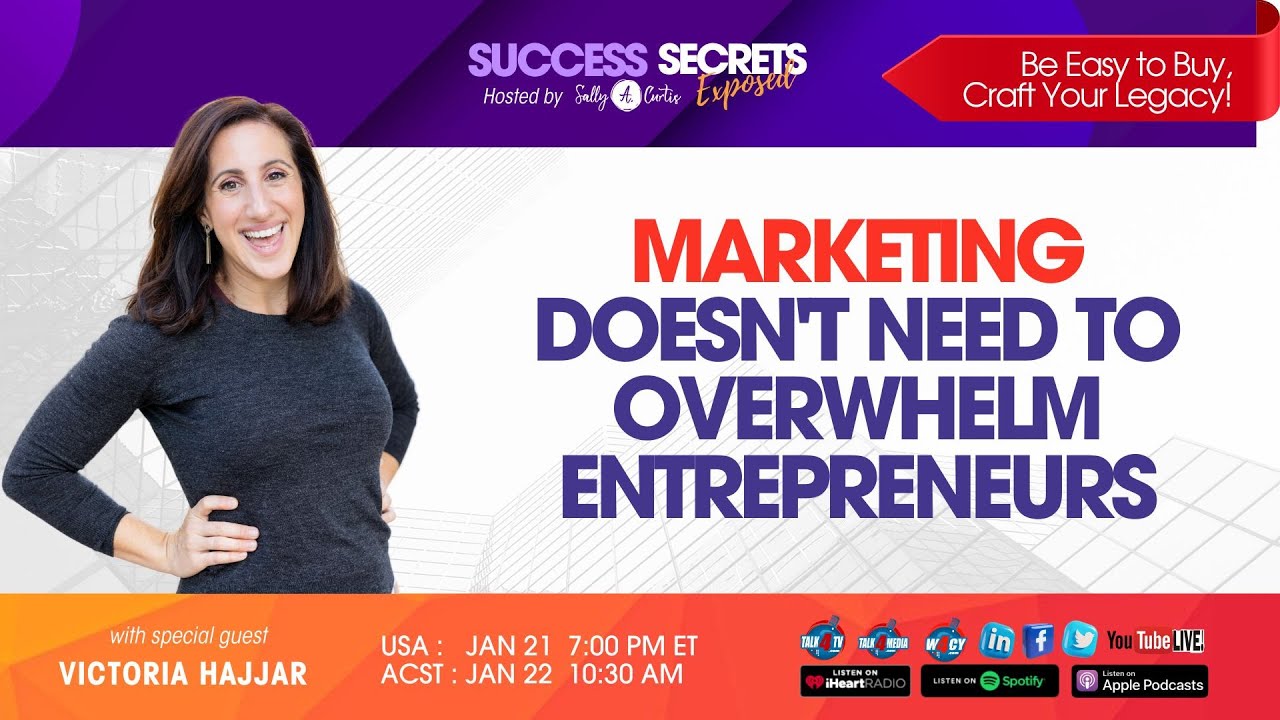
In this episode of the Legacy Leavers series on Success Secrets Exposed, host Sally Curtis interviews Victoria Hadjar, founder of Ugly Ventures, about how entrepreneurs can stop feeling overwhelmed by marketing and build scalable, profitable marketing systems. Victoria shares her 10‑year "trial‑by‑fire" journey, the origin of Ugly Ventures, and the four foundational pillars of a successful marketing program: brand communication strategy, a repeatable 24/7 marketing flywheel, a capable team, and strong leadership. They discuss how brand messaging evolves, the importance of measuring every step with UTM parameters and channel analysis, and the distinction between marketing for lifestyle founders versus investor‑driven growth. The conversation also covers practical tactics such as working a month ahead of the calendar, batching content, using a replacement ladder to outsource tasks, and applying the 80/20 rule to focus on high‑impact channels. Victoria emphasizes the unique challenges women face in reaching the million‑dollar mark, urging female founders to adopt a CEO mindset, build loyal teams, and leverage systems rather than trying to do everything themselves. The interview ends with resources available on uglyventures.com.
Chapters
The topics and opinions expressed in the following show are solely those of the hosts and their guests and not those of W4CY Radio, its employees, or affiliates. We make no recommendations or endorsements for radio show programs, services, or products mentioned on air or on our web. No liability explicit or implied shall be extended to W4CY Radio, its employees, or affiliates. Any questions or comments should be directed to those show hosts. Thank you for choosing W4CY Radio.
Welcome to the Legacy Leavers series on Success Secrets Exposed. Tune in live every Tuesday at 7 PM Eastern time or Wednesday mornings in Australia on W4CY Radio and Talk4TV. The series showcases experts, changemakers, and disruptors leaving a lasting legacy with those
Good morning, good afternoon, and g'day to you all, and welcome to another episode of Success Secrets Exposed. Today we're going to be talking about marketing doesn't need to overwhelm entrepreneurs. And marketing, I find, and my guest today finds, is the number one thing that keeps entrepreneurs stuck and keeps them from growing their businesses. And overwhelmed, which gives them of course less time to focus on their legacy. And we both find that the missing link is having the right systems, and marketing is of course a big beast. So we'll be diving into all things marketing in our specialties. And today I'm very excited to share this conversation with Victoria Hadjar, who is the founder of Ugly Ventures. Now I bet that name just caught your attention, which helps startups scale from 6 to 7 figures with a focus on empowering female entrepreneurs. Now, Victoria specializes in streamlining sales and marketing strategies, building strong teams, and fostering leadership development to create profitable businesses. She has a global track record in the US, the UK, and the UAE and beyond. And Victoria is committed to breaking barriers and helping more women reach that million-dollar mark. Now she's based in Miami, enjoys her summers in Spain, is loving raising her 2 sons, and stays very active with CrossFit. So please help me welcome to the show Victoria.
Hi Sally, thank you for that wonderful introduction.
You're very, very welcome. And as I said, I'm very excited to share this conversation because it can go anywhere and everywhere as far as both our So thank you for joining me.
I'm so excited to be here and, and talk about how we can end overwhelm with marketing, because it really is a place that so many entrepreneurs, business owners, whatever you want to call yourself, get stuck in business.
Yeah, yep, absolutely stuck. Deers in the headlights stuck. Yes, absolutely. So I'd love to share more of that. Can I ask you just to kick things off, What was it that inspired you to start Ugly Ventures and what does the name represent for you? So that's a great place for us to start.
Oh, absolutely. Well, my, my, the precipice for starting Ugly Ventures really began many, many years ago in the early days of my marketing career. So my career has always been marked working directly with founders and with investors. And in fact, My very first real kind of marketing job was on your side of the world. I left New York after university and moved to Shanghai, China, where I began working in entrepreneurship. So working with business developers and entrepreneurs and really cut my teeth doing marketing, working directly with these founding teams. And when you're in that situation, which I believe many young marketers are, you sort of find yourself hitting a ceiling where your marketing expertise only reaches as far as those who are guiding and developing you. Yes. And so what that did for me was really quickly understanding that if I were to really get to unlock marketing and what it can do for these businesses that I help, then I'm gonna just about have to figure it out myself. So that started a more than, I would say, 10-year trial-by-fire kind of education where I was so hungry, Sally, to just get more accomplished entrepreneurs, more experienced entrepreneurs so I could be learning from them. their secrets to marketing. And so Ugly Ventures is the culmination of this more than 10 years' work of really taking pieces from all these brilliant minds that I've gotten to work with and creating a system of my own that I've been able to replicate across many different verticals and many different countries. But Ugly Ventures really comes from— the name comes from the frustration that I felt Especially in the beginning of my career, just feeling that marketing and sales is such an important part of business. And it's really the influx point of so much pain because it's connected so intimately to revenue that to me it felt very ugly. It felt very ugly for many years.
And I find too in that space, in that entrepreneur space, that entrepreneurs are often seeking more education on how to do it, but not understanding the implementation process. And they find a guru at the front of the room that's got different values to them, different life experiences to them, and therefore it might— it often doesn't work for them. Whereas what I love about your story of the 10 years of your, your adventure was that you've actually utilized expertise from people that have had been there and done it experience and then filtered through that and found, uh, you know, what works predominantly for everybody and brought that to to life to be able to help people scale.
Yeah. And, you know, it's interesting because when I, when I first started my career, I had this great opportunity to work with entrepreneurs that were part of a wonderful global organization called EO. And in EO, there is, there's like a basic textbook that everyone works off of, which is called Scaling Up. It's by Verne Harnish. And I have to tell you, as a young woman in my 20s, he was like my idol. I really I picked up this book and I was like, wow, it's like an instruction manual for how to run a business. But when I started implementing that, those pieces of marketing in real, in the real world, I realized there was a lot of pieces missing. So my desire was to create almost like an instruction manual for building a marketing department and how to organize it and how to create your strategy and how to build your team. And really that's what I have done. Yeah. And that's sort of the result of all of this. It's not just the one small tactic for marketing, right? Those things change. What I was always interested is how do I create a marketing program that's profitable, that's lean for a business? And so as I began uncovering this and talking about this, I realized that there's many wonderful teachers that are talking about specific pieces of marketing. But my interest had been, well, how do we actually really build the whole part of this plane of this business, the part of, you know, this wing or the engine of the plane? How do we build this part from that 10,000-foot view? And so for me, it's been a beautiful sort of piece of educating entrepreneurs on how they handle this part of marketing, which, by the way, as you're growing and scaling, many times find themselves in a situation where doesn't make financial sense, or they can't afford to have a marketing director or a chief marketing officer in that spot. And so, they're forced as the entrepreneur to kind of have their content team, you know, have their developers, and they're managing it all. But maybe that's not their biggest strength, or they really need to understand how this whole thing works. Not that you need to be perfect at, you know, posting social media yourself, but you gotta know enough. to give it away, and you have to know enough to understand what success looks like. So that's been really my passion, um, to— for teaching entrepreneurs how it works.
Yeah, beautiful. Thank you for sharing that. So based on, um, the global brands that you've worked with, and I've got a mental note, I'm just going to say this so we come back to it. I'd love to discuss the difference between marketing, um, as a founder, so general marketing, and marketing when you're trying to bring on an investor, because I find that in itself is an area. So we'll come back to that. And this might be one of the lessons. So I wanted to ask you, you work with global brands, you've talked about various industries and various verticals. What are the most common lessons that have been brought through the support of the startups that you can share with the audience that would be relevant?
Yeah, so as I began my trial-by-fire experience, I realized that there were 4 key areas. And it doesn't matter what kind of business that you're running. These 4 key areas are really the backbone of building an effective marketing program. And you talk to any marketer, Sally, I'm sure you talk a lot about this. Us marketers love talking about who are our clients, who are the ideal clients, and really talking about that brand communication strategy. And the table legs of any business— That's good. And this is, is this is really understanding your customers, but more than that, understanding how to communicate with them effectively. So brand communication strategy is the first layer of building that profitable marketing program. The next layer is building a marketing strategy and not just saying, oh, we're gonna, you know, we're gonna run ads and we're going to be on Instagram. No, it's more about how are you creating a system? I call it 24/7 marketing flywheel. You can call it a client journey, a marketing funnel. There's a lot of ways to conceptualize it, but you need to build a marketing strategy against kind of a proven framework.
Yes.
And the problem is, is you can't, it's the chicken before the egg. You cannot build a profitable and effective marketing strategy before knowing how to communicate with your client and really understanding who they are. And a lot of times we put the cart before the horse where
we
go. We do. And also another interesting thing to mention, and I'm curious if you agree, a lot of times too, as we build and grow our businesses, that brand communication piece It actually shifts and grows as well.
Yes, it does.
So many of us, maybe we go through that, um, that process at the beginning of our business where maybe we're very diligent. A lot of very methodical people say, I, you know, I do my, my market research, I do my case, my, my interviews with potential clients, I'm studying them, I know their keywords and all that. But a year into the business, you may say, hey, I really don't like those kind of customers, I don't like working with those people. And you change and grow. So I think that the process of evaluating your brand, your brand communication strategy, your ideal client, that is worth doing at least once a year to revisit that. And then if that changes at all, that's going to affect that marketing strategy overall, that marketing growth strategy. Yeah. So the 2 pieces are, you know, getting that brand together, getting a marketing system in place, that is repeatable and measurable. Because marketing is a kind of alchemy, right? It's part science, it's part art, but we can't actually know what's working or not working unless we can measure it. So that's why the marketing system is so important. Then beyond that, we have 2 other important layers here. It's our team and then leadership. So the team, again, And I love explaining this because it's one of those things where many times— and listen, I've been in my own business guilty of this— but a lot of times we kind of collect this hodgepodge of people that help us in our business.
And oh my God, I need help now. That gang, that oh my God, I need help now gang. Yeah.
And they're usually these beautiful, lovely souls that are like, put on all the hats they wear and they're like, figure it out, I'll figure it out. But when you're in a growth and scale period, it really is a game changer to really look at that growth strategy that you've created, that marketing system that you've created, and ask yourself, do I have who I need to execute this well?
Correct.
Do I have the right people helping me to do the kind of strategy that we wanna do? And really, Identifying who you need and then filling the positions from the need instead of kind of putting people, putting fires out with people. So you kind of start— and I don't care if you have one virtual assistant or you've got a team of 40, this team mentality is really important for growth of any
kind. Mm-hmm.
I myself know in my own business, and I think many women can relate to this, held myself back for many years because I didn't like think of my business as like a real business. I didn't think of myself as a leader with a team. Sure. I had, you know, a video editor and a VA, and I thought they're just the people helping me in my business. But really, from these incredible entrepreneurs that I've met and I've— and worked with, and I've— I tell you, I've worked with entrepreneurs that have built, you know, million-dollar-a-month businesses. I've I've worked with entrepreneurs that have built billion-dollar unicorn businesses, and I've had this experience to work in different businesses with these entrepreneurs and see that these— this big business mindset, they apply to their small new projects as well.
Exactly. Yes, it gives you goosebumps, doesn't it, when you actually see that insight? Yes.
And you say, oh, this person is applying what they, what they know to work their systems, the strategies, even though the team that, you know, I, the project I come in, I've come in with some of these entrepreneurs are quite small. Like we've got a team of 5, right? But system and the mindset, the mentality, the efficiency, right? It's all there. And that kind of plays into this idea of leadership where—
Yeah.
If you can reconcile with yourself that your biggest contribution to your business is to maintain that 10,000-foot view, to be the leader, to be driving everything, that you do not have to be the executor. That's a huge change and something that women— I've also been guilty of this, but women I have seen time and time again struggle. And one anecdote I always like to share is the men that I've been able to work with that have raised a lot of money, for example, the mentality is completely different than the women I've worked with who— it's very difficult for women to raise money in, in general, but the women who are bootstrapped, that, that you can— the mentality is so different. And you can see how the exponential growth that the male counterparts have just simply because the attitude investing is there because they've raised money, the risk-taking is there, then showing up as the leader, coming with that mentality. So I'm not saying that, of course, not all women— I've worked with incredible women leaders that do not suffer from this, but on boots on the ground in my communities, and I can tell my own experience, that is something that is a big shift. So
yeah,
the framework, overarching framework that I called building yourself a scalable marketing machine, it's these 4 elements. It's that, it's getting that brand together, building in a marketing system that's measurable that you can iterate and improve upon, finding the right team to execute the right things, and then leading them to success. That's how you extract yourself out of the day-to-day and are able to create a marketing department for your business. Mm-hmm. Instead of what a lot of us do, which is getting completely overwhelmed by Yeah, details. Yeah,
we're putting out all of the fires, and you've resonated a number of things there for me. Um, I jokingly, like, uh, was last year always said to the team, okay, so what choke points am I causing now at the moment? Which was me being flippant about what I was. But I, I had my mindset coach pull me up and, uh, and said, you know, that act— what you may be joking about it, and it may be the reality, but that, that's that perspective and the difference between the guys and the girls, which is just what I wanted to, uh, just touch on because I'm working with some amazing entrepreneurs at the moment that are, you know, wanted to increase their business by $10 million in a, you know, in a 12-month period. And they've developed, um, and they're doing, you know, months like that now. And just as you said, the difference in the attitude and how they start things and etc. The first question he asked me when we, we've just started a new business was, okay, so Are you looking at selling this in the first 3 years, 5 years, 10 years? I'm like, I didn't— we were just off the ground. Again, it was starting it where you want it to finish. It was like, wow. Then just as you said, their perspectives, the way in which their attitudes, the way in which they go about doing things, the way they bring the right specialists in to solve the right— create the right solutions and all those sorts of things. For me, I was doing similar things, but not, certainly not at that level. So it was a real eye-opener. So I can really, really appreciate that.
But Sally, you touched on something that you had mentioned before about the difference between the marketing for investors versus founders, right? And you just hit the nail on the head. And this is what was chiming in my head, 'cause I often tell this to the women that I work with. It's understanding what game you want to play.
Yes.
Because obviously an investor and these male counterparts that I was mentioning earlier, right? When you build to sell and build to scale and grow and to sell, right? Obviously that's a whole different marketing approach that you're gonna take as opposed to what many women in my communities and even what I wanna build for my own business, Which is definitely more lifestyle-driven.
Lifestyle-related, correct. Yeah.
Both have their merits, right? But I find that there is a huge misconception with people in general that are building these lifestyle businesses. And it is full, it's wrought with these inefficiencies because you think that the scale and the growth. So when we think of team, when we think of bringing on employees, we think of massive growth and scale that's more fit for the kind of investor mindset, sort of the build-to-sell mindset.
Yeah.
But if we were able to borrow some of the very practical, right, habits, mindset, but also systems, we'd be able to build our businesses with more ease.
And I think that— And we get into it for that. For freedom and ease. Yeah, but we lose it.
Many of us, we, we look at— we kind of quit our corporates to start our own thing, just to build a lifestyle business, because there's a lot of people that maybe they don't have an appetite to have 100 employees or 50 people on their team. Maybe that doesn't excite them, right? But they can still build a beautiful business that changes people's lives and changes maybe their family. However, In order for that to be possible, for that kind of growth and sustainability of a business, I believe that we need to borrow some of these best practices from this mindset because in the end we're just holding ourselves back and maybe find ourselves creating a job for ourselves instead of a business for ourselves.
Yeah.
And that's a tough place. Yeah.
Yeah. And I was just gonna say, and I think too, when we talk about that, the difference between, you know, the job versus the the business when we're outsourcing. And this was the experience I have with my range of clients, because a lot of the clients we work with are crafting that lifestyle legacy business. They want a lifestyle for themselves and they want to leave a legacy with the shared wisdom that is their expertise. And what I often find is when they're in that growth, that first growth phase where they're bringing in either the virtual assistant or the online business manager, they think of systems, well, okay, I go about doing it like this. We'll do this, we'll do this, we'll do this. And they actually are creating tasks around projects, particularly when it relates to creating content. Okay, I need to create a week's worth of content. So they'll go off and find all of those sorts of things and it's super inefficient versus if they actually set up simple systems to actually create production lines as it relates to here's my Here's the voice that we have as a brand, which I'd like to touch on again. Here's the images of the brand that we have. Here's some template designs in a whole range of campaign styles. So setting up some of those simple systems to create the speed and efficiency when it comes to the creation process is just one of the things that we help with clients because we get so stuck in the, what I call the plod, plod, plod versus— Yeah. speed this up to do it efficiently so we can actually be at the front of the room serving our clients or on the beach where we want to be.
Yes. Well, the other thing that I've also seen, and this was something that I learned firsthand from incredible founders, uh, one— so just to touch on what you just mentioned, so one of the founders that I had the honor of working with, um, is a Canadian entrepreneur named Dan Martell, and he has an incredible book called Buy Back Your Time. And one of the principles that he talks about in this book is the replacement ladder. And it's really interesting because, you know, he, he's a systems guy, but he's really talking about business as a whole system. But he says there's, um, there's actually strategy for how you should be replacing yourself in tasks.
Yep. And replicate and duplicate. Yep.
Right. So the idea is that, you know, Hand, you know, ground floor, every business owner should not be managing their inbox and their calendar. He's like, table legs, get yourself a virtual assistant to manage those administrative tasks. The next layer is customer service and client fulfillment, right? After that is marketing, after that is sales, and then leadership, right? Mm-hmm. So that's kind of like, as your business grows, these are gonna be the things that you give away. Many of the business owners that I work with, and I would suspect that you work with as well, are in that where it doesn't make financial sense for them to get a sales leader or a marketing leader. They're probably driving a lot of that. And so these systems that you talk about, even when I'm brought in to lead the marketing, these incredible founders still are there not to be executing with their hands to be in that day-to-day stuff, but to get that 2% or 5% sprinkle of magic that they put on top. And when you have the systems in place, because if you're working in a, especially with your content, right? Mm-hmm. That's what you do is so incredible because you produce this breadth of content, you create the system around the content. And when the content is done, right? Let's say it's final draft phase. What is the highest value for a business owner or the founder or the main creative of this is to sprinkle that last dust, to bring, to make it exceptional, to make it extraordinary. But we don't have the brain space to do that if we're stuck just with the deadlines, pumping it out, if we're behind schedule. And especially when it comes to content, and especially now in the AI world, Where it's going to be more important than ever to weave those personal stories and anecdotes, that humanity to it. And the only way you're going to be able to do that is if you have systems in place so you can work ahead of your calendar.
Capturing ideas or thoughts or, you know, those thought bubbles we talk about, you know, the creating ideas airport systems to capture ideas, to capture stories, to catch on those fly. Because they're all the gold, they're all the humanness, but we're just so busy with life, we just charge through and we miss all those opportunities.
Yeah, yeah.
We've just had a question from the audience, uh, from Taylor. What was the name of the book and who was it authored by that you just mentioned?
Yes, so it is Dan Martell, D-A-N-M-A-R-T-E-L-L, and it's called Buy Back Your Time.
Thank you.
Buy Back Your Time. Yeah.
Excellent. I was going to ask you the questions as it relates to the return on investment from marketing, because that's always one that we hear when you're in marketers. Oh, you never get any return on investment from marketing. And it's like, so please, I'll leave that one and open the door for you to talk about that from your perspective. That would be amazing.
Yeah, well, I think that we've definitely experienced a seismic shift the past 2 or 3 years on attribution, but I don't wanna get too much in the weeds on the technical kind of underbelly of it all. But I think that if we pull it out from a 10,000-foot view, we have in marketing 2 distinct functions. One is about brand and more about brand awareness and just making sure that we are getting in front of brand new people and more and more people know about who we are, what we do, and how we serve them.
Mm-hmm.
That's more of this awareness phase. And then we have this kind of conversion, um, aspect of it. And I want any business owner right now to ask themselves this question because I think It seems simple, but I think oftentimes in practice it's difficult.
Mm-hmm.
You know, I'll just be sort of frank on what is the purpose of your marketing? It's a very simple question, but one that often we don't ask ourselves. We need to make sure that in marketing, in sales, we're playing the right game, so to speak. And so if you are a business that is a product-based business, it's very A plus B equals C. Meaning you get the traffic, the traffic comes to the site, they either click buy or they don't buy, right?
Mm-hmm.
Service-based businesses though can be a little bit tricky because if you have a very high-touch, high-cost offer, it's going to be a completely different, um, strategy than maybe a SaaS business that has a low-touch, low-cost offer, right? Or if you're selling a resource for $49 versus selling a mastermind for $40,000, we're going to have a very different approach to marketing. So I think it's, you know, we're going back to that phase about strategy. We need to be frank to understand again, what exactly is our product and how are we going to sell this?
Hmm.
I think that many times we get in this idea, and I think there's a lot of online marketers that give us this impression, where it's just like more eyeballs, more, we gotta get in front of more people, more impressions, more, more, more, more. Yeah. And especially since we're all inundated, I'm sure, with, you know, a lot of folks saying, you know, I'll do outbound email marketing for you and get you 3 booked calls an hour and all of these things, right? There's a lot of kind of snake oil that's being sold to us on, so, I think sometimes people create their marketing strategy where there's a little bit of a mismatch.
Yes, agreed.
Of what the strategy they need versus how they actually get clients into their world and convert them. So again, if you have a high-cost, high-touch offer, I believe it needs to be matched with a high-cost, sometimes high-touch, bespoke sales and marketing program.
Right, Graham.
Yeah, and that's going to look a little bit different than just— and again, where a lot of people maybe just start running ads when ads might not really be the best thing for them, right?
Yeah, I see that a lot too.
Right. So again, we can do this A plus B equals C if we have a very straightforward business where we're having marketing do the sales for us, which is essentially product— get them to the page and buy the thing. But if we are trying to build up trust and interest enough to get them on a sales call, that's gonna take a totally different approach. Mm-hmm. And so sometimes it is quite difficult to measure. And this is where we talk about, I talk about attribution quickly, where we can't sometimes follow the exact journey that our clients go on because it's, people search a little bit differently nowadays. You know, they could be— a mastermind has a WhatsApp group that recommends someone, and then, you know, someone's website, and then they go to the website, they check that out, and then they go to the social media and they check that out, and they go to the— and so there's a lot of different layers on how people find you and how they digest your content.
Sure. Yeah.
So I will say, what is an important thing to do to overall look at ROI? Is if we can manage to track the different ways in which we are putting things like our lead magnets or our, our pieces of content where we're asking people to get to give their contact information, things like that. If we can be very diligent about using tracking on those links via UTM parameter, which you can look up UTM There's a lot of different softwares that can help you generate for free little pieces of code that you can put on the links. Now, if you become diligent in that, you'll be able to identify where leads are coming from, where sales are being— are coming from. This is a really great practice to get. It doesn't matter how big or small you are. It's a very accessible way that you can begin to put those pieces together of where people are, are coming in from. Interesting with you. And if we're able to do that tracking, and by the way, we can also set up tracking on Google Analytics, and sometimes our CRMs that we use will help with tracking. But if we can really, step 1, pay attention to getting that tracking done. So this would look like if we're sending out an email campaign, that, that email campaign link to get your thing for free or to Buy your thing, has that tracking on it, we'll be able to identify, okay, it came from email. Or you're putting some posts through social or your LinkedIn profile, we'll be able to put a different piece of code. So we'll be able to aggregate that data. The next piece that I love to do is on a quarterly basis or a yearly basis to run what I call a channel analysis.
Thank you.
Yeah. So with all of this data, right? So if we're We're able to kind of, and again, we don't have to get fancy with it. You can just be doing, you know, here's my email link with its special code. Here's my social link with its special code. Here's any partnerships I do, special code.
Put
it in a Google Sheet. You'll be able to kind of build that data. But when you have that data over a span of time, I like to do this over, I say quarterly, but really a 6-month or a year. Yeah. Data. And then we can kind of do, again, we're gonna be able to track, okay, which channel are people coming in through? Is it ads? Is it organic social? Is it through a referral program? And because we're tracking those leads and we're able to track conversions from those leads, 'cause once they're a lead, we'll be able to tag 'em.
Yeah.
I'm getting a little bit spicy here maybe. I don't know how, how, how—
You're speaking my Sally nag language.
But once we're able to see how they came in from, once they're in our world, right? Once they're a contact of ours, we can stick a tag on them so we know exactly where they came in from. And then we'll be able to track whomever bought our stuff or whoever came onto that sales call and we can identify where they came from. Well, then we're gonna be able to pull that into a channel analysis where we'll be able to see, Not only the performance through channel, but what is the most important piece of this for ROI is to reconcile how much money did I spend on this particular effort? Ads are really easy. Okay. Ads are like, oh, who manages my ads? How much I spend on ads? What is a little bit more difficult to measure, but it would be worth it for you to understand what are your values around this is social media organic. Mm-hmm. Well, you probably pay for some help. With content creation, or you pay for someone to post and engage or whatever, what's the cost of that? And at the end of the year, you'll be able to see, or 6 months, okay, this is how much money came in. And then here's actually how many leads I got. So we can identify cost per lead for that channel.
Yes, exactly.
How many sales did I get? What is the cost per client acquisition? And with that, we'll be able to determine the return on investment. Again, it's really cool if you spend the time to do it. It's so exciting.
It is. I'm nerding out. But if I track it back to use it this way, the way that I've offered, say, to clients is when you know the data, when you can see the magic in the data, you actually know what's working. So you can say, I can I can do more of this because this particular channel is working. Sometimes though, as you've just said, you've got to just check what the convert— the investment versus expense is. But by knowing that, you actually can do more of what's working and drive the growth through the working channel.
Yeah.
And get rid of things that aren't working. That was one of the greatest relieving years for me was when I could cut 3 things that we were doing that wasn't working. One of which for us was webinars, which are incredibly time-consuming.
Yeah.
And if I spend that on working on partnerships where I get clients from that I would never actually ever be able to work out how I would actually market to them, but I get them through my partnerships, that saved so much time worry and aggravation. But we did not know that until we looked at the data.
Yeah. And that's the beautiful— that's where 80/20 really comes into play. 80% of my— all of my clients are coming from these beautiful partnerships. And again, it's the data. So I think when anyone out there realizes how much you could be exponentially growing your business just by paying attention to the data, What I believe happens is that you're gonna want, you're gonna be excited to simplify your marketing as much as possible because then you're gonna get to see way more clearly the results of what you're doing. Because again, marketing is simply experimentation. It's simply about that feedback loop. Mm-hmm. And what I think one of the major cleanup issues that I usually have when I go into businesses is like, how can we simplify to amplify? So,
yeah,
in the marketing system that I, that I teach called the 24/7 Marketing Flywheel, there are 6 stages.
Mm-hmm.
It's called the flywheel. That's kind of bringing people through first knowing about your brand to, you know, actually converting into a client and, and having a wonderful experience with you. However, In these 6 stages, what I find is that many times people are running dozens of different tactics within these 6 stages, and oftentimes they're, they're not doing any of those things well. And social media is a great example, right? Mm-hmm. Many of us know that with automatic posting tools, we can be on all of the channels. However, you'll Probably noticed that the ones that perform well are the, are usually the ones you pay attention to, the ones that you put more effort into. There's usually one that your ears are perking up if there's an algorithm change, or maybe actively learning because they're, that's the channel, that's your primary channel, which is just a beautiful way of showcasing is like nothing's gonna grow or work if you don't pay attention to it, right?
Yep.
So we need to be very diligent about how we spend our time and how our team spends our time to be as focused and simplified in our marketing sales processes so we can iterate and improve, right, from how we measure that data.
Yeah, perfect. We've just had another question come in from the audience from Zane. Can you explain work ahead of your calendar?
Oh, yeah. Oh, goodness. So funny because I would love everyone to I don't know how many marketers we have out there, but like the worst possible feeling is being on a marketing team and having like something completely inane, just kind of sucking your whole existence. Like, like a social media post not going like that needs to go out on time. And you realize like we're not curing cancer, we're doing marketing, right? So when I say work ahead of your schedule, it's like I make it a rule that we need to work A month ahead in any team that I work with, at least a month ahead. Batching is your friend. Yes. So it's like you're gonna be, you have to put out content for your business every month. I want that signed, sealed, and delivered 2 weeks before the month is that we get into the month of final drafts so we can have the founder of the business owner sprinkle that magic on top, finalize everything. Everything could be scheduled. That we have that breathing room of 2 weeks to change anything, add anything. And that's what I say, the blogs, they have to be done a month in advance, not on day 1 that it's going out in 3 days. No, a month and, you know, 2 weeks. Okay. The blog post, the email newsletters, all of the social media posts, the podcasts, right? No one wants to be rushing last minute. That's when we have typos. That's when we do things wrong. That's when also just it's not your best work. So that's what I mean, again, ahead of schedule. So I love to, for any of the social media managers and the content managers that I, that I have on teams that I create, is really like create a great template that is in a shareable document that they can submit to you. You can have your comments and that's done well ahead of time.
Yeah, love it. We always talk about working on 90-day runs, you know, what's the 90-day run as it relates to content. But one of the things I would love to add in here is the big rock, small rock philosophy as to what you've got coming up, because you've just mentioned podcasting, and like me, you're on other people's podcasts and vice versa, and we get asked to speak and all those sorts of things. To me, when you're doing that content plan, those key activities when you're doing your own thing or guesting on somebody else's or just rock going to attend a networking event for fun, if that's what you're doing. All those things need to be in your calendar because if you and your team have that high visibility view over some of the social things that you're doing and some of the fun things you're doing, that actually helps your team. This is where it comes in for me. I get nagged by my team, oh, don't forget to take some photos out when you're tree climbing with your son. Yeah,
you
know, set up those reminder systems to capture some of that personalized human stuff, which we all forget to do, and we're all guilty even as marketers to capture that, let alone crafting and, you know, getting our normal content in there. But you really do open up your opportunities when you get into that, the beautiful habit of planning your calendar and overlaying different elements into your calendar in advance.
I love, I love that you said that because I have gotten pushback in the past of founders saying, well, I don't want to work ahead of time because it is so important to be in the moment. And, you know, which I think to some degree there is merit there. However, I feel like there's no problem with having more. You know what I mean? There's no problem with having more. I've had Plenty of situations where something really timely to a business happens. And so we want to create a bunch of content in the moment because it's pertinent for their brand. So then, well, then we build up a bank. The thing we were— that was going to go out today, and yeah, and when you create from spontaneity and excitement, the quality is so much better.
Isn't it just? Yes. Yeah, you're in that— we call that the inspired state, and it's just a completely different level of It's
a different level. Exactly. But, but we need to make sure that the train keeps moving and that you're covered. And, and by the way, doing this work in this way is so beautiful for like if your kids get sick. I mean, you know what I mean? Or, or you get sick or something gets thrown off. And, you know, it's like, that's where, you know, I always look at like batching things as like self-care, really, because I think, oh, I'm gonna You know, but I wanted to mention another thing about the, about the personal calendar, because that is another huge important point on, you know, how you spend your time and making sure that you are allocating enough time to the important rocks. So you had mentioned— Mm-hmm. What came to mind was a lot of things that I see from businesses when I first enter them. is that they're not getting the results they want from some of their promotions or campaigns. And a lot of times it's because it just wasn't properly planned out in the calendar. So it's kind of like feeds itself because if you're not planning things ahead, like all of the content, let's say you're running a promotional campaign.
Choreographing it. Yeah.
Choreographing it. Because a lot of times, like maybe things, maybe that campaign, and I'm a big fan of Jeff Walker, if you know him and his Product Launch Formula.
Yep.
And when I was learning about Product Launch Formula, you know, he, he leaves 18 to 36 weeks for the whole crescendo of his promotion. And a lot of the businesses that I go into, I say, you know, they're running a promotion for 10 days and expect it to be a knock out of the park. But there's something really magical happens when you really methodically methodically build the content crescendo where you're building excitement and interest and you're building that relationship and you're supporting. The difference that, that is a much larger project content-wise. The quality is much higher, but the results are much better. But again, you need to be working at a pace where that's possible. So going back to, to the original question, working ahead of time is what allows you to do all of that stuff. And I feel like many of us are too much in the, in the hamster wheel of that, and we never get ahead, you know, and it always feels stressful.
Yeah, yeah, totally agree. That's been my experience, and certainly the experience of different clients that I've worked with, within that hamster wheel versus the ease of being able to plan some of that stuff in advance. And going back to those, you know, those inspirational, those inspired states Or stories that you capture, sometimes you actually can capture them and just have them ready and they can be in there as a library because they aren't timely. They're just an insight and something that's a bit quirky but relevant to what you do that you can share whenever you need it. So it is about capturing those. It's about capturing the opportunities to be able to serve yourself, etc. So we're getting through our time slot very quickly. I knew we would do as soon as we got into a deep dive conversation. Yeah. One of the things that I want to just touch on is the vision and the legacy, but particularly as it relates around women and the percentage of women that are achieving the million-dollar mark and beyond, because I believe the stats are relatively low, but I'd love to see how you're wanting to really craft that vision and actually really help with that legacy. where more of these women are actually getting to their million-dollar businesses because of the systems and the legacy that you've left behind?
Yeah. So this became a huge passion of mine. You know, in my 10-year trial by fire, I actually worked primarily with a lot of male entrepreneurs and was surrounded by a lot of more masculine energy. And for me, it was such a gift because when I When I started to turn towards working with more women, I was able to really clearly see kind of a delineation in the way that women are showing up, the way that they're building their businesses. And I became really passionate about helping women to unleash the leader inside of them.
Yes.
Now, of course, I'm really focused on marketing because that's kind of the conduit by which I get into business. And, and I, you know, I, and I love having a lot of very specific knowledge, but, you know, just about marketing. But when we look at business on a whole, I feel like all of the things that I teach in marketing, it's, again, it's very counterintuitive to a lot of the messages that women get now. Correct. very frustrating, which I, I think men also experience this, but I think that there's a lot of marketers out there that, yes, you can learn how to do ads yourself. You can learn how to write copy yourself. You can learn how to do SEO yourself, how to build a website yourself. But the problem is, is that we, a lot of us get so stuck doing it all ourselves.
Mm-hmm.
That actually the key ingredient in being able to build a bigger vision and a bigger dream that you have for yourself, not necessarily size of business, is stepping into that, those shoes of CEO and leader.
Leader. Yeah.
And in order to do that, you have to have, again, confidence in the key areas of your business, marketing being one of them, sales another, finance another, customer service another. You have to confidently understand these pieces of your business, but then you need to have those systems and strategies in place to be able to bring people on and trust them and lead them. Not so you're managing people, which I think a lot of us get stuck in. Yeah. One of the deepest passions I have is to show women how to manage out outcomes. Yes. And most successful leaders that I've worked with, they're not going into meetings and telling people how to do everything. In fact, this was really jarring for me when I first was working with Dan Martell, who's an exceptional leader, but he brings people on and expects you to come with answers and come with, you know, to come with solutions. And I feel like the women that I got to peek behind the curtain of their businesses, they were not thinking in that way.
Hmm.
Another incredible founder that I've worked very closely with, Sameera Madani, who has built a billion-dollar unicorn business, I saw that in her. And by the way, working with her, I also saw her have— be an incredible mother and incredible partner and sister and daughter and seeing that it is all possible. But what drags us down and holds us back is this idea that there's merit in figuring it out ourselves.
Doing it all ourselves. Yeah.
And so when, when we look at the statistics where less than 2% of women break the million-dollar mark in their business, I've had the enormous pleasure to be in wonderful community with many women that have crossed that barrier. And I think that I've seen proven time and time again that it is that understanding of those key elements of business and those systems and being able to manage the outcomes of those key parts of business. You need to understand how sales works. You need to understand how marketing works in your business, what growth means in your business, feel confident about it. And then beyond that, get really wonderful people to build the business for you. I think it was Zig Ziglar that says, You know, you build the people and then the people build the business.
Yes, yes.
People that are functioning on that highest level, they're doing that. They're building these people. And, and one last thing I'll say is, don't— I want everyone that's listening to start thinking in that way. Even if you have a virtual assistant and a contractor or freelancer working in your business, I want you to Imagine that that is your team. Think of them that like they're your employees, they're your team. I want you to bring them into regular meetings. I want you to have one-on-ones with them and cultivate a relationship with them. I want you to support them and support the growth and the vision they have for their own lives. Mm-hmm. Because by the way, the leaders that do that, they get fiercely loyal, amazing human beings to work for. work and build their business for them, because none of us can do this alone, you know. Yeah, yeah.
Very well said. Thank you very, very much for sharing that. And please, uh, you can certainly reach out to Victoria, and she's, uh, active on LinkedIn. Um, we've had our website going across— her website going across the ticker as well. So Victoria, thank you so much for sharing so much pearls of wisdom with us today. It's been great.
Thank you so much, Sally. Yes, I invite everyone to take a peek at my website. I was here as uglyventure.com, but I have a ton of resources, free resources on these elements I talked about, building a brand and that marketing growth strategy, those 6 stages I mentioned. There's a bunch of free guides if you go to uglyventures.com/resources, and that's ugly with an I. So uglyventures.com/resources. There's a bunch of goodies in there that you can check out that can kind of help you on your journey.
Awesome. Thank you very, very much. We look forward to seeing you another week on another episode of Success Secrets Exposed. Till then, see you later. Take care. Bye.
Remember, if you want to be sought after and sold out, as well as being known as the obvious expert in your industry, you need to speak with Sally, our host of Success Secrets Exposed. Sally is the Founder of Monetize Your Content, a done-for-you content marketing agency that helps you be easy to buy. See you next week on another episode of Success Secrets Exposed. Tune in live every Tuesday at 7:00 PM Eastern time or Wednesday mornings in Australia on W4CY Radio and Talk4TV.
More from Sally






The Coaches Results Express: How to Build a Thriving Coaching Business That Actually Works


