Success Secrets Exposed - Creative Flow
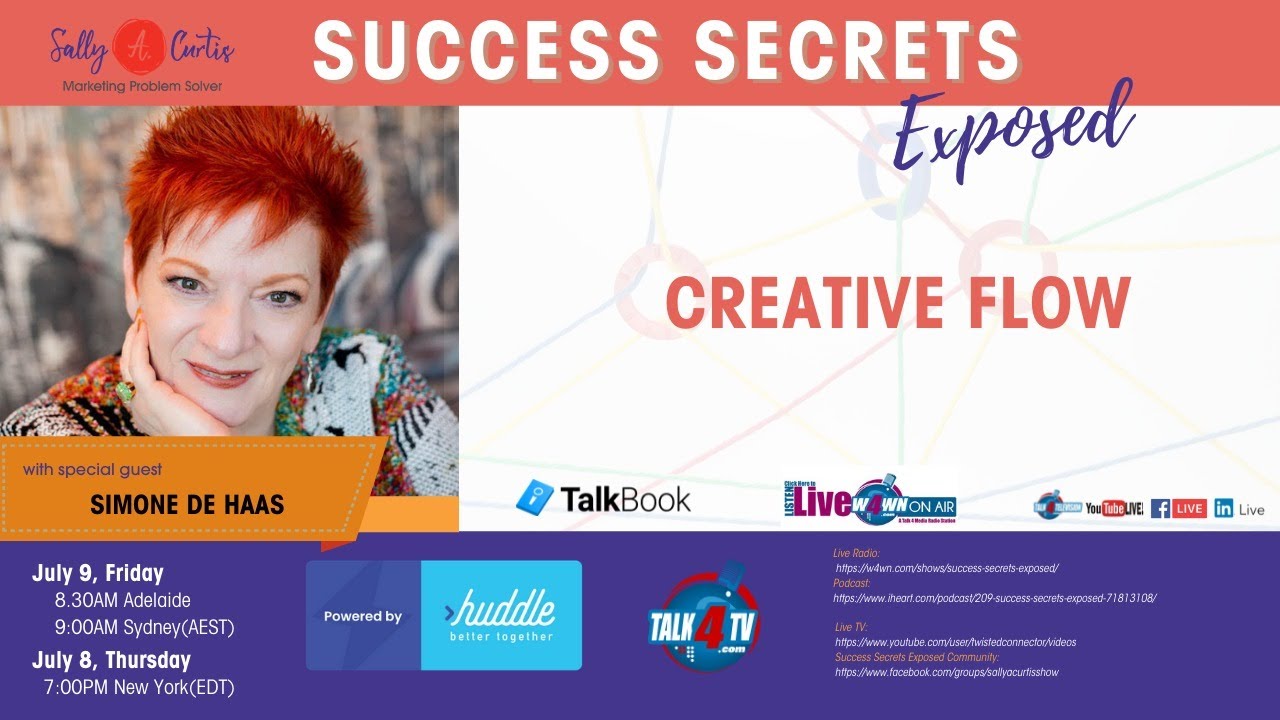
In this episode of the Success Secrets Exposed podcast, host Sally A. Curtis interviews international speaker and creative‑leadership expert Simone de Haas. The conversation weaves together Simone’s diverse background in theatre (artistic director of a 23‑year‑old theatre company, director of major musicals, film‑TV trainer) and her work with corporate leaders. Key themes include: • Translating stagecraft and improv techniques—especially the "yes, and" principle—into boardroom communication and inclusive leadership. • The concept of "exceptionality" as a re‑framed neuro‑diversity quotient, positioning differences (ADHD, autism, etc.) as gifts rather than deficits. • A dual‑energy model of intuition: gut instinct followed by heart‑centered feeling, and how leaders can move from instinct to intuition. • Vulnerability as a catalyst for authentic, inclusive leadership and the importance of creating safe space for leaders to be emotionally open. • Distinguishing empathy (a skill) from being an empath (a heightened, sometimes overwhelming sensitivity), and strategies for highly sensitive people to manage empathic overload. • Practical tools such as the "Is it mine?" self‑check, asking "what if?" after a "yes, and," and cultivating presence before expanding ideas. • Storytelling and signature‑speech development as a way to amplify impact for coaches, consultants, speakers, and CEOs. The episode also includes anecdotes from Simone’s work with CEOs, a boardroom lunch for the CEO Institute, and personal stories about navigating highly sensitive environments. Promotional segments for Sally’s content‑repurposing services and a brief ad break are interspersed throughout. Overall, the interview offers actionable frameworks for leaders to foster creative flow, inclusive cultures, and authentic communication.
Chapters
The topics and opinions expressed on the following show are solely those of the hosts and their guests and not those of W4WN Radio, its employees, or affiliates. We make no recommendations or endorsements for radio show programs, services, or products mentioned on air or on our web. No liability, explicit or implied, shall be extended to W4WN Radio, its employees, or affiliates. Any questions or comments should be directed to those show hosts. Thank you for choosing W4WN Radio.
Welcome to Success Secrets Exposed with Sally A. Curtis, where we share stories of challenge, success, and inspiration, along with practical tips and strategies to move you forward to your success. And now here's your host, Sally A. Curtis.
Good evening, good morning, and good day to you. Welcome to another episode of Success Secrets Exposed. Today we're going to be talking about creative flow, uh, and all the things that comes through being creative and being in flow. And you'll get to experience a great conversationalist today in my guest Simone de Haas. So for those that are actually new to the show, let me give you a little bit of background on myself. I'm a marketing and business strategist specifically for coaches, consultants, and speakers specializing in content repurposing, turning your old collateral into new profits, and LinkedIn strategy. And it's my role to help you amplify your voice your message, and your impact. Now I'm very, very excited to share this— our guest with you today, Simone de Haas. She's an international speaker on creative leadership, the spirit of feminine leadership, as well as exceptionality. So I'm looking forward to finding out a little bit more about that as well. She's a multi-award-winning author— sorry, director and producer. Of lots of different events and productions, etc., which we'll be talking about as well. And she brings a very inspiring, a very intriguing, and lots of different shifts in paradigms as it relates to leadership and communication. And her philosophy is about building transformational leadership and exceptional organizations. So So please help me welcome and bring to the show Simone de Haas to talk on creative flow. Welcome.
Hello. Thank you so much for having me on your show. And hello to everyone listening around the world.
Thank you so much. Well, I'm super, super excited because I know we have great conversations and get into all sorts of excitement when we do get a chance to speak. And your words of wisdom and your background and knowledge is insanely incredible, which is great. I'd love to ask you to share a little bit with the audience, if I may, a little bit of your background, because it's very, very diverse and crosses both corporate and creative quite exceptionally. So can you give us a little bit of a background backstory on that, please?
Yes, absolutely. So as you say, it is quite diverse. And for pretty much all of of my working life right up until right now, I've had a foot in 2 very different worlds. So the world of corporate, but also the world of the creative industries, entertainment, film and television, and host— producing and directing major musicals and hundreds of plays and things like that. So I've had my own theatre company for over 23 years. And for that, I was the artistic director and I ran the company with my husband. I've had— been very proud to have directed some really significant musicals such as Les Misérables and Cats and Phantom of the Opera. And it's been fascinating in some ways because all of the things that I learnt in the theatre, I've been able to bring into corporate life. So, you know, what I used to actually say was I bring the stage to the boardroom. Mm-hmm. You know, sometimes that raises eyes in the boardroom, as mentioned. But it's really important that we recognise that we have so much experience. You know, our lived experience can really lead us and guide us into so many different ways. And so, as a, you know, when I started out as an actor and a singer, and then I got like literally thrown in the deep end to become a choreographer, which I never expected to do. And that led me to become a director. So I've pretty much experienced most aspects of the creative arts as it relates to theater. And then I went on to train people in film and television for many years for an organization based here in Australia and in Los Angeles. And, you know, teaching actors to act. I worked at our university, our conservatorium of music here, as a lecturer in acting. For their inaugural year of launching their Bachelor of Musical Theatre. I've trained actors at our local University of Technology in all of that. And every time I kind of move back into that, it's very fluid. My career has been very fluid and an absolute example of creative flow because I've always been aware of where the energy is and where I need to go and where I need to place myself. For the most impact.
Yeah. Wow. And there's so many gold nuggets in that. And something I'd love to dig into, if we may, is that the stage in the boardroom— and I'm digging into this because I've only just recently myself done some improv work.
Oh.
And for the professional associate chapter meeting this week for the Professional Speakers chapter that I run, we actually got the improv school to come in and do a little bit of work with us. And it's amazing how much you don't know, but you then learn and then realize how much is part of daily life. So I'd love you to bridge that gap between the stage and the boardroom as it relates to the work that you do and what you notice, if you can, for us.
Yes, I'd love to. The improv, I love that you've brought that up. And What I've noticed is that when we learn some of those techniques, so, you know, when I started to talk about bringing the stage to the boardroom, it was about how we recognize what particular acting techniques could we use that would enhance our ability to communicate, maybe in the first instance, or our ability to present well, or even simply our presence, like bringing our full presence to whatever we're doing. And they're all things that I've learned for myself as an actor and then as a director, you know, helping coach that out of people, helping them to be really present and be in the moment. And they are all aspects or attributes, if you like, of actually being in creative flow. Mm-hmm. So the things that I would share with people, and particularly from the world of improv, is that really fabulous piece, which is the yes, and. And you probably would have gone through that or heard about that when you did your improv session. What that does is it encourages people to open up their thinking, encourages curiosity, it encourages us to look beyond what we know, stretches us out of our comfort zone a little, and actually opens a doorway to a more open and fluid conversation and communication with people when we're willing to embrace what they've shared with us and build upon it. And I think it's one of the most useful tools that we can use in the boardroom that comes from the world of theatre. And it is, in fact, something that I train in my workshops is I teach people how to do this and what that looks like and sounds like and feels like when you're in that moment of saying, yes, and then building upon what has come before.
Yeah. So just as a reference, and that's— I found that incredibly impactful because you don't realize, or I certainly didn't realize, when you're talking to somebody and you've got 2 different opposing opinions or slightly different opinions where you go, yeah, but blah, blah, blah, blah, blah. Yeah, but blah, blah, blah. So you're sort of always bringing it down, whereas you go, yes, and you're really building it up. And that was And exceptionally insightful for me. So I'm glad you've been able to elaborate more on that today.
It's a great, it's a great tool. I remember sharing it in one of my very early presentations to a group, a networking group for women. And I shared that particular thing. We talked about exactly what you just said, how frequently we yes, but each other. And, you know, we just shut down the conversation immediately. Because people don't feel heard and they don't feel valued. And so when we are able to open up that conversation with the yes, and— so I shared that in this group, and one of the women came up to me afterwards and she said, do you know, Simone, you have just changed my life with those 2 words. She said, I've just realised this is how I've always yes-butted my children, and my son in particular. I always shut him down. And you've just given me an amazing tool to help me open up the conversation with him and to make it more equal and to let him know that he is heard. And I thought, wow, isn't that powerful stuff?
Yes. And I think it's very important. I've had conversations with friends when we've talked about it as well, that you don't actually— until you're aware of the but and the yes, and you actually don't realize how much you say the but to yourself. In your own thinking, or you can go, yeah, I'd like to do that, but, or, yeah, I was thinking about doing that, but, as opposed to, I was thinking about doing that and. Really, really changes the whole energetic opportunity for everybody involved. So, yeah, great. Great.
And what I, if I may add, what I love to add on the end of that, particularly when you're talking to yourself, I think this is And, you know, particularly for women, because we can shut ourselves down really, really quickly. And so I do the yes, and, and then I add what if.
Oh, nice.
So it's an— so yes, and what if? Because what that does is then it makes us go, oh, oh, it's like suddenly we become a little more curious about the opportunity. And curiosity is a great way to get us into creative flow. So yes, and what if? So we have like, it bookends our thoughts, and it allows us to really explore possibility.
Yeah, love that. And I'd also love to talk, because I'm very curious about the word that you used, exceptionality. When I was reading that on your LinkedIn profile, I went, oh, I've got to practice that a couple of times in my own head. I've got to practice that a couple of times, I'm going to trip over that one. But I love the essence of it and what it sounds as though it's going to demonstrate. So talk to us about the creative flow of exceptionality.
Oh, that's a beautiful way of pulling all of that together. So the reason that I started to use that word, and if I might, I'll just give it a little bit of a context, is that normally the word exceptionality, particularly in that form, not the word exceptional, we're kind of used to that one. But exceptionality has been used predominantly in education to define people who are outside the spectrum of what they perceive to be normal.
Mm-hmm.
So someone might have an exceptionality and they are on the spectrum of ADHD, or they may be on the autism spectrum, or it might be Asperger's. Whatever it might be, there's a label attached to That. And so exceptionality was always couched in those terms of a difference, but not necessarily in a positive way.
So not as a gift?
Yes, and very rarely seen as a gift. And I wanted to change the conversation around that and start to talk about the fact that we are all gifted in very different ways, and we all have this, what I call the exceptionality quotient. We all have something that makes us uniquely us. And yet, when it comes to people who have a different chromosome, for instance, we make that difference as less than instead of being more than. And so I really want to start to change the conversation around that. And as it does in when you are in that creative flow and you are, you absolutely know that you're on the right track for the work that you're here to do in the world, whatever that looks like for you. When you're in that flow, things show up. You know, synchronicity. There's these wonderful moments where something happens, you go, oh, this is why this is in my world. And I was asked to do a keynote. I was initially asked to be the master of ceremonies for a theater group here in Brisbane where I'm based. And the theater group is very different. It is full of exceptional individuals. Many of the— some of them are in wheelchairs, some of them are non-verbal, some of them are on the spectrum. There's a myriad of exceptional differences in this group, and they come together as performers. They create their own work, which is astonishing. And I've seen some of their productions, and they, they're riveting. And the storytelling is unique, it's heart-affirming, and it is incredible. That's fantastic. incredible to watch. And I was asked to emcee their 10-year anniversary dinner. And because they knew of my background in the theatre, I was connected with one of the people on their committee, and they said, would you please— we can't pay you, but would you come and do it? And I went, I would do it. This is— these are my people. You know, you are performers first is what, you know, we believe. Yes. So I did that, and then as it happened, they asked me to be a keynote speaker for it because the Minister of Arts couldn't attend. And they said, well, you're already our MC, would you do the keynote address for us as well? And so I created a, um, a keynote for them around their experience of being exceptional performers and what it meant to the world to make space for exceptionality in all its shapes and sizes without labels rather than the label of exceptionality. And I talked about the fact that, you know, that's our future. And essentially what I'm— I suppose I'm talking about here is about inclusivity and diversity.
Yeah.
And how important it is. And of course, from my world of performing arts, how important that is that these performers have a platform to express And that it's their right as much as it is a right for anyone to have a platform on which to express.
Mm-hmm.
And so that was the tone, I suppose, and the— what I wanted to voice was that the future is exceptionality because the more that we embrace that in each other and in ourselves, the more that we can play to the strength of that inclusivity in whatever field of endeavor we are.
Beautiful. I can only imagine, uh, what the, what the ending of that event was and the energy and the, the heart-touchingness of it. So we can talk more about that as well. I'd love to hear a little bit more about, um, we've talked about the expressiveness and this, um, the exceptionality, but we've also talked about how people are often not heard. Can you transition the conversation and your insights now as it relates to what you've been seeing within the boardroom, within organizations, and some of the transformations that either need to occur or you've witnessed starting to occur?
Great question, Sally. What I've become aware of, I suppose, particularly over the last couple of years and also just in the the conversations that I had before, you know, the world started to change. And what I'd noticed, like the conversation that I'd noticed in the space that we seem to be moving into, is recognizing that inclusivity, in fact, and recognizing that inclusivity and diversity are not just words, that they are actions. Absolutely. And we are— look at what we are looking for in boardrooms now. What we're looking for from our leaders is for them to become inclusive leaders. Mm-hmm. You know, we've had servant leadership, we've had, you know, humble leadership, we've had authentic leadership and empathic leadership. They are all part of the conversation, absolutely. Because when we are able to bring those particular strengths together, when we're able to weave all of that into our leadership, both of ourselves and others, then we do become more inclusive. We are able to recognize where these conversations need to happen. about our diversity and how we give space for every voice to be heard.
Mm-hmm.
And it's something that I'm really passionate about, in fact. And, you know, I do a lot of work with entrepreneurs on finding their voice. And it doesn't necessarily mean that they don't know what they're, they're doing in their business, but they don't know how to talk about it. They don't know how to share it in a way that creates impact. They don't have sometimes they just don't have the language, or they haven't been in a reflective enough state to really discern what it is, the change that they're here to make. And that's the shift that I've noticed over the last 2 years, is more and more people are stepping up and saying, well, this is what I'm in the business of. And that's what I help people with, of course, helping them to identify what it is that they are in the business of, helping them find their voice. That's the shift I'm noticing is that people, uh, whether male, female, or, you know, other, it doesn't matter what kind of business you're in. But what is becoming imperative is your ability to share authentically and from the heart, because that's what people are searching for now. Mm-hmm. They're really searching because we've been constrained with our ability to see each other in person. People are aching for that heart-to-heart connection. So it's— I think it's imperative for us to be able to share ourselves in a really authentic way that resonates with our business, that resonates with the audience that we are aiming to connect with.
And I'm just going to add on to that because there's a couple of things, 2 things I just scribbled down really quickly. And that was the bridging and the inclusiveness of the leadership style. And that's a significant sort of change that I'm hearing there. So as you said, we've always had a singular leadership style, which is the but, and now we've got and leadership style, which is all of the leadership styles, which in itself is inclusive, which is now becoming inclusive to the organization and the people that are within the organization and who it serves. So I think that's a Significant. And I love that because that's very much about how you come around with these new paradigms and shifts things. That's been an incredible shift for me because I work with so many leadership coaches, and they're usually a leadership coach in this area or the leadership coach in that area or the leadership coach in that area. But the reality of it is even reflecting, using the reflecting method to look back, they are actually leadership coaches and they are actually incredibly inclusive. And that's what's actually— that is what's leading them from the front. They are leading from the front because they're doing that. And as a result, they've got the connection to their audience because they're being very authentic in that and very inclusive. So yeah, very insightful.
I think we could come up with an entirely new style of leadership, which is improv leadership. Although some people might think that's like making it up as you go along. Which might not serve. But you're— I love what you said, how you, you know, like, use the yes-and leadership style, which is about being inclusive of all voices.
And reading that, and also reading the room and reading the energy and understanding, which comes from listening, listening and understanding your people and, and the trends and the changes that are going on. So it's that awareness and that the awareness in the moment so that being in creative flow, it's also the ability to reflect back what's going on in the moment to actually continue to move forward. Do I say correctly? But maybe it's not, it's correctly, compassionately, and inclusively.
Yeah.
Yeah. Very interesting. I've got a couple more. Another question I'd love to ask you about some of the tips as it relates to transformations in the boardroom or transformations as it relates to communication with these entrepreneurs finding their voices. But we'll just go to a very, very quick break and come back, and I'll let you answer that question for the audience. Thank you.
Great. To get the word out on your business, you might consider hitting the streets in a chicken costume. What is What is it about the feathers and floppy orange feet that makes people more open to taking those flyers off your hands? The answer is pity, and not an interest in what the flyer you're handing out is actually selling. Not so with what your ad with AT&T Advertising Solutions is selling, because nothing can beat its power to reach potential customers at the exact moment they're trying to reach you. AT&T Advertising Solutions. To advertise, call 1-800-GET-REAL.
Welcome back.
Have you ever dreamt of being on the radio? Well, now is your chance. Be a radio show guest on the number one ranked internet radio station and promote you and your business for free. Yes, you heard it, free.
Are you a speaker, coach, or consultant wanting to increase your reach and impact? Need to save time and leverage your resources? Content repurposing is the fastest way to increase your visibility, credibility, and profitability online and reach your audience with ease. You already sit on a mountain of gold that is highly valuable to your audience. It's in your books, training manuals, articles, and presentations. We regularly turn clients' books into 12 to 24 months worth of content. Let us turn your existing content into visually stunning bite-sized content tiles. Content repurposing is the easiest way to turn your past into profits. Turn your existing content into bite-sized glitter that you can sprinkle everywhere with ease to attract your ideal audience. Let us amplify your voice, your message, and your impact. Find out more at sallyacurtis.biz.
And we just did a little bit of improv there in between just to keep it interesting. That's called creative flow.
Absolutely. You go with the flow, don't you?
Very much so. So I'd love to hear your insights about the work that you're doing with the transformation with the boardroom and the entrepreneurs.
Yes, I'd love to share that. And in that break, I was thinking, well, what would be something that would be really valuable for your listeners. And I thought, well, some of the things that I share, like when I'm working with CEOs or if I'm doing a presentation to CEOs, a lot of my shifting paradigms, if you like, do come from the world of theater. The things that I've learned, the things that have been really valuable. When it comes to transformation though, there's a couple of things that I think really do help people shift and particularly shift into creative flow. And the first one of those, and it's really interesting when I do share this in a boardroom, because if I use the word intuition in a boardroom, I get some like side glances.
Yes.
And it's like, and so then I unpack that. And I say, well, when was the last time you actually acted on a hunch? And pretty much, and often these rooms, there's a predominance of male CEOs in the room. And I do love to challenge them.
Yeah.
So I'll ask them that. So when was the last time you acted on a hunch, you know, and ask them to, to share a time that they did that. And so then I ask them, so where does that come from? Does that come from thinking or does it come from your gut? And they go, oh no, that's like, you know, gut instinct. And I said, and that is intuition. And then it's like, oh! So, but I want to actually expand on that a little bit because it is actually 2 separate energies. So the first thing I do is actually explore the idea of instinct, our hunches, our, um, our gut instinct, which is centered in the gut. And we've all had that, where we've had moments where we've just known something is right. We absolutely feel it. We can feel that creative flow. Mm-hmm. And the times where we absolutely know something is wrong for us or the— where we're at or the team or whatever it might be, that situation might be. So our guts are a great guiding post in that. But then the second step, and this is the piece that most people don't necessarily understand, is that we then need to lift that. So we have that gut instinct, but in order to trust it, we need to then anchor that, um, not the thinking but the feeling. So we, we get the feeling in the gut, right or wrong, yes, no. Mm-hmm. Yes, and— or yes, no, definitely. And then what we do, we need to actually lift that. We need to lift that into the heart space because that's where the intuition resides.
Mm-hmm.
It's, it's a dance between gut and heart, gut and heart. The mind's got nothing to do with it. The mind really does— I mean, yes, it's our brain, but the mind does not get involved in this dance. And so when we're able to shift, we go, okay, my gut's saying this. And then we feel into what that is for us. And in order to do that, we need to trust that intuition. We need to trust that being— we are being led in the right direction in our own personal creative flow. And we will know whether that's right because we're guided by the gut first, and then the heart gets involved. Mm-hmm. And we go, Yes, correct, right path forward or not.
Yes.
And that's— that little dance is what helps us stay in, um, and to access first off and amplify and then move forward onto the right path for us. So that little dance of, of the gut, you know, trust the gut and the heart about the feeling that is coming up because that will always guide you in the right way. So that's one of the things that I teach people first is, is difference, but also the dance of that difference of those 2 pieces combined.
Yeah. And what's— what are some of the comments? I can imagine some of the looks and then the aha moments that you have in the boardroom. But what are some of the comments that you get from the CEOs when they've been through the process and they suddenly get it in a different or a new light?
Well, I think one of the things that I find really fascinating is that generally they're really open to it, but they've never really thought about it.
Yes.
So, and when I say thought, it's not a mind process. They've never sat in the energy of it. And, you know, that's where the shift happens, doesn't
it?
You know, when you sit in the energy of it, when you actually spend time in reflection, then it's like, oh my God, I've— and that's, that's probably the predominant reaction is, oh my God, I never thought of it in that way. No wonder when I've ignored my gut. They're, they're more likely to come up with examples of when they've ignored it. And most of us do have lots of those. We don't necessarily recognize when we're in creative flow because it feels so natural.
Yes.
But when we're out of it, we really do notice that. We go like, nothing's working. You know, I thought it was this, but, you know, I've got such a pain in the gut when I think about that project or that team member or what I've got to do next. You know, and we get out of creative flow. So we see that we are more easily able to recognize that than we are when we are in flow because it feels so natural and at ease. So the, the predominant reaction tends to be, I never thought of it like that before.
Yeah.
Um, and the other one, which was a fascinating conversation I had a little while ago at a, uh, the— it was for the CEO Institute here in Australia. and for their boardroom lunch. And the, the chair of that is somebody that I worked with many years ago. And he invited me to come and speak. And we were talking about vulnerability as a leader and what that meant. And so I talked then about being willing to sit in that heart space of vulnerability and trusting that what comes out of that is in the best interests. And so we had this beautiful discussion. And you could just— look, I literally could feel people's hearts start to crack open a little bit because they suddenly thought, oh, is it okay for me to be vulnerable? And do you know, it— I must admit, it almost brought tears to my eyes because one of these CEOs of a multimillion-dollar company asked the question, is it okay for me to be vulnerable? It scares me. And I thought, well, you have just shown incredible vulnerability in this room of movers and shakers in asking that question.
Question, yeah.
And everybody in the room, you could just feel the energy as everyone just held space for each other in that moment for that question to be answered and for him to feel okay with his feelings.
Yeah.
And so then over the, the next little while, people in the room began to share examples of when they'd done that and the effect of that on their team when they were willing to crack open that little bit, when they were willing to trust their heart and sit in that heart space and be a more inclusive leader by being willing to be vulnerable as well. And it was such a rich conversation. Honestly, I just— you know when you have those conversations and the flow is just It was just extraordinary. And I came out of that going, wow, I did not see that coming myself, even though I knew I was going to be talking about vulnerability. I did not see— I hoped that there would be this kind of awareness would happen and this shift would happen. And I hoped for that. But, you know, you just never know what's going to happen in a room. It depends very much on the audience.
And I was busily scratching my little notes as I go through because, you know, I'm a prolific note-taker. But when we were actually talking about the, um, the dance of, and the, the aha moment around, oh, I actually am using gut instinct, that is intuition. And, and that dance, I actually wrote down the word permission giving.
Mm-hmm.
Uh, in that essence. And then I went, and then you went into the vulnerability and that whole, that whole, um, as you said, that starts, has started with intuition, but then they've actually connected and you've, uh, you've got them into a different conversation and, and then that's That it's cracked open and then they're starting to, to see and feel and experience inclusivity for themselves in a different way.
Yes, yes, exactly. Because, you know, you can't, you can't be an inclusive leader. You can't be in creative flow unless you're actually in your heart. You know, it has to, it has to come from there. You can think about it as much as you like, but, you know, compassion and empathy That comes from a heart space.
Yeah.
And in order to be inclusive, we need to be empathic. Not an empath, which is a different kettle of fish entirely, but we need to have that ability to be empathic. And, you know, you asked earlier about the shift that I'm seeing, and what I am seeing is the call on our leaders, particularly our world leaders, to be more empathic. You know, they're suddenly coming up with, you know, empathy training. I mean, that's, to me, that's like a, that's tautology in a way, you know, like those 2 words don't go together. Empathy training, why? But for some people, it's absolutely essential for them to be able to walk in someone else's shoes. They just don't understand it. Mm-hmm. And I think that is a massive shift that we are seeing and why there is a requirement for that training, because for some people, it is almost like a foreign language.
Yeah. And even the most— I'm having an experience there with myself with a couple of friends and a couple of clients that are so experienced in what they do. They're a little bit more data-focused and those sorts of things, but they're so detailed. So it's slightly different personality type, but they love it so much and they're here to make an impact and that's what they want to do. But because they're so into the detail or the science or the information, they're not— in my words, is they're not finding their everyday language that their community needs to hear it in. But in reality, they're not stepping into the shoes in an empathic way of the person that they're trying to relate to. So I can sort of understand where that— where the empath training is coming in, because we get so, um, routine. And I'm thinking of my own experience. You get so routine and structured, and I'm going to be doing this and I'm going to be doing that. And I get, get into that very, you know, getting stuff done mode. Um, and you still have the ability to be empathic in there, but when you're getting in that focus, you are very much in your head. So you're not actually coming back down. So I can sort of understand where that training is coming from. I agree with you that it's a bit bizarre, a bit sort of a bit weird. But the empathy side of things from an inclusive perspective and having the ability to walk in somebody else's shoes and get where they're coming from. So you can perhaps, perhaps potentially listen differently for the first time. So you can then connect differently. And that's that listening and connection and that yearning that we're all looking for with, with what's gone on in the world of late. is, um, is the, the, the catchcry of what we're all, as you said, searching for. So I'd really love to, um, yeah, I'm really— let's, let's dig into this empathy thing a little bit more. Um, uh, Simone, if you, if you, if you can.
Oh yes, absolutely.
Something there. I, I just, I can feel it. It's one of those moments I can feel it. There's something there. Let's go.
Let's go. Absolutely. Okay. So Let me frame the com— this part of the conversation about just highlighting a couple of things. So many of us, um, do feel that we are empathic. We are able to feel and/or sense or, um, walk in someone else's shoes, like the, um, the Native American proverb goes, you know, walk a mile in my moccasins.
Mm-hmm.
And And so, you know, we— I would say that for many women, we are very empathetic. And we, you know, we are compassionate. And we learn that, I think, fairly early on. But I had a fabulous conversation with someone just recently about the difference between empathy and being an empath. And so I'd like to actually talk about this a little bit more and unpack that a little bit more. Because up until now, empathy has been seen, or being an empath has been seen as a weakness, much like vulnerability has often been seen as a weakness. Whereas to me, it's your superpower. Mm-hmm. You know, it's absolutely a strength. Your willingness to be vulnerable helps you to show up in the world, helps you to show up to the people who are looking for you. Empathy. So being an empath is slightly different. So an empath is someone who can sense, um, often at a very intense level, the emotions of others. And it's a gift, and it can also be a bit of a burden in that you can't always switch it off. Yeah. And Fun. And often, um, exceptionals, people with like that exceptionality quotient, um, are highly empathic. So they're highly sensitive people. And in the past, we have called, uh, people who, uh, have this empathic gift, um, highly sensitive. And it's been considered a weakness because, oh, stop being so sensitive. You know, we get that, um, yelled at us, you know, if we cry easily or if we feel things too deeply. Stop being so sensitive. And, you know, gender has nothing to do with it. But we have this highly sensitive perception around of our— how we move through the world. And so we feel things more deeply, we're more attuned to nature. We, like, we can't watch mistreatment, you know, because it just makes our world contract. And so for people who've been highly sensitive, suddenly we're hearing the world word empath, and it's becoming, uh, a recognized positive gift. And so when I then hear empathy training, it's like, okay, you're going to train— you know, it's not quite the same as teaching someone to sing or dance.
No.
It's a very different kind of training. Um, and so it— you know, there's this little kind of part of me that's going, I actually find it quite amusing because having been not necessarily highly sensitive, but having been an empath my entire life, in that I've been able to intuit what people are feeling. You know, if someone's in a bad mood, like, like that, I can— I pick up on that and I end up being in a bad mood. And, you know, it's things like that that actually stop your creative flow when you take that on.
On.
So empathy training is actually good in the sense that it allows you, like emotional intelligence training, it allows you to become aware. And allows you to actually step out of it when it is becoming overwhelming, and it allows you to develop strategies to deal with it. So as an empath, we often will walk into a room and we'll know immediately there's been an argument.
Oh yes, yes.
All right. Or we'll walk into a room and go, and you, or you walk into a, a building or a space and you think, I don't like this. I'm like, I'm getting out of here. I saw my— I remember my husband and I on one of our overseas holidays, we just, we We were actually in San Francisco in kind of like the, the glitzy shopping district. And we walked out of this major mall and we turned left instead of right. And within 100 yards, we were in a very different neighborhood. And there were a lot of people hanging around, leaning against buildings, watching everyone. And both of us stopped in our tracks and went— Oh my God. This feels really unsafe. Like, we were just responding to our environment. We were both picking up on the energy. And across the road, it felt different. And we both, like, looked at each other in the same instant, because my husband is also highly sensitive, even though he'd probably deny it. But we both, in that moment, literally, like, in unison, turn around, cross the road, and walk back to where we had been.
Yeah.
So You know, being empathic, being sensitive to your surroundings, um, can also be a superpower if you know how to harness it and not allow it to actually impact you. And what I have noticed with empaths, with people who have lived with this for a lot of their life and have been maybe previously called highly sensitive and now being called empath, And I've even seen it on a TV show recently, and I must admit it did make me roll my eyes a little because they're using it as a, oh, this is a trait, a brain trait. It's like, no, it's not. It's a heart trait. But anyway, that aside, when— if we are— when we recognize that trait within ourselves, that we are a highly sensitive person or an empath or that we are feeling empathy, what we can do is actually become more discerning. So it's really important, in fact, for us, in that if we identify with that, if we feel that that is true for us, is to become more discerning and to become more aware of how our energy is impinged upon. So if you walk into a room and you immediately feel like, oh my God, like, What's the point of all of this? You know, like, if we feel that, um, so a strategy that I use, which I'll share in just a moment, um, I've had to develop some strategies for myself to be able to move myself out of that space because it can be quite damaging to our psyche if we're in that space and we believe that what we're feeling is our own, whereas it's not. We're empathizing it from someone else. Mm-hmm. And I still remember, and we're, you know, we're both members of Professional Speakers. I still remember being at one of the PSA conferences, and it was the final day. And I'm sitting in the audience, you know, there's hundreds of people around, and a really interesting conversation, like somebody like really intriguing and fascinating content. And I was overwhelmed. And it just kind of crept up on me. I was absolutely overwhelmed by feelings of being unworthy and, oh, what's the point? I don't belong in this room. I've got nothing to offer. Like, I'm, you know, like, who wants to listen to me? All of that incredibly, um, horrible negative self-talk. And that's not me.
No.
And so in that— but in that moment, I totally believed it was me.
Of course.
I absolutely believed it was all mine and that, oh, yeah, look, I'm just, you know, a terrible person, and, and I just shouldn't be in the room because I was absolutely outclassed and totally unworthy of being a speaker. And it was overwhelming. And I think for many of us who are sensitive to these nuances of energy, it is often overwhelming. And so in that moment, it was like I, I just had to get out of the room. I had to leave because I thought, look, I don't belong here. And how often has that happened to you? And how often has that happened to your listeners where that's like, I don't belong here? And so I made the choice. And that's one of the important things. I made a choice. I made the choice to leave. But I was still in that space. And so then I'm— I went as far away from the room as I could. And it was only on reflection. I went and grabbed a coffee and I just sat down and I started to write. And I realized none of it was mine because the further I distanced myself from the energy of that room, the lighter I began to feel.
Yeah.
And it was such an epiphany for me. It was like the first time that I really understood the intensity of my empathic ability and my— the— my being sensitive to these kinds of energies. And I'm sitting there and I'm journaling. And so this is the strategy that I use. The first question I asked myself was, is it mine?
Hmm.
Oh, like I've got goosebumps head to toe just saying that to you right now. It's such an important thing to ask ourselves when we are empathic, when we are highly sensitive, when we are empathizing the energy of others. We walk into a room, we feel this sudden onset of something that feels so foreign to us in that moment because, you know, a minute ago we were happy as anything, and suddenly we feel so shattered and so brought down. Ask yourself, is it mine? And you do need to sit in your heart space to get to the, the core of that, to get into the flow of that. So you just sit in your heart, take a couple of deep breaths, and ask yourself, is it mine? And you will get a really clear read. It'll be either yes or no.
Yeah, beautiful.
Most of the time it's no.
Yeah. Yeah. And I think the key— there's a couple of key phrases there for me. And one is that awareness. When you have the awareness that, oh my God, I've just gone from really feeling really good to feeling not so good now and really horrible. And A, having the awareness, then taking the action to move yourself out of it so that you can then ask yourself a better question. Because our life unfolds based on the questions that we ask.
Absolutely.
And others. So yeah, that's— I'd love, because we're actually going to start to run out of time, which doesn't surprise me with our conversation. I'd love for you to tell people how's the best way that they can get in contact with you. And then I'll do a bit of a quick wrap.
Oh, yes, absolutely. I'd love to. So my website is my name, simonahass.com. And you can find information about the way that I work with people, um, on my website. But I'm also on LinkedIn. It's, uh, Simone de Haas 1 on LinkedIn. No, I know, I think that's it. Simone de Haas 1. I think I forget what my handles are, but you can find me on LinkedIn and also on Instagram as Simone_DE_ H-A-A-S. Um, so I'm on that and on Facebook as The Speaker's Director. And there are many different ways that people can work with me. I do work with a lot of female entrepreneurs on finding their voice, helping them to step up into a space of maybe, you know, they've become an author. I'm working with a brand new author at the moment. I'm working with a politician at the moment who didn't get Um, the, the gig in the last election and realized that, you know, he really wasn't being authentic and, um, you know, having his authentic voice there. So I work with all kinds of people, but people who are looking to expand their impact, much like yourself, Sally, with, you know, amplifying their impact. But I work with them from the space of identifying their their signature story or their signature speech, helping them to develop that brilliance and bring that to whatever stage or boardroom that they have. So whatever their platform looks like, whether it's online or in person, or it might be a blog, I help them craft their signature story or their signature speech to help them get their voice out into the world. And so I do that through coaching and mentoring and a number of different online programs. So you can find all of that on my website as well.
Beautiful. Thank you very, very much. It's been an absolute pleasure to be able to share you today. Um, so thank you.
It's been fun.
It has been so fun. So it's a bit of a wrap-up that from my notes here, it's very much around and having your own awareness, uh, taking to heart yes and followed by what if to open, to expand it even further, and to ask the question Is that mine?
Yes. And I would probably add that, um, the final one is probably— which kind of brings all of this together in some ways— is that element of being present. Being present with— and so this comes before the yes, and— so being present with what is. Saying yes and to expand your horizons and asking what if.
Well, goosebumps. Yes, thank you. Lovely. Thank you, Simone, so much for joining us and sharing so much of your wonderful wisdom. It's been an absolute pleasure. Thank you.
I can't believe how quickly that time went. And thank you so much for allowing me to share with you today and with all your listeners. Um, I feel Very honored to have been able to share just a little bit of my own personal exceptionality with you.
Beautiful. Thank you. Thank you very much, listeners, and I will look forward to seeing you next week for another fantastic show. Thank you very much and have a great day. Got some improv going on.
That's it for this week's episode. Thank you so much for joining us. I trust you got some inspirational tips to move you forward. See you next Thursday at 7 PM Eastern for more Success Secrets Exposed.
More from Sally






The Coaches Results Express: How to Build a Thriving Coaching Business That Actually Works


