Success Secrets Exposed - Discovering Hope, Healing and Strength When Disaster Strikes
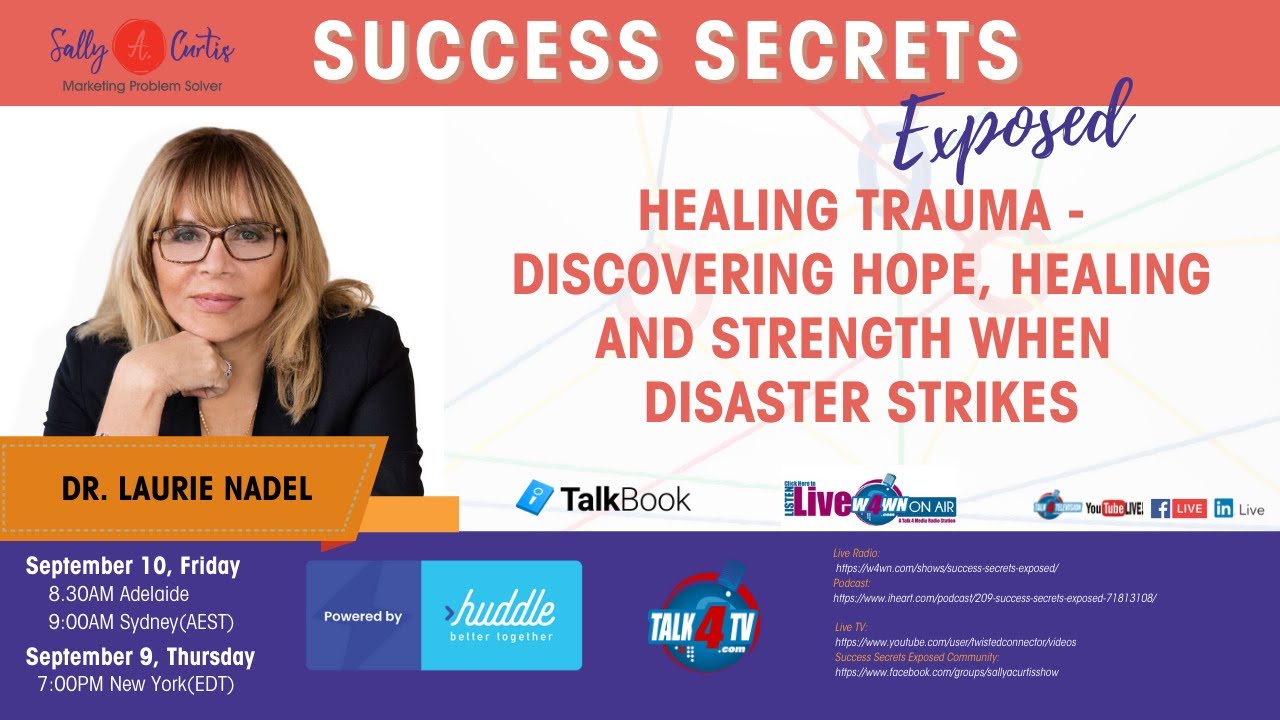
Dr. Laurie, a psychotherapist who treated 9/11 and Hurricane Sandy survivors, shares tools for recovering from disaster and trauma. She describes the "Three Elephants" framework (loss of control, safety, identity) and five core gifts—humility, patience, empathy, forgiveness, growth—that build resilience after crisis.
Chapters
The topics and opinions expressed on the following show are solely those of the hosts and their guests and not those of W4WN Radio, its employees, or affiliates. We make no recommendations or endorsements for radio show programs, services, or products mentioned on air or on our web. No liability, explicit or implied, shall be extended to W4WN Radio, its employees, or affiliates. Any questions or comments should be directed to those show hosts. Thank you for choosing W4WN Radio.
Welcome to Success Secrets Exposed with Sally A. Curtis, where we share stories of challenge, success, and inspiration, along with practical tips and strategies to move you forward to your your success. And now here's your host, Sally A. Curtis.
Good evening, good morning, and welcome to you all. Thank you for joining us for another episode of Success Secrets Exposed, where today we're going to be talking about healing trauma. And I've got a very, very special guest with me today, Dr. Laurie. Who's been, uh, is currently traveling, is going to be joining us while she's actually traveling. So we'll get to introduce her to you shortly. For those that are new to the show, a little bit of a background on me. I'm a marketing strategist who specifically works with coaches, consultants, and speakers. The area of my specialty is content repurposing, and it is my role to help you amplify your voice your message and your impact, which is why I'm very, very excited to be able to share Dr. Laurie with you today. Now, a little bit of background on Dr. Laurie while we're just getting things sorted and getting her online with us today. She's been a journalist for 20 years. She's a 4-time bestselling author who has also been featured on Oprah twice. She's a trauma specialist and has had 30 years' experience both helping people through their trauma, running support programs for civilians and first responders. Some of the examples of the things that she has done, she's supported teachers after the Parkland school shootings, and she's run programs for teenagers whose fathers were killed in the September 11th attacks. On the World Trade Center. She's also currently working with COVID long haulers. So her own life was actually impacted both by September 11th and Hurricane Sandy. And it's, um, this has all led her to her most recent book, which is called The Five Gifts: Discovering Hope, Healing, Strength When Disaster And she's going to be sharing some of those teachings with us today on how you can actually get back up after being knocked down and how you can not only survive with some after some of these very considerable hard blows, but how you can also eventually thrive. So please help me welcome Dr. Laurie to the show. And we Just see where we are at. So that's all right. Now, as I said, Dr. Laurie is traveling at the moment, and we were just getting her on in the audio. So she will be joining us very, very soon. To give you a little bit of a further background, still, she just got a message. Thank you, Roxy, from our engineers saying they're just still working on it. So I'll give you a little bit more of an insight and some of the questions that I'm actually going to. speak to Dr. Laurie about. Um, so clearly she has extensive experience. She is in actual fact a practicing psychotherapist, um, and she has lots of her own stories to share. So we'll be asking her a little bit about her background and the types of work that she does. She's also going to be sharing, uh, with us the emotional first aid and self-care that becomes so very, very important after And one of the things that I'm very, very interested to hear is how we can all recognize some of the trauma reactions that people have and how we can help manage our own reactions to their reactions, but also help them manage their own reactions as well. So I'm also really keen to find out from her what these 5 gifts are. Gifts are and how we can actually intersperse them into our lives and supporting those people around us as well as supporting ourselves. And one of the things that I've also read about Dr. Laurie is that she has a pack-a-go kit. Um, so for those that watch any of the crime scene or, um, or, um, TV shows that are about the firefighters or the SWAT teams or any of those sorts of shows that are on TV, which I do, I love those shows, and they've always got a go bag where they, you know, run out with their go bag and go off and help the relevant people. So she's got a bit— we're going to have a conversation around what is our version of a go kit as well, and whether that's a go kit for the mind or whether that's a go kit that we actually take with us. So I'm curious to find out. Uh, what that go kit is for us as individuals as well. She also has her own practice specializing in stress, health, obviously trauma, because that's the significant area where she's both done extensive study and has her practice around trauma as well as PTSD. And she also has— does a lot of work still supporting, obviously, other clinicians to support the audiences and the clients that they look after as well. She's very much a distinguished scholar, as I said, and a practicing psychotherapist. And when it comes to teaching, these are some of the comments that I've read about her. And I love taking notes and discovering, like, the guests that I have on the show. So One of the comments is that Dr. Laurie has immersed herself in the academic study of suffering. In addition to her own depth of stories, which we'll obviously get to hear a little bit about some of those backstories, she's very prolific in helping people and teaching them how to get up after being knocked down and also learning through our own life and personal experiences. She also breaks down her information in her books, etc., into very, very easy to understand, very readable content pieces, and makes it very easy to digest and put into practice. And one of her comments from her many comments around her books is that she touches off with New sunbursts of thoughts as she helps and guides you through what you need to know as it relates to coping and going through whatever the troubling, um, terms are or experiences that you have. But I really love that phrase of, uh, creating, um, sunbursts. Um, so we're gonna have a fabulous conversation. Um, we're just getting close to getting her on board. As I said, uh, we're very, very lucky to be having, uh, Dr. Laurie on, uh, the show today, and she is currently traveling, assisting people, etc., as well. Let me see. So some of the, um, I'm just having a reading another, um, another little message here on some of the feedback as it relates to the books that she's written. And the most recent one here, it provides ideas, insights, tools, and emotional stamina and clarity needed to cope with acute stress responses as well as emotional aftershock. Um, so there's going to be, um, and she talks about being open to receiving the gifts of humility, peace, empathy, forgiveness, and growth. And these are the 5 gifts that we'll actually get into talking about. So Roxy, if she is in, um, I'm more than welcome to bring her onto the show. Good morning or good evening to you, Dr. Laurie. How are you? Welcome.
Uh, I'm fine, but I can't I can't hear you very well. Can you possibly boost your audio?
I certainly can. Can you hear me better now?
A little bit. Just, uh, can you do a little bit more?
Um, I'm maxed out now.
Okay, that's good, that's good.
But I'll move closer to the microphone. I do appreciate you so much for coming in.
Oh, thank you so much.
Thank you. So I was just giving the audience a bit more of your background, um, and all of the different things that you've done as far as your life experiences as well as your academic, um, and obviously your practice that you have, um, as well. So I'd love to ask you if you can tell us a little bit about your backstory as to what's brought you to doing all of the fabulous work that you've been doing and the impacts that you've been creating.
Yeah, I'm really not hearing you. I'm so sorry.
That's all right, Dr. Laurie. I was just asking if you could share a little bit of your backstory as to what's brought you to where you are today.
Oh, thank you so much, and thank you so much for having me on the show. I really appreciate it. It's a great, great gift. I was a journalist for 30 years, both 20 years in TV news in London and New York and a field reporter in South America. And after about 20 years in newsrooms and covering all kinds of disasters and earthquakes and assassinations, which was kind of overwhelming to be in a room with satellite feeds coming in from all over the planet. I came to realize that people who had experienced something catastrophic would need special help and support because we never— you never see them after you get that close-up of the person crying or carrying the baby in their arms. And so as a result of my having gotten sick with overwork and burnout, When I was recovering from 3 years of— I think you call it ME or chronic fatigue syndrome, we call it here. Yes. I went back to school and I studied psychology. And in 1991, I opened a practice specializing in helping people with stress and health issues and trauma and post-traumatic stress. And so I've been doing that for the past 30 years. It became my second career.
Yeah. Beautiful. Um, and when, when I was, um, reading some extra information on you, you also talked, um, about, um, the lessons that you've learned through your own experience, because I certainly picked up the burnout experience, but you've also been experienced or had your own experience around 9/11 as well as Hurricane Sandy. So can you tell us a little bit about that? Uh, and then we'll jump into the work that you do and the book that you've recently written.
Well, thank, thank you so much. You know, September 11th, my, my office was in the FEMA zone. It was an hour— it was a mile and a half north of Ground Zero. And I wasn't in the office that day, but I did start working directly with people who were survivors, witnesses, first responders. And for nearly 3 years, I ran a program for teenagers whose fathers were killed in the towers. And we also had programs for their moms who, you know, woke up one morning and they had a parenting partner, and then at the end of the day, they were single moms.
Yeah. And I also noticed that you did a lot of work with the children and the teens through that process as well.
The children, and especially the teenagers, were— You know, it's particularly traumatic because teenagers don't like to be singled out. Mm-hmm. And, you know, they don't want to be pointed to. And, you know, they used to joke about the 9/11 mobile and are they going to give us t-shirts and do we have to go? But we started a program that we took them on windsurfing clinics. I was a big windsurfer and a windsurfing journalist as well. And so we had taught them how to windsurf. Taught them how to surf. We took them to sporting events and they grew together.
Yeah. In that experience of where they've come together, they've moved from not wanting to be pointed at or singled out. And I can— I've got a nearly 18-year-old son, so I can sort of relate to that. Yeah. But I find it interesting that they've come together through sport, but you've actually— I'm going to use the word normalized. You've normalized their experience by normalising the activities to help support them. But obviously it wasn't a normal experience, but they've got normality between themselves. Is that how it's actually helped to support them?
Yeah, my goal was really to create a kind of activities that they would want to do where they could connect kind of non-verbally with each other and become friends. Because, you know, they don't need another— they didn't need another mom. Although I got to be a surrogate mom, which was great because my daughter had just gone off to university. So I was used to having kids in and out of the house. And so it was a lot— it was really a wonderful experience for me. But more important, I wanted them to know that they would always be able to be there for each other.
And
so,
yeah, 20 years.
Sorry, I just want to say that one of the things that happened is, uh, there's the 3rd baseball season that we did together was that the older boys began to coach the younger boys.
Lovely. Yes, I was just going to ask you, sort of 20 years on, what have you witnessed, um, as it relates to those relationships? And you've just answered that question beautifully. Thank you. What other things did you experience with that?
I'm sorry.
Uh, what other things can you share with that you've experienced through some of that? Some of— so I'm asking, um, what are some of the joyous moments you've also experienced through the processes that you've helped people with?
I think that whenever somebody, you know, says to me, I was feeling alone, or I didn't feel that anybody understood what I was going through, um, especially, you know, we'd say after, uh, a natural disaster, I lost my own home, um, in Hurricane Sandy. And I, because I had worked with the kids after 9/11, I thought I didn't— I couldn't do the heavy lifting of removing sheetrock, you know, or stripping out your mold. But I was able to do the heavy lifting in kind of helping my neighbors again to build support for each other where they could understand that the horror that they were going through, you know, it's— I think it may be true in Australia, but certainly here. When you deal with— suddenly you're dealing with the government and you're dealing with insurance companies and you're dealing with banks and everybody is giving you conflicting information. And the person you spoke to today will tell you tomorrow, I never said that. And 2 weeks from now, there's a different policy. And one week you don't need building permit and the next week they're trying to fine you because you don't have a building permit. You know, and you're just trying to survive as a middle-class homeowner. All of these experiences, I was able to kind of offer support and sometimes information and sometimes contact. And also a lot of, we call them psychological first aid tools, that are techniques that I developed over the years working with the kids and working in private practice that really helped to alleviate rapid onset stress responses or anxiety or panic attacks. And so I was able to share those with people so that they wouldn't get retriggered at— you know, it's very hard if you're a natural disaster survivor and it's 8 years later or 10 years later, or even now for the first responders I know who were on the scene on September 11th, when they see all those pictures. The firefighters in Miami who I work with, some of them have living with long COVID. And, you know, some of them were working on the pile when the Surfside building collapsed. And now when they see— it's one month, it's 2 months later. And now when they see these images of the anniversary of 9/11 and they see the first responders working on the pile, it triggers their own unprocessed or, you know, the traumatic memories that they're trying to put aside and cope with. And so, you know, I've developed a toolkit to help people to resolve or to release some of that buildup so that they can carry on, if you will.
Yeah, yeah, beautiful. And that's one of the elements that we wanted to talk about, is that emotional first aid that you talk about, as well as— I love the term self-care. So can you explain sort of through what, what do you, what do you do? And I'm sorry, I'm going to also say you also talked about the go kit. So if you can explore with me both the emotional first aid and the self-care that needs to happen, but also talk a little bit about the go kit in emergencies for the mind.
Well, those are great. No one ever asks about the go kit. So thank you. You know, they tell you, the first responders will tell you that, you know, if you're living in a fire zone or you're living in a monsoon zone, that, you know, you should have an emergency kit of things that you will take with you if you have to evacuate suddenly. And it's always very practical things like flashlights and enough water. But you also need to include several small items that will give you comfort when you find yourself in a, say, in a new place, whether it's in a group setting or whether you find yourself living in your car, which many people have to do sometimes for months on end. If you find yourself in a shelter, you find yourself far from home, or even living with friends or relatives, but, you know, your house is burned out, or you've escaped, you know, with the clothes on your back. And unfortunately, you know, these things happen to millions of people around the world every single day, and many different, many, many different types of situations. So if you are preparing your go kit to include, say, a playlist of music that you find soothing, things that you can bring with you, comfort food that's not too bad for you if possible. But I, I had all of these military meals ready to eat, you know, these kind of powdered meal packets. And then a few years later, I checked my go kit and I decided to just chuck them and replace them with peanut M&Ms. And I said, it's not necessarily the healthiest food, but you could always barter them for flashlights and water.
Yeah.
And, you know, for me, that would be— I'd be the most popular girl in the shelter if I had, you know, giant bag or box of peanut M&Ms. So something that you can have with you for comfort, coloring books, something that is not dependent on electricity or an internet connection. for your kids to keep them busy. So, you know, coloring books or puzzles, very, very important. Board games if they're small. Anything that involves writing. We always recommend keeping some kind of a notebook with you, both in terms of writing your own feelings, what you're going through, because it really helps to physically get the feelings out of your body and onto a piece of paper. And There's a lot of research on that. But it's also equally important to keep a log of every phone number that you dial or tap. And every person who you speak to, to write down the person's name and phone number. If you can remember the date, that's wonderful. But the most important thing is to recall the person's phone number or write down the person's phone number and the person's name. And a few keywords about what they told you, because within 2 weeks you will have been bombarded with so many pieces of conflicting information that at least you'll have a trail of who told you what. Right. And you could say, well, 2 weeks ago I spoke to the, uh, the bank official or the insurance adjuster. His name was Steve, and he told me X, Y, and Z. And now you're telling me that that's not true and that I need to do A, B, and C. You'll be— you really can't keep track of your own thoughts for the first few months after any kind of tragic event. You're so overwhelmed. You're kind of just living moment by moment. You know, it's sometimes hard to breathe. You're trying to do the best you can to kind of, you know, keep a roof over your head or, you know, to keep your kids getting up and going to school or to make sure that, you know, you can just kind of survive. The aftermath. And so writing down who you speak to and then the phone numbers so that when you have to go back to them again. It's a lot of what happens after especially a natural disaster, but also after a terrorist attack like 9/11. There was no cell phone service.
No.
You know, there was no cell phone service for quite a long time. So if you didn't have a backup landline, You know, you had to really kind of make do and make notes of every time you went to a Red Cross center, for example, or every time you went to an aid center. Write down the name of the person you spoke to. And when the phone service came on again, you might not have had internet service. You can't really count on the internet being there for you. Sometimes you can't even count on electricity being there for you. So, I had— we had no electricity on the barrier island for a month after Hurricane Sandy. And so, you're kind of— you go someplace where they have electricity or you have somebody drive you if your car— we had 2 vehicles that were flooded. So, we would try to hitch a ride to some town where they had not been as badly affected and where the cell phone service worked. Right. But you have to really think ahead. Yeah. In terms of, you know, what, what kind of backup communications can I provide for? Have an emergency radio, have a solar, solar charger. But, you know, most of all, bring a few things that you can have for comfort. A picture that you keep near your bed, a little statue if you have something like a statue of a dog or a cat or a children's toy or just, just something that, that gives you That sense of ease and a feeling that you're at home. That's what I mean about, you know, a psychological go-kit.
Yes.
And you see what I said? You have a couple of things that you can reach for. So even if you're sleeping on a cot or you're sleeping on the floor and you have your favorite picture or you have your little statue of your cat or Saint Joseph or something that you're you know, your spouse gave you, and you can put it next to your bed, and you have something to write on, and you have, you know, one or two items of food or herbal tea or something that you enjoy eating or drinking, you'll settle in okay. It'll really take the edge off that feeling of being completely uprooted and ungrounded, which is what we feel after a disaster.
Yeah, and just Just listening to the, the, um, the ex— or listening and hearing the experience of, uh, of, you know, the, the toing and froing between different people that are trying to help you out. Not only are you stressed, but you're actually almost having to rethink everything, uh, if it relates to, you know, not having a mobile phone and having to go back to, uh, writing down notes and almost keeping evidence to keep you— you're almost keeping your thoughts organized, but you're also supporting yourself to not get freaked out by things changing even more constantly when everything's already changed for you in an instant.
That's very, very true. I mean, you know, your anchors of safety are literally— it's as though the ground gets ripped out from under you, and the day that you thought you were going to have, it's just suddenly— it's just ripped away. And so the tomorrow you thought you were going to have isn't there either. And you really don't know where to put your— you don't know where to put your feet, literally. That's a good point. Psychologically and sometimes even physically. And, you know, for all the information that is out there, nothing ever really prepares you for the loss of— the sudden loss of life around you. or the loss of everything that you've built because it's not so much the property, it's not so much the possessions, it's the years of work that you put into building that and earning it and investing it and creating it. And that really— nothing really prepares you for the shock of the totality of that kind of a loss. Yeah. And for people who lose a parent, or they lose a partner, they lose a spouse. There are so many swirling feelings. We say that trauma is not a bad hair day. It's not an upsetting argument. Yeah. People say, oh, it was so traumatic. I had a fight. It's not. It means literally loss of life, injury, a death, something that happened suddenly, violently, and unexpectedly. And whether you've witnessed it or whether you're close to somebody who survived it or whether you yourself escaped. It could be a near miss on the highway. And it can be watching disturbing images on the screen can also cause a form of the same kind of post-traumatic reaction where your body will respond as if you were actually on the scene. And so nothing really prepares you for the sense of helplessness and horror that you live with every day. It feels like you're walking through Jell-O is the only way I can describe it. It's like the air is like heavy and kind of moist, and you're kind of— you're like looking for a landmark. Like, okay, Tuesday, you know, Tuesday was the 10 o'clock meeting, and then I had lunch with my friend, and then afterwards, you know, we would— Tuesday is spaghetti night, and then we would watch, you know, we'd watch something on television. All of that is gone. Wow. It's just all, you know, all those little routines and rituals that kind of keep us with a foundation of safety are gone. And so it's so important to have these comfort rituals that do not involve— and it's very easy for me to say this because I'm not in that situation in the moment— but to avoid drinking too much alcohol. I mean, it's one thing, you know, to have some wine with a meal, but, you know, substances, using substances or Medications or, you know, addictive medications or compulsive behaviors that are basically unhealthy to numb out the pain that you're feeling creates a whole other set of problems down the road. So it's really hard. It's very, you know, we don't, we don't have impulse control and we don't have self-discipline when we're just trying to survive breath by breath.
Yeah.
So we have to be really compassionate with ourselves and Literally breath by breath. It's, it's, uh, it's a very hard lesson in life.
Yeah. And that, that's resonated with me, that breath by breath. I can sort of, you know, it's, it's that you literally get— literally getting up and restarting every time you take a breath. You're sort of doing that step by step. Something that I'd like to, um, just talk with you about is, um, one of the— is the area of Recognizing and managing traumatic reactions. Now, I'm asking that because in life, when life is going along fine for us, we sort of— you sort of get the clues from people, but you don't often really take on board the awareness or the telltale signs until a little bit later down the track. So how can we as individuals in the human race Help recognize when people are starting to have those triggers or those reactions. Do you have any advice or suggestions on that?
Well, I think it's really important to, you know, to know to— and certainly there are lists available on the internet, but the 3 main things that, you know, to watch for are Severe anxiety and kind of phobic reactions. And there's something that we call an exaggerated startle response. So it's that jumping out of the skin when there's a loud noise. So for example, after the Parkland school shootings, I developed a program for the teachers at Marjory Stoneman Douglas so that whenever, you know, a fire alarm bell rang or whenever a change of classroom bell rang, Mm-hmm. They were jumping out of their skin. The children were jumping out of their skin. And it was really important to understand that, you know, you're a normal person having normal reactions to an abnormal situation, and that it can take, you know, months, um, and, you know, at least several months for that jumpiness to, to subside. So understanding that jumpiness is normal, that, you know, severe anxiety, that, that that we call it hypervigilance, the sense of dread, the belief that, you know, that something even more awful is about to happen right around the corner, the tendency for the body to re-experience the moment of sudden knowing, whether you were actually, you know, one of the teachers who witnessed the shootings in her own classroom, or whether you were a or an administrator or a custodian who was working on the grounds and had to help lead the children out of the school, you know, your body may re-experience those moments when you wake up in the morning. Or one of the things I— we always tell people to do is to stop watching TV and stop, you know, turn off your social media and turn off the screens because the immediacy of the images will remind your body to go back into that state of shock. So we want to try to minimize the triggers. Yeah. So re-experiencing is a trigger, anxiety is a trigger, and what we call the arousal or the ominous feeling of dread. And the feeling of dread is something that is the result of a continuous flow of stress hormones.
Nice.
That it's like the brain doesn't turn it off until the brain feels that you're out of immediate danger. And so it's a physiological and it's a chemical response, which is why probably the most important thing after finding safety, finding a place that feels safe, or finding someone you feel safe with, you can talk about you know, what you're going through is to avoid the triggers. Really, really, you know, shut down all media and try to deal with people in person until you begin to feel more stable in your own body. I'd say that's, that's the most important thing.
And that's, as you said, that's that giving your body the ability and the practice of being able to turn off those chemicals and those reactions so you can actually regroup and balance, rebalance again. It's sort of like creating your own set point.
Exactly. Exactly. Yes.
Wow. Um, and you also talk a lot, um, about the, uh, the 5 gifts and the values that come out of, um, the long-term healing, healing and discovering through that process. Um, and I've got them written down. written down as hope and strength. So you talk about this in your latest book. So I'd love you to share a little bit more around your book and why you've written it and who it's going to help, please. Yeah.
Well, thank you so much for asking. I actually started writing The 5 Gifts before the hurricane. And it was going to be called All of Nature Speaks. And it was based on meetings that I'd had with indigenous healers in South America in the 1990s. I was very fortunate to have studied with a number of healers. Yeah. And they all would say that, you know, we are disconnected. We in the industrialized world are disconnected from nature. But that, you know, we have to learn to listen or nature is going to get louder and louder and angrier and angrier. And of course, you've seen that yourself, you know, with the tragic fires. Yeah. And, you know, we're seeing it here with the wildfire. There's no longer a wildfire season. And we have, you know, continual weather events, climate change events here on the East Coast of the United States. And so It was All of Nature Speaks, and it was going to be kind of a spiritual book about indigenous wisdom. And then nature spoke very loudly and brought 4 feet of seawater into my little beach cottage. And then life became just completely upside down. And after several months of working with people in the community and fighting my way through bureaucracy every day, You know, 5 hours on the phone being lied to, being told, I never said that, being told, you know, you didn't speak to me, you have to speak to somebody else, receiving threatening faxes. I mean, it's just, it was a, it's a red tape horror show. Right. And a lot of money was involved. And we're talking about, you know, the money to rebuild a home is a lot of money. And so you're fighting for your financial survival And one day I asked myself, if somebody came to see me in my office and they were going through what I was going through, what would I tell them? And I realized it's very hard to live your own advice. But what I would tell them is, you know, please turn off all your phones, the faxes, the internet for 48 hours and just focus on taking care of yourself. Rest, get a massage, you know, read. hydrate, take baths, take walks by the ocean, whatever you want to do. But just basically let yourself kind of come down from the massive stress of arguing with people and fighting with people for every dollar. I mean, it was constant aggravation. And I'm not somebody who thrives on conflict. I mean, some people love it. and they can go to bat and they just, they find, you know, they find it, you know, entertaining, you know, to argue. I'm not one of those people. So I was having a very hard time. Yeah. And after a couple of days, I sat down to just meditate and to get my mind calm. And I was asking internally, you know, is this what I'm going to have to live with for the rest of my life? You know, is this really going to be what I have to live with? You know, is this going to be— is this life as it's going to be from now on? And I heard an inner voice whisper to me 5 words, which were humility, patience, empathy, forgiveness, and growth. Mm-hmm. And then I heard, these are the 5 gifts that will help you to get through any disaster, will help you recover. please write them down and share them with the people in your community and the people you work with. Okay. And that evolved into from the first book. And I do have a chapter in the book called All of Nature Speaks. But I realized that we're also talking about— they're called intentional disasters, acts of terrorism, acts of mass random mass murders like the Parkland school shooting, which, of course, hadn't happened at the time that I started working on the book. It happened in 2018, actually, just as the book was coming out. Or the pandemic. I mean, I've had many people who are living with long COVID, which is the kind of second phase of COVID that attacks the nervous system. And causes perpetual brain fog and nerve pain and balance issues and internal tremors and, you know, strange changes in heartbeat whenever you stand up. I mean, it's very complicated neurological disease— diseases, actually. The government calls it a constellation of symptoms that you didn't have before you got COVID. Yeah. So if you go through the initial phase a respiratory infection and you come out the other side, you may recover, but you may find that 1 or 2 months later you're suffering from, you know, severe nerve pain, or you can't keep your balance, it's hard to walk, you have incredible fatigue, you have— you can't concentrate, you have no memory. And these are all neurological symptoms that are part of what we call, you know, long COVID or PASC, the official term in the States is PASC-2, which is post-acute sequelae. In other words, it's after the acute phase you get that. And about 1/3 of people, they think, the World Health Organization estimates that 1/3 of people around the world who get COVID will develop the long COVID constellation. And so we have, I have 2 support groups online for people who have long COVID. And one is open to anybody. And that's— the link is up on my website. They're both free. And there's a Pulmonary Wellness Foundation, pulmonarywellness.org. And then there's one for firefighters, which is open to any and all firefighters anywhere who are living with COVID or living with long COVID. And So, we— and we do talk about the 5 gifts because many of the people in both groups have said that when they read— when they're reading the book, they feel that I must have written it for them in mind because there is— it's a long-term process of recovering from something like COVID or any disaster. It does take a few years before you recover so that it doesn't— completely take over your mind and your heart as soon as you wake up.
Yeah. Yeah. Um, that's so that, um, term that I've, uh, I've written down cause I didn't know what it was. You talked about, um, COVID long haulers. That's the scenario you've just talked about then. I'm good. I'm going to ask you another question that I had found when I was reading up on you. Um, and that was, um, as it relates to those, uh, online courses that you're doing, you talked You make mention to the 3 elephants.
Yes.
Meet your 3 elephants. Can you tell us a little bit about that?
Well, I think anybody who's had an illness or an injury that doesn't heal quickly, and until, you know, several months, you know, you're not, you're not getting better, you meet 3 elephants. And the first one is the loss of control. You know, your body isn't doing what it's, you know, what it's supposed to do. You know, sometimes you can't walk or, you know, you might be able to get up and make it to the bathroom or the kitchen, but a lot of times you can't. So you have the loss of physical control. And the second elephant is the loss of safety. Yeah. And that's when you feel literally unsafe in your own skin and you feel vulnerable and you start— you develop that kind of post-traumatic hypervigilance where you're wondering, You know, what if I fall? Or what if I never get better? Or what if I leave the house and I can't make it to the corner? And when I was recovering from chronic fatigue, I remember there was one— we have a tendency as active people to want to make up for the time. We think the time that we were bedridden is lost time. Yeah. So when you get a burst of energy, you want to make up for the lost time, and you tend to overpush yourself, and then you end up with a relapse. So there was one day I said, okay, I'm going to go to the supermarket today. And it was like going on a Himalayan expedition. I mean, it was literally going around the corner. And I was so proud of myself. I got to the store and I had my list and I got everything on the list. And then when I got to the line, the queue for the cashier, I just fell apart and I had to rush home because I was about to faint. Yeah. And so that would be the loss of safety, the second elephant. It's like, what if I can't? What if something else happens? Or what if I can't do this anymore? So you start to feel very vulnerable and you start to avoid situations where you might possibly relapse again. And the third elephant is the loss of identity, where we ask ourselves, you know, who am I if I can't work? Who am I if I can't run anymore? Who am I if I cannot play tennis? Who am I if I can't be an active parent? You know, who am I if I can't do the things that give me a sense of joy and competence? And that's the more complicated elephant because that really takes some exploration to resolve because we never go back. You know, we think— we talk about going back to normal. You know, normal is, is a facade of reality anyway. There really is no normal. Yeah. You know, we talk about the new normal. It's really a new baseline in which we're incorporating or integrating the things that we've learned from having had this tragedy happen to us without feeling that we, we're a failure in some way. And to accept that it's going to take time, we're going to have to explore What are my new strengths and what are my new limitations and how can I develop or design or create a new way of balancing, say, my need for rest with my need for activity or my need to work with my need to take care of my health? So, you know, it's incorporating what you've learned so that you can literally grow a new sense of confidence and competence. Yes. And identity. Um, but, but not feeling that you're comparing yourself to who you used to be because we'll never be who we were before.
Yeah.
And that's not a failure. No, no, it's not a failure.
Yeah. I've just, uh, there's been a couple of comments come in. Peter, um, one of our regular listeners and a dear friend said that he's, he's met all 3 of those elephants. And I must say I have, um, as well, when you were talking about the chronic fatigue and being in the shopping line and, uh, that, that need and want to push through because you've missed, uh, you've missed out on that time. I've had chronic fatigue, not as, uh, for as long as yourself. Um, but I do remember doing that, having it, and then, you know, being well enough and trying to do too much that you, in my words, you crash and burn again afterwards. Yeah. Pick yourself up again. And then you do go into that, what I'll call panic mode going, oh my God, you know, am I not going to be able to do this? You know what? Why am I bothering? What's this going to, you know, how am I going to look after the other people? And then you go into that sort of downward spiral that can be quite depressive. Um, so there was a lot of resonance then with those 3 elephants, that's for sure. So thank you for sharing that with us.
Of course.
Um, and people can find you, and we've been popping your website up on, um, the ticker so people can see that there, but they can find your book
Yes, they can find
the book on
Amazon. It's also available as a Kindle, as an ebook, and it's now an audiobook as well. So we have a very lovely professional narrator reading, reading the book.
Lovely. And if people— just to reiterate the invitation— if people are first responders or experiencing with the COVID scenario, you do have those support support groups that are online that I also saw on your website, which is where I found out about the Three Elephants. And so there's lots of information that you can find and support and connect with Dr. Laurie via her website, but also you can find her on LinkedIn as well. So just as a bit of a recap, as we come sort of getting close to a close, it's about remembering the 5 gifts It's also about having a prepared go kit, and I watch all of those shows, so I sort of was familiar with the go kit. But what really stood out for me was putting those personal elements in there that make it fit, help make you feel safe. And I would have never thought of things like your music playlist, your comfort foods. I knew straight away that my son Rory would want his jar of peanut butter. As well as colouring books. And I love the— you've talked about writing the notebook. Initially, I thought it was to, you know, dump your, you know, your ratty thoughts in it, but it was more about a book, as well as a book to stack the evidence so you know who you've spoken to, so you're not having to try and remember that and overconfusing yourself. So I think that was some great tips. tips in a way to support yourself. Um, just as we close out, as we start to come to the last couple of minutes, uh, Dr. Laurie, is there anything else that you'd like to share with us that we need to know, um, to, um, about either you or the support work that you do or best ways to support ourselves?
Well, anybody can contact me through my website, which is laurienedell.com. So, you know, please feel free to shoot me an email, you know, if you'd just like to Comment or connect. I'd be very happy to hear from you. If there are any first responders, firefighters specifically, who are living with long COVID, again, please shoot me an email through the website. And we welcome all firefighters. Right now we're at a monthly group, but we may, we may go back to weekly or biweekly. But right now it's once a month. And we welcome, you know, all firefighters who are living, you know, with the pandemic themselves. And, you know, if you're listening and you're going through a hard time, you know, my heart, you know, really goes out with you. It goes out to you. But you are stronger than you know, and you will get through it.
Yeah, beautiful, beautifully said. And I love also what you said about as you go through and experience the 3 elephants and you have that growth to then not get stuck in the comparison of what was. It's all about what it now is, uh, and taking that opportunity to grow into the new version of you with your new strengths, um, and whilst you overcome the new challenges. So,
um, that's the gift of growth. That's the 5th gift is the gift of growth.
Yeah. Well said. Thank you very, very much, Dr. Laura.
Thank you. Sorry about the tech problems at the beginning, but I really appreciate your patience, and it's wonderful. Thank you so much for inviting me to be on your show. It's a great gift for me.
Oh, thank you. It's been my pleasure, and I always like to be adaptable, and we've got great support with Roxy, who's our engineer, who's got—
Yeah, Roxy, thank you.
Yeah,
yeah.
So thank you, thank you. And we've got comments in the, in the chat that people are saying, hear, hear, um, and growing into the new is a powerful perspective. So I think if that's, uh, one great takeaway lesson is growing into the new and taking on that new perspective. So Dr. Laurie, thank you very, very much. Thank you very much, audience, for listening to us, and we will see you again next week for another episode of Success Secrets Exposed. Have a great week ahead. Thank you so much. Thank you, Dr. Laurie.
Thank you. Bye-bye.
That's it for this week's episode. Thank you so much for joining us. I trust you got some inspirational tips to move you forward. See you next Thursday at 7 PM Eastern for more Success Secrets Exposed.
More from Sally






The Coaches Results Express: How to Build a Thriving Coaching Business That Actually Works


