Success Secrets Exposed - Flip Goal Setting into Goal Getting!
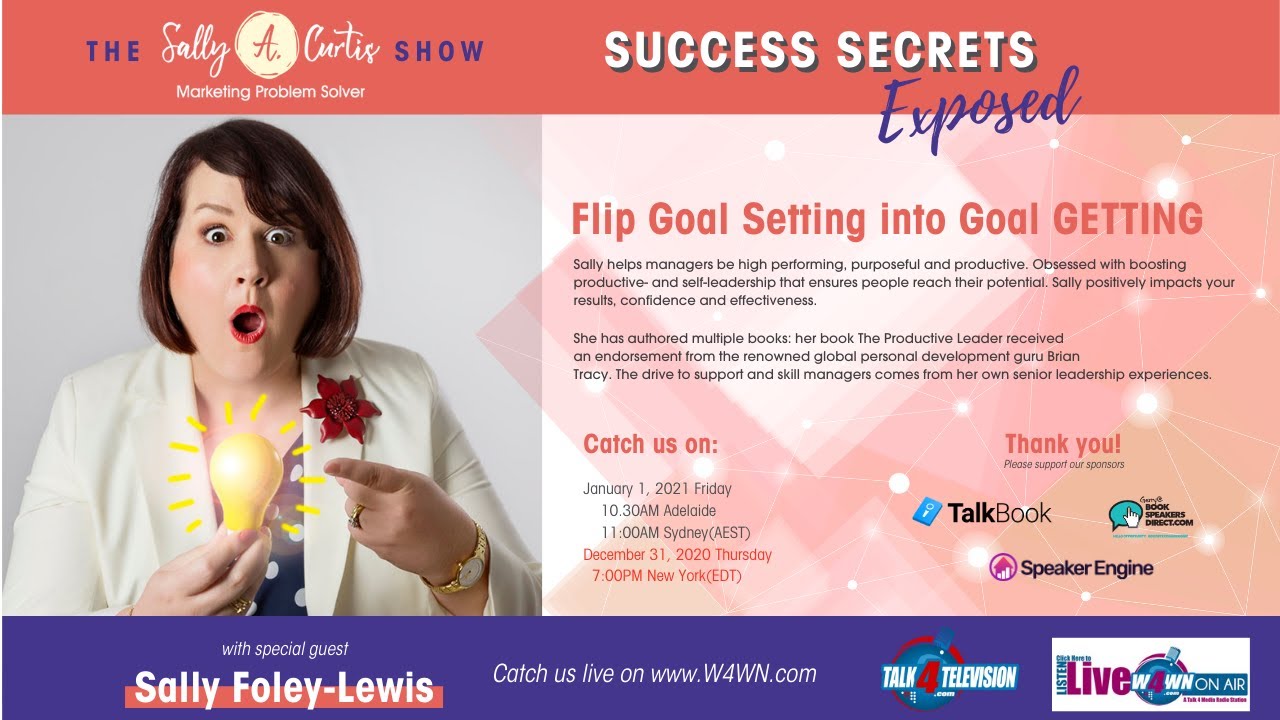
Sally Foley-Lewis challenges the SMART goal framework, arguing it misses emotion, help, and review. Her SMOOTHer framework adds those elements and separates the what from the how. She shares tactics like visual planning with Post-its and breaking big goals like climbing Kilimanjaro into tiny daily actions.
Chapters
The topics and opinions expressed on the following show are solely those of the hosts and their guests and not those of W4WN Radio, its employees, or affiliates. We make no recommendations or endorsements for radio show programs, services, or products mentioned on air or on our web. No liability, explicit or implied, shall be extended to W4WN Radio, its employees, or affiliates. Any questions or comments should be directed to those show hosts. Thank you for choosing W4WN Radio.
Welcome to Success Secrets Exposed with Sally A. Curtis, where we share stories of challenge, success, and inspiration, along with practical tips and strategies to move you forward to your success. And now here's your host, Sally A. Curtis.
Good evening, good morning, and good day. Welcome to Success Secrets Exposed. We've got a fabulous show for you today, and I'm going to share a little bit of some backstory. You can't deny that the number 1 is linked to being first, best, win, triumph. And the first of the year brings a sense of renewal, opportunity to re-energize the best year yet. New Year's resolutions are a fickle act, with more letdowns than successes. While there are for sure successes, up to 80% of New Year's resolutions are failed by the second week of February. Our guest today is a productive leadership expert who has a unique take on New Year's resolutions And she'll share with us what we need to leverage from firsts, and especially the first of the year or of a new year. We're going to explore how goal setting is not as much fun as goal getting. And we're going to look at ways in which we can chase— in actual fact, we're going to not chase, we're going to achieve your dreams with her very, very practical steps. Our guest is a multi-award-winning speaker and facilitator with over 20 years experience in people, productivity, and professional development. She has lived and worked in the Middle East, Europe, Asia, and even outback Australia. She has coached and trained well over 10,000 managers to be more confident, productive, and successful in their roles and careers. She helps people find their purpose, perform, and be productive, and she absolutely gets results. Her clients include L'Oréal, Australia Post, National Bank of Kuwait, Canadian shipping lines, Abu Dhabi onshore oil company, just to name a very, very few. She was also named in 2020 the Breakthrough Speaker of the Year by her industry association, plus named in the top 25 voices on LinkedIn for Australia in 2018. And they're just some of the tip of the icebergs of the awards that this, um, our guest today has won. So please do help me welcome to Success Secrets Exposed, Sally Foley-Lewis.
Hello, Sally. It's the 2 Sallys.
It's double trouble today, and I love it. Yes, and we're both in red, so it's going to be a power hour.
Oh, I love that. Absolutely love it. I do know what, I just didn't notice your red jacket because I'm just so excited to be here. But yes, double trouble, all the reds. Let's get this goal-getting done.
Absolutely. So please tell us some of your backstory as to how you became so obsessed with productivity.
When I was a little girl, there was a front room in our old— it was an old crickety house, wooden floor, and there's this little tiny room at the front of house which had my mum's sewing set up in it and a little tiny desk with a really old typewriter. When I'm talking old, I mean tap, tap, really had to hit hard on the keys. The keys, if you hit 2 keys together, the fingers would stick up at the ribbon. But I would sit there, and this is before I actually knew how to really spell a whole lot of words or, you know, I hadn't gone to school yet. And so I was just sitting there And I would be typing away, typing away, and I'd rip these pieces of paper out of the typewriter, and I'd put them very neatly in a stack in the corner of the desk, very neat. And I would turn around and I would boss my imaginary minions to go do things for me. And so, and I would stomp, like, for no reason other than I thought that it was powerful. And I felt powerful doing that. And unfortunately, I'm sure there are some bosses that do that, and it's certainly not, let's just say powerful is not the word that probably comes to mind. But in my little head and in my little imagination, I was a super organizer. And, you know, kids being kids, I was accused of being bossy and things like that. But it was— it came down to wanting things to happen and to get things done. I'm the type of person that sort of says yes and then works out how to do it and has to get a lot of help usually. But But it's about, it's about achieving the things you want to achieve. And so I think that thread of productivity has always been there with me. I like to make sure that if I can pick up on a procrastination that I might be experiencing, and we all have them, then I want to jump on it quickly and explore it and know why. When, when something's stopping me from doing something, I want to know why. Mm-hmm. And so I tend to have a slightly different bent to most time management experts. in that to me it's about productivity. And to me, I'd much rather get drunk on that sense of achievement than drown in a sense of busy.
Yeah.
That was pretty gold there, wasn't it? That was pretty good.
Yeah, that was great. And I love that you've got that— I think we're probably tarred with that same brush that, you know, let's get things done. And I remember when my mum and dad lived with me and when they had retired, so they were elderly, I used to— and it's not necessarily a good thing, but they would walk a lot slower than the pace that I like to do. So I'd be going along going, come on, let's go, let's go to the shops. And I remember doing that to Rory when he was little. And then since then, I've caught myself going, perhaps we just need to work at— and now with clients, I have to sort of come back to a pace that they're prepared at. Yes, help them be more productive. But it's finding that balance of their version of speed and my version of speed. And your version of speed is probably a little bit different, but the level of productivity comes out of that is the goal for sure.
Absolutely. And if the— and I think before we scare too many people, I think what we're talking about is if the ultimate goal is to have a leisurely stroll across, you know, down the waterfront or to go for a nice slow walk through a hiking trail, Then that's the goal. It's not about going 100 miles, 100 kilometers an hour all day, every day. But it's about if I'm setting myself out to achieve something, then that's what I'm going to do. And I will say, I have set myself goals to do nothing.
Yes.
They're the hardest, they're the hardest ones for me to achieve. But I, when I get to the end of, say, a couple of hours of doing nothing, because that's what I said I would do, Then I feel like I've achieved that because it's my rest and it's my reconnection and refresh. So
yeah, very much so. I find myself needing to do that because we're probably both very, very fast-paced. I have to schedule time out those weekends every quarter to go away, and they have to be blocked in. Otherwise, I'll just charge through them because of being that action taker. And for me, that's been my greatest lesson, is working in the goals to stop, to rest, to refresh. But that, as you say, it's still very much a goal. It's still an achievement. It's still an outcome I want for my own greatest good.
And, and, you know, it's such a critical thing. I'll just grab this because what you've hinted on is one of the things that I carry with me quite regularly. It's my, it's my oxygen mask. And I think that, and just in case you're worried, I didn't steal it off the plane. All the seats are fine. But I did buy this legitimately. But to me, this is my cue to make sure that I'm scheduling me first. And I think what What you're talking about, I think, is a great lesson for everyone. And very few people do this. And one of the things I think— well, I would really encourage people to start doing is when you get out your calendar for the year and you're plotting out your year, mark off you first. And that includes your holidays. And yes, maybe the school holidays if you've got kids. But I actually think— don't tell the kids this— but you first. You know, mark off a couple of days throughout the year that are just absolutely not negotiable. They're your days. And then you put in the school holidays, and then you put in the rest of the business of life. And it's just a little flip, and it does take a bit of adjusting. But when you look at that yearly planner, if you're a yearly planner kind of person, and you can see that your days are coming up, now that's motivating.
And inspiring. Yes, absolutely. So while we're on that trend of inspiring and achievement, etc., let's talk about goal-getting because I know that's your specialty. So let's jump into that. So yes, go for it.
So most people have heard of SMART goals. And so they've been around since forever. That was— it came out through a management conversation or a paper where they're talking about the The achievement of goals through organizations must be done in a SMART way. And I think I've basically plagiarized something there, but it wasn't my line, before my time. But the essence of what they're talking about, I absolutely agree with. So when we talk about SMART goals, we're talking about specific, measurable, achievable, you know, realistic and time-bound, or resource, depending on who you ask, what the R stands for. And there have been hundreds of incarnations and variations on SMART goals over the years. Mm-hmm. And at the end of the day, one of the things— well, there's 3 key things that I think are missing from SMART goals that actually make them exciting. See, when I used to teach time management in a big corporation, and, and we'd— and in the book you have to do SMART goals, and a little bit of my soul would die every time that I had to teach this because it's just not exciting. And it's just Hard
work. Yeah,
absolutely. So I feel sorry for all the people who had to suffer that half an hour with me, but, um, but there's got to be a better way. And when I look at the goals that people achieve and I look at what was it, what's that, what's that X factor, or what's that secret sauce that actually got them over the mark and achieving those goals, there are 3 things that I think SMART goals are missing. And those 3 things are emotion, help, and review. And so I've come up with smoother goals, and I'll run through those shortly. And there's a great downloadable that's there that's got it all covered in the downloadable. But so those 3 things— emotion, help, and review. If we aren't emotionally attached to a goal, then we are like walking through treacle or walking through honey. It's so hard and it's resistant. Mm-hmm. And, you know, when we talk about work goals as well, when a goal has been imposed upon us because that's what we're there to do, is achieve the goals of the organization, if we don't find some emotional connection, it's just harder. Yeah.
Yeah. Yeah. As you said, that sort of, with that hardness comes the resistance, becomes the, and that just gets people Yes.
Yeah. And a great entrepreneur, Marie Forleo, she's, um, I don't know if you've heard of her, but she's just in the last while written a book called Everything Is Figureoutable, which is a tribute to her mum. And, um, in her book she talks about if you hear yourself saying I can't, I want you to stop and think about and really just say, is it really can't or is it just won't?
Yeah. And,
and if it's— yeah, and if it won't, then let it go. Stop pushing for it. Um, you know, I know, and it was a great reminder to myself. I'm in the process of writing my 4th book, and there's something about it that's not gelling, and it's, it's actually— it's a won't. So yeah, it's a won't. So I need— it's the wrong book or the wrong time, so I need to put that down and, and move on, and something will come. And I think something's already coming, but that's It's a great check around the emotional connection. If you're telling yourself, I can't, then ask yourself, is it really can't or is it won't? And if it's won't, drop it. However, you can't do that at work. So, so the alternative when it's work goals is to, is to have conversations around what's the benefit to us for achieving this? Mm-hmm. What's the great way that we can actually really connect with this? And, and get a sense of achievement and joy from doing this work. And some days that's harder than others. But if you're on that lookout for it, even if your mindset is shifted to looking for the joy and looking for the positives and the benefits, you're going to be far more ahead in your progress. And it's going to make achieving that goal easier because there's less—
Taps into that emotion of curiosity, if that's the right thing, where it is, if you're curious, you're looking to discover the opportunity, the connection, the emotion to it, you're more likely to discover it. So that with that curiosity, that sort of goes into that, into that realm as well.
Yeah, I love that, Sally. And I think also what you, what you mentioned there, what comes up for me is this concept of a beginner's mind. Even when you know it's the same thing year after year, you got a fairly routine job, where's your beginner's mind on how can we do this differently? How do we make this widget or this service that we do even better? Or how do we tweak it so that we can expand the market? You know, just exploring and having that beginner's mind and that curiosity, I think, is gold.
Yeah, that term of beginner's mind is great. And I can imagine, you know, the difference of going into a— I'll call it a board meeting or a meeting of some form where you're not going in curious, where you're sort of going through, oh, here we go again. versus that new beginning, the curious, the open mind to that. And then if everyone in the room comes in, in that place, the magic that can happen. And that's obviously where you get your result, the results that you're achieving and helping them achieve. But also it's enabling them to tap into epiphanies as a team to move forward, to get excited, to align, to collaborate, to be more productive. productive and out of that more confident.
Yeah, definitely. And I think what you're pointing out today— have you ever been going into a meeting, you're okay, but you're just tired? Yes. You know, you're really, really tired. There's nothing wrong about the meeting you've got to go into, but you're just tired. But you come out of that meeting absolutely zinged up and ready to go. You know, there's that. And then on the other extreme, if you go into a meeting, I just don't want to go to this meeting. I don't want this meeting. I don't want to do this meeting. I don't want to be part of this meeting. And then you come out of the meeting, Even worse.
Yeah.
And you get a face like this, you know. You get all crotchety and angry because you didn't want to be in that meeting with those people. And I think there's, you know, even that slight difference in a mindset of, you know, being tired is one thing, but being open to the experience versus I don't even want to be part of this experience, you know, you get a different outcome. And so, you know, just— and it's not about not having emotions. Because every emotion is valid, every emotion is real. It's just how you regulate them and deal with them that will determine the success of any particular situation. But just checking yourself and having that deeper level of self-awareness will set you up for greater success.
Yeah, absolutely. And you also talked about help, which I imagine— now I'm just going to say, I find in a lot of the communities that I work in, we're terrible at asking. And Sally's touching her chest, so Sally knows that she's actually also terrible for asking for help. And so share some insights around that, because I know that's a tricky element for people.
Hands up, hands up, all those who need to go to Helpers Anonymous because they don't ask for enough help.
We know who you are, and we're doing this With love because we're guilty too and we know that we can help and we just need to ask for
it. Yes, and look, I'm as guilty as the next person, but when I looked at all the people who have succeeded the big goals that they set for themselves, and even if you read— I'm not a massive fan of these things, but you read those articles around the 12 things the most successful people do or the, you know, What Richard Branson Did to Be a Success. But, you know, they're very sort of clickbait titles.
Mm-hmm.
But when you read into the actual content, you'll see 100% of the time help shows up. They— there's some element to achieving that goal that included help. And one of the things I think so important that we, we could probably plug into our own system and think about is that if we ask for help, we're giving someone the gift To help us.
Yes.
Because most people, you know, most people, when you— when someone asks you for help, you feel valued. And they see something in me that I can do, and we feel good because we've been asked. Okay, depends on what it is, of course, but most of the time someone has seen something in us. And so we are, oh, that's nice, you've asked me because you can see something in me. Mm-hmm. So do a 180 on that and remember you're actually seeing something in someone else and they get the gift to help you. They get to feel good about being a part of a process that, that's important for you. And, um, you know, yes, you might pick the wrong person, you might pick the wrong time, but they're the minority, not the majority. And I think one of the things is also when you're asking for help, you give others the opportunity to shine. And so I, when I work a lot with middle managers, and this crosses into setting goals and delegating. And so when a manager doesn't delegate, they are robbing their people of the opportunity to shine. And, you know, the link is there, definitely. So asking for help is absolutely critical. And, and I think there's a great, you know, Barack Obama, there's a quote that I often talk about from him that when he talks about Asking for help is a sign of strength, not a sign of weakness.
Yeah, nice. Yeah, and I love that, um, that how you— the gift element of that, because I know even when I'm just asking with little, um, little things, uh, with Rory, my son who's 17, um, lucky enough he's not a grunting 17-year-old, um, but, um, when I ask him to do things, he's— unless it's the dishes, um, his face does light up because he does want to be helpful. And they are only little things, but it's those little things for him that accumulates to his life experience. And that comes back to that very important— the gift that you give people when you're delegating, you're actually giving them the gift of learning, which can only better their careers, which I imagine is the work that you do a lot of.
Yes. And I think also because someone's helped you and you thank them for it and you acknowledge the effort they've put in, they're more prepared to come back and help again. And I love— there's a question in the chat box is, who do we ask for help? Well, that's a massive question because it depends on what it is you need the help with. But what I would say is be mindful of if you've got a really big goal— and I'll go back to when I first— when I came home from living in Germany, I came home with 2 business ideas. Mm-hmm. And I was so excited about them because I had no money, no job, and these ideas were zero capital to set up. And I thought I could just, you know, hang out in my parents' spare bedroom for a little bit while I try and get this off the ground.
Yeah.
And so when I got home and I said to my parents, okay, so I've got these 2 business ideas, I shared them with them and both of them had a little Well-intended, loving concern for me and told me to go get a job. And if I could get a job, that job should be in the public sector because that's the most stable. And so I don't know if you know anything about politics in Queensland over the last 20 years, even the public service is not stable. So— But I listened to them back then and I actually went and got a job in the public service. And yes, it was stable, it was good income, but it wasn't— my dream just got trashed and I let it. Interestingly, it was probably about 5 years later, there was this magazine, like a city-free high-end fashion magazine, and I opened up and there's a 2-page spread of this person who had actually done one of those business ideas that I had. Wow. The gloss and the beauty and the— oh, it it reeked of success, you know. And so I am— I, I was very immature and I went back to my mum and went, look, look, this was my idea, remember? And I have to say, all credit to my mum. She said, I realize we killed your dream and we probably shouldn't have.
Oh.
And we, and we should have supported you in some options. Yes, you needed to earn some money, but It was all or nothing. And so I have to take my hat off to my mum for acknowledging that. But what I'm getting to is around the point about who do you ask for help. Just be mindful that your really close friends, your family, those people who go— when you give them— when you share your idea and they go, oh, not so sure, they love you.
Mm-hmm.
They don't want you to fail. But if you know in your heart of heart and in the pit of your stomach that this is a goal you have to chase, love them back and ignore their advice.
Yes. Yeah.
And thank them for the love and concern. And maybe you can say, I can see where this is coming from. You love me. You want me to be happy and successful. All I need you to do is love me. That's all you have to do. I'll look after the rest. And then depending on your goal, of course, is depending on who you need to get help from, whether it's a mentor or a coach, or you need some marketing advice, go see Sally A. Curtis, or you need— it depends on your goal. Yeah. But, you know, I would suggest even if you're really fresh with this new goal in mind, maybe it's about picking up 3 books about the topic, and that is a classic, A contemporary and a really popular early bestseller, like a bestseller. And read those 3 and get yourself a little bit of grounding in where it is you need to go with your goal.
Yeah, absolutely. And I think that's such an important question. Working in a slightly different arena to you, I get asked that a lot. And I talk about, you know, asking for help. But I always say, ask for somebody— if you're going to ask for help, don't ask a competitor. Ask somebody that has been there and done it experience. Which is where the book element comes in so beautifully and different perspectives of the same area. So that's beautiful. So we've also need to talk around, um, the help and the review. So after you've asked for help, um, unless you've got some more tips on asking for help, because that seems to be a, a, an interesting topic for a lot of people and a difficult one. And we've also got the review element.
Yes. So the review element is It takes me back to when I was a public servant, and one of my jobs would be to travel around the outback of Australia and help local governments and sporting organisations plan and do their annual planning, because part of their constitution or their incorporation was to make sure that they had some planning done. And so we would look at the programs, the facilities, all the needs within that organisation or within that sporting group and create a plan, and it would be a weekend workshop where I'd be facilitating this whole process. And at the end of the weekend, we'd have the most gorgeous-looking plan you've ever seen. Everyone would be so excited. Look at what we've done. And we'd be all these photos holding the plan and rah, rah, rah. And the scope of what my role was stopped there. And then 12 months later, Sally, can you come back and do another planning workshop with us? We had so much fun. And I'm thinking, I'm glad you had fun, but what did you do with the last plan? And, and so, you know, they pull the plan off the shelf, blow the dust off it. Here it is, it's still pretty. It's like, I don't want it to be pretty. I want it to be well worn and crumpled, and you've got notes all over it, and the pages have got coffee ring stains because you've used it.
Used it.
And so this is where review comes in. This has to be in your face, in the nicest possible way, all the time. And you need to probably be reviewing your progress and checking that you are actually getting where you need to go. And if you're not, why not? And if you need to, you know, if you need to detour and do something, that's fine. Just be really, really conscious of that. And come back on track. So the review part is so important. So many beautiful planning documents exist in this world purely to prop up desks and chairs and keep doors open as opposed to the implementation. And so review— reviewing your planning document, I believe, reinforces implementation.
Yes, great. Can I ask you a question because as it relates to what are the best documents, so your planning documents, how have you seen that best displayed or utilized in some of the organizations that you've worked for? Do they pin it up? Do they have it as a board that they walk in? Where do they— where and how do they use it so it is in their face so they do have— they create that habit of review? Because of course everything comes back to habit creating as well, I would imagine, from a team perspective.
Yeah, absolutely. So with the sporting organisations that I worked with, it was in their monthly agenda. It became a line item that they talked about. And they also had to have not only the action but accountability. So what they would talk about as a line item in their agenda is where they're at with their plan,
Yeah.
And then, what's the action going forward? And it's really just a confirmation that they've done it, and then the next thing. And then they would— I would actually ask them to talk about or agree on, OK, this responsibility might be for the groundskeeper of the golf club, you know, the head groundskeeper. That's his or her responsibility. So who in the committee is going to help them be accountable? And so it's a shared kind of responsibility. Now, the committee member and the head groundskeeper, they may not actually have to do the work, but together they're going to make sure the work gets done.
Yeah. So it comes down to who's doing what by when. Yeah.
Yeah. And what you— look, I'm in the process of rearranging my office at the moment, but— and so I'm definitely not showing you my office right now. But Where I'm sitting right now, off to my left-hand side in my line of sight, I had a strip of wall which had all my goals on it. And I can— it's about 2 meters away, so about, I don't know, 6 foot or so away. And I could see, and because I'd written them in nice big Post-it notes and big things are sticky taped to the wall, and I could see what those goals are. And I'm ticking them off as I go. And Another example where, with one organization, they have got their, their planning document was blown up to A3-size pieces of paper, and they would, they were attached to the wall down a hallway where no customers would see it, but it was all the team could see it. And so, and below that was blank pieces of paper where people could add their notes and questions and comments. And so that it would influence the next, the next step in the action plan. And the senior leaders could read that, and then they would sit around and make their strategic decisions based on the feedback that was given. And I thought that was really cool. And it's back to pen and paper. And I get that, you know, there's, you know, are we being environmentally friendly? And you could do this online as well. I know there's, there's, there's more apps and tools to poke a stick at that you could use. But there was something quite visceral
Yes.
About it being up on a wall and getting a good old pencil and actually writing. There's something truly connecting about that, that I believe, and this is a personal opinion, I believe an app just doesn't do.
Yeah, I'm with you on that one. One of my— and the reason I asked the question, when I was working in franchising, we used to have it all along the wall and we used to have Post-it notes that if we needed to move it, we peel it off and do it as part of our planning. But what I remember distinctly from that, with it being so visceral, with it being down a hallway and accessible and people could comment on it, was that you could actually see where there was gaps. So where there was gaps of information or gaps of time. Mm-hmm. And that in itself created opportunity because people would go, well, you know, they come with that curiosity. They'd go, well, what's happening there? Oh, we could do this, we could do that. So that creates more of that inspired teamwork that we were talking about earlier as well.
And it's almost a— when you put it up like that, you're inviting help.
Oh, yes.
You know, and even I remember someone I used to work with who was the— if you know Edward de Bono's 6 Thinking Hats, she cherished the black hat. She would be everything was wrong. That won't work. We tried that before. To the point where I would go to her first and go, pull this apart so I know what to do. You know, like, flip it around and exploit it. So, but I can remember, like, I have this visualization and I put her, I put her through my test of things and think, even if that's up on the wall and one of her goes past and goes, that's, that's not going to work. Why? Why? Why won't it work? Tell me. Yeah.
And learning, such beautiful learning comes from that, doesn't it? With somebody else's perspective, even if it's an opposing perspective, there's opportunities for learning and making it better, tweaking it, changing it, etc. So share with us now your smoother goals philosophy.
Okay. So smoother, because I like the word, but It does incorporate SMART because, as I said before, SMART's great. It just, I just don't think it went far enough. And so SMOOTher stands for, the S is for specific. And so in SMART goals, SMART does the what and the how together when you talk about specific. And that's a lot when you're trying to actually write down the what and the how. Mm-hmm. That's, that's quite in-depth. And so what I want to have, I want to pull those apart. And so in smoother goals, the S is just the what. What is it you want to do? What is it you want to achieve? The how will come through the rest. And I think separating that out makes it a lot easier. The M is measurable. Sorry, Sally?
It stops the pause point of the first activity. If you get stuck at the how, you paused and you can't proceed. So it actually eliminates that first barrier. Sorry to interrupt, but that was just great.
Yeah, but you absolutely agree. And, and that's what I was stuck on when trying to teach SMART goals, because it wasn't until it was, hang on, this is the what and the how. This is huge at the first S. Yeah, precisely.
Yeah.
So the M, of course, is measurable. You cannot beat that statement. from Peter Drucker about what's, you know, you can't measure, you can't manage what you can't measure. So how do you know you'll achieve it? And I think sometimes it's simply because you've got to the top of the mountain, but other times there are far more specific things like a certain amount of income by a certain period of time. Someone's just something, not everyone knows how to find the what and the how. Absolutely. And that's where I think that comment, not everyone knows how to find the what and the how. That's where I think expanding out the SMART into, say, SMOOTher, it helps you to formulate the difference between the what and the how. And you'll— it'll make sense as we go through. So thank you for that. Yeah. So measurable, the, the first O is operational plan. So what are the actions you need to take? And so really start to drill down into what is it that we're going to do, the how of achieving the what. of this goal. And included in your thinking with that will be the resources, the timeframes, and things like that. But it's starting to actually really get some groundswell into this really early on. Obstacles is the other O. So what's going to get in the way of success? What's going to stop you? Who's going to stop you? What environmental resource? All the obstacles that are going to get in your way. And then what is it that you can do to That will help minimize or eliminate them. So get in there early.
Yeah.
So T is time-bound, just like in the SMART goals, and T is included into your operational plan. So when are you going to achieve what and by when? And H is help. So included also in your operational plan is who's going to help you. And then also the E is what are you going to feel, or how are you going to feel when you've achieved this goal? Yeah. You know, just truly, how are you going to feel when you've achieved this goal? So that's the E for smoother, is emotional connection. And then the R is when are you going to review? And you actually schedule these things in. And I think that's the thing that, that we— that, that's the step that gets missed, is this is great, we've done this plan, but when are we going to review it? when are we going to be holding ourselves accountable to this? And when are we going to make sure that we're, you know, we're implementing? So, yeah, so that's smoother. Sorry.
When it comes to reviewing, is there an ideal timeline? Is it sort of every month? Is it every quarter? What's been the most productive reviewing element that you've come across with the work that you do within organizations?
From an annual plan, I would be, there'd be sort of these tiny, every month when you're having a meeting around it, even if it's a meeting with yourself, then, am I on track? Why am I not on track? What do I need to do to get back on track? Or what do I need to do differently? And that's not, it's not about getting yourself, letting yourself off the hook. Sometimes when we start this process, and this happens a lot in coaching, you might do a goal, a goal exploration session in one of your first sessions with your coach. And You go away and you've got time for it to all wash over you and reflect. And then you come back to session number 2 and you think, I'm not really all that excited about these goals. OK, so what do we need to do? And so I think, you know, you could be weekly reviewing for 5 minutes. It's not a, it's not a huge, meant to be laborious situation. But if it's a 12-month goal, Weekly, monthly, quarterly. And this is the thing that I talk about with goal getting. If you're— when you've got a big goal, say it's a 12-month goal, and you're goal getting, you're doing one thing every single day towards achieving that goal. So you're, you're actually consistently reviewing anyway.
Yeah, and I just love that you've used the word consistency there because because I think that's such an exciting element and such an important element as it relates to achieving and getting, getting towards things that we want to achieve, having that forward movement. So have you got some insights to share around consistency as it relates to your smoother goals? I love the elements that you've said there, and I can really feel that there's less pause points, there's less sticking points where you sort of bogged down in this, in the process of it. You can actually move through it and then have that reflection to refine it, to, to see if it— with that washing over that you talked about, I know I've set my own goals and gone, yeah, that felt really good because perhaps I wanted you to hear what I was going to say. But you know, this week it's sort of not, it's not, it's not sitting with me. So there's just little tweaks or the reviewing with there, but there's There's consistently consistency elements that play out all the time. So can you share anything around?
Absolutely. And I'll share it with, um, in 2017, I woke up and I rolled over and I just was, I've had enough of this. And I nudged him and said, wake up, I'm nagging at you. And, um, he's like, what? And I said, I need something. I need a huge goal. And he goes, okay. Radio, and I said, I'm going to climb Mount Kilimanjaro. And he said, now? Because it was like 6 o'clock in the morning. Um, I said, no, I'm going to be on top of Mount Kilimanjaro for my 50th birthday. And he said, do I have to come? Oh. And I said, yes, you're carrying my bag. Um, but that began this whole goal-getting for me. And what I did from day one was I was, and have been, COVID has killed my travel plans. However, up until then, I had been doing one tiny thing every single day consistently and constantly towards achieving that goal. And I have, and I will admit, when COVID hit, I kind of went into a tailspin and it went on pause, but I'm back on it again. And so I'm doing one tiny thing every single day because what I know for sure in my heart of hearts that the tiny, tiny consistent and constant steps lead to massive transformation. And I will be on the top of that mountain. I will be 50. I will be 50 for one last day. So instead of turning 50 on the mountain, I'm actually going to have my last day of my 50th year on the mountain. So I'll be coming down the mountain for my 51st birthday. So that's the current plan, thanks to COVID.
But yeah,
it's that consistency. And, and when we have these goals, they're massive big goals. They, you know, you're sitting here today and that goal is way off in the distance and it is huge. So one of the things I do, and you'll get this in the downloadable, is that is a breakdown of a goal getting. so that you can actually go from massive big goal, how will I feel when I achieve that goal, to what will I be doing, what will I hit in a quarter's time, what will I hit in a month's time, what will I hit in 7 days' time, what am I going to hit tomorrow.
Yes.
So what tiny thing. And so, and as an example, for Kilimanjaro, it's a few years ago now when I started that process, the first thing I did was actually And I ask audiences this, what do you think I did? And some people said lose weight. And I thought, well, that's true. However, cheeky. But what, um, the very first thing I did was actually look up a podiatrist for my feet. That was it.
Wow. Okay.
That was it. I didn't make an appointment. I didn't, uh, ring anyone. My very first tiny step was look up a podiatrist.
And we talked, and we've got a question in the question box about how do you make goals smaller so they're actually stepping stones. So this is an example of you starting to create your stepping stones for this great huge goal of being on the top of Kilimanjaro.
Yes, and so Dave Allen, who's written a good book about first things first, and Steve Covey did First Things First, but Dave Allen was What's the First Thing, I think his book's called. But it talks about we often go, we often step too far Yeah. And we don't break that down. And so my thinking for Kilimanjaro, when it came to my feet, is I've got old netballers and runners' feet, so they need a lot of help. And I hadn't been to a podiatrist for years. And so in my head, I need to— I need new orthotics. That's the big goal inside that, right? So, but that's too big. Break that down. How do I get orthotics? Well, I need to go see a podiatrist. Okay. Which podiatrist? Hmm. Okay. Need to look up a podiatrist. So, you know, trying to peel back the onion layers on something and get to the very first thing. Yeah. Yeah. Can we talk? Can we break down, um, how can we break down the process? So, um, that's all right. English, English is also not my best. I'm Australian. You're all good there. To break down the process, okay, so what you'll get when you're in the downloadable, you'll see it there. Mine's just in black and white at the moment, but you'll see it there. And we talk about the big goal. How will you achieve it? How will you feel when you achieve it? Which is that emotional connection. And then what you'll achieve in 90 days. Then within that 90 days, what will you achieve in the first 30 days? And then within that first 30 days, what will you achieve in the first 7 days? So you can see how I'm breaking you down into what you're going to do today. What's one first tiny action you'll complete within the next 24 hours that's towards achieving your day 7 milestone? So you already know your big goals over there. Now come back to here and break it back down into here. And so I would— was doing one walk a day as well, and I was increasing the walk. So that's another thing. If I— even though you set yourself one tiny action, once you get momentum, you tend to be doing more anyway. And so the podiatrist was the first step in it, was my first tiny action, and I had to go look up the podiatrist, and that was it. And I think we overthink what our actions Yeah, and I think we do, we do. And it's a bit like, you know, New Year's resolutions. I love firsts. I think firsts are important. And so, you know, we need to start right, we need to start again, and permission to start again I think is massive. I love firsts. It doesn't matter if it's the 1st of January, first of the week, first of the month, first day of your next year because you've had a birthday, whatever your first is, if that gives you that energy to start right or start strong or start again, go for it.
Yeah.
So
cool. People asking where they can get the downloadable from. So if you go to the Success Secrets Exposed website, or if you go to the radio station w4wn.com's website and go to the blog, you'll actually be able to find the link there. And of course, that'll give you the opportunity to to be able to download it so you can work from there. And of course, reach out to us if you're having any trouble because we will be able to direct you to finding that very easily.
Yeah.
That's been— and I love on the top of the goal-getting action that you've actually referred to it as a map. And I think that's the goal we all love. And coming back to the curiosity and the play and the fun, we all love a treasure map. And goal setting can be a treasure map for us. And those tiny steps, if we actually work it to a smoother process, that it makes it easy for us to be able to work our own treasure map and stay in that, in that curious state as we move forward with those tiny incremental steps that make such great magic for achieving what we're wanting to achieve. So just as we start to wind up, do you have any more particular insights that you'd like to share that we've missed or anything else? I know you've got so many and you've been able to help so many people, but is there anything that you'd like to finish with?
I just think that when you, when you spend some time, and this comes to the question here about would you say think things out before actions, and I'd say yes. And I want you to have a goal that if it was a fridge magnet, so it was actually as a little image or something sort of picture as a magnet that you can put on your refrigerator, and every day you walk past it, you go, oh, oh, you know. And no one else has to understand that, but just every time you see it, you get that extra little sparkle in your eye. Then, then do that. Do what you need to do to make that connection stay strong for you.
Yeah.
And I want to also Sometimes we can get all hyped up in the creating of the, of the goal, but also don't, don't avoid just sitting with it as well. I think one of the things that we could probably get caught up in our everyday, and we're already busy, but just sitting for a moment and just thinking through calmly what it is about this goal that will really, really resonate with you as you're achieving it and once you've achieved it. it. Big goals, 12-month goals. And I think for all of us who may have had a big goal on our horizon and then COVID hit us, we now have, you know, 36 to 24-month goals. And it hit me, I'll own that, and I've had to bounce back. But I think just being calm helps us find that sense of purpose. And I've included the poster in the downloadables as well, where calm comes from purpose, and purpose comes from planning. Planning comes from goals, and goals come from dreams. And so allowing yourself to be still and just, and be really connected to that, I think, is one of the biggest things. And this even includes work goals. And I know we talked about at the top of the show, and we've sort of, we've sort of moved into more personal goals. But even with your work goals, if you think about how will I feel when I've achieved this and what impact this will have on my career, You know, that's massive and not to be underestimated. And one of the things, and I think this will resonate with you, Sally, is that LinkedIn is no— is not a resume service. It's a, it's a brand ambassadorial service. So if you're an employee and you've got a LinkedIn profile, then you could ask your boss to write a recommendation about a piece of work you've done. As part of being a brand ambassador to the organization. And, you know, it might— you may need to have the conversation with your boss saying, this is not about me looking for a job, it's about me being part of the brand ambassador for this organization, which is, you know, LinkedIn is, like I said before, it's not a resume service. So imagine, imagine asking your bosses and your colleagues or your clients to give you recommendations on work that you've done. To help boost you in your own work goals as well.
Yeah, I think that's beautiful because there's such an opportunity with LinkedIn, and there comes in— comes back again that asking, and it's such a great conversation to have. So thank you very, very much, Sally. If you can just share with us your website so people can hear that website, obviously they can get your details from the radio station. Look as well.
Sally, it's been an absolute blast. I love chatting with you always, and I can be found at all the W's, sallyfoleylewis.com. S-A-L-L-Y-F-O-L-E-Y-L-E-W-I-S.com.
Thank you so much again, a beautiful pleasure. I'm glad that we've been able to rock out a power hour in red. Thank you so much for sharing so much wisdom and insights to our audience today. So thank you very, very much. I look forward to sharing more time with you again. Thank you very much, listeners and audience. We look forward to sharing more stories with you as we proceed with this. Always lots of fun, lots of great practical tips, and I look forward to sharing and talking with you more next week. Thank you very much. Take care. Bye.
That's it for this week's episode. Thank you so much for joining us. I trust you got some inspirational tips to move you forward. See you next Thursday at 7 PM Eastern for more Success Secrets Exposed.
More from Sally






The Coaches Results Express: How to Build a Thriving Coaching Business That Actually Works


