Success Secrets Exposed - Leading the Future
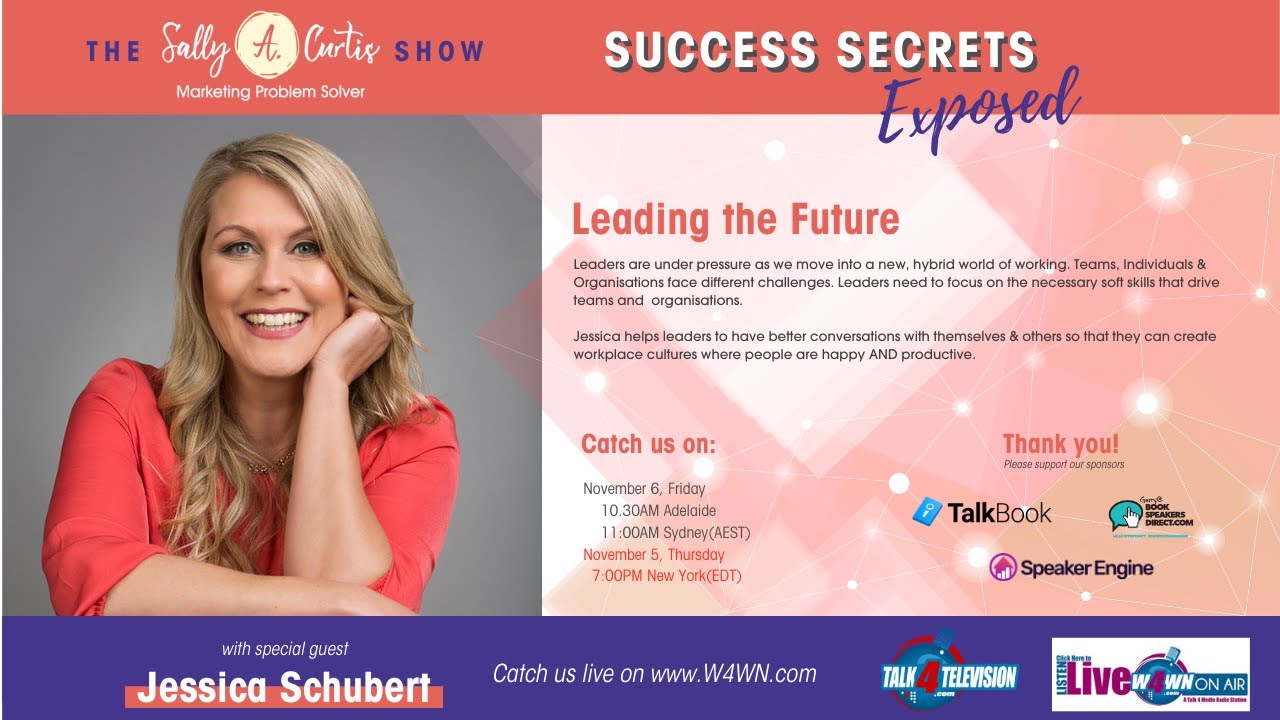
Leadership coach Jessica from Intact Teams discusses managing hybrid teams after COVID. She uses the Kübler-Ross grief curve to help leaders understand how employees experience workplace change, and emphasizes empathy-driven check-ins and balancing productivity with wellbeing across office, home, and remote locations.
Chapters
The topics and opinions expressed on the following show are solely those of the hosts and their guests and not those of W4WN Radio, its employees, or affiliates. We make no recommendations or endorsements for radio show programs, services, or products mentioned on air or on our web. No liability, explicit or implied, shall be extended to W4WN Radio, its employees, or affiliates. Any questions or comments should be directed to those show hosts. Thank you for choosing W4WN Radio.
Welcome to Success Secrets Exposed with Sally A. Curtis, where we share stories of challenge, success, and inspiration, along with practical tips and strategies to move you forward to your success. And now, here's your host, Sally A. Curtis.
Good evening, good morning, and good day to you. We have an exciting show for you this morning and this evening, and we're going to be talking about leading the future. And I'm very excited to have a dear friend and client on today with me, Jessica, and she's going to be sharing her phenomenal insights on how to lead the future after COVID and through this period. Now, let me give you a little bit of an insight and backstory into Jessica, and she'll certainly be sharing more with you today. Jessica helps leaders be better leaders. And after over 20 years of leading cross-cultural teams, both in Europe, Asia Pacific, in the commercial real estate industry, she decided to give it all away and decided to leave that corporate career to now help leaders in that corporate environment to navigate through power dynamics and organizational complexities. And it's absolutely her quest to create workplace cultures where people are both happy and productive. Now, Jessica works with leaders both on a one-on-one coaching aspect, and she also designs and facilitates group leadership workshops. And of course, as you'll get to see today, she also demonstrates her insights via panels, discussions, as well as keynotes globally. And since the world changed for all of us in March this year, Jessica herself has transformed her own business, Intact Teams, to be completely digital and focuses now on helping people lead remote teams. So please help me welcome Jessica to the show.
Hello, Sally.
Hi, how are you? Fantastic to have you here today.
Thank you for having me. Very exciting.
Absolutely. Now, I'm, as I said, super excited to share so many of your insights. I know we have some very great and deep conversations around your— what I would classify as your inner genius, which especially as it comes to working with remote teams and teams in general. So would you be happy to share some of your backstory with us a little bit, please?
Yes, as you can probably tell from my name, but also my weird accent, and people place me in different backgrounds, but I'm actually originally from Germany, grown up and schooled, but I haven't spent the last almost 20 years in Germany. I've lived and worked in New Zealand, Sydney and Melbourne, and then I spent 6 years in Hong Kong and spent a lot of that time in Japan as well, leading teams in the commercial real estate industry. So I've had my fair share of blending into cultures, working with people with different backgrounds, either in one team in an organization or in a country. And I think that's really helped me to connect extremely well with other people on a very deep level because I had to. my job, especially going to Hong Kong, was getting the best out of a new sales team in a very short amount of time. And I had to understand how they work and, you know, what motivates them, what their fears are, and how they work. It wasn't about me, it was about the people around me.
Absolutely.
That's my largest learning curve.
Yeah, absolutely. And that's why I think when we have our in-depth conversations is that insight and the level of your understanding of both the cultural elements within a team. And I know we've talked about the multicultural, but it's just that level of understanding other people. And I would almost go on to say that your obsession is that understanding that the diversity and getting the best out of teams, because I know from the results that you've created and the work that we've discussed, it is all about creating results for the organization. And you can only do that when people are aligned in general. So can you share a little bit more about that? And then I have a question for you.
Yes. Well, what I've done well, I guess, is using my natural curiosity to start off with when I work with people. And my career in the corporate world certainly has helped me to understand those power dynamics and how organizations work. Because it gets very complex when people come together. Our processes are easy, but they're driving it. And what I've really tried to do is help other people to understand that it starts with understanding yourself. Yeah. So I've got a very different background from my nature and nurture, having grown up in Europe, being able to understand that and see my own culture from a distance, it's really helped to connect well, working and living in Australia, although it's quite similar, but certainly across Asia. And what I find when I work with leaders now, I have a lot to share in terms of experience, how I got there. But there's also really helpful models and tactics and techniques to change behavior. And just You know, don't get there by yourself. Sometimes you need help of someone else.
Yeah, absolutely. And one of the things we were talking about yesterday was the saying that's going around a lot that we're all in the same boat. So what are you finding as it relates to that statement? Because I know we're going to sort of debunk that a little bit. But also, what are your global clients currently challenged with as it relates to that?
Yeah, so the saying goes, you know, we're all in the same boat when we are looking at the situation at the moment, you know, with COVID and everything else that happened, uh, 2020, and it's still happening. And I absolutely believe that's not true. I think we're all facing the same or very similar storm, but our vessels are vastly different. Some people are on, you know, life rafts, some people are on big, you know, cruise ships, and some people are actually on land. Our personal and professional situations are very different, and we tend to forget that. We either, you know, um, sort of compare up and to think, oh, but I should be happy with what I have. It's completely fine also to feel what you feel in your situation. But we certainly can't assume that what's going on for us, the way we live or work from home or not, depending on which country you live in and which organization you work for, that that's the same for everyone. Everyone feels the situation we're going through at the moment, has different emotions, but vastly different work and personal situations at home. So, we have to really look at that empathy piece.
And that's such a great word with empathy because when we first started the conversation, you were talking about the different boats or vessels that people are on. You sort of think of, oh yes, in Australia we've got this, in America they've got that, in Asia they've got that. But it's actually not so much even about that diversity, it's about the individuals in the same organization, in the same team, having the life raft or the yacht or the cruise liner. There's that level of difference within the actual teams that work together.
Yes, absolutely. I mean, you just look at, you know, a team I worked with last night out of the UK, and, you know, whilst they live on the other side of the world and, you know, just going into lockdown, but not even everyone because it's England and Wales at the moment. You know, we just had a check-in in the beginning, you know, where are you at, what are you feeling on a level from 1 to 10, and they disclose so much of what's going on at home. Yeah, and One of the participants was actually, you know, I'm an 8, I'm fine, everything is going all right, I've done this before, and, you know, kids are out of the house, I've got my own office. Whereas, you know, someone else had, you know, 3 schoolchildren at home having to homeschool, partner had lost, you know, their job. It was really, really difficult. And just listening by those stories, the empathy level just went up. Mm-hmm. And everyone was quite gobsmacked, like, oh my God, I didn't know you were in that situation. I didn't know that was going on for you. And that's what's really important. So even within teams, everyone's situation, their mental state, how they feel about everything, but also just the situation at home or at work is different.
Yeah. And what you've actually described there is very natural empathy. It's just that level of, oh my God, I didn't realize that for you. And that only comes about by having those very open conversations to start with. So is that something that you facilitate and help teams to do generally?
Yes, absolutely. And to be honest, Sally, what I did in March when, you know, this all happened, I just really checked in with, you know, most of the leaders I work with, or even leaders I worked with, you know, in the past years, and just asked them, how are you going? What's going on for you? And what I saw was there was an instant disconnect of, you know, people having to work from home. That was huge. Yeah. But also this overwhelm and fear of uncertainty.
Yeah.
And those challenges haven't really changed. They have shifted, but I still see, you know, this happening in the world and in the workforce everywhere globally. So they're the challenges that are still there.
Yeah. And do you see those challenges still as a constant roller coaster? We have overwhelm, we get certain things, and then we dip back down, and then we're okay again, and we dip back down. So is everyone on multiple roller coasters all at once?
Yes, and that's such a great description, Sally. A client of mine said that actually the other day. My God, it's like a roller coaster. And, you know, I use when I work with clients for them to understand what's going on with people, I actually use the 5 stages of grief, which, you know, really show— and you can use this, you know, in any sort of change situation. It's called the Kübler-Ross Curve of Grief. But what it really explains is that people go from shock into denial. And then, you know, at the bottom where there's this, you know, despair and overwhelm, and it takes people to be able to get back up. Yeah. And it's that curve of roller coaster. And we have multiple of those, you know, right now, everywhere, really. And for leaders to understand, OK, that's what people are going through, just gives them a really good picture and visual of what they need to do next. Because what we're trying to do when there's change is train people. Here's something new, we're going to do something new. But you have to let them experience what's going on. And what we actually need to do is empathy, sympathy, communication, checking in and letting them get used to what's happening now. We just can't yank people into a different direction and expect You know, a return of productivity within 24 hours.
Yeah, yeah, a gentler approach. And I just think, just on that note, I remember chatting with you, and I've got a couple of other clients that are in Melbourne who've just recently come out of lockdown. And just for me, just from a visceral perspective, seeing your, your faces all shine again because you'd been allowed out, that was just so noticeable. I think it started with you when we spoke earlier in the week, and then I had 2 clients in that same day, and there was just that level of blossoming of, you know, freedom of, you know, positive change. So a new experience, and that was so easy to see. So I can imagine what the, what those impacts create for the teams as they move forward. So as we've been talking about leadership and all the changes that are going on and that rollercoaster ride that everyone's on at the moment, that's continuing and continuous, what does the hybrid world look like now for the leaders that you're, that you're working with at that global level?
The hybrid world, and it's a big word at the moment, it's been thrown around a lot, and people actually ask me what is a hybrid world, and really is a sort of two-way or hybrid sort of anything is possible. What I'm seeing at the moment is that some people are going back to work in some countries like New Zealand and other parts of Australia. In Europe, it's reversed, people are going back into lockdown, and in the US, I guess we'll see what's happening there, but they enjoy some freedom. But of course, you know, people are going back to the office. Corporations actually are downsizing and changing their commercial real estate models because they know that everyone will go back to work. So people are looking forward to going back to work. They've been really missing the social aspect.
Yeah.
But employees will ask for a level of flexibility. And of course, in some jobs, especially when you're customer-facing at the front line, it's not possible to work from home. But most employees that I know and leaders that I work with, you know, would like to have the opportunity and the freedom to decide when they want to work from home, when they go to the office, or at least negotiate with their managers or leaders. So there'll be, you know, a bunch of us working in the office, a bunch of us working at home. And for leaders, that means it's, you know, a different dynamic every single day, because some of your team members are at home, some of your team members are in the office. And when we're physically disconnected, we're communication, problem-solving, collaboration is different. So it becomes much more tricky and we have to really put an intense focus on our leadership skills to be able to work well in that hybrid world.
Now you've touched on a couple of words there that I love, which is collaboration and problem-solving. So how is that now different from a delivery perspective When you've got the teams that are half there and half not, what are you seeing that's working or is problematic? And as a result of those problems, they're now doing these things that are working.
Well, what's problematic is that we don't see each other. When you problem solve, you require brainstorming. You have to look at things from different perspectives. You have to use productive conflict. You have to challenge the status quo. to problem solve. And when you're not in the same room, you can't read up on cues and body language as much. Also, people get distracted. And again, there has to be a level of empathy because we're working from home. There's kids and dogs and cats and all sorts of stuff going on and Wi-Fi and technology, of course, as well. That disruption also doesn't help. Or Zoom fatigue, being on one call after the other or being too long on a screen. There's a lot of research done now what interaction through an interface, how that impacts your mind, your sight, your brain, and then that interaction. So it's really tricky to get the same level of human interaction when you're not in the same room because you don't, you have a lack of body language and talking. I mean, You know, you know what it's like, Sally. You talk with people on Zoom all the time, and it's just the same as when you're in the same room. You know, and you can't just go, okay, let's go outside for, you know, lunch or coffee and let's talk about something else, or grab a whiteboard in and use that in a really interactive way. So there are things you can do to do this really well, and that's the work that I do mostly, or a lot, with teams globally at the moment.
Yeah, beautiful. You've just touched on something else, and then I want to dig into a little bit more of, you know, what are the solutions. But the whiteboarding aspect, I'm starting to have conversations with people around that, where we've always done things on apps for productivity or team building or whatever, we've got used to using the apps. I'm seeing and hearing a lot of people go back to what I'm going to call old school because Sally still loves a good whiteboard and Post-it notes and seeing things visually. And I think by having those sorts of older-school methodologies. It helps teams see what's happening and maybe add to it. Are you seeing a change with some of the tech stuff being— and going back to sort of more old-school methods? Are you seeing any of that in your world at the moment?
Yeah, absolutely. I mean, what I really see is that leaders who embrace this change, because we're talking about a struggle and fear and challenges, but there's a silver lining in all of this. Yeah. When I look at teams that are actually physically, you know, not working together because they're in different countries, you know, all of a sudden they get the support of, you know, evolved and advanced technology that helps them. A lot of people I work with and a lot of my friends are single mums. So much easier for them to not have to go to the office. Their private life becomes much easier. You know, they don't have the commute. So there's, you know, there's a real silver lining to be able to use technology and working from home and in a hybrid world and with remote teams. What I've really observed over the last few weeks in particular is that the leaders who are open and agile and embrace technology, they get the most out of it. So yes, they go back to, you know, scribing, using Post-it notes, because they are just really how you put your thoughts on a piece of paper so it's visual for everyone. That's really what you do. Yeah, you use a model or you write down words, and then you use that for problem solving and brainstorming. And technology absolutely offers that. Yeah, there's, you know, Zoom and Teams and all the platforms are advancing like there's no tomorrow. There's an amazing platform called Mural, which is really visual in terms of Post-it notes. But all the platforms have, you know, offer this. And what I find is that some leaders really struggle with embracing that and being open to using it, and some leaders embracing that technology. And that's one of the new skills, if you ask me, when we talk about post-COVID leadership skills. Embracing technology and seeing the opportunity that comes out of using technology is really important, and it sets leaders apart of being successful.
Yeah, so that leads in. We've got a question just in the feed at the moment. It says, is there anything wrong with doing things the old-school way?
Actually, I agree with doing things the old-school way if it still works and it's still relevant. Yeah, we don't have to reinvent the wheel. If anything, I would say, let's go back to the drawing board. The foundations of leadership skills haven't changed. So old-school skills, old-school methods, like let's actually draw on a whiteboard, let's use Post-it notes. I would completely encourage that. And to take it a step further, actually foundational leadership skills of self-awareness, emotional intelligence, social intelligence, tuning into other people, giving feedback, It's not falling off the wayside. If anything, that's exacerbated and it comes up. We have to almost put like a lens on this in our leadership because we're not in the same office. We have to make a more conscious effort. So great question.
Yeah, thank you. So what are the solutions and what does leading the future look like?
So leading the future, what it looks like, and I really put it on a couple of lenses and pillars, and one is the disruption that we've seen in the world through automation and the future of work. People having the fear that their job doesn't exist anymore by the time they finish university. We hear this in the news, or that our jobs are taken over by automation and machines. And that fear and that uncertainty is valid. But again, I see a big opportunity in there to really shift the way we do things. And it goes back to soft skills. And then, of course, it came with a big smacking hammer this year and said, okay, let's, you know, there's a pandemic and let's make it just a little bit more difficult. So for me, it's really what are we going to do with all of that? And the future is actually not in the future. For me, leading the future is right now and it happens right now.
Great distinction.
Yeah. And, you know, and we can't wait for it. Yeah. This, we are in an infinite game. This is not a finite game. Yeah. It's not stopping at the end of the year. Everyone talks about 2021. is not going to look vastly different from 2020, apart from that we already know what this feels like, right? Yeah. And so when I sat down with leaders, and I asked a lot of leaders since March, and I'm working with leaders who, you know, who are making massive changes in their lives and their people's lives, you know, what do we need to have to focus on? And it is actually going back to the foundations of leading self, lead others, lead change, and lead the future. And there are a lot of skills that we, you know, that are called the foundations of leadership, but there are also some new skills that we really have to take on board as leaders to be able to adapt and manage and lead that change, not just, you know, catch up with change that's already happened.
Yeah, beautiful. So can you share some of the— as you talk about leading self, so if we could perhaps chat on leading self, what are some of the foundational elements and what are some of the new things as it relates to leading self?
Yeah, wonderful. And I'm loving to talk about it because, you know, of course, Lead the Future is one of my programs. And it starts with creating self-awareness and really going back to strength-based leadership. And the reason why that's important, and I know a lot of leaders do work on that with their coaches and their internal leadership development, you know, already, but we have to sort of recalibrate and find out what are our strengths, that really help me to be happier with my life and my work right now? Because work and our environment is changing and we have no control over that. Yeah, there's restructures everywhere. Every large organization that I work with has gone through a restructure, reorganization, or will in the next 12 months. Yeah. So revisiting what are my strengths that I can bring to, you know, loving my job, doing what I do well so I can do more of it, And how can I help my team with that as well? So going back to strengths-based leadership and, you know, going back to these exercises. And as we know, building resilience has always been sort of part of it. And that's definitely a big one. Yeah, you can't serve from an empty vessel. And we have to be able to, you know, bounce back from hardship. We have to look after our own mental health, you know, set boundaries in our lives where work seeps into everything. And I've certainly experienced this over the 4-month lockdown here in Melbourne, where you just start living in your head. So again, as leaders, we have to make sure that we're resilient and we can serve from a full vessel. Yeah. Emotional intelligence, yeah, going back to hear the emotions. Because even those strong leaders and resilient leaders, we still feel that you know, there is uncertainty and hardship in the world. I don't know any leader who was not affected by what's happening right now. And so really going back to being able to, you know, manage your emotions so you can lead your people well. And then tech savviness is definitely the big one for me. Leaders don't have to become experts in everything. But we have to, as leaders, be able to gauge what technology has to offer in terms of opportunities for ourselves, for our teams, the organization, the industry, or even the world. And then we hire people to be able to, you know, put this into place.
Yeah.
Use your millennials and Gen Z because, you know, they're very nifty, you know, and very natural with technology. So there's a real good opportunity to, you know, give projects to your younger workforce and get them involved to create, you know, the base of that because we will be using technology so much. It's here to stay. So that's around self.
Yeah, so that's self, and you mentioned that there's an element after that, and I've got another question percolating right there ready to ask too. So do you want to expand on the other areas of the foundation as well after you've sort of looked at your self-leadership and then it's leading others? So do you want to talk about those elements?
Yeah, leading others now, you know, comes to for me, leadership and leading others really comes down to 2 things, and that's conversations and relationships. So we have to go back and look at our conversations and what's changed here that we are more disconnected. So either we're in a full lockdown or we work in a hybrid world. And being physically disconnected, the work I really see that I do with leaders and who do well change the way they communicate using virtual and using Yeah. You know, computers and apps. One of the biggest changes I've seen is really then using your social intelligence to tune into people and understand what's going on with them. Because your conversations are not just about work. Yeah, it's about connecting, knowing who they are, you know, the good old Johari window, self-disclosure, asking for feedback. You know, that's again much harder when you're not in the office because you don't have the water cooler or going for coffee conversations. And so as a leader, you have to keep that up. How do I do coffees virtually? You really have to watch out for your sort of more introverted and shy people because they're loving it. They're loving working from home and not having to deal with everyone. But they also feel lonely and they're probably unlikely or they're rather shy to talk about what's going on with them. Right. So having empathetic conversations with them to make sure they're OK. And your extroverts, of course, you know, they tell you how they feel any minute of the day. But they struggle with that disconnect more. So how can you juggle that? So those personal conversations. And the one thing I've seen as well, we have to change the way we present and we have to change the way we hold meetings. A meeting in a conference room that we used to have a team meeting doesn't work in the same fashion online. And again, work with a lot of, you know, teams who, you know, do really long updates about, you know, technical aspects and data. you know, it's sort of, you know, one person talks, you know, half of the people are not tuning in, you know, there's minutes that no one reads, you know, all that. So, you know, we're really going back to the drawing board and I encourage people to review how they do meetings. Yeah, they need to be short. People have a very short attention span. People need to be engaged. Yeah, it's so easy to look at your email or get distracted somewhere else. Sure. And to keep people engaged when they're not in a room, you have to engage them. So Leaders have to think about the content and also the facilitation of their meetings and their workshops, and a bug of more work is in that at the moment.
So definitely hearing lots of self-responsibility on lots of levels and lots of adaptability for sure. Now I'm going to touch on— you talked about the different age groups or the different generations within organizations, and I know we've got a standing joke at my house that if any of the tech goes, like we experienced just before we came on and I couldn't work, that something wasn't working, it's like, Rory! He's 17 now, so, you know, it used to be us, the 12-year-old, but he's 17 now. Come and help me with this. So, from that perspective, there's obviously golden opportunities and problems, and then the golden opportunities as it relates to the diversity of the age brackets or the generations that we've got. Can you explain and explore that with us today?
Yeah, absolutely. I do a lot of multicultural and multi-gen work because our workplaces have vastly changed. And it's more evident now than it has ever been that in 2030, there's going to be very few Gen Xers, sort of you and my age, no baby boomers anymore. And 30% of our leaders will be millennials. And a lot of our— 25% of all leaders are now millennial anyway. And Generation Z. So you're talking Rory's age, yeah, they're gonna be a big part of the workforce. So it's not just about technology, it's a big part, and it's not that everyone who's a millennial or, you know, Gen Z is, you know, tech smart, but they grow up with tech, yeah. So what they are experiencing is, yeah, we just use tech for everything, so paperless and, you know, fast processes. It comes down to building relationships and communication. Yep, both those things that come down to, you know, in leadership. And, you know, baby boomers, you know, would, you know, still, you know, of course, you know, use the computer but have a written word, and that's how they communicate, that's how they hire, that's how they train people, how they communicate. And, you know, in a quite formal way, whereas our younger generations, the way technology impacts their communication. Yeah, we're going back to hieroglyphs, right? Like it's on mobile phone and it's symbols and signs. Yeah, I mean, the words they use, I don't even know what they're talking about. But they communicate. Yeah, but they also connect and communicate really fast. Where for us, it takes forever to write an email, send back, and they're just hyperconnected everywhere in the world and they're plugged in and quick message and likes and it's It's just different. What we have to understand is that this is not a pendulum. We as the older generations can't say, OK, let's have those millennials and Gen Z starting in our organizations and then we show them how we work here. They will change. They will not change because it's deeply ingrained in their nature and nurture, how they've been brought up. And Sally, Rory behaves in that way. the way he does is because you brought him up that way. So I'm not making it personal, but, you know, our Generation X, you know, brought up, or was bringing up Generation Z. So we just have to understand that their attitude towards communication, towards purpose-driven organizations, towards retention is very different. Yeah, they have multiple careers, you know, I think 16 or 26 careers in, you know, 6 different jobs in 6 different careers. You know, it's just— Wow. a lot faster because they see things much flatter. It's opportunities, not careers from one title to another and staying at the same organization.
It's opportunity? Did I just hear that right?
That's correct. Yeah, it's about opportunities. And therefore, when I work with leaders who have a young workforce and they've changed their hierarchy to make it flatter, Because it's just not possible to always, you know, every year to bump someone up and promote someone. It's not so much about the title and the promotion for younger generations. It's about purposeful work. And when I see how, you know, organizations who do this well provide, you know, interesting projects, even outside the organization, yeah. If you're not looking after sustainability and offer your employees to do good through charity work and so on and so forth, you're really missing the game. That is important for younger generations. They're happy to take charge of it. So have that conversation. What I don't see is that dialogue going on in a lot of organizations. It's still sort of like, here's how we've always done it and people just don't understand you.
Yes, yes, I hear you on that one. I've got little things where I go, Rory, I've just got this message from somebody and it's just Oh, you know, hieroglyphics. What does that mean? He just looks at me and laughs. Mum, it's blah, blah, blah, blah, blah. It's like, oh, OK, yep, cool, not a problem. So that— and that's just that level of difference in communication and where we tend to be stuck, it's we've always done it that way. Now, we've just got a question in the chat box where someone's asked, how can people adjust to change and be more adaptable? So how do people be self-responsible as it relates to that adaptability? Have you got any tips on that?
Yeah, is that for adapting to change self or others or both?
They've just used change in a broad sense, the term, so perhaps if you want to share a couple of insights on both would be great.
Yeah, so adaptability, when we look at leading change for ourselves, is to start off with seeing the opportunity. So as a leader, and part of leading change and then lead the future is having foresight. Embracing discomfort and being able to sit in fear and not getting out of fear, but really sitting in fear, being able to move forwards anyway. That's, I think, for self, when we look at self, one of the biggest learning curves I've had. There's something called the happiness movement. We associate happy with happiness with good and not being happy or sad with bad feelings. And that's just not right. And what we often do is when we feel sad and when we're in discomfort, waiting to be happy to be able to move forward. I've got to change something first, and then when I'm positive again, then I can move forward. And that doesn't help us to move forward. That's not leading change.
Right.
You know, that's getting probably more fearful because we're really immobilized. Yeah, and that's what we've seen in the last few months.
Yeah, so that's— sorry, I was just gonna say, you touched on a couple of good things there because you talked about that waiting element. I've seen lots of people as it's that, and that is fear, but we see a lot of people sitting in waiting and not being curious. So it's probably potentially just being curious help with you Getting out of that waiting state.
Yeah, that's right. Yeah, it's about being okay with not being okay and moving on anyway. Yeah, just okay, okay, you know, this doesn't feel right, it's not, you know, it's not normal, something is happening. Because there'll be always things that are out of our control. It's out of our control what's happening with the pandemic apart from our own, you know, behavior, how we adhere to, you know, what the health officials say, right? But it's about then moving forward and, you know, taking our people with us. So getting out of that habit happiness movement. So sitting in discomfort and dealing with fear of just being OK and moving forward, that's actually a big part of building resilience. The biggest learning curve for me in resilience was, we talked about resilience for leading self, but resilience obviously is also helping others in our teams to be resilient, was that I had an old view on resilience or to resilience. I always thought you know, because of where I grew up and, you know, what I've overcome in my life and, you know, I've traveled a lot and I had to really reestablish myself many times. I'm a resilient person. Yeah. Yeah. And when March happened and literally my face-to-face business disintegrated in a month and I didn't know how long this is going to take and will I have work, paid work, what's going to happen, my family was far away and over and over I felt myself in this state of fear, and I couldn't get myself out of it. And I'm like, what's happening? I'm a resilient person. Why can't I? And here's the thing, you're not either resilient or you're not resilient. Yeah, resilient— resilience is systemic. Uh, resilience, um, you know, you need different resources you tap into for build resilience for certain situations. Um, so it's not, um, you know, it's not, you know, global. Um, that, you know, you just, you know, resilience is just there. And it really helped me to look back and go, okay, why am I feeling the way I am feeling? And it's okay as well. Sit in that discomfort. But what do I need to do? And some of it was, you know, creating boundaries so, you know, work wouldn't seep in too much into my, you know, private life, connecting with friends, and also being okay with being okay. So lots of different, you know, measures. But I had to understand that first. Yeah, so that's, that's part of being resilient. But I think we digressed.
That's all right. And that was part of that curious, and that, and you were curious about what was going on for you. So it enabled you to have that insight and be able to then move forward with change to create a different outcome for yourself. So one of the questions that we talked about the other day, and we've got a bit of time left, and I do want to explore, come back to leading the future with your new program. But you also talked about the element of getting stuff done. And everyone talks about productivity. And obviously, with the work that you do with teams, that's one of your major outcomes. You do help people be happier and certainly more product— productive. But during the hybrid arena that we're moving into, what is the cost of leaders when they get into that productivity zone? What's the cost of that, that they need to be aware of so they can perhaps mitigate some of those challenges that might crop
up through Yeah, it's a, it's a very interesting question because productivity is such a big KPI, you know, for all organizations I work with. And what leaders have experienced in this time of, you know, the hybrid world and, you know, people working at home, either they, you know, didn't quite see, you know, the productivity. And a lot of leaders would come to me and they'd be quite honest and they say, look, I just don't trust my people because I can't see them. I don't know how productive they are. Yeah. Because you you know, wait for the outcome. So that's a lot of work we had to deal with. But there was an evident factor of a decrease in productivity. And, you know, the measures there and the steps that I helped those leaders with was reconnect. We're going back to the drawing board, yeah, reconnect with people, check in with them, yeah, embrace that technology. And, you know, look at how you visualize, you know, KPIs and productivity as well. Our biggest job right now is, and the question that I get asked by clients who want to work with me, how do I keep my teams motivated and focused? And on the other spectrum, and I said this to you yesterday, Sally, was, you know, but I also hear from people and from organizations saying, no, we're super, we're actually way more productive than we were before. I'm loving it. I'm going to keep everyone at home.
Yes.
And then you said, oh yeah, but at what cost, right? And you are absolutely right. At what cost? individuals and teams, when I look at their happiness. And we want people to be happy and productive. And happy comes first in that sentence for a reason, right?
Yes.
An increased productivity, but everyone works longer hours. Work is at home. Physically, their office is in the same room as their living room. And that's dangerous. And what it's not is sustainable. It's not sustainable. So as leaders, we have to make sure that we help our staff set boundaries, that we set those boundaries, and that we lead by example as well. And that's the whole thing around productivity. You know, again, we have to, you know, super focus on what that looks like, but really careful because the signs of burnout are there. And I'm helping a lot of leaders to look out for those signs as well. It's very important.
Yeah, beautiful. So we've got about 10 minutes left, so I'd love to chat on, as it relates to leading the future, and what that really looks like with your new program and perhaps give us some insights of why you've dived into those particular elements in Leading the Future. So I'll let you have more free rein and it looks like we've got some more questions. Oh, yep, hot button, burnout. Let's just go to the questions just quickly. We've got, what should we look for as far as burnout goes?
It's actually a tricky one and I help leaders with, you know, some foundational, you know, sort of coaching work. But we, as leaders, have to draw the line then also very quickly, and we have a responsibility to go, OK, this is how far as I can, you know, help and look out. What organizations and leaders actually have to do is have— and I think in Australia, certainly most organizations, all organizations I work with have a COVID-safe plan, which which really means, and it's not only because we're working remotely, it's just stronger now, that we refer and encourage people who are battling mental health issues, that we refer them to professionals. I'm an executive coach, and one of the first things I learned in my first Stage 1 training was we're coaches, we're not counselors or psychologists. Reading that line where we have to refer someone to a professional is really important. In general, the signs we look out for, first of all, you know, talk to your people all the time. Ask questions. And ask questions where someone can almost, you know, sort of make it visual or validate what it is. I think one really good measure that I've, you know, I use and my leaders use is do a check-in. How do you feel from 1 to 10 and why that number? Always start with yourself. So I did this yesterday with the UK group, and we'd actually had to work together for a few weeks now. We're halfway through a program. But because they're going into a different situation right now, they're going back into lockdown, and it's really hard. And all of a sudden, their numbers went down. They were 5s and 6s rather than 10s. And they started to talk about what's happening at work. So make sure that you're open and you have that trust with people that you can ask them what's going on. Tune into people. Any sort of change that you see, it's not just a bad day, but, you know, change of communication or being absent or negative talk that keeps on going on and on and on, that's a real hot button as well. Yeah, any sort of change in attitude, you know, have a look at their, you know, facials and their mannerisms, you know. You know, don't bug people and you're like, oh my God, you're really pale today, what's going on with you? We don't want that. We don't want to panic people. But it's that asking open questions, building that trust first, asking open questions and look out for any change. And you'd be surprised when you ask people how they're feeling and what's going on and you have developed that skill to do that well, they will mostly tell you.
Yeah.
Get everyone to train your own people to be able to look out for those same signs as well. We're creating a culture of hyper-emotional and social intelligence and empathy and making sure that we read those signs. So it's being really alert. Of course, when people talk about struggle, when they use those words, I really struggle, then we have to dig deeper and ask them, what can I do for you? How can I help you?
Yeah, beautiful. And on that question, how can I help you? I know you get asked this a lot on LinkedIn as it relates to, hey Jessica, I love what you're doing, how can you help us? So in a broad perspective with the work that you do, can you just share with our audience, you know, how can you help those people that run large remote teams? And then that'll tap into the, you know, Leading Your Future program that you've got as well.
Yes, yeah, so I work with leaders and teams and organizations to really help them to identify what their challenges are, where they would like to be. So it's really around, you know, sort of the fact-finding and the problem-finding, and then the co-creating of learning solutions. So I help with one-on-one coaching sessions, and I often coach, you know, the leader of an organization or the team leader, and then team coach and provide workshops for the team or the group within that organization to help learn those new skills. So it's a lot of creating awareness through, you know, facilitated conversations and coaching and team coaching, but then also soft skill workshops to be able to, you know, change the way we have meetings, you know, help teams and leaders to connect really well, you know, in a remote environment. So, you know, all this good stuff I talked about today, and it's all in my program, Lead the Future.
Yeah, beautiful. Now I'm going to touch on something because I know you say it very often and you brush over it, but it's actually a very significant word, and that's that co-create. So when you're working with organizations, it's not a, you know, one-stop shop, everything there. It's you actually help them co-create the right solution to fit that team. So just explore the co-create because I think that's one of your significant differences and adds so much value to the to the organizations that you work with. So you're not off the track easily.
And I am, and I am actually really proud of that. And that's what my clients come back to me and they say, Jessica, you know, and I work with clients over a number of months on, you know, different, you know, learning solutions because they say to me, we just love how well you understand us and that you work with us on things that we really need and that really work for us. Because, you know, there are theories, there are models, there are insights, there are stories. Yeah, they're all valid. And of course, I've got a whole shelf behind me with stuff. So they're all the exercises and the flows and trainings and workshops, etc. But not the same solution works in the same way. While Lead the Future is built on Lead Self, Lead Others, Lead Change, Lead the Future, and the foundation of leadership goes through that, it's really then about OK, so what do we need to mold, you know, maybe even flip around? Yeah, sometimes I, you know, start with a SWOT and, you know, to identify, or I do it at the end. Sometimes we start with, you know, communication and, you know, feedback and, you know, it becomes later. So it really depends on, you know, what's going on. And co-creating really means having a dialogue, yeah, of what's going on before I even, you know, present a solution. Yeah. I don't just take a workshop off my shelf and go, here you go, you know, there's your 7 steps to, you know, leading remotely. I've got articles about that, but not learning solutions. So they're co-created because I take what the clients tell me into consideration before I design a program.
Yeah, beautiful. And I really wanted— I'm glad you explained that. Thank you very, very much, because I think that's absolutely one of your absolute inner geniuses. So I want to make sure everyone was aware of that today. So thank you. So, as well as that, Jessica, we've got a download that you're going to provide today, which is around COVID and how leaders will move forward. So, I just want to share with the audience that they'll be able to get that later after the show at gettalk.at/future, and that will be in the ticker along on the screen, and we'll have that into the social media feeds as well. So you'll be able to get one of Jessica's recent articles on leadership as it relates to the future and moving through COVID as well. So quickly, what's the best way for people to actually get in contact with you?
Yeah, all the social media channels, of course. Yeah, I'm on LinkedIn. I'm very active on LinkedIn. Email me at jessica@intactteams.com, and I'm sure you'll be put all my details somewhere as well, and they will be in the doc that you can download, or follow me on, you know, Instagram. My website is www.intactteams.com. And yeah, just send me a message and a note, and we'll have what we call a discovery call.
Yeah, absolutely. So thank you very, very much for sharing so much with us today. It's super appreciated. Is there any one single tip that you would share with people as we finish off?
Are you putting me on the spot, Sally?
I love to do that.
I would just say, you know, the biggest tip I can give everyone is this shall pass too. You know, look really deeply in yourself. You all have the strength and the basic skills to be able to lead self and lead others well. It's just about unpacking, you know, what's inside you. Go back to your strengths and really use that to lead others through these times of ambiguity and change.
Yeah, beautiful. Thank you very, very much, Jessica. It's been an absolute pleasure. So for next week's show, it'll be myself and a girlfriend, Christine Robinson, and we will be sharing with you business development tactics to help you increase your profitability with things that are already hidden from or already around you but may be hidden in plain sight. So we'll be discussing with you different ways you can increase your profitability with elements that are already part of your business that you're already doing, etc. So thank you very, very much, Jessica, absolute pleasure, and thank you very much everyone for joining us again today, and I look forward to sharing more with you next week. Thank you very much. Thank you.
That's it for this week's episode. Thank you so much for joining us. I trust you got some inspirational tips to move you forward. See you next Thursday at 7 PM Eastern for more Success Secrets Exposed.
More from Sally






The Coaches Results Express: How to Build a Thriving Coaching Business That Actually Works


