Success Secrets Exposed - "Networking and Collaboration Success"
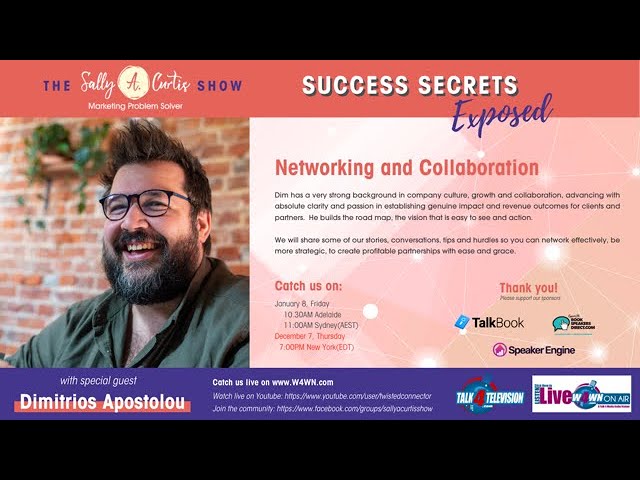
Demetrius, founder of the co-working platform Huddle, shares how he turned 200 LinkedIn conversations into 70 committed partners for his podcast. He vets people with three questions about their superpower, biggest failure, and success roadmap, then builds long-term alliances through what he calls a concentric-circle family culture.
Chapters
The topics and opinions expressed on the following show are solely those of the hosts and their guests and not those of W4WN Radio, its employees, or affiliates. We make no recommendations or endorsements for radio show programs, services, or products mentioned on air or on our web. No liability explicit or implied, shall be extended to W4WN Radio, its employees, or affiliates. Any questions or comments should be directed to those show hosts. Thank you for choosing W4WN Radio.
Welcome to Success Secrets Exposed with Sally A. Curtis, where we share stories of challenge, success, and inspiration, along with practical tips and strategies to move you forward to your your success. And now here's your host, Sally A. Curtis.
Good morning, good evening, and good day, and welcome to the show today. It's going to be a high-energy, action-packed, fun show for you. We're going to be talking all things networking and collaboration. And particularly as it relates to business growth. And I'm super excited to share our guest with you today, which will be Demetrius. So for those that don't know me and don't, haven't been to the show before, let me give you a little bit of my background just very, very quickly. I'm a marketing strategist specifically for coaches, consultants, and speakers. What we do is repurpose content and help that work with LinkedIn strategies. So my whole role is to help you amplify your voice, your message, and your impact. Now, our guest today, Dim, is affectionately called just that, Dim. And for those that know him very, very well, you'll often hear the call cry, hey, Dim, I need some Dim magic. So I'm going to give you the opportunity to share in some of that Dim magic today. And which you will soon discover. Now, Dim, I only met about 4 months ago, and in the last 2 months we've been collaborating on a project that we're excited to be launching here in the Adelaide marketplace very, very soon. Now, Dim has a background in tech as well as innovation and growth. He absolutely understands the power of simple systems. and he's also revenue-focused. What I love most is he has the ability to see with total clarity the roadmap or the way forward, and this makes it very, very easy to follow his strategic lead and to follow along as he creates the magic. As you'll get to experience very soon, he's very warm, generous, and insightful, and that magic that he's going to share with you now is contagious. So please help me welcome Dim to Success Secrets Exposed.
Hey everyone. Oh wow, I'm almost tearing up. That was a great introduction. Thank you.
Well, it's been an absolute great experience. It feels like we've been working and playing alongside each other for almost a lifetime, but it has only been so so short. And for those that know me very, very well, Dim is a connection that I didn't meet on LinkedIn. It was actually through a combined connection. And so we've got along and off to a fast start, which is something that always excites me as it does Dim. So very
much
congrats to us. Let me ask you a little bit, if you can give us a little bit of your backstory. Who's Dim and where have you come from and where are you about to head?
So, uh, it's a very good question. Um, the song that I currently sing is, is one of 3 chapters. So chapter 1 is I thought I was going to be in IT forever. I thought that, you know, I would have been a software engineer, network administration, be in a server closet. Um, but, you know, 6'3 European and confined spaces don't really work for me. So all of a sudden, I started to basically push myself out there and to see what was going on in terms of process and people, rather than just talking to a screen and making sure that everything was ticked and clicked in terms of compliance. That drive and that passion of wanting to, you know, talk about process, talk about outcomes, and making sure that the people involved can achieve that to something that's reasonable but also socially impactful. really came from a traditional family business mindset. So, you know, my grandfather came to Australia, the old traditional European story, one shoe, one briefcase, became a truck driver and went from one truck to a fleet of, I think it was like 70. So for all the guys that are in Australia, we were up against TNT, Toll, we're talking your big logistical companies at a national level. So being a part of that experience, you know, and just be organically being in that environment, by the time I got to uni and by the time I got my first 2 jobs, it was pretty much like, eh, I can make a decision on where I wanted to go rather than trying to, uh, explore my self-worth and understand where I needed to go. So that's chapter 1. Um, chapter 2, uh, from the age of like 24 to let's say 27. Um, I've been a lecturer, I've been a tutor. Um, those were across the 3 main universities here in South Australia, so the University of South Australia, Adelaide University, Flinders University. So I did that for around about 6 years. So your standard IT, marketing, um, a bit of psychology because I'm all about consumer behavior and understanding a person. So that was quite fun. Um, but a lot of that time was exploration in getting my hands dirty to really qualify and finesse my own abilities.
Yes.
I know that sounds a bit, you know, commonsensical, but that time for me was like, okay, I'm really good at this. Am I really, really good at this? Is it something that's going to provide me with a forecasting mechanism so that I can, you know, position myself when I'm 30? So I'm 32 now, in terms of the career goal that I want, which was to become a general manager. So I actually did that at the age of 29. Um, funnily enough. So that was that milestone squashed. That was pretty cool. Um, but again, it was kind of expanding the way, getting my hands dirty, understanding the problem, providing the solution, looking at all the opportunities has allowed me to be a general manager, commercial manager in a mining company, which was, uh, my last job, which was pretty cool as well. Didn't think that would come to the table. Um, I've been an operations manager for a nightclub Um, that was a— I've got plenty of stories about that, but that was a bit of experience too. But, you know, the heart and soul of everything that I've done in terms of my career has always been people and how that can be elevated, uh, in terms of systemized technologies so that, you know, whether it's the receptionist at the desk or the director who's sitting in, you know, his or her office away from everyone else, there's always a sense of connection between the big vision that is set by the company all the way down to that precognitive understanding of, I am here because it will provide a social impact. I am here because it will provide a business outcome and goal.
Beautiful. And I think you've tapped into something really key there, is that self-understanding. And by having that self-understanding of yourself, that's enabled you to actually understand people, which is where the psychology stuff comes in. I see that really come out very, very strongly as well.
I appreciate that.
Yeah, excellent. So I've got it. I know by nature you're actually naturally very collaborative. But I know when we first met and now knowing you further and knowing the questions that you ask, there's also that element of curiosity but also caution. So, you have a particular way of sorting people, or can you provide some tips on what you do instinctively of how you sort people when you first meet them?
If we had more time, I could do a whole lecture about it, but I'll keep it short and sweet. Majority of my qualification is, as much as I would love to say it's instinctive, it's, it's more been an adaptive process in terms of my behavior. Um, as a foundational way of thinking, I've been burnt a lot of times, I've failed a lot of times, but I've also been very successful in certain things. And as a result of that, I've come to understand the type of people that I want to surround myself with. Yeah, that's the first step, understanding who you want to surround yourself with. So that— and I'm going to quote my grandfather, or my late grandfather— is if you surround yourself with idiots, you're perceived as an idiot. If you surround yourself with good people, then there's a greater potentiality of good things happening. So for me personally, it's going, okay, who is that person? Why are they here? Which is a very purposeful question. A lot of the consultation advisory that I do with directors, they don't really ask that to themselves. It's more of a we need to grow by 10%, or we need to decrease our resources by 10 people. And I'm like, well, hold on. Like, what's the end goal? What's your five years? What's your ten years? What's gonna make you feel good at the age of 50? Yeah. So all of a sudden, it's that understanding of well, you know what? I really don't need 50 people that are all in marketing. I just need two. And I need more people that are in operations. So really understanding who you want to talk to. And then this is where I ask very much 3 specific questions in very different ways. And I know, I know I did this to you when I first met you, but the 3 main questions that I ask people is, what's your superpower? Which is quite impactful because A lot of conversations come from, you know, what's your strengths, what's your weakness. Now, a lot of people, you know, sugarcoat it. I'm a really good people person. I'm not really good at public speaking. And it just becomes a really generic conversation that doesn't really provide any force to build momentum for like a more productive, you know, outcome. So talking about your superpowers, like, what do you wake up in the morning? What If you were a superhero, you can fly, or, you know, you've got a lot of patience, or you can run really fast. All of a sudden, you start pushing this individual you're talking to into a position where even though you have a set of strengths, you start identifying what their actual massive priority strength is at the end of the day. Why that's important to me in the way that I qualify is because the way that my brain works— and I'm going to quote my little brother— He goes, your brain's like a computer, right? What you're trying to do is to position everyone into their folders so that when it's the right time, right place, you can go, oh, I just had this conversation about sales, LinkedIn, click, click. I'm gonna pick up Sally and I'm gonna put Sally into that equation. Yeah. So understanding your superpowers from there. Again, being a storyteller, Sally, as you would definitely know by now, It always comes down to, you know, what's your biggest— sorry, what's your most impactful failure? Because what that does is it opens up to you empathetically and very emotionally. People don't like talking about dirty laundry, but that question isn't geared to present dirty laundry. It's actually geared— and this is more of a psychological thing— to see if the person's genuine, right? If you see it reactively, right, you see the person go, you know what, I'm willing to open up, I'm willing to tell it, even, even if it's 10% of the story, it still means that there's been an action in order to do so. I've had times where people just, you know, go with the flow and they tell me a story that doesn't make any sense. But for me, little computer in my brain goes, maybe he's not the right person for the people that I want to surround myself with. Yeah. And then the only other question I ask is, you know, what's your success and what does that mean in terms of your roadmap? The reason why I talk about success and roadmap in conjunction is it's all well and good to say, you know, Sally, what was your last success? And you're like, oh, I got this, you know, sale in the US. It was this much money and I'm feeling amazing. I'm like, cool. How do we forecast that? How do we replicate it? How do we do it time and time and time and time again? Now, you know, people would then say, oh, you know, you're working hard and not smarter. But for me, it's Understanding that process and then going, Sally, how do we systemize it? Right? How do we automate it? And I know you're getting giddy because we had this conversation the other day, right? So, you know, how do we automate it? So then, you know, 80% of what you're doing in the real world is just being done. So then you can spend 100% of your time qualifying that lead and making sure that you're servicing the client appropriately. So in summary, figuring out this is Getting them to be genuine and opening up. So what's your most impactful failure? And then just talking about the next 6 months, 12 months, 5 years, because then you can make your own judgment to say, well, based on my plan, based on my most impactful failure and the way that I want to be perceived and my superpower, you know what, I need to build an Avengers team and I really need Iron Man right now. So come with me and let's go do it together.
Beautiful. Very, very well encapsulated. And I've got to say, clearly your superpower and my superpower is continuing regardless of what's going on in the background. Just, I can hear your coffee machine going, so that's
cool. I'm sorry.
No, no, no, that's all right. That just demonstrates the superpower and your laser focus and that roadmap forward. We're on a mission today to share, so that's beautiful. Thank you. And I do remember you asking me the questions. I have no clue what I actually we said, but I remember how your body language shifted and how you— how there was a distinct change when we talked about the failure side of things and that whole settling down. I thought, yeah, we're kindred spirits. I knew from that moment on it was a journey to be had there. So one of the questions we've just had in the chat was, when you say that we're in a relationship or a working partnership, what does that mean? So I'll just explain it from my side and you might want to Yes, of course. Your version of it. So when I, when I think of collaborative partnerships, I think of 2 individuals or businesses working together, remaining in their single identity, but working on something jointly, equally, and with their strengths. So using your beautiful story and analogy of the Avengers, we've got 2 Avengers working together, although there's a lot more Avengers at the moment. But it's actually bringing them together. But they still have their own superpower and they still go off and do their own thing. Would you like to add to that at all, Dim?
Yeah, so just to refresh, so the question was about the difference between collaboration in a business versus personal. Is that correct?
It's just got, what do you mean in relationships or work— mean in relationship or working partnerships? I think it was they were wanting the distinction of what a working partnership was, even though we have sort of separate businesses.
Gotcha. Um, if I was your traditional, uh, suit and tie, uh, type of consultant specialist, pick a synonym, whatever it was, um, the answer I would be giving is there has to be an outcome and that there is some type of, let's call them, milestone scheduled, right? Very black and white, you know, this is what it is. This is what we're trying to achieve. Yeah, you're a good person, Sally. I'm a good person, Dean. That's fantastic. That's gonna happen organically, right? But when people start throwing out collaboration, and I'm gonna go back 3 years, I used to have a mentor who used to use it every day of the week so sparingly. He would like meet someone off the street and say, let's collaborate. And then he'd go to another person and go, let's collaborate. And I would sit there in meetings and I'm like, why are we collaborating with this person? Why are we collaborating with that person? And he couldn't give me an answer. Yeah, so when we talk about, you know, building that collaboration and meaning it— and I'm gonna use it, I know I said I wouldn't, but never overpromise and underdeliver, ever.
Yeah.
Right? If you say you're going to achieve this, whether it takes you twice as long or half as long, that's, that's something that happens organically in business. Where it falls over is the collaboration. If the outcome doesn't occur, well, it's not the right person to be collaborating in the first place.
Yeah,
so that's my take on it.
Yeah, beautiful. You highlighted something there for me when I get asked about, you know, how do I create a profitable partnership, collaborative partnership, and it's so key to have an outcome, but it's so key to overcommunicate to make sure that we're all keeping the outcomes front and centre, that we all know who's doing what when. We'll perhaps come back around to that because I think that's important. So, I know we're going to talk, and I'm going to tease a little bit of this, and I want to get into the conversation around how you've had 200 conversations and had through those 200 conversations 74 yeses or outcomes. So, we'll talk a little bit more on that shortly. But what are your tips as it relates to showing up correctly online? Now, I asked that question because I know you used LinkedIn in this scenario, and I use LinkedIn a lot as well. So I'd love you to share your insights on how you show up correctly online to start a conversation.
Okay, again, I know we haven't got enough time, but I'm gonna really simplify it for everyone. So the way that I see online perception, or what's called— what I like to call personal equity or brand equity, Is how you perceive yourself in the real world needs to be a one-to-one relationship on the way you present yourself in the digital world. End of story, right? Like, that's, that's as simple as it can be. Like, I wear flowery shirts because that's me right now. There isn't a, you know, online perception on my Instagram, which— guys, go and stalk me, you'll see everything I'm about to say is literally what I'm executing right now. My Instagram is me from a family perspective. It's one element of Dim, right? Because it's suiting that channel, right? You go to Facebook, ah, I exist, right? But it's the same thing. Um, it's more of an advocacy point of view from my family, birthdays, dates, but you won't see me dancing on the table, right? Um, after a Saturday night with a couple of mates. Yeah. But if you go to LinkedIn, and Sally, this is where you're helping me out and you're educating me about how that needs to be, you know, elevated, updated to make sure that it gets, you know, it packs a punch when it comes to delivering that message to whoever I need to talk to, is I haven't gone and told, you know, my life story. I've been extremely selective, you know, because at that point in time of my career right now is I'm marketing in tech. But if you were to take a snapshot of LinkedIn 2 years ago, it was commercial management, operations, team building, right? Completely different person, completely different person. But the idea is, at the end of the day, if you're not presenting— sorry, if you can't talk to the client that you're, you're trying to vet online and you can't talk to them the exact same way you are in the real world, don't engage. Right? Because you're lying to yourself, number one. You start lying to the client, number two. And I don't know about you guys, but a lie plus a lie does not equal the truth, right? So again, it's that one-to-one relationship where, you know, in terms of tips, make sure that you present yourself in such a way that it's the most purest form. And I say purest in a very loose way, but in the purest form that you You can actually deliver, right, on what you're saying, what you do.
Yeah,
so that's how I see it.
Yeah, beautiful. So I also think you've touched on something there about the conversation as it relates, because I know when I work with clients, start conversations on LinkedIn, I can see the, the color drain from their face and they start to overcomplicate it and they start to go into a, you know, a 50-paragraph email conversation scenario. That's not what you would do if you were talking to somebody over coffee. So that's one of the other elements is keep your conversations real. Yeah. An example of mine I had with Darryl that introduced me to a whole community of people in the US was I messaged him and he messaged back and he referenced the book bots that everyone was using on LinkedIn at the time and how everyone was being hit with all of these messages, etc., from a networking perspective. And I just typed back, no bots here, baby. And that was where, because of the open, honest dialogue around that, and it was so very much Sally, as you would know, that got us into what I'm going to call a real conversation. And that's—
Agreed. And that's exactly right. It's all about that sense of clarity. Like, you know, just to jump into the, you know, the next step in the, let's call it, you know, communication process, is once you've identified who you are in the real world versus, you know, the digital world and you've aligned that up, Yeah. It's, it's, it's like dating, right? You don't want to, you know, send one big message, you know, I'm 32 years old, I love dogs, and here are my interests and here are my hobbies, and it's not relatable, right? It's not relevant, you know. And, you know, with me, like, for me, it's just like whenever I get a connection, like every single time, no matter who it is or what they want or whatever, I have this beautiful statement which basically says, hey Sally, I appreciate your connection. And this, this question that I put after is, what was the trigger, right, in your mind that made you connect? Question mark every single time, right? And what that does is all of a sudden the other person on the other side of the screen is going, oh, um, uh, uh, right? And all of a sudden I go, cool, so you're either a bot or you've been instructed to build your network in inverted commas, right, ingenuinely. Or they reply and all of a sudden they like tell me their life story and I'm like, sweet, let's go for a coffee, etc., etc. So it's just those little nuances in that communication to get the right person at the right time.
Yeah, absolutely. And that helps, as you said, part of that sorting mechanism. I remember one of the guys I connected with, Steve Sims, who's also in the States, very large entrepreneur over there, and he's got a swear word in his profile and his title, which of course I loved. And he asked that question and I went, because you've got a swear word in your title. So that opened up a whole new conversation. So it's about that honest conversation. So, yeah, so now can you please tell us— I think we've teased everyone well and truly long enough— a bit more of the story as it relates to the 200 conversations? So this is 200 conversations and you've got 74 people, um, that said yes to being on Huddlecast. So you can get to explain a little bit about Huddlecast and Huddle as well for us.
Done. Um, so in the last 4 and a half years, uh, whilst being in various senior management roles, uh, I, I made a decision that at somewhere in the next couple of years of my life, I wanted to own my own business. I didn't know what it would be. I had no idea what it would come out of it, who I'd get involved with. But I was like, you know what, if I can do it for everyone else, I might as well do it for myself. So I gave myself a bit of a roadmap and a milestone. I said, by before 35, um, that would happen. Yeah, since that time, I'm gonna squeeze the last 4 years, right? I'm gonna squeeze it. Um, identified that co-working would be a thing, uh, evaluated and started to forecast that co-working would change. This is pre-COVID, right? COVID has accelerated, which is a bottle of wine and a Friday night, but we'll leave that there. Um, but for me it was something in co-working because the behavior that I found in my team and my peers and everyone was talking to started to change. So I was like, I have to get on top of this. So behind the scenes, I was talking to over 80 global vendors in completely separate markets. So we're talking— I was talking to software guys in Tel Aviv, hardware guys over in Dubai, Marketing guys over in the UK, booking applications over in the US. My body clock wasn't, wasn't playing nice in that time period, but I was passionate and driven and I set that milestone. And that's just how I was being in terms of discipline. So I wanted to achieve that goal. Speedrun to January of 2020. Um, I just moved on from my previous role as a commercial manager, started to do some BDM work. Um, COVID hit. Um, everyone kind of threw their hands up in the air and waved it just like they didn't care and said coworking is a thing, remote work is a thing. And I was like, awesome, right? Everything's accelerating, everything's mainstream now. If I don't take this leap of faith within this brand new demand, then someone else is going to come in and maybe not provide the exact same product that I have, but will basically, uh, let's call it half-bake what needed to happen. Yeah. So again, took a leap of faith and I said, boys and girls— so went back to my directors and said, thank you very much for the opportunity, I'm going to go do my hustling and sort out. So the way that I express huddle is we are a social enterprise where we provide property enablement for on-demand workplaces. So the more simplified version of that is think Airbnb but for business. So you pay one fee a month, you get access to multiple locations, right? And you have unlimited hours. So if you want to sit down by the beach for an entire day to do work go right ahead. If you want to work in the city because you've got a couple of meetings, go right ahead. Traditional workspaces or traditional co-working spaces right now— and I had the worst memberships in the last couple of years. I was spending like $1,000 a month, but I had card A, card B, card C, card D. And that's not to say that I wasn't spending money on car parks and spending money on meeting rooms, and it just got really, um, overbearing extremely fast. So all of a sudden I was like, cool, I have the technology, I've got my vendors, everything's in play, what do I do? So I played to— yeah, right, so I played to my strengths, right? And I started to be my own BDM. Now this was literally Like, this thought was 2 days before COVID right? Like, when the outbreak happened and the world decided to, like, implode. So I am not a person— and I know you know this, Sally— I could be very strategic long-term, but I can be very fluid short-term, right? And in, I think it was the 4-day period where, you know, everything was breaking out, everyone was trying to figure out how the world was gonna you know, being— I literally was just a sponge. I rang everyone that I knew in my networks. I rang all my mentors from even like 7 years ago. I connected with all these people, just giving them phone calls. What are you feeling? How do you do it? Why is this? Why is that? What do you think is happening in 6 months? I just kept going, right? I think it was by the end of that week, I had so much information from an inner circle perspective Versus what was happening in the world that the next two months I was in R&D, like purely I wasn't making any money. I was just like, okay, I've got this information. I've got that information. What is Huddle going to mean in a during COVID but also in a post-COVID world? So we're now in probably July, right? The world is still blowing up. You know, everything's happening, people don't really understand, but everyone is kind of like coming into an introductory phase of it being normal. So we're not fearful anymore, but it's COVID is here to stay, what do we do? And I said, you know what, I'm gonna go and grab all this R&D and test it inside of the Adelaide market. Yes. So the pattern is, guys, if you don't put in the work, nothing happens, right? So what I did— thank you. So what I did is during that time, um, instead of chasing work or curating work, is I actually took on a volunteer role and mentoring at UniSA. Okay, um, it was twofold. It's always been my goal because I'm currently mentoring at Adelaide University, Business SA. UniSA was like The last piece of the puzzle for me so I can get the trifecta. Yeah, but I got headhunted, invited, and off I went. But from a strategic Huddle perspective, it was like, I need to figure out who these 200 mentors are because funnily enough, they're the perfect client for Huddle in terms of membership. So I started, I made my script. I stalked everyone. I think I spent 3 hours a day, 4 hours a day, like curating LinkedIn, Facebook, Instagrams, uh, people of people in first-degree separation. Like, I know, Sally, we use Monday and it looks a lot cleaner, um, but I was using an Excel spreadsheet and you, you would look at it and be like, what is going on? But I could literally see how everyone was connected who I needed to talk to when I needed to talk to them. Yeah. Now, I don't personally advise people to do what I'm saying at this capacity, right? Because this is engineered towards my beliefs, my ethics, and the experience that I've had over the last 5 years, right? But in a simplified world, if you can identify that person and start building up a dialogue, which is what happened with these 200 Is all of a sudden I wasn't really— sorry, I wasn't at all actually. I wasn't contacting these people to say, hey, I exist. Instead, I actually built a product which I found because someone was actually asking me at the time to do more of what's happening right now. And they said, you should do your own podcast, right? You should do your own radio show. And at the time I was like, yeah, it's too hard, right? Two days later, it wasn't that hard. I already found a supplier, found the technology, and all of a sudden I had a podcasting product, which is called the Huddlecast now, which is really cool. So all of a sudden, once I started to vet those people, the initial dialogue was not, "Hey, I'm Dim. I'm in tech and marketing. Give me work," or "Hey, I'm Dim. I'm in tech and marketing. What do you do?" Instead. I engineered that first communication, which basically I remember off the top of my head. Hey Sally, I am a fellow executive partner and mentor at UniSA just like you. I am currently feeling this way in terms of COVID Would you be interested in an opportunity to share your knowledge? Full stop. Let's discuss. That's literally all I said. Yeah. Okay. So the moral of the story when it comes to, you know, vetting or starting a communication, going back to what we previously said, is identify your purpose and outcome because it actually fast-tracks everything. So 200, 200 turned into 197 replies. 197 replies turns into 182 coffees. 182 coffees Yeah, so I met them all face to face. Uh, 182 coffees turned into, I think it was around about 300 Zoom meetings, so on loop. So I was following up everyone. Out of those 300 Zoom meetings, that turned into, I think it was about 110. I could bring up my spreadsheet, but I think it was about 110, um, soft commitments. So in other words, what's a Hydrocast? What does it involve? Can you show me? Can you show me an example? Et cetera, et cetera. About 110 of those, and then from the 110, it turned into 70 yeses during COVID during a global pandemic and a massive change in business behavior. Now there's one mentor out of the 70 who asked me why in God's name would I even do any of this? Because at the end of the day, um, Haru is launching in February, right? The way of the future is sharing knowledge through different channels, which means content creation is now king. And it's always been king, but now it's mainstream king.
Yes.
Right? And going back to the way that you introduced me I, I'm all about the narrative, right? So why wouldn't I play to my strengths in amongst other specialists? And again, I accept this, that are smarter than me, have more experience, have better networks, have qualified networks, right? All I'm doing is providing the system and the platform and the brand in order to allow everybody to work together in order to then educate the market in software services and products that we can all basically have And, um, so it's an extremely long-term strategy, Sally, like extremely. Like, I don't— I look back and I'm like, damn, you were crazy. But now, you know, I've got all these connections, you know, I've been introduced to you, the conversations are free-flowing, and all of a sudden it's now gotten to an organic reach because now, you know, 2021, uh, 2020 is dead. What are we doing, Tim? You know, what are you doing, Tim? You know, I've got John Smith who wants to be a part of the Huddlecast. Can we introduce him? And I'm like, yes, but I've already got a year's worth of content. How about we start mapping out for, you know, 2022? So again, putting in that hard work, talking to the right person after being vetted, and asking the right thing at the right time is key. Right. And again, going back to dating, right, you don't just walk in and say, hey, let's get married, right? You know, do you want to go to the movies? Do you like horror movies? Oh, you don't? Okay, let's, let's talk about that. So, you know, it's all about communication and being clear and confident in, in what you need versus what you want.
Yeah, it's beautiful. And I think I know I've talked to you quite a lot about the soapbox and the, oh my God, so many people just do marketing and it's like, for God's sake, go and do some business development. And I know you've had me on my soapbox and my community are yet again rolling their eyes going, oh God, she's going to do it again. That was part of my reason for having you on because you've actually got into action in a Yeah. At a time when most people had stopped. The action was intense for a short space of time, but the opportunity and the consistency of that action created the opportunity you've got today. So 200 people in a short space of time to get 70 people that said yes, and, you know, as you've just said, 12 months' worth of content. It's like you don't have To do. It's not that hard. It's actually— the actual process is not that hard. The hard thing for most people to get through is to get started and then remain consistent. And that can be hard.
Exactly. 100%.
Yeah, they're often not because they haven't got the clarity around why they're doing it and what they need.
Yes.
So thank you for sharing everybody else's insight.
Good one.
Okay. So let's have a little bit of a chat as it relates to some of your, I suppose, top 3 networking tips, because you've very clearly and instinctively moved 3 people from a variety of different digital spaces onto a face-to-face, which in this situation was Zoom, obviously, but you probably would have had coffee. face-to-face. So you're actually instinctively moving people from digital to face-to-face. So talk to us about some of that.
So yeah, you hit the nail on the head. A lot of what I've explained is very digitally minded, right? It's talking to a volume of people or a sample of people and getting them to a position where you can have that face-to-face meeting in the real world or through Zoom. Now, when it comes to, again, Face-to-face or Zoom, nothing changes, right? And a lot of people, you know, say to me, whether I'm sitting in front of them or I'm on Zoom, my European hands are still getting waved around, right? But one thing I see a lot is this.
Ah, yes.
Yeah, and let's have a conversation, Sally, about something. Or can I get, uh, is that, you know, what are we doing today? Are we all good? So in terms of tips and tricks, right, when it comes to Zoom or just face-to-face in general, is to make sure that you can be seen, right? Make sure that that lack of transference of energy that normally happens in the real world can be presented or translated in a different way. Yeah, so tip number 1 is make sure, if we're talking Zoom specifically, you're in frame, right? Make sure that at the end of the day there's a lot of light, right? I've got a lot of mentees who, you know, they do this and they're sitting in their bedroom with their lights off, and I'm like, either you're a stalker or I'm talking to someone completely different. Yeah, yeah. So tip number 1, Framing, light. Tip number 2, breathe. I don't know why it's the case that people on Zoom assume, oh, we've only got 30 minutes, and for some weird and wonderful reason you have to like rush through the entire conversation because what, Zoom's gonna blow up or something, right? I just don't get it, right? So I have always said breathe. Right, think about what you're about to say, breathe, wait for the other person to say it, and have a proper conversation. Yeah, instead of, you know, and I'm sure you get this as well, Sally, oh, it's a bit of lag, or blah blah blah. And I'm just like, it's none of that, right? It's the fact that for some reason we've got this perception that we have to rush in a different format. Yeah,
yeah.
So framing, lights, Breathe. The last one is keep the Zoom meetings consistent. So a lot of my vendors, uh, like I said, are overseas, right? For example, the boys over in Sweden, every Tuesday, every fortnight at the exact same time. All right. Now, why is consistency so important when it comes to Zoom? I don't know about you, But I don't like, oh, it started, we booked it in at 9, and then I wake up the next morning and it's moved to 3, and then I get to 3, then it's moved to 5, then from 5 it's moved back to 9 o'clock the next week. It seems, right, that because technology is now this, uh, fluid, um, you know, sense of inertia where there's this flexibility of just moving stuff around with ease, that There's this etiquette which I don't— I do not even favor at all. There's this etiquette that meetings can be moved without consent.
Yeah,
right. So again, you know, going back to the original statement, communication is key, whether you're on Zoom and you're using this type of channel or if you're talking face to face. There's no difference.
And I think that's the great thing I've noticed working with you in the collaboration is that we have that consistent catch-up. And the word that you use so often is just, let's keep the momentum going, let's keep the momentum going. And that's one of the greatest keys to any collaboration, but also to any great conversation. So I think that ties in perfectly with both the networking etiquette, but also, you know, how do you have successful collaborations? Through consistent communication at the same designated time each time, so we all know what's happening, who's doing what, when, and also the deadlines don't change. You know what the deadlines are. That's it. Yay! We've only got— just sort of getting towards the end of it, so there's a couple of questions I wanted to ask you. as it related to how do you continue to keep your alliances and collaborations strengthened? Because this seems to be something you naturally do as well. And this is me asking from an observer role, and we haven't been sort of working long enough for me to know this yet about you.
Yeah.
But it seems to be something that comes from you instinctively as well. So you've probably got a process. Uh, so if you want to share that with us too.
Uh, I'm happy to share. Um, it comes— for me personally, it comes down like as an extension of what we've been talking about. It comes down to semantics and syntax. Okay. Um, I use the word inner circle, I use the word ambassador, I use the word family in a business sense because it relates to my culture, the way that I want to build these strategic alliances, strengthen them, and then sustain them, right? But if I started to do the more traditional thing and said, Sally, you're just a partner, I'll see you whenever, right? All of a sudden, the—
Oh no.
See, right? The, the shallowness in, in building that, that, that rapport and that relationship between you and me is, is it won't work. It won't grow. It won't, it won't condense. It won't be strong. It'll just be, oh, I know Dim. Dim's a nice guy. He says I'm a partner. Don't know what that means. Um, but yeah, he'll ring me when he needs work and I'll ring him when he needs work. Yeah. So all of a sudden, correct. So then all of a sudden I'm just like, okay, well, you know, for me, family is like if you're part of the family, you're, you're with me, like central. If you think of it as concentric circles, right? Then you've got the inner circle, which is, yeah, you're not privy to everything, but you're privy to things that the public isn't actually privy to. Yeah. So it's really identifying how you want to build your culture, which dictates the strength of your relationships, right? That's something that I learned over the years, um, with one of my mentors. His name's Dale Schmidt. So Dale used to be the national operations manager for Westfield, and even though he was always, you know, in a, in a rock and a tight place every single time when it came to deadlines, he always knew that he could literally pick up the phone and ring Brad and Bill and Ted because they were family, right? Not biologically, but in terms of business. And then magically things would happen. Yeah. So to strengthen those relationships, you just really need to be true to yourself. I know where I'm bouncing around, but be really true to yourself and saying, you know what, are you committed? And be transparent about it. Like the conversations I have with you, right? From where it was at 4 months to where it is now, it's like you said, we've known each other forever. That's how it feels, because it's like, are you feeling okay? Are you not feeling okay? Can we do that deadline? Can we not do that deadline? Um, Who do we need to talk to? How can I help you out? It's— it falls outside of the realm of, did you do your hours this week? Yes. Right? And then you, you're telling me, did you get those sales this week? End of transaction, right? Yeah. You really need to just like open up. I know this is going to sound very, you know, cliché, but you gotta, you gotta open up your heart. and allow people to be yourself, but at the right time, at the right place, right, with the right person. Hence why I think the way that I work is I've got concentric circles and people are privy to certain milestones, pieces of information, in order to keep that consistent strength. But at the same time, and you know, a lot of, um, again, I'm generalizing, but a lot of clients go, oh, but Tim, you know, they call it good faith. And I said, good faith means jump off the cliff and I'll jump off with you, and then you don't jump, right? It's a single transaction, it's set in real time. I'm not talking about that. I'm talking about, you know, 10 years from now, Sally, uh, we're still doing work, but every Friday for the last 10 years, we all sat down together and we're having dinner.
Yeah, yeah.
It's, it's that type of story-driven culture that needs to be established.
Yeah, excellent. And that's a little bit different from me, which will just as a bit of a wrap-up. I've got what I would call key connections that have been part of the inner circle at different times. They've been key mentors. They've moved in a slightly different direction. We might not see each other. We still sort of see each other, but we don't actually see each other. We don't actually sit down with each other regularly. But if they ring me and say, hey Sally, I need XYZ, or I ring them and go, hey, I need— can you help me out with that? We're there for each other straight away, just like we would have been as though we had dinner yesterday. And that's through the similar scenarios of having great relationships, great conversations, and great collaborations over time that you can go back. Yeah. You could just sort of cycle in and out of different people that you need at different times that need you and vice versa, depending on what venture you're on.
100%.
Excellent. Any closing words from you in the last minute that you'd like to share, or you've got anything else to wrap up?
I will use the same 3 sentences that I use to everyone. In business, you need to be yourself. You need to surround yourself with good people and ensure that you deliver on your promises. That's it.
Perfect. Thank you very, very much. Perfectly said. It's been an absolute pleasure sharing some of the DIN magic today, and there will be more to come. So thank you very, very much for joining us, and we are looking forward to it. Sharing you more soon. Thank you so much.
Done.
Thanks. We look forward to seeing you very much and chatting with you again next week. See you soon.
Bye. Bye.
That's it for this week's episode. Thank you so much for joining us. I trust you got some inspirational tips to move you forward. See you next Thursday at 7 PM Eastern for more Success Secrets Exposed.
More from Sally






The Coaches Results Express: How to Build a Thriving Coaching Business That Actually Works


