Success Secrets Exposed - Storytelling : The Secret to Your Success
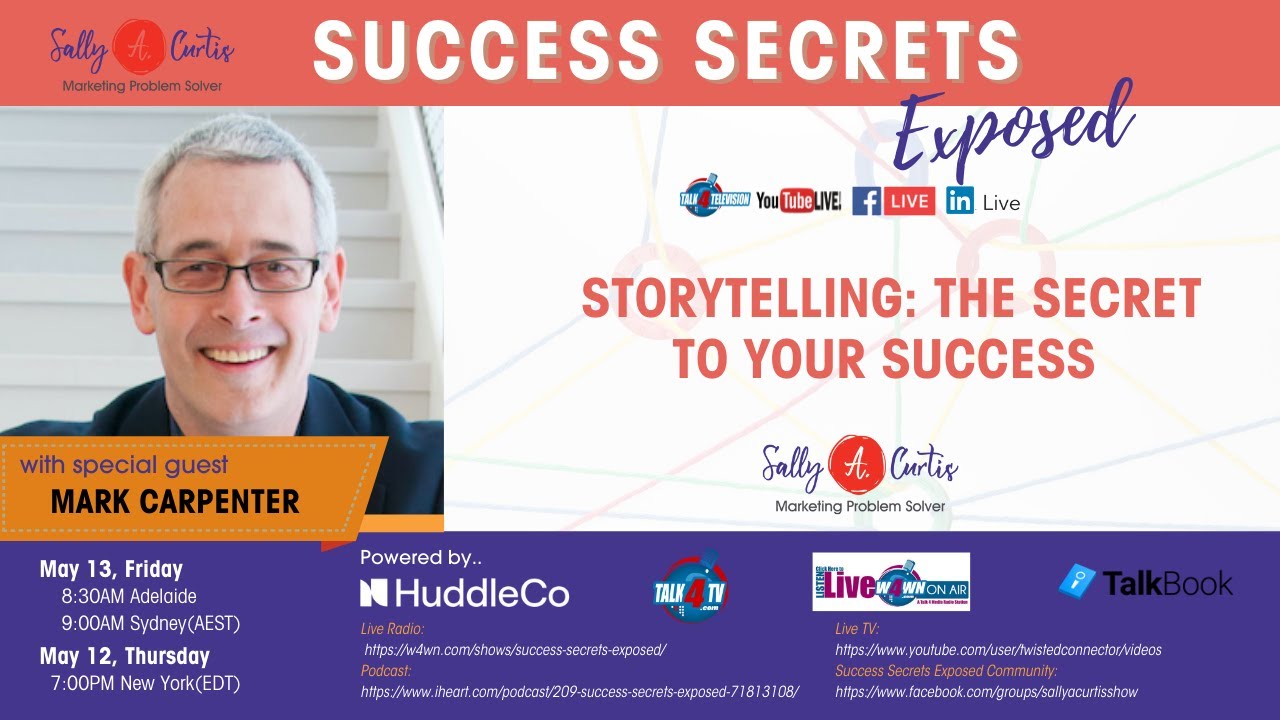
In this episode of Success Secrets Exposed, host Sally A. Curtis interviews storytelling expert Mark Carpenter about why storytelling is a powerful, science‑backed skill for teaching, leading, selling and inspiring. Carpenter shares research that shows brain synchrony between storyteller and listener (Uri Hasson’s fMRI work) and the neurochemical cascade triggered by well‑told stories – oxytocin (trust), cortisol (focus/threat) and dopamine (satisfaction). They discuss why most people over‑complicate storytelling, outlining common pitfalls such as the curse of knowledge, failing to “land the plane” (provide a clear resolution), and lacking a defined point. A simple three‑step framework is presented: start with the end‑point, work backwards to find a relevant experience, and craft a concise 2‑3‑minute story that illustrates the point. Everyday moments (airport shuttle smile, a small‑plane weight‑balance request) are used as illustration of how ordinary experiences can become powerful stories when they contain an emotional hook and a clear lesson. The conversation moves to practical applications – sales teams using stories to break through clutter, safety communications framed around personal stakes, and leaders using stories to build rapport. Carpenter also introduces the “Story Catcher” PDF tool for systematically hunting and shaping stories, and points listeners to his website, LinkedIn, and weekly storytelling tips. Throughout, both hosts emphasize that storytelling is a natural human ability that, when made purposeful, can dramatically increase credibility, retention, and impact.
Chapters
The topics and opinions expressed on the following show are solely those of the hosts and their guests, and not those of W4WN Radio, its employees, or affiliates. We make no recommendations or Endorsement for radio show programs, services, or products mentioned on air or on our web. No liability explicit or implied shall be extended to W4WN Radio, its employees, or affiliates. Any questions or comments should be directed to those show hosts. Thank you for choosing W4WN Radio.
Welcome to Success Secrets Exposed with Sally A. Curtis, where we share stories of challenge, success, and inspiration. Along with practical tips and strategies to move you forward to your success. And now here is your host, Sally A. Curtis.
Good evening and good morning to you and g'day. It's great to have you on another episode of Success Secrets Exposed. Thank you so much for joining us. For those that are new to the show, I'm a content repurposing whiz for speakers, authors, coaches, and consultants. Helping them turn their books into 2 years' worth of social media posts to increase their visibility, credibility, and profitability. I effectively help them turn their existing content into new profits. And today you are in for an absolute treat. I have a very, very special guest today, Mark Carpenter, and we're going to be talking about storytelling, the secret to your success. Now, Mark has been a storyteller since childhood, and he's gone on and actually leveraged this skill and ability into a career in marketing communications, public relations, also as a college professor, and now as a corporate facilitator and speaker. What I'm really excited about is his storytelling became even more purposeful and effective after he spent some time researching whilst he was writing his bestselling book, Master Storytelling: How to Turn Your Experience into stories that teach, lead, and inspire. Now, as a facilitator, consultant, and speaker, he actually teaches us how we can use that process that he learned during his research and writing that book. So I'd love you to please welcome to the show, Mark.
Thank you much, so much, Sally. It's so great to be with you and your audience. I'm privileged to be here today.
Thank you so much. As I shared with you, and we'll tell a little secret this morning, as I shared with you before we came on, I absolutely had a laugh as a serendipitous moment about reading you being a storyteller as a child. Because as I'll share more with the audience, I've never seen myself as a storyteller. But I did have flashbacks to telling stories to get out of trouble, which I also shared with Mark. Rory, my 18-year-old son, has adopted very, very successfully. And we now laughingly call that marketing spin. So I'd love to really explore with you these storytelling elements, the everyday ways in which we can use stories to help to lead and inspire. But I think for me, when we were first talking, the overcoming aversion of storytelling was what really intrigued me because that has very much been my belief, I suppose, in my life, even as a speaker. So I'm curious, because I love a good bit of research, can you share a little bit more about the research that you did for the book and what you perhaps discovered?
Oh, of course. Thank you. And Sally and I did have this discussion before that we're both guilty of the purpose of our storytelling as kids was to try to get out of trouble. That was our way to position ourselves. And for me, it was partially just positioning myself in the family. I always knew that stories worked. You, you go to meetings, you go to classes at university or wherever. Who are the teachers and the speakers you remember? It's those that can tell a great story and a great story that actually makes a point. And so I knew this intuitively. I knew this and I used it all the time. But it wasn't until I got into doing this book that I realized, oh my word, there are, there's science around this.
Yeah.
There's research that tells why this works. And there's been some, there's an amazing body of work around this. And we do share some of that in the book. A couple of things that always stood out to me, No. 1 is work by Uri Hassan at Princeton University. And he, He would connect people to functional MRI where it was tracking their brain activity, and he had one person tell the story and one person listen to the story. And as the storyteller was telling their story, they noticed that the listener's brain waves were very closely following that of the storyteller. But as the story progressed, the listener actually caught up to the storyteller, and their brainwaves started coming into sync. And so they started thinking the same way. Now, now think about this. When you hear a well-told story that you can relate to and you can connect to, you almost automatically feel connected to that person.
Hmm.
That's why, because your brains are starting to fire on the same level because you can connect to each other within that story. So that's one example of how powerful the brain connection is. You asked about overcoming the aversion to that. Part of it is just recognizing that we all tell stories. We've done this. This is how we've learned from the time that we were little. Think about this. You come home from work at the end of the day and somebody says to you, How was your day? You don't just recite a tale of, well, at 8:01, I did this, and at 8:05, I went to this meeting. And you tell the story of what happened in that day. If you can become more purposeful, if you understand what makes a story an impactful story, you can take that natural ability that we have as human beings and leverage that into stories that teach, lead, sell, and inspire.
Yeah. And I think that was what for me was the epiphany this morning. Because as I said to you, I've never really classified myself as a storyteller. I quite happily extract other people's stories. But it wasn't until I was sitting there going, but I have told stories, usually, as I said, to get out of trouble. So we do actually have it intuitively and instinctively as part of who we are as humans. And we do understand it because of course it's always part of life. But like everything that we can tend to do, we tend to overcomplicate it. When someone says you need a great story, for your keynote, or you need to be telling a story when you're doing this. And the minute that rotten blank piece of paper comes out or the sheet comes up on the computer, everything just freezes or stops. So how do we overcome that? But also too, you also talk about the everyday stories. And to me, that was a gold nugget for me because again, when we get into this overcomplicated, we start to make up these great big fandangled stories that are, you know, epics, epic movies instead of the singular movie. So, can you talk us through the everyday elements that actually do help to lead and inspire?
Yeah, because that's one of the most important things. And to your point, Sally, when somebody comes to you and says, you need a good story for this, we do overcomplicate it. We think we need to tell a story. Well, wait, I haven't walked on the moon. I haven't, you know, run across the world or the continent or whatever. I haven't done any of these great, fantastic things. Guess what? Most of the people you're talking to haven't done that either.
Yeah.
What can they relate to most? They can relate most to these everyday things that happen to us. We love stories because we live stories. Stories are just the moments of our lives that actually happen. And these are the ones that are most powerful. An example I use sometimes is I haven't argued a case before the Supreme Court, but I have had an argument with a coworker or a family member.
Yes.
And you can probably relate more to the argument that I've had with a coworker or family member than if I said that I'd argued before the Supreme Court. We can connect in those. And that's what connects us as a species, is these things that we have in common. So my first tip for people who say, oh, I just don't have any great stories to tell, is to start looking for them. Look for the everyday experiences that you have, that you have some kind of an emotional reaction to. Because if there's an emotional reaction to your, to your experience, there's probably a story in there that teaches an important point or an important principle. You may not even know what that is in the moment. There's an experience I share in the book that just kind of popped into my head. I was sitting on a shuttle bus at an airport. I just turned the rental car in. I was on the shuttle bus going back to the airport. I was exhausted. I'd had a long business trip. I was so tired. And I was like, what a miserable day. It's been so long. I'm so tired. Now I have to get on that flight. And all these negative thoughts are running through my head. And I looked across the shuttle bus from me, and there's this little girl about 4 years old, and she smiled at me. And all of a sudden, the day seemed a lot better.
Yeah.
Now, that's a simple, simple experience. And I've used that to point out that if we look for light in our lives, we will find it. But there's many other ways that I might be able to use that story. It's a simple little everyday experience. But these things happen to us all the time. And if we'll take note of the experiences that create any kind of an emotional response in us, it could be joy, it could be frustration, it could be anger, it could be sadness, it could be excitement. There is likely a story there that's going to teach an important principle.
Yeah, I love that. And I love that story because it is literally so simple, but so incredibly impactful. And again, I'm thinking, yeah, that was such a powerful story. But you, again, we sort of try to overcomplicate it. Is it, is it, you know, my head was going, is it, is it just as simple as that? But it, but it was so profoundly, um, powerful. And I was just, I was actually just thinking as you were saying that story, I was on another Zoom call before with a lady who's written a book and she trekked through the high Himalayas and she was with, um, some of the Tibetan villages, and she was talking about her experience of how— she didn't use the word harmony, she used the word harmonious, and she was describing that to me. And I remembered in that moment, as you were sharing that, as she was doing that, because I'm drawn to collaboration, I was actually leaning forward into the Zoom to absorb more of the conversation. That in itself was somebody telling me a story, but is my reflection of that storytelling.
Yeah, it's, again, it's that human connection. It's that moment. She might've had to go to the Himalayas and talk to the Tibetan villagers to feel that, that moment of harmony. But you can relate to that because of the moments of harmony that you felt in other parts of your life.
Correct. Nice marriage. Yes.
And so you can do the same thing. You can take those, those harmonious moments of your life. And share those in a story form with other people who can make the connection to the harmonious moments in their lives.
And I think I'm just having a pickup there when we try to do the, oh my God, I've got to tell a story. It becomes about us. We're making it about us. Whereas in retrospect, it's never about us. It's always about the other person, which as speakers and authors, we know that. But when we get put under pressure and you've got to write a story, all that goes out of the wind— out of the window because we become overcomplicated again.
Well, and I'm going to check you on your pronouns because not only when you say us, you say me, me as the storyteller, because it isn't about me. It isn't about you. It is about us collectively. It's about us together and the connections that we make as human beings. But yeah, you're right. The story's not about me. I may frame a story completely differently with one audience than I will with another. I'll tell the same story, but because they're different groups of people, or maybe they have different backgrounds or different interests or different knowledge or understanding, I might frame it slightly differently with one group than I would with another. Right. For example, if I'm standing and talking in front of a group of people who lead a healthcare organization, I might tell a story that I would also tell to students at a university, let's say students that are preparing to be physical therapists. Well, that's a healthcare environment, but they're in a different place than the, than the healthcare professionals as students. And so I'll frame that story a little bit differently for the healthcare students than I would for the professional healthcare providers.
Yeah. Yeah, brilliant. Can you give us an example of that? Oh
yeah, you're putting me right on the spot with that. Well, I am going to answer that, but I'll tie it back to something that you said earlier, that we often overcomplicate these. Yeah. And there are people out there who say, well, here is the 18 steps to take to create the perfect story. I can't handle that. My brain can't get around that. And so we have a very simple 3-step process that we, that we get people through to tell a story. So actually, I will do this in the context of something that just happened to me last week. So, but proving the point that these stories are everywhere. Yeah. I was on a flight where I had to fly into a small airport. And so we had a very small plane that we were, that we were going on. We all boarded the plane. I was sitting on the 3rd row. And there was only one flight attendant on this plane because it's so small and the flight was short. Well, we get to the point where they close the door and the flight attendant comes on and says, I need somebody from row 2 to move to the back of the plane.
OK.
OK. In that moment, what is everybody on row 2 doing? Exactly, Sally.
They're hiding.
They're looking down, they're looking away. They're not making eye contact. They're turning their headphones up to full volume so they can't really hear. They're all kind of looking at each other. And he came on again and says, come on, row 2, come on, somebody move to the back of the plane. Come on. And I'm thinking, these people are all settled in. They've got their bags put away. They're toward the front of the plane where it's going to be quicker for them to get off.
Yeah.
They don't want to move to the back of the plane. And the people in the back of the plane started yelling, come on, row 2, come on, somebody move back. I looked at the flight attendant and I said, why do you need someone to move to the back of the plane? And he said, oh, we've got a weight imbalance issue where we can't take off until we move a little bit more weight to the back of the plane. As soon as he said that, what happened?
People volunteered.
Somebody on row 2 said, well, okay, I'll go back. And they moved back. What was missing in the first statement of somebody from row 2 needs to move to the back of the plane?
Context and reasoning.
Yeah. The why.
The why. Yeah.
Why do you need me to move to the back of the plane? Why do you need me to move back there? Now, I could use that story to talk to people in a safety environment, to talk to, to explain Why are you putting this safety regulation out there? I could also use this in the context in a banking environment about why we have this banking regulation that we need to follow. But the point is the same about why. Get the why out there in front of us. It's a simple experience. We can all relate to it. And it helps us remember, when you're asking somebody to do something, Explain why. Give them context. And they're much more willing to do it.
Is that why I get, no, Mum, or it's not quite, no, I'm not doing that because I've done the order with the no why, go to the back of the room, go to the back of the plane. And I'm getting the, particularly now because he's bigger than me, definitely need to know the reason why. And doesn't that actually reduce all of the barriers, the barriers, or the heckles that come up in people when, when we've actually done that? Because it Turns that conversation into an us, more of an us scenario than a, I'm telling you to do this. Yeah.
It was interesting, as I was leaving the plane, this same situation. I just leaned over to the flight attendant. I said, next time you need somebody to move, explain why first, and they'll be more willing. And he went, but it was obvious. It's like, it was obvious to you. It wasn't obvious to us. And I think that's one of the barriers that keeps us from doing that, is that we know why we're asking, and we assume that other people know that too. So there's another twist that I could take on that story, depending on the audience, to say, don't assume that other people know what you know.
Yeah, brilliantly said. And I think that also ties into— and we're all so guilty of that, in that we know it so well, we expect osmosis to have occurred. So you understand why I've actually just said that. See, Sally's got the bossy finger out. And that is so true, because we're so close to it, because we understand. And for me, I'm always fast-paced, so I might have rushed through. We just need it because we just need that done. So I need to say it in this many, in this many words. I'm not going to tell a story because it's now become an order. But if it was a little bit more contextual, it had a little bit more of the why in it, there would be less rebuffing and more activity in the direction. So this is where, as you said, it's the inspire, it's the lead, it's the get moving people in the direction for themselves and for what we're trying to achieve there as well.
And my hope is, now that I've shared that story, that your listeners, and maybe even you, the next time you're tempted to just tell somebody to do something, you go, ooh, that flight attendant.
Yeah.
But if I told you, hey, make sure you tell people why before you ask them to do something, you're not going to remember that.
Well, no, that causes me a pause point.
Yeah, you'll remember it as a story.
Yes, so very true. Brilliantly demonstrated. Because if you say that— the minute you said to me, you need to tell people why, I'm getting— my brain's going, and I'm getting that pause point because I'm going, but I don't know why. I probably do, but I can't articulate it. Um, but through a story It becomes much easier, doesn't it?
Yeah, absolutely.
Beautifully brilliant. So, so based on— I know we've covered some of my problems and challenges. What are some of the common problems that you did discover through your research? We've sort of shared some of them. I'd love for you to share some more of those because the examples are brilliant.
Yeah. So, so some of, some of the biggest challenges that we see people face is they say, okay, good. Now I can tell stories. Now I understand I'm going to take these experiences from my life. And I'm going to turn them into a story. One of the problems is something we already talked about, which is they don't contextualize it for the audience. They tell the story from their perspective and in the things that they understand. And what we talked about really was the curse of knowledge. I know this, so everybody else should know this too.
Therefore, yes. So,
they don't think about who they're talking to, and the story does become more about them than about us collectively. So that's one of the common mistakes. Another mistake— we're on an airplane theme today, so I'll use this term— another mistake that we, that we sometimes see people make is they don't land the plane. They, they start their story and they want to tell every single detail of every specific thing that happened in every moment of that, many of which aren't relevant to the point that they're trying to make.
Yeah. And
so I tell people, when you're sharing a story to teach, lead, sell, and inspire, it should only be 2 or 3 minutes.
It
should be fairly concise so that you get to the point. Which kind of leads me to the third mistake that we see people make is they aren't clear on what the point is they're making.
Yeah.
They're telling the story because they feel like they need a story. But if it doesn't have a point, you leave people at the end of that story thinking, Okay, that was entertaining. That was interesting. But so what?
And
so if you're clear on your point, it will help you with the second problem I identified because you'll start filtering out things that don't lead to that point. So you'll land the plane instead of just flying the story around and around and around.
And does that tie into starting with the end in mind that, you know, we all hear that? So how do you get Clarity of the point. So,
yeah, sometimes it's working backwards. And what I mean by that is I'll go to the example that you gave earlier. I've got to give this speech. I need a story to make this point. Well, if you have that in mind, then start just watching around in your life and thinking about what's an experience that'll help me make that point. And the experience will come to you. It's like the universe sends you those experiences when you're looking for a point that you need to make. And so watch for, I know I need a story to illustrate this point. And then if you start watching for experiences that'll help you get there, you've, you've started with the end. And so you've worked backwards to, I need to make this point. OK, now here's the experience that I can tell that's going to lead me to that point.
Hmm.
So that's one of the best ways to do it. Is to just work backwards from your point to what's the story that can illustrate that.
Yeah. Being, and that illustration, I think that's, um, such a beautiful, I'm just writing that down, such a beautiful word because when you think of the word illustrate, um, it's got, it's a storybook. And so, and I know you write children's books, so I've gone, when you talk about illustrate, I look, look for an illustrative story. book and that makes it almost feel easier for me versus tell a story and I think of text. So the two different things and being visual, I suppose that's the visual representation makes that process easier.
Well, and what are we doing with telling a story? If we're telling an effective story, we're painting a word picture. For someone. As I told the story about the airplane, you probably had a vision of yourself sitting in an airplane seat, looking at a flight attendant up the aisle who's got the little microphone and is saying, somebody from row 2, move to the back. You could see that because I painted that picture for you in the words.
Yes.
And that's how our stories create those illustrations for people that they can connect to, to their life. Now, your picture of that was probably a little bit different than the actual picture that I saw. But that doesn't matter because it was more relevant to you because it was your picture of what you created in your life.
And when actually, that's such a great example too, because when you started talking about the little plane, I've only ever been on a little plane twice. And it was a really little plane because it only literally had 4 or 5 seats. So it was tiny. I don't think we actually had an air hostess at the time. But I actually was walking onto that plane and looking at that plane, remembering that I sat right behind the pilot and absolutely loved it because I could see all the dials. A bit of an adrenaline junkie, that's a dead giveaway. But for me, I actually went into my— you're dead right, I went into my experience first and then I worked back with the context that you provided of how that would look like when it was slightly different, when you were painting the picture to be slightly different to where I started with my reality of that picture.
Yeah. And I might have painted even a more clear picture by saying it was a plane that had 2 seats on each side of the aisle and about 20 rows. Well, now you've got a really clear picture of what that plane is, and you can still connect it to your experience. You can take your 4-seater plane and just extend it a little bit.
Yeah.
And you can still relate to that.
Yeah. And we've all been on a plane to know what the air hostess looks like at the front when they're talking on the mic. So that was easier to join those dots, even though in my case, she, uh, he wasn't there. I could put him in that picture.
Yeah.
And be on that journey with you and then take the lessons from that.
Yep, exactly. So that, that's another example of how our brains are starting to connect on those things as we, as we create those, those word pictures, those illustrations for people.
Mm-hmm. And I love, I love, um, the way when you talked about that before of how, um, I'm gonna use the word resonance when somebody's telling a story and the resonance starts to come in. I love movies and I love a good chick flick on a Saturday night and those sorts of things where you sort of, you do, you get encompassed into their story and you go through the, especially if it's a romance, you go through the roller coaster of what's occurred. So you actually are in that story with them. And that was what you were able to also do with the plane story. So I suppose that's a demonstration of how— We all naturally want to have that resonance and have that connection. And obviously, that's why from a marketing perspective, we talk about building trust is when you've got that, that resonance. That's where it's, where people, the audience are getting the feeling. So yeah.
It's really interesting, your point about, about, you know, building the trust. And we think particularly in things like sales and marketing, it's like, well, we're going to establish trust by telling people about our wonderful features and benefits and how, how this product is so superior. Guess what? That doesn't build trust. But you know what does? Telling stories that people can relate to.
Yeah.
And that actually ties to some of the other brain science. Dr. Paul Zak of Claremont Graduate University talks about 3 brain chemicals that happen when you hear a well-told story. And you mentioned even watching movies. You'll see these things happen as you're watching the movie too. When you create characters in your story that people can relate to, The listener's brain gets an increase of oxytocin, which is the trust hormone. And so I trust you more because, oh, Sally's talking about this experience she's had. I had a similar experience to that. The, the person you were listening to talking about that, that connection that they made with people within, in Tibet. Mm-hmm. You're like, oh yeah, this is important to me. I love making those connections with people. All of a sudden, you can relate, even though you may not have been to Tibet doing that. You could still relate to that. And it increased your oxytocin so you could sense that.
Yes. Yeah, absolutely.
The second brain chemical that comes in is cortisol. That comes in when there's some sense of threat. The person's got a worthwhile goal that they're trying to get to, and there's a threat in that, or even a perceived threat. Cortisol has the, the capacity to increase your focus and attention.
Mm-hmm.
That's why you pay attention to stories, because you want to know, how is this threat going to be resolved? How is this problem going to be overcome? And then that leads to the third thing that happens, that when that problem is overcome, you get a sense— you get dopamine. You get an increase in dopamine, which is a neurotransmitter that gives you a sense of completion or satisfaction. And so when those things happen, you feel a connection to that person that you're talking to. And part of it's due to the brain chemistry that's going on.
Can I ask, uh, just from a chemical perspective, the cortisol in the middle, when somebody's, um, they're leaning in, they're more, um, focused on what you're doing because they feel that bit with it being the threat hormone. And then someone says something wrong and all of a sudden you get, you get that hinky feeling. Yep. So we've, we've gone, okay, we've just got that. So that would be a spike in the cortisol where there's a bit more of an alarm. Something's just not quite right there, that hinky feeling. And then they wouldn't get the, uh, in the scenario where we haven't landed the plane, we're actually focused, but we're actually following it and we're trying to work out where it's all going. And then we haven't actually had the last one. Would that be right?
Yeah. And that's where you leave people hanging and going, well, but
I
don't get how this relates to me. So that leaves them unsatisfied.
Yeah.
And so that's the key thing. That's why you want to land the plane. You want to get to that point to overcoming the resolution. I'll go back to your, your romantic comedy movies.
Yep.
You think about this. You relate to the characters. They're having— they build this relationship and it's, oh, it's so nice. And every time I watch one of those movies, because I know this, this process, I go, okay, something's going to happen that's going to create some conflict here that's going to drive them apart. And that's where the audience goes, oh no, this was going to be such a great relationship.
They were so perfect.
If you leave it there, if you leave them broken up, people at the end of the movie go, that was terrible.
Yes.
And so you have to have that resolution at the end that brings them back together so that you can go, ah, at the end of the story.
And haven't we all watched— well, for those that love movies as much as I do, haven't we all watched a movie where, where we have cracked up? And I know I've cracked up at the end because it didn't end the way it Should have done. And I'm going to add to that, I was doing some research around movies and I learned that if the couple at the end of the movie walk off into the sunset together, it adds an extra $50 million to the revenue.
See, movie makers know this. And to your point earlier about how do we get better at storytelling if we're not natural storytellers, watch for Watch for people in movies and books and short stories, in speeches, in facilitated training. Watch for people who are good storytellers and look at those elements. Look what they do to make that effective. The people who are making the films, they know that walking off in the sunset translates to dollars for them.
It's got emotions.
Think about the things that connect people and start applying those into the stories that you tell.
Yeah, yeah, brilliant. Love that. Thank you. So you— we also talk about, um, from a marketing perspective and a business perspective and even pandemic perspective, there's so much clutter, there's so much noise. Everybody wants to stand out. Everybody's often doing the same thing. How does somebody really utilize a storytelling perspective, narrative expertise to make their business really stand out?
Yeah. So I'm gonna start my answer by asking you a question. I'm gonna put it back here. What do marketing and salespeople tend to do when they want to make Their product or their service stand out.
Make it bigger, bolder, brighter, louder, and do the blah blah blah blah blah blah. So yeah, exactly.
And so my first point is, if you're telling a connecting story to people, you're going to stand out just by the fact that you're doing something different than other people are doing. I'll give you an illustration actually. of this. I taught the Master Storytelling content to a group of sales professionals. And the resistance that I got, like right in the middle of this, it was so funny. They were like, well, you can't expect me not to share features and benefits. So I had to tell them, no, I'm not saying don't do that. I'm saying add this to your repertoire because then you're going to connect to the people.
Hmm.
About— and I left that going, well, I hope that landed with them okay. And they seemed pretty good about it when I left.
Yeah.
About a month later, I got an email from one of the people that was, that was in that session. And she said to me, I need to tell you the impact this storytelling had. I have a client that I've been trying to work with for months, and I can't get their attention. They keep saying, well, not now, not now, maybe some other time. And every time I come back to them, they put me off like that. The last time I called them, I said, let me share with you an experience that a client that's similar to you had in using our product and the impact that it had on them. And I just told them a story that took like a minute and a half. As soon as I was done with the story, there was a pause on the other end of the line. And they said, you know what? Write me up a proposal of what this would look like. Hmm. That was a huge breakthrough for that sales representative, because they could now connect to not just what you're telling me the features and benefits are, but how that actually applied in a real-life situation.
Yeah.
And that's how not only do you break through the clutter, but you make connections with those people that you're, that you're talking to. We hear a lot these days about relationship sales. Well, you're not going to develop relationships with people by talking to them about features, products, prices. You're going to make relationships with people by telling them the story of how what you have is going to help them overcome some challenge that they're facing.
Yeah, absolutely. And I love that in, in its simplicity of her just doing her normal thing, it was a minute 30. And it was, you know, profound versus, you know, every other week knocking on the door going, I'm back, I'm back, I'm back, I've still got it, still got it, and all those sorts of things. That's also just, um, I suppose highlighted or reminded me of a conversation I was having with a client of ours who's actually, um, in the work— workplace safety space, which every minute you talk about work health and safety here, everyone sort of does the Oh no, not that again. But something that caught my attention when I was listening to him speak, he said, I ride a motorbike. I pay to be dropped into the ocean with sharks. I understand risk and how to continue living with it.
Yeah.
And I went, and he had, so when you talk, you talked about focus for me, I heard that and went, okay, now you, now, now I'm a bit curious because now there's more to, there's more to the story. There's more to you than just telling me that I've got to have policies and procedures and blah, blah, blah. Yeah.
Think about why people have that reaction when you bring up health and safety. You know, you roll, have the eye roll and the head goes back. And the head going back is almost like, oh no, just kill me now. I don't want to hear any more of this. Because what do we do when we, we promote health and safety protocols? You have to follow these regulations. You have to do this. You have to do this. You have to do this. But what if you said to them, I want you to do this because I know you have 3 children who count on you to be there for them. And I want you to be there for them fully and completely every day when you come home from work. And if we don't do these things, we risk you not going home. fully, completely capable of being with your family. Well, that's a different perspective now.
Yeah.
This isn't about following procedures. This is about my kids. It's about my family and the things that I care about. So we can, we can frame those things in the things that people care about. They'll hear them better. They'll remember them more. And they'll be more committed to acting on them.
I love that we talked about that they will actually hear them. And don't, as parents, there's 2 scenarios that come up. We've got the child that does, mummy, mummy, mummy, mummy, and we're not listening. And then we've got the reverse of that where we go, Rory, I need you to do this today. And I get the, yeah, yeah, yeah, no problem, it's going down well. That child is not going to Went right
through.
Yeah, straight to the keeper. And that's the thing, isn't it? When a story or the scenario is told as a story well, people are actually able to hear it and then actually act on it.
Yeah. That was another bit of research that I found that it was just beautiful. And I can't remember the university or the people involved. So, I'm not going to try to guess and do it wrong. But the study was they had 3 groups of people that they were sharing basically the same information with. One group, they just gave them the information verbally. The second group, they gave them the information and showed it to them in charts and graphs. And the third group, they shared the information with them in the form of a story.
Hmm.
Now, they were expecting that there would be an increase in retention from one group to the next, from the verbal group would be the lowest, The charts and graphs group would be next, and the story group would, would be next.
Yeah.
What they actually found was that the first 2 groups were almost the same.
Oh, really?
Statistically, there wasn't any difference in the first 2 groups. There was a significant difference in the people that heard it as a story. The thing that surprised them is not only did they remember more information, they remembered it more accurately And they found it more credible.
Oh, wow.
When we're trying to build credibility, what do we do? We make charts and graphs. We put all these colorful diagrams.
Yeah,
they actually found it more credible as a story.
And do you, based on that, the scenario of the infographic and the video, is that why you believe from a, well, when video is used well from a marketing tool perspective or a business development development tool. Again, it was video using it in a story, in that story format. So you're actually capturing everything from there.
Yeah. But it's really the format of the story itself.
Story. Yeah.
Because you can use video and it's just like sharing a bunch of information or putting a bunch of charts and graphs in video. And I think it's going to work better because, hey, it moves.
Yes, I was going to say. But it doesn't connect.
Yeah. Like actually telling the story well.
Yeah, yeah, so well said. Now, Mark, you've also got the Story Catcher. So I know that I'm gonna have to jump into this because I knew we'd get absolutely carried away with the conversation, but I'd love you to share your Story Catcher resource that you have with the audience so they can take advantage of that.
Yeah, this is just a downloadable PDF. And it's really to, to get you thinking consciously and deliberately about finding those stories in your life. It's what we talked about earlier, Sallie. I need a story with this topic. OK, where can I find that? Start looking around. And listen to other people and their stories too. You can borrow stories from them. You can borrow stories from the news and from history. And so look for those opportunities. But it's a way for you to consciously think about that And then take the experience and craft it into a story that will actually have the impact that you want. So it's not just, I'm going to tell stories to tell stories, but I'm telling stories with the purpose that I want to teach, lead, sell, and inspire.
Yeah, with the point. Brilliant. And how can people get in contact with you? Where's the best way for people to find you?
You can find me so many places. First place I would point people
to—
Cyberstalk me. That's the first place. Go to our website, master-storytelling.com. So it has to have the little hyphen in between, not the word hyphen, but the little dash that's in between. master-storytelling.com. That's the first place to start. You can also connect with me personally, Marc Carpenter, on LinkedIn, Facebook. But also, we have Master Storytelling sites available on LinkedIn and Facebook. where people can connect. I put a story a week out on our LinkedIn site. And I put a Tuesday tip for storytelling on our Facebook page every week to just give little ideas about ways that you can craft your stories better, just things to think about as you're turning your experiences into these stories that teach, lead, sell, and inspire.
Brilliant. And as a consultant and somebody that goes in to help businesses, obviously, you've talked about that you've been helping sales teams and those sorts of things. Where's your favorite place to be at the front of the room? Who's your favorite audience to be in front of?
Oh my goodness, any audience. But really, it's any audience who needs to teach, lead, sell, and inspire. We do a lot of work with sales teams because that's one of the places that, again, relationship selling has become a really big thing. That people don't want to buy just from anybody based on feature, price and benefit. They want to, they want to connect with people that they feel like they can trust. So that's one of them. Another one is leaders and emerging leaders, people who need to stand up in front of a room and speak to people. Because we tend to stand up, particularly as a new leader, and say, I need to show how smart I am.
So true.
And what we really need to do is say, I want to show you how we're in the same boat. And as a leader here, my job is not to dictate, to drive the boat. We're here rowing the boat together. And that's going to connect you to the people who will more willingly follow you in those situations.
Yeah.
And I would say the third audience is those who are facilitating training, those who are, are trying to teach, lead and inspire by their training. That's another place that we can always increase our storytelling skills.
Yeah, brilliant. And I think when I think of the emerging leaders and even the entrepreneurs as well as the business owners, the story that you shared around the flight attendant moving to the back of the room versus, you know, we need to sort out the weight scenario is a really good— I'm going to use the word leveler or, you know, pin that point Um, of an example of how you can actually be that, that leader, that bossy leader that we're, you know, the Sally version.
Yeah.
Just do it because I said, uh, versus the, uh, we need to move to the back of the bus to sort out the weight, um, scenario. So I think there's huge opportunities there for people to connect with you to get all of the additional tools in a simple form to be able to really make themselves successful in whatever vocation they choose to be in.
Yeah, I'm a simple person, so I like to keep things simple.
And I love that the most. I absolutely love that the most. Any closing words from you as we start to go towards the end of the show?
Every week when I put out my Tuesday Tip for storytelling, I end with the same phrase, and I'll end it with here. Go tell your stories. You have them. Find ways to use stories to help you accomplish your goals, to help you teach, lead, sell, and inspire. They're out there. Your life is full of stories. Use them in an effective way, and they will help you connect to people very powerfully as you teach, lead, sell, and inspire.
Brilliant. Thank you so very, very much, Marc. What we will do just very, very quickly, if we've got enough time, is just go to a quick commercial, Blake, which will give me a chance to do a recap at the end. Thank you so much.
Sounds great.
Are you a speaker, coach, or consultant wanting to increase your reach and impact? Need to save time and leverage your resources? Content repurposing is the fastest way to increase your visibility, credibility, and profitability online and reach your audience with ease. You already sit on a mountain of gold that is highly valuable to your audience. It's in your books, training manuals, articles, and presentations. We regularly turn clients' books into 12 to 24 months' worth of content. Let us turn your existing content into visually stunning bite-sized content tiles. Content repurposing is the easiest way to turn your past into profits. Turn your existing content into bite-sized glitter that you can sprinkle everywhere with ease to attract your ideal audience. Let us amplify your voice, your message, and your impact. Find out more at sallyacurtis.biz.
Thank you so much. So as a very, very quick recap for the audience, and this is Bossy Sally coming out again, you've got lots of opportunities to certainly connect with Mark, and there's lots of opportunities to learn and to continue to grow and have forward movement. So you've certainly got the Story Catcher resource that you can download from Mark. You can connect with him on LinkedIn where he provides a story example every week, as well as tips on his Facebook page. And of course, there is his book, which we've just popped up across the screen there as well. It is The Master Storyteller: How to Turn Your Experiences into Stories That Teach, Lead, and Inspire. inspire. So thank you, Mark, for sharing so much wisdom, laughter, and naughtiness with us today. Thank you so much.
Sally, it has been delightful visiting with you. Thank you so much.
It's been an absolute pleasure. I'm super excited for that, for all the audience can learn, for all that I have learned today, and for all of the practices that I can put into place for myself. So thank you very, very much. We also look forward to seeing you again next week on another episode of Success Secrets Exposed. Please give Mark a warm thank you very much. Thank you very much, Mark. Great to have you.
Thank you.
That's it for this week's episode. Thank you so much for joining us, and I trust that you got some inspirational tips to move you forward. You can find this episode along with With many more on your favorite streaming platform such as iHeartRadio, Spotify, iTunes, and more. See you next Thursday at 7 PM Eastern time for more Success Secrets Exposed with Sally A. Curtis.
More from Sally






The Coaches Results Express: How to Build a Thriving Coaching Business That Actually Works


