Success Secrets Exposed - Telling & Dwelling
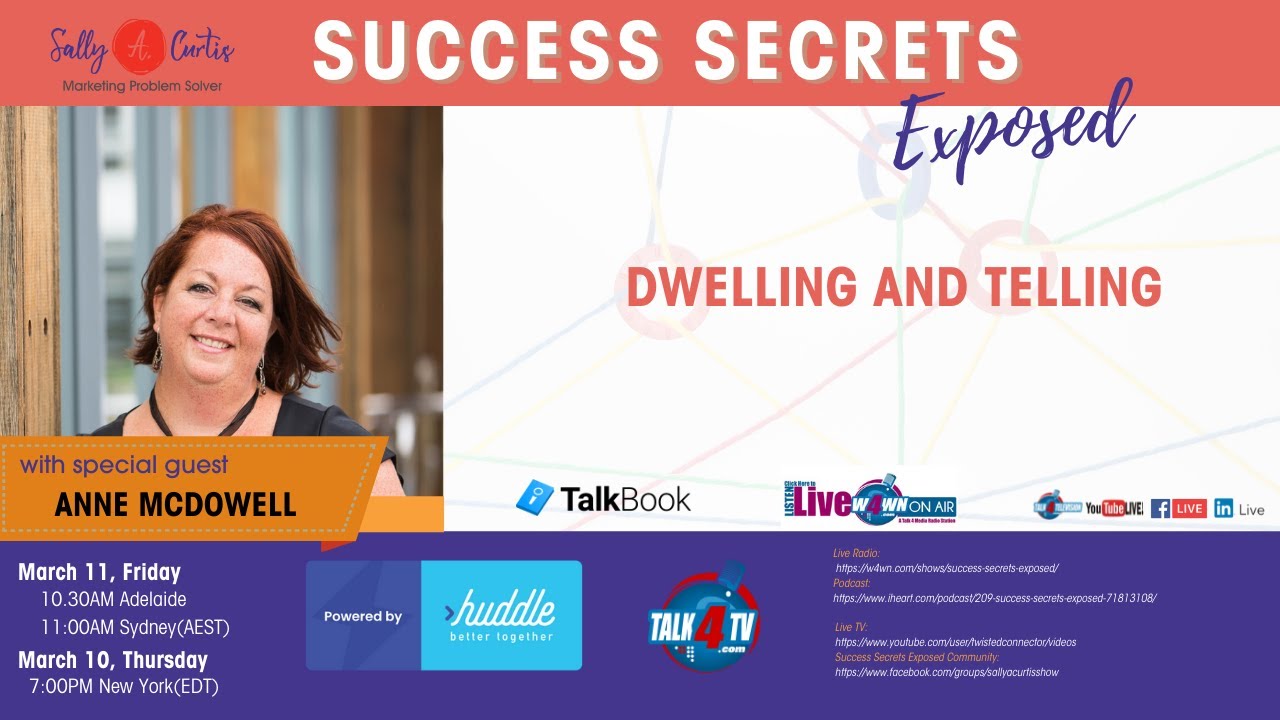
In this episode of Success Secrets Exposed, host Sally A. Curtis interviews positivity and transformation specialist Anne McDowell. Anne shares her personal back‑story of moving from chronic dwelling on trauma—marked by an emotionally abusive relationship, health challenges, and weight‑loss struggles—to becoming a self‑designed problem‑solver. She introduces the concept of "dwelling and retelling" versus "problem solving," illustrating how people can become trapped in a narrative loop that reinforces victimhood. Drawing on Rotter’s locus of control theory, Anne uses the Disney characters Tigger (internal locus) and Eeyore (external locus) as vivid metaphors for mindset states. The conversation explores practical, low‑cost strategies to shift from an Eeyore mindset to a Tigger mindset: time‑boxing grief (24‑48 hours), breathwork, movement (stairs, dancing, star jumps), music, nature exposure, sunlight, journaling ("rant files" and gratitude logs), and small acts of kindness. Anne emphasizes self‑awareness, recognizing emotional states, and deliberately choosing actions that generate endorphins and perspective. The episode also highlights the host’s expertise in content repurposing for speakers and coaches, and provides Anne’s contact information and her book Creating Eternal Optimism as resources for listeners seeking further tools.
Chapters
The topics and opinions expressed on the following show are solely those of the hosts and their guests and not those of W4WN Radio, its employees, or affiliates. We make no recommendations or endorsements for radio show products. The following is a production of W4WN Radio. programs, services, or products mentioned on air or on our web. No liability explicit or implied shall be extended to W4WN Radio, its employees, or affiliates. Any questions or comments should be directed to those show hosts. Thank you for choosing W4WN Radio.
Welcome to Success Secrets Exposed with Sally A. Curtis, where we share stories of challenge, success, and inspiration, along with practical tips and strategies to move you forward to your success. And now here is your host, Sally A. Curtis.
Good evening, good morning, and good day to you all. Welcome to another episode of Success Secrets Exposed, where we have conversations with today's thought leaders, changemakers, and kindred spirits to bring you tools and strategies to help you have forward movement. For those that are new to the show, I'm a content repurposing whiz for speakers, authors, and coaches, helping them turn their books, for example, into 2 years' worth of social media posts. My role is to help them turn their existing content into new profits. But today we're going to be talking with Anne McDowell on being a problem solver, not a problem dweller and reteller. So let me give you a little bit of background on Anne. She is the positivity and transformation specialist Who facilitates tricky one to trip over transformational change through positive and emotionally intelligent decision making. So that's what I'm really going to be loving about that conversation today is that an intelligent decision making conversation we're going to be having. She's also a two times international award winning author of the book Creating Eternal Optimism, Redesigning Your Thinking and Transforming Your Life in. 30 Days, and it's filled with 101 strategies to help you redesign, rethink, and overcome adversity. So please, without any further ado, help me welcome Anne McDowell to the show.
Hi everyone, it's lovely to be here. Thank you very much for having me.
You're very, very welcome. I feel thrilled to be sharing with you today. I know we've had some fabulous conversations and we're very much kindred spirits. spirits with similar stories. Um, so welcome and thank you for joining me.
Delighted, delighted to be here. Thank you.
You're welcome. So I'd love to kick it off with asking you if you could share a little bit of your backstory. You and I are both problem solvers in the essence of what it is that we do, but there's always interesting when that problem-solving ability eludes us for a little while. And you've got a very interesting backstory. It's very similar to mine. So can you share a little bit about how you've of got to being this transformational specialist now. Sure.
Sure. I've been, I've been happy to. So I guess like everybody else, we go through our lives thinking that, you know, we can do lots of different things, uh, in our life. And we've experienced lots of things such as relationships and relationship breakups and, and, you know, as we learn and grow throughout our life. And sometimes we feel that we can overcome any challenges that come our way. And sometimes we can't. So I guess my little bit of my backstory is that I seem to have been sort of like an agony aunt for people throughout my entire life and helping them overcome their particular issues without really knowing it. I was just that friend that, you know, I could be relied on to, to support people through their trauma or their upset or their challenge and often provide a little bit of what I thought was just normal advice. But people seem to keep saying to me, oh wow, you really have a way of solving problems. And gee, that's really great advice. Thanks. And I, and I thought, oh, well, great, I've helped somebody. And then I've moved them, you know, they've moved on and they've done their thing and they've, they've bounced back.
Mm-hmm.
Uh, it wasn't really until I, um, people kept saying it to me that I was called like a, a Pollyanna or a, uh, somebody who looks at things with an eternally optimistic attitude that I realized that people really valued this and they didn't necessarily have those skills for themselves. And I guess I've been a person throughout my own work life and social life where I've, you know, been faced with lots of different adversities but overcome them because I thought about just picking myself up, dusting myself off, and moving on. I didn't realize that that wasn't a very natural thing for everybody. And equally, um, you know, it wasn't until that I, you know, I had been— I'd had lots of challenges throughout my life with some, um, some illness and some, um, some challenges where I, I had a metabolic syndrome, um, polycystic ovarian syndrome, and I put on a lot of weight and I couldn't shift it. And it really wasn't until I was in my 30s where I discovered that Um, I had, I had, I had been told lots of different things and it wasn't until I made up my mind to do something about it myself and created my own thing that things started to really change. Then I managed to lose, um, you know, 50 kilos, which in, in, um, the pounds scenario is around 120 pounds by myself in, in around the 12 months. thing. I kind of did my own Biggest Loser sort of, sort of thing, but created it for me. And then after I had reached a pinnacle of success, I'd been in business for myself, I'd done all of this thing, that I got myself embroiled in a situation that led me to doubt my own abilities to bounce back. I, and I seem to be doing a hell of a vast amount of just speaking right now, but it's kind of leading me to where you're, you're, you're asking me about how this all transpired. I was unfortunately hooked up into an emotionally draining and emotionally abusive relationship with someone about 15, 16 years ago. And as a seemingly intelligent person, I got hooked up and had hit rock bottom, I guess is the only way to describe it. I hit rock bottom throughout this, this scenario. And it wasn't until a girlfriend said to me, you were at such the top of your game before you met him. That I realized how far I'd fallen and how much I got stuck. I got stuck in dwelling in the drama, dwelling and retelling my drama story, and I couldn't get out of it.
Yeah.
And it wasn't until she said that that I realized How far I'd fallen because I was fighting with my intellectual self and my emotionally intelligent self, and it wasn't working, and it was a disaster.
Yeah.
And I'm thinking, oh my goodness, I need to do something. And as a consequence of that drama, um, I realized how easy it is for us to fall into a trap and fall into the mud of what life can throw at you.
Yeah.
So that's why I, I developed these strategies for myself. And it was post then as to why I decided to make it really— um, I mean, I'd always done change work and helping people cope through change. That was part of what I did, but when the ball— when the boot's on the other foot, when you have to pull yourself out of it yourself, that I realized there are so many people on this planet that have things like this happen to them that I really need to be there for people. Yeah. That's why I've identified it as dwelling and retelling Your story.
Yeah. And I'm so glad you took the time and thank you for doing that and sharing that because there was a couple of gold nuggets that was going to come out of that. Firstly, that I'm just going to, just going to pick into a little bit. A, there's that, there's that moment where you've, for those people that are listening, when you're on and trying to find your purpose in life. And sometimes it takes us, you know, we might be 30 or 40 or 50 before we really find that real, you know, that real calling of what we're coming in into. You were that person that everybody went to, that, that you became the problem solver. So that you had the hints all the way through your life that, you know, that was what you were great at. You didn't realize necessarily the ultimate value of it, like most of us don't, because it's so instinctive and so easy and natural for us, whereas for others it's not. So it becomes highly valuable for them because it's not at ease. So for me, it's an acknowledgment of, hey, that's an inner genius element. So I want, I want the audience to sort of recognize that, A, in you, but also potentially in themselves as well. If you're continually getting asked for something, there might be a little bit of inner genius in there. The other thing that I really loved is that when you, you also spoke about when you finally made your decision, when it was around losing the weight, you created your own solutions. You worked out what the problem was and created your own solutions. I also want to acknowledge that because I think a lot of us think that the solutions always need to be external. So we go looking for them elsewhere and in other people, which was my experience around relationship. And we'll get onto that one in a minute. But I also think, you know, it's really great for the audience to recognize that, you know, we actually already do in most cases have the answers, but we may be looking at them with the wrong glasses on, where in your case, we're going to be talking about the, you know, problem-solving glasses, whereas you might have dwelling and retelling glasses on. And I know I had that for myself for years. So, you know, being— having the ability to take those off, or having that one or two amazing girlfriends that just say something to you that cuts like a knife, but enables you to go, oh my God, that is so true. I wasn't seeing it like that. Shifting your perspective.
Yes.
Yeah, for you, for us all to then be able to go, oh my God, that isn't right. How do I need to change that? What do I need to do? You know, just having that, that, that opportunity to, to see it in the reality for the very first time.
Hmm.
So I love that also you talked about being stuck in that, and we are until somebody tips us out of the— I suppose tips us out of that apple cart and sort of gives us that shake. But the other thing you talked about, which I Which I loved because I giggled when you were talking about it because I remember experiencing this for myself, the self-fighting, you know, laying in bed, retelling the story to yourself and saying, I should have said that, I should have done this, I shouldn't have done that. If he hadn't done that, I would have done blah, blah, blah, blah, blah, blah, blah, blah. Please continue. The
mental anguish is something to behold. And, you know, here are some— In my fitness campaign and me going out and doing my 3 kilometers walking every day, my the endorphins would then kick in my brain and and my emotion my sorry my intellectual self was then fighting saying you know what's right you know this is wrong this is this is not acceptable why are you accepting and then my emotional brain is saying oh but you know it's complicated it's this it's that you know and we had gone through a a major natural disaster during this period. And it's sort of like, oh, well, he didn't have anywhere to live. He didn't because of the— we had massive floods in our area and his apartment had been flooded. And so he moved in with me. And then, you know, it was a whole range of a— what do they call it? Unusual incidents that kind of clashed. And then it was me in my intellectual brain talking about saying, you know that this is not acceptable behavior from someone. You know that this is, you know, nothing to do with you. But then my emotional brain is saying, oh, but you know, he's been— he's a victim in this circumstance. He's, he's had all this. And you know, I'm, I'm a problem solver. I'm, I'm this, I'm that. So it was, uh, it was stealth manipulation, which I didn't realize at the time was happening. And this continual fight between my, my two opposing selves was quite interesting. And And on reflection, very interesting on reflection. But, but it was, it was sort of, you know, trying to— there were excuses being made. There were excuses being made from my emotional self to my rational self about why I was in this particular situation and how I could then get to the other side. The, the, the upshot of all that is that the universe works in strange ways.
And, yes.
And, and I think the universe had been telling me things all along the way that my emotional self was refusing to listen to.
Yeah.
I'd been shown signs. I had been shown hints. I had been given, you know, little bits of kicks and, you know, all this sort of stuff. And I my emotional intelligence I ignored and that it was to my peril. And that was the something that I had to, to, and my instincts I ignored to my peril. So it was then about when, when the, when it came really crashing down, apart from all the stuff that had happened before.
Yeah.
I, I was then left emotionally spent. It was that it was an emotional vampire, took everything that I had, and it was the Titanic. And basically I was floating on that surface only just.
Yeah.
Um, and then I had to realize that what my responsibility was in all of that, and that was a hard, hard thing to swallow at the time because again, I had allowed the situation to occur because I didn't listen to my instincts and listen to the messages that were in abundance around me.
Yeah.
So it was, it was then, you know, I, and I, what I did, and I'll share with, with, um, your audience that I cried for 3 months together every day. I was, had the biggest victim pity party I think I could have had. And then at the end of it, my girlfriend then said, She gave that pearl of wisdom, and which, which made me stop and think, oh my goodness, you really need to lift your game. And, and I did. And you said before, in, um, when you were talking about, you know, the power within yourself, that's the key. Yeah. You do have the power within yourself, but what happens in a trauma situation We surrender our power in the situation and we give it to a taxi driver to take us wherever we need to go in our life.
Yeah.
We forget to— we relinquish control and we get in the pity party victim thing, which is, which is totally fine, by the way. There's nothing wrong. You've got to have the emotional outpouring in order to recover.
Yeah.
There's no, no denying the emotional intensity of the situation. You, you must feel. You must. But it's about how long you feel. It's how long you give your control to that taxi driver to take you places.
Yeah.
It's when you decide to get back in the driver's seat and how long that is. Yeah. Grief and trauma and the emotional turmoil from those events is not dictated to by, you must do it at a certain time. Everybody is different.
Yeah.
But it's about when you make the decision to say, I'm not just grieving at this point, I'm wallowing in my grief at this point. And that's when the realization is, is there. And it's, it's not about not being able to grieve for an ex— you know, inordinate amount of time if you've lost a loved one. That's a completely different scenario. Yeah. And that's not what we're talking about. It's about when you've been knocked down with, uh, challenges in your life and you choose to stay stuck in that drama. Just as an example, um, and I know I did it and this is why my, my girlfriend had to tell me, um, she, I, I allowed myself to stay stuck in that trauma for too long when that person wasn't worth the, the angst.
Yeah.
And, and I let it affect me. So in my coaching, I talked to, I've talked to lots of different people. Um, and one person was actually friend rather than a client. And she said she had a story. Everybody does have a story. But then she decided, you know, she was still telling the same story 3 years on, still stuck in that problem 3 years on. And I said to her— and incidentally, that actually transpired to 8, 9 years on—
Mm-hmm.
And I said to her, why would you stay stuck in this drama for that length of time. And that's, that's what we're talking about.
Yeah.
We're talking about being stuck for lengthy periods of time where you, you know, I'll, I'll, I've got something else to tell you about that, but it's, it's very much about choices.
Mm-hmm.
And the choices about whether you continue to stay stuck.
Yeah.
Or whether you choose to move forward.
Yeah. And I think as easy as that sounds, when you're in it, when you're in it, it's actually very hard, which is why I wanted to dig into this conversation. Because I remember, you know, we do— if I look at my own experience, you do have— you hey, I'm in marketing, I can make marketing— as Rory puts it, my son, is that marketing spin, Mum? I can spin you the best version of that story and I can spin it in all different directions because as humans we are evidence stackers based on what our perspective is. So if we're stuck in— and from my experience, when we're stuck in that circling loop, by bringing in all of the other evidence and all of the marketing spin, as Rory puts it, it goes from being sort of like that little, like a you know, 10-cent piece to it becomes this really bigger story and the story gets bigger and it gets more life and, you know, it takes longer to go round and round in that circle so you're actually in it longer and you start tumbling all in these different directions. Yeah. And in my own experience, you talked about, you know, how it became emotionally tiring. I remember being absolutely exhausted and sort of going through almost a burnout but it wasn't a work-related burnout that I'd experienced previously because I was overworking. It was an emotional because of all of the stuff that I kept playing, or I kept trying to keep down because I had my story and I wanted all the other stuff to stay down there because if that came up, it changed my story and I'd got my story perfect. So it's almost, you know, it's exhausting trying to keep all of the balls, you know, under the water when all they want to do is pop up for you to deal with them. And it takes that that special girlfriend or that, you know, that somebody that says something to you on top of the— and I've got this talk where I talk about the feather, the brick, and the Mack truck.
Mm-hmm.
You know, you've all got all of those universal signs and we've got all those intuitions coming in saying something's not right. But if we sort of flick them away and don't listen, eventually the Mack truck comes along, whether that is a health illness or it's your girlfriend slapping around you, you know, driving the Mack truck over the top of you to make you suddenly realize. But it's that point, uh, where we acknowledge the change, potential change of a story, and we acknowledge that we can actually now choose. And it takes courage.
It's such a powerful thing. And what we forget when we're faced with adversity or challenges, we forget that we're in control of things. And this is one of the things that I learned while I was doing my master's degree, um, was about the locus of control. And I've got— it was a concept theory that was developed, um, by a gentleman named, uh, Rotter, W-O-T-T-E-R. And he did it in 1954. And it was about the power of choice and the power of what— how you perceive yourself as being the decision maker, where the power lies in a particular situation. The best way to illustrate it is by the characters, and I think this is probably more of a universal thing that, that people can latch on to, is the characters in A.A. Milne's Winnie the Pooh.
Yes.
And it's also about the Disney characterization of Winnie the Pooh, and I think that it's gold. It's absolute gold. So, um, with, with that, there are 2 pivotal figures within, uh, Winnie the Pooh. Apart from Winnie, but they are, um, Eeyore the donkey and Tigger the tiger. So in terms of the locus of control, I'm going to talk about those 2 characters in particular because they're so easily accessible online that people can find it out, and they probably already imagine the, the Tigger and Eeyore figure.
Yeah.
Now Tigger is what we— is illustrative of the internal locus of control. Meaning that he feels he has control over his life, over his destiny. He's upbeat, he talks in an upbeat tone, he always thinks— sees things as an adventure.
Yeah.
Even when the jaguar comes to town, he looks at going out and meeting the jaguar, and everybody else is instilled with fear about the jaguar, but he sees it as an adventure. But he also bounces everywhere. So it's a concept about mindset, and it's a concept about who's in control of us and how we feel. It used to be called attitude. Mindset used to be called attitude, but now it's— mindset is the, the buzzword of the 21st century.
Yeah.
So when, when, uh, Tigger moves along, he bounces everywhere. He's got high energy. He, he even laughs in an upward tone. He goes, So it's sort of like an up.
Yeah.
Theo is the opposite. He's the pendulum swing. So he has what they call an external locus of control, meaning he feels that the universe and everything in the external environment controls him. He speaks with a downward inflection to his voice. He always looks at the worst side of things, and he catastrophizes over everything. So if in the, in the Disney characterization, he says things like, oh dear, the sky is falling down, it's going to rain on me, I, you know, I go forward, I go backward, you know, that sort of thing. So you've got the polar opposite pendulum swing. So you've got Tigger on the one hand who's upbeat and up, and you've got Eeyore who's down.
Yeah.
So in terms of that, the locus of control is who you choose to give your thought processes and choices to in any moment. So I would like to, to, um, think of myself as Tigger. I'm Energetic, happy for most of the time. Um, but I have Eeyore tendencies.
Me too.
So I'm normally Tigger, and I actually have Tigger sitting always beside me.
Oh, bless.
So that I, I'm reminded of being upbeat if I'm faced with a challenge that I think, oh, okay. But during that time where I was in that terrible space, I was Eeyore. I was Eeyore 100%, and I couldn't get out of Eeyore. So what I, what I do is, from that experience and in my work, combined with all of the things that I've learned over the years, I, I learned to become self-aware.
Yeah.
Not self-absorbed, self-aware. And Thinking about what I've got going on in here.
Hmm.
How am I feeling? I want to articulate how I'm feeling. Am I feeling happy, sad, powerless, angry, concerned, joyous, excited? Whatever the emotion is, I tap into it. I tap into thinking about it. What am I feeling right now? And so am I feeling like Tigger?
Yes.
Or am I feeling like Eeyore? And if I'm feeling like Eeyore, what can I do to get back to Tigger?
Yeah, beautiful.
That's what I do. And that's what I'm talking about, this dwelling and retelling. When I'm in a dwelling and retelling space, I'm Eeyore. When I'm in a Powerful, empowered, make choices, get in the driver's seat of my car behind the steering wheel. I'm Tigger. So am I a taxi? Eeyore. Am I in the driver's seat? Tigger.
Hmm.
So, and that's why I talk about those 2 characters in particular, because they're so easily accessible. Go and watch a Disney cartoon, you know, and all of a sudden You'll see, oh my God, I'm like Tigger, or I'm like Eeyore. What can I do? So in my coaching, I talk about things like, well, if I'm Eeyore, what do I do to get out of Eeyore?
Mm-hmm.
And so it's actually easier than you think because it's like, I'll just go outside into the, into the air, into the sunshine. So like none of what I talk about in my book or in anything else costs anything. They're all free and they're all accessible to us all, all the time.
That's such a— and let's talk about that further. And I just wanted to share, as you were talking and expressing Eeyore and Tigger, I was going back and I was revisualizing as an observer, sort of watching my own mannerisms through that period. And when you talked about Tigger, I sort of think of Tigger as very much as that bouncing. When you've got the bounce in your step, you have more of a helicopter view, so you can see more, you're opportunistic, there's more to see. Whereas when you talked about Eeyore, I sort of, instead of being upbeat and upright, I felt like I was crawling along in the carpet with all of the dust and the dirt and carrying on.
Yes.
We're Eeyore. It's just I'm only focusing on the filth that's in the carpet fibers or those sorts of things. So I found that a beautiful representation that I could really look at myself and, you know, going into that hunched-shouldered and, you know, very inward. But also too, with you, when you've talked about the resources in that time period, for me, I chose to hide in inside and stay away from people. So I was, you know, I was very much inward, not self-aware where we're going outwards. So for me, I knew I could go outside and put my feet in the grass, but I chose not to because I wanted to dwell where I was, which was, you know, concentrating on the dirt and filth and carpet. And so I'd love to explore some of these easy to utilize And easy accessible options with people so they can help themselves trigger and go, Eeyore, let's just go outside and play, and Tigger. So tell us some Tigger opportunities.
So Tigger has, has a multitude of easy things that we can do. It might be turning on the radio, or it might be getting out your favourite CD or MP3 or whatever it is in these, in these instances for these days. Depending on your age bracket. Um, if, you know, you just put on your favorite song that's got a beat to it and get up and dance. And so if you can't go outside, the weather's miserable, or whether, you know, whatever the circumstances, you can actually alter your mood by doing running up and down a flight of stairs, uh, walking around the block. Um, you know, if you've got, you know, staircase, even if you can't go outside, if, you know, if it's snowing or if it's flooding or if it's whatever, then you're inside. Turn on some music, you know, you've got— sing. So there's— with, with the, um, with the endorphins, endorphins are very important for decision-making. So when you're Eeyore, you don't— you're not building any, and you are shielding yourself from, you know, whatever else is, is going on. Yeah. So you don't— you're crunched up. Your analogy about being crunched on the floor and crawling is exactly what Eeyore does in that space in your head, because you can't absorb anything. You can't let any light in. You can't, you know, you want to be curled up in the dark. Yeah. Now, I just want to talk on just on that feeling at the moment for just that immediate moment, because it's okay. It's okay to be upset and feel victimized and feel You know, upset by the situation, whatever that situation is. That's normal. What's not normal is to stay there.
Guilty as charged, because that was what I had done, and we've all done it. So it's a reminder to not do it for as long next time around or something.
Exactly. So, so what I do to transit, transit between Eeyore and Tigger is that I give myself a time frame. Which is also part of the strategy. So let's just say I've had, um, you know, a, a situation where somebody was abusive in the street and cut me off, you know, while I'm driving. Now I have a choice not to react to road rage, um, although I'm sure we've all felt it at some stage, you know, in, in our life with the injustice of what's just happened. Or something happens at work or something happens in, you know, friend's really horrible to you for whatever reason, you can choose to dwell in that for a period of time, or you can choose to draw a line in the sand, feel the feelings for 24 hours if it's a really serious situation, or 48 hours, and then draw a line in the sand and bounce over it. Bounce, Tigger, bounce. Not, not crawl over it. Bounce over it because you need to be able to let all your feelings out. You know, write a list of, of, of all the pros and cons in the situation, or write a letter and then burn it, or, you know, put a letter and go underwater and scream your lungs out, or in the shower, and, you know, or whatever it is that you do to release the pent-up emotion that is from the situation. Then you can— and if it's not that bad and you think, I just feel really down, I just feel really Eeyore today, then you can be Eeyore for the day. But tomorrow you have to be back to Tigger. Mm-hmm. So turn on some music, get some fresh air into your lungs, sing. Even though you may not be a good singer, it doesn't matter. It's just you at home, darlings. Don't worry about who can hear you or not. Sing, because when you breathe in and you breathe in, you know, fill your lungs up, and then you exhale, and you're singing to your favorite song or rapping to your favorite artist, the, the endorphins that you do to breathe in and out creates all these beautiful, lovely little chemicals in your brain, and you start to feel better. Then you can go and do something else more energetic or more, um, you know, go outside and walk around the block. Yeah. And if you've got mobility issues, which I've had from time to time, You know, do it in your lounge room.
Yeah,
open your window and stick your head out the door or something like that. You don't have to if it's pouring with rain.
Shake your hands and that sort of thing.
Yeah, you know, touch your toes a couple of times if you can reach your toes. Well, or start by reaching whatever you can reach and then build up to reaching, touching your toes. Or do a star jump or What it does, it— the, the blood, you need to get the blood flowing.
Flowing. When
we're, when we're, you know, in a, like a, in a tortoise shell, yeah, you know, like hiding, we, we don't have the, the blood circulating through our, our veins properly. So be active, walk up and down a stair, do a star jump. You've got to do something to get the blood flowing. Because the minute, this nanosecond that you do, you'll start to feel better and then you can look at things more objectively.
And I'm just going to pop, jump in there because when we were, when we, when you were actually talking about the breath, I actually did, I did take deeper breaths concentrating. And so I breathed shallower. And the minute I took those deeper breaths, I actually did have a burst of energy. So I wanted the audience, because they've probably done that along with us, they've breathed along with us. Did you actually notice it as much as I did? So, you know, just that, that, that conscious breathing of just getting in a bit deeper into the lungs makes, makes all the difference. And also, how many of us have got, um, housework, uh, playlists? So I've, you know—
Yes.
I've got a housework playlist that, you know, snaps me in. So we know that music can help us. We know that we've got all these tools around us. It's about the The choice.
Choice.
To actually utilize them and get out of the turtle shell, which I loved for way too long. And some of us have done that. And there is ways in which you can become your own best problem solver. And it starts by starting with maybe a little bounce of tiggers in your hands and flopping your hands around and then seeing where the rest of that movement might go just to shift and use the energy.
Exactly. And, you know, look, you need to do things without the fear of other people watching or judging you. So, you know, and if there are other people in the house and you feel like you can't, you know, shake your hands or, you know, without being judged or whatever, then do it while you use the bathroom. Go into the bathroom and shut the door for 2 minutes. Mm-hmm. It doesn't have to be a half an hour, an hour session, just a couple of seconds, really, you know, 10, 20 seconds. So surely you can find some patch where you can go and jump in, in the bathroom or, you know, something so you don't feel like you're being judged by others who may not understand what you're doing.
And that's so true. I'm sorry, I'm sorry to cut you off. I'm so glad you actually mentioned that because even though it's only me and my son at home, there was points— I've got this dance that I do that's 8 minutes which starts with shaking your hands and then you go. And that for me is, you know, I need to shift my energy. I look and feel like an absolute weirdo. I feel great afterwards. But when I very first started doing that, I said to Roy, if you hear some strange music coming out of my office or out of my room, just don't come in. Just don't come in. Just let me— That's right. I didn't want to do it in front of him because I did— I knew I looked, looked, and it was out— it was out of character and weird for me. And so I even had my own, um, thing going on around judgment. And it's my son, and, you know, he's as easygoing and loves weird as much as I do, but I still had to do it in my own privacy so nobody could see me doing it.
Yes. And I, and I think, you know, if you're, if you're in a situation where part of the problem is within your own home and own household and the, the draining energy is within, then you then potentially, uh, would be opening— you would feel you're opening yourself up to judgment by that person that you are trying to emotionally combat, um, you know, in terms of that. So it's, it's about these nanoseconds of privacy and private time where you can be your total authentic self without the judgment. And you just need to find that opportunity. And it might be going to take the garbage bins out onto the driveway, or it might be going into the yard and the garden for 5 minutes, or, you know, something where you have an opportunity to be yourself. And yeah, instead of just walking up and down the stairs, run up and down the stairs. Automatically, then you've got your endorphins flowing, and it's not then an opportunity for somebody then to, to take advantage of the difference that they see, or a different behavior that you're, you're then showing to combat and lift yourself up. from, from wherever, wherever you are. You may not always have an opportunity, and I know a lot of people haven't throughout the last couple of years, of having a lot of privacy. So, you know, just that couple of things, and, you know, running up and down a staircase to and from your house is really no unusual thing.
Yes.
Yeah, no, it's not an out-of-the-ordinary experience for others to see. So therefore, you know, you can do it in complete and utter privacy. So
yeah, beautiful. Thanks, Peter. And that's— and I just wanted to do it as I can't believe how quickly we've gone through time. A bit of a recap. Peter just popped across the screen about how the difference of standing tall and walking forward can make in your own persona. Lifting your head and walking tall can instantly lift a mood. And you were talking about, you know, jotting elements down. I've got— I can't— I haven't got them in my hand, they're in the bedroom at the moment. I've got a peachy colored journal and then my red journal. And my peachy one, on the front of it's called rant files. Oh. That's where all the crap goes when I need to just get it out of my head so I don't keep telling the story and keep saying, I wish I'd said that, I should have told them that, blah blah blah. It gets all written in the rant file, not to to keep for prosperity. It's just out of head, out of mind. And then I've got the other one, which is, you know, more like the gratitude journal or the wins for the day journal.
Oh, that's lovely.
Oh, thank you. And another little tip that somebody shared with me is when you're having a dark day, the shower is always a great place to move. And if you want to create an element of luxury and nurturing yourself, when the water's going over your head, take a piece of chocolate into the shower and have— and feel the essence of the chocolate, how it explodes in your mouth while the water's coming over it. And that's a— that's been a phenomenally, um, shifting self, you know, self-nurturing, uh, tool, as long as again you don't do it too often. Um, all in moderation. But let's, as we sort of wind up today, I'll go back across to you and talk about some of the, the other things that we've recapped. So we've talked about water. Sure. Walking, running up and down the stairs, movement. I'll let you continue.
One of the things that I find is nature is incredible. Like, you know, you just have to look at a flower or be out in a forest, or if you're in suburbia like, like a lot of us are, you know, there is nature outside too, just in the fresh air or the sunshine. One of the things that— excuse me— one of the things that is is, is so meaningful to me is being able to be in the sunshine. Wow. So we are lucky in, in our environment because we have sunshine so much. Um, but it's, it's not about long periods in the sun. It's about the vitamin D that comes from the sun.
Mm-hmm.
So you can go outside and even if it's a cold day and if it happens to be sunny, just shutting your eyes and letting your sun, letting your face bask in the sun is an incredible mood lifter. Talking to a friend, picking up the phone and talking to someone, but not talking about the problem, talking about, you know, other, other issues or other happy thoughts, reading an inspirational quote, going and doing something for others. If you're— if you are experiencing a lot of hardship yourself, going and doing something for another person alleviates a lot of your own issues and helps you put things into perspective. So perspective is an amazing word that I find is— because when, because when we're in Eeyore, we lose perspective. Our problems are overwhelming to us.
Yeah.
And there's no— it's not dulling down or making those problems insignificant because they're not, but it's about putting them into perspective. So there was always a saying I remember I used to feel sorry when, you know, I had no shoes until I saw someone with no feet.
Mm-hmm.
You know, so it's, it's not making your situation illegitimate or insignificant, but it's putting it in proportion to what it actually is. And when we're in it, we find our problems are overwhelming. So we need to do something to put them back into perspective and proportion. Yeah, so that's about what Tigger and Eeyore do in comparison. But, you know, laugh, find something to laugh at, or even giggle. If you can't manage a laugh, just manage a giggle. You know, it makes it— it makes a huge difference.
It certainly does. And for those that would like to get in contact with Annie, we've got a ticker going across the screen where Annie's providing some inspirational tips and quotes, and I'm just going to read it out at this It is gettalk.at/anne. So I'm going to read that again for you. It is gettalk.at/anne. And Anne, how is the best way for people, or what is the best way for people to actually get in contact with you, and where are you most most active on social media?
Well, I'm most active on social media on Facebook. Um, you can just type in my name, Anne McDowell. Um, I can't think of the hashtag off the top of my head, but, uh, the other place is that, um, I have a website address which is www.amc.id.au. Um, and you can then contact me there and get in touch with me. But Facebook is probably where I'm at. I'm also on Instagram, on Twitter, on LinkedIn, wherever I'm there. And you'll see my profile, same profile image that you had before. So you'll be able to see, see me and go, oh yeah,
that's her. And for those that want to find out a little bit more too, don't forget Anne's book, Creating Eternal Optimism: Redesigning Your Thinking and Transforming Your Life, because that has 100 101 different tools, tips, and strategies. Is that right? Do I have that number right? So that's a great opportunity for you to experience and have some of those tools for yourself if you want to start your own self-reflecting and start Tiggerizing yourself.
Lovely.
Thank you so much for sharing and telling so many fabulous stories for us and really using the Eeyore and Tigger analogy because I can really relate to both of those. As we all can.
It's been my absolute pleasure, and it's such a joy to be able to to talk to you today, Sally. Thank you so much. It's it's been a fun fun time. So thank you.
You're very very welcome. And what we'll do now very very quickly is just nip to a quick commercial break, and then we'll wrap the show up for the day, and we'll see
you. Are you a speaker, coach, or consultant wanting to increase your reach and impact? Need to save time and leverage your resources? Content repurposing is the fastest way to increase your visibility, credibility, and profitability online and reach your audience with ease. You already sit on a mountain of gold that is highly valuable to your audience. It's in your books, training manuals, articles, and presentations. We regularly turn clients' books into 12 to 24 months worth of content. Let us turn your existing content into visually stunning bite-sized content tiles. Content repurposing is the easiest way to turn your past into profits. Turn your existing content into bite-sized glitter that you can sprinkle everywhere with ease to attract your ideal audience. Let us amplify your voice, your message, and your impact. Find out more at
Thank you once again. So next week's show is going to be a little bit different as well. I've got Linda coming on to share with you. She's also a marketing strategist similar to myself, but she's a specialist on Pinterest. Now here in Australia, we don't use Pinterest in a great way and we don't use it as much as they do in the US. But Pinterest is a phenomenal tool for SEO and redirecting people to your website, etc. So it's a great lead generation tool when done correctly, and I'm currently not using it correctly, so that's why I've got Linda coming on to share with us some, some tips. So she's going to be sharing how to use Pinterest correctly, and it's perfect for coaches, consultants, and service-based businesses. Because it is actually an SEO driving tool. So that's next week's show. And again, thank you so very, very much, Anne, for joining us and sharing so much with us. I'm sure the audience have got some great tips to move them forward. So thank you once again.
Pleasure. Pleasure.
Thank you. Likewise. Thank you very much, everyone, and we will look forward to seeing you next week on another show of Sorry, on another episode of Success Secrets Exposed. Till then, have a great time. Take care.
That's it for this week's episode. Thank you so much for joining us, and I trust that you got some inspirational tips to move you forward. You can find this episode along with many more on your favorite streaming platform such as iHeartRadio, Spotify, iTunes, and more. See you next Thursday at 7 PM Eastern. Time for more Success Secrets Exposed with Sally A. Curtis.
More from Sally






The Coaches Results Express: How to Build a Thriving Coaching Business That Actually Works


