Success Secrets Exposed - Ways to Increase Your Profitability
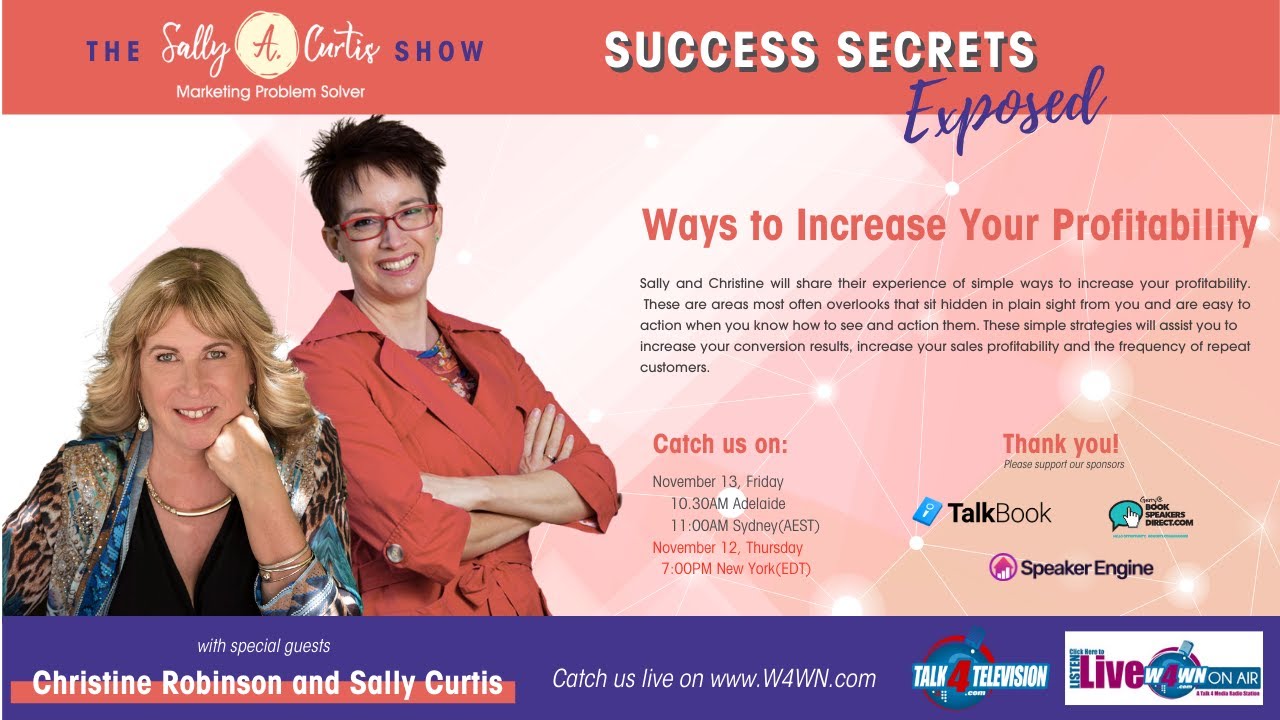
Christine explains how to turn books and content into profit engines for coaches and consultants. She covers audience segmentation, content repurposing across platforms, mining email analytics for high-value leads, and using third-party endorsements to build authority. Small incremental actions in attention, leads, and conversions compound to multiply profitability.
Chapters
The topics and opinions expressed on the following show are solely those of the hosts and their guests and not those of W4WN Radio, its employees, or affiliates. We make no recommendations or endorsements for radio show programs, services, or products mentioned on air or on our web. No liability, explicit or implied, shall be extended to W4WN Radio, its employees, or affiliates. Any questions or comments should be directed to those show hosts. Thank you for choosing W4WN Radio.
Welcome to Success Secrets Exposed with Sally A. Curtis, where we share stories of challenge, success, and inspiration, along with practical tips and strategies to move you forward to your success. And now here's your host, Sally A. Curtis.
Good evening, good morning, and good day, and welcome to our show today. Today we've got a power-packed episode on ways to increase your profitability, so I'm really, really excited to share some tips and some strategies with you today and to enable you to have some quick wins. Christine, who's my guest today, and I both work with similar clients. We both work with entrepreneurs, small speakers, coaches, and consultants. And what the work that we actually do— Christine is a specialist in helping people create and write a book and create a profitable book. So she works on business development and growth through books. For myself, I help clients work with increasing their profitability as it relates to increasing their systems and repurposing their content. So today we're going to give you a bit of a mixed bag of different ways you can increase your profitability. So think of it, think of it as a bag of mixed pebbles, and we're going to give you lots of different pebbles, and it will be then your choice to be able to lay out those pebbles to create your profitable pathway or your roadmap to increasing your profits. The reason I wanted to share this with you today is I had a reflection after talking to a client last weekend about when people get started in business. They're so busy doing things that they actually miss opportunities right in front of them, those opportunities hidden in plain sight. So that's what we want to share with you today. And the reason people miss them is when you're starting out or even when you've been successful for a while, while you're so busy being busy or busy being in activity that you don't actually stop to see the opportunities. Often you don't even know that they're there. So we're going to share some of those tips and strategies with you today. So what I'd like to do now is welcome Christine to the show. She'll be with us shortly, just jumping in now.
Hey Sally, how are you?
I'm very well, thank you. Thank you for joining us yet again today on the show, and I'm super excited to be able to share some tips and strategies with you.
Yeah, it's great to be here. Thanks for having me. I loved it last time, so looking forward to it.
Excellent. So we'll just go backwards and forwards and share some tips and ideas and strategies for the folks on the, on the call and on the Christine, you're going to share some quick wins with us as it relates to authority, results, and trust. So can you tell us a little bit why it's so important to have authority?
Yeah, look, it's all around, you know, we're in the moment right now where it's Sales 3.0. So we went through Sales 1.0, which is all about turning benefits into features, and a lot of salespeople still don't do that, they just list the features.
Yeah.
And then back in 2008, 2010, we had Sales 2.0, which was all about attraction marketing. And nowadays, of course, a lot of people know about attraction marketing. Seth Godin first talked about it, you know, years ago. And so it's such a crowded marketplace out there that you really have to do something to show that you're the leader, to stand up and to stand out for something. So what is it that you stand out for? So the It's Sales 3.0, which I call an art form, ART, which is you have to show that you're the authority, demonstrate your results and build relationships, and then also develop the, the know, like, trust. People only want to buy from people that they like and trust. So that, you know, that's one of the big reasons that you have to show that you're the authority. And then, you know, the other reason is, why not? You are the authority in what it is that you do. You have a unique way of doing the things that you do that no one else does. You are the authority in your experiences, your skills, and no one else has got, you know, maybe they teach the same thing or can help people in doing the same process, but you will do it in a different way because of the, you know, your experience, the past that you've had, the different, you know, people that you've touched your lives, the lives that you've touched, and what have you. So they all make you totally unique and an authority in what you do. So you really have to demonstrate that. You have to show up as the leader. People want to be led. So, you know, who gets paid more, the, the GP or the specialist? You have to become the specialist and become the author of your own content. So whether that's a book, videos, content, a podcast, you know, a radio show, whatever it might be, you're showing up as the leader and the authority.
Beautiful. And I think that's such a big thing. You've just touched on a couple of things there. We've got a couple of questions in the chat that says, how much, how long does it, uh, how much time does it need to be invested in things to see results? So I think from that, I think, um, if you're able to clearly demonstrate, um, your expertise and your results, then that certainly fast-tracks and certainly shortens that time frame. But a couple of things you just touched on there, um, is that people underestimate their life experience, um, as it relates to having that authority, um, as well as being that, that leader standing up in that leadership, in that leadership space. Um, one of the key things I find working with the clients that I do, which is in that thought leadership space and in that speaker space, so they're used to creating content and they're They are experts in their field, so they have moved from that generalist to that specialist. And one of the phrases, things that I have— I'm just looking at it— Mm-hmm. Is the ability to be a sensemaker. And a sensemaker is somebody that helps others, the people that they serve, make sense of what's going on in their world. And the phrase that I've got up in my room says, a sensemaker takes today's chaotic information information overload and turns it into simple understanding chunks that are both meaningful and relevant to the individuals, the communities, or the organisations that they serve. So, that's what I believe, that the authority gives people the ability to make sense and stand in that leadership role for themselves with the experiences, etc., that they've had. So one of the other things that we've, I know we've had to and fro and backwards and forwards on is discovering and understanding your clients intimately. So can you share some of your insights around that? Because that's an area that people miss initially.
Yeah, absolutely. I think it's one of the most important things that people miss. If you don't get this right, you certainly can't get your messaging right. 'Cause I'm an ex-school teacher, so I used to teach high school, but also primary school. And I just think back to those days and the way I teach people to write books is the same as I used to teach how to write an essay or an advertising piece, you know, a persuasive piece of text, or whether it was just a recall in primary school. You need to know your audience. Who are you writing for? Who are you doing the video for? Who are you doing a quote board for? You know, whether you're on Instagram or LinkedIn, who is your audience? What problems do they have and how can you help them solve it? A lot of people are trying to say, you know, buy my stuff, buy my stuff, this is what I do. But it's not— yeah, it's in the face. It's, it's not— it's like when you're walking down the mall and can you remember down Rundle Mall, there used to be the guy, um, he's in one of the other, um, shopping centers now, but he used to be outside the, um, where the lift is, the glass lift, and he always used to be spruiking from there.
Yeah.
And he's just shouting on the microphone. I'm like, oh, will you shut up? And that's what it's like, you know, you're just, um, aiming at the people, the top 3% who want to, who are ready to buy his stuff. Uh, there's 67%, which is your hidden market, who are there, who really need your stuff. They may— they're at different levels of awareness, whether they're aware that they don't have a problem, you know, they're unaware of the problem that they have, then they're unaware of the solution, and they're unaware of you and the solution that you provide to help them get there. So that's what you need to do. It's, you know, it's educating them around that. So you do that through your stories, through your messaging, and And really being intimate, stepping into their shoes, and you have to know them better than they know themselves, what keeps them awake at night.
Beautiful. I've just got another question in the chat box is, how do you determine your audience? So it's very much, and there's a key phrase in there, certainly knowing intimately, knowing their fears, the fears that they happily will share with others. We often talk about 3 levels of fears, the fears that they'll share around the water cooler, There's fears that they'll share with their friends and maybe their family, but certainly some close friends. And then there's the fears that keeps them awake at night that they haven't actually really acknowledged yet. Right. So, we're able to walk in their shoes. And when I'm with yourself working with clients, they say, oh my God, have you been a fly on my wall before? Because we do understand the pains, the frustrations, their fears. But just going back to the questions, how do you determine it? Yes, you need to know those things, but you also need to know their desires. So you need to have been in their shoes, as you were, as you were saying.
But was the question, how do you determine who is that person?
Yeah, how do you determine your audience?
It's your choice. Your choice. That's the beautiful thing about it. That's what's so rich and juicy. And who do you— if you had only one person to serve, who would it be? If you could only work with one person, then you could clone 100 of them. Who would that one person be? It might be someone that you're already working with now. Or it might be someone who you're, you know, like I would just love my current one of my current clients who lives in Colorado. He's about to in it was supposed to come out in November, but it's coming out in January and the Discovery show, and it was with Grant Cardone, the underground billionaire. So he's been working with him during the process of you know working with me, and it's just amazing. I would just love a hundred of him. Well, no. 10 of him. That's all you need, 10 of him.
You've had that experience because you've been in business for a while. So perhaps just answering that question for people that are actually on their journey. Often we start with a calling, and this was certainly the case for me, was to help people like me not make the mistakes that I've made. So bounce off the
shoulders
of giants, as I had the ability to do, but to help people have forward movement without all of the mistakes. So often we actually start by serving a version of ourselves before we find the ideal clients that's more in tune with where we're really, really going. So Christine, you also talked about, so how do you actually, from your perspective, when you've either writing a book or going to write a book or are an author, how do you actually increase your authority through the book writing process?
Yeah, that's a really good question because a lot of people tell their story from their perspective. And once you understand your ideal client or audience or reader or, you know, viewer of a video, whatever content you're creating, once you understand them, then you can bring in stories, you can bring in case studies, you can bring in— it doesn't— and if you're starting out new, then you won't have any case studies. So what I did And probably, I'm sure what you did, Sally, when you first started, you went and did it, you did the work for free. So you did the work for free for someone, so then you had a case study, then you had a testimonial that you can share. But the other thing is you can use third-party stories. So for example, with regards to what I'm currently doing with teaching people how to build 6 and 7-figure businesses from their book, with the book at the tip of the iceberg, a lot of the time I'll be using third-party people, people who, um, people viewing my video or, you know, my content or whatever will recognize. So like Brendon Burchard, Tony Robbins, Russell Brunson, Renee Brown, you know, Lisa Sasevich, people. So I will be using those names and using them as examples. That's what you can do when you're first starting out, bringing— so it's bringing in stories, your own Clients or third-party stories. You can also use metaphors. Metaphors are really good to give an image, and really quickly give an image in someone's mind. We think in pictures, so it's really helping to do that.
Excellent. And we also talked about when you've written a book, so it'd be actually interesting to ask the audience today how many of of our viewers actually have already written books. Because I know you and I have a conversation around that most people have actually already either written a book or haven't written a book, but they've written the content already. And I'll share one of my stories. Yeah. And then you've obviously got that when people have written books. So just while we're waiting for people to pop in the chat if they have or haven't written a book, so just go ahead and pop that in the chat. Christine will laugh at this, but several— what was probably 15 years ago now, before I met Christine, I had one of my mentors at the time say, oh, for God's sake, Sally, you've probably got so much, you've written so much content and you're doing so much stuff, you've probably got 6 books there. Well, I thought he was a raving nutter because people know I actually don't like writing. Give me an audience, let me talk.
I don't like writing.
Either. He said to me, Sally, you've probably got 6 books. And I went, no. But he did refer me on to somebody that helped him out. And I took a 45-minute presentation which was videoed and the small training manual that went with that. And that actually ended up creating a 200-page book. So if I can be an author and write a book, you know, way back then, then they certainly have the ability to do that. People are saying they'd like to write a book. Lots have got lots of ideas written down, so I'll just share some tips on that. And we do have a few book writers there as well, etc. Perfect. So yeah, if you can just share some insights on the repurposing or the writing of the book from that perspective, and then I'll share what we do as a specialist in repurposing book content.
Yeah, just one thing before I go into that. I just want to hold this up. I went to the bathroom— it doesn't matter what it says really— I went to the bathroom beforehand and I had this brilliant idea for my next book. So I just quickly came and wrote it down and went to see if the domain was available to buy it, and it wasn't. So I'll have to work a way around that, but I just quickly You know, you get these ideas when you're in the shower, if I'm walking the dog, weeding, just write them all down. You might never do anything with it, but you, you might well do. So, okay, so back to the repackaging from your book. So what we do is with your book, you know, say for example you have an introduction and 7 chapters or 12 chapters, whatever it might be, you have your content out there and the way you should write your book is that you're really demonstrating the why, the why for the reader, but the why for you as well. And then you really teach, you know, you're explaining a lot of the what, and you can seed a bit of the why, but very few people can get to the— not the why, sorry, the how. But very few people can get to the how without help. They can start doing something, and then you should certainly have things that can help them take one or two steps. But to get from A to B, they really need help to do that. Otherwise, it's going to take them a long time. They're going to make mistakes just like we did when we were trying to do things by ourselves. And so what you do is you take the content is how you're going to help them. And so you can take that content and you can create out of— oh, cookbook, I can just see. Awesome. A video. It just— let's use the cookbook for example. You could create a video, you can do a Jamie Oliver type thing over your kitchen sink and, um, and take, you know, create 12 videos, say for example. And then those videos, you don't have to do all the work yourself, you get someone to edit them. You can have a larger video that might be 10 or 15 minutes, and then you can chop each video down into 3 or 4 or 5 steps. Each of those can become a blog post, an article, it can go on to a guest post, it can become a podcast just like this is, um, it can be onto YouTube, you can chop it down onto Instagram stories, onto Facebook, a whole range of things. Then you can have it transcribed, and I use otter.ai. I used to use rev.com, then I used temi.com, and now I use Otter. And I can actually have— if I'd set this, it could be listening to what we're saying and actually transcribing it as we're, as we're recording it. So you can have it almost instantly. And from that, then someone else, if you've got a virtual assistant or assistant in your office, who can then create written content, you can create memes, GIFs, you can create quotes, images, a whole range of things for all different types of media.
Beautiful. So that's what you've just gone through there is just helping people to get their book started or to refine their book by using otter.com, for example, as a transcription to then collate the written word. Then it's a case of handing it over to a specialist that will help edit that into the correct format with the why, the what, and the how. And that's an area with the clients that I work with, that they often need a hand, which is obviously why we work together, etc., through there. Just to give people a bit of an idea of what the possibilities are, whether you've written an article or you've got a collection of articles that could form an ebook or could in fact form part of your own book. Part of the work that we do is if people have written an article, we can turn that, as Christine was saying, into 15+ visual tiles. And in a lot of cases, if someone's written a book, and as a quick example, if someone's written an 80-page ebook, for example, we were able to turn that into 300 visual tiles. What I might do is give people a bit of an idea of what those visual tiles look like and how you can actually repurpose articles or books into bite-sized chunks. Remember that if we go back to that quote, a sensemaker is somebody that creates simple-to-understand chunks of information. Because we're all so busy at the moment, we need bite-sized chunks, smaller, we don't necessarily want to read lots of stuff. So, I'll just quickly share my screen and just to show you what some of these options could look like, very quickly up on the screen. So, this is just a really, really quick snapshot of some content tiles that we've created. So, this is just obviously one of mine talking about repurposing using your existing content. One of the things that I find with clients that I work with the most is they don't take advantage of what's already sitting around them and where you really can get your quick wins. So one of the ebooks that Christine and I are giving away in our download today, which you'll be able to receive, is one of my ebooks on social selling. And this is just an example of some of the tiles that I've been able to create. Create here in the purple from that ebook. Then we've got a couple of the slides up here in the top corner, and these are also just quick visual tiles that we've created from somebody's ebook. And then the client here that's in the stunning black and pink, she loves writing and sends out lots of e-newsletters each week, and we've just repurposed that content into bite-sized chunks. The key reason we do this, and I'll just unshare my screen, is because thought leaders and clients that we work with, speakers and coaches and consultants, they love ideation, but they get to the point where they get fatigued with it because they're always creating ideas. They're always in that sort of running mode, which is great, but sometimes they want to have some downtime. So with that content repurposing, it gives them the ability to save time and to have some brain space, which is all very important. So if you've written a book, to give yourself some brain space and know that you've got a library pre-created of brand assets, you can turn a book into, for example, those brand assets, at least 12 months, if not 2 years worth of content.
Yeah.
Just to give you an idea. And that's just tiles. Before Christine was talking about videos and all those sorts of things. So, we'll talk a little bit more about collaborative partnerships and I'll provide a couple of examples from there as well. One of the other things that you were talking about, Christine, that I want to jump into next is results, but I've just remembered one of the key tips that I just wanted to also share with a lot of people in the comments is that there's— we've obviously got a lot of writers listening to the show today. That generally means that they have got an e-news or a database that they're sending end users or out to, or they've got subscribers. So I'm curious to see how many, again, if you can just tell us if you do actually have a subscribers list. This is one of the most underestimated profitable opportunities that you are missing out on. Mm-hmm. A number of people have a subscribers list but do not, do not look at the reports. The reports that you get are full of gold, so I just wanted to share with you some of the information that you can pull from your e-news reports, etc. So I'm just going to quickly share the screen again. I'll just flick through that one, come back to that slide. So let's have a look. This slide here, very, very quickly, is a quick example of the data that you can capture from your e-news reports, etc. So if you have a look at the slide here, these are my campaigns or the title of the e-news that I actually sent out. This column here in the middle is the number of times particular people have actually opened the e-news. Over here you can see the names of the people that have actually opened the e-news. So what this tells me, and in the pink squares or rectangles I've actually just highlighted the campaign that was called Plan Your Profits in Advance. And you can see there that Diane's opened it 16 times, Gillian's opened it 16 times, Eileen 13, and then we've gone down to a group of Anisha, Bernard, and Jane that have opened it 7 times, Janet 7, etc. What this can tell you is that that particular e-news has captured their attention It's something in it that has made them curious enough to keep going back to it. So the opportunity from a profitability perspective is that it gives you an opportunity to actually reach out to them, to connect with them, to call them and actually ask them, hey, what was it about that emu that caught your attention? I noticed that you jumped into it a little bit. And that gives you a great place Have a conversation and be of service. Now, I'm just going to share one extra little element of what your reports can also show you. When you get really, really extremely high numbers like these 2 here, where Marilyn has opened Perspectives Count 36 times and Alex has potentially opened it 26 times, it indicates that they've either shared it with others or forwarded it on to a group of people. So again, that's hit home with people. So please, one of the greatest profitability-increasing opportunities you've got is have a look at your report, see who's opening a particular campaign with a level of frequency, reach out and have a conversation with them, pick up the phone, send them a message, send them an email, get into a conversation because through conversations you can actually start to have meaningful connection and actually also achieve conversions and sales opportunities for yourself as well. So let me just jump back out of that, Christine, and then we can jump on to sharing some tips on results. So we've just moved from sharing with the audience that, you know, they've got opportunities that they can create for themselves Also, obviously from a results perspective, that e-newsletter has created a result for them because people have actually engaged with it, they're curious, they keep going back to it. So what are some of the ways in which you suggest people use their results as tips to grow their profitability?
One way is building the relationship, but you just mentioned about reaching out to people, so Um, you know, you have to have something there that, that is of high value for them that you give away for free, that then you receive their name and email address. Or they, you know, for me, a lot of my clients, you know, will have them coming into a Facebook group, for example, where they can add more value. And through that, you can show results that you're getting for people. So it might be people within the group, or it might be You know, you mention it on email or on video, but then it can also be testimonials that you get from people who've worked with you. And you can string the— I've actually just, you know, I've always sent out individual— it's something I've got to do. Mm-hmm. I've always sent out, you know, a page with lots of different videos on. And, you know, I've got my daughter's fiancé, he's a filmmaker, so I'm like, right, you've got to do this for me. And I'm just gonna give him all of my testimonials, and I want him to create like a little testimonial reel and just have some points going through them where we just snip in little, little parts of, you know, each individual's testimonial going through to make it a bit more, you know, interactive. And the other thing that you can do is obviously show like B-roll if you have any footage, any B-roll of you presenting and talking to people. A lot of people want to be speaking more. Well, you have to show that you are a speaker. Get onto video. This is how you're able to demonstrate your results, is just by giving someone a hint. Just before, while I was waiting to come into here, there was something on my Facebook feed for someone that I haven't seen for a long while. And she used to be— anyway, it doesn't matter. She's got some really great top tips and what have you for Instagram. So just— she had a 5-minute video And it was a quick snippet of what you should be doing on Instagram rather than what most people are teaching her. So she's standing out, she's going against what other people are showing, and it's showing how you can really use it. So that's showing that you know what you're talking about, you're not following the crowd. When other people are zigging, you should zag. That's, that's another great thing that shows your authority and your leadership as well. So yeah, the testimonials are a great thing. Case studies are another, bringing in different case studies of you talking about how you worked with someone.
Yeah, absolutely. I think you've touched on a couple of really great things, particularly the lady that you did the video for Instagram. What she's done there is she's actually demonstrated her expertise. You used the word show, I always use the word demonstrate. And something else that I'm always saying to my audience, it's not about buy this, buy this, buy this, buy this. It's about educate, educate, educate. And what she's done is she's zigged, zagged, and those sorts of things. She's actually demonstrated and she's actually educating. She's giving people forward movement even without her being there.
Absolutely.
Because she's there for them. She's been in that place of service. But
it was also strategic as well, because you can't— you shouldn't be doing anything without a call to action.
Yes.
Even if it's just go and take this step, you know, it might not be leading them through to something of yours, but it might be go and do this now, go and do this tomorrow, you know, whatever the step is, give them a call to action. People need to be told what to do. So hers was strategic and it led through to her, um, a free, uh, a free week or 2 weeks in her membership.
But provided, and there's another key thing, a call to action doesn't have to be tacky sales, it can simply be an invitation to join you for something else, to experience something else, to receive a download, etc. I think it's very, very important. We also talked previously about, I call it collaborative partnerships, you talk about third-party endorsements. As it relates to using other people's stories, which you do when you're creating a book, and obviously with your own testimonials, etc., you can use those in different ways from a repurposing perspective. You talk about using third-party endorsements at the beginning of a book to help position you from an authority perspective. Can you just talk a little bit about your version of third-party endorsements? Because I'll come into after that How collaborative partnerships can help people be profitable as well.
Yeah, definitely. A lot of people have, you know, missed an opportunity for having a foreword in front of their book, and a foreword by someone who is, I should say, not are, that's not very good grammar, someone who is 2 or 3 steps or even 5 or 10 steps Further ahead than they are. So for example, Matt's book that we're currently doing at the moment, his foreword is going to be from Grant Cardone. We've just got to pin him down to get, to get it so we can put it in there. But so that's one. But so what you need to do for the foreword is just think, who would I ideally like? And you can only have one. So you start off with the top one and you don't get anywhere there. You kind come down and you, you just come down until you get to the, you know, someone that you would really love. And that really, it's like, oh wow, this is written, you know, they've got a foreword written by whoever X person is. They may or may not know it, but it still adds that endorsement. And when they read through the foreword as well, it's like from a different, a third-party point of view, isn't it? It's from someone else's Perspective. It's like getting a referral for, you know, when referrals come to me, they're already half sold because someone else has told them how marvelous I am.
Touching in on that, that's just triggered one of my rants, and my clients that are on the show today are gonna go, oh no, here she goes again, is actually asking for referrals. We don't do enough of that, and we don't utilize our testimonials enough. So I think utilizing and actually asking for referrals or connection requests is a really great way to increase your profitability. Now,
you know what, sorry Sally, I've just realized I don't actually do it. I've always done it in sales before. I used to be in real estate, and I'd have a house open on a weekend, and I would always come away with 4 or 5 bookings for the following week for an appraisal and what have you, and asking for referrals. I have not done it for the last 5 years.
Yeah, and it's an area that we all struggle with. And for me, it's like you, I've worked in— worked for other organizations before and been in business and development and sales. So it's part of a system, it's part of a process. So when you're asking for referrals, which sounds terrifying and scary when it's your own business. It's about creating a simple scripted process.
Mm-hmm.
So, hey, we've had a great conversation today. We've been able to go through this problem and this problem. Do you know anybody else that has these similar problems that would like to have a conversation with me? And then be quiet. And then you sort of see them starting to think of people visually and you go, oh, I just saw you. Think of somebody and can you describe that person to me? And then you can get into a conversation and away you go. So asking for referrals doesn't have to be as scary. So just on that tip, I'm going to come back to a quick note and then I just want to jump on to the collaborative partnerships. From a database perspective, and you talk about social media and I know you use social media a lot. I use LinkedIn a lot and Facebook slightly less. But just so from a profitability and a way to increase your profitability for the listeners, and people on the show today is statistically, and we all love some statistics, is if you've got, for all of the connections that you've got across your social media, in your databases, etc., and you actually said this at the very beginning, Christine, between 1% and 3% of people that you already know, that you are already connected to on social media, they may or may not be on your database, are actually in a position ready to buy your product or service. They just need to know that you offer it. So this is where I think it's so relevant to get into the, into the conversations with people and have conversations on LinkedIn, etc., or Facebook. Content that demonstrates your expertise, but also humanize it. Actually talk to people, connect with people, converse with them, whether it's in the field, especially nowadays Absolutely. So just going moving forward with the third-party endorsements, obviously that's a very good positioning piece as it relates to building your credibility when you're an author and you're writing your book. And I work with a lot of clients who— and I know we work collaboratively, and I've worked with a number of different people collaboratively— and this is one of the biggest opportunities for you to increase your profit that I really wanted to make sure that people got the gist of today. So Christine and I, as we've said, share similar audiences, so we're able to cross-pollinate and collaborate with each other and share clients. I'm just going to give you another example of mine. I work with another lady, Lauren, who is a brand and content strategist in video form. So what she does is she works with similar clients to me that want to demonstrate their expertise. She's an expert interviewer, but in video. So she interviews them across 6 different types of brand stories that she pulls out their inner genius while capturing it on video. Generally speaking, she creates about 3 hours worth of video, and then those clients go, great, I've got the videos, what do I do with them? And so what we then do is we actually, like you referred to, slice and dice the videos into smaller segments to use on social media, etc. And then those videos we then turn into those tiles. So, from that collaborative partnership, we're able to take 3 hours of content and turn it into literally sort of 12 months or even 2 years' worth of content. So, we're working collaboratively. Now, what happens, and you've also said this strategically, is you're actually leveraging trust. Because Lauren's clients have trust with her. They don't know me yet, but that third-party endorsement absolutely makes the sales process shorter and faster. So let me just give you some marketing and sales statistics. On average, when we're looking for a new client, the opportunity to convert that new client to a sale or be profitable is generally between 5% and 20%. When we're working with our own existing clients and we're working with them and they're looking at a new product or a new offering or service that we have, the likelihood conversion because they trust us, they know, like and trust us, is between 60% and 70%. So that's how it goes from a brand new cold client or brand new client to where existing clients are potentially much more profitable and easier to convert. Now the opportunity from a collaborative partnership perspective is, is that level of trust and that percentage of 60 to 70% is the same because you're the third-party endorsee. So when you work with collaborative partners, you are able to leverage their trust with their client and actually get to a sale faster. So profitable opportunities to look at and consider working with other people in a collaborative manner and cross-
Can I— yeah, sorry, have you finished what you were saying about that
bit?
Yes, I just want to quickly give you some other sort of statistics around that, that there's sort of like 5 different metrics or matrix, depending, you know, metrics depending where you come from, that can really add like quadruple to 32x your profitability. So they are— the first one is attention. So how do you get the attention? So you can either go out there and get organic attention by putting out lots more content, you can get paid, or you can work with people like Sally was just talking about, whether it's a joint venture partner or whether it's collaborative. And then it's converting those into leads. And then when you convert them into leads, then it's It's actually converting them into paying clients. So you have to have some sort of discussion or a sales page, whatever it might be, depending on the price point that you're working at.
Hmm.
The next one is profitability, and then the last one is frequency. And you talked about frequency there. So people, you know, when they come in, they're cold, the icy cold, and then they get to know you a little bit more, and then they become warm, and then they become your hot market, and everything that you put out there. Not everyone, but you've got certain people, whatever you put out there, they will buy. They're a hungry market for it. They know that you've got high value. So when you— a lot of people just look at, I need to get more leads in, but how are they going to get the more leads? They're going to pay for them or whatever. Well, first thing you need to do is get more attention. If you can double your attention and then double the turning that attention into leads by giving them free value, that 4x is the end result. Like, I could do the maths here and show you, but I've got slides and everything for this. But if you were to just increase all of— like, double each of these. So say, for example, your profit was £1,000 and you turned it overnight to £2,000 by adding more value. You're not just charging people more, you're more adding more value. And you sold to them once, instead you sell to them twice in the year. By doing all of that, you 32 2x your business, your profitability. It's huge. Little incremental steps add up to a lot, a lot.
Absolutely, and I think that's the key thing is it's not about doing those great big huge jumps, it's just doing little small incremental bits that all add together. Just quickly, just with the last few minutes, one of the areas that I really wanted you to talk on because I know you sort specialize in this area is, as it relates to trust, what are some of your tips to help reduce buyer's remorse?
I would say you under-promise and you over-deliver. For myself, sometimes it depends whether I'm working, you know, I have do-it-yourself programs where people go off and they can start consuming straight away and working on that. I have group coaching where I work with people. I have one-on-ones. I have clients who are do-for-you— done-for-you, not do-for-you— like Matt, where we, we're starting straight away and we're doing everything by interviewing him and, and what have you. So I think the biggest place is where I've got that group coaching where it's like, here, here, I've paid you the money and it might not start for 2 weeks, so you have to provide them something straight away. You have to get them into action straight away, so then they're not thinking about it. And the other thing is, is just being totally transparent and vulnerable, but having a way of addressing their pains, but then really taking them to their desire, to their dreams, to their aspirations, really sowing the seed, or, you know, giving them vision of what it can be like And really, you know, we love to buy, but we hate to be sold to. So it's, you know, buy on logic and then— sorry, buy on emotion, and then we justify it with logic. So you have to really, you know, go through that and show them how much value. Give them something straight away that they can get started on, get them excited, keep communication lines open. Yeah, if you've got someone else who can get in touch with them, whether it Whether it's another client or a team member. For a lot of people who might be working completely on their own, so it's just keep that communication lines open.
Getting them into that forward movement and keeping them moving forward.
Getting some results quickly.
Yeah, absolutely. So a bit of a recap today. Obviously we've covered a lot and Christine's got a great ebook that she's able to share with people. I've got the resort ebooks there as well. So there's one on collaborative partnerships, there's one on how to increase your profitability, and there's also ones on social selling. So you can find that in the ticker along the bottom that'll come up, and the download resource is at gettalk.at/profit. So you'll be able to— which is just going across the screen now. So as a bit of a recap, of how you can actually increase your profitability and the ways that you can do that. Become a specialist, not a generalist. And the key thing here is specialize in one particular client audience to start with. No, you're not going to be married to it forever. You will have the opportunity to have different clients, but start with one and know them really, really well. It makes making your messaging easier and getting into action and gaining results results and profitability much quicker. It also increases your own confidence, which keeps you excited and spurred on. Know that audience intimately, as though you're a fly on their wall and that you know them and their life better than they do. Become a sense maker. Help people take chaos that's going on in their world and make it simple to understand and relevant to them. Also, Great time saver and a great way to increase your visibility engagement is repurposing your content. Yes, we know as thought leaders and speakers you love ideation, but just just give yourself a brain break. Just look at repurposing that content into the bite-sized chunks, etc., that we showed you. And for God's sakes, if I'm going to have a rant, make sure you look at your report. In your subscribers list. There is opportunities for selling there straight away. Look to your existing connections in your databases, in your social media. Just one of— out of one of my keynotes, 87% of business sits in your network untapped. So look at your existing network for collaborative opportunities to educate them on who you're looking looking for and who you serve as clients, because they can be really good referral sources as well. So obviously they're asking for referrals, and just consider for yourself, there's so many opportunities sitting around you. Just work out which one or two you want to focus on for the next 2 or 3 months, and that will be a great way for you to increase your profits, etc. So just going on to next week's show—
Sorry, just before you do that, can I just Can I just add, if you want videos around that, how to 32x your results and income, and I think there's also a book and slides and everything there as well, if you go to magnifyyourmessage.today, magnifyyourmessage.today.
Excellent, thank you. So there's some other great resources for everyone there to take advantage of today. Beautiful. So, um, sorry, the screen's just flashed up. I wasn't quite sure what was happening there. And so just to recap what we've got coming up next week on the show, we've got Laura Wentworth, who is a lawyer or ex-lawyer who now helps lawyers be more resilient. And she also has a career that spanned 20 years, but she's going to be talking about building resilience, building confidence, Stopping the mind chatter and just being an extraordinary human being. So whether you're a lawyer or not, do join us for the show on ways that you can increase your resilience and be more robust as we move forward into 2021. Thank you very much, everybody, and I look forward to sharing more with you on next week's show. Thank you so much, Christine, as well. It's been a pleasure.
Thank you, Sally.
Thank you.
Take care. Thank you.
That's it for this week's episode. Thank you so much for joining us. I trust you got some inspirational tips to move you forward. See you next Thursday at 7 PM Eastern for more Success Secrets Exposed.
More from Sally






The Coaches Results Express: How to Build a Thriving Coaching Business That Actually Works


