Success Secrets Exposed - Win More Clients Using Visual Models
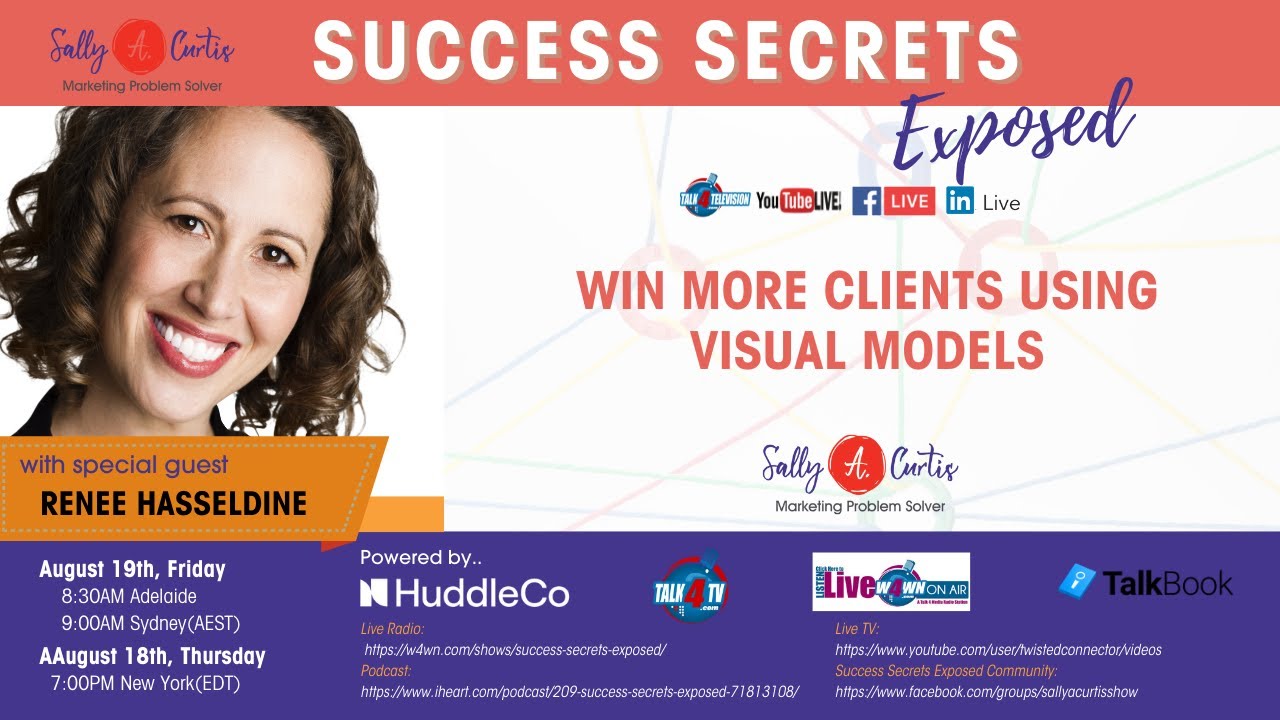
In this episode of Success Secrets Exposed, host Sally A. Curtis interviews Renee Hasseldine, founder and CEO of Think Wrapped, about her award‑winning visual‑model framework called RAPT (Results, Answers, Process, Target). Renee shares her personal journey from corporate accounting to creating a niche business that helps experts, coaches, and consultants communicate complex ideas clearly. She explains the four visual models: the Results model that visualises the gap between current and desired outcomes; the Answers model that lists the ingredients a client needs; the Process model that maps a concise 3‑to‑7‑step pathway using linear or footprint graphics; and the Target model that highlights three key benefits/KPIs. The conversation covers how these models simplify pitching, enable rapid 3‑5‑minute presentations, and can be expanded into workshops, master‑classes, or a 12‑month mastermind. Renee describes her licensing program, the ThinkCraft platform, and how the system has helped clients scale from $300k to $1M in revenue and achieve 50% conversion rates at live events. The episode ends with a special offer: a free copy of Renee’s bestseller “Get Visual” for listeners who use a coupon code. Throughout, the dialogue is conversational, enthusiastic, and instructional, emphasizing the practical value of visual IP for business growth.
Chapters
The topics and opinions expressed on the following show are solely those of the hosts and their guests and not those of W4WN Radio, its employees, or affiliates. We make no recommendations or endorsements for radio show programs, services, or products mentioned on air or on our web. No liability, explicit or implied, shall be extended to W4WN Radio, its employees, or affiliates. Any questions or comments should be directed to those show hosts. The following is a production of W4WN Radio. Thank you for choosing W4WN Radio.
Welcome to Success Secrets Exposed with Sally A. Curtis, where we share stories of challenge, success, and inspiration, along with practical tips and strategies to move you forward to your success. And now, here is your host, Sally A. Curtis.
Good evening, good morning, and g'day to you all, and welcome to another episode of Success Secrets Exposed. Super excited to be sharing with you a very, very special friend today. So we're going to be sharing with you how you can win more clients using visual models. So if you're somebody that's ever struggled to communicate what you do clearly and succinctly, then this episode is absolutely going to be for you. So So for those that are actually new to the show, I'm a content repurposing whiz specializing in repurposing content for speakers, authors, coaches, and consultants. Effectively, I actually help them turn their books or their existing content into up to 2 years' worth of social media posts designed to help them increase their visibility, their credibility, and their profitability, turning their existing content into new profits. But as I said, we've got a very, very exciting episode with a person that is lots of fun, and we're going to be talking to you about winning more clients using visual models. So Renee Hasseldine is the founder and CEO of Think Wrapped, and that's R-A-P-T, Think Wrapped. Think Wrapped is an award-winning system that enables small business owners, consultants, experts and thought leaders to wrap up their complex ideas into very, very powerful visual models. And what this does is it actually helps them streamline, stand out, and scale their business. Now Renee is also an author of 3 bestselling books, Share Your Passion, you've come to the right place, Game Changer, and of course Get Visual. So can you please help me welcome to the show today Renee, who's going to be sharing with us win more clients using visual models. Yay!
Thank you, Sally. Thank you so much for that introduction. I was like, I was reading like, oh, I'm going to clap for this person who's coming.
Yeah, I should hope so. Absolutely. And as I said, everyone, Renee is lots of fun. We've known each other for a little while. We get very giddily excited about all things nerding out as it relates to IP content and business growth. So you're in for an absolute treat today. So thank you very much for joining me. Much appreciated. It's
a thrill to be here.
Now, I would love to ask you a little bit of— if you can elaborate a little bit more on your backstory. So I know that you like nerding out on IP and you get really excited by visual models and you like sort of weird things like spreadsheets. So can you tell us a little bit more of your background, please?
Well, you see, you say spreadsheets and then it's not going to sound so weird because actually in a past life I was, um, well, you know, went to, went to university. I actually did Commerce Arts double degree at Melbourne Uni and I was on track to be, you know, working in— I was actually majoring in accounting and finance. Like, what? How bored would I have been, Sally?
I know.
It wasn't for me, and I learned that pretty quickly. But so, you know, I, I had, you know, so that early, early days of my career were, you know, PricewaterhouseCoopers and IBM Global Services. And, you know, so I worked in that big corporate world and very quickly realized that I don't fit very well into it. I felt like a caged battery hen, you know, like just, it just didn't suit me. Um, I, I wanted to break out and be free and be me. So yeah, so really, I mean, no one ever told me that what I do today is actually a job, right? Like when I was at school, no one said, you know, visual models expert or intellectual property developer. Like that was not on the list of doctor, plumber, whatever the other things were, fireman, right? Like none of those were, none of the, it wasn't an option, right? So I kind of made up my job. Um, and it really just came out of my own passion, my own strengths, what I just naturally love to do. And yeah, that's, you know, in October I'll be celebrating 21 years running this business.
Wow.
Which is crazy, crazy. Uh, and yeah, I, I think Raptor's sort of evolved over time, you know. mean, the, the new— the name of it, um, for example, was a rebrand in 2020. And my business has had multiple rebrands through the years as I've evolved as well, right? When we are small business owners, we kind of are the business. So as we grow and learn and change and evolve, so does the business. So, um, but yeah, it was in about 2017 that we came up with the IP that is the business today. Uh, and yeah, that's what I'm hoping to share this morning.
Yeah, absolutely. So I think that's what's really important about this, and I'd love to use— before we do the big reveal, if you can sort of explain some of the problems that you were also actually seeing that your audience was having. Like you, I work with speakers, authors, and coaches, and we've often got, you know, really great IP that's in our head, hence why we evolve so much and rebrand so often, is we've got this great stuff in our head. We know exactly what we mean and what we saying, but often the translation of that to another party can be quite complex. And we sort of look at them going, but didn't you get what I just said? Because it was really clear to me.
Can't you see inside my brain?
So walk us through some of the experiences you've had.
I mean, I can just tell this from first person really, because, you know, I say 21 years in business, but, you know, for at least the first decade, I, you know, all of my clients came, I was trading time for money as a consultant, right? So all of those clients came from word of mouth, from referrals, and it was easy to be fully booked doing that for me anyway. When it was— I was just trading time for money, right? I only needed a few clients to have a full book, and there I was, you know, done. But I've— I kind of— I was itching to do more. I wanted to— I kind of really wanted to be leveraging my time more. I wanted to be doing more than trading time for money, and I felt like I wanted to have more of a legacy and I wanted to, I don't know, build something that was bigger than me. And yeah, so what I kind of struggled with then was, well, when I'm just relying on word of mouth, it's easy. I don't have to be good at sales and marketing, right? Someone else does that for me. And suddenly, you know, I only had to be good at my job. I only had to be good at what I was an expert in. And then suddenly, you know, I don't think many of us start our business except for the marketers and many, most of us don't start start our business because we love sales and marketing. Most of us start our business because we love the thing that we do. We love helping people do the thing that we do, right? And that was kind of my, ooh. Because you can't, when you, when you kind of want to scale up and run a bigger business that's not just, you know, trading your time for money, uh, you do need to be good at the sales and marketing. And that's where I was just I kind of had a bit of a rude awakening because, you know, I'd been in business already for many years and was very successful and then went, oh, this is harder than I thought. Why? I'm not getting enough referrals to, you know, to fill 100 sales a month or, you know, any of that sort of thing. So that's where I kind of got stuck and realized, oh, I've got to be good at sales and marketing. And then, you know, to me, sales was such a thing that I had this like— I did. I felt really, especially because I was the product, right? So when I was the product and I had to sell, I felt like I had to sell me. And that was where my ickiness came in, Sally. I don't know about you, but like, I don't want to be out there going, oh, I'm amazing. You should totally work with me. Like, you know, if I was— when I was the product, I was like, oh, I just want to spew. Like, I don't want to sound like that. I was sabotaging myself because I just didn't want to do that. I didn't feel comfortable. It didn't fit within my values. That was part of my struggle as well. Then also because what I do is not a one-word thing like a doctor or plumber that someone will understand. If I'm at a barbecue, does it pass the barbecue test? Can I say— someone says, what do you do? When I say I'm a plumber, yep, we know what that means. Yeah. But I say I'm a visual models expert, they're like, huh? I don't know what that means. What does that do? So I struggled to explain what my zone of genius was. I struggled to explain how I help people clearly and succinctly. And, you know, I'd often get into that trap, Sally, like, you know, in those social scenarios or at networking events where someone would say, what do you do? And I'd start talking and then I'd be watching their eyes glaze over and I could feel, I was like, you know, you know that feeling where you're like, I'm not making any sense. And then I'm just keep, I keep talking. Yeah. And I can see I'm making less sense. It's like the more I talk, the less sense I make.
Yeah. And they're starting to—
Someone please get me off this bus.
Yes.
Step away. You know, you can watch the other person. You can see they're just like looking around for someone else. They know. And you're just thinking, oh, what have I done? You know? And it's just such an uncomfortable feeling. Um, and then I guess part of the other challenge of it was, um, you know, in those sales calls or in those moments where I had opportunities to promote or pitch what I do, I'd be like, what do I include in a pitch? Like, how do I pitch? What goes into a pitch deck? What goes into a proposal document? How do I answer? And then second-guessing myself as well. Once I've got everything in there, have I got everything I need in there? And that's—
And like, what can I add? Yes. Yes.
Yes. Oh, I can put this other thing in and what do— oh, and then suddenly there's a set of steak knives in there as well. So yeah, so really, you know, it's the classic story, isn't it, that we create what we most need for ourselves? And that's kind of what I did with ThinkCraft is I used my, my expertise and my skills in creating IP to create a solution for myself and for other people like me who also feel icky about selling themselves because now that I have the Thinkwrap system, I can talk about this system and the system's not me. Yes, I created it, but it doesn't even matter that I created it, right? Because this thing stands alone with or without me. Yeah. And this is why we can license people around the world to use that IP, right? So I can talk about how great this system is and the results that the system gets, whether I'm delivering it or whether one of my licensees is delivering it. It doesn't matter, right? This is a great system. It's a proven system. It works every time. We know it. People love it. It gets rave reviews. And I don't feel icky about talking about the system and how great the system is because it's outside of me.
Yeah, and I have just seen the difference for those that are actually— will have the opportunity to watch the video. You can actually see Renee talking about her experience, and then all of a sudden when she starts talking about her system, she absolutely epiphanies and elevates to a different level. And that— I just wanted to acknowledge that because as entrepreneurs, women entrepreneurs, male entrepreneurs, we all have difficulty selling ourselves at times. Especially when we're wanting to grow. As women, we're beautiful at self-sabotaging ourselves and trying to jam too— my greatest thing is trying to jam too much in, which then just creates more confusion.
To prove that we're worth it, right?
Yeah, absolutely. Whereas when you've got a proven systemized model, which is what you're going to explain today, because that does actually help you win more business, because not only does it make sense to you, but it lands so elegantly and effortlessly with the audience. And what I've also heard as you were talking about your licensees, obviously prior to your licensee scenario and the certification, you were obviously also able to replace or duplicate yourself as a salesperson as you started to grow your team. And this is, this is to me the beauty of the models and why I get giddy excited about it, because there's this whole duplication and replication scenario. So yeah, please continue.
We found a way to clone ourselves.
This is the—
for those of you who don't have the benefit of the video.
Yes, for those that, um, under— yes, now we're getting into the nerdy stuff, but there's a very good reason for it. It's all about business growth and scaling and having fun along the way.
Absolutely. And you know, that was part of it. The reason I left corporate was because I, I wasn't passionate about it. I wasn't enjoying it. It didn't meet my values and needs. And so I'm so committed to making sure that when we build our businesses, we build them around what we're passionate about. We make sure that we're in alignment with it. We can thoroughly enjoy it. And so if we don't love sales and marketing, let's find a way to love it, right? And this is, you know, I found a way to love it by creating this system.
Yeah, brilliant. And do you want to go through, do you want to talk about the system now or do you want me to ask you another question? Should we dive in and give them some context around the system?
Should we give them some context?
Yeah, let's.
All right, great, great. Let's do it. I'm ready to share.
Beautiful. Not sure whether you need to push the buttons or whether Juan's going to pop that up for us. There we go.
There it is. Thank you, Juan. All right, so, um, what we want to do when we're explaining our, our services in an expert-based business is we want to take all of that genius from our brains and put it into 4 categories. And if you're watching the video, you can see on your screen, the 4 categories are represented by this acronym RAPT, right? So this is going to help you remember the 4 visual models that you need to create a complete system. And you can use this system for your service delivery, for pitching, for proposals. And actually, it should really become the basis of everything you do in a service-based business. Yeah. From onboarding new team members to your sales and marketing, all your content, you know, you're working with the fabulous Sally, create all your content around your Think-RAP system. Sally can repurpose it. Amazing, right? It's a match made in heaven. So the RAP system, the first model you need to create is the results model. Now the purpose of this model is to show your audience what is the gap between the results they're currently getting and the results that they want, right? Because human nature says when we see a gap between those 2 things, We want to close the gap, right? So we want to show our audience, we want them to, without telling them that they have a gap, right? This is the power of the model is we just show them as the expert that this is what we've seen, that these are the scenarios they get. Let's have a look at a couple of examples. So for example, this one here uses a hero's journey style of results model where you can see we've got dollar signs here to represent how much revenue, we've got clocks there for time. So those KPIs can be represented by icons. And we want to make sure as well that every— there should be no 2 sets of models in the world that look the same, right? Yeah. They should always be on brand. So you don't want your shape choices to be the same as somebody else's shape choices. You know, choose shapes that are on brand for you, that make sense. The metaphor makes sense for each of these models. So that your models are going to look very, very different to your competitors' models, right? So that you are really going to stand out. This is a way for you to demonstrate your value proposition, your unique selling points as well, right? So this will make you stand out. So don't look like everybody else. Don't be beige.
Definitely don't be beige. And I think these first models really help to demonstrate the journey that the journey and the transformation that the client's going to go on. I've got that right.
Yeah, absolutely. Absolutely. Because as you, um, you know, as you're presenting this model, your audience will go, oh yeah, I do feel like a bit of an adolescent in my business. And I would quite like to go up the top there and be up at the director stage. And so the person that's presenting this, I'm going to go to them and say, show me how to close that gap. You've now shown me my gap. Like, you haven't told me that— you haven't told me I'm wrong. You haven't told me that I have a problem, but I can see I have a problem just by looking at this. And now I do know how to fix it.
Yeah.
So it also takes away that, you know, that— I mean, no one wants to be told that they're wrong, right? No one wants to be told that they have a gap. But we're quite comfortable with doing a self-assessment and going, oh yeah, I have a problem there.
And having that insight.
Yes, absolutely, absolutely. Here's another way to show a results model. This is the results matrix. style. So, um, you know, if you, for example, if you work, um, B2B or if you are working in the corporate world, this is probably a more appropriate shape than Hero's Journey. So the Hero's Journey kind of style one we had a look at previously, that one is great if you're working B2C. So you've, you know, maybe you're a life coach or something like that, or if you're working with very small business owners where the business owner is the business essentially, because that hero's journey kind of does apply in that scenario because they are the business and it really is all about that individual. So, you know, you can kind of go hero's journey because that really plays a role. But where you're dealing with a much larger organization, a results matrix is probably more appropriate because it's not about any individual in an organization, a large organization. So a hero's journey might be a bit weird. So results matrix here. So essentially what we want is Worst case scenario is that bottom left, best case scenario is the top right, and then you're kind of in-betweens are the other 2. And here we can use, you know, basically we're using icons in this scenario, um, just, just sort of add a bit of an emotive kind of element. They're aesthetic, but also they add a little bit of feeling to, to the model. Yes. Um, and, and again, we're on brand here as well for this client. So yeah. Essentially, what we can see here for, for this client is that for, for his audience, there are 2 things that make a massive difference in the results that they're getting. One is about whether the individual— individuals inside a team are thriving or they're stuck. And the other is, what is the team culture like? Is it a toxic team culture at one end, or is it an aligned team culture at the other end? And then depending on the combination of those 2 things will give you the outcomes that you know, possible within a team environment. And then you can see how the team is performing. Any questions on that, Sally?
I was just gonna say, so from, for those listening to the radio, the radio side of things, the hero's journey very much looks like a mountain. So it's a triangle. So it's a mountain, the hero's journey from one destination to another. And when we were talking about the quadrant, that's very much like your, I was going to say your Noughts and crosses, but it's not quite like that, but it's your 4 quadrants, your normal thing that we've all seen before where you've got your 4 boxes and you, as Renee said, it highlights what the issue is. So the visual models are representative of the experience that the clients and/or their clients are having. So please continue with the next one, which is A.
A, and A is the second model, is the Answers model. So this one is for you as the business owner, as the expert. What are the answers that your audience is seeking? So to create this model for yourself, what you want to really think about first is what are the challenges, the problems, the obstacles, the reasons my clients aren't already successful? So, you know, if you think, reflect back to that first model, right? Why do they have a gap? What are the things that they need to master to close that gap? And that's what comes into the answers model. And You know, we've got a little puzzle piece there because this kind of does represent— these are all the pieces of the puzzle that your audience needs to create the big picture of the result that they want. So the answers model is these are all the things that they need. So in this one, you want to also have— you want to be using nouns. These are things, right? Think about it as if you were writing a recipe for your audience about what they need. This is the ingredients list. You need this, you need this, you need this, you need this, right? So that's what goes into the answers model. And, you know, this is a metaphor here. So this is Sally Stable. She works in the tourism industry as a marketing strategist. And, you know, her results model, we actually did have a mountain. And, you know, we had that metaphor of climbing the mountain because that's what it is like to run a business. And then for her, for the answers model, we've got, you know, this guy with a backpack. And all the things that you need to be successful have to go into the backpack. So these are all the things you need in your backpack. Right. You need promotion, distribution, packages, visitors, objectives, gear, right? These, you could put all these things in your backpack. If you forget one of these things in your backpack, you might be in trouble if there's an, you know, you won't make it to the top, right? Right. So that's kind of how we play around with that. Uh, and then this one here. So another example, this is an IP lawyer and, you know, for her, for her ANSYS model, what we've used is this metaphor of an umbrella, right? Because you, and you wanna make sure you don't have any holes in your umbrella. No leaks, no leaks in your IP protection, right? Make sure your IP is bulletproof. So, so, you know, that's why we've used the umbrella there for her. Any questions on that one, Sally?
I was just gonna say, from it, that's just really, really surprised me because when— and I just really want to clarify for people— when we're thinking models and having— this is why it's important for everyone to be able to rewatch the video on YouTube— is that the Answers model was so on brand. They weren't your boring circle, square, triangle. They were on-brand visual models that were very, very representative of the business. So the first one was an individual. It was a person with the elements that needed to go into the backpack, as Renee said. And then the umbrella was bulletproofing or rainproofing, waterproofing your IP. So the visual models themselves are Quite extraordinary. So please continue now to P.
Thank you, Sally. Uh, and so yes, the 3rd model is the process model. So, you know, many people who are listening or watching may already have some version of this. You know, you may have heard about, oh, you need to get a signature system, right? But essentially this process model is how do you get your clients from A to B? This is how do you work, right? So you probably have some version of this, even if it's not explicit. You know, when a client comes to you, you do this, then you do this, then you do this, then you do this. So turning it into a model is just making it a bit more tangible and visible for your clients. So it's more memorable. And so they can latch onto something and feel a bit more safe and secure inside this process, right? Because when we see it solidified into a visual model, we trust it more, right? Yes. It makes more sense. We know that you're not just, you know, for me anyway, when I'm going out and engaging an expert, I want to know that they know what they're doing and they've got a plan. Right. I don't want to feel like they're just making it up as they go and they're just kind of like, maybe this will work, trial and error, let's see what happens, right? That's so uncomfortable for me because I feel like that's going to cost me an arm and a leg and may or may not work.
Yeah, and I think too with the process model, just hearing it described as the how-to, and when you've— when it's easy for somebody to grasp on and it's memorable, it's actually easy for them to tell the story of something to somebody else. So if there's 2 people in a business, it's easy for them to explain to the second person, which means there's more buy-in. And then that person's actually just sold themselves in the process because they've been able to easily explain it as well. So that's the beauty of that model.
Absolutely, absolutely. Um, so with, with the process model, you want to kind of be looking at between 3 and 7 steps in your process. So if you have a 15 or a 27 or a whatever step process, Chunk it down. Put some of that, put some of those steps, group them together into categories because, you know, we're all, we're all way overstretched in our, in our lives. And what feels comfortable to a buyer is between 3 and 7 steps. You make it too many, it's going to feel too overwhelming. And, you know, they're already in enough pain to feel like, I need help, someone help me. But they don't want to feel like it's going to be a lot of work and a lot, you know. So—
True.
Simplify it into between 3 and 7 steps to make your audience feel safe and comfortable. The other thing I would say here as well is we want to use verbs. So these action words and doing, if you've forgotten what that one is from school, we want to be using verbs. This one here on the screen, Melanie Colling is the queen of alliteration. And what I mean, so, you know, we have all of the words starting with the letter D here.
Yeah.
Our brains are so funny. Our brains think that if something— if there's alliteration, if there's an acronym, if there's rhyming, we make this not necessarily true assumption that it must be more true, it must be more real, right? We kind of just— I don't know why, but our brains play that trick. But, you know, so if we can, it's nice to do that. But I also would say don't force it. If you're trying to force everything to start with D and then you make up a word that starts with D, or you kind of trying to stretch the meaning of that word and then you have to explain it, you've kind of broken the whole purpose of having a model in the first place, which is to make it really clear and simple. You want your audience to look at it and know what it means. If you have to explain it, then you haven't got the words right. Use words that you— and language that your audience is already using for your models.
So everyday language is, is what I usually say. Is that everyday language or a word you've made up? Yeah, brilliant.
Yes, I mean, and everyday language is going to be different for different audiences, right? Like, if you, if you're in a scientific world and your audience is always using this scientific language, then everyday language for them will be very scientific, right? So that's okay. But if, you know, you're working with laypeople out in the, in the, you know, in mainstream outside of the science world, then you're going to need to sort of dumb it down a bit, right?
Absolutely. Brilliantly said. Thank you.
Yep. So, okay. And the other thing I'll say about this process model as well is that we want to be thinking about— and I'll just bring another example up while we do this— is we want to be thinking about shape choices. And here, really, we want the shape to be linear. We want to show, you know, we know that the shortest distance between 2 points is a straight line. And We, you know, we want to make sure that our clients don't feel like they're landing in a foreign city they've never been to before. They get into a taxi and the taxi driver's taking them around the long way, right? Because often if the clients are buying our services, our zone of genius, our expertise does feel like a foreign city to them. We don't, you know, they don't understand it, which is why they're engaging us. Right. And so, you know, we want to make sure they feel safe. We want to know that we want them to feel certain that We are taking them on the critical path, right? We're not throwing in extra stuff that they don't need. And we're not confusing them by going around the block and going the long way, like, you know, a taxi driver who's just taking the piss, right? We really just want to make sure that we're giving them what they need.
Yeah.
So that we can guarantee results, right? So that linear shape shows them that we are giving them what they need in the shortest possible time.
And just for those, again, this linear shape is beautiful footprints that have actually— if you imagine footprints going up the screen like you would see footprints on the beach, this virtual model, again, it's not boring circles or squares. We've got beautiful footprints that are indicating the journey and the steps here. So this is fantastic. Thank you, Renee.
Pleasure. Great. And the 4th and the final model is the target model. So the purpose of this model is to show our audience what are the KPIs, the key performance indicators, the benefits that we are targeting, right? This is answering the all-important what's in it for me question. Yep. Now, you know, we talked about in the previous model, for the process model, that we want between 3 and 7 steps. The target model, though, we really want 3. 3 is a great number of benefits. And The reason for this is imagine yourself standing up pitching to a potential client, or the other scenario could be you are doing a speaking gig and you're presenting your models because they are education. This is the great thing about it is when you create your models like this, yes, they sell. That's a bonus, but not in a salesy way. They sell in a way that allows you to educate and add massive value to your audience every single time. The cool thing is like you can use this 4-model system, yes, for selling and all of that stuff, but you can also use it to run workshops, to do speaking gigs, to do webinars, all of those things. Um, you know, this is basically— I use this exact structure for every single gig I do, right? I just, I don't— I use that, I just repurpose the same thing and I can add angles and, you know, bring in context from the audience that's in front of me, but I don't need to reinvent the wheel. And, you know, it's really Yes, it's so great for repurposing content like, you know, like Sally does. And
it saves a lot of time in your presentation, preparing for presentations, etc. You don't have to rethink and overthink and rethink and refine. You just provide education.
Exactly. So this target model is the last one that you present. And so yeah, the reason I was bringing up that context of, you know, imagine you're up on stage is the target model is the last one that you present. And what works really well in terms of the rhythm of the presentation is for the target model for you to say, and when you follow my step-by-step process, these are the benefits. You get this, you get this, you get this. Boom, drop the mic. 3 benefits. If you throw in 6 benefits or 7 benefits, the energy starts to wane, right? You say, and you follow my step-by-step process, these are the benefits. You get this, you get this, you get this, and you get this and a set of steak knives. And oh my goodness, now I feel awkward as the presenter and so does the audience and it feels icky. Am I in an infomercial? What is going on? Right. We don't want that scenario. It just doesn't feel good. So 3 benefits in your target model is ideal. Sometimes clients will stretch it to 4 if they can really convince me it's necessary. But really, if you can stick to 3, would be awesome.
Yeah. Fantastic. Oh, wow. I love it. Sorry. Yep. Keep going.
So this is coming back to Sally. So the example on screen is Sally Stebler. So coming back to, we had the backpack for her earlier, right? So marketing in the tourism industry, and for her, we've just got, we've got the flag at the top of the hill. You've made it to the top and boom, there's your flag, and you've got more visitors, more time and energy, you hit your revenue targets. Boom, boom, boom, done, right? 3 benefits. Yeah,
fantastic. That was brilliant. So now you've shared with us the models, you've given us some great education around, you know, what are the key elements of each of models, how does— and now put the beautiful bow on it all, beautiful— and how does this help somebody when they're actually in that pitching process? Now, I've obviously heard the benefits because obviously when you get to the— you've gone through the whole process, it makes a lot more sense. But walk us through what it really does from a pitching perspective and how to craft it using the visual model.
Yes, yes, yes. Well, so The great thing is that what happens with these 4 models is they answer all the decision-making needs of your audience. So the results and the target model speak to our emotional decision-making, right? We are emotional beings. We all make decisions based on how we feel, right? So your audience is doing that too. And the results of the target model will speak to that emotional decision-making need. But then, of course, we justify our decisions with the logic, with the rational stuff, right? And the answers in the process model will do that. So essentially, if you present your solution to your audience in your pitch decks, in your proposals, in, you know, speaking gigs, if you present these 4 models in order, what you are giving your audience is an emotional-rational sandwich with all of the information they need. Because the results and the target model will answer the question of why do they need you? Why should they work with you? The answers model answers, what do I need? And the process model says, how do we do it? Right? So you're answering everything they need in 4 pictures.
Yeah.
Which is cool because it means if you've got, um, 5 minutes to jump up on stage, right, you can present 4 models in 5 minutes. Actually, the record for one of my clients is 3 minutes, 20 seconds. I kid you not. You can present those 4 models in 5 minutes. But also, it's like this concertina, right? You can imagine that you are expanding. You add more storytelling, you add more detail, you add more, you know, you just elaborate. You can give examples, you can add in, you know, building exercises. And it's a half-day workshop, or it's a, you know, a 2-day workshop, or it's, you know, add some implementation in, and it can become everything, right? It can become the basis of a 12-month mastermind program, right? Yeah. It just, it really is this kind of like a concertina, right? Just let it expand and contract. So, you know, I give an example. I probably can stop sharing, um, that now too. Oh, actually, before I stop sharing, I'll just let this one show because this is showing what it looks like in a proposal document. This is a client's proposal. So the first one was the results model, answers model. This is a process, and then you'll see the target model next. Right. And then of course you add in your, you know, about page as well. So yeah, everything you need in one document. So yes, we can pull down the slides now. Thank you. Thank you, Juan. So yeah, everything that your audience needs to make a decision is there in 4 pictures. And yeah, like to give an example, I was talking about that 5-minute scenario where, you know, we had clients. Yeah, so we had this client who donated a door prize at a networking event, and so she got to stand up on stage for 5 minutes. She used her 4 models and boom, converted 50% of the room into her, into her, whatever her call to action was. I think it was a workshop. So I think, Sally, you know this probably more than me being in the speaking world more than I do, but I believe the benchmark in terms of selling from stage is 10%, right? If you can get 10%, that's considered pretty good. So 50% selling from stage.
Because of the clarity. Yeah. And that was what I was— I'm so glad you actually— I know you've shared that story with me before and you brought it up as we were just talking. And that's such a typical and everyday scenario for so many of us in business is you know, you're talking to somebody in the elevator, you've got that elevator pitch, or that, you know, you're at the networking event, or you have a massive opportunity to speak one-to-many like that. You know, we don't always get given those opportunities, but you don't want to let them slide because you don't know what you're talking about. And this is really the impact that the visual models actually, and the RAP system actually helps people do. Now, I know we're starting to get to the end of our show because I knew we'd get into so much excited conversation. So we've just shared an example of where we've Concertina'd it down to the minimal, so the 3-minute pitch or the 5-minute pitch. Yeah. Can you explain, as part of it also explaining what you do as it relates to the licensee, how you've then elongated that concertina for your business, using yourself as the example again, as to how that's helped you be able to do more with your business? Like one day, you know, your masterclass is over 12 months and you're certification process, because that'll be a great example too.
Yes. Well, yeah, so I'll firstly go to another client example, um, because this will give an example of the 12-month mastermind. So, um, another client of ours, um, when she came to us, already had a very successful business as a career accelerator, $300,000 a year turnover, trading time for money though with one-on-one clients, right? So that was single one-hour sessions, you know, with, with their clients. You know, $300,000 turnover though. So it was still a respectable business. However, she had great aspirations and wanted to grow more. And obviously when we're trading time for money, we can only help so many people and she wanted to help more people. So the idea was she wanted to bring in a 12-month mastermind program, but as a career accelerator, as a sort of career coach, if you like, her methodology and the way that she worked with her clients meant that you know, the clients have all the answers. So the client would come to her and she would know how to do it. She would just know which tool to pull out of her toolkit at the right time, depending on what the client showed up with, um, in the particular moment. But in creating her ThinkWrap system, what she was able to do was actually show there is actually a proven system. I do have a system, but it wasn't explicit. And so what we did was made it more explicit, uh, in creating that ThinkWrap system. And so she went from a $300,000 turnover To $1 million turnover in just 15 months.
Yeah. Sorry.
Um, and, and that's the— and, and how did— so, you know, she was using the models in a number of ways, right? One, those models gave her confident clarity that she could show people what it was that she does. Um, 2, higher conversions, right? Because she used those models to run half-day workshops, and from that, sell into the 12-month mastermind program. So she's using them as, you know, to pitch in a way, but in a way that educates in the half-day workshop. And then the 12-month mastermind program, the models then form the basis of the curriculum, right?
Yes.
And so you've got confident clarity, higher conversions, and then higher prices as well. Like she was able to charge, I believe it's something like $10,000 a year per person, but she's able to help a lot more people as well. So that's how she grew that income and scaled up so, so quickly. Uh, and, and that's the power of having the IP created, right? These are assets that generate income in your business. They are, you know, they are gifts that keep on giving.
Yeah, yeah, brilliant. I love that. And I, I do know the person that you're referring to, and just from a, from an outsider, what, watch, watching and not knowing that you had been working with her, I had actually seen this significant and epic rise. I'm going to say across social media and those sorts of things. I just saw the transformation in her, not necessarily what was occurring because I didn't know what was occurring until we had an additional conversation. But I just saw this woman just step up and just be magnificent in her own way, but also magnetizing in what she was doing for her community and Those sorts of things. So brilliant.
Yeah, yeah, absolutely. And I didn't answer the second part of the question, which is about the licensing. So, so basically, and, and we learned this ourselves. So in 2020, we decided to move into the licensing model for us. So what that means is we train people who are already working with clients that need this kind of system. We train them to create Thinkwrap systems for their own clients. And that's a 4-day intensive training. And then they're licensed to then use it so they can, you know, go out and do that. Now, to create a licensing model, you know, just in case anyone else out there is thinking about it, you know, it is a— can feel like a big hairy audacious goal, right? Yeah. It's a big unknown. But what we realized, I very, very quickly, I pretty much created that training in less than 2 weeks. And because, believe it or not, my process model was the basis of that training. I just needed to show my new licensees how to run my process model. That's all the— that's what the training is based on. So the process model became the basis of my licensee training. And, you know, I'm constantly discovering new things about these models and new ways that they can be used. And when I discovered— when I found that, it was just one of those— There's another great thing about these models, you know, and that was just super exciting to me. And we love, you know, we've got our first licensees now out there working with clients around the world. I no longer work one-on-one with clients. The licensees do that. And then we have our Craft Your Pitch kind of platform as well where people can create their own visual models using our step-by-step guided system. And again, they get a feedback session with that though, with a licensee. So You know, we're really, really committed to making sure that people— you can't create these things in isolation. Yeah. Because there's so much going on. And, you know, I think we second-guess ourselves all the time anyway. You know, if you go back to me at the beginning of the story where I was, you know, if I'd create a proposal document or I'd create something, there's that second-guessing of thinking, have I put in everything I need? I think this is good, but is it good enough? I don't know. Like, you need someone else to look at it and you need them to look at it with expert eyes to know. So, you know, if you're going to build your whole business on it, it's definitely important to have that expert opinion and feedback to make sure that you take the quality from yeah, maybe to awesome.
Yeah, brilliant. And we've got a bit of an offer which I'll ask to drop across the ticker. If you can just explain a little bit about what that offer is so people can take advantage of that Now or later.
Awesome. So if you go to the link, we have a special offer, which is a copy of my book, Get Visual. It's a bestselling book. And it explains more about the 4 models that we've, we've talked about today with more examples as well. And you get a free copy of that book. Just use the coupon code Sally when you go to the checkout. And yeah, you just pay for postage if you're getting the paperback or the ebook will be completely free because there's no delivery charges.
Yeah, brilliant. And I have read that book, which is another reason I wanted to have Renee on. It's a beautiful book. It's very easy to read. It really does step everything out and gives you some incredibly good insights of how to go about creating your own visual models. So thank you very, very much. We've got a few more minutes left. Is there anything else in closing that you would like to share or say to help the audience have fun? forward movement?
I think, I, you know, it's— and I do this every year in my business, and that is to set aside time to work on, you know, the big picture stuff. And this is really big picture stuff. Yeah, big picture. Haha, picture, visual. Sorry, it's time for another coffee, Sally. I'm like, I'm making myself laugh.
Yeah, that's all right. I can relate to that. And I was just coming back to From a recap perspective, from a visual perspective, I think it's very much where you and I align is, you know, I see the inner genius in other people, but this is their process of actually extracting that inner genius in themselves to create their own versions of visual models firstly. And then in the second, and in that second growth stage where, and that second growth stage is ever continuing, it's ever evolving, is turning that knowledge and those models into the productization. Whether it's the first, the 5-minute pitch, whether it's the half-day workshop, whether it's a full-day workshop, whether it's a 12-month scenario, or in your case, whether it's a licensing. I think that really is the opportunity that the audience actually has when they've solidified and created their visual models.
Yes, absolutely. And I would say, so we cover that in stage 4 of the book. So that's where we talk about packaging because yes, you know, we talk about ThinkCraft as a pitching and proposal system, but it is so much more than that. It really is developing the intellectual property in your business, which is about that productizing, right? And that's how you streamline. That's how you can scale is by, you know, not trading that time for money by actually turning what it is that you do into a repeatable You know, process. Because if you can repeat it and you know every single time it's going to work, you can over time increase the profit margins because you've got economies of scale. Look at me, the old accountant coming out.
There was a reason that you started the journey there. There you go. Yes,
and we come full circle.
Yay! Thank you so much for sharing so much of your inner genius with us today. It's been an absolute pleasure to be able to share time with you and relearn and re-remember some things that we had actually discussed and I had actually learned and, and look forward to continue to implement. So thank you very much, Renee, for sharing so much with us. Thank you everyone to the audience. We look forward to seeing you on another episode of Success Secrets Exposed. Take care.
Thanks, Ellie. Bye.
That's it for this week's episode. Thank you so much for joining us, and I trust that you got Some inspirational tips to move you forward. You can find this episode along with many more on your favorite streaming platform such as iHeartRadio, Spotify, iTunes, and more. See you next Thursday at 7 PM Eastern time for more Success Secrets Exposed with Sally A. Curtis.
More from Sally






The Coaches Results Express: How to Build a Thriving Coaching Business That Actually Works


