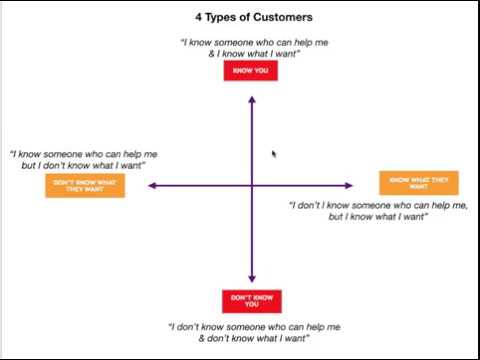
In this instructional video, the presenter walks through the Influence Diagnostic’s four‑quadrant model that categorises customers into four distinct types and outlines how to engage each group effectively. The first quadrant – Direct Contact – contains the most valuable clients who already know the business and its offerings; the speaker stresses the need to stay top‑of‑mind through regular, courteous communication such as calls, messages, and newsletters. The second quadrant – Network/Search – comprises prospects who know what they want but lack a personal referral; success here hinges on a strong reputation, optimized online presence (especially LinkedIn keywords), and visibility at networking events so that the community can point them toward you. The third quadrant – Awareness – includes prospects who neither know a helper nor know what they need; the presenter advises building awareness via case studies, articles, social media, blogs, and speaking engagements to showcase solutions. The fourth quadrant – Education – consists of people who know the presenter but are unaware of their own problem; the goal is to create “aha” moments by educating them about hidden challenges, positioning the presenter as the natural solution. The video concludes by previewing a forthcoming follow‑up that will provide concrete action steps for applying these strategies.
Chapters
So now let's have a look at the 4 types of customers as it relates to the 4 quadrants. So the very first quadrant, as you know, is this one here, is the direct contact. And this is the most valuable quadrant of the model because these customers, they know who you are, they know what you offer, and they must keep top of mind to these clients for them to buy from you when they are ready. So let me repeat that: you need to be keeping top of mind with these clients so they buy from you when they are ready. So it's super, super important to keep in regular contact with these clients, whether that's through just keeping in contact through general good manners, phone messages, etc., newsletters, those sorts of things. But it's very, very important to keep top of mind in this quadrant. The second quadrant is the network or search, which is this one here. And this is the group of customers that don't know somebody who can help them, but they do know what they want. So this section is very important as it relates to the how am I found. In other words, how are you found by the people that are actually looking for you? Because they know what they want. Generally in this quadrant, these people will tend to seek first recommendations from people that they know, so from their network. And this is where it's very important that you have a strong reputation. Your reputation and how you manage your online presence is very, very important here as well. For those clients that are in your community that are a little bit more introverted, they will tend to do Google searches or LinkedIn searches, and this is why it's very, very important that you have your keywords in the right spot, particularly as it relates to your LinkedIn profile. This is also very important in this quadrant to be known at networking events, and that's all how you will help your community and network point you— people that are looking for you towards you. The 3rd quadrant is this one here, which is the awareness quadrant, and these clients, they don't know somebody who can help them. And they don't know what they want. So to engage with this type of client, you need to build awareness of what it is that you offer, who you are, and how you can help them. So it's very important to share with people case studies and ideas of how you've been able to solve clients' problems previously, and you need to do this both online and offline. So that's an example of that, is attending networking events, writing articles, doing relevant social media posts that aren't one-dimensional, blogs, and speaking, of course. And the very last quadrant, or the 4th quadrant, is this one here, which is the education quadrant. And these clients, they know who can help me, but they don't know what they want. And although they know you, they are not aware that they need your help yet. And they're not actually even sure yet that they have a problem or a challenge that's actually holding them back. They're unaware of it. And it's your role in this particular quadrant to educate them. So when they realize that they have a challenge or problem to overcome, You are then naturally the first person that they can think of and choose. The goal here is to have and create aha moments for your clients, the wow, that's exactly what I need, and you become a clear connection between their problem and your solution that can actually help them. So that's the 4 types of clients as it relates to to the overlay of the 4 quadrants that we have within the influence diagnostic. And of course, I'm going to be doing another video shortly on the action steps that you can do to become more effective using the tips and strategies within the diagnostic. So I look forward to helping you in the next video.