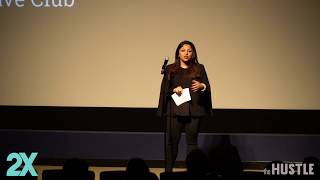
In this solo talk at a Hustle event, Amber Hameed, VP of Information Systems at Dollar Shave Club, shares a personal narrative that intertwines family legacy, mentorship, and professional breakthroughs. She begins by honoring the sacrifices of her single mother, who immigrated from Pakistan with three daughters, and her educated female relatives, framing her success as a collective effort. Amber recounts her first pivotal mentor, Paula, who secured her a Gillette internship despite cultural bias against her nose ring. She then describes Tony, a consulting executive who gave her a high‑stakes opportunity during the 2008 financial crisis, leading to a prototype that generated $17 million in business and showcased at major software giant events. A later anecdote highlights Amber’s own unconscious bias when she hired Zui, an eight‑month‑pregnant data architect, who proved essential to a delayed project, underscoring the importance of inclusion. Amber concludes by calling out naysayers who doubted her, turning their skepticism into motivation, and urging the audience to recognize both those who showed up and those who didn’t. The talk weaves themes of cultural resilience, mentorship, entrepreneurship, and the need for inclusive hiring practices.
Chapters
Wow, this is really bright. Hi everyone. I have to follow boobs and fart jokes and SNL, basically. My name is Amber Hamid. I'm the VP of Information Systems at Dollar Shave Club. Woo! I wanted to thank everyone here who's attending in the audience. I think this is a great support mechanism for us women up here telling our stories. I want to thank Hustle for arranging this amazing venue and having us up here. This is a great opportunity, and I'm in great company of some fantastic women and their storytelling. When I was thinking about what to talk about, I was giving it, you know, I was bouncing a lot of different story ideas off the wall, and I thought that, you know, I got here, but I didn't get here alone. So my story is not just mine. It's a story of a lot of other people who contributed to where I am today. And I wanted to pick a handful of those stories of people who contributed to my life and the success of my career, and I wanted to give them a shout-out. And tell my story through them. These are people who sacrificed their lives, their future. They're people who made sure that I got that opportunity that showcased my skill. These are people who put aside their preconceived notions about whatever culture and biases to make sure that, you know, I got that— I made the cut and I got that opportunity. And there are people who just showed up. Imagine growing up in a country where women don't get a lot of opportunities. And most importantly, growing up, you know, in an environment where you are barely educated, a single mom with 4 daughters, and your entire inspiration is to make sure that your daughters get the best and the highest of education that money can buy. This story is about 4 women who were highly educated in a third world country. One of them ended up being a master's in psychology. Another one ended up being a gynecologist. One of them ended up being— did her master's in fine arts. And another one was the principal of a very coveted school. That woman was my grandmother. And the woman who got me here to where I am today is my mother. And when we got here, she brought 2 suitcases and 3 kids in tow as a single mom. And she made sure that her children had the best of opportunities that she could afford. I'm very lucky to be part of that legacy, and I'm very lucky to be here because of her. And when I came here, all she said to me is, you know, "What I can give you is a shot at a good life and a good opportunity, and the rest is up to you." That wasn't too long ago. And when I look back at it, all I can say is, "Thanks, Mom, for giving up your entire life, your family, your comfort zone to make sure I got here." The second person I'd like to talk about— and there's one more thing she said to me. She's like, "You know, you'll do well because I raised you like a son and not like a daughter." And if you know where I come from, that's a huge compliment because it's all about sons and guns where I come from. So it's interesting that the biggest mentor, the first mentor in my life was this woman called Paula. When I grew up in Pakistan, where I'm from, it's almost kind of a coming-of-age story. You get your nose pierced. You turn 16, you go over, and you get your nose pierced. And it's an exciting thing to do. It means something completely different, obviously, in the US. It's rebellion. It's kind of going out there and making a mark. And my first opportunity out of college for a young student was a coveted internship at a pretty big employment company in Boston called the Gillette Company. It's amazing how you come full circle. And I was in college and I was, you know, doing 4 jobs to make ends meet and go to college and pay my way through it. And, you know, I was told that my nose ring would be an impediment to me getting this internship. And the reason I knew this— I didn't know at the time— is that I showed up to the interview, I did my interview, and Paula, who was my boss and mentor, my first female boss, my first ever female boss, she looked at me and she said, "By the way, I just wanted to let you know you have the job. I have a bunch of students sitting out there who are, you know, I have to go through the rigmarole and interview them because they're here and they showed up, but I just wanted to let you know you have the job. And I also wanted to let you know that your student counselor in your cover letter that he sent me told me that you wore a nose ring." and that might be an impediment to the Gillette culture. And he said, "I want you to go back and tell him that I gave you this job despite the nose ring." So thank you, Paula, for giving me that shot, that shot that made me never look back. The third story is about Tony. Tony is interesting. We used to call him the billion-dollar boy. He was a boy. His— his entire life— this was at a consulting company that I worked at— was contributing to the consulting company and the bandwidth. His entire personal network is what brought almost $1 billion worth of business to the consulting company. And it was a good idea to be in his good graces. Now Tony is this big, burly Italian guy. You know, you can cast him in any Tarantino movies, you know, or Ford Coppola movies. This was during the time when nobody was hiring consultants. People were letting go, and this was 2018— sorry, 2008. I lived in New York, and right across the street from me was the Lehman Brothers office. So everything was pretty much going downhill at that point. And he called me into his office, and he looked at me and said, "I'm gonna make you an offer you can't refuse." And I said, "What is it, Tony?" And he said, I have a little bit of budget, and I have an opportunity in which you will be working with two of the biggest software giants, and I want you to spearhead a practice for this consulting company. I was like, okay, why me? And he said, because I know you'll get it done, and I'm going to give you one resource, and the rest is up to you to go figure it out. And not only not only did I manage to get that going, I was able to showcase that all over the world from the platform of this consulting company. All over Europe, we won almost $17 million worth of business off of this prototype that we built. And it was something that was actually showcased at both of the software giants' major events as a cut-through, a breakthrough for them in both events. And this all started with two people. And this was a shot and a flavor of entrepreneurship that I got. And it was extremely exciting for me. And that propelled my career in all kinds of different directions, and one of the reasons why I'm standing here today. And the last story that I would tell is something about my own unconscious bias. During one of my most thrilling career opportunities, but very stressful career opportunities, I was in dire straits. This project that I was on was gravely behind schedule, and I was really looking for data talent. And as most of you in the tech industry know, that's hard to come about. And this was in New York, and being behind schedule drastically, was a huge challenge for me. So I needed somebody to come in and hit the ground running and really do a good job. And I'd already gone through about 3 different data architects and I was having no success. So finally, I had this woman walk through my door. And as she was coming in, I realized she was 8 months pregnant. And she was looking for a job that would keep her local because she was having a child and she wanted to start a family and she didn't want to travel anymore. And I needed somebody who can hit the ground running. And if you're 8 months pregnant, I knew she was going to be going on maternity leave very soon. So I started interviewing her, and she knocked it out of the park. She was exactly what I wanted. And I looked her in the eye and I said— and I couldn't ask her about her pregnancy, obviously— but I said, you know, this is what I'm looking for. I need somebody to be here. You know, this is an opportunity that I just can't afford to lose again. And she looked at me and she said, "I'm having a C-section. I have 3 kids. I know what I need to do. I know when I'm going in. I know when I'm coming out. I'm going in December 4th. I'll be showing up January 4th." And the other person who was sitting next to me is another woman, another mother, and she looked at me and she says, "No way she's showing up. Mm-mm. It's not happening. After a C-section and delivering a child, there's no way." And lo and behold, she showed up. January 4th, she was there. And she was one of the cornerstones of the success of the project that I did. So thanks, Zui, for showing up. In inclusion, I also want to talk about people who didn't show up. Now you know who those people are. You know who you are. I don't want to take names. The people who didn't show up, The naysayers, the dream snatchers, the ones who always told me I would never amount to anything, and there's a lot of them. There are a lot of people who told me basically that I wouldn't succeed because I wasn't ready. I would like to thank them because they made me work twice as hard, they made me more determined than ever, they made me work harder and better And they made me show up. And all I have to say to them is, "How do you like me now?" Thank you very much.